Categories
Bitcoin News

Core Scientific upped BTC output by 10% in July

Despite having to shut down many times due to demand on the Texas power system, the cryptocurrency mining business Core Scientific announced that its operations generated 1,221 Bitcoin (BTC) in July.

According to a statement released by Core Scientific on Friday, its monthly output of Bitcoin climbed from 1,106 in June to 1,221 in July, or nearly 10.4%.

However, the company also boosted the number of its self-mining servers and hashrate by 6%, to 109,000 and 10.9 exahashes per second (EH/s), respectively. The company claimed limiting operations “due to severe temperatures at numerous data centers.”

In order to assist the Electric Reliability Council of Texas, or ERCOT, which manages the state’s power grid, Core Scientific claims that the business repeatedly shut down all activities at its Texas data centers in July. The company claimed to have reduced its energy use by 8,157-megawatt hours (MWh).

In July, temperatures in several areas of Texas reached above 100 degrees Fahrenheit for many days in a row, despite ERCOT’s warning that the demand for energy would exceed the supply.

Riot Blockchain reported a 24 percent decline in its BTC output from June to July, from 421 to 318. Riot Blockchain also runs mining operations in Texas. CEO Jason Les claims that the company reduced operations by 11,717 MWh.

According to Core Scientific CEO Mike Levitt, the company intends to add 75 megawatts to its data center hosting capacity, with the goal of achieving a hash rate of 30 EH/s by the end of 2022. After selling more than 7,000 BTC for $167 million in June and 1,975 BTC for $44 million in July, the corporation said as of July 31 that it retained 1,205 BTC worth about $28 million at the time of publishing.

On August 11, the mining company intends to disclose its profits report for the second quarter of 2022.


Categories
Altcoins News

Optimism Token’s TVL Exceeds That Of Polygon

Polygon (MATIC), the premier Ethereum (ETH) scaling ecosystem, has a TVL that is now lower than Optimism for the first time ever.

In the year 2022, there will be an increased prevalence of second-layer solutions that are based on the Ethereum network, with L2 majors Optimism and Arbitrum hosting a combined total of over 160 protocols.

Optimism, the biggest rollup-based second-layer scaling solution for the Ethereum network, has hit yet another key milestone in broad adoption. This milestone was attained earlier this week.

61 goods on the Optimism network amassed a total value locked of $2.38 billion, as reported by Defi Llama, a notable tracker of decentralized finance (DeFi) protocols. During this time, the Polygon network’s 282 protocols were awarded a total of $1.83 billion in funding. Both results include information on money that was borrowed.

With $5.88 billion and $2.29 billion locked, respectively, Tron (TRX) and Solana (SOL) continue to be the market leaders in the non-EVM sector. This sector is comprised of protocols that do not have easy interaction with Ethereum.

The two most important second-layer networks on Ethereum, Optimism and Arbitrum, both make use of a method called Optimistic Rollups in order to package Ethereum transactions and then broadcast them to the mainnet.

In August 2022, the Ethereum L2s ecosystem had finally recovered from the losses it had sustained as a result of the Terra (LUNA) disaster. The measures returned TVL to the levels it had been at before the collapse.

According to Defi Llama, there has been a staggering increase of 700 percent in the number of TVLs distributed by Optimism over the course of the previous week.

Moreover, CoinMarketCap data shows that the OP token’s value has increased by more than 80 percent in the last week, reaching a high of $2.22 early on Thursday morning.

Categories
News Regulation

European vs. U.S. Crypto Regulation

Patrick Hansen, a crypto venture adviser and European policy specialist, provided forecasts on the timeframe of two significant EU crypto measures. Between December 2022 and January 2023, Markets in Crypto-assets (MiCA) and Transfer of Funds Regulation (TFR) will become law, according to Hansen.

US authorities are alarmed by the rapid pace of EU legislation. Hansen demonstrates that the extent and speed of these rules are concerning to the United States and may prompt them to act more quickly.

The mission of the MiCA is to safeguard the clients and investors of crypto firms. It also establishes obligations for issuers if they lose users’ crypto assets.

MiCA supervises stablecoins and mandates its issuers to keep enough reserves and fulfill withdrawal liquidity standards. The TFR, on the other hand, establishes money-laundering rules and addresses money-laundering difficulties with cryptocurrency.

Hansen indicates that the European Union is working on other crypto projects with significant ramifications. These include further restrictions against money laundering, the DeFi report, the NFT report, the DeFi monitoring pilot, and the Digital Euro Legislation.

The United States is worried about the breadth and velocity of EU crypto regulatory discussions. Hansen explains that although the exact date has not yet been determined, the rules might be voted on as early as January of the next year. In addition, he states that at this stage, voting is really a formality since all rules have been agreed upon.

TFR, being a lesser rule, might take effect far sooner.

US legislators are also advocating for crypto regulation. In the United States, support for a regulatory crypto framework is bipartisan and bicameral. However, there is currently no timeframe for any significant action. Caroline D. Pham, commissioner of the Commodity Futures Trading Commission, said that the United States should seek to be rule creators rather than rule followers.

Categories
Blockchain News

Mahastra State Issues 100k Polygon Diplomas

The Indian Express reported on Thursday that the Maharashtra State Board of Skill Development (MSBSD), in partnership with the Maharashtra State Innovation Society (MSINS), had awarded about 100,000 verified certificates on the Polygon blockchain using the LegitDoc platform.

“The initiative seeks to digitize diplomas and transcripts provided by MSBSD to about 100,000 students yearly. Neil Martis, the co-founder of LegitDoc, said that this was accomplished by building tamper-proof digital diploma PDFs based on Polygon Blockchain.

MSBSD has never before issued online degrees; this is the first time it has done so. Martis said that the board opted to offer online diplomas using blockchain technology because it is more safe, private, transparent, and cost-effective than conventional centralized digital systems.

Martis stated that in the past, MSBSD only issued hard copy certificates to students, necessitating the hiring of more than 1,000 staff throughout its network of training institutions and departments to assist distribute the diplomas, a time-consuming process.

In addition, he said that the verification of the degrees was also a manual procedure that required three board employees to complete verification requests within one month.

“Therefore, this initiative was undertaken to automate the whole procedure by digitizing diploma issuing and verification using blockchain technology and removing all human interventions and inefficiencies,” he said.

According to Martis, Maharashtra has previously trialed this solution for former student credentials on the Ethereum blockchain; but, because of the “scalability and high gas cost associated with Ethereum,” they have chosen to issue it on the Polygon blockchain.

In the past, Maharashtra used blockchain technology for use cases like caste certifications and COVID certificates.

The board’s “previous experience in adopting blockchain use cases,” according to Mithun John, Joint CEO of MSINS, was a major factor in its decision to award these blockchain-based degrees.

In the meanwhile, the deployment of blockchain technology by several government entities has increased in recent years. Nigerian Trading (NGX) Ltd. said in June that it intends to build a blockchain-enabled exchange platform within the next year.

Categories
Blockchain Business News

India Freezes WazirX Assets As Part of Investigation

As part of an investigation into immediate personal loan fraud, India’s Directorate of Enforcement (ED) has revealed that it has frozen around $8.1 million and conducted a search related to the cryptocurrency exchange WazirX.

In a statement released on Friday, the Directorate of Enforcement stated that WazirX enabled transactions by unidentified fintech businesses “to acquire crypto assets and subsequently launder them overseas” as part of a plan involving Chinese-backed corporations evading India’s licensing laws.

In its investigation, the ED said that it had ordered the freezing of WazirX bank accounts totaling 646.7 million Indian rupees (about $8.1 million at the time of publishing) and performed a search related to co-founder Sameer Mhatre.

According to the regulatory agency, the inquiry continued. However, the ED asserted that the cryptocurrency exchange had “lax KYC rules” and “weak regulatory supervision” over transactions between WazirX and Binance, and did not record the information required to authenticate the origin of the money used to acquire cryptocurrency in the alleged scam.

“Despite multiple chances, WazirX did not disclose the crypto transactions of the suspicious fintech APP firms or the KYC of the wallets,” the ED noted, adding:

“WazirX cannot account for the lost cryptocurrency assets. It has not made any attempts to track down these digital assets. By fostering anonymity and having inadequate AML regulations, it has actively supported around 16 fintech businesses in laundering criminal money through the crypto method.”

Binance CEO Changpeng Zhao said on Twitter on Friday that the company “does not hold any ownership in Zanmai Labs, the organization that operates WazirX and was founded by the original founders.”

Binance exclusively offers wallet services to WazirX as a technical solution, while WazirX is responsible for KYC and other exchange activities.

WazirX director Nischal Shetty refuted several of CZ’s accusations on Twitter, stating that the cryptocurrency exchange “was bought by Binance Zanmai Labs” and “is an India business controlled by myself and my co-founders.” Binance is responsible for managing cryptocurrency trading pairs and processing withdrawals, according to him.

Categories
Blockchain News

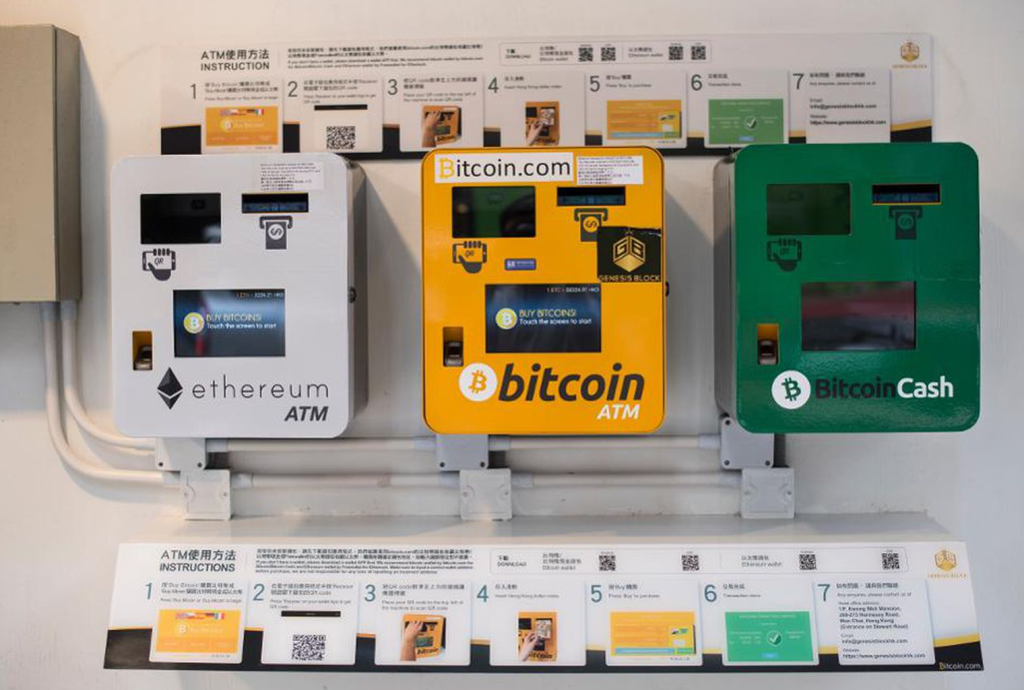
Crypto ATMs To Make a Comeback in Japan After Several Years

After a break of four years, crypto ATMs, often known as BTMs in the industry, have reemerged in Japan. On Tuesday, the regional cryptocurrency exchange Gaia Co. Ltd. made the announcement that it will soon offer BTMs that support Bitcoin (BTC), Ethereum (ETH), Bitcoin Cash (BCH), and Litecoin (LTC).

Although the first automated teller machines (ATMs) for Bitcoin were installed in Tokyo in early 2014, the city has not had any ATMs for other digital assets running since the crypto winter of 2018. Coincheck, a domestic cryptocurrency exchange, was hacked, resulting in a loss of $530 million. This hacked exchange crippled the local economy and reduced interest in crypto ATMs.

The first batch of BTMs will be installed at various sites around Tokyo and Osaka; however, the business has announced ambitions to deploy a total of fifty BTMs across the country over the next twelve months. Within the next three years, the company’s goal is to grow the number of BTMs that are operational at installed sites to 130.

Users of BTM will have the ability to withdraw up to $747 or 100,000 yen in a single transaction, with a daily maximum withdrawal limit of $2,243 or 300,000 yen. Anti-Money Laundering (AML) compliance procedures include a limit on the amount of cash that may be withdrawn.

It was reported on Wednesday by a local media site called Mainichi Shimbun that the action by Gaia would be the first time a locally registered cryptocurrency firm has placed cryptocurrency ATMs in Japan.

Users are required to register with the firm in order to get a unique card that serves as their access pass to the BTM in order to make a withdrawal. After approval has been given, customers will be able to deposit cryptocurrency assets to BTM through their smartphones and subsequently withdraw the same amount of cash in yen.

According to Shimbun, BTM will contribute to the acceleration of the present domestic withdrawal procedure, which currently takes several days to complete and involves the transfer of cash from an exchange to a local bank account.

Categories
Blockchain News

Voyager gets $270 million customer refund approval

Voyager, a crypto brokerage, has been given permission by a New York bankruptcy court to repay $270 million to consumers.

The Wall Street Journal reported on Thursday that the bankruptcy judge overseeing Voyager, Michael Wiles, had approved the brokerage’s request to access client cash at New York’s Metropolitan Commercial Bank (MCB) due to an “adequate basis” for the court’s consent.

After suspending client withdrawals owing to the bear market and exposure to crypto hedge fund Three Arrows Capital 3AC, Voyager filed for Chapter 11 bankruptcy protection earlier this month in order to reorganize.

The bankruptcy petition reveals the business has $1.3 billion in crypto assets and over $350 million in cash in its For Benefit of Customers (FBO) account at MCB. When Voyager filed for bankruptcy, MCB stated the company only had roughly $270 million in the account.

The court has not yet determined how to divide up the $1.3 billion in crypto assets stored on its platform.

Voyager disclosed many offers for its assets, all of which are greater and better than AlamedaFTX’s offer, in a court document dated August 4.

Voyager has already rejected AlamedaFTX’s proposal, calling it a low-ball offer disguised as a white-knight rescue.

In response to AlamedaFTX’s public comments on the plan, the business said it had delivered a cease-and-desist letter.

The crypto broker claims it has reached out to 88 parties with interest, 46 have signed NDAs, and 22 are now involved in marketing efforts. A sale hearing is scheduled for September 27, and the last day to submit bids is August 26.

Over twenty parties who might be interested in working with Voyager have already been contacted by the company’s advisers. In the event that Voyager, in collaboration with the Committee, pursues a sale transaction, the Bidding Procedures Motion, if authorized by the court, will lay out a schedule for an auction and sale to a strategic third party.

The brokerage business anticipates the conclusion of its bankruptcy procedures to occur in the first quarter of 2023.

Categories
Bitcoin Price Analysis

Bitcoin (BTC) Market Update 08/05

On August 5, Bitcoin (BTC) market saw a new rejection at the $23,500 resistance level. This occurred as United States stocks were unable to embrace unexpectedly good payroll statistics.

As the market remained inside its intraday trading range, data from Cointelegraph Markets Pro and TradingView tracked BTC/USD. Bears maintained the market in this range.

Despite the fact that U.S. payrolls for the month of July came in at double the projected levels, Wall Street began with a whimper. The peculiar response led some observers to argue that the data did not really reflect that the economy was strong; rather, they indicated that current employees were taking on second jobs as a result of inflation.

“The addition of 528K jobs in July suggests that the majority of the new jobs went to those who already had work,” gold bug Peter Schiff commented. “Since the labor force participation rate decreased to 62.1, this means that most of the new jobs went to people who already had jobs.”

“As real earnings continue to fall, many people are forced to take on additional jobs in order to make ends meet. If the employment market were robust, a single position would be sufficient.
Schiff was not the only one to have concerns over the current situation of employment; Wealthion CEO Adam Taggart was one of the individuals who voiced their mistrust.

In the meanwhile, Kyle Bass, chief investment officer at Hayman Capital Management, remembered the Federal Reserve’s optimistic stance on employment in the years leading up to the Great Financial Crisis of 2008.

Bitcoin market has bounced back from a drop below $23,000 to retarget range highs as of the time this article is being written. Meanwhile, the S&P 500 and the Nasdaq Composite Index both started the day off with a little loss until a relief rally entered the picture.

Traders of Bitcoin, in the meanwhile, were considering the likelihood of a new leg down as the price continued to be rejected at $24,500 many times.

Categories
Blockchain News

Blackrock Partners With Coinbase To Offer Crypto Services

According to a blog post published on Thursday, the world’s biggest asset manager, BlackRock, has teamed with the prominent cryptocurrency exchange Coinbase to provide crypto services to institutional customers.

The collaboration announcement between Coinbase and BlackRock comes a few months after rumors that BlackRock would soon begin delivering cryptocurrency services to its customers.

As part of the cooperation, BlackRock’s Aladdin investment management platform will integrate Coinbase Prime, an institutional prime broker platform, to provide institutional customers with direct access to cryptocurrencies.

BlackRock institutional clients who are also Coinbase customers will have access to cryptocurrency trading, custody, prime brokerage, and reporting services. According to reports, BlackRock’s Alladin software controls an estimated $21 trillion in assets, a portion of which customers may elect not to allocate to the cryptocurrency market.

BlackRock’s Global Head of Strategic Ecosystem Partnerships, Joseph Chalom, commented on the situation by noting a surge in institutional interest in crypto assets. He said:

“Our institutional customers are increasingly interested in acquiring exposure to digital asset markets and are focused on managing the operational lifetime of these assets in an effective manner. This integration […] would enable customers to manage their bitcoin exposures directly inside their regular portfolio management and trading processes, providing a holistic picture of portfolio risk across asset classes.”

According to the blog post, BlackRock and Coinbase will continue to enhance the platform’s integration and bring out new features in stages.

A few years ago, BlackRock developed an interest in cryptocurrencies. In 2018, the asset management established a group to research cryptocurrencies and blockchain technology.

According to a filing with the United States Securities and Exchange Commission (SEC), the company began trading bitcoin CME futures contracts earlier in 2017. The investing business submitted an application to the SEC for a blockchain technology exchange-traded fund in January (ETF).

In the meanwhile, it’s not just BlackRock. Globally, other large financial institutions have maintained their interest in cryptocurrencies. Fidelity Investments, a provider of financial services, said in April that it will let customers to add a bitcoin account to their 401(k) later this year.

Categories
Blockchain Ethereum

Justin Sun’s Poloniex Plans for 2-Chain Ethereum

Poloniex said on August 4 that it will generate two unique coins to symbolize two distinct versions of the Ethereum chain that might arise after The Merge. This is the first exchange with this particular move.

The exchange will let users transfer ETH into ETHS and ETHW, two specialized tokens. ETHS represents the Ethereum chain using Proof-of-Stake, while ETHW represents the Ethereum chain using Proof-of-Work.

The exchange rate for ETHW/ETH and ETHS/ETH will be 1:1. In the future, the exchange will explore introducing other trading pairs. ETHS and ETHW will exist solely on Poloniex and will not be able to be deposited or withdrawn to other wallets.

Prior to The Merge, Poloniex will collect the balances of all accounts holding ETHS. If a chain split happens after this Ethereum update, the exchange will convert ETHS to ETH using PoS at a 1:1 ratio for all customers.

Poloniex will choose the Ethereum chain with the greatest Proof-of-Work hashrate as the primary blockchain to be converted to ETHW. Evidently, the exchange has also planned for the possibility that many Ethereum chains using PoW would emerge.

In contrast, if The Merge occurs without incident and no unit breaks the Ethereum chain to preserve Proof-of-Work, ETH will continue to be exchanged normally on the exchange, however, two ETHS and ETHW coins would be canceled.

Poloniex was formerly one of the top cryptocurrency exchanges. From 2017 to 2020, however, the standing of the exchange declined substantially as a result of the management team’s many errors. In 2019, TRON creator Justin Sun acquired it and included it in the TRON ecosystem.

Justin Sun claims to have more than 1 million ETH, and if a hard fork happens between two chains, TRON will transfer a set quantity of ETHW to the new project to assist in the development of its ecosystem.

Categories
Blockchain News Regulation

Warren advocates restricting Wall Street’s crypto engagement

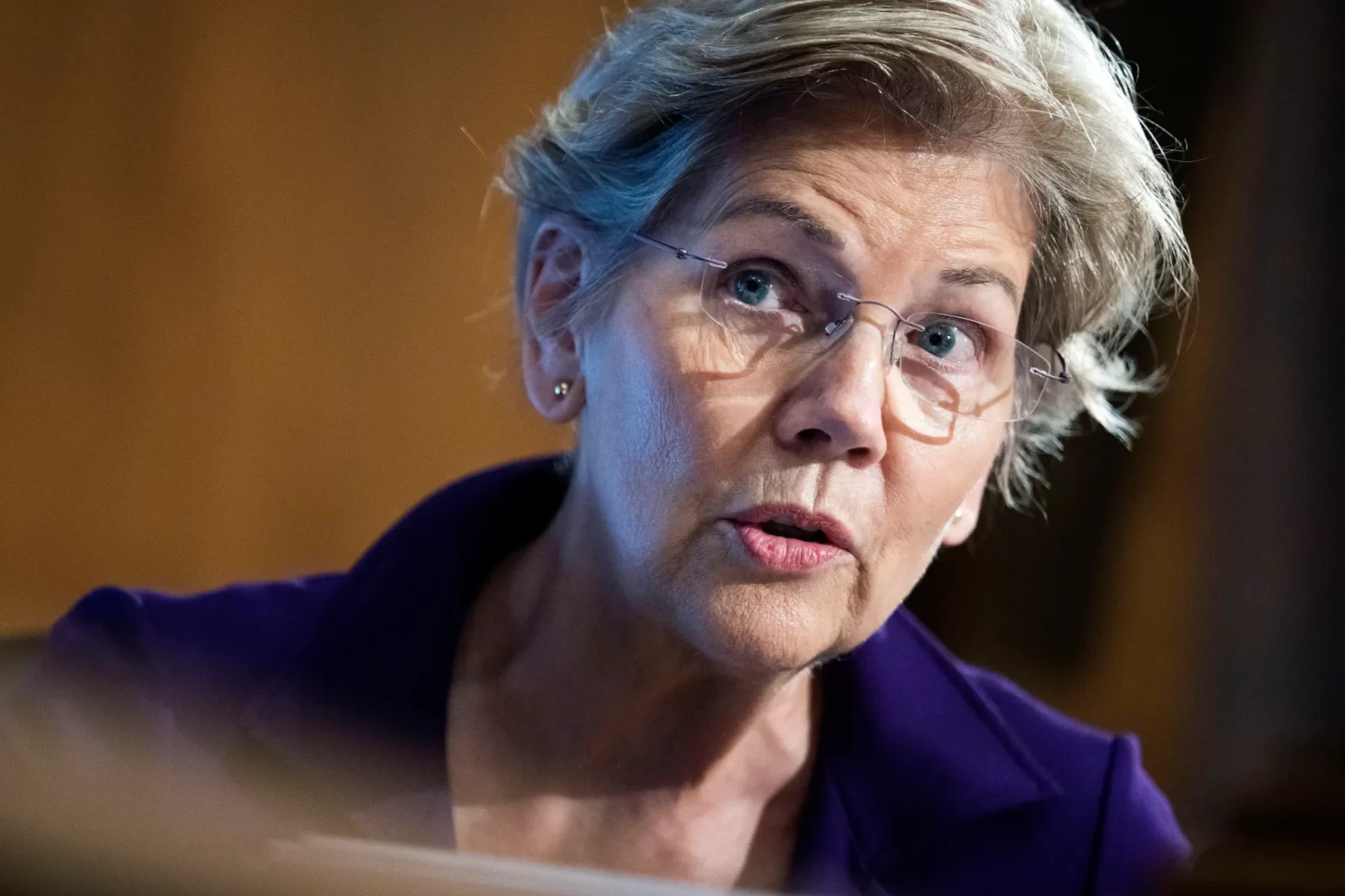
Bloomberg reported on Thursday that the United States Senator Elizabeth Warren is continuing her anti-crypto crusade by introducing legislation that would essentially shut down bank-provided cryptocurrency services.

Senator Warren, a member of the Senate Banking Committee, is pushing committee members and senators to sign a letter to the Office of the Comptroller of the Currency (OCC) requesting that banks quit offering crypto services such as crypto custody.

The banking committee thinks that by publishing crypto rules, authorities placed the financial system at risk by allowing Wall Street institutions to join the market.

The letter invites the OCC to engage with the Federal Reserve and the Federal Deposit Insurance Corporation (FDIC) to devise an alternate strategy for cryptocurrencies that appropriately protects customers and supports the “safety and soundness of the banking system:”

“We are concerned that the OCC has failed to adequately address the deficiencies of previous interpretative letters and the hazards connected with crypto-related banking operations, which have become more serious in recent months.”

The final form of the letter will be forwarded to Michael Hsu, the OCC’s acting comptroller. The OCC’s answer to Bloomberg’s question cited recent statements by comptroller Michael Hsu about banks’ expanding engagement in cryptocurrencies, suggesting the agency’s intent to amend bank crypto guidelines.

Hsu has advocated for more vigilance over the penetration of cryptocurrency to conventional banking institutions. Recent cryptocurrency volatility has resulted in billions of dollars in lost investments, pushing politicians and regulators to focus more on crypto-related businesses.

According to Warren’s letter, the OCC’s earlier directives and regulations were inadequate to protect the financial system from recent crypto volatility.

It asks for the reform and elimination of crypto banking regulations to prohibit banks from engaging with cryptocurrencies. In addition, the paper requests information on the current number of licensed institutions that provide crypto-related services and the overall cash worth of such services.

As the letter has not yet been made public, its signatories remain unknown. However, Senator Warren has been an outspoken opponent of cryptocurrencies and has previously advocated for further regulation in the field.

Categories
Altcoins News

Sam Bankman-Fried Reiterate His Support For Solana

A day after Solana was subjected to a significant exploit, FTX CEO Sam Bankman-Fried (SBF) publicly backed the SOL coin. Solana is now the most underrated cryptocurrency, according to SBF, who said as much in a recent interview with Fortune magazine.

He said that despite all the negative publicity, Solana has effectively resolved two-thirds of its technical problems. He continued by saying that he is optimistic that it will pass the last third. In the conversation, the FTX director said:

Any blockchain that attempted to achieve what Solana did would have collapsed. This allowed it to determine what needed to be improved. The thing that other blockchains “should be doing” is pushing the envelope to see what breaks.

Bankman-Fried recently compared the wallet scams at Nomad and Solana and stated:

This is a perfect illustration of how something might be overlooked. When a random dAPP is hacked, the underlying blockchain is held responsible. (To be clear, neither the core nor the internal infrastructure had any problems. Some users only utilized a single third-party program.)

Nearly 8000 wallets were hacked late on Tuesday, causing over $7 million worth of SOL tokens to disappear. Further analysis reveals that Slope’s mobile apps were hacked, despite prior reports that the Phantom wallets had been compromised. Solana just posted an update on Twitter, saying:

It seems impacted addresses were once generated, imported, or used in Slope mobile wallet programs, according to an examination by developers, ecosystem teams, and security auditors.

Additionally, it said that the attack only affected one wallet on Solana. However, slope continues to employ only secure hardware wallets. Solana continues by saying that there is no proof that the Solana protocol’s encryption has been hacked.

The new incident is yet another illustration of how wallet operators are vulnerable and how crucial cold storage is.

Categories
Ethereum

Details on The Failed $350k ETH Transaction

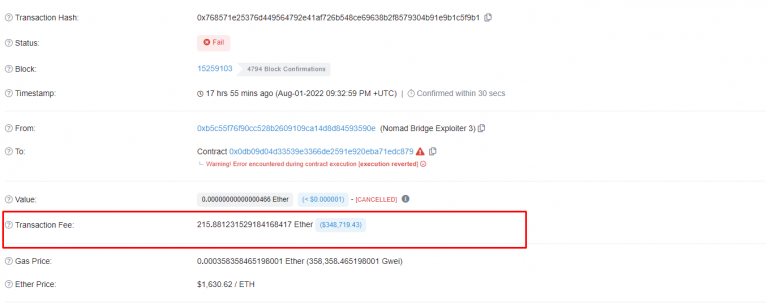
Transactions made via a blockchain are remarkable for being irreversible. While most of the time this functionality might be helpful, it can sometimes become problematic. For example, a recent development reveals that $350,000 (or around 216 ETH) was spent on transaction fees, and the transaction ultimately failed.

The address that paid the significant transaction fee is connected to the recent Nomad bridge attack, which deleted nearly $200 million from the protocol, according to blockchain explorer Etherscan.

The sending party transmitted a very modest amount of Ether to the receiving address on Monday, as shown in the picture above, however, the transaction eventually failed.

While the network presently uses a Proof-of-Work (PoW) consensus mechanism, Ethereum (ETH) has not yet migrated to the Proof-of-Stake (PoS) consensus mechanism. The speed at which transactions are handled—only 30 transactions are executed in a second—is a significant drawback of the PoW technique.

A user who wants to speed up a transaction may do so by adding gas, which raises the transaction price that must be paid. The user will always lose access to that cash if they incorrectly set the amount spent as the gas charge. In the aforementioned transaction, the sender (Nomad hacker) probably injected gas to expedite the transaction, spending close to 216 ETH in the process.

While it is true that blockchain transactions cannot be undone, it is also important to remember that block miners get fees as incentives. Therefore, if a strategy is made to recover the $350,000, Etherscan will be used to get in touch with the transaction’s miner as the fee was awarded to block 15259103.

It’s interesting to note that in September 2021, it was reported that a transaction in which a transaction fee of $23.5 million was paid was reimbursed to the sender after the miner was contacted.

Categories
Blockchain News

Digital Yuan Loan Now Offered in China

The Agricultural Commerce Bank of Zhangjiagang, which is located in the province of Suzhou in China, made the announcement on Wednesday that it had issued a 500,000 digital yuan (e-CNY) loan with intellectual property backing it as collateral.

The news of the loan’s issuance was reported by the local news outlet Sohu. The municipal authorities, the city’s consumer markets regulator, and the city’s financial markets regulator all gave their unanimous permission before the loan was distributed.

The firm that will get the loan is not identified in the paper; nonetheless, it is an organization that produces environmental protection equipment for steel plants in the province of Suzhou.

According to what was shared by the organization, because of an increase in the number of customer bills, it made the decision to conduct an experiment with a novel form of borrowing money, in which the loan was immediately released into its digital yuan wallet.

In the meanwhile, the Agricultural Commerce Bank of Zhangjiagang said that this was yet another test that was being conducted as part of the country’s e-CNY pilot program.

Two days earlier, the People’s Bank of China said that it intends to increase the number of testing locations for the e-CNY, which are now located in 15 provinces around the country.

Since its debut, there have been a total of 264 million e-CNY transactions for a combined 83 billion CNY ($12.29 billion), as reported by the central bank in its most recent statistics update on May 31. E-CNY is accepted as a form of payment at over 4.567 million different merchant terminals in China.

In addition, 64 businesses that are listed on the stock exchanges in Shanghai and Shenzhen and with a combined market valuation of $82.9 billion are investigating blockchain technology.

In recent weeks, it seems that China has boosted its attention on building its own central bank digital currency. In doing so, it has cited the advantages of increasing consumer spending as a justification.

This comes after COVID-19 lockdowns had a negative impact on the economy. Participants may presently claim prizes and utilize them at a variety of merchant platforms thanks to the many different digital yuan airdrops that are currently underway.

Categories
Bitcoin Ethereum Regulation

New Senate bill seeks CFTC regulation of BTC ETH

Two influential U.S. Senate Committee members have introduced legislation that would place Bitcoin, Ethereum, and other digital assets under the supervision of the Commodities Futures Trading Commission (CFTC).

The Digital Commodities Consumer Protection Act of 2022, sponsored by Michigan Senator Debbie Stabenow and high-ranking Republican John Boozman, seeks to expand the regulatory scope beyond the CFTC, potentially putting an end to the protracted dispute between federal agencies over who should regulate digital assets.

Despite the fact that the market for digital assets has grown exponentially over the last 13 years, it has remained mostly unregulated, leaving investors vulnerable to financial fraud and market manipulation.

Federal authorities like as the SEC, CFTC, and DOJ have found themselves mired in a regulatory rabbit hole resulting in “regulation by enforcement” as they strive to erect guardrails for the emerging sector, causing concern and uncertainty among industry participants.

The law, which was introduced on Wednesday, “seeks to exclude securities from the definition of digital commodities,” clarifying the nature of securities. In addition, it will confirm the function of the SEC, which has been fighting numerous cryptoassets utilizing the securities card.

The SEC has been criticized for allegedly “stifling innovation” in the digital asset industry. Chairman Gary Gensler emphasized last week in a video that Cryptocurrencies should be governed by securities legislation, noting that “we should be technology agnostic when it comes to investor safety.”

Rostin Behnam, head of the Commodity Futures Trading Commission (CFTC), has intensified lobbying efforts to have his agency become the major spot market regulator, declaring last week that the CFTC was “equipped and well positioned” to manage spot markets for several cryptocurrencies.

Due to its precise wording on securities, this law is more likely to pass in the Senate than crypto-related legislation proposed in recent months, according to sources. Its proponents also belong to the Senate Agriculture Committee, which earlier this year urged the CFTC to provide more comprehensive advice on crypto assets.

Moreover, because industry participants believe it is simpler to comply with the CFTC than with the SEC, different crypto businesses such as Coinbase, Ripple, and FTX have been vigorously urging Congress to establish a new digital asset category and authorize the CFTC to regulate it.

Categories
Blockchain News

New York fines Robinhood Crypto $30 million

On Tuesday, Robinhood cryptocurrency trading division was hit with a $30 million punishment by the New York State Department of Financial Services (NYDFS) for suspected breaches of AML, consumer, and cybersecurity regulations.

As far as we know, this is the first time the NYDFS has initiated enforcement action against a cryptocurrency-focused business.

The Wall Street Journal reported on Tuesday that the New York State Department of Financial Services fined Robinhood Crypto $30 million after investigating the company’s compliance. The banking watchdog claims that Robinhood did not take enough precautions to prevent cyberattacks or comply with applicable anti-money laundering regulations.

The government agency claims that the corporation did not upgrade to a transaction monitoring system with enough capacity as the number of users increased. Also, Robinhood Crypto was dinged because its site lacked a phone number where aggrieved clients might be reached.

According to New York Department of Financial Services Superintendent Adrienne A. Harris, “as its business grew, Robinhood Crypto failed to invest the proper resources and attention to develop and maintain a culture of compliance, resulting in significant violations of the Department’s anti-money laundering and cybersecurity regulations.”

In 2021, when the company was experiencing explosive expansion in response to a surge in demand for equities and cryptocurrencies, Robinhood reported the enforcement inquiry by NYDFS in a filing with the SEC. These problems multiplied as the firm expanded.

Robinhood has requested for a license from the New York Department of Financial Services (NYDFS), stating it is in full compliance with anti-money laundering and cybersecurity legislation despite these deficiencies.

The cryptocurrency trading division of Robinhood is the first U.S. business to be fined by the New York Department of Financial Services (NYDFS) for violations of its virtual currency, money transmitter, transaction monitoring, and cybersecurity rules.

In addition to paying a fine, Robinhood Crypto must hire a third-party expert to evaluate whether or not it follows state legislation.

Robinhood has allowed cryptocurrency trading since 2018, but clients had to convert their cryptocurrency holdings to conventional currency before they could withdraw them.

As the cryptocurrency market flourished in the middle of 2021, the retail trading firm dove further in, ultimately launching a division devoted to digital assets called Robinhood Crypto. Along with the launch of its trading platform, Robinhood has unlocked its cryptocurrency wallet, enabling users to finally withdraw their coins from inside the app’s previously restrictive environment.

To no avail, Robinhood has been unable to withstand the storm that has befallen crypto and internet businesses in recent months. The publicly listed company had a sales loss of almost 43% in the first quarter of this year. Similarly, Robinhood’s sluggish development and economic uncertainties led to the reduction of a large section of the company’s personnel.

Categories
Blockchain News

Michael Saylor Steps Down As MicroStrategy

Michael Saylor, a Bitcoin (BTC) maximalist, has announced his resignation as chief executive officer of MicroStrategy, the business intelligence company he co-founded in 1989.

Saylor will assume the job of executive chair, while Phong Le will assume the role of CEO, MicroStrategy said in a Tuesday earnings report for the second quarter of 2022. The modifications are anticipated to take effect on August 8.

Michael Saylor said, “I think separating the responsibilities of Chairman and CEO would allow us to pursue our two company strategy of acquiring and holding Bitcoin and expanding our enterprise analytics software business more effectively.”

Le served as the chief financial officer of MicroStrategy from August 2015 to July 2019 before merging his duties with those of the company’s president until May 2022, when he assumed the latter position full-time. According to MicroStrategy, Le will continue to serve as president and CEO, “managing the day-to-day execution of the company’s business plans,” whilst Saylor will concentrate on “Bitcoin acquisition strategy and associated Bitcoin advocacy projects” as executive chair.

MicroStrategy reported holding more than 129,699 Bitcoins as of June 30, valued at approximately $2 billion after taking into account the company’s cumulative impairment losses, with total revenues for the second quarter of 2022 reaching $122.1 million, compared to $119.3 million for the first quarter. In June, the company revealed to the U.S. Securities and Exchange Commission that it had purchased 480 BTC for $10 million.

Saylor said that MicroStrategy will “continue to HODL through hardship” during the June market collapse, during which the price of Bitcoin plummeted below $18,000, adding that the company had braced for volatility and structured its balance sheet appropriately. According to the soon-to-be-former CEO, this method would enable MicroStrategy to post collateral even “if the price of BTC falls below $3,562” – a temporary occurrence during the March 2020 market crisis.

Jefferies said on July 26 that it has downgraded MicroStrategy’s shares from hold to underperform, with a price objective of $180. MSTR shares were trading at $278.26 at the time of publishing, up more than 48 percent in the past 30 days.

Categories
Ethereum Price Analysis

Ethereum (ETH) Price Analysis

In his most recent live technical analysis, cryptocurrency expert Michal van de Poppe gave optimistic signs for Ethereum’s price. Poppe thinks that if the price of Ethereum reaches $1,700, there may be a bull run, as the second-largest cryptocurrency is currently reversing from earlier estimates of three figures.

Popular cryptocurrency trader Michal van de Poppe predicts that the price of Ethereum will rise above $2,000; he attributes this to many factors. After a series of unfavorable market events, the currency saw a precipitous decline. According to his research, bearish expectations are already included into the market, and further declines should be restricted.

First, he believed that the September Ethereum merging will result in a price increase owing to FOMO and the continuing FED interest rate scenario.

Poppe says that the hysteria that accompanied the fall of a number of market titans is dissipating. However, he also said that it is not prudent to pursue longs at the present, since this option was available in July but is no longer available.

According to CoinMarketCap, ETH is presently selling at $1,670, a gain of over 2% in the last 24 hours. With a market value of $192.73 billion, the second-largest cryptocurrency is now exchanging hands for roughly $1,650 per coin.

According to statistics from CoinMarketCap, the current trade price is 67 percent lower than its all-time high of $4,891 reached in November 2021.

Growing fears about the future of Ethereum and its miners in the wake of the new proof-of-stake consensus algorithm are mainly cited as the cause of Ethereum’s downward price trend.

The merger will no longer need miners for network maintenance, but rather validators. Instead of buying farms of computers to verify transactions, users may stake 32 Ether to become validators on the updated network. Validators are compensated for their efforts but might lose money if they engage in fraudulent activity.

Categories
Blockchain News

Shiba Inu Unveils Shiba Eternity

A recent announcement from the creators of the Shiba Inu project revealed that the name “Shiba Eternity” would be given to the much-anticipated video game that will accompany the project.

The game will be available for purchase via the Google Play Store as well as the Apple App Store. The team working on Shiba Inu’s development is now cooperating with PlaySide Studios, a video game developer headquartered in Melbourne, Australia. PlaySide Studios is located in Australia.

Last week, on the official Twitter account for the cryptocurrency, the project’s creators released a teaser in preparation for the real news that was going to be made.

The official name of the game was revealed by the production team on the day that marked the second anniversary of the popular meme coin. August of 2020 was the month that saw the introduction of meme money.

The partnership between Shiba Inu and the publicly traded corporation was announced in December. Before forming a partnership with the Shiba Inu team, PlaySide has already collaborated with notable companies such as Disney and Pixar.

Playside and the Shiba Inu have been working together to develop what the game’s pseudonymous developer, Shytoshi Kusama, called “the finest collecting game on the globe.” Kusama wrote about the game’s development in a blog post that was published on Medium one month ago.

A recent partnership was formed between Shiba Inu and The Third Floor (TTF), a well-known visualization business that is most recognized for its work on many Marvel movies. The TTF will be responsible for developing a virtual environment for the much-touted project’s metaverse.

Back in May, Kusama said that the game would be released sometime in September. In November, PlaySide provided an estimate that Shiba Eternity will be developed over the course of about eight months.

Categories
Blockchain News

Orange County Men Go To Jail For Crypto Scam

The United States Department of Justice (DOJ) stated on Monday that two individuals from Orange County were sentenced to federal prison for coordinating a $1.9 million initial coin offering (ICO) scam.

Jeremy David McAlpine of Orange County was sentenced to 36 months (3 years) and Zachary Michael Matar was sentenced to 30 months (2 years and 6 months) in federal prison by U.S. District Judge Cormac J. Carney.

The ICO hoax was perpetrated on the official website of the private company Dropil, which McAlpine and Matar founded in 2017. The pair performed an unregistered sale of the company’s native token, DROP, since none of the companies hosting the sale was registered with the United States Securities and Exchange Commission as a broker or dealer (SEC).

In 2018, the creators performed an ICO and raised over $1.9 million from over 2,400 investors who purchased 629 million DROP tokens.

Dropil claimed to provide investment management services for digital assets, enabling investors to trade on the platform. McAlpine and Matar persuaded users to purchase and trade DROP tokens by claiming that the transactions would create profits that would be “distributed every 15 days in the form of extra DROP tokens.”

To further mislead investors, the firm fabricated a white paper that falsely depicted it as a thriving business that offered risky investors significant yearly rates ranging from 24 to 63 percent.

When approached by the U.S. SEC over the unregistered ICO, Dropil submitted false information by misrepresenting the firm’s financial stability. Dropil went on to publish a fraudulent report indicating that their token sale received $54 million from 34,000 investors, while in reality just $1.9 million was raised.

While McAlpine and Matar are now being sentenced to jail, the DOJ intends to recompense the 2,472 victims of the ICO fraud. On September 26, Judge Carney has scheduled a restitution hearing.

In the meanwhile, a separate report reported that the U.S. SEC has filed charges against the four founders of Forsage in connection with a $300 million crypto Ponzi scam.

Categories
Blockchain News

Singapore Court Grants Vauld 3-Month Moratorium

Vauld has been given three months of protection from its dissatisfied creditors by the Singapore courts. With time running out, the lender must restructure before lawsuits stream in.

The Singapore High Court gave Vauld’s parent firm a three-month respite from its creditors on Monday. While Vauld’s attorneys requested a six-month moratorium, Justice Aedit Abdullah’s ruling will only remain in effect for a quarter of a year, expiring on November 7.

“I am afraid that a six-month moratorium would not get enough oversight and monitoring,” Abdullah added. The court granted an extension based on the firm’s handling of the case.

Vauld was granted two weeks to form a creditors committee that would present all impacted persons with necessary information such as cash flow and asset appraisals, as well as investigate the possibility of minimum withdrawals for clients.

The inference is that litigation against Vauld are barred for the period of the moratorium. The ruling leaves 144,000 creditors with almost $400 million in assets without legal recourse until the decree expires.

However, there seems to be a ray of light for creditors after reports that Nexo was poised to buy the struggling lender. Nexo signed a term agreement with Vauld, and the transaction may be finalized if its due diligence is completed within 60 days.

Nexo CEO Antoni Trenchev expressed confidence in the deal’s success but cautioned of many risks. His firm intends to utilize Vauld as a springboard to expand its operations across South East Asia.

“We have to understand the liabilities, the receivables, who the counterparties are, what the possibilities of obtaining those receivables are, and all that kind of stuff in order to be in a position to make a judgment,” Trenchev said.

During the crypto winter, Vauld assuaged consumers’ concerns about its financial health, but the tide soon turned against the lender. Vauld startled its community when it announced major layoffs before delivering the news that withdrawals for its customers will be halted.

The fall of Terra was the tipping point for numerous struggling crypto companies. The virus spread to Three Arrows Capital, then Babel Finance, Celsius, and Voyager crumbled like dominoes.

Another crypto startup, Zipmex, is requesting a suspension for up to six months to allow time for the team to work on fixing the liquidity crisis.

Categories
Blockchain News

Ripple Labs plans to hire hundreds in Toronto

Ripple Labs, a fintech and blockchain business, stated its goal to recruit hundreds of employees over the next several years in a statement on June 22 after announcing the launch of a new office and plans to hire 50 engineers in Toronto, Canada.

In reality, Ripple CEO Brad Garlinghouse revealed in a video of the branch opening broadcast on the firm’s Twitter page on July 31 that the company picked Toronto as the site for its technical base. Garlinghouse described Toronto as a city with “excellent engineering knowledge.”

He also said that Ripple would recruit 50 new employees in its Toronto headquarters by the end of the year, with an additional 100 to 200 hired in the years to come:

“I believe you are all aware that we want to employ 50 individuals this year, with the goal of adding 100 or 200 in the next years.” (…) It isn’t simply about asset decentralization. “Talent is becoming more distributed.”

“While our technical teams aren’t massive, there are still enough individuals for us to operate in very productive teams, and your ideas and contributions have a substantial influence at scale. I’ve got the opportunity within my team to work on various projects at the same time, which is nearly unheard of.”

Mohit Doshi, a Ripple software developer, outlined the blockchain company’s opportunities

Ripple recently announced the opening of its Toronto office, with the goal of making the city a significant technological center for blockchain and cryptocurrency solutions, as well as making it easier for the company to grow its operations in the area and throughout the globe.

Despite the extended crypto winter and an expensive legal fight with the US Securities and Exchange Commission (SEC) since December 2020, this is just one component of Ripple’s development plans.

In mid-March, the company offered one billion XRP tokens, which were valued at around $790 million at the time, to help project developers build on its payment-focused ledger. The tokens will be dispersed over the next ten to twenty years.

Categories
Blockchain News

CZ Clarifies Binance KYC Leading to Loss of Users

According to the statements made by the CEO of the firm, the Know Your Customer (KYC) procedure for Binance was carried out at a total cost of one billion dollars. CZ rebutted reports that there had been a decrease in the user base by stating that the cryptocurrency exchange has, in fact, risen in recent months. 

He addressed the allegations that the Know Your Customer (KYC) procedure eliminated the majority of Binance’s potential clients. Additionally, the CEO of Binance said that there has been a rise in the number of deposits made on the platform in recent months.

In response to allegations that the cryptocurrency exchange had lost the majority of its clients as a result of the installation of KYC procedures, CZ said that the exchange’s market share had not decreased. According to him, the data from the blockchain demonstrates that Binance’s share of the market has risen. 

In point of fact, he went on to say that the exchange was the most dominant among exchanges in terms of market share. He said that the deposits of cryptocurrencies have been continuously growing over the last few months or years. However, it was discovered that the process of implementing KYC resulted in a revenue loss of one billion dollars for the corporation.

More than one billion dollars was spent on compliance initiatives by Binance, which resulted in a successful passing rate. It’s all good. There was a growth, not a reduction, in the market share held by Binance. The data from third parties and the blockchain demonstrates this.

CZ also released evidence from Glassnode that showed Bitcoin deposits being removed from cryptocurrency exchanges. Nevertheless, the numbers that he presented from the previous month demonstrate that Binance remains the exchange with the highest holder of Bitcoin holdings overall.

Recent developments on Binance have shown an increase in activity for not just Bitcoin but also Ethereum (ETH). In the last week, there was a significant increase in the number of ETH transactions that took place on the platform as a direct result of the reduced gas charge.

Categories
Blockchain News

Forsage founders charged with $300M crypto pyramid scheme

Monday, the Securities and Exchange Commission (SEC) of the United States revealed that it has filed charges against four persons purported to be Forsage founders. According to the securities market authority, Forsage is a crypto-based pyramid scam that has gathered over $300 million from investors in many nations, including the United States.

The Forsage team offers smart contracts enabling members to lock assets on the Ethereum, BNB Chain, and Tron blockchains. Members also get affiliate connections for recruiting people to the program, which increases their potential profits.

According to information available on the Forsage website at the time of writing, the cheapest Ethereum registration costs around 0.05 ETH ($80). The sum is smaller for the Tron and BNB networks, though.

Vladimir Okhotnikov, Jane Doe (a.k.a. Lola Ferrari), Mikhail Sergeev, and Sergey Maslakov, the four accused masterminds, reportedly created Forsage in January 2020, touting it as a means for investors to receive a higher return on their crypto assets. However, the firm was managed as a pyramid scam, with new investors often funding previous investors.

The SEC further says that Forsage hired U.S.-based promoters and a particular “Crypto Crusaders” network to market the scam and recruit new participants.

In addition, after receiving two cease-and-desist orders from securities authorities in the Philippines and Montana, the project mislead investors by denying it was conducting a Ponzi scheme in several YouTube videos.

Samuel Elis and Sarah Thiessen, two of the seven named U.S.-based Forsage promoters, have resolved charges without admitting or rejecting the allegations. While the SEC continues to pursue action against more promoters, both defendants have paid civil fines and disgorgement.

The U.S. SEC’s most recent action against Forsage makes it the second most popular crypto scam to be shut down. Five persons were prosecuted by the Commission in 2017 for their involvement in the $2 billion Crypto-Ponzi scheme Bitconnect.

Categories
Ethereum

Survey on whether the merge will split Ethereum’s chain

There are 50 days till the week of September 19, and the cryptocurrency world has been debating whether or not Ethereum developers would postpone The Merge. In addition, on July 27, the crypto hedge firm Galois Capital issued a poll on Twitter indicating that more than 33 percent of respondents believe Ethereum might split again.

Following the announcement of the so-called penciled-in date for The Merge, the value of Ethereum (ETH) and Ethereum Classic (ETC) soared against the U.S. dollar.

The Ethereum developer and community director for the Beacon chain, Superphiz, indicated that the “timetable is not definitive,” but according to the planned timeline he published, The Merge might be completed during the week of September 19. The Merge will essentially consummate the shift from a proof-of-work (PoW) chain to a proof-of-stake (PoS) consensus architecture.

After experiencing a bear market decline before the announcement, the price of Ethereum rose significantly almost immediately after the news broke. In the last 30 days, ETH has appreciated by 62.4% versus the dollar.

As the day approaches, there is far less exciting, and some are wondering whether Ethereum devs would postpone The Merge split. This weekend, The Merge’s postponement has been a popular topic of discussion on social media. One writer stated:

In addition to the many Twitter threads discussing The Merge’s postponement, the crypto hedge firm Galois Capital has distributed a poll asking if people believe Ethereum will break into two chains after The Merge’s implementation. 53.7 percent of study respondents believe The Merge will go smoothly, while 33.1% believe the network might split. If it would split, there would be a PoW and PoS token, even if ETH already has a PoW version.

The Ethereum Classic (ETC) network was launched after the 2016 split to repair the DAO compromise, and 51.8% of respondents to the Galois Capital study believe ETH miners will move to ETC.

Categories
News NFT

Tiffany & Co. Unveils First NFT Collection

Tiffany & Co., one of the most recognizable brands in luxury products for more than a century, is introducing a line of NFTs.

The jeweler teased its impending sale, scheduled to begin on August 5, by tweeting a video of a pixelated grid with the letters NFTiff.

The tweet also included a price of 30 Ethereum (about $51,000 at the time of writing).

An illustration published by the prominent NFT trader Cozomo de’ Medici indicated that NFTiffs will consist of a set of digital and physical pendants resembling the NFTs currently owned by Cryptopunk owners.

According to the webpage the tweet refers to, the promotion is limited to 250 units. Tiffany & Co. is introducing the NFTiffs, the company’s first NFT product, following months of flirting with a deeper Web3 investment.

Tiffany & Co. entered the NFT market for the first time in March when it acquired an Okapi NFT from Tom Sachs. The luxury goods business allegedly paid $380,000 for the NFT and has since used it as its Twitter profile photo.

The next month, it released TiffCoins, a limited-edition collection of gold coins that appeared on April 1st. Individually engraved and restricted to a total of 499 pieces, the solid gold coins were made in a quantity of just 499.

Tiffany & Co.’s website states, “No, we will not be establishing our own cryptocurrency.” “However, these limited-edition 18k gold coins represent a contemporary interpretation of our Tiffany Money and a celebration of our heritage.”

In April, Tiffany & Co. also designed a necklace for the company’s senior vice president of products and communications, Alexandre Arnault, that contained the image of his CryptoPunk #3167. It was crafted from a rose gold set with sapphires, rubies, and yellow diamonds.

At the bottom of the website for NFTiffs is a statement that it is “powered by Chain,” a 2014-founded block-chain-based technology startup that has attracted financing from Capital One, Nasdaq, and Visa.

Categories
Altcoins News Regulation

SEC vs. Ripple Case Continues

Ripple Legal has submitted a motion with the purpose of frustrating the SEC by emphasizing the improper methods used by the SEC. Due to the fact that the token constituted a “security per se,” the Securities and Exchange Commission (SEC) engaged in unethical use of the Howey Test. This concept was first brought up by the SEC. The Securities and Exchange Commission is to blame because of its “unprecedented assertions.”

A well-known lawyer named James K. Filan just sent out a tweet in which he disclosed a fresh turn of events in the case. A previously unidentified corporation has now joined the picture and has submitted a motion asking for certain paragraphs from the Daubert Motions to be kept confidential. The gathering makes an effort to keep confidential business information a secret in order to protect both the corporation and its employees.

The party wants to keep information about digital wallets, such as “financial account numbers,” confidential. This information was first included in a redaction that was provided by Ripple.

A letter outlining the exhibits that are subject to the sealing requests made by the same party was delivered to Judge Torres in a sealed envelope. The parties involved will be sought out by the case observers for an in-depth review. The discourse among the crowd started almost soon after the tweet was sent.

Ripple is scheduled to respond to the objection raised by the SEC about Judge Netburn’s AC privilege order on August 9th. After then, on the 16th of August, the SEC is required to hand in a response brief after a week has passed.

The current deadline for submitting statements on uncontested facts and motions for summary judgment is September 13th, 2022. The date of October 18th, 2022 is the cutoff for submitting oppositions to requests for summary judgment and answers to such motions.

Categories
Blockchain News NFT

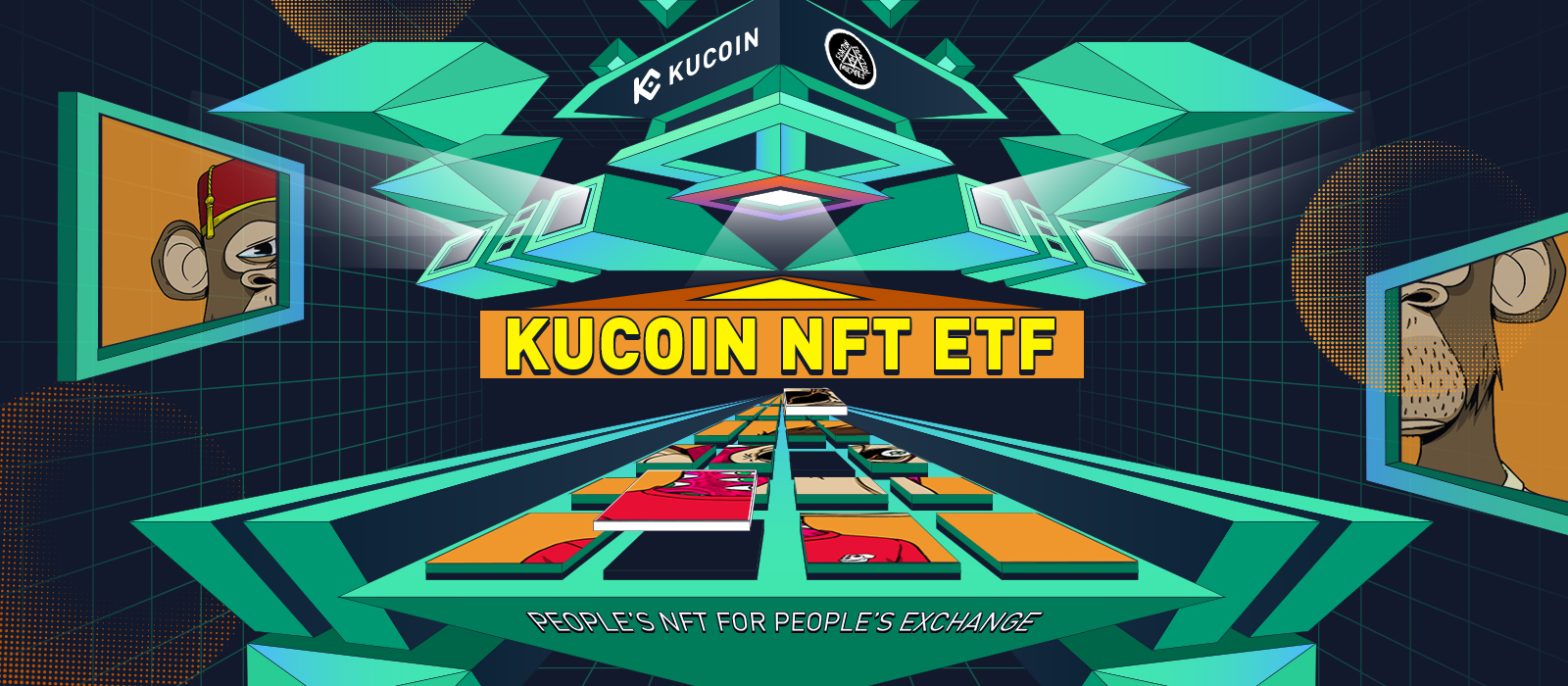
A First-Ever NFT ETF Has Been Launched by KuCoin

With the debut of an NFT ETF product aimed at more than 20 million customers, KuCoin has become the first centralized trading platform to provide blue-chip NFT investments.

According to a press release obtained by Coinposters, the revolutionary trading product reduces entry barriers for millions of users and enables the issuance of a USDT blue-chip basis for Non-Fungible Tokens, propelling leading Non-Fungible Tokens to the top of the market.

KuCoin’s relationship with Fracton Protocol has enabled the debut of the new NFT ETF Trading Zone, allowing the exchange to list hiBAYC, hiPUNKS, hiSAND33, hiKODA, and hiENS4 as underlying assets at the start of trading.

The hiBAYC ERC-20 token symbolizes 1/1,000,000 BAYC token ownership, which is native to the BAYC Meta-Swap of the Fracton Protocol. KuCoin plans to begin hiBAYC token trading on the NFT ETF Trading Zone as the first asset, with more assets to be added to the trading list in the near future.

The CEO of KuCoin, Johnny Lyu, had the following to say on the debut of the new product:

“As a trading platform that maintains its penetration rate in the NFT industry, KuCoin will continue to provide user-friendly goods for investors, enabling them to engage in NFT investments with ease. We are ecstatic to be the first centralized crypto exchange to handle NFT ETFs, allowing customers to invest and trade top NFTs using USDT in a straightforward manner. KuCoin will investigate other NFT-related solutions for our consumers in the future.

The NFT ETF Trading Zone is being introduced by the KuCoin exchange in an attempt to increase premium exposure to the NFT industry. The reduction of entry barriers for NFT trading will let millions of users to participate in the market and contribute to its progressive growth via confidence and liquidity injections.

The NFT ETF Trading Zone is intended to stand out as a specialized trading arena that provides users with access to direct NFT purchases utilizing USDT for stable exchange rates, as well as significant functionality, such as wallets and other modules.

KuCoin’s penetration in the NFT market has advanced in recent months. The introduction of the Wonderland NFT launch platform in April and the Windvane NFT Marketplace in late May positioned the exchange as the go-to location for NFT trading, management, launchpad services, and minting.

Categories
Bitcoin Price Analysis

Bitcoin (BTC) Market Update 07/30

Cointelegraph Markets Pro and TradingView data indicated that Bitcoin (BTC) will maintain $24,000 as resistance until July 30.

In the second part of the week, the pair benefited from macro tailwinds across risk assets, including a strong finish for U.S. stocks. The S&P 500 and the Nasdaq Composite Index each gained 4.1% and 4.6% during the last week, respectively.

In light of the likelihood that off-peak trading would trigger turbulent circumstances at weekly and monthly closing as a result of less liquidity, experts cautioned that anything might occur between now and July 31.

“Like usual, I’ll just observe the market till the end of the week,” Josh Rager said.

In the present market environment, it is difficult to enter substantial trades, however, there may be a few outliers that continue to perform strongly over the weekend.

Others focused their attention on the importance of the present spot price levels, which are above the 200-week moving average (MA) at $22,800. A Bitcoin weekly close above this trendline would be unprecedented since June.

Due to “overbought” circumstances, however, the well-known trader Roman predicted a rebound to at least $23,000 in the immediate term.

The Crypto Dread & Greed Index reached its highest level since April 6 after departing its longest-ever stretch of “severe fear.” Optimism continued to rise throughout crypto markets throughout the week, reaching its highest level since April 6.

The Index entered “neutral” area for the day at 45/100.

Regarding the next month, Cointelegraph writer Michal van de Poppe said that stock performance will continue to foster favorable circumstances for a cryptocurrency recovery.

August was expected to be a calm month for U.S. macro triggers since the Federal Reserve was not planning to modify policy until September.

With the next Consumer Price Index (CPI) reading coming on August 10, the possibility of inflationary acceleration persisted. This Monday, the European Union released its highest-ever estimate for the eurozone’s monthly inflation, at 8.9 percent.

Categories
Blockchain Ethereum News

Vitalik Buterin Concept For An Extremely Secure Blockchain

Vitalik Buterin, the inventor of Ethereum, has presented a method for constructing a blockchain with exceptional security. Vitalik Buterin, commenting on the classic argument between optimistic rollups and ZK rollups, presented a hybrid model that combines the advantages of both.

Rollups are Layer 2 solutions that try to increase a blockchain’s scalability. Rollups may consolidate many transactions into a single one and then report the final status. Currently, Ethereum’s maximum throughput is between 20 and 30 TPS. Rollups may double the rate of transaction processing.

Positive rollups and ZK rollups are the two most common forms of rollups. Optimistic rollups have a pessimistic disposition that assumes all transactions are accurate unless otherwise shown. They mix all the transactions without verifying their legitimacy. Then, they provide an opportunity for anybody to contest the validity. In contrast, ZK rollups verify the legitimacy of each transaction.

Although ZK proofs are safer, they are often costly to construct. Buterin seeks to resolve this problem.

Buterin’s strategy incorporates the best of both worlds. He suggested the construction of a rollup that would mix optimistic and ZK rollups. According to his concept, a block would be published on the blockchain. The chain would then wait 24 hours before submitting a challenge. A ZK-SNARK, which is a form of ZK proof, will be released if there is no challenge to the block.

If there is a challenge to the legitimacy of a transaction, the decision will be determined by consulting the optimistic rollup, the zero-knowledge rollup, and the blockchain governance as a whole. The government will resolve any disagreements between optimistic rollup and ZK rollup.

Rollups are a big issue in the Ethereum environment right now. Polygon has recently introduced a zero-knowledge EVM that is compatible with any Ethereum mainnet-compliant smart contract. Matter Labs and Scroll revealed their own zkEVMs after Polygon’s announcement.

Categories
Ethereum

The Ethereum Foundation Awards Developers a $2M Grant

In its recently held Academic Grants Round, the Ethereum foundation awarded a $2 million grant to encourage research on Ethereum and related network technologies.

The Ethereum Foundation stated earlier this year that it would provide a $750,000 grant to finance numerous “formal, scientific, and systematic” research initiatives targeted at enhancing the Ethereum network.

Before April 2022, ideas were requested from academic think tanks, research institutions, Ph.D. students, and anybody interested in investigating and increasing their understanding of Ethereum.

Recently, 39 of the several scholarly applications submitted during this time span have been deemed acceptable for funding. Following a follow-up announcement by the foundation on Friday, the award projects span seven of Ethereum’s core categories: Economics, Consensus Layer, P2P Networking Maximum Extractable Value, Formal Verification, Cryptography, zero-knowledge proofs, and other fields.

Teams for these research initiatives are reportedly from Canada, China, the United States, Vietnam, and fifteen other nations.

The original grant allocation of $750,000 was significantly increased to $2 million. The rationale given by the foundation was that the number of high-quality project ideas submitted surpassed their expectations. In addition, it was said that a few of the projects had tremendous potential, therefore justifying the increase in cash.

The Ethereum Foundation said, “We anticipate the outcomes of the several academic studies funded in this round…We are pleased to follow these research teams and see their wide influence on extending academic knowledge across the Ethereum community.”

This is not the first time the Ethereum Foundation has awarded research grants totaling millions of dollars.

In fact, the non-profit organization was founded for the primary purpose of funding research initiatives on Ethereum and related fields.

In 2020, the Foundation provided grants totaling $2.4 million to about 25 companies, including Dark Forest, Web 3 Labs, Hardhat, and Bitfly. These companies were active at the time on Ethereum initiatives spanning the community, education, cryptography and zero-knowledge proof (ZKP), developer experience, Ethereum 1. x, Ethereum 2.0, Layer 2, and user experience indirect financing.

Categories
Blockchain News

Recession-Proof Assets, According to Experts

Chief Global Strategist of BCA Research, Peter Berezin, divulged the recession-proof assets that he thinks can safeguard investors during a moment of economic crisis. Berezin is a prominent crypto critic who has referred to Bitcoin as a total scam and said that the cryptocurrency has no practical use.

According to Berezin, investments in consumer staples and healthcare are advantageous for economic protection during a recession. Berezin thinks that things that are essential for people to purchase will do pretty well in comparison to those that are optional.

The United States is most likely not in a recession, according to Berezin. According to him, the United States is only in a recession when the National Bureau of Economic Research acknowledges it.

Since the GDP of the second financial quarter indicated successive quarters of negative growth, there have been extensive arguments as to whether or not the United States is in recession.

The remainder of the economy, according to the White House and Fed head Jerome Powell, is doing much too well to be in a recession. On the other hand, many have accused them of redefining terms to suit their agendas.

The strength of the job market and unemployment rates indicate that the economy is not in a recession, according to Berezin, whose perspective is much more in line with that of the White House. Therefore, recession-resistant assets may not be necessary.

Berezin feels that the Federal Reserve could not engineer a smooth landing. According to him, a successful soft landing has never occurred in the United States. Berezin concurs that the inflation rate will decrease to 4%.

Berezin disagrees with Fed chair Powell’s assertion that September’s FOMC meeting would see an exceptionally substantial interest rate increase. According to him, the Fed will lower the increase to 50 basis points and finally to 25 basis points.

Categories
Blockchain News

Dubai Issues Operating Permit to FTX

It was announced on Friday by the cryptocurrency trading platform FTX that it has been awarded a license for a Minimum Viable Product by Dubai’s Virtual Assets Regulatory Authority. This accomplishment makes FTX the first cryptocurrency trading platform to be awarded this certification.

Institutional investors will be able to benefit from the regulated crypto derivatives products and trading services that will be made available by FTX Exchange FZE, which is a subsidiary of FTX’s division in Europe and the Middle East.

These products and services will be made available by FTX Exchange FZE. In addition to this, the cryptocurrency exchange will operate a marketplace for NFTs and provide users with custodial services for their bitcoin holdings.

Sam Bankman-Fried, the Chief Executive Officer of FTX, said that the firm intends to take the lead in building the digital asset industry in countries and jurisdictions that already have a well-established framework for digital assets now that they have been granted this license.

FTX created history at the beginning of this year when it was awarded a provisional license as the first fully regulated exchange to get such an authorization. With this license, the exchange is now ready to try out complex crypto derivatives that are aimed primarily at professional institutional investors in the UAE. These investors are located in the UAE.

As a result of the fact that VARA was able to successfully complete its in-depth regulatory review, the company has now been granted the go-ahead to switch over to an MVP license that allows it to conduct actual operations.

This will make it possible for the Company’s VA Exchange to provide regulated crypto derivatives products and trading services to Qualified Institutional Investors situated anywhere within the area.

In addition, the VARA MVP Licence grants FTX permission to function as a Clearing House, operate an NFT Marketplace and provide Custodial Services within the confines of stringently controlled limits for a certain category of customers. This assures that there will be robust guardrails in place to protect the market and maintain economic stability.

Categories
Blockchain News

U.S. FDIC Warns Banks About Voyager

Following claims by troubled cryptocurrency lender Voyager, that it is FDIC-Insured and the subsequent issuance of a cease-and-desist statement by The FDIC and The federal reserve, the United States Federal Deposit Insurance Corp (FDIC) has issued an advisory to banks and FDIC-Insured institutions regarding its policies. The advisory was issued by the FDIC as a result of these events.

The Federal Deposit Insurance Corporation of the United States has expanded its warning to include all bankers, stating that these bankers need to check with their cryptocurrency partners to ensure that they are not making false claims that the funds of their customers are protected by the government simply because they are affiliated with these banks.

In a letter that was sent out on Friday, the regulatory body made clear that the provision of deposit protection is only applicable in the very unlikely case that an insured bank fails.

The Federal Deposit Insurance Corporation (FDIC), which shields depositors of insured banks from the risk of having their funds stolen, has said that this does not apply to “neobanks,” which are organizations that look like banks but are not really banks.

Deposit products like checking and savings accounts that are provided by insured banks are eligible for coverage under the FDIC’s deposit insurance program.

Products that are not deposits, such as stocks, bonds, money market mutual funds, securities, commodities, or crypto assets, are excluded from the protection provided by deposit insurance. The FDIC offered an explanation.

Earlier on, these two United States regulators issued an order to the troubled cryptocurrency lender Voyager, telling it to desist from telling its customers that their funds are protected by the United States government with The FDIC insurance simply because it had accounts at Metropolitan Commercial Bank in New York. On Thursday, the Federal Reserve and the FDIC issued the following statement:

Voyager has made a variety of representations online, including on its website, mobile app, and social media accounts, stating or implying that the following three things are true:

(1) Voyager itself is insured by the FDIC; (2) customers who invested with the Voyager cryptocurrency platform would receive FDIC insurance coverage for all funds provided to, held by, on, or with Voyager; and (3) the FDIC would insure customers against the failure of Voyager itself. Voyager is not FDIC-in

Categories
Altcoins Blockchain News

Dogecoin warns about scam tokens

The Dogecoin community has cautioned users to be aware of imposters claiming affiliation with the cryptocurrency and its Dogechain block explorer.

The current endeavor is known as “Dogechain,” and it asserts that by placing “wrapped DOGE coins on the smart contract bridge,” the cryptocurrency DOGE will be able to support both NFTs and DeFi.

Despite this, the DOGE development community immediately severed all links with the project after raising many red flags about it.

Mishaboar, a popular Twitter account that focuses on Dogecoin, brought attention to this problem and urged DOGE users from placing their DOGE on any such “bridge.”

On the official Twitter account that it maintains, the DOGE team issued a warning, saying:

Over the course of the previous nine years, there have been plenty of tokens that have rapidly come and gone. There is just one Dogecoin, which is its blockchain, and it is not directly related to- any tokens. One Dogecoin is equal to one Doge, and there is only one. “Be on the lookout for impostors.”

In the past, there have been a great number of fake imitations that have attempted to profit off DOGE’s popularity. The DOGE token known as TeddyDoge (TEDDY) had a price drop of more than 99.94 percent in a single day when it was discovered to be part of a scam involving the cryptocurrency known as Dogecoin. As soon as the price of DogeMother plummeted by 91 percent, it was very evident that it was a honeypot scam.

Before things began to slow down, DOGE had an amazing boom in the first half of 2021, soaring to record highs of $0.76 in May 2021 after having risen by tens of thousands of percent earlier in the year.

Fraudsters are still attempting to profit from the cryptocurrency’s popularity despite the fact that its price has decreased by using questionable tokens to attract new investors. These tokens usually wind up being obvious hoaxes.

Categories
Blockchain News

CZ says crypto is healthier after $2T correction

It is Changpeng Zhao (CZ), CEO and creator of prominent cryptocurrency exchange Binance, who feels that a sequence of events that knocked roughly $2 trillion off the crypto market has made cryptocurrencies “far healthier.”

While the crisis harmed investors, CZ argued that it was beneficial for the sector as a whole.

As a result of the Terra LUNA accident, many individuals have been harmed.” However, it also eliminates many of the industry’s weaker companies. When Bitcoin hit $68,000, “I believe the industry is far stronger today than it was [six to nine months ago],” he said.

The Binance CEO went on to discuss the current state of crypto regulation in the US. Zhu said that the SEC and the Justice Department are seeking to exert too much control over the crypto market, which is not in the best interest of the crypto community. Power disputes, according to CZ, may lead to a variety of “issues in diverse ways.”

The crypto millionaire pointed out that in other nations, cryptocurrencies are handled by a single government agency. Cryptocurrencies may now be accepted in these countries, rather than being banned as they had previously been.

El Salvador and Central Africa are examples of nations that have accepted Bitcoin as legal money. Cryptocurrency regulations have been introduced in other nations, such as Dubai. According to CZ, these tactics are “very beneficial” to the sector.

The failure of several crypto initiatives has also been cited by CZ as a contributing cause to the current strength of the crypto industry. A number of crypto enterprises, particularly those that lend money, went bankrupt this year.

Stablecoin UST, the Terra algorithmic stable currency, lost its 1:1 peg to the US dollar in May and fell to zero as a result, bringing down the whole Terra system with it. It wasn’t long until CZ weighed in on the network’s design issue and said that the tokenomics creators needed to have their brains examined.

Terra-exposed firms including Three Arrows Capital and Anchor Protocol had their finances destabilized, and a few of them went bankrupt.

CZ thinks that, despite the demise of several crypto startups, new applications are being developed by other organizations that might lead to greater acceptance of cryptocurrency. Aside from the fact that investors are now more concerned about the long-term rather than short-term profits,

Categories
Blockchain News

Nirvana Suffers A Flash Loan Attack

The Solana network has experienced a second flash loan assault within a month. This time, the victim was the decentralized finance (DeFi) yield system Nirvana, and according to on-chain statistics, the attacker took $3.5 million worth of assets.

The attacker carried out the vulnerability by obtaining a $10 million USDC flash loan using the Solana-based lending platform Solend Protocol. The borrowed funds were then utilized to create $ANA, Nirvana’s native currency.

The hacker accomplished this by manipulating the price of Nirvana’s native token $ANA to boost its value. Thus, the amount of borrowed funds in the exploiter’s possession approached $10 million.

The exploiter then exchanged the inflated money, which was initially valued at $10 million in $ANA, for $13.49 million in USDT, deducting the additional $3.49 million from Nirvana’s Treasury.

After the attack, the hacker refunded the $10 million USDC loan to Solend Protocol and transferred the $3.49 million exploit money to an Ethereum wallet using Wormhole bridge. The compromised funds have been converted to DAI and are in the possession of the attacker.

About seven hours after the hack, Nirvana issued a statement on the vulnerability, saying that it would pursue the stolen funds. The business noted that the error was not caused by Solend, but by “a software exploit by Nirvana.”

In the meanwhile, Solend remarked on the incident, stating that it has reached out to Nirvana for assistance in locating the exploiter. Additionally, the lending platform said that it was not impacted by the incident.

As a result of the exploit, the value of Nirvana’s native token $ANA plummeted by 81 percent, to $1.71 as of this writing.

Nirvana’s stablecoin $NIRV also saw a severe decline, resulting in the loss of its 1:1 peg to the US dollar. At the time of writing, $NIRV was trading at $0.18, implying a loss of more than 90 percent.

Categories
Altcoins Blockchain News

Congress Pushing the U.S. Stablecoins Bill Until After the August Break

After the August vacation, bipartisan legislation to provide a regulatory framework for stablecoins in the United States will be considered.

Rep. Maxine Waters (D-CA) issued the following statement: “Although the Ranking Member, Secretary Yellen, and I have made significant progress toward a compromise on the legislation, we are regretfully not there yet and will continue our conversations over the August vacation.”

She continued, “It is crucial that we continue to advance in this area so that we can have a regulatory framework that protects consumers while permitting responsible innovation.”

The measure was likely to advance yesterday as a result of bipartisan collaboration between waters and Representative Patrick McHenry (R-NC). The bill would purportedly require stablecoin issuers, such as Tether and Circle, to keep 1:1 reserves of their stablecoins in circulation and restrict the sorts of assets that might be used to support these stablecoins.

The delay is a result of rumors that Treasury Secretary Janet Yellen expressed reservations about the draft legislation’s treatment of difficulties regarding the custody of digital assets.

Rep. Waters highlighted the risks of stablecoins during a hearing in February 2022, noting that “investigations have revealed that many of these so-called stablecoins are not, in fact, fully backed by reserve assets” and that speculative trading and a lack of investor protections “could even threaten U.S. financial stability.”

Following the demise of the algorithmic stablecoin UST earlier this year, the planned regulation of stablecoins has taken on a new sense of urgency.

Yellen expressed an “urgent” plea for stablecoin regulation this year at the time. She stated that the run on UST “illustrates that this is a quickly expanding product with rapidly expanding dangers” and that “digital assets may pose hazards to the financial system, necessitating heightened and coordinated regulatory attention.”

In comments to Congress days later, however, Yellen agreed that stablecoins have not yet reached a size “where they are financial stability issues,” saying that the cryptocurrency sector does not yet constitute a “systemic risk.”

Categories
Blockchain News

Ripple lawyer: SEC chair declined to see crypto leaders

The Securities and Exchange Commission (SEC) of the United States has come under fire from prominent figures in the digital asset business due to the regulatory rules it has implemented.

Now, a lawyer has disclosed that SEC Chair Gary Gensler turned down the cryptocurrency companies’ request to meet with him last year.

According to claims made by John Deaton, the creator of Crypto Law and a lawyer representing XRP holders, Gary Gensler declined to meet with the 69K XRP holders.

Having said that, he also disclosed that the Chair of the SEC did not even meet with Congress. Instead of meeting with crucial players, Gensler meets around seven times with a company that owns the majority of its wealth.

Deaton revealed this information in a thread on Twitter, and it is being estimated that the SEC Chair’s current wealth is over $100 million. He went on to say that the commission doesn’t care about how improper it would look to be acting.

According to the Crypto Law, records of Gensler’s declaration from 2020 to 2021 indicated the bulk of his wealth is invested in funds managed by the Vanguard Group.

These data cover the time period from 2020 to 2021. Two of his most important companies are an LLC called Annabel Lee and a marital trust.

In the meantime, the public calendar of the SEC Chief does not show any significant meetings with any retail crypto companies or even with the leaders of blockchain association organizations. During the time that he was having a meeting with his asset managers.

The data pertaining to Gensler reveal that the architect did not even bother to respond to the letter sent by the US Rep.

In addition to this, he missed out on an appearance before the Republican members of the Financial Services Committee to address some important concerns.

While he declined to face the leader of the cryptocurrency industry, SEC Enforcement was swarming retail holders in the courtroom.

The Securities and Exchange Commission (SEC) has begun monitoring the cryptocurrency exchange known as Coinbase for potential violations of regulatory laws.

The legal representatives for XRP emphasized that Coinbase has, from the very beginning, made every effort to comply with the commission’s requirements. Even after that, the XRP tokens were delisted, and the platform decided against launching LEND.

According to Deaton, the only reason Coinbase was chosen as a target was that the company cooperated with the commission.

Categories
Bitcoin News

As BTC buying pressure rises, experts predict Bitcoin will hit $106k

Bitcoin has exceeded early proponents’ expectations. Once deemed worthless, crypto has become one of the most promising financial asset classes. Some industry experts estimate Bitcoin to hit $100k in 3 years, according to recent research.

Finder’s Panel predicts Bitcoin’s (BTC) short- and long-term performance. The panel of 53 industry experts predicts BTC will reach $106,757 by 2025, or 468 percent of its current price of $21,795.

This projection is positive, but it’s less than half of the Panel’s July 2021 estimate. A year ago, the Panel predicted Bitcoin will reach $256k by 2025.

This change was triggered by the Crypto Winter and ongoing crypto concerns, like LUNA’s bankruptcy and the 3AC controversy. John Hawkins, a senior professor at Canberra University, highlighted inflation and central bank balance sheet tightening.

The panel predicts BTC will fall to $13k this year but reach $35k by year’s end. The panel predicts BTC will end 2022 with over $25,473 and exceed $314k by 2030. Fred Schebesta, the creator of Finder, expects BTC will touch $75k by 2022.

Fearful market. The technology remains robust. Bitcoin is following the economic slump, but Schebesta believes it will recover.
Panelists said global interest rate rises contribute 70% to the current Crypto Winter. They think the LUNA crash caused a space contagion (68 percent ). Inflation was high (40 percent ). Most panelists expect Crypto Winter to endure until 2023.

Panelists encourage investors to buy additional coins. 50% of panelists indicated it’s time to buy, 40% to hold, and 10% to sell.

After the crypto markets’ rebound, the area has a new, hopeful view after the previous month’s collapse. BTC is trading at $21,795 after gaining 10.71 percent in the last week. The Crypto FGI rose to 31 from 11 last month, indicating optimism. The BTC Coinbase Premium Index shows strong US institutional purchasing.

Categories
Altcoins Blockchain News

IMF sees stablecoins causing another crypto winter

Cryptocurrency markets are groaning under pressure after the Terra-LUNA meltdown and liquidity crisis in June, which has been exacerbated by the U.S. interest rate rise. Even stablecoins might collapse, according to a report from the International Monetary Fund (IMF).

During an interview on July 27, the IMF’s Director of Monetary and Capital Markets Tobias Adrian said that the crypto market selloff isn’t done since stablecoins might cause another crypto winter. Even in 2022 and 2023, the International Monetary Fund (IMF) predicts weak global economic growth.

As a result, crypto assets and risky asset markets like stocks might suffer more declines.” If any of the coins offers, especially the algorithmic stablecoins, fail, “there are others that might collapse,” says the author.

Some cryptocurrencies, notably algorithmic stablecoins and fiat-backed stablecoins, might be severely harmed if another crypto selloff occurs.

Adrian warns that stablecoins that aren’t completely backed by cash and treasuries offer bigger hazards. Since Tether is not backed one to one and contains hazardous assets, he predicted that it would lose its peg to the US currency after the Terra collapse. Stablecoins backed by cash reserves, on the other hand, have a lower failure rate.

This was disclosed by Tether’s CTO Paola Ardoino today, who said that USDT does not own any Chinese commercial paper. In addition, its exposure to commercial paper has decreased from 30 billion pieces a year ago to approximately 3.7 billion pieces now.

Tether intends to reduce exposure to 200 million people by the end of August and to zero by the end of October/early November of this year. Tether expects to further minimize exposure.

The International Monetary Fund (IMF) has reduced global economic growth because of rising inflation, which might lead to a recession in the near future. According to Adrian, exchanges and wallet providers should be regulated globally.

During the Federal Reserve’s decision on an interest rate increase between 75 and 100 basis points, Bitcoin and Ethereum values have been turbulent.

If the Federal Reserve raises interest rates by 100 basis points in July, it will have a huge impact on the crypto and stock markets. Ethereum’s price is presently at $1,489, while Bitcoin’s price is up 3%.

Categories
Altcoins Blockchain News

Cardano Comes Out As The Most Developed Crypto

According to Santiment, a business that specializes in crypto analytics, Cardano (ADA) retains its position as the most prominent blockchain with regard to the frequency of relevant activity on GitHub.

This information was provided by Santiment. In addition, the data from Github that was provided by the business Santiment showed that there has been an increase in the amount of activity demonstrated by developers working on Cardano.

It’s possible that the level of activity on GitHub could be taken into consideration as a significant metric for assessing initial coin offers (ICOs) and other cryptocurrency-related ventures.

The time of developers is a resource that may be rather expensive, and the fact that a particular project has a big number of developers who are committing their time and skills to the project can mean a variety of different things depending on the context in which it is being considered.

There is a possibility that these folks have hope that the project will be successful, that the project is releasing a growing amount of features, or that there is a decreasing risk that the project is really an intricate scam.

It is essential to point out that the long-awaited Vasil hard fork has enhanced the popularity of Cardano (ADA), bringing more people to test out the advantages of the cryptocurrency. This is one of the reasons why it is necessary to notice this.

This is something that has to be taken into consideration. You may expect the introduction of more functionality when the substantial upgrade is ultimately made accessible on the mainnet. This will occur at some point in the future.

Cardano’s price has the potential to climb by a factor of 10 as a consequence of the long-awaited Vasil Hard Fork if previous ADA hard fork events are any indicator.

This event has been anticipated for quite some time. In addition to this, it is reasonable to set a 10x goal for Cardano given that the ADA all-time high price of $3.10 will be achieved in September of 2021.

According to the information given by CoinGecko, the price of Cardano has dropped by 0.4 percent over the course of the last twenty-four hours, bringing it down to $0.4666. This brings the total value of the cryptocurrency to $0.4666. A fall of 9.5 percent may also be noticed in ADA membership numbers during the last week.

Categories
Blockchain News

Polygon Network Q2 Transactions At $284M

As recently as the second quarter of 2022, Ethereum layer-2 solution Polygon revealed that their network has surpassed a transaction high of $284 million between April and June.

The volume of trades in the second quarter increased by just 4% compared to the first quarter (Q1). The overall number of wallet addresses on the network increased by 12 percent in Q2 to 5.34 million, accounting for $5.56 million in income.

As the number of projects produced on the Polygon blockchain grows, so does Polygon itself. Bungee, a bridge aggregator, has grown its user base by more than 1,000 percent, bringing it to 90,000 users, among other initiatives in the DeFi segment. The aggregator project also saw a 972 percent rise in transaction volume, putting it in fifth place among the network’s DeFi projects.

Meshswap Protocol, an automated market maker (AMM) that switched from the Klaytn chain to Polygon in April, witnessed excellent growth in Q2 as well. Polygon’s implementation of the protocol resulted in 1.6 million transactions and the addition of 91,000 additional members.

As a result, Polygon-based blockchain games saw a surge in revenue. NFT game project Aavegotchi garnered the greatest attention, attracting 102,000 members to its metaverse, nicknamed Gotchiverse. Planet IX, another blockchain game, has surpassed the 58,000 user mark and now ranks in the top 10 most popular on the network, thanks to a modest 8 percent increase in new players.

Despite the worldwide NFT market’s lack of growth in Q2, Polygon Network was able to make some strides throughout the quarter.

NFT marketplace OpenSea reported 1.2 million new wallets on Polygon, raising the total number of NFT wallets to 1.51 million, according to the sidechain. In the second quarter, the network saw a 122.45 million rise in the amount of NFT transactions.

A 49% drop in transaction costs was reported in Polygon Q2’s report, making the network’s average cost per transaction $0.0018. However, according to last week’s news, the blockchain’s developers have launched a Zero-Knowledge Ethereum Virtual Machine (zkEVM).

As the network grows and transaction costs are reduced, the blockchain trilemma may be maintained while maintaining decentralization and network security.

Categories
Ethereum Price Analysis

Ethereum (ETH) Market Forecast 07/26

The cryptocurrency known as Ethereum (ETH) was unable to recover its losses and trade higher than $1,550. As a consequence of this, the price of ETH started to fall again, and it eventually fell below the critical support zone of $1,500. Additionally, the price of ETH is trading at a level that is lower than the 100-hourly simple moving average (SMA).

ETH started the day with a significant drop that took it below the $1,450 mark and tested the support zone around $1,400. As the price of Ethereum continues to consolidate its losses, the price reached a new low of approximately $1,402 in close proximity.
The price of ETH has decreased by 6.65 percent over the course of the last 24 hours, as indicated by statistics made public on CoinMarketCap. At the time of this writing, the price of ETH on the market is $1,424.79.

On the upside, there is some immediate resistance close to the level of $1,440, and the first significant resistance is close to the zone of $1,450. It is currently located quite close to the level that represents the 23.6% Fibonacci retracement of the decline that began from the swing high at 1,662 and ended at 1,402 dollars.

On the hourly chart for ETH/USDT, we can see that a significant negative trend line is forming near $1,460, which is acting as resistance. If Ethereum’s price is able to make a decisive move over the trend barrier, it may be able to reach the level of $1,500. After that, the key barrier to overcome will be at $1,550.

In the event that Ethereum is unable to break over the resistance level of 1,460 dollars, the price of ETH may continue to decline. Near the zone of 1,400 dollars is where bears will first find some support.

A decisive break below the support at $1,400 might send the price down toward the zone of support around $1,375. If there is any further selling pressure, the price of ETH may fall to the $1,300 support level.

Categories
Bitcoin Price Analysis

Market Update on Bitcoin (BTC) 07/26

In the preceding week, Bitcoin price rose from $20k to as much as $22,000, thanks to an almost flawless start. Bitcoin’s upward trend continued through the second day of the week until it hit a correction at $23,800.

During Wednesday’s trading, Bitcoin $24,000 level of resistance was broken. Market panic sparked a halt to the upward trend after a negative announcement. A Tesla bounced it.

According to the automaker, the majority of their bitcoins were sold in the second quarter. Customers and other shops who had taken pleasure in the company’s position on the digital currency were surprised by this development.

Since the market is fearful, BTC’s price has fallen and is unable to shake off the current pessimistic atmosphere. Despite this, the coin’s value dropped below $21k just a few minutes before publication.

There are numerous signs that the cryptocurrency will continue to decline in the near future. The Moving Average Convergence Divergence (MACD) is an example of one. A closer look at the indicators suggests that it may have a bearish divergence in a few days.

If, for example, the 12-day EMA dips below the 26-day EMA in the next 48 hours, it will meet. There is a chance that bitcoin will go below $20k if this scenario occurs. An additional danger is looming at the $19k level of support.

Even so, a shift in market mood is possible, changing the aforementioned prognosis. Coins such as Bitcoin are likely to resume their upward trend and reach $22k support. After that, we may expect to see more price hikes.

At the moment, the price of bitcoin has fallen below the pivot point. Since the asset has no obvious future, it’s classified as negative.

Categories
Altcoins Price Analysis

Solana (SOL) Price Analysis 07/26

A two-week low was reached on July 26 at roughly $35.50 for Solana (SOL), which was in line with other cryptocurrency markets. It is still technically possible for Solana’s price to rise by 40% in August, based on these indicators.-

Although the negative continuation pattern for Solana is evident, the bullish setup for the stock arises out of it.

There has been a “bear flag” formation on SOL’s daily chart, which occurs when an instrument’s price decreases and then recovers when it breaks out of the “bear flag.”

As of this writing, the so-called bear flag collapse has not taken place. This chart shows that if SOL can hold on to the lower trendline as support, it might make an immediate move back toward the higher trendline.

SOL might rise to $49.50 in August, a 40% increase from today’s price, according to the rebound setup. In May, the $49-$50 range had functioned as a support and a barrier.

As long as Solana’s overall bias remains negative, bulls will be relieved by a possible bear flag comeback.

For example, macroeconomic issues such as rising interest rates and a “algorithmic stablecoin,” Terra, which was valued at $40 billion, have thrown crypto markets into a spiral. Since Solana’s financial and network usage indicators have declined in 2022, like any other hazardous asset, as a consequence,

The average daily number of Solana blockchain transactions, for example, decreased by 17.6 percent in Q2/2022 compared to the previous quarter, according to Messari statistics.

Quarter-on-quarter, Solana’s sales fell by 44.4%. (also because of recurring network outages).

Deteriorated network performance has a negative impact on network use and income generation, according to Messari researcher James Trautman.

It’s possible that if Solana’s performance degrades for an extended period of time, it might have a negative impact on network value and volatility.

Categories
Blockchain News

Hollywood Producer Scams $2.5M Crypto

The Department of Justice claimed in a news statement on July 21 that Hollywood producer Felton, who was charged with several charges of wire fraud, securities fraud, and money laundering, agreed to direct the cash towards financing his luxurious lifestyle.

Notably, the funds were sent to Felton’s account, where he used them to buy a $1.5 million home, a $180,000 Ferrari, a $58,250 Chevy Tahoe, and around $30,000 in diamond jewelry.

The Hollywood producer got the funds by advertising an Initial Coin Offering for a streaming network called FLiK, with the promise that the firm would exceed Netflix.

It’s worth noting that the producer allegedly lied about a popular Atlanta rapper and actor backing the project as a co-owner in order to attract additional investors. However, the aforementioned rapper was not a member of the project.

Surprisingly, innovators were led to believe that the United States military was also on board, having agreed to disseminate the streaming platform to service personnel.

In addition, during the height of the 2017 ICO boom, the platform claimed to be closing license arrangements with major film and television studios.

In the end, Felton dumped almost 40 million FLiK tokens on trade exchanges, causing the value of FLiK coins to plummet dramatically.

In addition, Felton pushed another ICO for CoinSpark, a cryptocurrency trading exchange, in 2018. He guaranteed Spark coin holders that they would get 25% of the trading exchange’s income in dividends. The corporation was never audited, despite a previous pledge.

Felton was also accused of pretending to be a possible investor on numerous online forums and social media platforms, according to the DOJ.

The 48-year-old is awaiting sentence before U.S. District Court Judge J.P. Boulee after pleading guilty to twelve charges of wire fraud, ten counts of money laundering, and two counts of securities fraud.

Categories
Blockchain News

JP Morgan Says Coinbase Shareholders Might Be At Risk

Following the recent exposure of a bitcoin insider trading tipping operation, another piece of unfavorable news may be on the way for Coinbase stockholders.

Coinbase has been in the headlines for all the wrong reasons since the leading exchange revealed that they will be laying off employees. According to JP Morgan’s findings, the corporation could try something different this time around with regard to the employee pay programs it offers.

On Monday, customers of The Wall Street had been advised that stockholders in Coinbase “the danger of increased share dilution coming from restricted stock units.”

According to what was said, the situation is the same with regard to the shareholders of Robinhood. It was noted that the restricted stock units, sometimes known as RSUs, may be included in employee compensation schemes.

A decrease in the price of Coinbase’s shares, as stated by Kenneth Worthington, an analyst at JP Morgan, may lead to an increase in the rate of share dilution by 7 percent per year in the following years.

“Just like their competitors in the technology industry, both of these businesses provide considerable equity to their personnel in the form of restricted stock units (RSUs) as a method of motivating their workers while maintaining lower levels of cash remuneration,”

It is possible that Coinbase will be required to pay its workers by issuing extra shares if this scenario plays out. This might result in a significant reduction in the value of the existing shares.

The analyst from J.P. Morgan noted that the additional shares that were issued and dilution might diminish the value of each firm by thirty percent over the course of five years.

One month ago, Goldman Sachs lowered its rating on Coinbase and suggested that investors sell their shares of the company’s stock. The recent collapse in crypto market prices was the direct cause of the rating cut.

On Friday, the Securities and Exchange Commission (SEC) said that it had prosecuted three persons, including a former product manager for Coinbase, in connection with the very first cryptocurrency insider trading scam. According to the allegations, the worker disclosed confidential material to his immediate family members and friends before Coinbase made various announcements public.

Ishan Wahi, a worker with Coinbase, participated alongside his brother and a buddy in the process of coordinating important announcements. The commission said in its lawsuit that the plan resulted in an illegal profit of about one million and one hundred thousand dollars.