Categories
NFT

Binance launches NFT ticketing for Lazio

The world’s largest cryptocurrency trading platform, Binance, has announced that it would begin selling NFT tickets for the 2022–2023 season of S.S. Lazio matches in Italy. The non-fungible tokens (NFTs) buyers purchase will enable them to attend their preferred team’s home matches at Rome’s famed Stadio Olimpico, the city’s main sports venue.

In addition to having admission to the stadium, ticket holders will also get other discounts, such as 10% off any purchase made at the Lazio shop and 20% off tickets to the club’s Europa League games, which is an annual tournament run by the Union of European Football Associations (UEFA).

Supporters who buy digital tickets will also be eligible to win fan tokens, have access to a variety of unique events, and get discounts. Supporters of Lazio must sign up for a Binance account and visit the Binance Fan Token Platform in order to purchase tickets.

The NFT tickets, according to the digital asset exchange, will aid in resolving several well-known problems with the conventional ticket distribution mechanism. For instance, the non-fungible tokens enable the avoidance of multiple ticketing, which occurs when a single stadium seat is sold twice, as well as the prevention of ticket fraud and issues with loss or damage.

Lazio’s primary t-shirt sponsor is Binance. The sponsorship contract for €30 million ($30.5 million) was revealed last October. The two parties came to an agreement for a two-year initial term with the possibility of an additional year’s extension.

The NFT-ticketing idea comes after Binance and Portuguese soccer sensation Cristiano Ronaldo engaged in an exclusive, multi-year NFT relationship in June. To give fans the chance to possess a memorable piece of sporting history, the well-known player intends to issue a number of NFT collections.

Categories
People

Raoul Pal Influences the Crypto Market with Persuasion

In a recent interview with the asset management company Arca, the former Goldman Sachs executive Raoul Pal asserts that the macroeconomic climate that has kept the cryptocurrency market gloomy for the majority of the year is beginning to shift.

“The macro is rolling over for me. That is to say, we are entering a recession. Things such as the ISM (institute for supply management) survey and others should immediately begin to disintegrate. The futuristic components are already disintegrating. We observe it worldwide. Thus, growth is disappearing.

In addition, the narrative has not caught up, and most commodities are down 30% to 50%… Everyone is bullish and expects oil to reach $200. I anticipate a washout, and the price falls to $60. Thus concludes the inflation narrative.”

According to Raoul Pal, alterations to the macroeconomic environment would have an impact on businesses and subsequently the labor market.

“After Covid, people accumulated enormous stocks. These stocks are now unsold as a result of the economy’s slowdown and inflation’s eroding of disposable income. Therefore, we have seen it at Walmart and Amazon. They will begin discounting inventory in an effort to move it. People are terminating employees. Therefore, the macrocycle will enter its nasty phase.”

Pal underlines that the impending terrible economic news is good news for the financial markets.

“Why does it make Raoul belligerent? As a consequence, as inflation declines and bond rates decrease, liquidity circumstances improve. Liquidity conditions are the primary macroeconomic factor influencing financial markets.

In addition, the macro expert believes that, as liquidity circumstances improve, cryptocurrencies are poised to enter a new market cycle.

“From my perspective, let’s assign a 70% likelihood. Consequently, there is a high level of confidence that the bottom has been reached, and we are therefore beginning the uptrend.”

Categories
News

Anonymous Vows To Launch An Investigation Into BAYC

A video allegedly posted by the Anonymous Group has been discovered on Twitter. In the film, the hacking collective promises to look into allegations that the Bored Apes NFT collection has connections to Nazi symbology. The charges have been categorically refuted by the BAYC founders.

Anonymous said that BAYC collections have been the target of various terrible claims, including pedophilia, racism, occultism, and even simians, all of which it plans to examine. The hacktivist organization said in the addition that it would occasionally reveal its results.

The hacktivist group said that the film is an attempt to communicate with the Bored Ape Community in a nice manner.

Ryder Ripps was the first person to make allegations that Yuga Labs and Bored Apes Yacht Club Collection included symbols of the Nazi party.

Ripps has continued with his assertions, and Yuga Labs has filed a lawsuit against him for making false charges, despite the fact that the creators of the collection have issued many statements denying any connection to Nazism or any of the other claimed ideas.

In the meanwhile, some members of the community are calling into doubt whether or not this is the genuine Anonymous organization, while others believe that Ripps and his crew are responsible for the film.

An Anonymous-verified Facebook page wrote a message on August 9, encouraging @nxg4n to “keep up the excellent job” before the video was published on Twitter. Ryder Ripps and Pauly Cohen were both named in the post that has since been removed.

A review of the tweets sent by nxg4n revealed that the account only discusses conspiracy theories that are related to Yuga Labs. Nobody is aware of the identity of the person behind the account.

Anonymous is a loosely organized group of computer hackers from different parts of the globe who have no publicly acknowledged central leadership. Because of this, it is never easy to determine whether or not the statements made by organizations that identify themselves as The Anonymous are legitimate.

Categories
Altcoins

Dogecoin And Shiba Inu Are Seeing Massive Gains

At the time of publishing, two meme-based cryptocurrencies, Shiba Inu and Dogecoin, are doing very well, posting increases of 7.29 and 22.99 percent, respectively, during the preceding twenty-four-hour period.

The market value of the meme economy, which has seen fresh money flood into it over the course of the last twenty-four hours, has increased by 13.19%. The total value of the top ten cryptocurrencies is now estimated at $19.54 billion, according to statistics provided by CoinMarketCap.

The huge increase of 151% in trading volumes for this category of assets indicates that increased interest in meme cryptocurrencies is taking place.

According to the data presented by WhaleStats, one of the 1,000 greatest ETH whales throughout the course of the previous day, Shiba Inu, was among the top 10 whales in terms of the trading volume. On August 2, the designers of Shiba Inu revealed the collectible card game’s new name—Shiba Eternity—raising fans’ expectations that the game would deliver on its promise.

According to information obtained from the Shibburn website, more than 292 million tokens were burned in the preceding twenty-four hours, which further fuelled the spike of the Shiba Inu cryptocurrency. It is believed that the destruction of tokens would result in a rise in values; however, this cannot be proven.

Michi Lumin, a developer for the Dogecoin Foundation, was the one who presented the initial version of libdogecoin, the library of Dogecoin building blocks that was developed by the Dogecoin Foundation, last week.

It is not necessary for developers to have an in-depth understanding of blockchain technology in order to make use of this library, which allows lightweight direct integration of Dogecoin into a number of platforms.

Categories
Bitcoin

Bitcoin surpasses $25k for the First Time in Nine Weeks

Late on Saturday night, the price of bitcoin broke beyond the $25k barrier for the first time since June 13. At the time of this writing on Sunday morning, it has lost pace and fell back to $24,510 on CoinMarketCap.

This is an indication that Bitcoin’s $25k threshold is likely to continue to serve as a significant resistance level for the biggest cryptocurrency for the foreseeable future.

The price of Bitcoin has increased by just 5.85 percent over the previous week, while the price of Ethereum, which is ranked second, has increased by 16 percent over the same period of time due to anticipation of the network’s impending merging to a proof-of-stake model.

The important economic indicator stayed constant last month as the Federal Reserve’s interest rate rises looked to be counteracting growing prices. As a result, Bitcoin’s spike may be at least partially attributable to cooling in inflation.

The price of Bitcoin and the rest of the cryptocurrency market, in addition to other assets such as equities and bonds, have taken significant hits during the whole summer as a result of growing inflation and the possibility of an approaching global recession.

The Federal Reserve in response hiked interest rates, which resulted in the creation of a risk-off atmosphere. As a result of this climate, investors sold cryptocurrencies and risky tech companies in order to cling to dollars.

It was previously believed that bitcoin served as a buffer against inflation; however, its reputation as an anti-inflationary “digital gold” has been put to the test this year, as it has instead closely linked with IT stocks.

Despite recent indications of a resurgence, Bitcoin’s value is currently 64% lower than it was when it reached an all-time high of $69,044.77 in November 2021.

Categories
Bitcoin

Binance Is The Exchange With The Most Bitcoin Holdings

From January 2022 to May 2022, the amount of Bitcoin sitting on exchanges declined for both Coinbase and Binance, until Binance’s exchange balance dramatically flipped and started to rise. Even while both the total and Coinbase exchange balances are decreasing, it is still increasing.

image 1058
Source: Glassnode

The graph illustrates the cumulative Bitcoin exchange balance, the BTC price, and the Binance and Coinbase exchange balances.

Since February, the cumulative exchange balance is shown as a steeply descending green line. Beginning of the year, there were around 2.6 million Bitcoins on exchanges. This is a net loss of 200,000 Bitcoins.

This shows that Bitcoin supply has been eliminated off exchanges, signaling a long-term bullish trend for holding.

The overall balance of Coinbase has followed a consistent path. At the beginning of the year, the exchange held around 690,000 Bitcoins, but in eight months, that number fell below 560,000.

image 1059 1024x576 1
Source: Glassnode

The graph above displays the fluctuation of currencies on Coinbase. The red lines indicate Bitcoins leaving the exchange, while the green lines indicate Bitcoins entering the exchange. Since the start of the year, Coinbase has removed a substantial amount of Bitcoin. In addition, the amount withdrawn increased between March and July.

These transactions may have been impacted by the fact that US institutions favor Coinbase. In a down market, institutions are more inclined to purchase and hold, which may explain why they withdrew Bitcoins from Coinbase.

Despite beginning the year in the same bear market as January, Binance ended the month with more Bitcoins than in January. The exchange started the year with 586 thousand Bitcoins, fell below 560,000 until May, and ended with 623 thousand Bitcoins.

Recent news articles indicate that Binance and Coinbase approach the winter market differently. While Binance continues to prioritize its customers despite the severe winter conditions, Coinbase is grappling with layoffs, litigation, and bankruptcy rumors.

Categories
NFT

OpenSea Modifies Stolen NFT Policy After User Complaints

Amid growth in NFT frauds, Web3 platforms are more compelled to detect and manage stolen funds. OpenSea, as the biggest NFT marketplace, has bore the brunt of this Web3 obligation, but its strategy of banning identified assets has garnered significant reaction, particularly for penalizing customers who were unaware they were purchasing stolen NFTs.

In response, OpenSea said on Wednesday through Twitter that it would modify how it handles suspected stolen NFT assets.

Previously, OpenSea prevented stolen assets from being purchased, sold, or transferred on its platform while it investigated each case, resulting in an indefinite hold on access to these NFTs and their corresponding value.

OpenSea said in a tweet that it intended to address the elephant in the room by requiring a police report within seven days of reporting an NFT as stolen. The marketplace says that it previously did this for escalated disputes, but it will now be needed for all reported stolen NFTs.

This action is meant to prevent bogus reports. In the absence of a timely police report, the hold on the goods will be released.

In addition, OpenSea claims it will ease the procedure for revoking a claim after a user recovers their or her stolen NFT, or if they choose to withdraw a complaint for any other reason.

Thursday, OpenSea emphasized that the necessity for a police report would only apply to newly-filed claims for stolen NFTs and not to current instances. If we implemented this retrospectively, we’d be asking them to take further steps months or weeks after they’ve (hopefully) put this matter behind them, the marketplace tweeted.

OpenSea said that it cannot enable the selling of stolen NFTs since it is situated in the United States. However, as a consequence of the marketplace’s extensive blacklisting policy for reported assets, users who purchased NFTs unaware that they had been previously stolen are often unable to trade or transfer the asset.

OpenSea further mentioned that it is collaborating with other Web3 platforms to reduce the effects of such NFT frauds and educate consumers more effectively.

It referenced the recent upgrade to the popular Ethereum wallet MetaMask, which makes users more aware of the fact that they are giving away wide access privileges with certain transactions – broad access that is often sought to conduct such attacks.

Categories
Business

FTX and Paradigm Partner to Launch New Crypto Service

For futures contracts on eight cryptocurrencies, the global exchanges FTX and Paradigm will provide assured atomic execution and clearing of both legs of the trades.

Spread trading will now be available, according to a recent announcement made by Paradigm in conjunction with the cryptocurrency exchange FTX.

Users will be able to use “one-click trading with no leg risk for the spread between spot, perpetual, and fixed maturity futures on Bitcoin (BTC), Ethereum (ETH), Solana (SOL), Avalanche (AVAX), ApeCoin (APE), Dogecoin (DOGE), Chainlink (LINK), and Litecoin.” This information was provided by Paradigm as part of the FTX partnership (LTC).

FTX will ensure both the atomic execution of the transactions as well as their clearance before the deals are completed.

Anand Gomes, CEO of Paradigm, said that the arrangement attracted new cryptocurrency investors who were interested in cash and carried trades, which included leveraging cryptocurrency spot purchases and futures instruments traded on FTX.

According to the company, utilizing nuclear implementation for both legs of the spreads trading was systemically less risky than using regular exchange execution. As a result, market makers were able to quote prices that were significantly more precise and in significantly larger sizes after adopting atomic execution. According to Paradigm, the expenses will be reduced by fifty percent in comparison to the scenario in which two separate outright transactions are carried out.

In 2019, a block trading solution was developed via a partnership between Deribit, a cryptocurrency derivatives exchange, and Paradigm.

Categories
News

Celsius Users Fight For The Return of Their Funds

After Celsius’s bankruptcy filing a month ago, the crypto industry was in pandemonium as prices plummeted. Recently, Celsius users have joined together to fight for the recovery of their monies. 

Incidentally, the user community is becoming more active in legal battles. They have been using many social media platforms to unify users and gather resources.

According to a Bloomberg story, a Telegram group of about one thousand Celsius members has been fundraising for their shared cause. Not just Reddit, but also Telegram and Twitter have become conversation hubs for the community of Celsius users.

By requesting individual users to send letters to the court in the Celsius case, the communities are fueling legal fight efforts. The article said that they are also collecting donations for legal counsel.

Since being publicized on Reddit, the ‘Celsius Custody Accts’ Telegram group has gained more than 950 members. Several hundred users have paid $1,500 or more to join the committee of the organization.”

The crowdfunding effort has so far garnered nearly $3,000 from tiny contributions. Before the Celsius issue emerged and the community seemed to be in good shape, social media users were highly engaged. 

According to the research, there are more than 47,000 active members of the Celsius Reddit community. The same organization is now the focal point of a concerted effort to recover user payments.

In addition to the Celsius community, the community of Voyager account holders is also highly active in their struggle. According to the article, a Telegram user group spent $5,000 on Voyager.
 
Members of the organization exchange information and debate potential legal actions to escalate their struggle for the recovery of funds. In the first week of July, Voyager declared bankruptcy. The crypto lender has exposure to Three Arrows Capital, a hedge firm. The company has over $1 billion in assets and over 1,000,000 debtors.

Categories
Ethereum

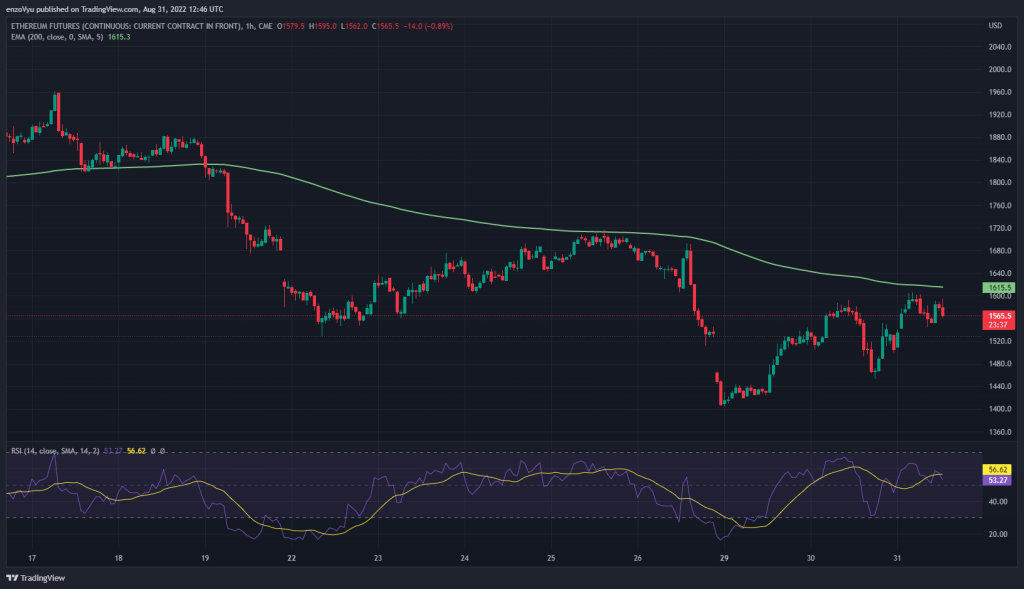
Ethereum (ETH) Price Analysis 08/13

Ethereum price is presently rising. As a consequence, it rose from $1,900 to $2,000.00 resistance a few minutes before to the publication of this sentence. The surge began on Wednesday, when the biggest altcoin increased by 8%.

Ethereum completed the trading session at $1,885, up from its starting price of $1,700. Since then, the asset’s price has continued to rise modestly, leading to the present achievement.

The most recent liquidation surpassed that of the previous day, as a greater number of short positions were REKT. The entire amount of liquidated money is $150 million, with bears capturing the majority of rekt capital.

As at the time of writing, all indications are obvious. For instance, the difference between the 12-day EMA and the 26-day EMA is growing. This is conclusive evidence that trade volume favors the bulls.

Additionally, we found a steady increase in the Moving Average Convergence Divergence histogram. The pivot point standard is an additional bullish indicator. Last month, Ethereum’s price soared over its pivot point.

In contrast, this is the first time the currency has taken extra stages. Currently, the asset under examination is trading above its initial pivot resistance; nevertheless, it has not yet acquired stability above it, since minor corrections threaten to cause a decline.

The peak reached by the second-largest cryptocurrency by market cap is a strong evidence of this. It topped out at $2,021. Nevertheless, based on the previously mentioned signs, we may be certain that the bulls are gaining ground in this conflict.

On other news, Celsius also had some good fortune, as its share price increased by more than 6% in the previous day. Consequently, it temporarily surpassed $4. The token is added to the list of assets experiencing significant price spikes. As of the time of writing, it is the leading gainer during the last twenty-four hours.

Categories
Blockchain

Alleged Developer of Tornado Cash Arrested in Netherlands

Netherlands crime agency FIOD stated today that it has detained a “suspected developer” of Tornado Cash, the Ethereum-centric mixing service sanctioned last week by the U.S. Treasury.

“On August 10, the FIOD apprehended a male of 29 years old in Amsterdam. He is accused of hiding unlawful financial flows and promoting money laundering via the mixing of cryptocurrencies using the decentralized Ethereum mixing tool Tornado Cash, according to an agency statement.

“Today, the suspect is taken before the examining court,” FIOD said, adding that “additional arrests cannot be excluded out.”

The Financial Advanced Cyber Team (FACT), which is part of the agency, initiated a criminal investigation against Tornado Cash in June 2022, according to FIOD.

“FACT thinks that via Tornado Cash, large-scale illegal money flows, including (online) cryptocurrency thefts, have been concealed” (so-called crypto hacks and scams). This includes monies obtained through hacking by an organization alleged to have ties to North Korea, according to the statement.

Tornado Cash, which was released in 2019, is a privacy tool that aims to obscure the origin of Ethereum transactions by combining a large number of transactions and mixing them to prevent them from being traced on the public blockchain.

However, the anonymity provided by Tornado Cash has long attracted the attention of authorities, many of whom are worried that the application is being used for money laundering and other illegal activities.

When the U.S. Treasury Department put Tornado Cash and a number of addresses affiliated with the service on its list of Specially Designated Nationals on Monday, it essentially prohibited Americans from using the tool and doing business with the listed locations.

The Treasury defended the action by noting multiple instances in which Tornado Cash was used for money laundering by groups such as the Lazarus Group, a hacker group supported by the North Korean government.

Since then, the Tornado Cash website has been unreachable, and the project’s final tweet, in which it posted a list of organizations and projects that have complied with the restriction, was published on Tuesday.

Circle, GitHub, which pulled Tornado Cash’s source code from its platform, Alchemy, Infura, and the decentralized exchange dYdX, which started banning addresses related to the service, are among them.

Categories
Bitcoin

Interlay Releases Bitcoin Cross-Chain Bridge

Blockchain startup Interlay, headquartered in London, has released a Bitcoin-based cross-chain bridge using the Polkadot platform.
This bridge, which has been given the name interBTC (iBTC), enables the circulation of Bitcoin use between several blockchains. Users on different networks are able to effortlessly trade coins/tokens and NFTs with one another.

According to Interlay, the cryptocurrency InterBTC functions as a BTC-backed stablecoin and is protected through a decentralized network of overcollateralized vaults. InterBTC is said to be similar to MakerDAO’s DAI token.

iBTC vaults make use of assets that are “overcollateralized” in order to safeguard BTC reserves. The Bitcoin blockchain makes it possible to trade an equal amount of iBTC and BTC from these reserves. The collateral is set up to automatically reimburse the person who sent the Bitcoins as a safety measure.

When we talk about a stablecoin being over-collateralized, we mean that it will be backed by a number of crypto assets that have a combined value that is more than the entire value of the stablecoin that will be issued. The most prevalent illustration of this kind of stablecoin is DAI.

Alexei Zamyatin, co-founder and CEO of Interlay, provided some insight into the thinking that went into the effort by stating:

“Bitcoin is the driving force behind the adoption of cryptocurrencies on a worldwide scale, while Polkadot, Ethereum, and other cryptocurrencies are where technical innovation is taking place. InterBitcoin brings together the advantages of both worlds while maintaining the decentralized and trustless character of Bitcoin.

The revelation made by Interlay brings attention to the plan that Ethereum co-founder Vitalik Buterin and Polkadot creator Gavin Wood have to build a completely decentralized Bitcoin bridge using Polkadot. It has been decided that the first DeFi hubs to deploy iBTC will be Acala and Moonbeam.

This initiative will be funded by a liquidity package of $1 million that will be given by Interlay treasury and partner projects. Other major DeFi networks including Ethereum, Cosmos, Solana, and Avalanche are included in the iBTC integration plan as well.

Categories
Business

Huobi founder Leon Li wants to sell 60% of company stake

Leon Li, founder and CEO of the crypto exchange behemoth Huobi, is in discussions with investors to sell his controlling interest for $2 billion to $3 billion.

According to a Bloomberg News story, among the interested parties are Tron founder Justin Sun and FTX founder Sam Bankman-Fried (SBF).

Li owns close to sixty percent of Huobi Global’s shares. If Li is able to sell them for $3 billion, it would be the greatest market takeover since the market capitalization dropped below $1 trillion.

So yet, FTX representatives have refused to comment, and Sun has said that he has had no conversations with Li over the sale.

In 2013, Li created Huobi worldwide, which has since become one of the major cryptocurrency exchanges. It lost momentum, however, when it ceased operations in China in November 2021. The judgment was made after China declared cryptocurrency transactions unlawful. China was Huobi’s major market, therefore the decision affected it more than any other exchange.

The exchange has grown internationally to nations like Turkey and Brazil and is now contemplating further development via the acquisition of a FinCen license. However, it seems that titans like Binance and FTX are Huobi’s competitors in these areas.

Li’s plan to sell his shares was disclosed in July 2022, but it was never verified. At the time, Huobi was also projected to reduce its workforce by 30%, or around 300 employees. The exchange said that the unfavorable market circumstances presented a financial challenge and that the business will implement cost-cutting measures, including layoffs.

Since the start of the weak market, FTX has been positive on Mergers & Acquisitions. Brett Harrison, president of FTX in the United States, said at the end of May that FTX aimed to expand globally by purchasing firms with the appropriate regional licenses.

On the other hand, SBF was certain that a large number of cryptocurrency exchanges and mining firms would collapse in the present winter market. SBF said that he viewed this as a chance to buy struggling businesses.

Following his statements, FTX contacted Bithumb, BlockFi, and Voyager Digital about acquiring their respective businesses.

Categories
Blockchain

Ethereum Merge Could Happen A Little Sooner Than Expected

The developers seem to have a definitive answer to the question of when Ethereum Merge will occur. Although it was previously said that the date may be the 19th of September, it was unknown and subject to change. And there was the possibility of a further delay.

Earlier on Wednesday, Ethereum completed the Goerli testnet Merge update. The improvement brings the transition to the proof of stake mechanism one step closer. The new technique might, among other benefits, improve network efficiency and scalability.

The developers seem to have hinted at a more precise schedule for the Merge on Thursday. The Ethereum Foundation has indicated that the network upgrade might occur a few days sooner than expected if everything goes according to plan. Using the terminal total difficulty (TTD) of 5875000000000000000000, a date between September 15 and 16 may be determined.

By switching Ethereum from proof of work to proof of stake, the event became highly anticipated in the cryptocurrency world. Before the developers’ conference call earlier in the day, a revised main net upgrade date was widely anticipated.

“The Ethereum main net merge is provisionally set for TTD 5875000000000000000, which indicates that Ethereum may be merged on September 15 or 16. The earlier anticipated date was September 19.”

In the meanwhile, the Ethereum (ETH) price seems poised to surpass $2,000 as the community anticipates the next update. On Thursday, ETH peaked at $1,920, sparking prospects for a further increase.

According to CoinMarketCap, the cryptocurrency is now trading at $1,904.43, up roughly 4% in the previous 24 hours. In the last week, the ETH price increased 19.67% as crypto investors went positive in anticipation of the main net upgrade.

During the conference call, the developers announced that the first Bellatrix update will be finished around September 6. The second update is slated for the 15th of September, following which the Merge will occur.

Categories
Blockchain

The Number of dApps On Polygon Reaches 37,000

It was revealed yesterday that the number of decentralized apps (dApps) running on the Polygon network has surpassed 37,000, representing a phenomenal rise of 400% from the beginning of the year to the present. This measure indicates the number of decentralized applications (dApps) that have been deployed, as well as the number that are in the process of being launched, on both testnet and mainnet.

To be more specific, the number of active teams, which is a key scale for blockchain developers, reached 11,800 at the end of July. This represents a significant growth of 47.5% when compared to the number of active teams in March. The remaining 26% of the project is deployed on both Polygon and Ethereum, while the remaining 74% of the product integrates solely on Polygon.

Polygon’s Proof-of-Stake (PoS) blockchain is compatible with EVM and is home to a huge variety of well-known cryptocurrency projects and businesses. These include NFT Marketplace OpenSea, Metaverse Decentraland, The Sandbox, the platform for DeFi Aave loan, and Animoca Brands venture capital fund.

According to the blog post, the deployment of decentralized applications (dApps) on Polygon has resulted in more than “142 million unique user addresses and $5 billion in assets safeguarded.” So far, around 1.6 billion transactions have been conducted on the network.

Ryan Wyatt, the CEO of the company, expressed his happiness straight away:

At the beginning of this year, the Polygon team pointed to their partnership with Alchemy as the primary reason behind the increasing number of decentralized applications (dApps) being developed on the network. Specifically, they mentioned how the infrastructure of the Web3 platform makes it “much simpler” for Polygon developers to build dApps.

According to the report, “Polygon’s cooperation with Alchemy in June 2021 proven to be an adoption stimulant,” which caused the number of decentralized applications (dApps) operating on the network to increase from 3,000 in October to 7,000 in January and then to over 19,000 in April.

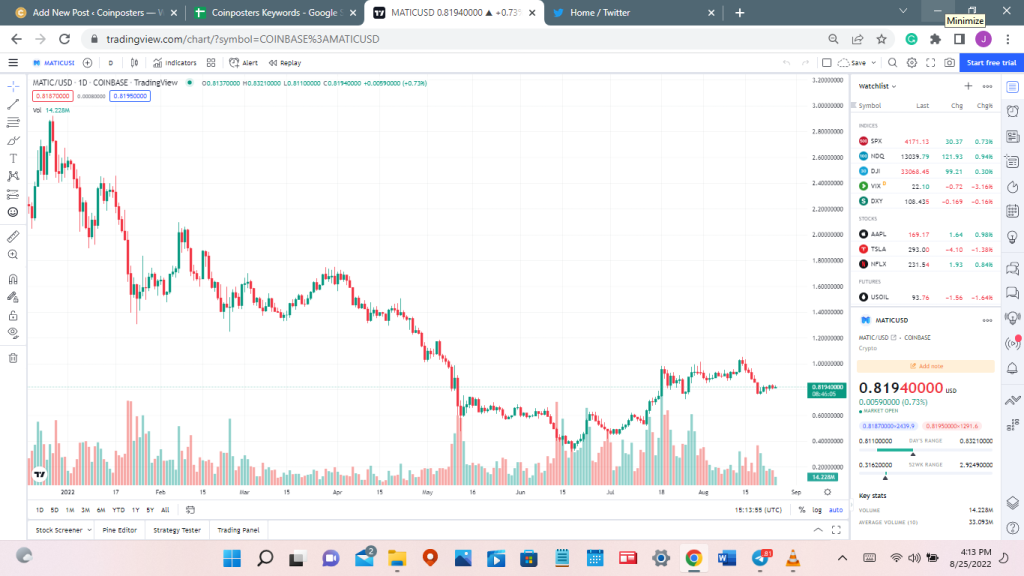
At the time of this writing, the current price of Polygon’s MATIC on the market is $0.9327.

Categories
Bitcoin

BlackRock Debuts Bitcoin Private Trust

After establishing cooperation with Coinbase, Blackrock has developed a spot Bitcoin private trust. This revelation from the world’s biggest fund manager might be promising for the crypto sector. BlackRock is dedicated to giving customers their choice of investing choices, it said Thursday.

The trust is available to U.S. institutional customers and tracks bitcoin performance minus expenditures and liabilities. Blackrock’s agreement with Coinbase will provide Aladdin customers access to the digital assets trading lifecycle. The asset manager witnessed considerable interest in cryptocurrency from certain institutional customers despite a market slump.

Despite the dramatic slump in the digital asset market, institutional customers are nonetheless interested in how to efficiently and cost-effectively access these assets utilizing our technology and products.

In a statement, Blackrock called Bitcoin the oldest, biggest, and most liquid cryptoasset. Bitcoin (BTC) is our customers’ principal interest in cryptoassets, it said. “Excluding stablecoins, bitcoin has close to 50% of the industry’s market value.”

After the Coinbase transaction earlier this month, analysts anticipated favorable crypto regulatory news. Long term, Blackrock’s formal entrance to the bitcoin market would be positive, they argued.

Blackrock said initiatives like evaluating the effect of market-based renewable energy purchases are promising. Research is planned to investigate whether renewable-powered Bitcoin mining and hosting businesses are sustainable.

Energy Web and RMI are non-profit organizations seeking to accelerate the energy transition and offer a certification program. These programs provide more transparency to sustainable energy use in bitcoin mining and will track progress, Blackrock said.

The business stated it was working in four areas of digital assets: permission blockchains, stablecoins, crypto assets, and tokenization. The Blackrock Bitcoin private trust will encourage major organizations to invest in cryptocurrencies. The introduction of the trust might also assist legislators to grasp blockchain’s application cases.

Meanwhile, crypto researchers predict Blackrock Bitcoin involvement might boost BTC price to $773,000. The alliance may enhance Bitcoin’s market value by a trillion dollars, claimed InvestAnswers. Also, BTC’s price and social sentiment jumped after the Blackrock Bitcoin private trust debut.

Categories
News

Mark Cuban sued for promoting crypto products

Mark Cuban, a wealthy entrepreneur who has been extremely engaged in the crypto world over the last year, is facing a class-action lawsuit for his promotion of the defunct cryptocurrency brokerage business Voyager Digital.

The Moskowitz Law Firm filed a civil claim against Cuban in the United States District Court for the Southern District of Florida for advertising unlicensed crypto items from Voyager. The complaint sought that the matter is heard by a jury.

The complaint said that Cuban repeatedly misrepresented the company, including questionable claims that it was cheaper than rivals and offered “commission-free” trading services. The complaint says that Cuban and Voyager Digital CEO Stephen Ehrlich used their years of expertise to convince naïve consumers to spend their life savings in a Ponzi scheme.

A portion of the complaint reads:

“Cuban and Ehrlich went to great efforts to leverage their knowledge as investors to defraud millions of Americans into investing — in many instances, their life savings — in the Deceptive Voyager Platform and acquiring unregistered Voyager Earn Program Accounts (‘EPAs’).”

Despite knowing this, Cuban allegedly continued to promote Voyager’s goods and encourage individual investors to participate in the company. Mark Cuban described the Voyager platform as “about as risk-free as you’re going to get in crypto.” The complaint stated:

“Voyager Platform depended on Cuban’s and the Dallas Mavericks’ verbal backing and Cuban’s financial involvement until its downfall and eventual bankruptcy.”

Voyager was one of the several crypto lenders to Three Arrows Capital (3AC) that failed after the latter’s collapse. The cryptocurrency lending company ceased trading and withdrawals on July 1 and then filed for chapter 11 bankruptcy on July 5. Currently, approximately $5 billion in bitcoin assets belonging to over 3.5 million American consumers are locked on the site.

The court hearing over Voyager’s bankruptcy proceedings in New York has authorized the release of $270 million in client cash held at Metropolitan Commercial Bank (MCB).

The next day, the lending company stated that customers holding U.S. dollars in their accounts may withdraw up to $100,000 in a 24-hour period beginning on August 11, with the monies arriving between 5–10 working days.

Categories
News

Ripple To Buy Celsius Network’s Assets

The business behind the cryptocurrency XRP, Ripple Labs, is a possible acquirer of Celsius network’s assets. According to a report by Reuters, the blockchain payments startup is interested in Celsius’ assets, although its precise intentions are unclear.

However, neither company has issued a formal statement on their interest in purchasing Ripple Celsius assets as of yet. The Celsius network filed for bankruptcy last month. This followed the June suspension of withdrawals and transfers from user accounts.

A spokeswoman for Ripple was reported in the newspaper as stating the business is interested in possibly buying the crypto lender’s assets. According to the article, Ripple is investigating whether Celsius’ assets align with its objectives. Nevertheless, the Ripple spokesperson declined to comment on whether Ripple is really interested in purchasing Celsius.

“We are interested in learning more about Celsius and its assets to see whether any are applicable to our company. Ripple has maintained its exponential growth and is aggressively seeking M&A options to strategically develop the business.

While announcing its reorganization plans, Celsius said that its assets were worth around $4.3 billion. It revealed liabilities of $5.5 billion and assets of $4.3 billion, including $600 million in CEL tokens worth $170 million.

Ripple’s potential acquisition of Celsius’s assets might provide regular investors with financial relief. Celsius has previously said that it was exploring selling assets to address its financial needs.

To satisfy financial commitments, the firm will also examine asset sales and third-party investment alternatives, according to the statement. It was stated at the time that the overarching purpose is to maximize profits for stakeholders.

In the meanwhile, the U.S. Department of Financial Protection and Innovation has lately begun to monitor the cryptocurrency lender. The agency said in an order that Celsius CEO Alex Mashinsky “committed substantial misrepresentations and omissions in the offering of crypto interest accounts.” The underestimation of the hazards of depositing digital assets with Celsius was especially egregious, according to the report.

“Celsius provided accounts that let clients to collect income on digital assets placed with Celsius without first classifying such accounts as securities in accordance with California law.”

Categories
News

CryptoCom CEO says crypto will make a strong comeback

According to Kris Marszalek, CEO of the prominent cryptocurrency exchange CryptoCom, the crypto sector will make a significant comeback once it rebounds from the present bear market. This past Wednesday, he spoke with CNBC to discuss his optimism for the market’s eventual rebound.

The value of crypto assets has fallen by more than 60% from its high in November 2021, causing severe turbulence in the crypto sector.

Marszalek predicted that, despite the current downturn, the sector will recover in the long run due to the technology’s inherent value and potential to improve society. However, he also noted that nobody can predict when or how the market would rebound.

The CryptoCom CEO continued by saying that the crypto industry is not immune to macroeconomic factors, thus things like inflation, Fed policies, supply chains, and global war will all impact the time frame for recovery.

We are certain that the bitcoin market will recover strongly after the crypto markets have reached their bottom. We’re still in a fantastic situation,” he said.

During the course of the conversation, Marszalek also spoke at length about CryptoCom’s recent growth plans. He said that the exchange is a strong purchaser, and that entering new markets is a crucial aspect of the company’s long-term plan.

The CEO said that the business is working closely with authorities to ensure that CryptoCom is appropriately governed in all key jurisdictions throughout the crypto industry.

The Dubai Virtual Assets Regulatory Authority (VARA) granted the cryptocurrency exchange conditional approval of its Virtual Asset MVP License two months ago, allowing it to provide a complete range of crypto services in the Emirate.

The Italian government’s Organismo Agenti e Mediatori (OAM) granted the firm registration and regulatory permission in July. The same month that Cyprus, Greece, and Singapore gave its stamp of approval, the firm also got the green light in the United States.

Recently, CryptoCom made several strategic purchases that allowed it to enter the South Korean market. When asked about “extremely significant” and “active” cryptocurrency markets, Marszalek mentioned South Korea.

Categories
Blockchain

Iran Pays For Import Orders Using Crypto

Despite being subject to a number of decades’ worth of economic constraints, Iran has reportedly placed its first foreign import order in crypto worth a total of $10 million, according to a senior government trade official.

The Islamic Republic of Iran has successfully placed its first import order using cryptocurrency, according to Alireza Peyman-Pak, the deputy minister of industry, mines, and commerce in Iran, who made the announcement on Tuesday.

Although Iran did not disclose the crypto used or the imported products, Peyman-Pak said that the $10 million transaction was the first of many foreign deals to be handled using cryptocurrency and that the practice will be expanded over the next month. He said that:

By the end of September, the usage of cryptocurrencies and smart contracts will have reached a widespread level in international commerce with the nations that are the focus of this study.

Up until February of this year, Iran was the country that was subject to the most restrictive sanctions. Trading Economics cites China, the United Arab Emirates (UAE), India, and Turkey as the top four countries from which Iran purchases the bulk of its commodities for import.

On the other hand, as a direct consequence of Russia’s invasion of Ukraine earlier this year, the country currently holds the record for the most sanctions of any nation in the world.

The mostly Muslim nation is prepared to start accepting cryptocurrencies as early as 2017. It changed laws that had previously been issued to make it possible to utilize cryptocurrency for financing imports beginning in October of 2020.

The Trade Ministry of Iran issued thirty operational licenses to Iranian miners in June 2021, allowing them to mine cryptocurrencies, the proceeds of which are required to be sold to Iran’s central bank. Iran is now making payments toward its import bills using currencies that it has created.

In February, Iran was also exploring implementing a central bank digital currency (CBDC) based on the Hyperledger Fabric protocol as a means to modernize its existing method of handling its monetary affairs.

Categories
Bitcoin

Bitcoin (BTC) Market Update As Inflation Rate Remains Unchanged

The price of Bitcoin increased after the U.S. Bureau of Labor Statistics (BLS) released Consumer Price Index (CPI) inflation statistics for July that showed no change.

Bitcoin surged from a local low of $22,600 on August 10 in anticipation of the news, as investors awaited the inflation report. BTC’s immediate response to the announcement of the information was a surge to $24,000.

The day before, crypto markets and stocks had a modest decline as investors displayed caution ahead of the BLS report — despite the fact that CPI forecasts of 8.7 percent were lower than the previous month’s estimate of 9.0 percent.

Following the most recent FOMC meeting on July 27, Fed officials announced a second straight 75 basis point increase, offering a range of 2.25 percent to 2.5 percent.

The next meeting of the Federal Open Market Committee (FOMC) will be held on September 20 and 21, with anticipation rising that the Fed will be compelled to implement another major rate rise to counteract the red-hot labor market and the increase in Average Hourly Wages.

There are two official measurements of inflation in the United States:

CPI inflation – measures the monthly change in prices paid by consumers in the United States. The CPI is calculated by the Bureau of Labor Statistics (BLS) as a weighted average of prices for a basket of goods and services that is reflective of total U.S. consumer expenditure.
The Personal Consumption Expenditures Price Index (PCEPI) tracks changes in the prices of household products and services. Inflation is indicated by an increase in this indicator, whereas deflation is shown by a drop.
The CPI is used by federal and state governments and enterprises. The PCEPI, in contrast, informs the FOMC of its inflation strategy.

Analysts anticipate that core inflation will grow from 5.9 percent to 6.1 percent in September, putting pressure on the Fed to implement a major rate hike. The CPI data indicates, however, that recent rate rises are acting to slow the economy.

In spite of this, Citigroup analysts anticipate a 75-basis-point rate rise in the near future due to good job data and faster-than-expected wage growth. Nonetheless, a 100 basis point hike is still possible if core inflation is stronger than anticipated.

Categories
Altcoins Blockchain News Regulation

China Takes Down Crypto-Promoting Social Media Accounts

For promoting crypto this year, China has suspended more than 12,000 accounts on some social media sites, including Weibo and Baidu. The platforms also removed some 51,000 discussions about buying bitcoin, the Cyberspace Administration of China (CAC) reported on Tuesday.

According to CAC, it has carried out CPC Central Committee directives to remove illegal content, accounts, and websites that encourage cryptocurrency investment since the year’s beginning.

In accordance with the law, the regulator also deactivated 105 website platforms that promoted the selling of crypto assets and provided online instruction on international crypto mining and speculating. The authorities also shut down 990 Weibo accounts, Tieba accounts, and public WeChat accounts that included Bitcoin.

The Cyberspace Administration of China announced that it would “strengthen the crackdown on unlawful financial operations related to virtual currency in the next step” and “guard the property safety of the people in accordance with the law” in a statement to CAC.

According to CAC, it has requested the local network information department to conduct interviews with more than 500 companies that promote cryptocurrency investing on their websites.

China Strikes Against Crypto
Despite being one of the first nations to adopt the asset class, China has kept up its antagonism for crypto in recent years.

Despite being illegal in the nation since 2019, cryptocurrency trading has continued through overseas exchanges. However, China’s crackdown on cryptocurrencies was largely carried out in 2018.

China outright banned crypto trading and mining activities in September, declaring them illegal and too risky for investors in the nation. This came after the country promised to focus more on the crypto ban and warned investors that they would not be protected if they continued to invest in such assets.

Categories
Ethereum

Circle Says It Will Fully and Solely Support Ethereum PoS

After the two chains have merged, the issuer of USD Coin (USDC), Circle, has announced that it would provide full support for the Ethereum (ETH) proof-of-stake (PoS) chain.

The issuer of the stablecoin, Circle, expressed excitement about “the future scaling potential (the Ethereum Merge) unlocks as well as the lower energy consumption profile of the network,” as stated in a blog post that was published on August 9th.

Although we do not comment on the likelihood of forks occurring after the Mainnet merging of Ethereum, USDC as an Ethereum asset can only exist as a single legitimate “version,” and as was said before, our only intention is to fully support the upgraded Ethereum PoS chain.

In addition, the issuer made it clear that it would not have any issues with the Merge, and that USDC will operate well on a PoS network.

The testing environment that Circle uses is linked to the Goerli Ethereum testnet, and we will be keeping a close eye on the process as it merges with Prater over the next several days.

This implies that the two stablecoins with the most market share in the cryptocurrency industry, USDT and USDC, will not support any hypothetical hard forks of Ethereum.

Not only is Circle’s USDC the most widely traded fiat-backed stablecoin on Ethereum, but it is also the most widely traded ERC-20 asset in the ecosystem as a whole.

In the meanwhile, cryptocurrency exchanges such as Huobi, OKX, Poloniex, and BitMEX, amongst others, have disclosed that they would back ETH hard forks if there was sufficient demand in the market.

Categories
Blockchain News

Polygon and Neowiz launch a web3 gaming platform

Polygon, an Ethereum layer-2 scaling solution, announced cooperation with South Korean game giant Neowiz on Tuesday to establish a new blockchain-based gaming platform called Intella X.

Intella X, like many other blockchain-based game platforms, is intended to generate revenue for its players, developers, and other contributors who support its development. When customers stake or provide liquidity on the decentralized exchange (DEX) offered by the firm, they get these earnings.

On Intella X, players will be able to earn in-game incentives that may be exchanged for the platform’s governance token, the IX token.

In the release, Polygon and Neowiz also said that developers would be able to take advantage of Intella X’s “Develop and Earn” program, which enables game makers to gain prizes depending on their contribution to the system.

“Projects that create and release on Intella X will be reimbursed with IX Tokens and a portion of the platform’s income, which includes in-app purchases, applicable fees, and more. This method is called “Develop and Earn.” [. . .] This enables developers to concentrate on what they do best without having to worry about other aspects in order to receive their portion of the monthly allocated benefits, according to the study.

Intella X is anticipated to arrive with a blockchain wallet named IX Wallet, according to Polygon. The wallet will be intended to incorporate access to various services like as bridges, non-fungible token (NFT) launchpads, NFT markets, decentralized exchanges (DEXs), etc.

Although no launch date for Intella X has been revealed, Polygon has said that the game platform will spread to additional blockchain networks in addition to Polygon’s mainnet.

In response to the fast expansion of leading platforms in the gaming finance (GameFi) sector, such as Axie Infinity, an increasing number of businesses have joined the bandwagon.

The developer behind the famous memecoin Shiba Inu disclosed last week that it is developing a test for its Shiba Eternity blockchain game, after anticipating its development in late 2021.

According to a previous report, the Singapore-based blockchain business Zilliqa collaborated with the blockchain gaming platform Alien World to increase the popularity of blockchain games.

Categories
Altcoins Ethereum

Ethereum Whales Continue To Accumulate SHIB

The global cryptocurrency market has declined by more than 3.30 percent in the previous twenty-four hours. However, the most popular meme tokens also suffered. The largest Ethereum (ETH) whales are taking advantage of the chance to “buy the dip.”

According to Whalestats, the ETH whale ‘BlueWhale0113’ purchased about 321 billion, 288 billion Shiba Inu (SHIB) in a single transaction. This sale cost the whale around $3.72 million.

As we go further, we find that the whale wallet is still holding $2.49 million worth of SHIB coins. It constitutes around 7.45% of its overall holdings. Meanwhile, Polygon (MATIC) is the largest token in the whale’s possession. It constitutes around 11.49 percent of the overall holdings.

The price of Shina Inu has decreased by more than 4 percent during the last 24 hours. Currently, SHIB is selling at an average price of $0.000012 per share. With a market valuation of almost $6.6 billion, it is still the second biggest meme token.

According to WhaleStats, the top 500 ETH whales have more than $652 million worth of Shiba Inu tokens. However, the largest token owned by the top 100 Ethereum whales is SHIB. They are holding Shiba Inu valued over $510 million.

Coin98 Insight revealed that the total 24 hour trading volume of meme tokens surpassed $1.2 billion. Shiba Inu recorded around $872 million in training volume. The 24-hour trading volume of SHIB increased by more than 40 percent, says Coinmarketcap.

However, the largest meme token, Dogecoin (DOGE), had the highest 24-hour trading volume, at $394 million. Over the last 24 hours, DOGE’s price has decreased by more than 4.30 percent. At the time of writing, the average price of Dogecoin is $0.0686.

In the meanwhile, the total market capitalization of meme tokens has decreased by around 5% during the previous 24 hours. It is now worth $16,18 billion. The 24-hour trade volume has increased by a staggering 60 percent.

Categories
Altcoins News

Robinhood Adds Support For AVAX and XLM

On Monday, Robinhood, a cryptocurrency exchange, announced the listing of Avalanche (AVAX) and Stellar (XLM). The exchange recently added popular cryptocurrencies such as Shiba Inu (SHIB) and Chainlink (LINK) (LINK).

Since the announcement, the price of Avalanche has increased by around 12 percent. At press time, AVAX is selling at an average price of $30.0. Its 24-hour trading volume has increased by more than 35 percent to $1.007 billion. It has a market capitalization of nearly $8.6 billion.

AVAX has emerged as one of the most inflated tokens within the last week. Its price has increased by almost 30 percent.

Stellar’s price has increased by more than 7 percent since the announcement. Nevertheless, XLM’s 24-hour trading volume has increased by more than 40 percent to $199.6 million. Stellar is now selling at an average price of $0.132. XLM has a market capitalization of almost $3.34 billion.

However, this news has allowed the XLM coin to become one of the tokens with the greatest 24-hour increase. Moreover, its price has increased by around 15% during the last week.

The cryptocurrency exchange is renowned for its conventional listing approach. Back in July, Robinhood implemented LINK support. Prior to that, popular meme tokens Shiba Inu, Solana, and Polygon were mentioned. Currently, Robinhood allows exchange for 15 crypto coins.

Previously, Robinhood enabled customers to trade options in cash accounts. However, it was specified that only certain consumers are qualified. It was recognized as one of the most desired features on the blog. This will enhance the trading experience for users.

It was introduced that customers may trade with these accounts using deposited cash or settled monies. Meanwhile, it offered options trading in cash accounts as a regular industry service.

In the last six months, Robinhood has also implemented Brokerage Cash Sweep, Stock lending, and several more products.

Categories
NFT People

Vitalik Buterin Concept of Privacy-Oriented NFTs

Vitalik Buterin, the creator of the Ethereum network, has divulged information on the use of stealth addresses in the trade of non-fungible tokens (NFTs). This means that a user may transmit an ERC-721 token (NFT) to a receiver without anybody else knowing the token’s recipient.

Buterin said that this new concept would “substantially increase the privacy of the NFT ecosystem.”

Vitalik Buterin elaborated on the idea on the Ethereum Research website, offering logical calculations on the theory and illustrating its utility, stating:

“[Y]ou just want to mask the connection between the sender and recipient’s extremely visible public identities (so that you may send an ERC721 to “vitalik.eth” and I can see it, but no one else can know that vitalik.eth got an ERC721; they will only see that someone received an ERC721).”

In the meanwhile, Buterin is not the first to propose a stealth address for NFTs. A member on the Ethereum Research website with the pseudonym Nerolation presented the concept four days ago. He described the procedures of token transfer, minting, and destruction.

Nerolation also provided a short explanation of how the stealth address for NFTs would be generated, adding that the notion is comparable to Buterin’s proposal for soulbound tokens.

While Nerolation believed that the Merkle tree corresponds to the theory, Buterin noted in his response that a developer is not required to utilize a Merkle tree or a cryptographic proof that allows a user to demonstrate ownership of a Zero-Knowledge Succinct Non-Interactive Argument of Knowledge asset (zk-SNARK). The reason for this was because NFTs are non-interchangeable.

Following Vitalik Buterin’s tweet, a number of people started to oppose the concept, pointing out that if the theory is applied, blockchain-based transactions would no longer be transparent and open source. Others feared that the new approach would result in an increase in NFT theft reports.

Even though NFTs are currently traded on popular crypto exchanges such as Binance, Coinbase, and Kraken, the adoption of the new proposal by many top NFT companies such as Yuga labs could lead to the same fate as private cryptocurrencies Monero and ZCash, which have been delisted from many exchanges.

Categories
Ethereum

Justin Sun Says He Support ETH Survival After Merge

Controversies about what will happen to the traditional Ethereum network after the merger are becoming more prominent as the anticipated date for Ethereum’s transition to a Proof-of-Stake (PoS) network–otherwise known as The Merge–draws near. Justin Sun, the inventor of Tron, has chimed in on the discussion and is in favor of keeping the Ethereum network’s PoW architecture.

Justin Sun claimed that Ethereum’s PoW has a special utility in a Monday update. If Ethereum ever switched from PoW to PoS, this value would be permanently destroyed. Added him:

In fact, as the exclusive blockchain for POW smart contracts, we could have undervalued Ethereum. In certain ways, he believes that the Ether community may undervalue POW’s contribution to Ethereum’s role as the main consensus mechanism.

Justin Sun attempted to use moral considerations while acknowledging that he may benefit from the hard fork as a “whale” by getting bitcoin on the new network. He came to the conclusion that he did not see anything wrong with keeping the PoW chain for the Ethereum community.

It is not unexpected that Justin Sun is in favor of keeping Ethereum’s heritage network alive. Synthetic coins for the Ethereum PoW and PoS systems were posted this past weekend on the Sun-owned Poloniex market.

In the days and weeks before the merger, the tokens would enable investors to bet on the price of ETH, with Poloniex ostensibly profiting from trade volume and fees. At the time of writing, the price of the ETHW token, which supports the upkeep of the original Ethereum network, was 0.08 ETH ($120).

The Ethereum “Merge” is now one of the main factors pushing ETH prices and is anticipated to occur sometime in mid-September. For the Ethereum community, a successful merger would include the PoW network going gone or at least being intangible in order to devalue the new PoS network.

Categories
Altcoins Price Analysis

Cardano (ADA) Market Update 08/07

The Cardano (ADA) market has been remarkable recently, with network activity hitting new heights and optimistic emotions remaining strong. A recent accumulation tendency seen among ADA addresses positions the asset for a major ascent, should it survive the next days.

A new Santiment chart reveals a frenzy of ongoing accumulation by ADA’s shark and whale addresses, which have 10,000 and 10,000,000 ADA tokens, respectively. In only eight days, these two address groups had accrued $138M worth of ADA.

The accumulation level remains very modest in comparison to previous occurrences. Nonetheless, having added 0.46 percent of ADA’s existing supply since July 27th, the accumulation looks to be gathering traction, and if continued throughout August, it might pave the way for a major ADA breakout.

This accumulating pattern is the first seen by the Cardano community since the major dump in mid-June, when ADA along with other markets lost a large chunk of their value between June 10 and June 18. During this time, the Crypto Winter’s impact was felt the strongest, and like other assets, ADA is gradually regaining its losses.

As ADA confronts a period of consolidation around the $0.50 zone in the wake of July’s relief rally, a fresh wave of bullish enthusiasm might be the impetus for the asset’s breakthrough from this level. The presence of whales might influence and expedite this process.

Considering that ADA has been confined to the $0.50 level for some time, this level implies that the asset is progressively improving, as psychological support looks to be anchored in the half-dollar region. ADA seems to have surpassed the $0.45 support level and is now expecting a push to surpass the $0.50 level.

ADA comfortably trades at $0.52 at press time, having increased around 1.55 percent of its value over the last 24 hours. ADA’s current market cap has seen better days, but at $17.5B, the valuation appears better than it did in mid-June when ADA was battling to crack the $0.40 threshold when it was valued at $13.8B.

Categories
Altcoins Bitcoin Blockchain News People

Billy Markus Mocks Bitcoin’s Performance

Billy Markus, the creator of Dogecoin, responded to an article that discussed several metrics for measuring development by bringing up Bitcoin’s controversial price movement and questioning whether or not it qualified as progress. This was in response to an article that discussed several metrics for measuring development. In a subsequent statement, he admitted that it is.

The first cryptocurrency, Bitcoin, has lost a substantial chunk of its value on the cryptocurrency market after it broke through the psychological obstacle of $50,000. This has caused panic among long-term and medium-term investors who were expected to earn big profits.

It is obvious that the creator of the most successful memecoin now available on the market was making a satirical inquiry regarding the development of Bitcoin given Billy Markus overall support for cryptocurrencies on Twitter. Later on, he elaborated by saying that progress is already being made if the number is greater than zero.

Because DOGE is currently consolidating near the 50-day moving average and has failed to break through any local resistance levels on the chart, investors are not likely to be pleased with the development of the first memecurrency. Unfortunately for them, DOGE has not been able to break through any of the local resistance levels.

Given how the price of Dogecoin has been behaving over the last several months, it is fortunate that a flag pattern is plainly obvious here. This pattern provides a clue at the imminent volatility increase that may be necessary for a rebound rally.

Since memecoins are the riskiest assets in the whole business, there is a possibility that they may see a reversal climb in the next months. This is because a better attitude within the industry is expected to lead to investors’ desire for riskier investments.

Categories
Blockchain News Regulation

Nepal prepares digital currency regulations

The Nepal Rastra Bank (NRB) is prepared with amendments to the statute governing its powers and duties that would let the monetary authority issue a digital currency of the Nepalese rupee, the country’s fiat currency. The announcement follows the conclusion of research indicating a central bank digital currency (CBDC) initiative is possible.

According to Revati Nepal, head of the bank’s Currency Management Department, an amendment bill has been developed by a task group. Sunday’s Kathmandu Post cited him as saying, “After internal deliberations, we’ll transmit the bill to the government for introduction in parliament.” Beginning in 2002, the Nepal Rastra Bank Act will be amended.

The research was revealed in the Monetary Policy 2021-22 document by the NRB. A committee led by Revati Nepal recommended that, prior to constructing the CBDC, the regulator should enact the legislative measures necessary for its implementation.

Now, the experts have offered tangible actions for moving forward, including the establishment of a legal framework for digital currency. The NRB representative said that there are proposals for technical and economic aspects to address.

The central bank aims to establish a separate digital wallet for the CBDC to facilitate digital banking transactions. Nepal explained, “Measures will also be made to investigate interoperability with digital payment service providers.”

Diverse forms of digital currency, including decentralized cryptocurrencies such as bitcoin, have been in circulation for years. However, most governments are still in the early phases of establishing digital currencies issued by the state.

According to a report conducted by the Bank for International Settlements in 2021, 86% of central banks were investigating the possibilities of CBDCs, 60% were experimenting with the technology, and 14% were establishing trial programs.

Nepal has a long way to go, but the NRB’s investigation has generated a concept paper that is being reviewed by the bank. “We will determine the next steps after the completion of current conversations,” Revati Nepal said.

The head of the central bank’s economic research department, Prakash Kumar Shrestha, stated that it would be beneficial for Nepal to adopt digital money using technologies obtained from other countries. He also emphasized the necessity to pay close attention to cybersecurity and other crucial issues.

Categories
Blockchain News People

Top Five (5) Crypto Billionaires In The World

The cryptocurrency industry has been expanding rapidly in recent years, and institutional investors are progressively entering the game. Additionally, crypto billionaires are increasingly emerging as the game-changing whales of this industry.

1. Changpeng Zhao “CZ”

The creator and CEO of Binance, “CZ,” is the wealthiest person in cryptocurrency and the nineteenth richest person in the world. Forbes reports that he controls at least 70 percent of Binance, the leading bitcoin trading platform worldwide. The company reportedly handled over two-thirds of all trade volume handled by centralized changes and generated over $16 billion in revenue in the prior year.

Forbes estimated CZ’s fortune to be $1.9 billion last year. The 44-year-old has some Bitcoin and an undetermined amount of Binance’s native cryptocurrency, BNB. Binance aims to make a substantial investment in the parent company that would control Forbes after the previously disclosed public listing agreement.

2. Sam Bankman-Fried

Late in 2021, the 30-year-old will shift his cryptocurrency exchange FTX from Hong Kong to the more crypto-friendly Bahamas. FTX received $400 million in January at a value of $32 billion. Among the startup’s backers are crypto VC firm Paradigm (headed by Coinbase founder Fred Ehrsam, another crypto billionaire), venture capital firm Sequoia, buyout firm Thoma Bravo, and the Ontario Teachers’ Pension Plan Board.

According to reports, investors valued FTX’s U.S. operations at $8 billion. Bankman-Fried, a self-described adherent of effective altruism — the utilitarian-tinged concept of doing the best one can — has vowed to donate his whole wealth throughout his lifetime. He holds more than 50 percent of FTX and more than $7 billion in the platform’s native coin, FTT.

3. Brian Armstrong

The CEO and creator of Coinbase took the cryptocurrency exchange public in April 2021 via an appealing $100 billion direct offering. Its current market value is around half of that, but Armstrong is still the third richest person in the Bitcoin industry with a 19 percent stake.

Armstrong, famed for his basic T-shirts and bald head, raised eyebrows in 2020 when he instructed his employees to refrain from discussing politics at work. In January, the 39-year-old spent $133 million for a house in Bel-Air, one of the most expensive real estate transactions in the city. Armstrong has recently spoken out against the proposed EU Parliament crypto bill.

4. Gary Wang

The press-averse Wang, co-founder and chief technical officer of FTX and Bankman-Fried launched the cryptocurrency exchange in 2019. Wang controls 16 percent of FTX’s global corporation and over $600 million in FTT, the native token of FTX. Wang was a software developer at Google before transitioning into crypto and helping to build the online booking website Google Flights. He studied mathematics and computer science at MIT.

5. Chris Larsen

Larsen, the co-founder and executive chairman of blockchain company Ripple, whose XRP token is currently the eighth largest cryptocurrency, has been busy fighting a Securities and Exchange Commission lawsuit, which was initially filed in December 2020, alleging that Ripple’s initial coin offering was an unlawful offer and sale of unregistered securities.

Many observers see the case, which is still pending in federal courts, as a turning point for future token sales. Both Larsen and Ripple deny wrongdoing. Larsen, 61, has worked with environmental groups to launch the “Change the Code, Not the Climate” campaign to push the Bitcoin community to reduce the digital asset’s huge carbon footprint.

Categories
Bitcoin News

Core Scientific upped BTC output by 10% in July

Despite having to shut down many times due to demand on the Texas power system, the cryptocurrency mining business Core Scientific announced that its operations generated 1,221 Bitcoin (BTC) in July.

According to a statement released by Core Scientific on Friday, its monthly output of Bitcoin climbed from 1,106 in June to 1,221 in July, or nearly 10.4%.

However, the company also boosted the number of its self-mining servers and hashrate by 6%, to 109,000 and 10.9 exahashes per second (EH/s), respectively. The company claimed limiting operations “due to severe temperatures at numerous data centers.”

In order to assist the Electric Reliability Council of Texas, or ERCOT, which manages the state’s power grid, Core Scientific claims that the business repeatedly shut down all activities at its Texas data centers in July. The company claimed to have reduced its energy use by 8,157-megawatt hours (MWh).

In July, temperatures in several areas of Texas reached above 100 degrees Fahrenheit for many days in a row, despite ERCOT’s warning that the demand for energy would exceed the supply.

Riot Blockchain reported a 24 percent decline in its BTC output from June to July, from 421 to 318. Riot Blockchain also runs mining operations in Texas. CEO Jason Les claims that the company reduced operations by 11,717 MWh.

According to Core Scientific CEO Mike Levitt, the company intends to add 75 megawatts to its data center hosting capacity, with the goal of achieving a hash rate of 30 EH/s by the end of 2022. After selling more than 7,000 BTC for $167 million in June and 1,975 BTC for $44 million in July, the corporation said as of July 31 that it retained 1,205 BTC worth about $28 million at the time of publishing.

On August 11, the mining company intends to disclose its profits report for the second quarter of 2022.

Categories
Altcoins News

Optimism Token’s TVL Exceeds That Of Polygon

Polygon (MATIC), the premier Ethereum (ETH) scaling ecosystem, has a TVL that is now lower than Optimism for the first time ever.

In the year 2022, there will be an increased prevalence of second-layer solutions that are based on the Ethereum network, with L2 majors Optimism and Arbitrum hosting a combined total of over 160 protocols.

Optimism, the biggest rollup-based second-layer scaling solution for the Ethereum network, has hit yet another key milestone in broad adoption. This milestone was attained earlier this week.

61 goods on the Optimism network amassed a total value locked of $2.38 billion, as reported by Defi Llama, a notable tracker of decentralized finance (DeFi) protocols. During this time, the Polygon network’s 282 protocols were awarded a total of $1.83 billion in funding. Both results include information on money that was borrowed.

With $5.88 billion and $2.29 billion locked, respectively, Tron (TRX) and Solana (SOL) continue to be the market leaders in the non-EVM sector. This sector is comprised of protocols that do not have easy interaction with Ethereum.

The two most important second-layer networks on Ethereum, Optimism and Arbitrum, both make use of a method called Optimistic Rollups in order to package Ethereum transactions and then broadcast them to the mainnet.

In August 2022, the Ethereum L2s ecosystem had finally recovered from the losses it had sustained as a result of the Terra (LUNA) disaster. The measures returned TVL to the levels it had been at before the collapse.

According to Defi Llama, there has been a staggering increase of 700 percent in the number of TVLs distributed by Optimism over the course of the previous week.

Moreover, CoinMarketCap data shows that the OP token’s value has increased by more than 80 percent in the last week, reaching a high of $2.22 early on Thursday morning.

Categories
News Regulation

European vs. U.S. Crypto Regulation

Patrick Hansen, a crypto venture adviser and European policy specialist, provided forecasts on the timeframe of two significant EU crypto measures. Between December 2022 and January 2023, Markets in Crypto-assets (MiCA) and Transfer of Funds Regulation (TFR) will become law, according to Hansen.

US authorities are alarmed by the rapid pace of EU legislation. Hansen demonstrates that the extent and speed of these rules are concerning to the United States and may prompt them to act more quickly.

The mission of the MiCA is to safeguard the clients and investors of crypto firms. It also establishes obligations for issuers if they lose users’ crypto assets.

MiCA supervises stablecoins and mandates its issuers to keep enough reserves and fulfill withdrawal liquidity standards. The TFR, on the other hand, establishes money-laundering rules and addresses money-laundering difficulties with cryptocurrency.

Hansen indicates that the European Union is working on other crypto projects with significant ramifications. These include further restrictions against money laundering, the DeFi report, the NFT report, the DeFi monitoring pilot, and the Digital Euro Legislation.

The United States is worried about the breadth and velocity of EU crypto regulatory discussions. Hansen explains that although the exact date has not yet been determined, the rules might be voted on as early as January of the next year. In addition, he states that at this stage, voting is really a formality since all rules have been agreed upon.

TFR, being a lesser rule, might take effect far sooner.

US legislators are also advocating for crypto regulation. In the United States, support for a regulatory crypto framework is bipartisan and bicameral. However, there is currently no timeframe for any significant action. Caroline D. Pham, commissioner of the Commodity Futures Trading Commission, said that the United States should seek to be rule creators rather than rule followers.

Categories
Blockchain News

Mahastra State Issues 100k Polygon Diplomas

The Indian Express reported on Thursday that the Maharashtra State Board of Skill Development (MSBSD), in partnership with the Maharashtra State Innovation Society (MSINS), had awarded about 100,000 verified certificates on the Polygon blockchain using the LegitDoc platform.

“The initiative seeks to digitize diplomas and transcripts provided by MSBSD to about 100,000 students yearly. Neil Martis, the co-founder of LegitDoc, said that this was accomplished by building tamper-proof digital diploma PDFs based on Polygon Blockchain.

MSBSD has never before issued online degrees; this is the first time it has done so. Martis said that the board opted to offer online diplomas using blockchain technology because it is more safe, private, transparent, and cost-effective than conventional centralized digital systems.

Martis stated that in the past, MSBSD only issued hard copy certificates to students, necessitating the hiring of more than 1,000 staff throughout its network of training institutions and departments to assist distribute the diplomas, a time-consuming process.

In addition, he said that the verification of the degrees was also a manual procedure that required three board employees to complete verification requests within one month.

“Therefore, this initiative was undertaken to automate the whole procedure by digitizing diploma issuing and verification using blockchain technology and removing all human interventions and inefficiencies,” he said.

According to Martis, Maharashtra has previously trialed this solution for former student credentials on the Ethereum blockchain; but, because of the “scalability and high gas cost associated with Ethereum,” they have chosen to issue it on the Polygon blockchain.

In the past, Maharashtra used blockchain technology for use cases like caste certifications and COVID certificates.

The board’s “previous experience in adopting blockchain use cases,” according to Mithun John, Joint CEO of MSINS, was a major factor in its decision to award these blockchain-based degrees.

In the meanwhile, the deployment of blockchain technology by several government entities has increased in recent years. Nigerian Trading (NGX) Ltd. said in June that it intends to build a blockchain-enabled exchange platform within the next year.

Categories
Blockchain Business News

India Freezes WazirX Assets As Part of Investigation

As part of an investigation into immediate personal loan fraud, India’s Directorate of Enforcement (ED) has revealed that it has frozen around $8.1 million and conducted a search related to the cryptocurrency exchange WazirX.

In a statement released on Friday, the Directorate of Enforcement stated that WazirX enabled transactions by unidentified fintech businesses “to acquire crypto assets and subsequently launder them overseas” as part of a plan involving Chinese-backed corporations evading India’s licensing laws.

In its investigation, the ED said that it had ordered the freezing of WazirX bank accounts totaling 646.7 million Indian rupees (about $8.1 million at the time of publishing) and performed a search related to co-founder Sameer Mhatre.

According to the regulatory agency, the inquiry continued. However, the ED asserted that the cryptocurrency exchange had “lax KYC rules” and “weak regulatory supervision” over transactions between WazirX and Binance, and did not record the information required to authenticate the origin of the money used to acquire cryptocurrency in the alleged scam.

“Despite multiple chances, WazirX did not disclose the crypto transactions of the suspicious fintech APP firms or the KYC of the wallets,” the ED noted, adding:

“WazirX cannot account for the lost cryptocurrency assets. It has not made any attempts to track down these digital assets. By fostering anonymity and having inadequate AML regulations, it has actively supported around 16 fintech businesses in laundering criminal money through the crypto method.”

Binance CEO Changpeng Zhao said on Twitter on Friday that the company “does not hold any ownership in Zanmai Labs, the organization that operates WazirX and was founded by the original founders.”

Binance exclusively offers wallet services to WazirX as a technical solution, while WazirX is responsible for KYC and other exchange activities.

WazirX director Nischal Shetty refuted several of CZ’s accusations on Twitter, stating that the cryptocurrency exchange “was bought by Binance Zanmai Labs” and “is an India business controlled by myself and my co-founders.” Binance is responsible for managing cryptocurrency trading pairs and processing withdrawals, according to him.

Categories
Blockchain News

Crypto ATMs To Make a Comeback in Japan After Several Years

After a break of four years, crypto ATMs, often known as BTMs in the industry, have reemerged in Japan. On Tuesday, the regional cryptocurrency exchange Gaia Co. Ltd. made the announcement that it will soon offer BTMs that support Bitcoin (BTC), Ethereum (ETH), Bitcoin Cash (BCH), and Litecoin (LTC).

Although the first automated teller machines (ATMs) for Bitcoin were installed in Tokyo in early 2014, the city has not had any ATMs for other digital assets running since the crypto winter of 2018. Coincheck, a domestic cryptocurrency exchange, was hacked, resulting in a loss of $530 million. This hacked exchange crippled the local economy and reduced interest in crypto ATMs.

The first batch of BTMs will be installed at various sites around Tokyo and Osaka; however, the business has announced ambitions to deploy a total of fifty BTMs across the country over the next twelve months. Within the next three years, the company’s goal is to grow the number of BTMs that are operational at installed sites to 130.

Users of BTM will have the ability to withdraw up to $747 or 100,000 yen in a single transaction, with a daily maximum withdrawal limit of $2,243 or 300,000 yen. Anti-Money Laundering (AML) compliance procedures include a limit on the amount of cash that may be withdrawn.

It was reported on Wednesday by a local media site called Mainichi Shimbun that the action by Gaia would be the first time a locally registered cryptocurrency firm has placed cryptocurrency ATMs in Japan.

Users are required to register with the firm in order to get a unique card that serves as their access pass to the BTM in order to make a withdrawal. After approval has been given, customers will be able to deposit cryptocurrency assets to BTM through their smartphones and subsequently withdraw the same amount of cash in yen.

According to Shimbun, BTM will contribute to the acceleration of the present domestic withdrawal procedure, which currently takes several days to complete and involves the transfer of cash from an exchange to a local bank account.

Categories
Blockchain News

Voyager gets $270 million customer refund approval

Voyager, a crypto brokerage, has been given permission by a New York bankruptcy court to repay $270 million to consumers.

The Wall Street Journal reported on Thursday that the bankruptcy judge overseeing Voyager, Michael Wiles, had approved the brokerage’s request to access client cash at New York’s Metropolitan Commercial Bank (MCB) due to an “adequate basis” for the court’s consent.

After suspending client withdrawals owing to the bear market and exposure to crypto hedge fund Three Arrows Capital 3AC, Voyager filed for Chapter 11 bankruptcy protection earlier this month in order to reorganize.

The bankruptcy petition reveals the business has $1.3 billion in crypto assets and over $350 million in cash in its For Benefit of Customers (FBO) account at MCB. When Voyager filed for bankruptcy, MCB stated the company only had roughly $270 million in the account.

The court has not yet determined how to divide up the $1.3 billion in crypto assets stored on its platform.

Voyager disclosed many offers for its assets, all of which are greater and better than AlamedaFTX’s offer, in a court document dated August 4.

Voyager has already rejected AlamedaFTX’s proposal, calling it a low-ball offer disguised as a white-knight rescue.

In response to AlamedaFTX’s public comments on the plan, the business said it had delivered a cease-and-desist letter.

The crypto broker claims it has reached out to 88 parties with interest, 46 have signed NDAs, and 22 are now involved in marketing efforts. A sale hearing is scheduled for September 27, and the last day to submit bids is August 26.

Over twenty parties who might be interested in working with Voyager have already been contacted by the company’s advisers. In the event that Voyager, in collaboration with the Committee, pursues a sale transaction, the Bidding Procedures Motion, if authorized by the court, will lay out a schedule for an auction and sale to a strategic third party.

The brokerage business anticipates the conclusion of its bankruptcy procedures to occur in the first quarter of 2023.

Categories
Bitcoin Price Analysis

Bitcoin (BTC) Market Update 08/05

On August 5, Bitcoin (BTC) market saw a new rejection at the $23,500 resistance level. This occurred as United States stocks were unable to embrace unexpectedly good payroll statistics.

As the market remained inside its intraday trading range, data from Cointelegraph Markets Pro and TradingView tracked BTC/USD. Bears maintained the market in this range.

Despite the fact that U.S. payrolls for the month of July came in at double the projected levels, Wall Street began with a whimper. The peculiar response led some observers to argue that the data did not really reflect that the economy was strong; rather, they indicated that current employees were taking on second jobs as a result of inflation.

“The addition of 528K jobs in July suggests that the majority of the new jobs went to those who already had work,” gold bug Peter Schiff commented. “Since the labor force participation rate decreased to 62.1, this means that most of the new jobs went to people who already had jobs.”

“As real earnings continue to fall, many people are forced to take on additional jobs in order to make ends meet. If the employment market were robust, a single position would be sufficient.
Schiff was not the only one to have concerns over the current situation of employment; Wealthion CEO Adam Taggart was one of the individuals who voiced their mistrust.

In the meanwhile, Kyle Bass, chief investment officer at Hayman Capital Management, remembered the Federal Reserve’s optimistic stance on employment in the years leading up to the Great Financial Crisis of 2008.

Bitcoin market has bounced back from a drop below $23,000 to retarget range highs as of the time this article is being written. Meanwhile, the S&P 500 and the Nasdaq Composite Index both started the day off with a little loss until a relief rally entered the picture.

Traders of Bitcoin, in the meanwhile, were considering the likelihood of a new leg down as the price continued to be rejected at $24,500 many times.

Categories
Blockchain News

Blackrock Partners With Coinbase To Offer Crypto Services

According to a blog post published on Thursday, the world’s biggest asset manager, BlackRock, has teamed with the prominent cryptocurrency exchange Coinbase to provide crypto services to institutional customers.

The collaboration announcement between Coinbase and BlackRock comes a few months after rumors that BlackRock would soon begin delivering cryptocurrency services to its customers.

As part of the cooperation, BlackRock’s Aladdin investment management platform will integrate Coinbase Prime, an institutional prime broker platform, to provide institutional customers with direct access to cryptocurrencies.

BlackRock institutional clients who are also Coinbase customers will have access to cryptocurrency trading, custody, prime brokerage, and reporting services. According to reports, BlackRock’s Alladin software controls an estimated $21 trillion in assets, a portion of which customers may elect not to allocate to the cryptocurrency market.

BlackRock’s Global Head of Strategic Ecosystem Partnerships, Joseph Chalom, commented on the situation by noting a surge in institutional interest in crypto assets. He said:

“Our institutional customers are increasingly interested in acquiring exposure to digital asset markets and are focused on managing the operational lifetime of these assets in an effective manner. This integration […] would enable customers to manage their bitcoin exposures directly inside their regular portfolio management and trading processes, providing a holistic picture of portfolio risk across asset classes.”

According to the blog post, BlackRock and Coinbase will continue to enhance the platform’s integration and bring out new features in stages.

A few years ago, BlackRock developed an interest in cryptocurrencies. In 2018, the asset management established a group to research cryptocurrencies and blockchain technology.

According to a filing with the United States Securities and Exchange Commission (SEC), the company began trading bitcoin CME futures contracts earlier in 2017. The investing business submitted an application to the SEC for a blockchain technology exchange-traded fund in January (ETF).

In the meanwhile, it’s not just BlackRock. Globally, other large financial institutions have maintained their interest in cryptocurrencies. Fidelity Investments, a provider of financial services, said in April that it will let customers to add a bitcoin account to their 401(k) later this year.

Categories
Blockchain Ethereum

Justin Sun’s Poloniex Plans for 2-Chain Ethereum

Poloniex said on August 4 that it will generate two unique coins to symbolize two distinct versions of the Ethereum chain that might arise after The Merge. This is the first exchange with this particular move.

The exchange will let users transfer ETH into ETHS and ETHW, two specialized tokens. ETHS represents the Ethereum chain using Proof-of-Stake, while ETHW represents the Ethereum chain using Proof-of-Work.

The exchange rate for ETHW/ETH and ETHS/ETH will be 1:1. In the future, the exchange will explore introducing other trading pairs. ETHS and ETHW will exist solely on Poloniex and will not be able to be deposited or withdrawn to other wallets.

Prior to The Merge, Poloniex will collect the balances of all accounts holding ETHS. If a chain split happens after this Ethereum update, the exchange will convert ETHS to ETH using PoS at a 1:1 ratio for all customers.

Poloniex will choose the Ethereum chain with the greatest Proof-of-Work hashrate as the primary blockchain to be converted to ETHW. Evidently, the exchange has also planned for the possibility that many Ethereum chains using PoW would emerge.

In contrast, if The Merge occurs without incident and no unit breaks the Ethereum chain to preserve Proof-of-Work, ETH will continue to be exchanged normally on the exchange, however, two ETHS and ETHW coins would be canceled.

Poloniex was formerly one of the top cryptocurrency exchanges. From 2017 to 2020, however, the standing of the exchange declined substantially as a result of the management team’s many errors. In 2019, TRON creator Justin Sun acquired it and included it in the TRON ecosystem.

Justin Sun claims to have more than 1 million ETH, and if a hard fork happens between two chains, TRON will transfer a set quantity of ETHW to the new project to assist in the development of its ecosystem.

Categories
Blockchain News Regulation

Warren advocates restricting Wall Street’s crypto engagement

Bloomberg reported on Thursday that the United States Senator Elizabeth Warren is continuing her anti-crypto crusade by introducing legislation that would essentially shut down bank-provided cryptocurrency services.

Senator Warren, a member of the Senate Banking Committee, is pushing committee members and senators to sign a letter to the Office of the Comptroller of the Currency (OCC) requesting that banks quit offering crypto services such as crypto custody.

The banking committee thinks that by publishing crypto rules, authorities placed the financial system at risk by allowing Wall Street institutions to join the market.

The letter invites the OCC to engage with the Federal Reserve and the Federal Deposit Insurance Corporation (FDIC) to devise an alternate strategy for cryptocurrencies that appropriately protects customers and supports the “safety and soundness of the banking system:”

“We are concerned that the OCC has failed to adequately address the deficiencies of previous interpretative letters and the hazards connected with crypto-related banking operations, which have become more serious in recent months.”

The final form of the letter will be forwarded to Michael Hsu, the OCC’s acting comptroller. The OCC’s answer to Bloomberg’s question cited recent statements by comptroller Michael Hsu about banks’ expanding engagement in cryptocurrencies, suggesting the agency’s intent to amend bank crypto guidelines.

Hsu has advocated for more vigilance over the penetration of cryptocurrency to conventional banking institutions. Recent cryptocurrency volatility has resulted in billions of dollars in lost investments, pushing politicians and regulators to focus more on crypto-related businesses.

According to Warren’s letter, the OCC’s earlier directives and regulations were inadequate to protect the financial system from recent crypto volatility.

It asks for the reform and elimination of crypto banking regulations to prohibit banks from engaging with cryptocurrencies. In addition, the paper requests information on the current number of licensed institutions that provide crypto-related services and the overall cash worth of such services.

As the letter has not yet been made public, its signatories remain unknown. However, Senator Warren has been an outspoken opponent of cryptocurrencies and has previously advocated for further regulation in the field.

Categories
Altcoins News

Sam Bankman-Fried Reiterate His Support For Solana

A day after Solana was subjected to a significant exploit, FTX CEO Sam Bankman-Fried (SBF) publicly backed the SOL coin. Solana is now the most underrated cryptocurrency, according to SBF, who said as much in a recent interview with Fortune magazine.

He said that despite all the negative publicity, Solana has effectively resolved two-thirds of its technical problems. He continued by saying that he is optimistic that it will pass the last third. In the conversation, the FTX director said:

Any blockchain that attempted to achieve what Solana did would have collapsed. This allowed it to determine what needed to be improved. The thing that other blockchains “should be doing” is pushing the envelope to see what breaks.

Bankman-Fried recently compared the wallet scams at Nomad and Solana and stated:

This is a perfect illustration of how something might be overlooked. When a random dAPP is hacked, the underlying blockchain is held responsible. (To be clear, neither the core nor the internal infrastructure had any problems. Some users only utilized a single third-party program.)

Nearly 8000 wallets were hacked late on Tuesday, causing over $7 million worth of SOL tokens to disappear. Further analysis reveals that Slope’s mobile apps were hacked, despite prior reports that the Phantom wallets had been compromised. Solana just posted an update on Twitter, saying:

It seems impacted addresses were once generated, imported, or used in Slope mobile wallet programs, according to an examination by developers, ecosystem teams, and security auditors.

Additionally, it said that the attack only affected one wallet on Solana. However, slope continues to employ only secure hardware wallets. Solana continues by saying that there is no proof that the Solana protocol’s encryption has been hacked.

The new incident is yet another illustration of how wallet operators are vulnerable and how crucial cold storage is.

Categories
Ethereum

Details on The Failed $350k ETH Transaction

Transactions made via a blockchain are remarkable for being irreversible. While most of the time this functionality might be helpful, it can sometimes become problematic. For example, a recent development reveals that $350,000 (or around 216 ETH) was spent on transaction fees, and the transaction ultimately failed.

The address that paid the significant transaction fee is connected to the recent Nomad bridge attack, which deleted nearly $200 million from the protocol, according to blockchain explorer Etherscan.

The sending party transmitted a very modest amount of Ether to the receiving address on Monday, as shown in the picture above, however, the transaction eventually failed.

While the network presently uses a Proof-of-Work (PoW) consensus mechanism, Ethereum (ETH) has not yet migrated to the Proof-of-Stake (PoS) consensus mechanism. The speed at which transactions are handled—only 30 transactions are executed in a second—is a significant drawback of the PoW technique.

A user who wants to speed up a transaction may do so by adding gas, which raises the transaction price that must be paid. The user will always lose access to that cash if they incorrectly set the amount spent as the gas charge. In the aforementioned transaction, the sender (Nomad hacker) probably injected gas to expedite the transaction, spending close to 216 ETH in the process.

While it is true that blockchain transactions cannot be undone, it is also important to remember that block miners get fees as incentives. Therefore, if a strategy is made to recover the $350,000, Etherscan will be used to get in touch with the transaction’s miner as the fee was awarded to block 15259103.

It’s interesting to note that in September 2021, it was reported that a transaction in which a transaction fee of $23.5 million was paid was reimbursed to the sender after the miner was contacted.

Categories
Blockchain News

Digital Yuan Loan Now Offered in China

The Agricultural Commerce Bank of Zhangjiagang, which is located in the province of Suzhou in China, made the announcement on Wednesday that it had issued a 500,000 digital yuan (e-CNY) loan with intellectual property backing it as collateral.

The news of the loan’s issuance was reported by the local news outlet Sohu. The municipal authorities, the city’s consumer markets regulator, and the city’s financial markets regulator all gave their unanimous permission before the loan was distributed.

The firm that will get the loan is not identified in the paper; nonetheless, it is an organization that produces environmental protection equipment for steel plants in the province of Suzhou.

According to what was shared by the organization, because of an increase in the number of customer bills, it made the decision to conduct an experiment with a novel form of borrowing money, in which the loan was immediately released into its digital yuan wallet.

In the meanwhile, the Agricultural Commerce Bank of Zhangjiagang said that this was yet another test that was being conducted as part of the country’s e-CNY pilot program.

Two days earlier, the People’s Bank of China said that it intends to increase the number of testing locations for the e-CNY, which are now located in 15 provinces around the country.

Since its debut, there have been a total of 264 million e-CNY transactions for a combined 83 billion CNY ($12.29 billion), as reported by the central bank in its most recent statistics update on May 31. E-CNY is accepted as a form of payment at over 4.567 million different merchant terminals in China.

In addition, 64 businesses that are listed on the stock exchanges in Shanghai and Shenzhen and with a combined market valuation of $82.9 billion are investigating blockchain technology.

In recent weeks, it seems that China has boosted its attention on building its own central bank digital currency. In doing so, it has cited the advantages of increasing consumer spending as a justification.

This comes after COVID-19 lockdowns had a negative impact on the economy. Participants may presently claim prizes and utilize them at a variety of merchant platforms thanks to the many different digital yuan airdrops that are currently underway.

Categories
Bitcoin Ethereum Regulation

New Senate bill seeks CFTC regulation of BTC ETH

Two influential U.S. Senate Committee members have introduced legislation that would place Bitcoin, Ethereum, and other digital assets under the supervision of the Commodities Futures Trading Commission (CFTC).

The Digital Commodities Consumer Protection Act of 2022, sponsored by Michigan Senator Debbie Stabenow and high-ranking Republican John Boozman, seeks to expand the regulatory scope beyond the CFTC, potentially putting an end to the protracted dispute between federal agencies over who should regulate digital assets.

Despite the fact that the market for digital assets has grown exponentially over the last 13 years, it has remained mostly unregulated, leaving investors vulnerable to financial fraud and market manipulation.

Federal authorities like as the SEC, CFTC, and DOJ have found themselves mired in a regulatory rabbit hole resulting in “regulation by enforcement” as they strive to erect guardrails for the emerging sector, causing concern and uncertainty among industry participants.

The law, which was introduced on Wednesday, “seeks to exclude securities from the definition of digital commodities,” clarifying the nature of securities. In addition, it will confirm the function of the SEC, which has been fighting numerous cryptoassets utilizing the securities card.

The SEC has been criticized for allegedly “stifling innovation” in the digital asset industry. Chairman Gary Gensler emphasized last week in a video that Cryptocurrencies should be governed by securities legislation, noting that “we should be technology agnostic when it comes to investor safety.”

Rostin Behnam, head of the Commodity Futures Trading Commission (CFTC), has intensified lobbying efforts to have his agency become the major spot market regulator, declaring last week that the CFTC was “equipped and well positioned” to manage spot markets for several cryptocurrencies.

Due to its precise wording on securities, this law is more likely to pass in the Senate than crypto-related legislation proposed in recent months, according to sources. Its proponents also belong to the Senate Agriculture Committee, which earlier this year urged the CFTC to provide more comprehensive advice on crypto assets.

Moreover, because industry participants believe it is simpler to comply with the CFTC than with the SEC, different crypto businesses such as Coinbase, Ripple, and FTX have been vigorously urging Congress to establish a new digital asset category and authorize the CFTC to regulate it.

Categories
Blockchain News

New York fines Robinhood Crypto $30 million

On Tuesday, Robinhood cryptocurrency trading division was hit with a $30 million punishment by the New York State Department of Financial Services (NYDFS) for suspected breaches of AML, consumer, and cybersecurity regulations.

As far as we know, this is the first time the NYDFS has initiated enforcement action against a cryptocurrency-focused business.

The Wall Street Journal reported on Tuesday that the New York State Department of Financial Services fined Robinhood Crypto $30 million after investigating the company’s compliance. The banking watchdog claims that Robinhood did not take enough precautions to prevent cyberattacks or comply with applicable anti-money laundering regulations.

The government agency claims that the corporation did not upgrade to a transaction monitoring system with enough capacity as the number of users increased. Also, Robinhood Crypto was dinged because its site lacked a phone number where aggrieved clients might be reached.

According to New York Department of Financial Services Superintendent Adrienne A. Harris, “as its business grew, Robinhood Crypto failed to invest the proper resources and attention to develop and maintain a culture of compliance, resulting in significant violations of the Department’s anti-money laundering and cybersecurity regulations.”

In 2021, when the company was experiencing explosive expansion in response to a surge in demand for equities and cryptocurrencies, Robinhood reported the enforcement inquiry by NYDFS in a filing with the SEC. These problems multiplied as the firm expanded.

Robinhood has requested for a license from the New York Department of Financial Services (NYDFS), stating it is in full compliance with anti-money laundering and cybersecurity legislation despite these deficiencies.

The cryptocurrency trading division of Robinhood is the first U.S. business to be fined by the New York Department of Financial Services (NYDFS) for violations of its virtual currency, money transmitter, transaction monitoring, and cybersecurity rules.

In addition to paying a fine, Robinhood Crypto must hire a third-party expert to evaluate whether or not it follows state legislation.

Robinhood has allowed cryptocurrency trading since 2018, but clients had to convert their cryptocurrency holdings to conventional currency before they could withdraw them.

As the cryptocurrency market flourished in the middle of 2021, the retail trading firm dove further in, ultimately launching a division devoted to digital assets called Robinhood Crypto. Along with the launch of its trading platform, Robinhood has unlocked its cryptocurrency wallet, enabling users to finally withdraw their coins from inside the app’s previously restrictive environment.

To no avail, Robinhood has been unable to withstand the storm that has befallen crypto and internet businesses in recent months. The publicly listed company had a sales loss of almost 43% in the first quarter of this year. Similarly, Robinhood’s sluggish development and economic uncertainties led to the reduction of a large section of the company’s personnel.