Coinposters
Dollar-Cost Averaging vs. Lump Sum Investing in Crypto
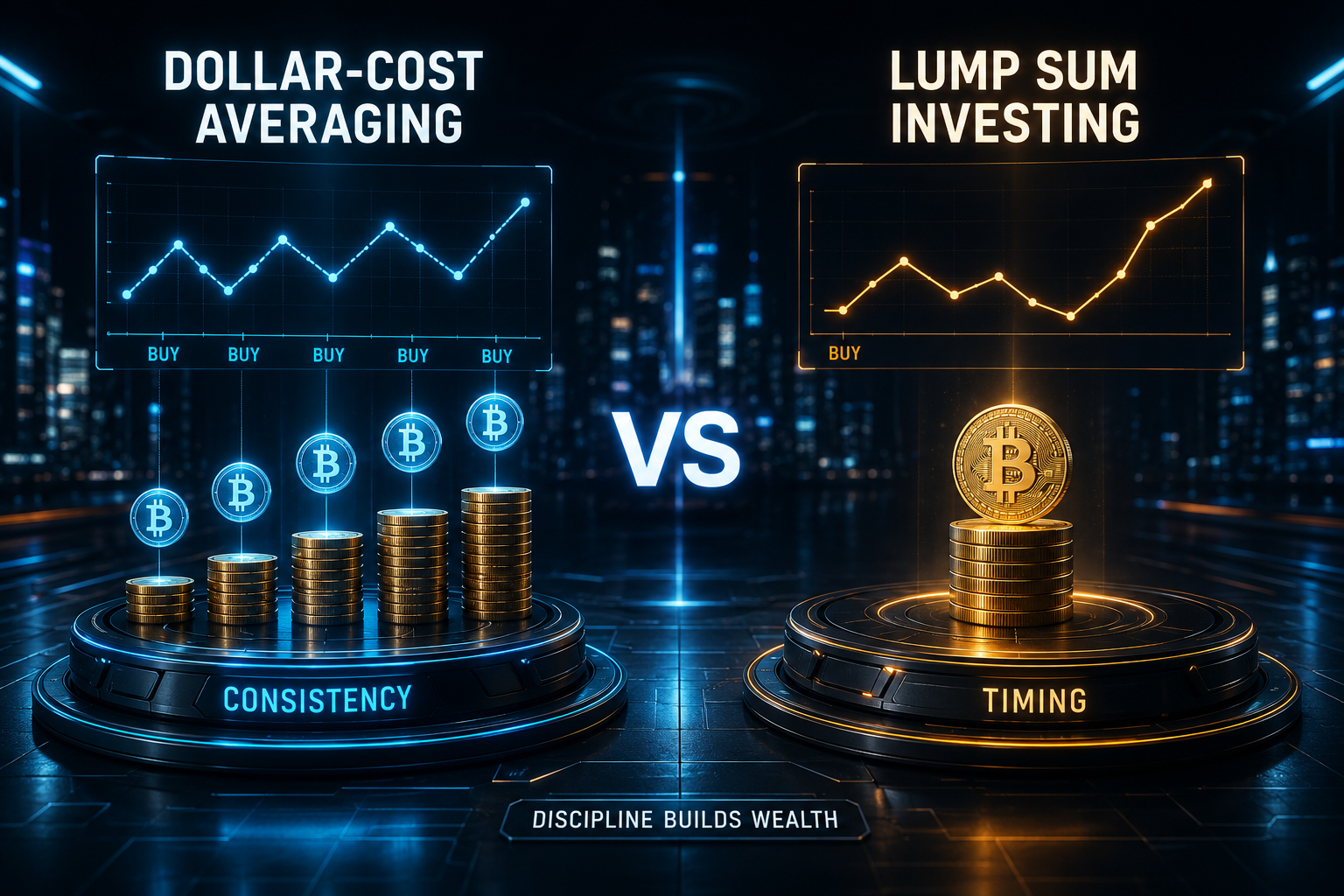
In the dollar-cost averaging vs lump sum debate, lump sum wins on raw returns roughly two-thirds of the time, but DCA wins on the thing that actually determines whether you stay invested long enough to benefit: your ability to hold through a brutal drawdown without selling.
Article at a Glance
Here’s the short version of dollar-cost averaging vs lump sum investing in crypto:
- Lump sum investing has historically outperformed DCA in traditional markets, and Bitcoin’s long-term upward trajectory suggests the same pattern holds, but timing risk is far more brutal in crypto than in stocks.
- Dollar-cost averaging removes the single hardest decision in investing, when to buy, and replaces it with a system that works automatically, no matter what the market is doing.
- Your risk tolerance, available capital, and emotional discipline matter more than any backtest when choosing between these two strategies.
- There’s a hybrid approach that combines the best of both strategies, and it’s one of the most overlooked tools in a crypto investor’s playbook.
- New and experienced investors both make costly mistakes when they choose a strategy that doesn’t match their psychology, not just their finances.
Table of Contents
- Lump Sum Wins on Returns, But It’s Not That Simple
- What Is Dollar-Cost Averaging in Crypto?
- What Is Lump Sum Investing in Crypto?
- What the Data Says About Lump Sum vs. DCA
- The Emotional Cost of Each Strategy
- Which Strategy Fits Your Situation?
- The Hybrid Approach: Combining Both Strategies
- Lump Sum or DCA: Here Is the Bottom Line
- Frequently Asked Questions
Most crypto investors don’t lose money because they picked the wrong strategy, they lose because they picked one that didn’t match who they are. The dollar-cost averaging vs lump sum decision is exactly where that mismatch tends to happen.
The debate between dollar-cost averaging (DCA) and lump sum investing is one of the most important decisions you’ll make as a crypto investor. Both strategies have merit. Both have real risks. And the answer isn’t as clean as most people want it to be.
Lump Sum Wins on Returns, But It’s Not That Simple – Dollar-Cost Averaging vs Lump Sum
The data from traditional markets is fairly consistent: lump sum investing outperforms dollar-cost averaging roughly two-thirds of the time over long periods. Vanguard and multiple academic studies back this up. The core reason is straightforward, markets trend upward over time, so the sooner your capital is fully deployed, the more time it has to grow.
But crypto is not the S&P 500. Bitcoin can drop 40% in a month and recover 300% over the following year. That level of volatility completely changes the risk profile of a lump sum entry. A poorly timed lump sum in crypto doesn’t just underperform, it can shake your conviction so badly that you sell at the bottom and never recover your losses psychologically or financially.
This is why the lump sum vs. DCA conversation in crypto isn’t just about math. It’s about whether you can hold through a 50% drawdown without flinching, and most people, even experienced investors, cannot.
- Lump sum = higher expected return, higher emotional and timing risk
- DCA = lower regret risk, lower volatility exposure, sometimes lower peak returns
- Neither is universally better, your situation determines which one serves you
What Is Dollar-Cost Averaging in Crypto?
Dollar-cost averaging is the practice of investing a fixed amount of money at regular intervals, weekly, bi-weekly, or monthly, regardless of the current price. Instead of trying to time the market, you buy consistently over time, which means you’ll sometimes buy high and sometimes buy low, but your average cost smooths out over time. For those considering different investment strategies, it’s worth exploring whether Dogecoin is a good investment in 2026.
In crypto, DCA is especially powerful because of how extreme price swings can be. When Bitcoin drops from $60,000 to $30,000, a DCA investor doesn’t panic, they keep buying, automatically lowering their average cost basis. That mechanical consistency is one of the most underrated advantages in volatile markets.
How DCA Works in Practice
Say you have $6,000 to invest in Bitcoin. Instead of buying all at once, you invest $500 every month for 12 months. Some months you’ll buy Bitcoin at $25,000, other months at $35,000. Over time, your average entry price reflects a blend of those highs and lows, reducing the chance that a single bad timing decision wipes out a large portion of your capital.
Why Crypto’s Volatility Makes DCA Appealing
Bitcoin has historically experienced multiple drawdowns exceeding 70%, including the 2018 bear market and the 2022 collapse following the Luna/Terra crash. During those periods, investors who lump summed near the top waited years to break even. DCA investors who kept buying through the dip accumulated significant positions at deeply discounted prices, and when the market recovered, their returns reflected that discipline.
What Is Lump Sum Investing in Crypto?
Lump sum investing means deploying all of your available capital into the market at one time. You identify your position size, execute the trade, and let time and market movement do the rest. It’s a high-conviction approach, and when the timing is right, it’s the most financially efficient strategy available.
The Core Advantage: Maximum Market Exposure
The entire argument for lump sum investing comes down to one principle: time in the market beats timing the market. When you invest everything upfront, your full capital starts compounding immediately. If Bitcoin is in a long-term uptrend, which its 15-year history strongly suggests, then every day your capital sits uninvested is a day of potential growth lost.
For investors who are highly confident in their long-term thesis, have strong emotional discipline, and are entering during a market correction or bear market, lump sum investing can generate substantially higher returns than DCA over a 3-5 year horizon.
“Time in the market beats timing the market, but only if you can actually stay in the market.”
The Real Risk: Buying at the Wrong Time
The brutal downside of lump sum investing in crypto is that bad timing can be catastrophic. An investor who put $50,000 into Bitcoin at its November 2021 peak of approximately $69,000 watched that investment fall to roughly $16,000 by late 2022, a loss of over 75%. While long-term holders eventually recovered, most retail investors don’t have the psychological fortitude to hold through that kind of drawdown without making emotionally-driven decisions. For those interested in understanding the differences between major cryptocurrencies, this analysis on Bitcoin vs. Ethereum provides valuable insights.
What the Data Says About Lump Sum vs. DCA
Research consistently shows lump sum outperforms DCA in markets that trend upward, and Bitcoin’s trajectory over any multi-year window has been decisively upward. But the data also reveals something equally important: the gap between lump sum and DCA performance narrows significantly during high-volatility periods, which describes nearly every phase of the crypto market cycle.
Swan Research Findings: Lump Sum Outperforms DCA Historically
Research from Swan Bitcoin analyzed historical Bitcoin investment scenarios and found that lump sum investing outperformed DCA in the majority of rolling time periods studied. The core finding aligns with traditional market research, when an asset trends upward over time, getting fully invested earlier produces better outcomes than spreading purchases over months or years.
That said, the research also highlighted something critical: the margin of outperformance varied dramatically depending on entry point. Investors who lump summed during bull market peaks saw their advantage evaporate almost entirely, while those who entered during corrections or consolidation phases saw lump sum returns significantly exceed DCA returns over 3-year windows. For more insights on managing your investments, consider reading about crypto portfolio rebalancing.
Why Bitcoin’s Upward Trajectory Favors Lump Sum
Bitcoin’s long-term price history makes a compelling case for lump sum investing. Despite catastrophic drawdowns along the way, Bitcoin’s four-year cycle has consistently produced new all-time highs. An investor who held any lump sum position for four or more years has never ended up at a loss, a track record few assets can match.
- Bitcoin’s 4-year cycle has produced new all-time highs after every major bear market
- Long-term holders (LTH), defined as those holding for 155+ days, have historically been in profit the vast majority of the time
- Early full exposure means more capital compounding during explosive bull runs, which can represent 300-1,000%+ gains in a single cycle
- Missing just the top 10 performing days in a Bitcoin cycle can cut overall returns by more than half
The mathematical edge of lump sum becomes clearest when you zoom out. If you believed in Bitcoin’s long-term value proposition strongly enough to invest $20,000, having that entire $20,000 exposed during a 400% bull run produces dramatically better results than having portions of it still sitting on the sidelines in a DCA queue.
The key word, however, is if. That level of conviction, and the discipline to hold through a 60-80% drawdown without selling, is rarer than most investors want to admit about themselves.
Where DCA Closes the Gap: Bear Markets and High Volatility Periods
DCA’s most powerful performance window is during prolonged bear markets and sideways consolidation phases. When Bitcoin spent most of 2022 grinding from $45,000 down to $16,000, DCA investors who kept buying every week or month were systematically accumulating Bitcoin at lower and lower prices. By the time the recovery began in 2023, their average cost basis was dramatically lower than someone who had lump summed at any point in early 2022.
This is the scenario where DCA doesn’t just close the gap with lump sum, it outright wins. The strategy turns brutal market conditions into a mechanical advantage, removing the temptation to wait for “the bottom” and replacing it with consistent action that pays off when the cycle turns. For more insights on investment strategies, check out this article on crypto portfolio rebalancing.
The Emotional Cost of Each Strategy
Returns matter, but so does your ability to sleep at night and stay invested long enough for those returns to materialize. The emotional dimension of this decision is not a soft factor, it’s one of the primary reasons most retail investors underperform both strategies, because they abandon their chosen approach at exactly the wrong moment. For those interested in exploring alternative investment options, you might want to consider the fastest growing altcoins as part of your portfolio strategy.
How Lump Sum Investing Triggers Panic Selling
When you deploy a large sum all at once and the market immediately moves against you, which happens more often than anyone likes to admit, the psychological pressure is intense. A $30,000 lump sum position that drops to $18,000 in three months doesn’t just feel bad financially. It triggers a very human desire to “stop the bleeding,” cut losses, and wait for things to stabilize. That reactive selling locks in losses and removes you from the market right before many recoveries begin. Lump sum investing demands an unusually high tolerance for short-term pain, and most people discover their real risk tolerance only after they’ve already committed the capital.
Why DCA Builds Discipline and Long-Term Consistency
Dollar-cost averaging works partly because of what it removes from the equation: the decision. When your investment is automated, $200 every Tuesday, regardless of price, you stop watching every candle and second-guessing every entry. That consistency compounds over time, not just financially but behaviorally. Investors who DCA tend to stay invested longer, panic sell less frequently, and build a relationship with volatility that becomes an asset rather than a threat. The strategy essentially trains you to be a better long-term investor while it works in the background. For those looking to explore different strategies, understanding crypto portfolio rebalancing can offer additional insights into managing investments effectively.
Which Strategy Fits Your Situation?
The right strategy isn’t the one with the highest average return in a backtest, it’s the one you’ll actually stick with through a 60% drawdown, a bull run that makes you want to sell too early, and every emotionally charged moment in between. The honest answer requires you to assess three things: how much capital you have available, where you are in the market cycle, and how well you genuinely handle financial stress.
There’s no shame in choosing DCA over lump sum because you know yourself well enough to recognize that a big unrealized loss would send you spiraling. That self-awareness is worth more than any theoretical return advantage.
You Have a Large Amount Ready to Invest
If you have a significant sum ready, from savings, a bonus, an inheritance, or an asset sale, and you have a high conviction in Bitcoin’s long-term trajectory, a lump sum during a confirmed bear market or major correction is historically one of the strongest entry strategies available. The key conditions are: the market is meaningfully below its all-time high, you have a genuine 3-5 year time horizon, and you’ve stress-tested your emotional response to a 50% drop before you pull the trigger. If all three are true, the data supports going all in.
You Are Investing Monthly From Your Income
- You receive a regular paycheck and want to allocate a portion to crypto each month
- You don’t have a large lump sum available and are building your position over time
- You find it difficult to watch large unrealized losses without feeling the urge to sell
- You’re newer to crypto and still developing your conviction around market cycles
If any of these describe you, DCA isn’t a consolation prize, it’s the right tool. Setting up an automated recurring Bitcoin purchase through a platform like Swan Bitcoin, River, or your preferred exchange removes the friction entirely. You set it, forget it, and accumulate through every market condition without the emotional whiplash of trying to time entries.
The practical edge of income-based DCA is that it aligns your investment behavior with your real financial life. You’re not trying to find a mythical perfect entry point, you’re building a position steadily, the same way people have built wealth in index funds for decades.
Over a 12-month DCA period in a volatile market, it’s common to see your average cost basis land significantly below the year’s opening price, simply because you bought more units during the months when prices were lowest. That’s not luck. That’s the math of consistent investing in a volatile asset working in your favor.
The most important thing isn’t which strategy is theoretically optimal. It’s whether you’ll still be invested two years from now. DCA makes that far more likely for most people, and staying invested is the single biggest variable in crypto wealth building.
You Are New to Crypto and Risk-Averse
If you’re just starting out in crypto and the idea of watching your investment drop 40% in a week makes your stomach turn, DCA is your safest psychological entry point. It doesn’t require you to have perfect market knowledge, a strong conviction about cycle timing, or nerves of steel. It just requires consistency. Start small, even $50 or $100 per week into Bitcoin builds real exposure over time while keeping your emotional downside manageable as you learn how this market actually behaves.
The Hybrid Approach: Combining Both Strategies
The most overlooked strategy in this entire debate isn’t choosing one or the other, it’s using both deliberately. A hybrid approach means deploying a portion of your capital as a lump sum during clear market corrections, while maintaining a consistent DCA schedule with the remainder. This gives you the maximum-exposure advantage of lump sum investing at opportunistic moments, while the DCA portion keeps you accumulating through every market phase without requiring perfect timing.
In practice, this might look like allocating 60% of your available crypto budget as a lump sum when Bitcoin drops more than 30% from its recent high, while the remaining 40% runs on a fixed weekly or monthly purchase schedule regardless of conditions. The lump sum component captures deep value during fear-driven selloffs. The DCA component ensures you’re always in the market and never completely on the sidelines waiting for a bottom that may not arrive when you expect it.
This hybrid approach also solves the biggest emotional problem with pure lump sum investing: the paralysis of waiting for the “right” moment. When you already have a DCA position running, the pressure to nail your lump sum entry is significantly reduced. You’re already in the market. The lump sum becomes an opportunistic add-on rather than your sole entry point, which makes it far easier to execute without second-guessing yourself into inaction.
Hybrid Strategy Example, $6,000 Annual Crypto Budget
Lump Sum Component (60% = $3,600): Deploy when Bitcoin drops 30%+ from recent high. Hold in cash or stablecoins until trigger is met. If trigger is never met in a given year, roll into DCA.
DCA Component (40% = $2,400): $200/month automatically invested in Bitcoin every month regardless of price. No decisions required. Runs in the background through every market condition.
Result: You’re always accumulating, you have dry powder for corrections, and you’ve removed the all-or-nothing emotional pressure from your strategy entirely.
The hybrid model won’t always produce the highest possible return, nothing will, because that requires perfect timing which no one has. But it consistently produces strong returns while keeping your emotional engagement with the market at a manageable level. For most real-world investors, that balance is what actually generates long-term wealth, not chasing the theoretically optimal entry.
Lump Sum or DCA: Here Is the Bottom Line
If the market is in a clear downtrend and you have the conviction and emotional discipline to hold through further pain, a lump sum during a confirmed bear market is historically one of the highest-return moves available in crypto. If you’re working with income-based investing, you’re newer to the space, or you know yourself well enough to recognize that a large unrealized loss would push you toward panic selling, DCA is not the inferior choice, it’s the right one. The best strategy is always the one you’ll actually stick with when the market tests you, and it will test you.
The data favors lump sum on raw returns. Psychology favors DCA on consistency and staying power. The hybrid approach captures both. Pick the one that matches your capital situation, your market awareness, and, most importantly, your honest assessment of who you are as an investor under pressure.
Frequently Asked Questions
These are the most common questions investors ask when deciding between DCA and lump sum investing in crypto, answered directly without the fluff.
| Factor | DCA | Lump Sum |
|---|---|---|
| Best market condition | Bear markets, high volatility | Bull market early stages, confirmed bottoms |
| Emotional difficulty | Low, automated and consistent | High, requires conviction through drawdowns |
| Historical return performance | Slightly lower on average | Higher in trending markets |
| Best for beginners | Yes | Only with strong risk tolerance |
| Capital requirement | Any amount, works on $50/week | Requires meaningful available capital |
| Timing dependency | Low, timing is irrelevant by design | High, entry point dramatically affects outcome |
Use this table as a quick reference when you’re deciding which approach fits your current situation. No single factor makes the decision for you, it’s the combination that matters.
Does dollar-cost averaging work in a crypto bear market?
Yes, and it works exceptionally well. A crypto bear market is actually DCA’s strongest environment. When prices are declining, each fixed purchase buys more units of Bitcoin or other crypto assets at lower prices. Investors who maintained their DCA schedule throughout the 2022 bear market, buying at $40,000, $30,000, $20,000, and $16,000, entered the 2023 recovery with a cost basis well below where the cycle eventually recovered to. The bear market isn’t where DCA investors suffer. It’s where they build the positions that generate outsized returns in the next bull run.
Is lump sum investing too risky for Bitcoin beginners?
For most beginners, yes, not because of the math, but because of the psychology. New investors haven’t yet experienced a full crypto market cycle. They don’t have the emotional calluses built from watching a position drop 50% and holding anyway. When that happens with a large lump sum position, the instinct to sell and “cut losses” is overwhelming, and acting on that instinct is what actually creates the loss. If you’re new to crypto and considering a lump sum, start by asking yourself: if this investment dropped 60% tomorrow and stayed there for 18 months, would I hold? If there’s any hesitation in your answer, DCA is the better entry strategy for where you are right now. You can always shift to opportunistic lump sum additions as your experience and conviction grow.
How often should you invest when using DCA for crypto?
Weekly DCA tends to outperform monthly DCA in high-volatility assets like Bitcoin because it captures more price variation points across a given period, which lowers your average cost more effectively during declining markets. That said, the difference is marginal compared to the most important factor: consistency. The frequency that you’ll actually maintain without disruption is the right frequency for you.
Practically speaking, bi-weekly or monthly DCA aligned with your paycheck cycle is the most sustainable approach for income-based investors. Set it to auto-purchase on payday so the decision is never in your hands. Platforms like Swan Bitcoin, River, and major exchanges like Coinbase all support automated recurring purchases, remove the friction and the strategy runs itself.
Can you switch from DCA to lump sum investing mid-strategy?
Absolutely, and doing so strategically is exactly what the hybrid approach recommends. If you’ve been DCA-ing for several months and a significant market correction creates what you believe is a high-conviction buying opportunity, there’s nothing stopping you from deploying additional available capital as a lump sum while your regular DCA schedule continues in the background. The two approaches are not mutually exclusive.
The key is making sure the shift is driven by a pre-defined strategy trigger, like Bitcoin dropping 30% from its recent high, rather than an emotional reaction to market hype or fear. Switching to a lump sum because you’re excited during a bull run peak is a very different decision than adding a lump sum during a confirmed bear market correction. The former is FOMO. The latter is strategy.
Is DCA or lump sum better for altcoins vs. Bitcoin?
For altcoins, DCA becomes even more important than it is for Bitcoin, and lump sum investing carries substantially higher risk. Altcoins are significantly more volatile than Bitcoin, with many experiencing 90%+ drawdowns during bear markets that they never fully recover from. A poorly timed lump sum into a mid-cap altcoin can result in losses that a multi-year holding period still doesn’t recover, because the project may not survive or may lose market relevance entirely.
Bitcoin has a 15-year track record of recovering from every major drawdown and reaching new all-time highs. Most altcoins do not share that track record. When applying either strategy to altcoins, the risk profile changes dramatically, and that asymmetry should directly influence how you size and time your entries. DCA into high-quality altcoins with strong fundamentals is a reasonable approach. Lump summing into altcoins should be reserved for investors with deep project-level knowledge and a clear-eyed understanding of the liquidation risk involved.
| Asset Type | Recommended Strategy | Key Reason |
|---|---|---|
| Bitcoin (BTC) | DCA or Hybrid | Strong long-term track record; volatility manageable with DCA |
| Ethereum (ETH) | DCA or Hybrid | High utility, but volatile enough to benefit from averaging |
| Large-cap altcoins | DCA preferred | Higher volatility, lower certainty of recovery from drawdowns |
| Mid/small-cap altcoins | DCA with strict position sizing | Extreme volatility, project survival risk, never lump sum |
| New or speculative tokens | Small fixed allocation only | Binary outcomes, treat as high-risk, limited exposure |
The further down the market cap ladder you go, the more critical it becomes to spread your entries over time. No amount of conviction in a small-cap project justifies a single large entry, the downside scenarios in that tier of the market can be permanent, not just painful.
DYOR Disclaimer
This article is for informational purposes only and does not constitute financial, investment, or tax advice. Cryptocurrency markets are highly volatile and past performance does not indicate future results. Always do your own research (DYOR) and consult a qualified financial professional before making any investment decisions.