Coinposters
Bitcoin ATM vs Crypto Exchange: Cheapest Way to Buy Bitcoin with Lowest Fees
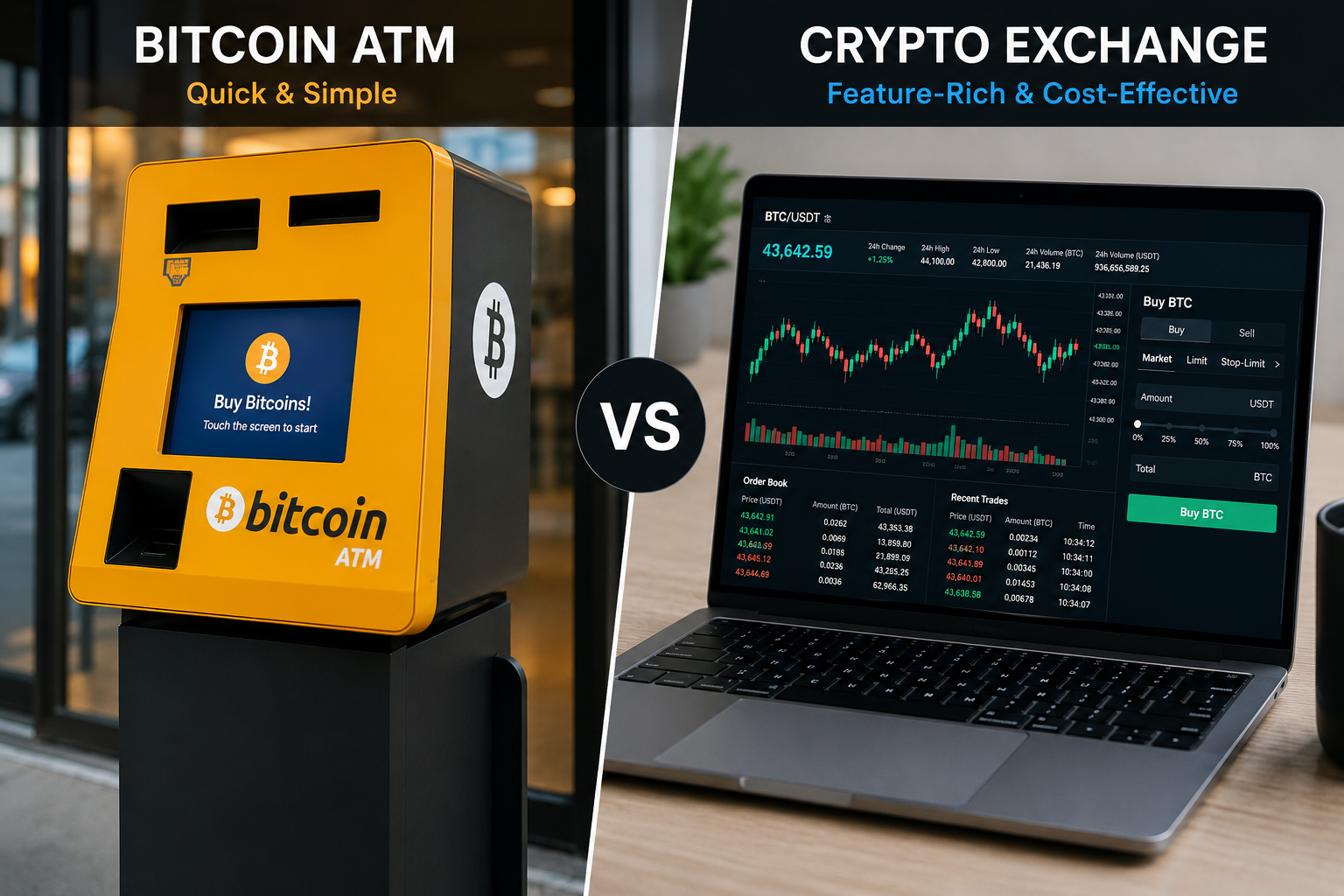
In the Bitcoin ATM vs crypto exchange comparison, exchanges win decisively on cost, charging under 1% per transaction versus 10 to 25% at most ATMs, though ATMs still make sense for unbanked, privacy-focused, or time-critical purchases.
Article at a Glance: Bitcoin ATM vs Crypto Exchange Fee Breakdown
Here’s the short version of the Bitcoin ATM vs crypto exchange fee question:
- Bitcoin ATMs charge 10-25% per transaction, online crypto exchanges charge as little as 0.1% or even 0%, making exchanges dramatically cheaper for most buyers.
- The cheapest way to buy Bitcoin is through a low-fee exchange like Kraken or Binance.US, funded via ACH bank transfer rather than a credit card or debit card.
- Bitcoin ATMs still have a clear use case, privacy-focused buyers and those without bank accounts will find them worth the premium in specific situations.
- Hidden fees matter as much as the listed rate, exchange rate markups and spreads at ATMs can add up fast, especially on purchases over $500.
- There are ways to cut exchange fees even further, using limit orders, funding with ACH, and increasing trade volume can all reduce what you pay per transaction.
Table of Contents
- Bitcoin ATMs Cost 10-25%, Exchanges Cost Under 1%
- What Is a Bitcoin ATM?
- What Is a Crypto Exchange?
- Bitcoin ATM vs Crypto Exchange: Side-by-Side Fee Comparison
- When a Bitcoin ATM Is Worth the Extra Cost
- The Cheapest Crypto Exchanges to Buy Bitcoin in 2026
- How to Cut Your Bitcoin Buying Fees Even Further
- Bitcoin ATM vs Crypto Exchange: Which One Should You Use?
- Frequently Asked Questions
The difference in fees between a Bitcoin ATM and a crypto exchange can cost you hundreds of dollars a year, and most buyers don’t even realize it until they do the math. This Bitcoin ATM vs crypto exchange breakdown walks through exactly where that money goes.
Whether you’re buying Bitcoin for the first time or looking to optimize a recurring purchase strategy, understanding where your money actually goes matters. Cash2Bitcoin, a leading Bitcoin ATM operator and online crypto platform, provides both options, and is transparent about the tradeoffs between them. That kind of clarity is exactly what buyers need when navigating this decision.
Bitcoin ATMs Cost 10-25%, Exchanges Cost Under 1% – Bitcoin ATM vs Crypto Exchange
Let’s put this in plain numbers. If you buy $500 worth of Bitcoin at a Bitcoin ATM charging a 15% fee, you’re paying $75 just to complete the transaction. Do the same purchase on Kraken using an ACH transfer, and your fee might be $0.50 or less. That’s not a minor gap, that’s the difference between building wealth and bleeding it out in transaction costs.
This fee disparity is the single most important factor in the Bitcoin ATM vs crypto exchange debate. Everything else, convenience, privacy, speed, comes secondary to the raw cost difference, especially for anyone making regular purchases.
What Is a Bitcoin ATM?
A Bitcoin ATM is a physical kiosk that lets you buy (and sometimes sell) Bitcoin using cash or a debit card. Unlike traditional bank ATMs that connect to your checking account, Bitcoin ATMs connect to a cryptocurrency exchange over the internet and process your transaction in real time, sending Bitcoin directly to a wallet address you provide.
They look familiar, touch screen, bill acceptor, receipt printer, which is exactly why they appeal to first-time buyers who find online exchanges intimidating. That familiarity comes with a cost, but for some buyers, it’s a worthwhile one.
How Bitcoin ATMs Work
The process is straightforward. You walk up to the machine, select how much Bitcoin you want to buy, insert cash or tap your debit card, and then either scan a QR code from your existing crypto wallet or receive a paper wallet printed on the spot. The machine contacts a backend exchange, executes the trade at the current market rate (plus its markup), and sends the Bitcoin to your wallet, usually within minutes.
Where Bitcoin ATMs Are Located
Bitcoin ATMs have expanded rapidly across the United States. You’ll find them in gas stations, convenience stores, grocery stores, malls, and airports. Their placement prioritizes foot traffic and accessibility over anything else, which is part of why they work so well for impulse or urgent purchases.
Operators like Cash2Bitcoin maintain extensive ATM networks across multiple states, making it easy to find a machine near you using a location finder tool. The sheer density of these machines in urban areas means access is rarely the problem, cost is.
The locations themselves tell you a lot about the intended user. Someone grabbing cash from a gas station ATM isn’t planning a sophisticated trading strategy. They want a quick, simple transaction. Bitcoin ATMs serve that same type of buyer in the crypto world.
That said, the convenience factor shouldn’t be confused with the cost factor. Location accessibility and transaction affordability are two completely separate things, and conflating them is one of the most common mistakes new Bitcoin buyers make.
- Gas stations and convenience stores
- Grocery and big-box retail locations
- Shopping malls and plazas
- Airports and transit hubs
- Pharmacies and check-cashing stores
Bitcoin ATM Fee Structure Explained
Bitcoin ATM fees aren’t always what they appear to be on the screen. Most machines display a transaction fee percentage, often anywhere from 8% to 20%, but the total cost is almost always higher once you factor in the exchange rate markup. Operators buy Bitcoin at market price and sell it to you at an inflated rate, pocketing the spread. This spread is often not shown as a separate line item.
For a $500 purchase at a machine advertising a 12% fee with a 3-5% spread baked into the rate, your real cost could land between $75 and $85, or 15-17% of your purchase. Coin ATM Radar, which tracks global Bitcoin ATM data, has consistently reported average fees in the 11-25% range when all costs are included.
What Is a Crypto Exchange?
A crypto exchange is an online platform where buyers and sellers trade cryptocurrency. Instead of a physical machine, you create an account, verify your identity, link a funding source, and place orders to buy or sell Bitcoin at current market prices. The exchange acts as a marketplace, matching your buy order with a seller and charging a fee for the service.
The major exchanges, Kraken, Coinbase, Binance.US, operate at massive scale, which lets them keep per-transaction fees extremely low. Their business model depends on volume, not high per-trade margins, which works heavily in the buyer’s favor.
How Crypto Exchanges Work
When you place a buy order on an exchange, you’re either buying from another user (on a peer-to-peer or order book exchange) or from the exchange’s own liquidity pool. Either way, the price you pay is very close to the true market rate for Bitcoin. Fees are charged on top of, or embedded slightly within, that market rate, but the spread is far tighter than anything you’ll see at a Bitcoin ATM.
Types of Fees on Crypto Exchanges
Exchange fee structures vary, but they generally fall into a few categories. Maker fees apply when you add liquidity to the order book (placing a limit order that doesn’t fill immediately). Taker fees apply when you remove liquidity (placing a market order that fills right away). Most major exchanges charge between 0.0% and 0.6% for these trades, depending on your 30-day volume tier.
Funding method also affects your total cost. ACH bank transfers are almost always free or very cheap, while credit card purchases can add 2-4% on top of trading fees. Wire transfers may carry flat fees. Choosing the right funding method is just as important as choosing the right exchange.
Bitcoin ATM vs Crypto Exchange: Side-by-Side Fee Comparison
Putting both options next to each other makes the cost gap impossible to ignore. Here’s how the two methods stack up across the most important purchase factors:
| Feature | Bitcoin ATM | Crypto Exchange |
|---|---|---|
| Average Transaction Fee | 11% – 25% | 0.0% – 0.6% |
| Exchange Rate Markup / Spread | 3% – 5% (often hidden) | Minimal to none |
| Funding Methods | Cash, some debit cards | ACH, wire, credit card, crypto |
| ID / Verification Required | Often minimal or none for small amounts | Full KYC required |
| Transaction Speed | Instant (minutes) | Minutes to days (depends on funding) |
| Asset Variety | Limited (BTC, ETH, LTC typically) | Hundreds to thousands of assets |
| Privacy Level | Higher (cash transactions) | Lower (full identity verification) |
| Best For | Quick, private, cash-based purchases | Cost-efficient, frequent buying |
Fee Differences on Small Purchases (Under $500)
On smaller purchases, the dollar amount lost to ATM fees feels more manageable, but the percentage hit is just as damaging. A $200 Bitcoin purchase at a 15% ATM fee costs you $30 in fees. On Kraken using ACH, that same $200 purchase costs under $1. Over the course of a year of weekly $200 purchases, that’s the difference between paying roughly $1,560 in ATM fees versus around $50 on an exchange.
Small purchases are exactly where new buyers get burned the most. The transaction feels minor, the fee seems like a small number in absolute terms, and the habit forms before anyone stops to calculate the annual cost.
Fee Differences on Large Purchases (Over $1,000)
Once your purchase crosses $1,000, the ATM fee conversation becomes urgent. At a 15% blended fee rate, a $1,000 Bitcoin purchase costs you $150 before you’ve even received a single satoshi. On Binance.US with a 0.1% taker fee funded by ACH, that same purchase costs $1. The math isn’t close, it’s a $149 difference on a single transaction. Scale that to a $5,000 purchase and you’re looking at $750 in ATM fees versus roughly $5 on an exchange.
Hidden Costs Most Buyers Miss
The listed fee percentage at a Bitcoin ATM is almost never the full story. Most operators embed an additional 3-5% markup directly into the exchange rate they offer you, meaning the Bitcoin price shown on the ATM screen is already inflated above the true market rate. You won’t see this called out as a separate line item, it’s baked in. Combined with the stated transaction fee, your real cost is consistently higher than the number displayed on the machine. On exchanges, what you see is what you pay, and the market price shown is the actual global market price, not an operator-inflated version of it.
When a Bitcoin ATM Is Worth the Extra Cost
The higher fees at Bitcoin ATMs aren’t always irrational to pay. There are specific situations where the premium makes complete sense, and understanding those scenarios helps you make smarter decisions rather than defaulting to one method for every situation.
No Bank Account or ID Required
Crypto exchanges require full Know Your Customer (KYC) verification, government-issued ID, sometimes a selfie, sometimes proof of address. For the unbanked or underbanked population, this requirement alone can make exchanges completely inaccessible. Bitcoin ATMs lower that barrier significantly.
Many Bitcoin ATMs allow purchases under a certain threshold, often $900 to $1,000, with minimal or no ID verification. You can walk up with cash and walk away with Bitcoin without linking a bank account, uploading a passport, or waiting days for account approval. For buyers who value financial privacy or simply don’t have access to traditional banking infrastructure, this matters enormously.
It’s also worth noting that ATM verification thresholds vary by operator and jurisdiction. Some machines require a phone number verification only. Others require a government ID scan for purchases above $200. Cash2Bitcoin, for example, structures its verification requirements in compliance with applicable regulations while keeping the process as friction-free as possible for users.
- No bank account needed to complete a transaction
- Cash is accepted, no card or digital payment method required
- Minimal ID verification for smaller purchase amounts
- No waiting period for account approval or funding settlement
- Accessible to buyers who’ve been declined by or excluded from traditional banking
Instant Cash-to-Crypto Transactions
Speed is the other legitimate advantage ATMs hold over exchanges. When you fund an exchange account via ACH transfer, settlement typically takes 3-5 business days before you can withdraw your Bitcoin off-platform. Instant buy features on exchanges let you purchase immediately, but those often carry higher fees, sometimes 1.5-4%, that begin to close the gap with ATM costs. A Bitcoin ATM, by contrast, sends Bitcoin to your wallet within minutes of your cash going into the machine. For more on Bitcoin security, consider the differences between a hot wallet and a cold wallet.
Real-World Example: A buyer needs to send Bitcoin to a family member overseas within the hour. Their exchange account has a pending ACH transfer that won’t settle for three days, and their debit card instant buy option carries a 2.5% fee. The local Bitcoin ATM charges 14%, painful, but it’s the only option that actually works within their timeframe. In urgent situations, ATM premium fees are sometimes the cost of speed.
This speed advantage is most relevant in time-sensitive situations: sending remittances, responding to a limited-time payment window, or simply wanting Bitcoin in your wallet today rather than in three days. For regular, planned purchases with no urgency, the speed premium is hard to justify.
The bottom line is that Bitcoin ATMs serve a real purpose, they just serve a specific type of buyer in a specific type of situation. If that’s not you, the exchange is almost always the smarter financial move.
The Cheapest Crypto Exchanges to Buy Bitcoin in 2026
Not all exchanges are created equal when it comes to fees. Some platforms, particularly those designed for casual retail buyers, charge as much as 1.49-3.99% per transaction. Others charge a fraction of that. Here are the platforms that consistently offer the lowest all-in cost for buying Bitcoin in 2026.
- Kraken, industry-low fees with a long-standing reputation for security and transparency
- Coinbase Advanced, lower-fee interface within the Coinbase ecosystem, designed for active traders
- Binance.US, competitive maker/taker fees with a large liquidity pool
- Cash2Bitcoin Online, a hybrid option combining ATM operator trust with online platform accessibility
Each platform has its own fee tier structure, verification process, and funding method costs. Choosing the right one depends on how often you buy, how much you buy, and what funding methods you have available.
One key thing to watch for: platforms that advertise “zero commission” often make up for it with a wider spread on the Bitcoin price they offer you. Always check what price you’re actually getting relative to the real-time market rate, not just the stated fee percentage.
1. Kraken
Kraken charges 0.25% for makers and 0.40% for takers at the base tier, with fees dropping as your 30-day volume increases. Instant purchases via the simplified interface carry higher fees, so using Kraken Pro or the advanced trading view gives you access to the lower maker/taker structure. ACH funding is free, and Kraken has maintained one of the strongest security track records in the industry since launching in 2011.
For buyers making regular purchases of $500 or more, Kraken’s fee structure makes it one of the most cost-efficient options available in the US market. Its verification process is standard KYC but typically approves within a few hours to one business day.
2. Coinbase Advanced
Coinbase’s standard retail interface charges up to 3.99% for debit card purchases and 1.49% for bank transfers, expensive by exchange standards. However, Coinbase Advanced (formerly Coinbase Pro) drops those fees dramatically, to 0.6% for takers and 0.4% for makers at the base level, falling further as volume grows. If you already have a Coinbase account, switching to the Advanced interface for your purchases costs nothing and immediately cuts your fees.
3. Binance.US
Binance.US offers a 0.1% standard trading fee, one of the lowest flat rates available to US-based buyers. Using ACH to fund your account is free, and the platform supports a broad range of trading pairs. The platform has faced some regulatory scrutiny in recent years, which is worth factoring into your decision, but for pure fee efficiency, Binance.US consistently ranks among the cheapest options for Bitcoin purchases in the United States.
4. Cash2Bitcoin Online
Cash2Bitcoin isn’t just an ATM network, the platform also offers an online purchasing option that bridges the gap between ATM accessibility and exchange-level pricing. For buyers who trust the Cash2Bitcoin brand from ATM interactions but want a more cost-efficient way to purchase regularly, the online platform is a logical next step.
The platform is designed with accessibility in mind, making it a strong fit for buyers who found crypto exchanges too complex when they first started out. The interface is cleaner and more guided than large institutional exchanges, which reduces the learning curve without sacrificing cost efficiency.
For buyers transitioning from ATM purchases to online exchanges, Cash2Bitcoin Online provides a familiar brand experience with meaningfully lower fees than their physical kiosk network, a practical bridge between the two worlds.
| Exchange | Maker Fee | Taker Fee | ACH Funding Cost | Best For |
|---|---|---|---|---|
| Kraken | 0.25% | 0.40% | Free | Regular buyers, security-focused |
| Coinbase Advanced | 0.40% | 0.60% | Free | Existing Coinbase users |
| Binance.US | 0.10% | 0.10% | Free | Cost-efficiency focused buyers |
| Cash2Bitcoin Online | Varies | Varies | Varies | ATM users moving online |
| Bitcoin ATM (avg.) | N/A | 11%-25% | Cash only | Unbanked, privacy-focused, urgent |
Use this table as your starting reference, but always verify current fee schedules directly on each platform, exchanges update their fee tiers regularly and promotions can temporarily reduce costs even further.
How to Cut Your Bitcoin Buying Fees Even Further
Choosing a low-fee exchange is the biggest lever you can pull, but it’s not the only one. Once you’re on a competitive platform, there are additional strategies that reduce your per-transaction cost even further, some of which can bring your effective fee rate close to zero.
Use Limit Orders Instead of Market Orders
A market order buys Bitcoin instantly at whatever the current asking price is. It’s fast and simple, but it costs more, you pay the taker fee because you’re removing liquidity from the order book. A limit order lets you set the price you’re willing to pay, and your order sits on the book until the market reaches that price. When it fills, you pay the maker fee instead, which is consistently lower, sometimes zero on platforms like Binance.US.
“On Kraken, a market order costs you 0.40% while a limit order costs 0.25%. On a $2,000 Bitcoin purchase, that’s $8.00 versus $5.00.”
Small per trade, but if you’re making weekly purchases, the annual savings add up to real money. The only tradeoff is that a limit order might not fill immediately if your target price doesn’t match market movement, a minor inconvenience for a recurring savings benefit.
Fund With ACH Transfer, Not a Credit Card
The funding method you choose can double or triple your effective fee rate without changing anything about the exchange itself. Credit card purchases on crypto exchanges typically trigger an additional 2-4% processing fee on top of your trading fee. Some cards also classify crypto purchases as cash advances, adding yet another layer of interest charges on top of that.
ACH bank transfers, by contrast, are free or near-free on virtually every major exchange. Kraken, Coinbase Advanced, and Binance.US all accept ACH with no deposit fee. The only real downside is settlement time, ACH transfers can take 3-5 business days to clear before you can withdraw Bitcoin off-platform, though most exchanges allow you to trade immediately while the transfer settles.
Wire transfers are faster than ACH, often same day, but usually carry a flat fee of $10-$25 depending on your bank and the exchange. For large purchases over $10,000, a wire transfer fee becomes negligible as a percentage of the total. For smaller purchases, ACH wins every time.
Increase Trade Volume to Unlock Lower Tiers
Every major exchange uses a tiered fee structure tied to your 30-day trading volume. The more you trade, the less you pay per trade. Kraken, Binance.US, and other major platforms all reduce maker and taker fees meaningfully as your volume climbs, though exact tier thresholds and rates shift periodically, so it’s worth checking each exchange’s current fee schedule directly rather than assuming a fixed number. If you’re buying Bitcoin consistently over time, your volume accumulates and you naturally progress through lower fee tiers without doing anything different.
For buyers who aren’t near those thresholds individually, pooling purchases into fewer, larger transactions is a simple workaround. Instead of buying $100 of Bitcoin five times per week, consolidate into one $500 weekly purchase. You cut transaction overhead by 80%, and if the exchange has any fixed minimum fee structure, you avoid hitting it on small orders where it hurts the most proportionally. For more tips on how to manage your cryptocurrency investments, consider reading about how beginners can invest in cryptocurrency with low risk.
Bitcoin ATM vs Crypto Exchange: Which One Should You Use?
The answer comes down to your specific situation. If you have a bank account, can pass KYC verification, and aren’t in a time-critical situation, a crypto exchange, particularly Kraken or Binance.US funded via ACH, is the objectively cheaper option by a significant margin. If you’re unbanked, value financial privacy, need Bitcoin in your wallet within minutes, or are simply making a one-time small purchase and don’t want to set up an account, a Bitcoin ATM from a trusted operator like Cash2Bitcoin makes practical sense despite the higher fee. Most serious Bitcoin buyers eventually use both: ATMs for urgent or private transactions, and exchanges for their regular, planned accumulation strategy.
Frequently Asked Questions
Here are the most common questions buyers ask when comparing Bitcoin ATMs and crypto exchanges, answered directly based on how these platforms actually work in practice.
What Is the Average Fee at a Bitcoin ATM?
The average all-in fee at a Bitcoin ATM, including the stated transaction fee and the exchange rate markup built into the offered Bitcoin price, typically falls between 11% and 25%. Coin ATM Radar data consistently places the average closer to 11-15% at the low end for competitive operators, with some machines in less competitive markets charging 20% or more. Always check the rate on screen against a live market price source like CoinGecko or CoinMarketCap before inserting cash, so you know exactly what spread you’re being offered.
Which Crypto Exchange Has the Lowest Fees for Buying Bitcoin?
For US-based buyers in 2026, these platforms consistently offer the lowest all-in fees when funded via ACH transfer:
- Binance.US, 0.1% flat maker/taker fee at the base tier, free ACH funding
- Kraken, 0.25% maker / 0.40% taker at base tier, drops with volume, free ACH
- Coinbase Advanced, 0.40% maker / 0.60% taker, significantly cheaper than the standard Coinbase interface
- Cash2Bitcoin Online, competitive online rates with the accessibility of a trusted ATM brand
The lowest fee option for any individual buyer depends on their 30-day trading volume, preferred funding method, and whether they’re placing limit orders or market orders. At the base tier with ACH funding and limit orders, Binance.US typically wins on raw fee percentage alone.
Keep in mind that “zero commission” claims from some platforms often mask a wider bid-ask spread on the Bitcoin price they show you. Compare the offered Bitcoin price to the live market rate on any major price tracker before assuming a zero-fee platform is actually cheaper than one that charges a transparent 0.1% fee.
Can You Buy Bitcoin at an ATM Without ID?
Yes, in many cases, though the rules vary by operator, machine, and transaction size. Most Bitcoin ATMs in the United States allow purchases up to a certain dollar threshold (commonly $900-$1,000 per day) with only a phone number verification. Above that threshold, a government-issued ID scan is typically required to comply with Anti-Money Laundering (AML) regulations. Some machines in certain jurisdictions have tighter requirements starting at lower amounts.
For buyers who need to purchase above typical no-ID thresholds, operators like Cash2Bitcoin structure their verification requirements to comply with applicable regulations while keeping the process as straightforward as possible. ID requirements at ATMs are still significantly less invasive than full KYC on a crypto exchange, which typically requires a government ID, a selfie, and sometimes proof of address or source of funds for larger accounts.
Is It Cheaper to Buy Bitcoin Online or at an ATM?
Buying Bitcoin online through a reputable crypto exchange is substantially cheaper than buying at a Bitcoin ATM in virtually every scenario. Online exchanges charge 0.0%-0.6% in trading fees with free ACH funding, while Bitcoin ATMs charge 11%-25% all-in when exchange rate markups are included. The only exceptions are cases where an exchange charges unusually high instant-buy fees (sometimes 2.5-3.99%) or where a credit card funding surcharge is applied, in those specific situations, the gap between ATMs and exchanges narrows considerably, though exchanges still typically win on cost.
Are Bitcoin ATM Fees Negotiable?
For individual retail transactions at a physical Bitcoin ATM kiosk, fees are not negotiable. The rate displayed on the machine is set by the operator and applied uniformly to all users at that fee tier. There’s no mechanism to request a discount at the machine level.
However, some Bitcoin ATM operators, particularly those who also operate online platforms or OTC (over-the-counter) desks, may offer reduced rates for high-volume buyers who contact them directly. If you’re regularly purchasing $10,000 or more per month and currently using ATMs, it’s worth reaching out to your primary ATM operator to ask whether volume pricing or an online account option is available.
The more effective fee reduction strategy isn’t negotiation, it’s platform selection. Switching from a Bitcoin ATM to a reputable online exchange for planned purchases eliminates the fee problem entirely, reducing your cost from double-digit percentages to fractions of one percent without any negotiation required.
Cash2Bitcoin offers both physical ATM access and online purchasing options, giving buyers the flexibility to use whichever method fits their situation, and the ability to migrate to lower-cost online purchasing as their comfort with crypto grows.
DYOR Disclaimer
This article is for informational purposes only and does not constitute financial advice. Fee schedules at exchanges and Bitcoin ATM operators change frequently, always verify current rates directly on each platform before completing a transaction. Always do your own research (DYOR) and consult a qualified financial professional before making any investment decisions.

Latest
Bitcoin
08 Jul 2026
Bitcoin
04 Jul 2026