Coinposters
Fastest Growing Altcoins 2026: Most Profitable DeFi Tokens for Daily Traders
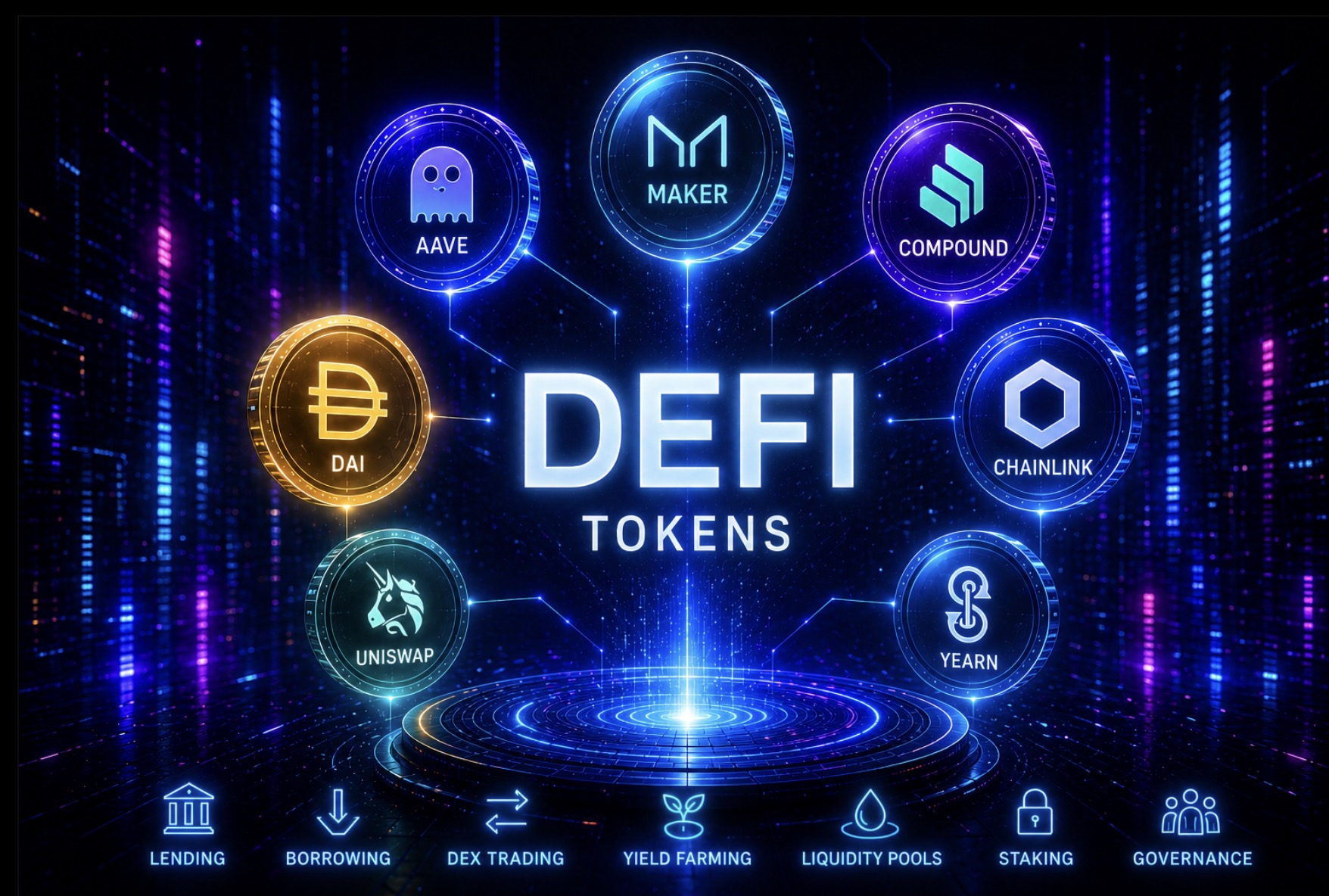
The fastest growing altcoins in DeFi for 2026 are the protocols with real revenue and defensible utility, Aave, Uniswap, and Chainlink lead on that measure, even after a rough second quarter that cut sector-wide TVL nearly in half from its early-2026 peak.
Article at a Glance: DeFi Altcoins for Daily Traders in 2026
Here’s what daily traders need to know about the fastest growing altcoins 2026 has produced so far:
- Total DeFi TVL peaked near $130–140 billion in early 2026 before falling roughly 37-39% following an April 2026 exploit wave and broader market correction, sitting at approximately $71–72 billion as of mid-June 2026, real capital is still there, but the “no longer experimental” story now comes with a sharp reminder of protocol risk.
- Aave (AAVE) remains the largest DeFi lending protocol with roughly $12–14 billion in TVL as of mid-2026, down from $26.4 billion in mid-April after the KelpDAO exploit triggered a multi-billion-dollar outflow, still the benchmark daily traders should monitor, but no longer untouched.
- Not all altcoin growth is equal, the difference between protocols generating real revenue (Aave, Uniswap) and those running on speculation alone determines which tokens survive the next market correction.
- One altcoin on this list has secured over $16 trillion in cumulative value yet remains consistently undervalued relative to its role in the entire DeFi ecosystem, keep reading to find out which one.
- Daily traders who allocate across lending, DEX, and infrastructure tokens are better positioned to capture upside while managing sector-specific risk in 2026’s volatile crypto environment.
Table of Contents
- DeFi’s Boom and Bust in 2026
- What Makes a DeFi Altcoin Worth Trading Daily
- 1. Aave (AAVE)
- 2. Uniswap (UNI)
- 3. Chainlink (LINK)
- 4. Lido (LDO)
- 5. MakerDAO/Sky (MKR/SKY)
- 6. Curve (CRV)
- 7. Compound (COMP)
- How to Compare These Tokens Before You Trade
- The DeFi Altcoin Landscape in 2026
- Frequently Asked Questions
DeFi’s fastest-growing altcoins in 2026 aren’t random moonshots, they’re protocols with billions locked in, real revenue, and token mechanics that actually reward holders. This roundup of the fastest growing altcoins 2026 has to offer covers exactly which ones, and why.
The crypto market has matured enough that chasing hype alone is a losing strategy. What separates profitable daily traders from the crowd right now is understanding which DeFi tokens have structural advantages, TVL dominance, fee capture models, and on-chain utility that drives genuine demand. Zipmex covers these market dynamics closely, making it a useful resource for traders who want data-driven insight rather than speculation-fueled noise.
This guide breaks down seven DeFi altcoins that are driving the most meaningful growth in 2026, with specific numbers, honest risk levels, and clear takeaways for daily traders.
DeFi’s Boom and Bust in 2026 – Fastest Growing Altcoins 2026
The total value locked across DeFi protocols climbed to the $130–140 billion range in early 2026, according to CoinLaw market research, up sharply from prior cycles. That was not a speculative figure, it represented actual capital deployed into smart contracts, earning yield, enabling trades, and backing stablecoins. But the story didn’t stop there. A wave of high-profile exploits in April 2026, most significantly a $293 million bridge attack on the liquid restaking protocol KelpDAO, triggered contagion across lending markets that accepted the stolen collateral. Combined with a broader market correction following Bitcoin’s October 2025 peak, total DeFi TVL fell roughly 37-39% over the following months, landing at approximately $71–72 billion by mid-June 2026.
What makes this still matter for daily traders is the composition, even after the pullback. Unlike the 2021 bull run, which was heavily driven by retail speculation and unsustainable yield farming incentives, the underlying 2026 DeFi base is anchored by established protocols with audited contracts and multi-year track records. Aave, Lido, and Uniswap collectively still account for a substantial share of locked capital, even after the spring correction. CoinLaw’s longer-term projection puts the sector’s compound annual growth rate at 43.3% looking forward, though 2026 itself has been a volatile year for that trajectory rather than a straight line up.
The risk environment has shifted as a direct result. The April 2026 KelpDAO exploit wasn’t just a hypothetical warning, attackers drained roughly $293 million in restaked ETH from KelpDAO’s bridge, then deposited the stolen tokens as collateral on Aave to borrow against, leaving the protocol with an estimated $196 million in bad debt and triggering a multi-billion-dollar wave of withdrawals. Composability risk, where one protocol’s vulnerability cascades through others, is no longer a theoretical concern for daily traders. Anyone ignoring smart contract risk in favor of price action alone is trading blind.
What Makes a DeFi Altcoin Worth Trading Daily
Three fundamentals separate a tradeable DeFi altcoin from a token that just follows Bitcoin’s price movements with extra volatility. Understanding these before placing any position is non-negotiable.
Total Value Locked (TVL) as a Performance Signal
TVL is the most direct measure of a protocol’s actual usage. When TVL rises, it means more capital is being deployed into that protocol, which typically signals confidence from sophisticated money. For daily traders, TVL trend matters more than the snapshot figure. A protocol with $5 billion TVL and a 30-day uptrend is often a stronger signal than one with $10 billion and a declining trend.
Revenue Generation vs. Speculation-Driven Price Action
A DeFi token tied to real protocol revenue has a fundamental price floor that pure speculation tokens lack. When Uniswap’s fee switch routes a percentage of trading fees back to UNI holders, the token price has an earnings-based anchor. Contrast that with tokens where price is driven entirely by narratives, those tend to collapse faster and recover slower during corrections.
Daily traders should track protocol revenue metrics alongside price charts. A token making new price highs while revenue drops is a divergence worth investigating before adding exposure. For those looking to trusted DeFi platforms, understanding these metrics can be crucial.
Token Utility: Fee Capture, Governance, and Staking
The strongest DeFi tokens in 2026 combine at least two of these three utility pillars: fee capture (revenue flows to token holders), governance (token holders direct protocol upgrades and treasury), and staking (tokens locked reduce circulating supply while earning yield). Protocols that check all three boxes, like Aave and MakerDAO, tend to have more stable demand curves than single-utility tokens.
1. Aave (AAVE), The Lending Protocol Still Leading DeFi After a Rough Q2
Aave isn’t just the largest DeFi lending protocol, it’s the benchmark that every other lending protocol is measured against, though 2026 has tested that position more than any prior year. Aave V3 held approximately $26.4 billion in TVL as of mid-April 2026, its cycle peak. On April 18, an exploit on the liquid restaking protocol KelpDAO saw attackers deposit stolen collateral onto Aave to borrow against, leaving the protocol with roughly $196 million in bad debt and triggering a wave of withdrawals that pulled Aave’s TVL down to approximately $17–20 billion within days, and further to around $12–14 billion by mid-2026. Aave briefly lost its position as DeFi’s single largest protocol as a result, though it has remained the dominant name in lending. For those looking to invest in cryptocurrency, Aave still offers one of the most established platforms for lending, even with the added scrutiny 2026 has brought.
For daily traders, AAVE matters beyond its price chart. The protocol’s borrow rates and utilization ratios across different asset pools are leading indicators of broader DeFi sentiment. When stablecoin borrow demand spikes on Aave, it often precedes leveraged positioning across the market, a signal experienced traders use to anticipate momentum shifts. For those looking to earn passive income with crypto, understanding these dynamics can be crucial.
How Aave V4 Changed the Lending Game in 2026
Aave V4 introduced a more modular risk architecture that isolates collateral types more effectively than previous versions. This means a volatile asset causing liquidation pressure in one pool no longer threatens liquidity across the entire protocol, at least in theory. The April 2026 KelpDAO episode tested that isolation model under real conditions and exposed how concentrated exposure to a single collateral type, in this case wrapped ETH paired against restaked ETH, can still create outsized damage even with more modular architecture. For traders using Aave as part of leveraged strategies, that episode is a live case study in how much systemic risk actually remains.
Why Daily Traders Watch AAVE’s Borrow Rates
Borrow rates on Aave are market-determined and reflect real-time demand for leverage. When ETH borrow rates spike, it indicates traders are borrowing ETH, often to short it or to deploy it elsewhere for yield. Stablecoin borrow rate increases typically signal traders are taking on leveraged long positions. These are live, on-chain sentiment signals that no centralized exchange provides with the same transparency.
AAVE token itself benefits from protocol fee distributions and governance utility. Realistic stablecoin lending yields on Aave in 2026 run between 2–5% APY, while riskier asset pools can exceed that significantly. The token’s market cap has compressed sharply alongside the TVL decline and now sits closer to the $1.3–1.4 billion range, down from levels above $2 billion earlier in the year, a reminder that AAVE’s price and Aave’s protocol health move together more directly than some traders assume.
2. Uniswap (UNI), Billions in Daily Volume and a Fee Buyback Model
Uniswap processes roughly $1.9–2 billion in 24-hour trading volume as of mid-2026, translating to somewhere in the $13–14 billion range on a weekly basis depending on market conditions, making it the dominant decentralized exchange by activity in 2026. That volume figure isn’t just impressive, it’s the engine behind the protocol’s fee revenue, which now flows directly to UNI token holders through the activated fee switch.
The fee switch activation, live since December 2025, is the most important structural change to UNI’s tokenomics in the protocol’s history. Before it, UNI was primarily a governance token with limited direct value accrual. Now, 17% of the trading fees generated across Uniswap pools on Ethereum and several other chains routes back to token holders through a buyback-and-burn mechanism, creating an earnings-based demand mechanism that fundamentally changes how the token should be valued.
For daily traders, Uniswap’s volume data is also a market health indicator. Significant spikes in DEX volume often precede or accompany major price moves in underlying assets, watching Uniswap’s on-chain volume through tools like Dune Analytics gives traders an edge that off-chain data sources simply can’t replicate.
How the UNI Fee Switch Creates Real Token Value
The fee switch routes a share of Uniswap’s trading fees, generated from the protocol’s 0.05%, 0.30%, and 1.00% fee tiers, to UNI holders via buyback and burn. This transforms UNI from a pure governance token into something closer to an equity stake in one of crypto’s highest-revenue protocols. For daily traders evaluating whether to hold or trade UNI, fee revenue per token is now a metric worth calculating, not just price momentum.
3. Chainlink (LINK), The Oracle Powering $16 Trillion in Secured Value
Chainlink has secured over $16 trillion in cumulative value across the smart contracts it powers, a figure that puts its infrastructure role in stark perspective. Unlike protocol TVL, which is a live snapshot and can swing sharply with market conditions as 2026 has shown, this is a cumulative measure of value that has flowed through Chainlink-secured contracts over time. Without Chainlink’s price feeds, most of the lending protocols, synthetic asset platforms, and derivatives markets in DeFi would simply stop functioning. LINK is not a speculative bet on a new idea, it’s a position on the backbone of the entire DeFi ecosystem.
- Price Feeds: Chainlink delivers tamper-resistant price data to hundreds of DeFi protocols, including Aave and Compound, making accurate liquidations and loan valuations possible.
- Cross-Chain Interoperability Protocol (CCIP): Chainlink’s CCIP enables secure token transfers and message passing across different blockchains, positioning it as critical infrastructure for multi-chain DeFi in 2026.
- Real-World Asset (RWA) Integration: Major financial institutions are using Chainlink to bring tokenized real-world assets on-chain, expanding the protocol’s reach well beyond native crypto markets.
- Staking: Chainlink staking allows LINK holders to earn yield while contributing to oracle network security, adding a direct value accrual mechanism to the token’s utility stack.
LINK’s role in real-world asset integration deserves particular attention from forward-thinking traders. As tokenized treasuries, real estate, and private credit markets expand on-chain in 2026, Chainlink’s oracle infrastructure becomes the connective tissue between traditional finance and DeFi. That’s a secular growth tailwind that doesn’t depend on crypto market cycles to materialize, and it’s notable that this part of Chainlink’s story held up even while broader DeFi TVL was falling sharply in the spring.
For daily traders, LINK tends to move with broader DeFi sentiment but often lags initial rallies before catching up sharply, a pattern that creates specific entry opportunities for those tracking on-chain data and protocol adoption metrics rather than price alone.
Why LINK Is a DeFi Infrastructure Bet, Not Just a Token
Most altcoins derive value from speculation about future adoption. LINK derives value from adoption that already exists, right now, today, at scale. Every time Aave processes a liquidation, every time a synthetic asset platform updates its price feed, every time a cross-chain bridge verifies asset values, Chainlink’s oracle network is doing the work behind the scenes. That’s not a roadmap promise, that’s current, verifiable on-chain activity.
For daily traders, this creates a specific dynamic: LINK’s price doesn’t always reflect its fundamental utility in real time. The market frequently undervalues infrastructure tokens during altcoin rallies because they lack the narrative excitement of newer projects. That lag between utility and price is where informed traders find asymmetric opportunity, buying LINK when DeFi TVL is expanding but LINK hasn’t yet repriced to reflect increased oracle demand.
Chainlink’s Role in Real-World Asset Integration
Chainlink in 2026: Infrastructure at Scale
Value Secured: Over $16 trillion cumulative across smart contracts
Key Integrations: Aave, Compound, Synthetix, and hundreds more DeFi protocols
RWA Role: Oracle infrastructure for tokenized treasuries, real estate, and private credit
CCIP: Cross-chain messaging enabling secure multi-chain DeFi interactions
Staking Yield: LINK holders earn yield by securing oracle network integrity
Institutional Partners: Major traditional financial institutions actively using Chainlink for on-chain asset verification
The real-world asset (RWA) narrative is one of the most consequential trends in crypto in 2026, and Chainlink is positioned at the center of it. Tokenized U.S. treasuries, private credit instruments, and real estate assets all require reliable, manipulation-resistant price feeds to function on-chain, which is precisely what Chainlink provides. As institutional capital continues flowing into tokenized RWAs, the demand for Chainlink’s oracle services scales proportionally.
What this means practically for traders is that LINK has exposure to both the native DeFi growth cycle and the institutional RWA adoption curve simultaneously. That dual exposure is rare among DeFi tokens and gives LINK a broader demand base than most altcoins in the same market cap range. For those interested in understanding how to invest in cryptocurrency with low risk, this dual exposure could present a unique opportunity.
Daily traders should watch Chainlink’s new integration announcements closely, each new protocol or institutional partnership that plugs into Chainlink’s oracle network increases the baseline demand for LINK tokens used to compensate node operators. It’s a compounding adoption story that doesn’t require crypto bull market conditions to generate fundamental value.
4. Lido (LDO), Liquid Staking Still Leading After a Contraction to ~$18–19 Billion TVL
Lido solved one of Ethereum staking’s biggest problems: the trade-off between earning yield and maintaining liquidity. Before liquid staking, ETH holders who wanted staking rewards had to lock their assets with no ability to deploy them elsewhere. Lido changed that by issuing stETH, a liquid token representing staked ETH, that can be used across DeFi protocols while the underlying ETH continues earning staking rewards.
The result is a protocol that held over $30 billion in liquid staking TVL at its 2025 cycle peak, and has since settled to approximately $18–19 billion as of mid-2026 following the broader DeFi contraction, still making Lido the largest liquid staking protocol by a wide margin. That TVL figure represents actual ETH staked through Lido’s validator network, not leveraged positions or synthetic exposure. It’s real capital, staked by real users who have chosen Lido as their preferred staking infrastructure, a meaningful signal of protocol trust and dominance even after the pullback.
For daily traders, LDO’s price is closely correlated with ETH staking demand and broader Ethereum network activity. When ETH staking yields are attractive relative to DeFi alternatives, more ETH flows into Lido, which drives LDO governance token demand. Monitoring the ETH staking participation rate and Lido’s market share of total staked ETH are the two most important on-chain metrics for timing LDO positions.
How Liquid Staking Lets You Earn and Trade at the Same Time
When you stake ETH through Lido, you receive stETH at a 1:1 ratio. That stETH is not a locked position, it’s a fully transferable token that can be supplied as collateral on Aave, traded on Curve’s stETH/ETH pool, or used in dozens of other DeFi protocols. Meanwhile, the staking rewards accrue directly in your stETH balance, which gradually increases relative to regular ETH as validator rewards compound. Realistic ETH liquid staking yields through Lido in 2026 run between 3–8% APY, depending on network conditions.
This composability is what makes Lido uniquely powerful in the DeFi ecosystem. A trader can stake ETH via Lido, receive stETH, supply that stETH to Aave as collateral, borrow stablecoins against it, and deploy those stablecoins into yield strategies, all while continuing to earn ETH staking rewards on the original position. That kind of capital efficiency is only possible in DeFi, and Lido is the infrastructure layer that enables it.
Risks Specific to Lido That Daily Traders Must Know
Lido’s concentration of staked ETH raises genuine centralization concerns, at recent levels Lido has controlled close to 28% of all staked Ether, which creates systemic risk for the Ethereum network itself as it approaches thresholds where a single protocol could interfere with consensus. Additionally, stETH can trade at a slight discount to ETH during periods of market stress, as seen during the 2022 liquidity crisis and again briefly during April 2026’s exploit-driven volatility. Daily traders holding stETH through volatile periods should monitor the stETH/ETH peg on Curve and have a clear exit plan if the discount widens significantly. Smart contract risk across both Lido’s staking contracts and any integrated DeFi protocol compounds the risk profile further.
5. MakerDAO/Sky (MKR/SKY), The Conservative DeFi Entry
MakerDAO, now rebranding progressively under the Sky protocol, is the protocol behind DAI and its successor USDS, among DeFi’s most battle-tested decentralized stablecoins. With DAI and USDS combined circulating supply in the $4–8 billion range as of mid-2026 (Sky has publicly targeted USDS supply doubling to $20.6 billion by year-end) and a governance structure that has navigated multiple market crises without a protocol failure, MKR/SKY represents the most conservative entry point on this list. The token’s value accrual mechanism is straightforward: a portion of the stability fees (interest paid by DAI/USDS borrowers) is used to buy back and burn MKR, now converting to SKY at a 1:24,000 ratio, reducing supply over time. For daily traders who want DeFi exposure with lower volatility than AAVE or CRV, MKR/SKY offers a more predictable risk profile backed by genuine protocol revenue and a decade of operational history.
6. Curve (CRV), The Stablecoin DEX Daily Traders Use for Yield Farming
Curve Finance is the backbone of stablecoin liquidity in DeFi. While Uniswap dominates general token trading, Curve specializes in low-slippage swaps between assets that should trade at similar prices, stablecoins, liquid staking tokens like stETH, and wrapped assets. This specialization makes Curve the go-to infrastructure for any DeFi protocol that needs deep, efficient stablecoin liquidity.
The protocol’s TVL has moved lower alongside the broader 2026 DeFi contraction, sitting in an estimated $1.3–2 billion range as of mid-2026 depending on the data source and date checked, down from its earlier-2026 levels but still representing a more sustainable base built on genuine trading demand rather than inflated incentive farming. Curve’s pools generate fees from every swap, and those fees flow to liquidity providers and CRV token holders who lock their tokens as veCRV (vote-escrowed CRV), the mechanism at the heart of Curve’s entire tokenomics model.
For daily traders, Curve is worth tracking for two distinct reasons. First, the stETH/ETH pool on Curve is the primary on-chain indicator of liquid staking peg health, if that pool becomes imbalanced, it signals stress across multiple DeFi protocols simultaneously, exactly what traders watched play out briefly during April 2026’s exploit fallout. Second, CRV itself is a tradeable token with significant volatility, driven by the competitive dynamics of the “Curve Wars”, the ongoing battle between protocols for CRV voting power to direct liquidity incentives toward their own pools.
Curve (CRV) Quick Stats, Mid-2026
- Protocol TVL: Approximately $1.3–2 billion (estimates vary by data source)
- Primary Function: Low-slippage stablecoin and pegged-asset swaps
- Token Locking: CRV locked as veCRV (up to 4 years) for boosted rewards and governance
- Risk Level: Medium-High
- Key Pool: stETH/ETH pool, primary on-chain peg health indicator
- Best For: Liquidity providers and yield farmers with active risk management
How the CRV Tokenomics Model Rewards Long-Term Holders
Curve’s veCRV system is one of the most sophisticated tokenomics models in DeFi. When you lock CRV tokens for up to four years, you receive veCRV, non-transferable voting power that determines which Curve pools receive CRV liquidity incentives (called “gauge weights”). Longer lock periods give more veCRV, which translates to higher yield boosts on your own liquidity positions and a larger share of the 50% of trading fees distributed to veCRV holders.
The practical effect for committed holders is compounding: more veCRV means higher boosted yields on LP positions, which generates more CRV, which can be locked for more veCRV. For daily traders considering CRV, understanding this flywheel is critical, it explains why protocols spend tens of millions of dollars acquiring CRV voting power, and why CRV demand is structurally tied to the success of every protocol that depends on Curve liquidity.
Why CRV Carries Higher Risk Than AAVE or UNI
CRV’s tokenomics create significant sell pressure from liquidity mining emissions, the protocol continuously distributes new CRV to liquidity providers, and many of those providers sell immediately. This constant emission schedule means CRV price requires equally constant demand (from protocols buying for gauge votes, from yield farmers locking) just to stay flat. In bear markets or low-activity periods, that balance tips toward sell pressure quickly, and 2026’s broader TVL contraction has made that dynamic more visible.
Additionally, Curve’s founder has historically held a large CRV position that was used as collateral across multiple DeFi lending protocols, a known overhang that triggered significant volatility when those positions faced liquidation risk in 2023. While that immediate crisis has passed, it’s a reminder that CRV carries protocol-specific risks beyond standard smart contract and market risk. Traders should size CRV positions accordingly and monitor the founder’s on-chain wallet activity as part of their risk management process.
7. Compound (COMP), The Protocol That Started DeFi Lending
Compound pioneered the automated lending market model that Aave and virtually every other DeFi lending protocol subsequently built upon. Launched in 2018, it was Compound’s liquidity mining program in 2020 that effectively launched the “DeFi Summer” era, distributing COMP tokens to borrowers and lenders and triggering an industry-wide explosion in TVL and token prices. That historical significance doesn’t translate directly to 2026 price performance, but it does mean Compound has one of the most trusted DeFi platforms with one of the most battle-tested smart contract codebases in DeFi, with years of adversarial conditions survived.
Where COMP Stands in 2026 Against Newer Competitors
Compound has ceded its TVL leadership to Aave decisively, Compound V3 sits at roughly $1.1 billion in TVL as of mid-2026, a fraction of Aave’s position even after Aave’s own sharp contraction, and Aave V4’s modular architecture offers more flexibility than Compound’s more rigid pool structure. However, Compound’s governance has been actively working on Compound III (Comet), a redesigned architecture that focuses on capital efficiency and reduced risk by moving to a single-borrowable-asset model. For daily traders, COMP is a higher-risk, higher-volatility play on whether Compound’s development roadmap can recapture meaningful market share from Aave, a genuine uncertainty that should be priced into any position size.
How to Compare These Tokens Before You Trade
Raw token prices and market cap rankings tell you almost nothing useful about which DeFi altcoin is worth trading on a given day. The traders who consistently extract value from these markets use a structured comparison framework built around on-chain fundamentals, not price charts alone.
Before entering any position in the tokens covered here, run through these four checkpoints systematically:
1. Check TVL Trends, Not Just Current Numbers
A protocol’s current TVL snapshot tells you where capital is parked right now. The 30-day TVL trend tells you where sophisticated money is moving, and that’s the signal worth trading on. 2026 has been an especially important year to internalize this lesson, protocols that looked unshakeable in April looked very different by June after the KelpDAO-driven contagion. A protocol showing consistent TVL growth over 30 days is attracting new capital, which typically precedes token price appreciation as demand for governance and utility functions increases alongside usage.
Use DeFiLlama to pull historical TVL data for any protocol on this list. Look specifically at the TVL-to-market-cap ratio, when a protocol’s TVL grows faster than its token’s market cap, it often signals the token is undervalued relative to its actual usage. That divergence is one of the cleanest entry signals available in on-chain data.
Pay particular attention to TVL changes during broader market downturns. Protocols that maintain or grow TVL during price corrections demonstrate genuine user dependency rather than speculative capital that evaporates the moment sentiment shifts. That resilience is a quality signal that price action alone cannot show you.
2. Look at Protocol Revenue, Not Token Price Alone
Protocol revenue is the on-chain equivalent of earnings per share, it tells you whether the underlying business is generating real value. Token Terminal tracks revenue for every major DeFi protocol in real time, breaking it down by daily, weekly, and annualized figures. Before entering a position in AAVE, UNI, CRV, or COMP, check their current revenue run rate against their market cap. A protocol with a price-to-revenue ratio significantly below its historical average is a potential value entry; one with a ratio at multi-year highs warrants caution regardless of price momentum.
3. Match Risk Level to Your Trading Strategy
Not every token on this list belongs in every trader’s portfolio. The risk ladder runs clearly from MKR/SKY (most conservative, single-digit billions in TVL, decade of operational history) through AAVE and LINK (established, high TVL even after 2026’s contraction, diversified revenue) to UNI and LDO (strong fundamentals, moderate volatility) and up to CRV and COMP (higher volatility, more complex risk factors requiring active monitoring). A common framework used by experienced DeFi traders allocates roughly 60% of crypto exposure to BTC/ETH, 20–30% to established DeFi tokens like AAVE and LINK, and 5–10% to higher-risk positions like CRV.
Daily traders who ignore this risk ladder and concentrate in high-volatility DeFi tokens without a clear exit strategy are the ones who give back gains during corrections. Decide your risk tolerance before the position, not after the price moves against you.
4. Use On-Chain Data Tools to Confirm Activity
Price charts are trailing indicators. On-chain data is leading. The four tools every serious DeFi trader should have open daily are: DeFiLlama for TVL tracking across all protocols, Token Terminal for protocol revenue and P/S ratios, Dune Analytics for custom on-chain queries including Uniswap volume and Aave borrow rate trends, and Nansen for tracking smart money wallet movements into and out of DeFi positions. When on-chain activity and price diverge, when volume and TVL are rising but price hasn’t moved yet, that’s the setup experienced DeFi traders are actively hunting for.
The DeFi Altcoin Landscape in 2026 Rewards the Informed Trader
With DeFi TVL having moved from a $130–140 billion early-2026 peak down to roughly $71–72 billion by mid-year, a still-substantial 43.3% long-term projected CAGR, and established tokens like Aave, Uniswap, and Chainlink generating verifiable on-chain revenue even through the correction, the case for informed DeFi exposure in 2026 remains real, though considerably more risk-aware than it looked in January. The traders who profit from these markets aren’t chasing hype, they’re reading TVL trends, protocol revenue, and on-chain wallet flows before the price chart catches up. The seven tokens covered here represent the most credible, data-backed positions in DeFi right now, each with distinct risk profiles, real utility, and structural demand drivers that don’t depend on speculation alone to sustain price over time. For those seeking platforms with high security and privacy, check out the most trusted no-KYC crypto exchanges and DeFi platforms.
Frequently Asked Questions
Below are the most common questions daily traders ask when approaching the fastest growing altcoins 2026 has produced, answered directly, with no filler.
What is the fastest growing altcoin in DeFi right now in 2026?
By TVL and protocol dominance, Aave (AAVE) still holds the strongest position in DeFi lending despite a sharp contraction from $26.4 billion in mid-April 2026 to roughly $12–14 billion by mid-year following the KelpDAO exploit. For infrastructure growth, Chainlink (LINK) stands out given its expanding role in real-world asset tokenization and cross-chain interoperability, two of the highest-growth narratives in crypto in 2026 that held up even through the broader TVL correction. “Fastest growing” depends on the metric: if you’re tracking TVL resilience, Aave and Lido remain the largest names despite the pullback; if you’re tracking adoption curve and addressable market expansion, Chainlink’s RWA and CCIP integration story is the most compelling forward-looking case. For those interested in the broader context of DeFi platforms, you might want to explore trusted DeFi platforms and their impact on the market.
Is DeFi still profitable for daily traders in 2026?
Yes, but profitability in DeFi requires a different approach than centralized exchange trading, and 2026 has made that more true than ever. Daily traders who combine on-chain data analysis with technical setups consistently find edges in DeFi tokens that pure price-action traders miss. The key is using protocol metrics (TVL trends, revenue, borrow rates) as leading indicators before price moves confirm the direction. For a deeper understanding of decentralized platforms, check out trusted DeFi platforms that provide valuable insights and opportunities.
Realistic yield benchmarks for 2026: stablecoin lending on Aave and Compound generates 2–5% APY, ETH liquid staking via Lido returns 3–8% APY, and higher-risk yield farming strategies can exceed those figures but come with proportionally higher smart contract and liquidity risk. Profitability is real but not guaranteed, the April 2026 KelpDAO exploit and the roughly 37-39% sector-wide TVL decline that followed are a direct reminder that even established DeFi ecosystems carry vulnerabilities that can materialize quickly and at scale.
What is total value locked (TVL) and why does it matter for altcoin trading?
Total value locked (TVL) is the total amount of crypto assets deposited into a DeFi protocol’s smart contracts at any given time. It matters for altcoin trading because it’s the most direct measure of a protocol’s actual usage and the market’s trust in its security. Higher TVL means more capital is generating fees for the protocol, which drives revenue to token holders and increases the fundamental value backing the token’s price. For daily traders, TVL trend is more actionable than the absolute figure, rising TVL in a specific protocol often precedes token price appreciation as demand for governance and staking functions increases alongside usage, while a sharp TVL decline, as 2026 demonstrated with Aave, can signal real protocol-specific risk that price alone won’t show you in time.
Which DeFi token is the safest to invest in for beginners?
MakerDAO/Sky (MKR/SKY) offers the most conservative entry point among the tokens covered here, with a decade of operational history and a token buyback-and-burn mechanism tied to real protocol revenue. For beginners who want broader DeFi exposure with a more established track record, AAVE is the second-most conservative choice given its continued dominance in the lending sector, though 2026’s KelpDAO episode is a reminder that even the largest protocols carry real exploit risk. No DeFi token is without risk, smart contract vulnerabilities, market volatility, and regulatory developments affect all of them, but MKR/SKY and AAVE have the longest track records of navigating those risks without a protocol-level failure of their own contracts.
How do I start trading DeFi tokens like AAVE or UNI today?
Start by setting up accounts on both a centralized exchange (for fiat on-ramp and initial token purchases) and a self-custody wallet like MetaMask or Rabby Wallet (for direct DeFi protocol interaction). Most major DeFi tokens including AAVE, UNI, LINK, LDO, MKR, CRV, and COMP are available on centralized exchanges for straightforward spot trading without requiring on-chain interaction.
If you want to interact directly with DeFi protocols, supplying liquidity to Aave, trading on Uniswap’s interface, or locking CRV as veCRV, you’ll need ETH in your self-custody wallet to cover gas fees. Start with small positions to understand the mechanics before scaling. Gas fees on Ethereum mainnet can be significant during high-activity periods; many traders use Layer 2 networks like Arbitrum or Optimism where Aave and Uniswap are both deployed, with dramatically lower transaction costs.
Before entering any position, run through the four-point framework covered above: check TVL trends on DeFiLlama, verify protocol revenue on Token Terminal, confirm your position size matches your risk tier for that specific token, and use Dune Analytics to cross-reference on-chain activity before committing capital. Trading DeFi tokens without on-chain data is like trading stocks without reading earnings reports, technically possible, but you’re operating at a significant informational disadvantage compared to traders who do.
DYOR Disclaimer
This article is for informational purposes only and does not constitute financial, investment, or tax advice. DeFi protocols carry smart contract risk, liquidity risk, and market volatility, TVL and price figures change quickly and should always be verified against current data before making decisions. Always do your own research (DYOR) and consult a qualified financial professional before making any investment decisions.


Latest
Altcoins
08 Jul 2026
Altcoins
04 Jul 2026
Altcoins
21 May 2026
Altcoins
13 May 2026
Altcoins
15 Mar 2026