Coinposters
Crypto Market Report Week of July 13, 2026 Fear & Greed Index Eases As $197.4M Flows Back Into Bitcoin ETFs
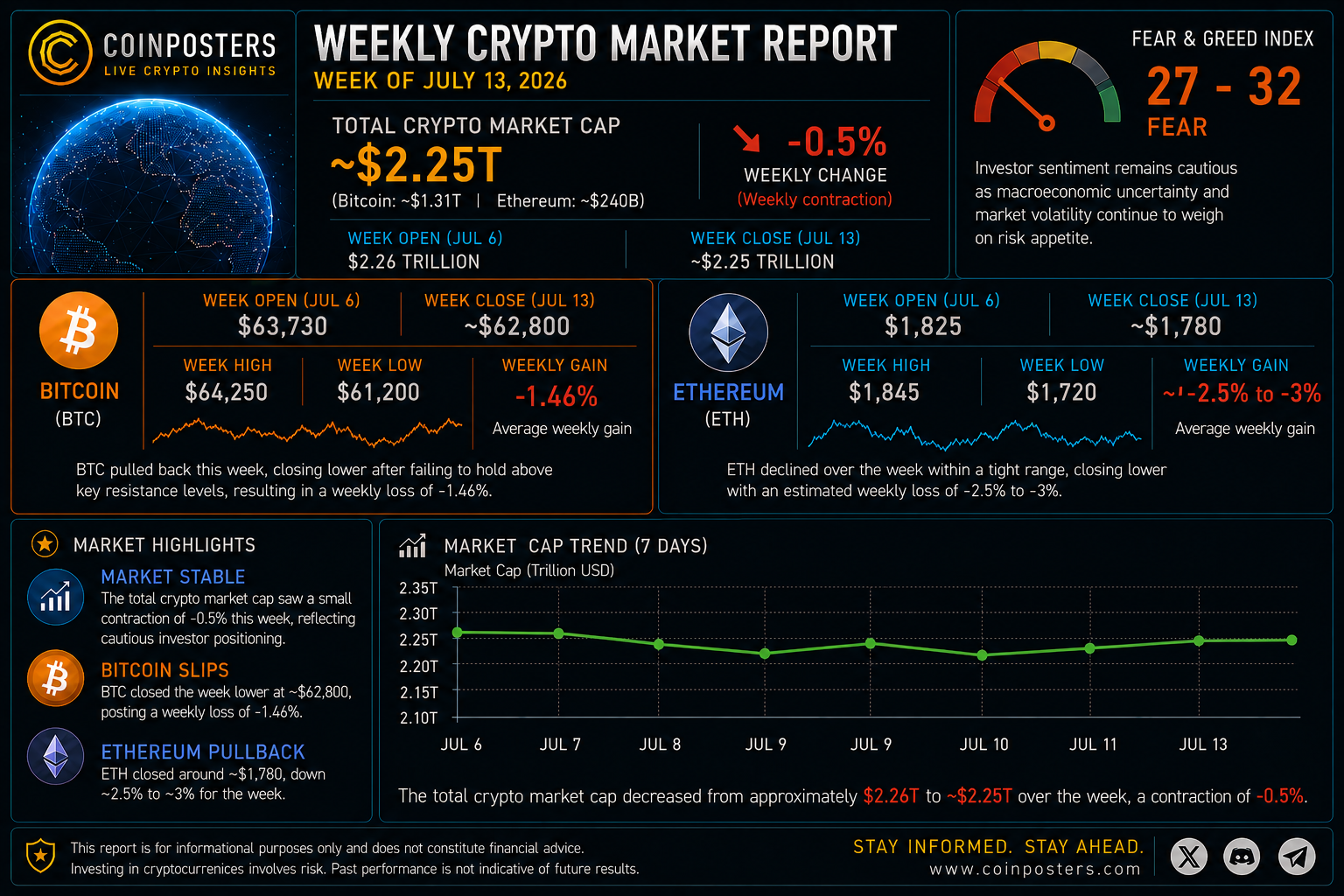
Bitcoin defended $62,000 through geopolitical stress as seen in the Crypto Market Report July 13 2026, ETF inflows reversed an eight-week outflow streak, and Circle secured a landmark federal bank charter, structural developments that matter more than the range-bound price action suggests.
Article at a Glance: This Week’s Crypto Market Report
Here’s what this crypto market report for the week of July 13, 2026 covers:
- Bitcoin held the $62,000 level this week despite renewed geopolitical pressure, with BTC dominance climbing to 58.92%, a sign traders are rotating to safety, not altcoins.
- The total crypto market cap sits at $2.16T, with stablecoin dominance signaling a large portion of capital is still waiting on the sidelines for a clearer macro signal.
- U.S. spot Bitcoin ETFs snapped an eight-week outflow streak with $197.4M in net inflows, a potential inflection point worth watching closely.
- Circle received OCC approval for a national trust bank charter, a landmark moment for institutional-grade digital asset custody in the U.S.
- The GENIUS Act’s July 18 final rule deadline could reshape the $318B stablecoin market almost overnight, and most traders aren’t positioned for it.
Table of Contents
- Bitcoin Holds $62K as Markets Navigate Macro Headwinds
- Total Crypto Market Cap Sits at $2.16T This Week
- U.S. Spot Bitcoin ETFs Snap an Eight-Week Outflow Streak
- Circle Gets OCC Approval for a National Trust Bank
- Crypto IPO Class of 2025-2026 Continues to Bleed
- Robinhood Chain and Polymarket Signal a Maturing Ecosystem
- 3 Key Events That Could Move Crypto Markets Next Week
- What This Week’s Data Tells You About Where Crypto Is Headed
- Frequently Asked Questions
The crypto market in July 2026 is not broken, it’s compressed. Pressure from multiple directions is keeping prices range-bound, but the structural developments underneath the surface are some of the most consequential the industry has seen in years. This crypto market report for the week of July 13, 2026 breaks down exactly what’s happening.
This week’s report cuts through the noise and gives you the data, context, and forward-looking signals that actually matter. Whether you’re actively trading or building a long-term position, understanding what’s driving BTC dominance, ETF flows, and regulatory catalysts right now is the difference between reacting and being ready.
Bitcoin Holds $62K as Markets Navigate Macro Headwinds
Bitcoin spent most of this week absorbing a geopolitical shock that would have triggered a much sharper selloff in prior cycles. Renewed Middle East tensions pushed oil prices higher and sent investors fleeing from risk assets broadly, yet BTC held firm near $62,000, a sign that the holder base is significantly more seasoned and less leveraged than in previous market cycles.
BTC Dominance at 58.92% Signals Cautious Sentiment
When Bitcoin dominance rises, it typically means one of two things: Bitcoin is outperforming altcoins in a rally, or traders are consolidating into BTC as a relative safe haven within crypto. Right now, it’s the latter. Dominance sitting above 58% tells you that the broader altcoin rotation hasn’t started yet, and it won’t until macro conditions give investors a clear green light.
| Metric | Current Value | Last Week |
|---|---|---|
| BTC Price | $62,300 | Below 30-day MA |
| BTC Dominance | 58.92% | +0.4% |
| ETH Dominance | 10% | +0.1% |
| Total Market Cap | $2.16T | -0.5% |
| BTC Fear & Greed | 28 | 24 |
| ETH Sentiment | 52 | 57 |
The Fear & Greed index moved from 24 to 28 this week, still deep in fear territory, but the direction matters. Gradual recovery in sentiment, paired with ETF inflows reversing, suggests the market may be quietly bottoming rather than preparing for another leg down.
The $62,000 Support Level and What Comes Next
Bitcoin’s ability to hold $62,000 through a week of geopolitical stress is technically significant. This level has acted as a demand zone multiple times in recent months, and each successful defense of it strengthens the floor. The key risk to the downside remains a sustained spike in oil prices or an escalation in conflict that triggers broader risk-off selling across equities and crypto simultaneously.
What’s working in Bitcoin’s favor is the deleveraged state of the market. Open interest has been steadily declining, which means there are fewer overleveraged long positions waiting to get liquidated on a dip. That structural cleanliness is part of why BTC absorbed this week’s news without meaningful dislocation.
“The tank is full but the ignition hasn’t fired.”
Why $64,400 Is the Key Breakout Level to Watch
Bitcoin moved back above $64,000 briefly late last week before pulling back. Options market positioning shows traders are not aggressively chasing upside, defensive structures are still dominant. A clean weekly close above $64,400 would signal a shift in that posture and likely trigger the next wave of institutional buying. Until then, the range holds.
Total Crypto Market Cap Sits at $2.16T This Week
The total crypto market cap came in at $2.16T this week, down slightly from the prior week’s $2.25T reading. That contraction is modest in percentage terms but reflects a market that is not yet attracting meaningful new capital. Here’s where the major asset classes stand right now:
- Bitcoin (BTC): $62,300, up 2.2% on the week, trading above its 30-day moving average
- Ethereum (ETH): $1,787, holding 10% market share, sentiment at 52
- 24H Trading Volume: $60.14B, moderate activity, not indicative of a breakout or panic
- Stablecoin Dominance: Elevated, large volumes parked on the sidelines awaiting macro clarity
- BTC Fear & Greed Index: 28, fear, but improving from last week’s 24
The aggregate picture is a market in a holding pattern. The capital is there, stablecoin dominance proves that, but the conviction to deploy it aggressively hasn’t arrived yet.
Ethereum Holds 10% Market Share at $1,787
Ethereum’s 10% dominance figure is worth paying attention to. ETH sentiment dropped from 57 to 52 week-over-week, suggesting some softening in near-term conviction among ETH holders. That said, the Ethereum ETF pulled in $84.3M this week, which tells a different story at the institutional level, large players are accumulating even as retail sentiment cools.
Stablecoin Dominance Reveals Investors Are Still on the Sidelines
Elevated stablecoin dominance is one of the most underappreciated signals in crypto markets. It means a significant percentage of total crypto market value is sitting in USDC, USDT, and similar assets, not deployed into BTC, ETH, or altcoins. That’s dry powder. When macro conditions shift, whether through a Fed pivot signal, a resolution of geopolitical tension, or a regulatory catalyst, that capital can move into risk assets very quickly.
Key Insight: Stablecoin supply has stabilized, but meaningful liquidity expansion has not yet begun. The rotation from stablecoins into risk assets is the fuel that drives the next leg higher, and right now, the tank is full but the ignition hasn’t fired.
Watch stablecoin dominance as a leading indicator. When it starts declining sharply, it typically precedes a sustained altcoin rally by days to weeks.
U.S. Spot Bitcoin ETFs Snap an Eight-Week Outflow Streak
This is the most consequential data point of the week. After eight consecutive weeks of net outflows, U.S. spot Bitcoin ETFs recorded $197.4M in net inflows. Eight weeks of sustained selling pressure reversing in a single week is not noise, it’s a signal that institutional sentiment is shifting.
The timing aligns with Bitcoin’s defense of the $62,000 level. Institutions aren’t buying the breakout; they’re buying the support. That’s a more durable form of accumulation because it suggests price-sensitive buyers who have been waiting for a floor rather than momentum chasers who will sell on the first sign of weakness.
$197.4M Flows Back Into Bitcoin ETFs
To put $197.4M in context, this single week of inflows offsets a meaningful portion of the outflow damage from the prior two months. The reversal suggests that the institutional community, pension allocators, family offices, and asset managers who access BTC through regulated ETF vehicles, saw the $62,000 level as a buying opportunity rather than a warning sign.
If inflows continue at even half this pace over the next two to three weeks, the ETF bid alone could provide enough structural support to push BTC toward the $64,400 resistance level that options traders are watching.
Ethereum ETFs Pull in $84.3M
Ethereum ETFs added $84.3M in inflows this week, a strong number for a week where ETH retail sentiment softened. This divergence between retail and institutional behavior in ETH is telling. Institutions are looking at Ethereum’s 10% market share, its role in the DeFi and stablecoin infrastructure stack, and its ETF accessibility, and they’re buying. Retail traders, focused on short-term price action near $1,787, are less enthusiastic.
What This Institutional Reversal Actually Means for Price
Eight weeks of outflows followed by a single week of $197.4M in inflows doesn’t guarantee a bull run, but it does change the risk profile of the trade. When institutional money reverses direction in ETF vehicles, it tends to be sticky. These aren’t day traders flipping positions; they’re allocators rebalancing portfolios. That kind of buying creates a floor that speculative selling has a harder time breaking through. The next two weeks of ETF flow data will be the most important confirmation signal in the market right now.
Circle Gets OCC Approval for a National Trust Bank
Circle, the issuer of USDC, received approval from the Office of the Comptroller of the Currency to operate as a federally chartered national trust bank. This is one of the most significant regulatory milestones in crypto’s institutional history, and it happened with almost no fanfare from the broader market, which is too focused on short-term price action to recognize what it means structurally.
What a Federally Chartered Crypto Bank Means for Digital Asset Custody
A federally chartered trust bank designation means Circle can now offer custody services for digital assets under the direct supervision of the OCC, the same regulator that oversees some of the largest banks in the United States. For institutional clients, this eliminates one of the primary friction points in crypto adoption: the question of whether their digital assets are held by a regulated, federally accountable custodian.
The practical implications are enormous. Pension funds, insurance companies, and registered investment advisors that have been legally prohibited or internally restricted from using unchartered crypto custodians now have a pathway. USDC’s role as the backbone stablecoin of regulated finance just got significantly more credible. This isn’t just good for Circle, it raises the floor for the entire digital asset ecosystem.
ARK Invest Increases Exposure to Circle
ARK Invest moved quickly following Circle’s OCC announcement, increasing its exposure to Circle across its actively managed funds. ARK’s track record of identifying structural inflection points early, Bitcoin ETFs, fintech disruption, genomics, makes this positioning worth noting. When Cathie Wood’s team adds to a position on a regulatory catalyst, it’s rarely a short-term trade.
ARK’s increased Circle exposure also signals confidence that the GENIUS Act framework, which is set for a critical July 18 deadline, will pass in a form that benefits established stablecoin issuers like Circle over newer, less regulated competitors. That regulatory moat is exactly the kind of durable competitive advantage ARK looks for in its investments.
Crypto IPO Class of 2025-2026 Continues to Bleed
Not every story in this week’s report is bullish. The crypto IPO class of 2025 and 2026 is one of the most painful trades in the market right now, and the drawdowns are severe enough that they deserve direct attention from anyone holding these names.
Gemini Down 89%, BitGo Down 77%, Bullish Down 71% From Opening Prices
The numbers are stark. Gemini is down 89% from its IPO opening price. BitGo has lost 77% of its value since going public. Bullish is down 71%. These aren’t minor corrections, they represent near-total destruction of early investor capital in companies that were supposed to represent the institutional face of the crypto industry. The gap between crypto native adoption metrics and traditional public market valuation expectations proved to be far wider than the IPO bankers modeled for.
Why the IPO Pipeline Is Effectively Frozen
When your most prominent recent listings are down 70% to 90%, the pipeline of companies willing to go public dries up fast. Investment banks aren’t going to risk their reputations underwriting crypto IPOs into a market where institutional buyers have been badly burned. The companies that were planning 2026 listings, several crypto exchanges and infrastructure providers, are now quietly shelving those plans or exploring private funding rounds instead.
The deeper issue is valuation methodology. Public market investors price crypto companies on revenue multiples and earnings visibility, which are metrics that don’t map cleanly onto businesses whose revenue is directly correlated to crypto trading volumes and asset prices. Until the market develops a more sophisticated framework for valuing crypto-native businesses, or until trading volumes sustainably recover, the IPO window will remain effectively closed.
Robinhood Chain and Polymarket Signal a Maturing Ecosystem
Amid the macro uncertainty and IPO pain, two product-level developments this week reminded the market that crypto infrastructure is still being built at a rapid pace. Robinhood Chain’s DEX volumes and Polymarket’s U.S. regulatory filing are both signals that the ecosystem is maturing in ways that don’t always show up in BTC price charts.
These aren’t speculative projects chasing hype cycles. Robinhood is a publicly traded company with millions of retail users, and Polymarket has established itself as the most credible prediction market platform in the world. Both making significant on-chain moves in the same week suggests a convergence of traditional finance infrastructure with decentralized protocols that is accelerating faster than most analysts predicted.
Robinhood Chain DEX Volumes Surpass Ethereum and Base
Robinhood Chain recorded decentralized exchange volumes that surpassed both Ethereum mainnet and Base this week, a remarkable milestone for a chain that most crypto natives were initially skeptical about. The volume is being driven by Robinhood’s existing retail user base accessing on-chain trading through a familiar interface, which effectively removes the UX barrier that has kept mainstream users away from DeFi.
The significance here goes beyond bragging rights. When a DEX on a new chain consistently outperforms Ethereum mainnet in volume, liquidity providers and protocol developers follow. That creates a flywheel effect where more liquidity attracts more traders, which attracts more builders, which deepens liquidity further. Robinhood Chain may be early in this cycle, but the trajectory is worth watching closely.
Polymarket Files for Regulated Margin Trading in the U.S.
Polymarket filed for regulated margin trading in the United States this week, a move that signals the platform is serious about transitioning from a grey-area prediction market into a fully compliant financial product. The filing is significant because margin trading on a prediction market platform is a fundamentally different product category than spot event contracts, it implies leverage, liquidation mechanics, and a level of regulatory sophistication that most crypto platforms aren’t ready to navigate.
| Platform | Development | Significance |
|---|---|---|
| Robinhood Chain | DEX volumes surpass Ethereum and Base | Retail on-chain adoption accelerating |
| Polymarket | Filed for regulated U.S. margin trading | Prediction markets entering regulated finance |
| Circle | OCC national trust bank approval | Institutional-grade USDC custody unlocked |
| ARK Invest | Increased Circle exposure post-OCC | Institutional confidence in stablecoin infrastructure |
If Polymarket’s filing is approved, it would represent the first regulated margin trading product built on a decentralized prediction market infrastructure in the U.S. That’s a genuinely new financial product category, and the precedent it sets for how the CFTC and SEC treat on-chain derivatives markets could have far-reaching implications for the entire DeFi sector.
The broader takeaway from both Robinhood Chain and Polymarket is that the most important crypto infrastructure developments in 2026 are happening at the intersection of on-chain technology and regulatory compliance, not in spite of regulation, but because of it. The builders who learned to work with regulators are now pulling ahead of those who spent years avoiding them.
3 Key Events That Could Move Crypto Markets Next Week
Three specific catalysts on the calendar have the potential to shift market sentiment materially over the coming days. These aren’t general macro risks, they are crypto-specific events with defined timelines and measurable outcomes that traders and long-term holders alike should have on their radar.
- July 18, GENIUS Act Final Rule Deadline: Sets the compliance framework for the $318 billion stablecoin market, affecting Circle, Tether, and PayPal
- August 9, Spot Cardano ETF Review Window Opens: Not an approval date, the opening of formal SEC review eligibility
- January 18, 2027, Full GENIUS Act Framework Enforceable: Non-compliant stablecoin issuers face legal exposure and potential delisting from U.S.-regulated exchanges
1. July 18, GENIUS Act Final Rule Deadline for the $318B Stablecoin Market
July 18 is the most important date on the crypto regulatory calendar this week. The GENIUS Act’s final rule deadline sets the compliance framework for the $318 billion stablecoin market, establishing reserve requirements, issuer eligibility standards, and federal oversight protocols that every major stablecoin operator, including Circle, Tether, and PayPal, will need to meet. The market has been pricing in a benign outcome, but the specific language of the final rules could create winners and losers very quickly depending on how reserve requirements and redemption standards are structured.
2. August 9, Spot Cardano ETF Becomes Eligible for SEC Review
On August 9, a spot Cardano ETF filing becomes eligible for formal SEC review. This is not an approval date, it’s the opening of the review window. However, the precedent set by the approval of spot Bitcoin and Ethereum ETFs means the SEC is now working within a framework that has already accepted the principle of spot crypto ETFs. The question is whether Cardano’s underlying market structure, liquidity profile, and custody infrastructure meet the same standards that BTC and ETH cleared.
ADA has underperformed the broader market significantly in 2026, and a spot ETF approval would represent one of the most powerful re-rating catalysts available to the asset. Cardano’s development activity and its growing DeFi ecosystem give the filing fundamental credibility beyond pure speculation. Watch for any SEC commentary or extension notices in the days following August 9, they will move ADA price meaningfully in either direction.
3. January 18, 2027, Full GENIUS Act Stablecoin Framework Becomes Enforceable
While January 2027 may feel distant, the decisions being made right now, by issuers, custodians, banks, and exchanges, are being made in anticipation of this date. The full GENIUS Act stablecoin framework becomes enforceable on January 18, 2027, meaning any stablecoin issuer not compliant by that date faces legal exposure in the U.S. market. That six-month runway is driving a quiet but significant restructuring across the stablecoin industry.
The practical impact on the crypto market is that GENIUS Act compliance is becoming a competitive moat. Circle, which now operates under an OCC national trust bank charter, is structurally positioned to meet the January 2027 requirements more comfortably than smaller or offshore issuers. Any stablecoin that fails to meet the framework faces delistings from U.S.-regulated exchanges, which would trigger a capital migration into compliant alternatives like USDC and potentially reshape stablecoin market share dramatically.
What This Week’s Data Tells You About Where Crypto Is Headed
The data from this week paints a picture of a market that is quietly building a structural base while most participants focus on short-term price volatility. Bitcoin defending $62,000 through geopolitical stress, ETF inflows reversing after eight weeks of outflows, Circle securing federal banking status, and on-chain infrastructure reaching new volume milestones, none of these are noise. They are the foundation that the next sustained bull phase gets built on. The compressed range won’t last forever, and when it breaks, the direction will be shaped by exactly these kinds of structural developments.
The single most important variable to monitor over the next two weeks is the continuation or reversal of spot Bitcoin ETF inflows. One week of $197.4M doesn’t confirm a trend, two or three consecutive weeks would. Pair that with the July 18 GENIUS Act deadline outcome, and you have a very clear binary setup: regulatory clarity accelerates institutional deployment, or ambiguous final rules extend the waiting period. Either way, the market will give you a clear signal. Be ready to act on it before the majority of traders even process what happened.
Frequently Asked Questions
Below are the most common questions readers have about this week’s crypto market report, answered with the context needed to actually understand the mechanics, not just the headlines.
Why Is Bitcoin Dominance Above 58% a Bearish Signal for Altcoins?
Bitcoin dominance above 58% is a bearish signal for altcoins because it means capital flowing into crypto is concentrating in BTC rather than spreading across the broader market. When dominance rises, altcoins are either falling faster than Bitcoin or Bitcoin is rising while altcoins stay flat, in both scenarios, relative performance favors BTC. For insights on the fastest-growing altcoins, check out this report. Historically, major altcoin seasons begin when Bitcoin dominance starts declining from elevated levels, typically after BTC has made a significant move higher and traders rotate profits into higher-beta assets. At 58.92%, dominance is still rising week-over-week, which means that rotation hasn’t started yet. The threshold most experienced traders watch is a sustained break below 55% Bitcoin dominance. Below that level, historical data shows altcoins begin to materially outperform on a risk-adjusted basis. Until dominance breaks that threshold convincingly, overweighting altcoins relative to Bitcoin carries significantly higher risk than the potential reward justifies in the current environment.
What Is the GENIUS Act and How Does It Affect Stablecoins?
The GENIUS Act is U.S. federal legislation that establishes a comprehensive regulatory framework for stablecoin issuers operating in the United States. It sets requirements for reserve backing, redemption rights, issuer licensing, and federal oversight, essentially creating a formal legal definition for what qualifies as a legitimate stablecoin and who can issue one. The $318 billion stablecoin market has operated without this kind of federal framework until now, relying on a patchwork of state-level regulations and informal guidance.
For the average crypto user, the GENIUS Act means that stablecoins held on U.S.-regulated platforms will increasingly need to be issued by federally compliant entities. Stablecoins that don’t meet the new requirements risk being delisted from major U.S. exchanges, which would effectively freeze their liquidity. Compliant issuers like Circle stand to capture significant market share from non-compliant competitors, making the July 18 final rule deadline one of the most commercially significant regulatory events in crypto in 2026.
What Does Circle’s OCC Approval Actually Change for Crypto Users?
Circle’s OCC approval means that USDC now has a federally chartered custodian behind it, the same regulatory tier as traditional national banks. For everyday crypto users, the most immediate change is increased confidence that USDC reserves are held and managed under federal banking supervision rather than relying on periodic third-party audits alone. For institutional users, pension funds, asset managers, and corporate treasuries, it removes a significant compliance barrier that previously prevented them from holding or transacting in USDC at scale. The downstream effect is more institutional liquidity flowing through USDC rails, which makes the entire DeFi and stablecoin ecosystem more liquid and more credible.
Why Are Crypto IPO Stocks Like Gemini and BitGo Falling So Sharply?
Crypto IPO stocks like Gemini, BitGo, and Bullish are falling sharply because their businesses are fundamentally revenue-correlated to crypto trading volumes and asset prices, and public market investors are applying traditional valuation multiples to a business model that doesn’t behave like a traditional financial services company. When trading volumes compress during a sideways or bear market, revenue falls, earnings visibility disappears, and price-to-earnings multiples contract simultaneously. That double compression, lower earnings on a lower multiple, creates the kind of 70% to 89% drawdowns we’re seeing.
The deeper structural issue is that these companies went public at valuations that assumed sustained high-volume crypto trading environments. The market priced them as growth stocks at a moment when the crypto cycle was not reliably delivering the revenue growth needed to justify those multiples. Until either crypto trading volumes recover sustainably or the public market develops a more sophisticated framework for valuing crypto-native businesses through cycles, these stocks are likely to remain under significant pressure.
What Would a Spot Cardano ETF Mean for ADA’s Price?
A spot Cardano ETF approval would represent one of the most powerful near-term price catalysts available to ADA. The mechanism is straightforward: ETF approval requires the issuer to purchase and hold actual ADA as the underlying asset, which creates direct buy-side pressure on the spot market. The same dynamic that drove Bitcoin’s price action following spot BTC ETF approval would apply to ADA, though at a scale proportional to the relative size of institutional demand for Cardano exposure.
ADA has significantly underperformed Bitcoin and Ethereum in 2026, which means its market cap relative to its development activity and ecosystem growth is compressed. An ETF approval would serve as both a liquidity catalyst and a legitimacy signal, the kind of dual trigger that historically produces outsized percentage moves in assets that have been overlooked during a period of BTC dominance.
It’s important to be realistic about the timeline. August 9 opens the SEC review window, it does not guarantee a quick approval. The SEC has a multi-step review process that includes public comment periods and potential extensions. A final approval could take six to twelve months from the initial review eligibility date, based on the precedents set by the Bitcoin and Ethereum ETF processes.
That said, the directional signal matters. The fact that a spot Cardano ETF is even in the formal review pipeline is a significant institutional validation of ADA as an asset class. Traders positioning ahead of a potential approval should understand they are taking on both timing risk and regulatory risk, but the asymmetry of the trade, given ADA’s current compressed valuation, makes it one of the more interesting setups in the altcoin market heading into the second half of 2026.
DYOR Disclaimer
This article is for informational purposes only and does not constitute financial, investment, or tax advice. Cryptocurrency markets are highly volatile and past performance does not indicate future results. Always do your own research (DYOR) and consult a qualified financial professional before making any investment decisions.




Latest
Market Brief
08 Jul 2026
Market Brief
04 Jul 2026
Market Brief
21 May 2026
Market Brief
13 May 2026
Market Brief
28 Apr 2026
Market Brief
15 Mar 2026