Categories
Altcoins

How Solana (SOL) Did in September

According to data provided by Solana, a misconfigured node was the cause of the Solana network going offline. And stopping the processing of transactions on Friday.

This was the popular blockchain’s fourth major outage since January when it experienced a series of partial outages for the majority of that month.

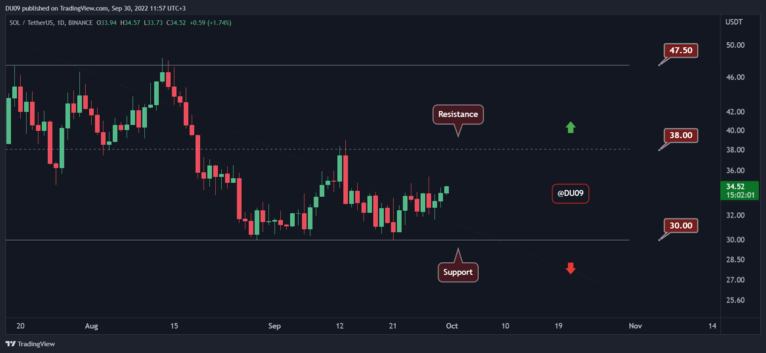
September was not a very pleasant month for Solana in a way. Also having a solid week was Solana. It was able to break out of the crucial support level at $30 after putting that level to the test the previous week. Since then, SOL has been successful in recording a price gain of 5.8%. This makes it the top performer on our list at the present time.

In the event that this trend continues, SOL will run into opposition at around $38. This is the next important level to keep an eye on. On September 12th, the pricing was promptly rejected after being examined for the final time. This line was tested that day. It is necessary for Solana’s purchase volume to improve. That is if the company is going to have any chance of successfully breaching higher.
sol

On its one-day chart, the alternative cryptocurrency has shown increased selling power. Despite the price increases over the last several days. Solana has not seen a significant uptick in the number of purchasers.

Additionally, this indicated that demand has existed, although at lesser levels. The Relative Strength Index showed an increase, and the indicator was located on the half-line. This indicated that the number of buyers and sellers was almost equal.

Nevertheless, other signs were congruent with the robustness of the selling shown on the chart.

Helium Moves to Solana Blockchain

Following a vote by the community on a proposed change, the crypto-powered wireless network Helium will formally switch from using its own blockchain to using Solana’s blockchain. In the end, more than 81% of the votes that were based on tokens were cast in support of the migration.

According to the developers, the benefits of the move would include an increase in the amount of its native token HNT that is available to subDAO reward pools. Increased mining consistency, improved data transfer reliability, increased utility for both HNT and subDAO tokens, and increased ecosystem support.

Solana is well recognized as a significant location for the development of decentralized apps. When vote transactions are taken into consideration, Solana’s daily transactions have increased from about 100 million to 200 million per day.

Beginning in May of this year, the number of users of the blockchain rapidly rose to surpass 1 million. The creators of Helium suggested making the switch since Solana has the potential to increase the operational efficiency as well as the scalability of projects.

According to Haleem, the Nova Labs team — which represents the founders of and core contributors to the decentralized Helium network — has already been working on the off-chain oracles to enable the new Solana-driven design.

The founders and core donors to the decentralized Helium network are known as Helium Core Contributors. In difference, he said that the work that will be done on the chain in the future. Such as the minting and redemption of tokens would be “quite a lot simpler.”


Categories
Blockchain

Explaining Smart Contracts: What to Know

Smart contracts play a very important part as an introduction to Blockchain technology since they assist to make the transactions that are taking place safer and secure while also allowing them to work in an ordered way.

In addition, it assists other components, such as programs operating on these platforms, in becoming even more accessible. However, what exactly is a smart contract?

What is Smart Contract?

A self-executing contract is known as a smart contract. In this kind of contract, the terms of the deal between the buyer and the seller are encoded directly into lines of code.

The code as well as the contracts that are stored inside it are spread out throughout a blockchain network that is decentralized and dispersed. The execution is under the control of the code, and all transactions are both trackable and irreversible.

The automation of processes that would normally call for the participation of a middleman is one of the most significant advantages offered by blockchain networks.

For instance, a smart contract may make it such that a client does not require a bank’s permission to transfer funds from the customer to the freelancer.

This means that the procedure can take place automatically. All that is necessary is for the two parties involved to reach a consensus on a single idea.

Why Smart Contract?

Developers are able to create a broad range of decentralized applications and tokens thanks to the use of smart contracts.

They are utilized in anything from new financial tools to logistics and gaming experiences. And just like any other cryptocurrency transaction, they are kept on a blockchain.

It is often not possible to revoke or alter the execution of a smart contract once the software that implements the contract has been posted to the blockchain.

Apps that are driven by smart contracts are sometimes referred to as “decentralized applications” or “dapps.” These apps may contain decentralized finance technology, also known as “DeFi,” which is designed to revolutionize the banking sector.

DeFi applications make it possible for holders of cryptocurrencies to participate in complicated financial operations, including savings, loans. And also insurance, without the involvement of a bank or any other traditional or alternative financial institution. And from any location around the globe.

How it Works

The following reasoning is used in smart contracts, which are computer programs that run on blockchains and are tamper-proof. For instance, “if/when x event occurs, then do y action.”

It is possible for a single smart contract to include a number of distinct conditions. And it is also possible for a single application to have a number of different smart contracts that work together to enable a network of related procedures.

In addition, there are other programming languages designed specifically for smart contracts, with Ethereum’s Solidity being the most widely used.

Any programmer has the ability to design a smart contract and publish it on a public blockchain for their own reasons. For example, a personal yield aggregator might be created that would automatically move a user’s assets to the application with the best earning potential.

However, many smart contracts include a number of separate parties, each of which is considered to be autonomous. And which may or may not know one another and may or may not trust one another.

The smart contract will describe precisely how users may engage with it. This includes who can communicate with the smart contract. And what kinds of inputs will result in what kinds of outputs. Users will be able to determine exactly how they want to interact with the smart contract.

The end consequence of this process is the development of multi-party digital agreements that transition from their current probabilistic state, in which they will probably execute as planned, to a new deterministic state, in which it is assured that they will execute in accordance with the code.

Pros

  • Safety and reliability: Strong tamper-proof, uptime, and accuracy assurances that the contract will execute on time. According to its conditions may be obtained by having the contract logic executed and validated in a redundant manner by a decentralized network of nodes.
  • Precision, Swiftness, and Efficiency: After the fulfillment of a condition, the contract is immediately put into effect. Because smart contracts are digital and automated, there is no paperwork to deal with. And there is no time spent correcting mistakes that may arise when filling out documents by hand. This eliminates a significant source of potential frustration and saves a significant amount of time.
  • Protection: Running the contract on a decentralized blockchain infrastructure ensures that there will be no central point of failure that can be attacked. There will be no centralized intermediary that can be bribed. And no mechanism that either party or a central administrator can use to tamper with the outcome of the transaction.

Closing Thoughts

Because the underlying blockchains that smart contracts operate on are isolated networks, this is one of the intrinsic constraints of smart contracts. This means that blockchains do not have connectivity to the outside world that is built into them.

Without a connection to the outside world, smart contracts are unable to interact with other systems in order to verify the existence of real-world events. Nor are they able to access computing resources that are both efficient and cost-effective.

Without this connection, the capabilities of smart contracts are comparable to those of a computer that lacks Internet access. They are unable to ascertain the worth of an asset before carrying out a deal.

They are unable to examine the monthly average rainfall before settling a crop insurance claim. And they are unable to verify that products have arrived before paying a supplier.

Many financial institutions and insurance companies are already making use of smart contracts in the day-to-day operations of their businesses.

Because of this, smart contracts already exist and are being tested in situations that take place in the real world. It will not be long until they become an integral part of our day-to-day activities and routines.

Regardless of the debate that came before it, there is still a significant distance to go before everything is regulated by a smart contract.

Categories
Guides & Tutorials

Explaining Bull Trap: What is It?

A reversal known as a bull trap is one in which market players who were on the incorrect side of price movement are forced to quit their positions with unanticipated losses.

When buyers are unable or unwilling to maintain a rise above a breakthrough level, a bull trap is created. By looking for confirmation after a breakout using technical indicators and/or pattern divergences, traders and investors may cut down on the number of times they are caught in a bull trap.

What is a Bull Trap?

When there is ambiguity in the market or when there is widespread dissemination of incorrect information on a certain asset, bull traps are likely to emerge.

It is referred to as a “bull trap” because unsuspecting traders are persuaded to assume that an asset that is really experiencing a decline is actually increasing in value. This illusory feeling of safety might result in significant financial losses.

When there is a suspicion that a bull trap is being set, traders should get out of the transaction immediately or go into a short position. In these kinds of circumstances, stop-loss orders may be really helpful. Particularly when the market is moving quickly and you want to avoid getting carried away by your emotions.

Finding a bull trap may be challenging, as is the case with a number of other aspects of trading. However, the most effective strategy for avoiding bull traps is to be vigilant. And watch for early warning indicators, such as breakouts with low volume. Below, you’ll find additional discussion about this topic.

How Does it Work?

So, you’re studying a chart of a declining asset. With enough time passing, the price eventually settles. Into what is known as a “range,” or a narrow band of stability.

At this juncture, bulls and bears are fighting tooth and nail to move the price in their respective orientations. There is a fierce battle going on between the bears. Who want to drive the price to new lows, and the bulls, who are doing all they can to protect the price from falling any lower.

The bears eventually triumph, and the price drops to a new low, signaling a breakdown from the range. Whenever the bears have a chance to reclaim control, the bulls make a return and reclaim control, sending the price back up to the previous high.

Identifying One

A bull trap may take many forms, but there are certain telltale technical characteristics that might help you spot one:

  • Either a downward trend or a mild upward trend, or the price is consolidating.
  • The price rises above the previous high point or the resistance level.
  • During this short period, the price is trading above the previous high (or resistance level).
  • Afterwards, the price drops below the previous resistance level.
  • Investors who have recently invested may want to dump their shares to avoid further losses.
  • Since there was no reason to be optimistic to begin with, savvy investors may utilize the current high price as an entry point to sell. The price is lowered in part because of this factor.
Categories
Ethereum

Will Ethereum (ETH) Pass Bitcoin (BTC)?

The two most widely used currencies in the cryptocurrency market are Bitcoin (BTC) and Ethereum (ETH). ETH is the native cryptocurrency of the Ethereum blockchain platform. Even after falling 57% year to date through September 30th, BTC trades at over $19,700 despite having a market valuation of around $380 billion.

The normal 24-hour trading volume for Bitcoin is in the tens of billions of dollars. On the other side, the market capitalization of ETH is around $180 billion.

A normal 24-hour trading volume is in the tens of billions of dollars, and it is now trading at around $1,500. It was anticipated that the price of ETH would rapidly increase after the Ethereum Merge. This resulted in Ether switching from a PoW to a PoS consensus method.

Some industry analysts believe that in the not-too-distant future, the cryptocurrency that reigns supreme, Bitcoin, might be overtaken by the altcoin that is now the largest.

Will Ethereum Pass Bitcoin?

The massive bull run in the price of Bitcoin in 2021 was the primary factor that drove its market capitalization to more than $1.2 trillion. Since then, it has plummeted back down to a meager $400 billion. During this time, the price of Ethereum had a massive spike that brought it to above $500 billion. That is before it dropped to just over $200 billion.

Now, some traders and investors are forecasting that the price of Ethereum will skyrocket after its long-awaited, dramatic upgrade. This event, known as “the merge,” has the potential to make Ethereum more valuable than bitcoin for the first time. And it is called “the merge.”

Even if Ethereum’s value is going down, it has, like bitcoin’s, been relatively stable over the course of the last week. This is significant since it occurs at a time when foreign currencies and the stock market are both falling. This is as a result of the Federal Reserve raising interest rates once more.

How Is Ethereum Doing Now?

The price of Ethereum continued its ascent and broke beyond the $1,300 barrier. ETH even managed to break beyond the $1,320 barrier while also going above its 50-hour simple moving average.

It is now fighting a losing battle to break above the $1,340 level and a connecting negative trend line that can be seen on the hourly chart.

If the price is able to rise over $1,350, then it may attempt to test the $1,400 barrier again. The next significant barrier is located close to that level.

At the time of this writing, one ether can be purchased for $1313, which is a decrease of 1.19% over the course of the previous 24 hours. And 0.8% over the course of the previous week.

Ethereum’s price presently bids at $1,333, providing minor signs that cause worry.

Since August, there has been a consistent increase in the amount of supply that has been distributed onto exchanges. As seen by the Supply On Exchange Indicator from Santiment.

In principle, the data seem to indicate that a greater supply on exchanges equals a greater number of handlers who are prepared to sell the price of Ethereum.

Categories
Altcoins

How Stable Really Are Stablecoins?

Stablecoins are crypto whose value is connected to another money, commodity, or financial instrument. Stablecoins are an attempt to give an alternative to the significant volatility of the most popular crypto. Such as Bitcoin (BTC) and Ethereum (ETH). This volatility is what has made investments like Bitcoin and Ethereum less appropriate for widespread usage in transactions.

Stablecoins do not have the luxury of doing so since they are required to exercise stringent control over the supply of their stablecoins in addition to maintaining a portfolio of assets or collateral. As a result, they are centralized by their very nature. Stablecoins are aware that this is a difficult assignment for them in this respect, and they have prepared themselves accordingly.

Understanding Stablecoins

Stablecoins are backed by a number of different sources, including fiat money. This refers to conventional currencies like the U.S. dollars in your bank account, other cryptocurrencies, precious metals. And algorithmic functions, as was discussed before.

However, the supporting source of a cryptocurrency might influence the degree of risk it entails: For example, a fiat-backed stablecoin may be more stable than other cryptocurrencies since it is connected to a centralized financial system. This kind of system has a figure of authority (like a central bank) that may hinder and exert price control when market values are unstable.

Stablecoins that are not tied to centralized financial institutions, such as a stablecoin backed by bitcoin. They have the potential to undergo significant and rapid price changes. This is partly due to the absence of a regulatory authority that controls what the coin is tethered to.

Why Stablecoins?

When compared to the concept of other crypto, Stablecoin’s entire focus on use cases, during which time other concerns, such as energy usage, are temporarily ignored, makes it a lot less objectionable. They give the impression of being supported by something and may perhaps perform some function.

Stablecoins provide the same level of value and strength to investors, and traders. And exchanges that traditional fiat money does to participants in traditional financial markets. Stablecoins are a kind of cryptocurrency. On the other hand, investors in assets other than crypto will shift sections of their portfolios into cash, treasury bonds. Or even money market funds when market volatility increases.

There are several reasons why players in the crypto market have opted toward stablecoins rather than cashing out into fiat currency. For one thing, being active in the crypto market enables them to move more quickly. Between deals since they do not need to wait for days to convert their holdings to traditional cash. Stablecoins are the only alternative available since not all crypto exchanges enable the usage of fiat money. This is another thing that is true.

Fiat currencies and crypto are separated by a gap that is filled by stable crypto. Although there are grounds for doubt about stablecoins, this may be mitigated by concentrating on individual stablecoins. Because of this, deciding whether stablecoins are reliable enough to be trusted relies on your understanding. Of both the broad idea of stablecoins and the particulars of the stablecoins’ potential use.

Categories
Ethereum

Binance Debuts ETHW Mining Pool; What is ETHW?

The cryptocurrency exchange Binance made the announcement today that it would provide its consumers with an Ethereum Proof-of-Work (ETHW) mining service. Binance also revealed on Thursday that those who participate in the ETHW pool would not be subject to a fee until October 29. This news came as part of the exchange’s announcement.

Binance maintains that the inclusion of ETHW support on the Binance Pool does not equate to the listing of ETHW tokens on the exchange. As is the case with all other currencies, EthereumPoW (ETHW) will be subjected to Binance’s rigorous listing review procedure. This protects the interests of investors and prioritizes the listing of tokens that have useful applications.

In addition, the cryptocurrency exchange only allows for the withdrawal of ETHW. Because of an internal policy, access to the deposits of ETHW is now denied. On the other hand, users may sell their ETHW holdings on Binance Convert in exchange for BUSD or USDT.

The price of ETHW shot up in response to the news, and at the time this article was written, it was trading for $12.21. This is representing a 12% rise over the previous twenty-four-hour period. According to CoinGecko, at one point earlier today, it reached a high of $12.72 per coin.

Binance said, as part of the announcement of its ETHW mining pool, that in order to ensure the safety of Binance users. ETHW would be subjected to the same stringent listing review procedure that Binance employs for all other coins and tokens. The business also said that even if ETHW is supported on Binance Pool, this does not ensure that ETHW will be listed.

What is ETHW?

The Ethereum Merge took place on September 15 and was successful in transitioning the blockchain to a proof-of-stake mechanism. This eradicated the need for cryptocurrency miners on the network. Even though it got off to a rough start, a new split version of Ethereum that is still driven by proof-of-work has been established.

Chandler Guo, a veteran in the cryptocurrency sector, is leading the EthereumPoW (ETHW) community-based project. It is a Proof-of-Work (PoW) fork of Ethereum. The team is comprised of sovereign developers and miners. On July 27, 2022, Guo tweeted out the concept of ETHW to his followers. Since then, there has been a lot of interest in the matter. Especially among miners who are opposed to The Merge.

A hard fork of EthereumPoW happened because certain miners refused to abandon the profitable PoW method in favor of the less lucrative PoS. According to the most recent Arcane Research research. Ethereum mining revenues will reach $18 billion in 2021, slightly more than Bitcoin’s $17 billion returns. Mining Ethereum has been the most lucrative cryptocurrency venture since early 2022.

Following the completion of the Merge, the price of Ethereum (ETH) has collapsed. However, whales and traders continue to unload their holdings of ETH. In addition, after the Merge, the total quantity of ETH has grown by 8,671 tokens. In the meanwhile, the price of ETHW has also dropped precipitously owing to the absence of support.

Categories
Guides & Tutorials

Decentralized Autonomous Organization (DAO): What Is It?

Cryptocurrencies are distinguished by their decentralized nature. This implies that their authority is dispersed among several computers, networks, and nodes rather than concentrated in the hands of a centralized authority like a government or central bank.

As a result of its decentralized nature, virtual currencies are often able to provide their users with a degree of anonymity and security not accessible when dealing with conventional currencies and transactions.

A concept for a decentralized autonomous organization (DAO) was conceived in 2016 by a group of programmers who were inspired by the decentralized nature of cryptocurrencies.

The idea behind a DAO is to improve governance and administration for a business-like organization. However, a decentralized autonomous organization (DAO) is only as good as its leadership and members.

What is DAO?

A decentralized autonomous organization, sometimes known as a DAO, is an organization that does not have a single authoritative figure. The community that is formed around a particular set of rules that are enforced on a blockchain is responsible for making decisions, which are then implemented.

DAOs are organizations that are native to the internet and are owned and controlled jointly by their members. They come equipped with treasuries that can be accessed only with the consent of the members of the organization. The group votes on several propositions within a certain time period in order to reach decisions.

How Does It Work?

The purpose of decentralized autonomous organizations, or DAOs, is to imitate the structure of traditional firms by having their policies and procedures written in open-source code and having smart contracts enforce them.

For those who aren’t taught, “smart contracts” are agreements that are designed to carry out their terms automatically if and when certain standards are satisfied. In most cases, these rules are determined by the DAO’s stakeholders.

In decentralized autonomous organizations (DAOs), as opposed to traditional organizations, there is no order. Instead, decentralized autonomous organizations (DAOs) reward a dispersed network of users to achieve their purpose. They do this in order to bring the interests of the organization into alignment with those of its members.

One of the most important parts of a DAO is its internal capital. This serves as a push for the many players inside the company and helps to keep things running smoothly.

DAOs will normally enter a financing phase when anybody who wishes to access them may partake in it after the first set of rules has been defined and written into smart contracts. This occurs once the DAO has completed its initial build.

When the fundraising phase is complete, the DAO is deemed to be live and active. And all significant decisions about the organization are made by users coming to an agreement on various ideas.

Users get the ability to vote on proposals when they acquire crypto and lock them into a voting contract. The voting weight is proportional to the amount of crypto locked. Thus users’ votes carry more weight the more crypto they have locked.

Voters are later awarded more money for their participation. And the proposal is eventually executed relying on the predefined rules for getting an agreement throughout the network.

Why DAO?

DAOs offer benefits over traditional organizations since they’re internet-native. DAOs stop the need for trust between parties. While a typical organization requires faith in its personnel, DAOs merely demand trust in their code.

Because the code is public and can be checked before launch, it’s simpler to trust. Every activity a DAO does after launch is transparent and verifiable.

A non-hierarchical organization. It can do activities and expand while being governed by its native token. Any stakeholder may provide an innovative proposal that the group will explore and enhance. Internal conflicts are frequently simply resolved by voting, per the smart contract’s provisions.

DAOs let investors combine assets and participate in early-stage enterprises and decentralized initiatives while sharing risk and rewards.

Pros

  • DAOs facilitate smooth and productive teamwork. It is possible for people from different parts of the globe to work together as one.
  • DAOs are focused on maximizing decentralization, which means allowing as many people as possible to take part in the organization’s strategy development, planning, and day-to-day operations.
  • Votes in DAOs are transparent since they are recorded on the distributed ledger. Token and stakeholder holders in a DAO have an incentive to make prudent choices. Therefore, democratic voting is based on careful review and strategic measures.
  • To a significant extent, objectives are what propel DAOs. Collectively minded individuals pool their resources to buy DAO tokens. Members of the DAO benefit from this since they are given the opportunity to work with others who share their values.

Cons

  • In Decentralized Autonomous Organizations, making decisions may be time-consuming since there are no preset boardroom members. Voter participation increases decision time.
  • DAO is new and tech-focused. Two consequences follow. A big section of the population may not have the proper technology or understanding to utilize it. It may also imply more work to educate stakeholders about DAOs so they can vote.
  • Decentralized DAOs may make voting more time-consuming.
  • Unprotected DAOs may be exploited, leading to the theft of treasury reserves.

Closing Thoughts

A decentralized autonomous organization, often known as a DAO, is a sort of corporate structure. It operates from the bottom up and does not have a centralized authority. Members of a decentralized autonomous organization (DAO) are allowed to hold tokens issued by the DAO. And members have the ability to vote on new DAO proposals. The DAO makes use of smart contracts. And the code that directs how it conducts its business is made available to the public.

People need to have a full grasp of blockchains and how they function before trying to use DAOs. Despite the fact that they may be quite useful and have the potential for future growth. In addition, the process of setting and emptying a DAO necessitates a lot of knowledge. Along with the inner workings of blockchain and an understanding of how to make use of the technology offered by blockchain.

Categories
Guides & Tutorials

Difference Between Bitcoin (BTC) and Bitcoin Cash (BCH)

Both pancakes and waffles are made using the same basic components, yet pancakes and waffles are very distinct things. BCH is a fork that originated from the original BTC. They use the same mining technique, supply, and even have the same incentive scheme. This means that they share the same white paper.

All these Bitcoin and Bitcoin Cash have the same overarching goal of becoming a digital currency that is accepted everywhere. However, there are significant technical differences between the two cryptocurrencies. Due to the fact that the communities supporting each crypto have different ideas about how scalability should be addressed.

Because the developers working on Bitcoin and Bitcoin Cash were pursuing distinct objectives, the number of differentiating factors that separate the two cryptocurrencies continued to expand over time. Because of the significant gap that developed between the two cryptocurrencies, members of the community today see them as entirely distinct forms of assets.

Bitcoin (BTC)

Mining pools and firms accounting for about 80–90% of Bitcoin’s computer power decided in July 2017 to add a mechanism known as a segregated witness (SegWit).

By stopping signature data from the block of data that has to be processed in each transaction and linking it to an ample block, this modification reduces the amount of data that needs to be verified in each block. This is achieved by binding the signature data to the extended block.

Since it is believed that signature data accounts for up to 65 percent of the data processed in each block. This represents a very notable change in the underlying technology.

Bitcoin Cash (BCH)

BCH is a separate entity from BTC. Bitcoin miners and developers were both worried about the future of the crypto and its ability to expand in an efficient manner when they began working on Bitcoin Cash. On the other hand, these people said some concerns when it came to the performance of a Segregated Witness technology.

They were of the opinion that the fundamental issue of scalability was not addressed in a significant manner by SegWit2. And that it did not follow the roadmap that was originally drafted by Satoshi Nakamoto, the unknown individual who first offered the blockchain technology that underpins crypto.

BOTTOMLINE

Both networks continue to adhere to the same standard for their financial policy. Each blockchain will have a maximum total of 21 million coins. And the rate at which new coins are issued will be halved every 210,000 blocks, which is equal to about once every four years. It is expected that the last Bitcoin and Bitcoin Cash will be produced in the year 2140.

Both of these cryptocurrencies were developed to provide protection against monetary expropriation and censorship. And the devaluation that might result from inflation that is greater than expected. Each blockchain is open and available to the public. And it is not possible for a single organization to make any changes to it.

Categories
DeFi News

An Introduction To Decentralized Finance (DeFi)

Decentralized finance, or DeFi for short, is an emerging field that allows participants to make financial transactions directly with other people, eliminating the need for a middleman. DeFi is quickly becoming recognized as a viable alternative to more conventional forms of financial service delivery. You are already able to accomplish most of the things that conventional banks and other centralized financial institutions make accessible to their customers thanks to DeFi, which makes new products and transactions available every day.

What is DeFi?

The Federal Reserve and the Securities and Exchange Commission (SEC) in the United States are responsible for defining the rules that apply to centralized financial institutions such as banks and brokerages.

Consumers rely on these institutions to gain direct access to capital and financial services. Individuals are given more authority inside DeFi’s peer-to-peer digital exchanges, which poses a threat to the current centralized financial system.

DeFi does away with the fees that traditional financial institutions such as banks. And other financial corporations charge customers for the use of their services.

DeFi allows users to save their money in a safe and encrypted digital wallet, transfer dollars in a matter of minutes, and is accessible to anybody who has access to the internet.

There is no one person who came up with the idea of DeFi. Nonetheless, the initial applications of DeFi were built on top of Ethereum, which was developed by Vitalik Buterin.

Since then, they have extended their operations to include additional networks that automate transactions using smart contracts. These include the cryptocurrencies Avalanche, Solana, and Binance Smart Chain.

How it Works

Despite the fact that decentralized finance (DeFi) is commonly discussed in relation to cryptocurrencies. It extends beyond than the production of new digital money or value. The’smart contracts’ offered by DeFi are meant to operate in lieu of more conventional types of financial systems.

Because there are no middlemen to allow transactions for DeFi apps, there are no banks or other organizations to whom you may entrust the management of your money. In addition, the code is accessible to anybody who wishes to examine it, creating an air of openness and transparency inside the DeFi protocols.

Additionally, there are open networks that operate beyond the borders of different countries. The majority of the apps that users may access are, as was noted before, based on the Ethereum blockchain. Users can access a wide variety of applications.

Using DeFi

The following is a list of some of the ways in which people are interacting with DeFi today:

  • Lending: If you lend out your cryptocurrency, you may earn interest and prizes on a minute-to-minute basis rather than on a monthly one.
  • Obtaining a loan: You can get a loan instantaneously without having to fill out any paperwork. And you can even get loans with incredibly short terms called “flash loans”. These are not offered by regular financial institutions.
  • Trading: You can engage in peer-to-peer transactions of specific crypto assets, just as if you were able to buy and sell stocks without the assistance of any form of broker.
  • Putting money away for a rainy day: When you invest part of your cryptocurrency in alternative savings accounts, you may earn interest rates that are superior to those you would normally get from a bank.
  • Purchasing derivatives: You may take long or short positions on certain assets. You can think of them as the stock options or futures contracts equivalents of the cryptocurrency world.

Why DeFi?

DeFi has a number of important characteristics. And although we’ve touched on a few of them previously, let’s go a little more into the rest of them and see what we can find.

To begin, it’s open, which means that you may use the programs by making a wallet. And you can do so often without disclosing any identifying information like as your name or address. In a theoretical sense, at least; in terms of the technology involved, having a bank account is more straightforward.

Second, using a blockchain allows for almost immediate movement of payments. This eliminates the need to wait for a bank transfer to clear before proceeding.

Next, one of the fundamental tenets of decentralized finance is the concept of peer-to-peer, or P2P, financial transactions. A transaction known as a P2P DeFi takes place when two parties come to an agreement to trade cryptocurrencies for products or services without the involvement of a third party.

P2P lending may fulfill a person’s requirements for a loan in DeFi. After a matching algorithm finds peers who are in agreement with the lender’s criteria, the individual is then given a loan.

P2P payments are carried out via the use of a decentralized application, also known as a dApp, and adhere to the same protocol inside the blockchain.

Last but not least, the rates are far better than those offered by conventional banks, even if the fees of transactions might vary widely depending on the blockchain network.

Pros

  • Individuals are able to send and receive money anywhere in the globe thanks to decentralized apps.
  • Investors’ potential to earn a profit from their investments
  • Superior degree of protection

Cons

  • Due to the inconsistent nature of the transaction rates on the Ethereum blockchain, active trading may quickly become prohibitively costly.
  • Your investment might be subject to considerable volatility depending on whatever decentralized applications (dApps) you use. And how you use them. After all, this is brand new technology.
  • In order to comply with tax laws, you are responsible for keeping your own records. Regulations might be different from one area to the next.

Closing Thoughts

The current legal framework was developed on the premise that there should be many financial jurisdictions. Each of these should be governed by a distinct collection of laws and regulations.

The potential of DeFi to conduct transactions without regard to national borders raises important problems for this kind of regulation.

Before you invest your money in any protocol, it is important to understand that there is no decentralized finance protocol that is risk-free. Nonetheless, the factors that have been discussed may assist you in doing an accurate risk assessment.

Categories
News

Crypto Lender Nexo Sued; Buys Stake in U.S. Chartered Bank

On Monday, state securities regulators in California and several other states took action against Nexo Group, the parent company of cryptocurrency lender Nexo. These regulators deemed the Earn Interest Product offered by Nexo Group to be an unregistered security and therefore took action against Nexo Group.

According to a press release issued by the California Department of Financial Protection and Innovation (DFPI). These cryptocurrency interest accounts are considered securities and are therefore subject to the investor protections provided for under the law. One of these protections requires adequate disclosure of the risks associated with investing in these accounts.

In the documents, it was also said that Nexo had misrepresented the accounts. And given the impression to potential investors that it is a licensed and registered platform.

According to one of the papers, these interest-earning accounts, which were referred to as “Earn Interest Product,” enabled investors to deposit assets with Nexo in return for getting yields of up to 36% on their deposits. The name of the product comes from the fact that it earned interest.

On the other hand, Nexo claims that just one asset generates an interest rate of 36%. And the company does not disclose or promote this yield in any of its marketing materials. The corporation claims that some of its most famous assets, such as Bitcoin, only receive returns in the single-digit percentages of the total amount invested.

When California’s securities regulator filed orders to stop doing business with the firm, it was supported by regulators from Vermont And also Oklahoma, South Carolina, Kentucky, and Maryland, among other states. According to Nexo’s Licenses and Registrations, the firm is authorized to do business in the states of California, Oklahoma, South Carolina, and Maryland as of the time that this article was written.

Nexo Buys Minority Stake in a U.S. Chartered Bank

In related news, Nexo has just bought a share in the federally chartered bank. It is located in the United States of America known as Summit National Bank. Nexo is able to broaden its range of financial services across the United States as a result of the investment. This enables the company to provide customers with a diverse selection of crypto-related options. Such as the ability to open accounts and apply for asset-backed loans and card programs.

Nexo co-founder and CFO Kalin Metodiev, who would also join the board of Summit National Bank, referred to the move as another landmark in Nexo’s dedicated drive to better serve our US customers in compliance with the ever-changing regulatory landscape. Metodiev will also serve on the board of Summit National Bank.

Through this transaction, Summit National Bank will be helped in reimagining itself as a contemporary Fintech institution. Digital asset services will be provided. And a bridge will be created between traditional financial services and the Web 3 ecosystem. The goal of this transaction is to strengthen the capabilities of both companies.

Nexo said that the transaction would further extend their presence in the United States. And enable them to provide their retail. Institutional customers in the United States with more creative solutions that exist at the crossroads of conventional finance and blockchain.

Categories
People

Getting Into The Entire Do Kwon Debacle

The disgraced founder of the Terra ecosystem, Do Kwon, has been the subject of media attention for several months now. Do Kwon is without a doubt the most notorious person in the cryptocurrency sector right now. This is due to the fact that his crypto project was a complete and utter disaster. And that he is sought by authorities in many countries.

An outcry ensued after the failure of the Terra cryptocurrency (Luna) and the so-called stablecoin TerraUSD (UST). This resulted in the loss of $40 billion in investor capital. As a result of this outrage, the prosecutors began investigations against Kwon and his associates. According to the prosecutors on Monday, he is the subject of criminal accusations in South Korea.

Additionally, Interpol has issued a red notice for Do Kwon, urging that law enforcement authorities all around the globe look for and arrest the founder of Terraform Labs, a blockchain business that failed earlier this year.

According to the information provided by Interpol, Red Notices are sent to fugitives who are sought for either prosecution or to fulfill a sentence. This notice is a plea to all law enforcement agencies throughout the globe to find and apprehend the individual in question. This might then result in the individual being extradited.

However, South Korean officials have ordered that the cryptocurrency exchanges OKX and Kucoin freeze 3,313 Bitcoin (BTC) that are apparently connected to Do Kwon. Kwon is the co-founder of Terra blockchain company Terraform Labs.

It was stated that Kwon opened a new wallet on September 15, only one day after a Korean court issued an arrest warrant against the fugitive cryptocurrency pioneer. Kwon is now on the run from the Korean police in connection with the securities violation case.

Where is Do Kwon Now?

According to reports, the Seoul Southern District Prosecutors’ Office in South Korea issued a summons to Kwon in order to question him regarding his company’s alleged violations of capital markets law in relation to the significant financial losses incurred by investors as a result of Terra’s collapse. The purpose of this questioning was to gather additional information.

In the meanwhile, Kwon said in a tweet that he sent on Monday that he has no intention of concealing himself from anybody. This is including the government authorities who are searching for him. Kwon said that he has been out and about in public more often during the last several weeks. He has mentioned that he goes for walks and even visits shopping malls.

Kwon also said that he does not see his name on the “Red Notice” list that is maintained by Interpol. These warnings are not always made available to the public by the agency.

According to a spokesman, the Seoul Southern District Prosecutors’ Office believes that Kwon is still evading capture.

According to his Twitter location, Kwon is now in Singapore. However, earlier this month, the Singapore Police Force said that Kwon was not present in the city-state. This was at the time of their investigation.

Categories
News

Voyager Accepts FTX US Bid And Will Let it Acquire Assets

FTX US, the United States section of the global cryptocurrency exchange FTX, has emerged victorious in the competition to acquire the insolvent cryptocurrency lender Voyager Digital’s assets. Voyager indicated that the FTX US offer is valued at about 1.42 billion dollars. This was in a press announcement that was issued on Monday evening.

According to the release, Voyager has decided to accept the exchange’s buyout offer of $1.4 billion. This means that the exchange has won the competition to acquire the insolvent company. It has beat out both Binance and Wave Financial.

Reportedly, Voyager received various offers considered sale and reorganization possibilities and conducted an auction. Moreover, based on the results of the auction. They have decided that the sale transaction with FTX is the best solution for Voyager stakeholders.

Per the statement, the FTX US proposal includes a fair market value of all Voyager crypto assets. They will do so at a point in the future that has not yet been established. The fair market value of all Voyager crypto assets is estimated to be about $1.311 billion based on current market pricing. The proposal also contains further consideration, which is projected to have an added worth of 111 million dollars.

According to Voyager, the bid made by FTX US maximizes value and minimizes the remaining duration of the Company’s restructuring. They’re providing a clear path forward for the Debtors to consummate a chapter 11 bankruptcy plan. And return value to their customers and other creditors. FTX US’s bid also provides a clear path forward for the Debtors to return value to their customers and other creditors.

The Voyager Digital Debacle

The first step was taken in July, when “market circumstances” were cited as the reason for freezing user assets and pausing trade. Voyager gave this explanation. Then, in the month of August, a total of $270 million was made available for withdrawal. This was a part of the bankruptcy petition for the company.

On the surface, Voyager Digital has several features that are typical of successful commercial enterprises. Voyager is a publicly traded company that can be found on the Toronto Stock Exchange (TSX) trading under the ticker symbol VOYG.

According to the plea for bankruptcy filed by Voyager, Three Arrows Capital defaulted on debts. They were in the amount of 15,250 bitcoin and 350 million US dollars in June of 2022. As per the company’s public exposure for the first quarter of 2022. These loans made up more than half of Voyager’s total loan book. In addition to not having any security attached to them, the loans recalled a highly concentrated exposure to a single counterparty.

There is no comparison between deposits made in cryptocurrency with a cryptocurrency lending platform and deposits made at a regular bank. The primary distinction between the two is that one is mostly unregulated in its operations while the other is highly controlled. Retail shoppers want a dependable atmosphere that does not place them in danger. In the event that they fail to read the legalese pertaining to rehypothecation.

In the meanwhile, after the announcement of the acquisition deal, the value of Voyager’s native token. VGX, increased by more than 2% during the day and was trading at $0.7032. This was at the time this article was written.

Categories
Guides & Tutorials

Everything You Need To Know About Coin Offering (ICO)

Is there a key to profitable investment that everyone should know? Not much, but having a strong idea may help you get a head start. Take, for instance, Google or Facebook as an example of an early investment.

The individuals who made investments in either of these companies before they became established are today worth millions of dollars. Imagine for a moment if you had the option to participate in the ICO (initial coin offering) assets of a big cryptocurrency such as Bitcoin or Ethereum. This would be an alternative to the traditional route.

What is ICO?

Initial coin offering is an abbreviation for “initial coin offering.” It describes a financing strategy that was formerly widely used for early-stage cryptocurrency businesses.

Initial Coin Offerings (ICOs) include a blockchain business minting a set number of their own native digital token and offering them to early investors, often in exchange for other cryptocurrencies like Bitcoin or Ethereum.

ICOs are a kind of digital crowdfunding that allow entrepreneurs to not only acquire capital. They can do this without having to give up stock but also to develop a community of users who are encouraged to want the project to be successful so that the value of their presale tokens will increase.

Understanding ICO

Initial coin offerings, or ICOs for short, are a popular method of raising capital for businesses that provide goods and services that are often associated with cryptocurrencies.

Initial coin offers (ICOs) are a lot like initial public offerings (IPOs), but the coins that are distributed during an ICO may also have some use for a particular software service or product. Only a few initial coin offerings (ICOs) have generated profits for their backers.

Numerous others have been exposed as fake or have not lived up to expectations in any way. To take part in an initial coin offering (ICO), it is customarily necessary to first acquire an older form of digital currency. And also possess at least a basic familiarity with cryptocurrency wallets and exchanges.

Researching initial coin offerings (ICOs) and putting money into them requires a significant amount of due diligence and prudence since, for the most part, ICOs are not subject to any kind of regulation.

How it Works

When a corporation makes the decision to conduct an ICO, it notifies the public in advance of the date, the regulations, and the purchasing procedure. On the day of the initial coin offering (ICO), investors will be able to purchase the newly created cryptocurrency.

The majority of initial coin offerings (ICOs) require investors to make payments using another cryptocurrency. Bitcoin and Ethereum are two of the most prevalent options. There are also initial coin offerings (ICOs) that take fiat currency.

Sending money to an address that is uniquely associated with a cryptocurrency wallet is often required for the buying procedure. Investors are responsible for providing their own recipient addresses in order to get the cryptocurrency that they have purchased.

Both the total number of tokens sold during an initial coin offering (ICO) and the price of each token may be predetermined in advance or left up to market forces.

Anyone may start an initial coin offering. This method gives rise to a large number of different forms of cryptocurrencies. Obviously due to the ease with which new ones may be created using it.

Investing From Them

Before you make an investment in an initial coin offering (ICO) or try your hand at a new cryptocurrency, arm yourself with knowledge by doing some preliminary research. This involves looking for new and potential Initial Coin Offerings (ICOs), as well as reviewing their white papers if they are available.

After you have finished reading the white paper, you should do some research on the development team and check to see whether any other investors have shown interest in the project. If the white paper does not include any information about the code of the token or the security features it contains, this should raise a red signal.

The following phase is to sign up for an initial coin offering (ICO) that piques your attention. On websites like as CoinDesk, ICOBench, TopICOlist.com, ICODrops.com, and CoinMarketCap, amongst others. You can find listings for initial coin offerings (ICOs) as well as pre-ICO lists.

When the time comes for you to start investing, you will first need to organize your funds. To achieve this goal, you will need to have sufficient funds stashed away in order to finance the investment.

Pros and Cons

Pros

  • The chance to invest in a brand-new cryptocurrency at a cheap price with the expectation of high profits. It’s similar to purchasing Bitcoin in 2011.
  • Benefits such as income redistribution or early access to the project’s goods and services may be included with ICO tokens.
  • Possibility of backing desired initiatives and groups.

Cons

  • Lack of confidence that the project will deliver on its goals due to the team’s lack of expertise.
  • There is no protection from the government or assurance of profits.
  • There is a lack of clarity on the development and progression of the project.
  • The possibility that it’s all a big hoax to get investors’ money.

Closing Thoughts

The concept of an initial coin offering is something that has only recently emerged in the fields of finance and technology. In recent years, the development of initial coin offerings (ICOs) has had a considerable influence on the methods that are used to raise cash. Regulatory agencies all over the globe. However, they were not ready for the launch of the new fundraising model in the financial industry.

In spite of this, it has become standard practice for investors in initial coin offerings (ICOs) to sell their coins. They do this at a discount in the market in the hopes of achieving a rapid. And also simple return on their investment or causing token values to pump and dump substantially.

Categories
Blockchain

A Dive Into Cardano’s Vasil Hard Fork

The much-anticipated Vasil update for Cardano was eventually made available to users on September 22. This came after a number of difficulties and more delays.

From the outside looking in, the hard fork is intended to assist increase the scalability of the ecosystem as well as the general transaction throughput capacity, as well as advance Cardano’s capacity for the creation of decentralized apps (DApps).

The Vasil Upgrade marks the beginning of a new age not just for the Cardano ecosystem. But also for the decentralized financial field as a whole. The update will hopefully strengthen Cardano’s capabilities in terms of smart contracts and make the network more scalable.

WHAT THIS MEANS FOR THE INDUSTRY AS A WHOLE

It is important to have a firm grasp on the concept of a “hard fork” before delving into an analysis of the advantages that the Vasil hard fork offers in the functional and operational realms. A hard fork, in its most fundamental definition, is a network update that is put into action when individuals responsible for the governance of a blockchain platform decide to enhance or improve specific characteristics of the ecosystem.

In other words, when a hard fork occurs, the network separates into two versions that operate independently, with one version adhering to the features and rules that were previously in place while the other version continues to function as an updated version of the network.

This update will improve the transaction throughput, efficiency, and block delay speeds of the Cardano ecosystem. It was given the name Vasil St. Dabov in honor of a significant member of the Cardano community. He died away in 2021.

In addition, the hard fork will result in the introduction of a strategy known as diffusion pipelining. This strategy aims to enhance the amount of time it takes for blocks to be propagated. While also boosting the number of transactions that can be processed by the network.

Digging Deeper

Although the beginning of the first wave of the hard fork occurred on September 22. The remaining improvements are scheduled to become active on September 27. At this point, the second phase of the hard fork will aim to redefine Plutus’ cost model. This has a direct influence on the processing power and memory costs necessary to manage Cardano’s native smart contracts.

However, due to a number of unexpected obstacles, the launch of Vasil was delayed until later this year. Even though the update has been made life, the ecosystem is still reeling from the effects that these delays have had on it.

For example, since the beginning of the year 2020, the transaction volume of ADA (Cardano’s native coin). It has continued to see a decline.

Not only that, but from a purely price-performance standpoint, the upgrade has not been able to do much. In terms of spurring ADA’s value, the currency trading down less than 1% on the week. This is in spite of the fact that the upgrade was able to do quite a bit in terms of boosting ADA’s reputation.

Categories
News

China Authorities Take Down Crypto Criminals

Local media in China stated on September 25 that the Public Security Bureau of Hengyang County had detained 93 individuals suspected of being engaged in the laundering of 40 billion RMB via the use of cryptocurrency.

As soon as the different municipal authorities came to the conclusion that what looked to be a money laundering operation was indeed taking place, they collaborated to form a task force that would deal with the situation.

Lai Moumou and Zhang Moumou are said to have been the masterminds of the operation. And it is believed that they were involved in a wide range of illegal endeavors while utilizing the CBDC.

The police stated:

“The criminal gang headed by Lai Moumou and Zhang Moumou is suspected of using digital RMB, digital RMB accounts, and virtual currency to provide illegal fund settlement services for overseas gambling, electronic fraud and other criminal activities. The amount of money is huge, and there are many people involved in the case, which are distributed in 13 provinces across the country.”

The authorities say that the criminal organization laundered its earnings by first purchasing cryptocurrencies using illegal cash and then selling the cryptocurrencies in exchange for U.S. dollars. The authorities believe that the illegal funds originated from either fraudulent telecom transactions or illegal gaming.

The digital yuan was used by criminals to launder a total of 200 million RMB, according to another local story. This indicated that the Chinese police were also responsible for busting a money laundering operation in Fujian.

According to the information provided in the report, Zhang Moumou and Lai Moumou were in charge of leading the illegal activity. They utilized the country’s digital currency for a variety of unlawful purposes. This includes supplying financing for gambling, fraud, and other similar acts.

84% Of All Blockchain Patents Are From China

In related developments, according to the most recent statistics that were made public by an official representing China’s government. China is responsible for 84 percent of all blockchain applications that have been submitted everywhere around the globe.

Within a year of President Xi Jinping’s promotion of the blockchain sector, Chinese enterprises have already submitted 4,435 patents related to the technology.

According to the findings of another piece of research, between the years 2015 and June 2021. China submitted almost sixty percent of the world’s blockchain patent applications. This was followed by the United States and South Korea.

According to South China Morning Post, China has the highest number of blockchain patent applications. But the approval rate is extremely low, with only 19% of the total number of applications being approved. This is despite the fact that China has the highest number of blockchain patent applications.

The Chinese government has chosen to stay out of the cryptocurrency sector. Despite this, the government in Beijing has shown support for the underlying blockchain technology. Since the nation has made significant efforts over the years to encourage the implementation of blockchain technology. The high rate of blockchain patents should not come as a surprise.

Categories
Bitcoin

Explainer: What is Proof-of-Work (PoW)?

Roughly put, PoW is a method that is used by cryptocurrencies as a means of ensuring the integrity of newly added transactions to a distributed ledger known as a blockchain.

Decentralized networks such as those utilized by cryptocurrencies and other defi applications use PoW since these networks lack any central controlling body. Thus, the integrity of newly generated data must be verified via the use of proof of work.

Bitcoin, which was released in 2009, is credited as being the first use of Finney’s Proof of Work concept to garner widespread support. Finney was also the recipient of the first bitcoin transaction. Proof of work is the basic protocol behind Bitcoin and a wide variety of other cryptocurrencies. It enables safe, decentralized consensus.

What is PoW?

The term “proof of work” (PoW) refers to a system that requires a not little but possible amount of effort. This is in order to prevent silly or hostile uses of computing power. For example, sending spam emails or casting denial of service attacks are both examples of foolish or malicious uses of computing power.

In 2004, Hal Finney applied the theory to the protection of digital currency by creating the “reusable proof of work” concept and using the SHA-256 hashing algorithm. This allows for the concept to be repurposed.

How Does It Work?

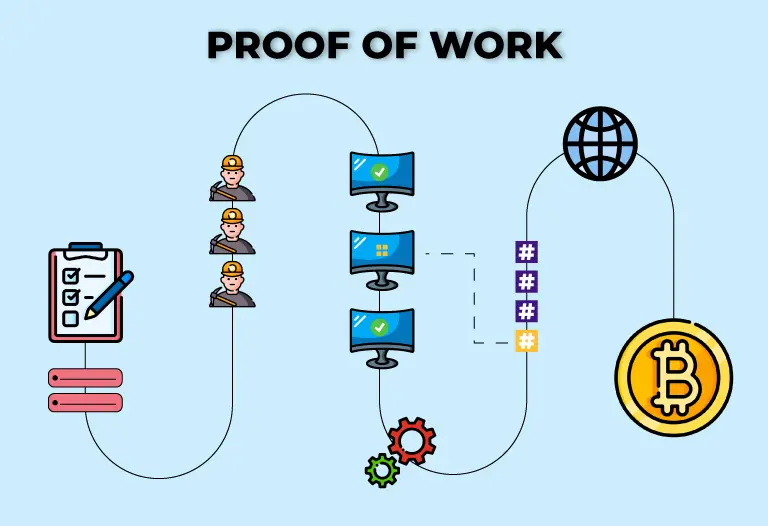
The verification and recording of bitcoin transactions are handled through a consensus process known as the proof-of-work model.

A blockchain is a public ledger that records transactions in discrete blocks. All cryptocurrencies use the blockchain. For cryptocurrencies based on proof-of-work consensus, every block of transactions has a unique hash assigned.

The crypto miner produces a target hash that has a value. The value is either less than or equal to the value of the block in order for the block to be confirmed.

Miners rely on mining hardware that can fast produce calculations so that they can achieve their goals. The goal here is to be the first miner to come up with the desired hash. Since only that miner will be able to update the blockchain and get the associated cryptocurrency incentives.

The proof of work protocol used in bitcoin is successful because finding the target hash might be hard. But ensuring it does not require much effort.

The procedure is complicated enough to exclude the possibility of meddling with the transaction records. On the other hand, once a target hash has been discovered, it is simple for other miners to confirm it.

Why Proof-of-Work?

The “double-spend problem” was one of the challenges that, in the past, hampered efforts to create a digital currency that could actually function as a medium of exchange.

Because crypto is merely data, there has to be a method to stop users from spending the same units in other locations before the system can record the transactions.

This mechanism must ban users from spending the same units in different areas.

Anyone who has ever produced a file on a computer by copying and pasting can probably imagine how you could spend digital money twice, even ten times or more.

While it would be difficult to spend the same physical dollar bill on two separate assets, it is possible to spend digital money multiple times.

Satoshi Nakamoto, the Bitcoin creator, solves the double-spend issue by the consensus method. Proof of work helps prevent duplicate spending by motivating miners to verify the goodness of new crypto transactions before adding them to the distributed ledger that is blockchain.

Pros and Cons

Pros

  • Used broadly by many of the most famous cryptos: Proof of work is the technique the most popular and widely used digital currency, which is bitcoin, uses.
  • Exceptionally safe: A crypto network is made safe by the actual computer resources needed by the proof of work protocol. This is because changing a crypto’s blockchain demands control over more than half of the computational resources used by the crypto network.
  • Miners of crypto get rewards for their work in letting new transactions. If they are able to successfully validate fresh blocks of cryptocurrency transactions, miners may make a profit.

Cons

  • Ineffective, marked by very slow transaction speeds and absurd costs.
  • High energy use.
  • Mining naturally demands pricey equipment.

Closing Thoughts

Proof-of-work is a consensus technique that assures miners will only add a new block to the blockchain of a cryptocurrency. This is after generating a significant amount of computing effort to show that the block is genuine. This prevents invalid blocks from being added to the chain.

When it comes to the two primary consensus processes that crypto uses for confirming transactions on blockchains, proof of work is by far the more prevalent option.

Miners that use proof of work assist guarantee that the blockchain is used for recording only genuine transactions. This is despite the fact that this method is not without its drawbacks.

Miners donate to the safety of the blockchain by operating in this manner. So warding off any assaults that may result in financial losses for companies who conduct their business using blockchain technology.

On the other hand, the consumption of a significant amount of power is necessary for the evidence of labor. This is something that skeptics of Bitcoin would contend creates too much of an environmental effect. To warrant the better security it gives in compared to other methods such as proof of stake. [Critics] of Bitcoin would argue that this is a problem.

Categories
Guides & Tutorials

Explainer: What is Proof-of-Stake (PoS)?

The majority of crypto in circulation today make use of one of two primary consensus processes. Proof of work is the more established method, and it is the one that crypto like Bitcoin, Dogecoin, and many others utilize. Proof of stake is the name of the more recent consensus method. And it is what drives Ethereum, Cardano, Tezos, and a number of other (usually more recent) crypto. This explanation pairs proof of work and proof of stake together because it is easier to understand proof of work before proof of stake, and vice versa.

So What Is Proof-of-Stake (PoS)?

Proof of stake is the consensus process that helps pick which parties get to handle this profitable activity. This task is considered lucrative since the members who are chosen to handle it are paid with new crypto if they verify the new data and don’t trick the system.

The Proof-of-Stake (PoS) algorithm serves as the foundation for Ethereum’s consensus mechanism. In 2022, Ethereum moved from its initial design, which was based on proof-of-work, to its new architecture. This is based on proof-of-stake since the new architecture is superior in terms of security, and energy costs. Plus the ability to adopt new scaling solutions.

How Does It Work?

The proof-of-stake approach enables owners of a crypto to construct their own validator nodes and stake their coins. Staking is the process of pledging your coins so that they may be used for the purpose of authenticating other users’ transactions.

During the time that you have your coins staked, you will be unable to exchange them. But you will be able to unstake them at any time.

The proof-of-stake protocol of the cryptocurrency will choose a validator node to examine a block of transactions for processing whenever a block of transactions is ready to be processed. The validator determines whether or not the transactions included in the block are correct.

If this is the case, they will be rewarded in cryptocurrency for their work by having the block added to the blockchain. However, as a consequence, a validator will forfeit a portion of their staked holdings. That is if they suggest the addition of a block that contains incorrect information.

How validators are selected is handled in a different manner by each individual proof-of-stake protocol. The sampling method will often entail some degree of randomness. But it may also be affected by other standards. Such as the length of time validators have been staking their coins.

Although everyone who stakes cryptocurrency might potentially be selected as a validator, the likelihood of this happening is quite remote if you are just staking a relatively little amount.

If your coins make up 0.001% of the total amount that has been staked, then your odds of getting picked as a validator is around 0.001%. This means that your chances of winning depend on how many coins you have.

Advantages

Flexibility

Proof-of-Stake can adapt to the changing needs of users and the blockchains themselves. This is readily apparent given the overload of different changes that are at one’s disposal. The technique is lenient and can simply be adapted to match the conditions of the bulk of blockchain use cases.

Decentralization

Many users are being encouraged to operate nodes as it’s cheaper. Both the randomization process and the reward itself donate to the network becoming more decentralized.

Conservation of energy

When compared to Proof of Work, the energy efficiency of Proof of Stake goes through the sky. The financial cost of staking coins rather than the computing cost of solving riddles is what determines how much it costs to take part in the competition. The amount of energy needed to keep the consensus process running is drastically cut down due to this technique.

Durability

Because it does not depend on physical machines to produce an agreement, Proof of Stake is more scalable than other consensus-generating methods. There is no need for large-scale mining farms or the purchase of significant amounts of electricity. It is less expensive, less complicated, and easier to get access to the network if more validators are added.

Security

The validator is provided with a financial incentive to avoid processing deceitful transactions via the use of security staking. In the event that the network places a fraudulent transaction, the validator will suffer the loss of a portion of its stake as well as the opportunity to take part in subsequent transactions.

Disadvantages

  • Not as well established in terms of its level of safety as proof of work.
  • Validators who have big holdings may have an undue amount of influence on the verification of transactions.
  • Some proof-of-stake crypto demand that staked funds be locked up for a certain period of time before they may be released.
  • In order for users to participate in Ethereum’s proof-of-stake, they need to execute three separate pieces of software.

Closing Thoughts

Proof-of-stake, also known as POS, is a consensus mechanism that was developed as an alternative to Proof-of-work, also known as POW. POW was the initial process that was used to verify a blockchain and add new blocks.

Miners are required to solve crypto problems in order to experience in PoW mechanisms. While validators are required to store and stake tokens in order to partake in PoS methods and receive transaction fees.

Even though it is still in its infancy as a consensus method for blockchain, proof of stake has a large amount of untapped potential. Proof of stake has numerous enticing aspects that might bring it to the mainstream for blockchain security.

This includes reduced energy needs and a better degree of accessibility for ordinary people to join as validators. These are only two of the benefits that proof of stake offers.

Categories
Blockchain

Explaining Decentraland Metaverse: Everything to Know

Many individuals all around the globe consider playing video games and online multiplayer games to be their most enjoyable pastime activity.

They continue to be the most popular kind of entertainment for gamers. This is because of the incredibly immersive visuals and gameplay experiences that they provide.

Now, the metaverse is bringing online games to a different level by enabling users to engage in the game via virtual 3D surroundings. This is one of the ways the metaverse is taking online games to a new level.

What is Decentraland?

Anyone is able to create and share their own unique metaverse experiences on the Decentraland (MANA) platform. This is a virtual reality environment powered by the Ethereum blockchain.

In a digital universe where the only constraint is the player’s creativity, the player has the ability to build worlds, explore attractions built by other players, and make money.

In contrast to the conventional video game business, which has for a long time prevented players from owning the material they play or having any input into the production of games, Decentraland aims to achieve the opposite of these things.

A mix of blockchain technology and play-to-earn gaming mechanisms enables players to both own in-game objects and earn real-world currency just by participating in the game.

Background

Decentraland is an Ethereum-based virtual world, also known as a metaverse, that is owned by its users and administered via a decentralized autonomous organization (DAO). It is scheduled to open its doors to the general public in January of 2020. 

It contains three native tokens: LAND, which is an ERC-721 token and represents individual parcels of digital land; Estate, which is also an ERC-721 token and represents merged chunks of digital land; and MANA, which is an ERC-20 token and acts as the currency of Decentraland.

Tokens issued by Decentraland are designed from the ground up to function as assets, complete with value and the capacity to be traded.

Ethereum is the glue that holds Decentraland’s economy, technology, and philosophy together. This turned the virtual world into an experiment in a digital, decentralized paradise in addition to a game designed for the purpose of providing amusement.

The blockchain technology that was developed by Decentraland is a potentially useful solution. It might distribute greater power to users of the virtual world.

Users are driven to greater levels of innovation and value creation for the community when they are given more agency inside the virtual environment.

2015 saw the beginning of development on Decentraland, at a time when widespread use of cryptocurrencies was still in its infancy.

What is it Like in There?

Each of the 90,601 individual pieces of virtual land on the platform measures 16 by 16 meters, making up the platform’s expansive geography.

Aetheria, commonly known as Cyberpunk, Vegas City, and Dragon City are just a few of the 39 established districts in this MMORPG at the moment.

One may find a little bit of everything in each of the neighborhoods. Since they all have their own distinct character.

Residents of Decentraland may meet and mingle in these neighborhoods. As well as play games, go to concerts, casinos, poker rooms, mini-golf courses, invest in real estate, run for office.

This platform’s tens of thousands of producers and developers make its potential applications almost limitless. You need just carve out a niche for yourself and build a name for yourself.

However, users need to acquire MANA, its ERC-20 governance token. This can be used to buy LAND and pay for products and services on the Decentraland platform.

Crucial before they can access the Decentraland metaverse and explore the apps inside its ecosystem.

Market participants in Decentraland utilize MANA to buy and sell virtual goods and services like homes, and avatars. Also clothing, and even custom domain names. You may buy MANA on the network itself, or via controlled exchanges like Binance, Coinbase, and Crypto.com.

Users are charged a fee equal to 2.5% of the selling price in MANA to utilize the marketplace. The MANA is being destroyed after usage. This suggests that market activity determines the rate of MANA consumption.

Closing Thoughts

When it comes to blockchain virtual-reality systems, Decentraland is rather exceptional in its own right. Because entering the globe and exploring it does not cost anything, you may quickly and easily form your own opinion just by signing up.

It began as a rather little initiative five years ago. But there has been a lot of hard work from its development team. This platform has grown into a somewhat mature entity in comparison to other cryptocurrency projects.

Decentraland is now structured similarly to a video game. Although, it seems likely that this may change in the near future. Many people’s ideas about what the metaverse is like portray it as a digital reality. That is just as complex and full of detail as the actual world.

At the present, Decentraland is mostly a really cool massively multiplayer online role-playing game (which is also decentralized).

According to the common conception of what Decentraland is, it is a collaborative online environment. It is geared toward providing users with the ability to create new things.

You may use the Decentraland token, known as MANA, to buy LAND. This is the platform’s version of virtual real estate, as well as other products and services.

Within Decentraland, users have the ability to create a wide variety of experiences, interactive content, and social gatherings. All of these have the potential to be monetized. Explore the site right now to get a more in-depth understanding of the comprehensive features offered by Decentraland.

Categories
Guides & Tutorials

Introduction To Ethereum Name Service (ENS)

In the early days of the Internet, when it was still in its infancy and not widely used, one of the most common issues that users encountered was that domain names and internet protocol (IP) addresses were not properly matched.

In the past, cryptocurrency was mostly in the IP address phase, in which users were required to enter lengthy addresses that were difficult to remember in order to access the sites they desired. The Ethereum Name Service was designed specifically with this use case in mind. Its goal is to make using cryptocurrency as simple as using the internet.

Users are able to locate webpages using names rather than numbers with the assistance of the Ethereum Name Service (ENS). It operates in a manner that is similar to that of the DNS system used on the internet.

It intends to become the naming protocol of the decentralized internet by establishing portable usernames for Web 3.0 that are compatible with all blockchains and decentralized applications (dApps).

So What Exactly is ENS?

According to the documentation for the platform, the Ethereum Name Service (ENS) is a naming system that is decentralized, open to the public, and extendable.

This system is built on the Ethereum blockchain. It is the responsibility of the ENS to convert human-readable names like “Jai.eth” into identifiers that are readable by machines, such as Ethereum addresses, addresses for other cryptocurrencies, content hashes, and metadata.

Alex Van de Sande and Nick Johnson, both of the Ethereum Foundation, were the driving forces behind the early stages of the development of the ENS in 2017. In 2018, however, it broke out to become a distinct company that is now directed by Nick Johnson.

In November 2021, the project’s developers handed out ENS tokens to the service’s end users and established a decentralized autonomous organization, or DAO, to oversee the operation of the tokens.

ENS token-holders are able to utilize their assets in the same manner as corporate shareholders. They have the capacity to make choices regarding pricing and protocol updates, as well as manage money inside the Treasury. The DAO is connected to the legal entity known as True Names Limited.

The ENS just passed the milestone of 2.5 million registrants.

How ENS Works

ENS is composed of two smart contracts written on Ethereum. The ENS registry is the first smart contract, and it is responsible for recording all of the domains that have been registered on ENS and storing three essential pieces of information regarding each domain. These three pieces of information are the owner of the domain and the resolver for the domain. And also the caching time for all records that fall under the domain.

The resolver is the second kind of smart contract, and its purpose is to convert human-readable domain names into machine-readable addresses and vice versa. The second smart contract does the matching between each domain and the user, website, or address that corresponds to it.

Those who are interested in making their own Web3 username may do so by visiting the ENS app and beginning their search for a domain name that is still available. Once you have located one, all that is required of you is to complete the registration procedure. This entails verifying two transactions made from your wallet and paying the annual cost. It is $5 USD per year for names that are longer than five characters.

Once you have acquired ownership of the domain, you will have the ability to connect it to your cryptocurrency wallets and websites. You can also build several subdomains, such as email.Jai.eth and website.Jai.eth. They will all be linked under the same ENS domain.

Why ENS?

Because it was designed specifically for Ethereum smart contracts and was built from the ground up as part of the Ethereum ecosystem, the Ethereum Name Service (ENS) does not have the same vulnerabilities that plague DNS. 

A centralized server is used to keep the DNS records of all of the domains and names. This indicates that they are susceptible to being hacked. The Ethereum blockchain provides a level of safety that prevents ENS records from ever being deleted.

In addition, the ENS makes names and addresses more open and simpler to interact with, so both of these benefits are improved. Participating in an auction is required to construct or register a domain ending in “.eth,” however anybody may do it.

The person who makes the highest offer will be awarded the domain name. It will also provide them the ability to construct subdomains and lease domains.

Closing Thoughts

The Ethereum Name Service (ENS) was developed specifically for use in Ethereum smart contracts. It is also an integral part of the Ethereum ecosystem. This indicates that it automatically inherits its security and transparency, in contrast to the DNS records. They are stored on central servers and continue to be susceptible to hacking attempts.

Struggling to work with large sequences of random numbers and characters is often the cause of errors. And in the area of cryptography, mistakes are fairly frequently quite costly. As a result, it is important to avoid making mistakes wherever possible.

In the same way DNS improves the overall user experience for Internet users, normalizing addresses and displaying them. It does in a form that is human-readable and user-friendly is a step toward enhancing the overall user experience.

There is no question that the ENS is a groundbreaking idea and a significant creation that has swiftly gained traction. It is also being used by thousands upon thousands of individuals.

Categories
Guides & Tutorials

Crypto Exchange Meaning: What To Know

Both inexperienced and seasoned investors need to choose where and how to trade in cryptocurrencies, as well as whether or not it is worthwhile to stake tokens, which is a method of receiving incentives or interest for holding particular cryptocurrencies. This includes making the decision to trade on a cryptocurrency exchange and educating yourself on how you will utilize the platform.

Crypto Exchange Meaning

A platform that allows users to purchase and sell cryptocurrency is known as a crypto exchange. Crypto exchanges not only provide trading services, but they also provide storage for cryptocurrency and the ability to find prices based on trade activity.

Before the advent of crypto exchanges, the only way for individuals to obtain cryptocurrency was either via the process of mining or through the organization of transactions in a variety of online and offline forums.

There are now hundreds of cryptocurrency exchanges, each providing a different selection of digital assets along with differing degrees of security and fees connected with those levels. It is up to you to locate the exchanges and digital assets that are suitable for your specific requirements, in terms of both price range and level of expected security.

Types of Crypto Exchange

1. Centralized Exchange

A cryptocurrency exchange that is formed and managed by a single entity is referred to be centralized. These exchanges are regarded to be centralized since one entity is responsible for monitoring all of the transactions and determining the regulations and fees that apply to the exchange.

For instance, Binance, Coinbase, Crypto.com, Kraken, and FTX are all examples of successful cryptocurrency exchanges. This means that they have created and operate themselves. When you utilize the firms’ browser-based platforms or mobile applications to purchase or trade cryptocurrencies, the companies stand to gain money. This is because the companies provide both types of platforms.

Pros and Cons of CEXs

Pros

  • When it comes to the purchase and sale of cryptocurrencies on their platform, centralized crypto exchanges ensure high protection for the investors’ cash.
  • High levels of trading liquidity for cryptocurrencies are often seen on centralized exchanges. This allows for the exchange of cryptocurrency at the agreed-upon price with little slippage.
  • When it comes to the financial authorities in the countries where they operate, most centralized exchanges are registered.
  • The majority of centralized exchanges strive to make their platforms as intuitive as possible for their users by including clear instructions on how to use the site.

Cons

  • Hackers target centralized exchanges because they rely on a “hot wallet” to provide users access to the site.
  • Most centralized exchanges will charge you a fee to use their platform.

2. Decentralized Exchanges

Trading cryptocurrencies takes place on a decentralized exchange, which is a computer software that handles the transactional details automatically. A DeX might be created and managed by an individual or a group. Like other DeFi programs, however, it is actively managed by a distributed network of computers. This means that once the platform is up and running, no one body has authority over it.

In contrast to a CeX, a DeX does not need the creation of an account. As an alternative, you may visit the DeX’s web-based software and link your cryptocurrency wallet there. The DeX will next attempt to execute your order to purchase or sell cryptocurrency.

Pros and Cons

Pros

  • Complete command over your crypto assets.
  • You are exempt from creating an account or proving your identity in any way.
  • Provides access to cryptocurrencies even if they are not listed on CeXs.
  • It is possible that its transaction costs would be cheaper than those of a CeX.

Cons

  • It may be more difficult to use and navigate.
  • If someone manages to hack the DEX, you run the risk of having your money stolen.
  • There is the possibility of an extra charge for each transaction.
  • In the event that there is a problem, you could be on your own.

Tips For When Choosing An Exchange

Tight Security

No matter whether you want to leave your cryptocurrency holdings in the exchange permanently or only store them there for a short period of time before transferring them to your own wallet, the security of the exchange is of paramount importance. Check how much of the exchange’s assets are kept offline, in hard storage, as one example.

Flexing withdrawal and deposit methods

Considerations in selecting an exchange include the availability of a variety of deposit and withdrawal methods, such as bank wire, Skrill, Neteller, debit and credit cards, crypto, etc.

Reasonable Fees

Fees are yet another factor to think about, but you shouldn’t automatically rule out an exchange just because its fees are large. When weighed against the benefits of the additional security and insurance offered by the larger and more widely used exchanges, the higher prices they charge may be justified.

P2P Trading

P2P trading platforms should absolutely be included, in particular for those nations in which it is illegal for banks to operate as middlemen for cryptocurrency exchanges.

Amount of Tokens Offered

An increase in the number of potential investors at a cryptocurrency exchange is directly proportional to the firm’s selection of cryptocurrencies. This also results in an increase in the daily volume traded on such exchanges.

Bottomline

Like traditional brokers, crypto exchanges ease the buying and selling of digital currency. You may store your digital assets in a more secure manner and with more options with these services than you would with wallet software you manage on your own.

Cryptocurrency exchanges have begun to provide custodial key storage to its customers. But you should utilize this service with caution since cryptocurrency exchanges are often desired targets for hackers.

You should do your own research to choose the cryptocurrency exchange and digital assets that best meet your requirements. You should also know that there is a wide range of crypto exchanges. Some of which are only accessible through a mobile device. Others of which need the use of highly specialized and powerful computers, and yet others of which charge various fees.

Categories
Blockchain

Guide to Getting Employment in the Metaverse

The metaverse has the ability to transport us to previously unreachable realms, such as those found solely in science fiction books and movies. Experiences that are immersive and engaging that take place in virtual worlds are intriguing options for many businesses looking to transform the manner in which they connect with their consumers.

The metaverse not only assists in the replication of the actual world in the virtual world but also provides the latter with the means to use various technological advancements. Therefore, in recent years, there has been an enormous surge in the number of people pursuing occupations related to the metaverse.

Getting Into It

We are now on the cusp of a new technological revolution that is being referred to as the Metaverse. It is anticipated that when it is finally finished, it will be the most advanced digital platform that humans have ever developed. It will serve as a platform for all activities, including work, athletics, and entertainment.

This platform will provide users with a new method of engagement. This which will be a simulation in three dimensions that will enable them to fully submerge themselves in a specific activity. 

The Metaverse will pave the way for the subsequent stage of digital transformation. This will eventually alter the way in which we interact with one another online. It will shift the focus from two-dimensional material to a three-dimensional, spatial virtual world.

The research and development of Metaverse are supported by massive investments totaling billions of dollars from market giants such as Meta, Epic, and Nvidia. 

And there is a reason for it: big financial organizations like as Morgan Stanley have forecast that the market for the Metaverse would be worth multiple trillions of dollars. 

Furthermore, this new market will give rise to a variety of employment opportunities. Many of these did not exist before the advent of the Metaverse.

Some Metaverse Jobs You Can Get

Developer

Nobody should anticipate that the metaverse would develop on its own. Creating a virtual environment on par with the metaverse calls for the assembly of a vast ecosystem with a multitude of components. All of these must be linked to one another. Even if you have the necessary technology and software to establish the metaverse, there is still something more you need in order to construct the enormous virtual places that are linked.

Architect

Skeuomorphic habitats, or digital copies of physical locations, will likely predominate in the early stages of the Metaverse. For example, a virtual copy of the TIME Square or Washington Monument, for example.

This eases the transition from the actual world to the virtual one for first-time users and makes for a more pleasant experience overall. Because of this, architects will find that many of the talents they’ve honed in the construction of physical structures and environments are applicable and useful in the Metaverse as well.

Cyber Security

Fraud, cyberattacks, and other unintended outcomes may all easily affect the metaverse. As a result, the metaverse is a fertile ground for the professional advancement of cyber security professionals. Experts in cyber security for the metaverse’s virtual worlds would primarily be responsible for preventing assaults in real-time. Moreover, they must recognize security threats and guarantee a reevaluation and revision of relevant laws and procedures.

3D Designer

3D designers will design 3D things for the virtual realm. These objects might be a big size, such as a whole city district. Or they could be on a tiny scale, such as the t-shirt that an avatar wears.

A Few Tips

Learn A Skill If You (If You Don’t Have One Already)

If you want to find employment in the metaverse, you’ll need to demonstrate that you have the appropriate level of experience or expertise. Experience with Javascript, React, Typescript, Node.js, Git, distributed systems, API integrations, etc. All other abilities are required of an engineer working in a frontend, backend, or full-stack job.

Socialize and Gain Experience

Internships are the best way to test the waters of a potential career path. If you’re a student at any level and you have the chance to intern, you should absolutely take it. You’ll learn a ton about the Web3 industry and build valuable professional skills. Look for a fellow crypto enthusiast to collaborate with on whatever endeavor you two have in mind.

When you expand your circle of contacts, more doors of opportunity will open for you. The beautiful thing about searching for a job in the metaverse is that you may meet folks in both the actual world and the virtual worlds you visit.

Develop Your Brand

It’s time to develop your personal brand once you’ve shown your expertise and begun to network at the professional level. Your own unique identity. Make sure your portfolio is up to date with design drawings, avatars you’ve produced, product design templates, and so on.

If you’re a designer or seeking a creative career in the metaverse. In order to demonstrate your abilities as an engineer, you may want to compile a portfolio of your previous work. A brilliant social media campaign, viral NFT creation, or growth hacking might get you a marketing gig in the metaverse.

Bottomline

The robust basis for the future of the metaverse is provided by the many employment possibilities available inside the metaverse. This is in addition to the promises connected to the metaverse itself. 

On the other hand, in order to acquire the employment relating to the metaverse that you seek, you will need to take a guided method. 

For instance, you need to understand all there is to know about the metaverse. Beginning with the principles of the metaverse and progressing all the way up to the difficult issues and related technologies.

As soon as you have a clear notion of the skill set you can provide to an organization. You may start looking for jobs. And the first step in uncovering those incredible opportunities is to pinpoint the exact region of the Metaverse in which your interest and enthusiasm are the highest.

Categories
Guides & Tutorials

Explaining Peer-to-Peer Crypto Trading

The blockchain society strongly believes in decentralization and peer-to-peer transactions. In fact, Satoshi Nakamoto described bitcoin as a decentralized, peer-to-peer (p2p) virtual monetary system. In spite of this, the great majority of crypto trading and purchases still occur on centralized exchanges, with market makers or brokers on the opposite side of the transaction.

So, What is P2P Crypto Trading?

The term “peer-to-peer trading” (P2P) is used to describe the buying and selling of cryptocurrencies between users on decentralized exchange marketplaces. In contrast to centralized exchanges, your money are never in the hands of a third party when you trade using this technique.

To complete a transaction, pending orders from other users are compared to the order you placed. Once confirmed, transactions are processed instantaneously and you pay a fraction of the fees paid by traditional exchanges due to the decentralized nature of the network. The P2P business model gained traction with the introduction of blockchain technology.

Understanding P2P Crypto Trading

File-sharing systems, such as the music-sharing program Napster, which was first released in 1999, are largely credited for popularizing the current peer-to-peer idea.

The peer-to-peer concept made it possible for millions of people who use the internet to directly connect with one another, to organize themselves into groups, and to work together so that they might serve as user-created search engines, virtual supercomputers, and file systems.

The client-server model of network organization is distinct from this form of network arrangement because, in the client-server model, communication is often directed to and from a centralized server.

How It Works

Let’s utilize a commonplace online marketplace to highlight the key distinction between P2P trade and dealing directly with a cryptocurrency exchange. Online retailers like Amazon and Jumia allow customers to peruse extensive product catalogs in search of the lowest possible price. You may avoid dealing with the product’s real vendor by paying Amazon or Jumia instead.

You receive your merchandise and the seller gets their money without ever having to talk to each other directly. Typically, a cryptocurrency exchange operates like this. By acting as a neutral third party, the cryptocurrency exchange conceals neither the identities of the buyer nor the seller.

The procedure is substantially different when using online marketplaces like eBay or Jiji. You may shop on the site by looking through a catalog of items and seeing information about the vendors right there.

You may contact the seller to negotiate a lower price, or you may finish the purchase entirely online, with payment sent straight to the seller’s account and delivery handled without any involvement on your part. In many ways, this is not unlike to a p2p system. The only real distinction is that you are exchanging fiat currency for cryptocurrency instead of actual goods.

Taking part in a peer-to-peer transaction indicates that you are familiar with the individual or organization with whom you are dealing, including their name, the address of their cryptocurrency wallet, the details of their bank account, their IP address, their location, and in certain instances, the possibility of meeting in person.

Pros and Cons

Pros

You will find a list of both the benefits and drawbacks of P2P trading below for your consideration:

Zero trading costs: Some P2P trading platforms do not charge any commission or transaction fees, in contrast to the typically low trading fees charged by centralized cryptocurrency exchanges, which range from 0.1 to 0.3 percent. However, it’s possible that you’ll end up paying a lot in gas and network costs for the on-chain transactions.

Reputation systems: P2P trading platforms have included reputation systems with reviews in order to have a better notion of the trustworthiness of a buyer and seller. Before moving forward with the transaction, both buyers and sellers have the ability to read the feedback left for their possible new business partner.

Payment options: Users of P2P trading may benefit from additional or more flexible methods of payment. This is compared to users of centralized exchanges, which are typically limited to SEPA. And also credit card, or PayPal as payment options. This is due to the fact that it is up to the preferences of the individual users of the platform.

Escrow assistance: The need to trust the other party is obviously much stronger with P2P trading. It is often an involved escrow service that enables users to begin transfers in a comfortable manner. This is because money is only released if the other party has completed its portion of the deal. However, the author feels obligated to mention that not all peer-to-peer trading platforms provide escrow services. Furthermore, the ones that do often demand payment in return for the service.

Cons

  • It’s possible that less popular P2P trading platforms may sometimes have insufficient liquidity. Illiquid markets increase the time it takes to execute a deal. Low liquidity affects currency prices. The use of P2P markets reduces this problem.
  • P2P trading completes fast as long as both parties agree on conditions in advance. If one of the parties involved in the transaction does not confirm or agree to the conditions. The procedure then slows down.
  • One main drawback of P2P trading is the possibility of falling victim to fraudsters and losing money. That’s why it’s crucial to constantly utilize reliable trading techniques and validate all transactions. When exchanges necessitate the use of third-party platforms, traders increase their risk of falling victim to fraud. Therefore, before agreeing to agreements, you should make sure the other merchant has fulfilled all conditions. Don’t act hastily while doing P2P transactions.

Closing Thoughts

P2P (peer-to-peer) crypto trading eliminates the need for a centralized authority to set pricing. It is believed by many to make it potentially more lucrative than conventional exchanges. Because of this, peer-to-peer markets may often provide improved exchange rates in addition to lesser costs. This can assist you in optimizing the amount of profit you make while trading cryptocurrencies.

Categories
Guides & Tutorials

Here Are The Best Crypto To Invest in 2022

The term “cryptocurrency” refers to a kind of digital currency that is not controlled or issued by a centralized authority such as a government. Instead, it relies on a technology called blockchain, the most well-known implementation of which is Bitcoin. There are already more than 20,000 different cryptocurrencies available for purchase.

And so since there are thousands of different cryptocurrencies, ranging from Bitcoin and Ethereum to Dogecoin and Tether, if you are just starting out in the world of cryptocurrencies, it may be quite confusing since there are so many different options. The following is a list of the best crypto to invest in at the moment to help you gain your bearings.

Binance Coin (BNB)

The Binance Coin, abbreviated as BNB, is a utility cryptocurrency that may be used on the Binance Exchange as a way of payment for the costs connected with trading on the platform. The total market capitalization of all cryptocurrencies puts it in third place.

Originally, Binance Coin was an ERC-20 token that was deployed and managed on the Ethereum network. In the end, it successfully launched its own mainnet. The proof-of-stake consensus model is used by the network. Binance Coin has a market capitalization of $44.1 billion as of September 18, 2022, and the value of one BNB is now around $273.34.

XRP (XRP)

Ripple, the company that developed the XRP Ledger in 2012 as a payment system, uses XRP as the native coin for the ledger. The XRP Ledger makes use of a consensus method known as the XRP Ledger Consensus Protocol. This protocol does not rely on proof-of-work or proof-of-stake in order to arrive at a decision or validate transactions.

In its place, client apps are responsible for signing and transmitting transactions to the ledger servers. After comparing the transactions, the servers come to the conclusion that the transactions are qualified candidates for admission into the ledger.

On that network, XRP may be used to enable exchanges of various currencies, including fiat currencies and other big cryptocurrencies. These transactions can include both fiat currencies and significant cryptocurrencies.

The price of XRP was $0.006 at the beginning of the year 2017. Its price has increased to $0.45 as of September 2022, which is equivalent to a growth of over 12,000%.

Ethereum (ETH)

Ethereum, a decentralized distributed computing platform, enables developers to launch their own cryptocurrencies and smart contracts by leveraging the Ethereum network. Even though Ethereum is far less valuable than bitcoin, it is light years ahead of the other competing cryptocurrencies.

Despite the fact that it was released many years after certain other cryptocurrencies, it easily surpasses its position in the market due to the innovative technology that it employs. At the moment, it is the blockchain with the most users and the second-largest cryptocurrency market cap, after bitcoin.

As a result of the successful deployment of an update dubbed “The Merge,” it stands to make even greater headway in the pursuit of its goals. The update, which took place on September 15th, 2022, changed Ethereum to a proof-of-stake-based consensus, which will result in a reduction in the total amount of coins and will make mining useless.

Dogecoin (DOGE)

Dogecoin was first developed in 2013 by two software programmers by the names of Billy Markus and Jackson Palmer. Reportedly, Markus and Palmer came up with the coin as a joke in order to remark on the irrational speculation that surrounds the cryptocurrency industry.

As the price of Dogecoin (DOGE), widely regarded as the first “memecoin,” surged in 2021, it generated a lot of buzz. DOGE is being a valid form of payment by a number of the world’s most successful businesses. The Shiba Inu dog serves as the avatar for the memecoin.

On September 22, 2022, the market capitalization of Dogecoin was $7.8 billion, and the value of one DOGE was somewhere about $0.06. This placed it as the 10th-largest cryptocurrency by market capitalization.

Cardano (ADA)

Cardano is significant for being one of the first cryptocurrencies to utilize proof-of-stake validation. This is despite the fact that it entered the cryptocurrency industry rather later.

Cardano eliminates the competitive and problem-solving aspects of transaction verification that are present in platforms like Bitcoin. This technique shortens the amount of time it takes to complete a transaction. It also reduces the amount of energy used and the effect it has on the environment.

Cardano operates similarly to Ethereum in that it enables smart contracts and other types of decentralized apps. ADA, the network’s native cryptocurrency, drives these.

In comparison to the rise of other major cryptocurrencies, Cardano’s ADA token has seen very moderate progress. In 2017, the price of ADA was $0.002 USD. When I started working on this essay, the price was currently sitting at $0.44. This is an increase that is almost equivalent to 4000%.

Bottomline

Bitcoin has not only been a pioneer in the development of other cryptocurrencies based on a decentralized peer-to-peer network. But it has also become the de facto standard for cryptocurrencies, spawning an ever-increasing legion of followers and spinoffs. The first technology to use this network is Bitcoin, after all.

There is no denying the fact that cryptocurrencies will be there for the foreseeable future. The question that has to be answered is, “Where in the market is the greatest spot to invest your money?” 

Take into consideration the speed at which transactions are processed and the costs associated with transacting. Also, the ability to utilize your cryptocurrency for routine purchases and bank transfers. When you are deciding which cryptocurrency will be the greatest investment for you.

Categories
Guides & Tutorials

Guide: Investing in Cryptocurrency

Since the market reached an all-time high in November 2021, cryptocurrencies have been going through a brutal bear market. The total value of the once-surging asset class has dropped by around two-thirds in a little under a year. It fell from over $3 trillion in November of last year to less than $1 trillion as of the time this article was written (September 19th, 2022).

Nevertheless, in spite of this, the sector remains a highly promising industry in terms of investment opportunities. The cryptocurrency market is a very volatile one; hence, just as it is now in a bear market, it will ultimately transition into a bull market just as it has done in the past. That is the natural flow of things. However, there should be no question in anyone’s mind that the cryptocurrency sector is a good potential investment in the long run.

What to Do When You’re Investing in Cryptocurrencies

Before putting money into anything, you should know precisely what it is. Since there are thousands of currencies, each of which performs a somewhat different purpose and new ones are minted every day, prospective crypto investors would be wise to complete extensive due diligence before making any purchases. Each transaction requires that you comprehend the investing case COMPLETELY.

Supply and demand are the only two factors that affect the value of a cryptocurrency. There will be a rise in price if demand exceeds the available supply. Price increases when supply decreases and vice versa. As a result, the most crucial factors to consider when assessing a cryptocurrency are the means by which its supply grows and the forces that will boost its demand.

At the end of the day, you shouldn’t invest any money in cryptocurrency that you can’t afford to lose. The same holds true for other market-based assets like equities and ETFs; if you can’t afford to lose it all, you shouldn’t invest in a risky asset like cryptocurrencies.

How to Invest In Crypto

You may make a direct investment in Bitcoin by using one of the main cryptocurrency exchanges, such as Coinbase or Binance. This will allow you to buy Bitcoin directly. Other alternatives include FTX, Gemini, and eToro, in addition to more recent brokers like Robinhood that enable cryptocurrency trading.

If you’re looking to exclusively invest in the world’s largest cryptocurrency Bitcoin, buying shares of a firm that has considerable exposure to the king crypto. Such as a Bitcoin mining company, is another option to obtain investing exposure to the cryptocurrency Bitcoin. Investing in a fund that focuses on Bitcoin, such as an exchange-traded fund (ETF), offers a third alternative.

Cryptocurrencies Beginners Can Invest in Right Now

Bitcoin (BTC)

Bitcoin is the finest Proof-of-Work coin and is what sparked the crypto craze. The OG crypto. The king. Market players invest in Bitcoin despite other projects’ more ‘exciting’ application cases because of its first-mover prominence. Instead of buying a whole Bitcoin (BTC), you have the option of purchasing portions of Bitcoin (BTC). At the time of this writing BTC is valued at precisely $19,038 apiece. You can even get a 0.0001BTC if you wish, although that’d bring you nothing seeing as it is only $2. 

Ethereum (ETH)

Ethereum (ETH), the world’s second-largest cryptocurrency, is also a good bet. The cryptocurrency recently underwent a major event known as the Merge upgrade. Ethereum shifted from a Proof-of-Work (PoW) consensus mechanism to a Proof-of-Stake (PoS) one. The goal of the Merge is to alleviate the cost of GAS for Ethereum users by making the network more scalable. If this update does what it’s supposed to, Ethereum would go on to do amazing things.

Cardano (ADA)

Cardano (ADA) is a cryptocurrency that was developed by a team of researchers comprised of engineers, mathematicians, and cryptography specialists. It is an “Ouroboros proof-of-stake” cryptocurrency. Cardano is developing Ethereum-like DeFi products and addressing issues like chain interoperability, voter fraud, and legal contract tracking. The network plans to become the de facto global financial operating system. At the time of writing, the market size of Cardano is $15.4 billion. This makes it the eighth biggest cryptocurrency by market cap, and one ADA coin was trading at around $0.45.

Solana (SOL)

Solana is another popular cryptocurrency coin for beginners. The network has a high degree of scalability offered by the blockchain. Solana emerged as the cryptocurrency with the most rapid rate of growth in 2021. Many developers of decentralized applications (dApps) have chosen to build their platforms on the Solana network. This is instead of Ethereum because of its issues with high GAS fees and sluggish throughput.

Several sources claim that Solana is capable of processing 65,000 transactions per second (TPS). This has an average cost of $0.00025 per transaction. The blockchain is able to do this via the use of a one-of-a-kind consensus called “Proof-of-History.” This is enabling Solana to continue to be totally decentralized while also providing significant scalability.

Ripple (XRP)

For the XRP Ledger, a digital currency developed by Ripple in 2012, XRP serves as the native token. Neither proof-of-work nor proof-of-stake is used in the XRP Ledger Consensus Protocol, which XRP is using for consensus and validation. Transactions are instead signed and sent from client apps to the blockchain servers. When the servers do their comparison, they decide whether or not the transactions should be added to the ledger.

The servers then forward the potential transactions to the validators. They verify the accuracy of the data and update the ledger accordingly. So far, XRP has amassed a market worth of $19 billion and is currently trading at roughly $0.38.

Final Thoughts

It’s true that blockchain, the technology behind cryptocurrencies like Bitcoin and Ethereum, seems complicated at first. Nonetheless, purchasing bitcoin is quite similar to purchasing equities.

For the most part, when you put your money into a cryptocurrency, you’re banking on the token’s value going up so that you may sell it for a profit. Yes, that’s the rub.

For investors wanting to put their money into cryptocurrency, be prepared for the crazy trip and know what you’re doing. The predicted returns are larger than those of most other asset types. So if you can pull it off, it may be worthwhile.

For those interested in learning how to invest in cryptocurrency for beginners CLICK HERE to watch a 5-part mini-series and learn about ways to invest in crypto.

Categories
Bitcoin

Nasdaq Will Offer Institutional Crypto Custodial Services

Nasdaq, the operator of the exchange, is planning to launch its own crypto custody service. This is according to information obtained by The Block and Bloomberg from separate sources.

The second largest stock market operator in the United States will be the first to provide custody services for Bitcoin and Ethereum. Institutional investors like hedge funds are the primary target market of the services.

Nasdaq Digital Assets will be led by Ira Auerbach, the former CEO of Gemini Prime.

According to Auerbach, they anticipate widespread institutional adoption to fuel the next phase of the revolution. Further, he said that Nasdaq is the best possible venue for launching such a trusted and prestigious brand into the marketplace.

Wall Street is making an attempt to attract institutional investors despite the crypto market is in a lengthy winter. The firms are unfazed by the recent decline in the bitcoin market. This is supported by the high demand from institutional investors.

Nasdaq presently supplies crypto firms with security and surveillance capabilities, but an official there, Tal Cohen, told Bloomberg that the corporation has no plans to market bitcoin exchange services.

To quote him:

Over the last several years, there has been a rise in interest from institutional investors in trading digital assets. Nasdaq is in a prime position to facilitate this trend’s widespread acceptance and long-term expansion.

He elaborated, saying, “Custody is fundamental. With custody in place, we can go on with the creation of other solutions, the provision of execution and liquidity services, and the consideration of how to best serve emerging markets.”

Categories
Altcoins

USDC Is The First Stablecoin Robinhood is Listing

This morning, the popular stock trading app Robinhood added support for trading Circle’s USD Coin (USDC). This makes it the first stablecoin that can be purchased by retail investors through its platform.

Robinhood Chooses USDC

In 2018, Robinhood became the first brokerage platform to enable the trading of cryptocurrencies on its platform. It has been consistently adding tokens over the course of time.

With the recent addition of USDC, the Robinhood app now supports trading in a total of 17 different cryptocurrencies.

Chris Koegel, head of investor relations for Robinhood, identified cryptocurrency trading as one of the company’s three key goals. He made the comments during the company’s most recent earnings call. The other two primary focuses are brokerage and money services.

According to the company, its goal with regard to cryptocurrencies is to become “the most trusted on-ramp to the decentralized web.

“Our users have expressed their desire for us to add other cryptocurrencies to the site,” they said.

However, it is unclear how adding USDC could potentially conflict with Robinhood’s reliance on payment for order flow as a means of making money.

According to CoinGecko, USD Coin is currently one of the most valuable stablecoins with a total value of $50b. This makes it one of the largest stablecoins by market capitalization.

The price has changed slightly over the course of time, reaching a high of $1.01 and a low of $0.995 over the course of the past week.

Tether (USDT) is the only other stablecoin that has a bigger market value than the USDC, and it was introduced in 2008, four years before the USD Coin in 2014.

The current market value of Tether is 68 billion dollars. Although, it has been losing ground since the collapse of Terra’s algorithmic stablecoin, UST. USD Coin has gained a greater market share than Tether.

Categories
Blockchain

Metaverse The Sandbox Hosts A Wedding

The first wedding in the metaverse was held at the Alkaff Mansion in Singapore. It was put on by The Sandbox, 1-Group, and Smobler Studios. Basically, the ceremony took place in both the real world and a virtual location known as “The Sandbox.”

Inside The Metaverse Wedding

Smobler Studios, 1-Group, and The Sandbox all worked together on the wedding. A web3 design company called Smobler Studios made a copy of the Alkaff Mansion in The Sandbox, right down to its unique architecture. The 1-Group was in charge of watching over the copy of the real house that was made from a clone.

Clarence Chan and Joanne Tham got married on September 17, and the theme of their wedding was a disco from the 1970s. Their families and close friends were there for the ceremony. One of the people who started The Sandbox, Sebastien Borget, was in charge of the digital event.

In a tweet, Borget wished the happy couple all the best:

“Clarence and Joanne, who are making history today, have my best wishes. This is a great start to their life together as a married couple.”

He added that he hoped their love grows not only in the real world but also in the Metaverse!

Loretta Chen, the co-founder of Smobler Studio, praised the metaverse by saying that invited guests who couldn’t be there in person might feel like they were there in spirit.

In the future, 1-Group and Smobler want to work together to create phygital and metaverse knowledge and products that can be used at weddings and other events.

As a direct result of this, Singapore now has one of its very first marriages between people from different worlds. In December 2021, the first wedding ever to take place in the metaverse happened.

All in all, the couple exchanged vows in both the real world and the virtual world. The real-life couple’s actions were copied by their virtual counterparts. Accordingly, they even wore the same wedding clothes and paid tribute to how they first met almost five years earlier.

Categories
News

Market Maker Wintermute Hacked, $160 Million Gone

According to the CEO of Wintermute, Evgeny Gaevoy, a security compromise caused the company to suffer a loss of 160 million dollars in cryptocurrency.

In an early morning tweet on Tuesday, the CEO of the company stated that the loss was related to the company’s “DeFi activities”.

They added that the loss would not have an effect on the company’s loan or OTC business.

In addition, the organization continues to see the breach as an act of goodwill and maintains the belief that the perpetrator will repay the stolen money.

Source: Gaevoy’s Twitter

How The Wintermute Hack Happened

Wintermute did not reveal the specific “DeFi activities” that were responsible for the company’s financial losses.

It would seem that the losses are exclusively related to the security mechanism.

The corporation employs these given that there have been no big DeFi protocol compromises in recent years.

Gaevoy revealed that the corporation had lost a total of ninety distinct assets. The majority of the assets have a value that is less than one million dollars.

Two of them are estimated to be worth more, although their total value does not exceed $2.5 million.

It is hoped that this would allay any concerns over the possibility of a significant market sell-off in the tokens as a direct consequence of the Wintermute hack.

The “main market-making business” of the company will see difficulties over the course of the next “few days,”.

After that, Wintermute anticipates that things will “return to normal.” According to the CEO, the business is still in a “twice as solvent” position and is able to meet its commitments regarding loans.

The centralized cryptocurrency corporation Wintermute is the most recent company to experience a security issue. You may recall that a series of investigations against BitMart was launched by authorities in the U.S. in August. Due to a cyberattack, the centralized exchange had lost a total of $200 million.

Categories
News

WazirX and The Sandbox Announce Campaign Partnership

In order to facilitate the launch of a “learn and earn” campaign, the biggest cryptocurrency exchange in India, WazirX, has collaborated with The Sandbox, which is one of the largest Ethereum-based metaverse gaming platforms, to develop a strategic partnership.

The promotion started on September 19, and according to a press release from WazirX, the top five winners will be given free admission to The Sandbox’s newly announced Alpha Season 3, which will be available soon.

The announcement states that in order to participate, individuals need to answer 10 questions in a quiz on The Sandbox Alpha and exchange at least 10 sand. According to the statement, Alpha Season3 has more than 90 activities that may be played alone or with other players.

If you are a fan of the Play-to-Earn (P2E) system and have already seen the enchantment of The Sandbox Seasons 1 and 2, then you have every reason to be eager about Season 3.

This time around, the Sandbox has brought a new level of innovation to the P2E gaming experience, which will see more than 90 activities unveiled over the course of 10 weeks. The announcement promised that both the single-player and the multiplayer experiences will have players on the edge of their seats.

Winners will not only get Alpha passes, but they will also be entered into a drawing for a chance to win 500 SAND tokens. Over 8,000 people participated in the peer-to-peer competition that WazirX ran in June as part of its “learn and earn” campaign. Winners received WazirX’s token, WRX, which has a value of two and a half dollars and is worth two hundred Indian rupees.

WazirX has quickly become one of the most prominent cryptocurrency exchanges in India. It has recently been in the news owing to a conflict with Binance as well as investigations by India’s financial crime-fighting agency, which last week gave the exchange permission to resume banking operations.

Categories
Bitcoin

Can Bitcoin Blockchain Be Hacked?

Because the Bitcoin blockchain is regularly examined by the whole network, Bitcoin is deemed hack-proof. Therefore, assaults on the blockchain itself are improbable.

Bitcoin (BTC) combines both a blockchain database and a network of computers known as nodes that connect with one another to construct and update the database. The network contains hundreds of thousands of computers owned by a diverse group of individuals. Anyone with no qualifications may join this network.

This open system’s database has never been compromised. This is because compromising one computer’s database is inadequate to damage the databases of all other computers.

In fact, the other computers on the network will instantly notify the compromised user that their database has been damaged and will either assist them in correcting the issue or disconnect them from the network.

Even more striking is the fact that a single legitimate blockchain computer may fix an endless number of faulty or out-of-date chains. The network follows the objectively most valid chain rather than the majority’s view.

Just How Secure is Bitcoin Blockchain?

A blockchain’s security is handled using cryptographic algorithms and consensus processes. Blockchains encrypt transaction information and incorporate data from prior blocks in each subsequent block. Through encrypted data, the whole ledger is linked together. Each freshly formed brick strengthens it.

An attacker—or group of attackers—could gain control of a blockchain by controlling a majority of its processing power, known as hashrate. They may introduce a changed blockchain if they control more than 50% of the hashrate, which is known as a 51% assault.

This enables them to make modifications to transactions that were not validated by the blockchain prior to their takeover. When six confirmations have been received, a transaction is declared successful.

For example, if you sent 1 BTC to a buddy, the transaction would be recorded and validated in a single block—the first confirmation. This is the second confirmation.

The data from that block is recorded into the following block, verified, and the block is closed. This must be repeated four times more for the network to complete the transaction. In a 51% attack, transactions that have not been processed can be reversed.

Categories
Blockchain

Charles Hoskinson: Ethereum Is The Hotel California of Crypto

In reaction to a tweet claiming that ETH staking withdrawals may be delayed beyond the Shanghai upgrade, Cardano (ADA) creator Charles Hoskinson dubbed Ethereum (ETH) the “Hotel California of Crypto.”

Source: Charles Hoskinson Twitter

The song Hotel California is about a jail where no one ever leaves.

A snapshot from the Ethereum developers’ Discord channel shows Micah Zoltu, founder of Serv.eth Support, stating that all documentation and publications have highlighted that there is no estimated delay for withdrawals of staked ETH.

The screenshot reads:

“Of course, I’m not recommending that we never implement withdrawals. I don’t believe there is a great deal of urgency. I believe that other factors are significantly more important to Ethereum’s long-term health than stakers’ ability to withdraw in 2023 rather than 2024.”

The statement seems to be in response to Kraken’s email, which informed clients that they will be unable to access their staked ETH until after the Shanghai upgrade.

The Shanghai upgrade is planned to take place six to twelve months following the Merge.

Many in the community anticipate access to their staked Ethereum by 2023 after the Shanghai upgrade, however the most recent information from the Ethereum devs discord channel says otherwise.

The Ethereum foundation also announced that the “Shanghai update will allow staking withdrawals.”

Charles Hoskinson questioned Ethereum’s staking process further, questioning whether there wasn’t another method of “implementing proof of stake that doesn’t involve locking assets like this.”

Unlike Ethereum PoS, Cardano PoS does not need users to lock their assets since they stake straight from their wallet and may withdraw anytime they wish.

However, Micah highlighted why withdrawals are not a priority. According to him, stakers are rich and can buy all of the pricey machinery required for staking.

Categories
News

Vietnam The Top Country In Crypto Adoption As Asia Leads

Chainalysis published an analysis on the global adoption of cryptocurrencies in 2022 on September 14. The analysis indicated that Vietnam had the greatest rate of cryptocurrency adoption, followed by the Philippines and Ukraine, with the United States in fifth place.

According to the survey, the prominence of developing nations in the adoption index, which stood out last year, has continued into this year. Vietnam, the Philippines, Ukraine, India, and Pakistan are categorized as lower-middle-income nations by the World Bank. On the other side, Brazil, Thailand, Russia, and China are upper-middle-income nations.

Only the United States is alone among the top 10 highest-income nations.

This year was Vietnam’s second straight year at the top of the crypto adoption leaderboard, with the country placing in first place.

In 2020, the United States ranked sixth, in 2021 ninth, and in 2022 fifth. Even though it saw a little drop in ranking from 2020 to 2021, the United States still occupies the middle position and is the only high-income nation with such a high adoption rate.

China was placed thirteenth last year, but made it into the top ten this year. According to the survey, China is particularly good in centralized services, which increased adoption. According to the World Bank, the country’s prohibition on crypto trading was either ineffectual or laxly implemented, since it had no influence on the adoption increase.

A further feature of the research was the adoption rate. Global crypto adoption decreased as a result of the bad market, but remained above pre-bull market levels.

Since the middle of 2019, adoption rates have been rising significantly, according to the research. The adoption rate hit a record high in the second quarter of 2021 and has fluctuated since then. The study reveals:

“[Adoption rates] have declined in each of the previous two quarters as a result of the bear market we’ve entered. Nonetheless, it is essential to remember that worldwide usage remains substantially above its levels prior to the 2019 bull market.”

Categories
Altcoins

How Dogecoin Has Been Doing Since Elon Musk SNL

Dogecoin (DOGE) may be back in the top ten cryptocurrencies by market capitalization, but its USD and Bitcoin (BTC) losses since Elon Musk’s appearance on Saturday Night Live (SNL) have been substantial.

The DOGE/BTC trading pair has declined 75% after reaching a high of 1,287 satoshis on May 9, 2021, a day after Musk appeared as a guest host on “Saturday Night Live” with the skit “The Dogefather.”

Prior to his visit, the billionaire entrepreneur incessantly tweeted Dogecoin jokes and graphics, which contributed to DOGE’s market valuation surpassing $90 billion in May 2021.

That is an increase of about 36,000,000% in only two years. But things have deteriorated since then.

Investors anticipated that even a glimmer of optimism from Musk on SNL on DOGE would encourage his 106 million followers to purchase the meme token. But Musk said something unexpected: he termed Dogecoin a “scam.”
The DOGE price started to slide from its all-time high one day later. It is now traded for around 300 satoshis, compared to its all-time high of 1,287 satoshis.

After reaching a high of $0.76 in May 2021, the price of Dogecoin has plummeted by more than 90 percent against the U.S. dollar.

Since then, Musk has made repeated attempts to reignite public interest in Dogecoin.

Since 2019, he said in May 2021, he has collaborated with Dogecoin developers to enhance the blockchain’s transaction efficiency. In addition, Musk’s Tesla and SpaceX began taking DOGE payments for their products, causing a steep but brief price increase.

In addition, Musk declared after a March 2022 market meltdown that he would not sell his cryptocurrency assets, including DOGE and Bitcoin. However, three months following Musk’s proclamation, Tesla liquidated 75% of its Bitcoin holdings.

Following Musk’s decision not to acquire the social media behemoth, the possibility of introducing a DOGE payment option to Twitter also vanished.

In September 2022, Tesla introduced Cyberwhistle, a limited-edition souvenir inspired by their Cybertruck vehicle that can be purchased only with Dogecoin.

Categories
News

LaLiga Dives Into Decentraland Metaverse

The top Spanish soccer league, LaLiga, is said to have partnered with the online gallery StadioPlus to join the Decentraland Metaverse.

Gen Z people, who are among the most active metaverse users, are the target audience for the move, according to a recent research. As LaLiga expands in the Vegas City region of Decentraland, people born between 1997 and 2012 could develop a greater interest in Spanish football.

The topic was discussed by Stephen Ibbotson, the head of franchises and licensing at LaLiga. He said that the group has discovered ways to innovate and exceed other events in order to provide the best experience for fans on and off the field.

We’ll be able to connect with a large and new audience thanks to this license deal, like Decentraland, he said.

Throughout the collaboration, StadioPlus will provide advice. Additionally, it purchases LaLiga’s industrial and intellectual property rights for use in commercial endeavors in the metaverse. An important executive of the digital art platform, Jon Fatelevich, claims:

“StadioPlus is on a quest to provide a link between the current sports landscape and the foreseeable future. In light of this, we are happy to have come to this arrangement with LaLiga, with whom we have been collaborating on the creation and integration of the competition in Decentraland for many months, and we are convinced that we will provide a fantastic experience for both football fans and Web 3 enthusiasts.

Two of Spain’s most prosperous teams, Real Madrid and FC Barcelona, have joined the metaverse tournament. Two enraged rivals banded together and filed a joint metaverse trademark application a month earlier. As a result, companies may offer aficionados virtual reality games and bitcoin transaction management software.

Categories
Business

SEC and Coinbase Debacle Gets Heated

Coinbase said on September 8 that it will fund a lawsuit against the United States Treasury Department. The cryptocurrency exchange is sponsoring a lawsuit initiated by six individuals challenging Tornado Cash’s punishments. And on September 9, Gary Gensler, chairman of the Securities and Exchange Commission (SEC), indicated he was working closely with Congress to establish legislation to enhance cryptocurrency rules.

However, these two explanations are not mutually exclusive. The series of events demonstrates that governments are only reactive, as opposed to proactive, regarding decentralized money (DeFi).

In August, the Office of Foreign Assets Control (OFAC) sanctioned Tornado Cash. Since its formation in 2019, OFAC claims the smart contract mixer has been used to launder more than $7 billion worth of bitcoin, including over $455 million stolen by hackers with ties to North Korea.

Brian Armstrong, the CEO of Coinbase, said in a statement that the Treasury went too far by taking “the unprecedented action of punishing a whole technology as opposed to particular people.” Coinbase stated, in addition to the contention that the penalties exceeded the department’s power, that the measures:

Remove crypto users’ privacy and security, harm innocent individuals, and stifle innovation.

The next day, Gensler doubled down on his call for more regulation of the DeFi industry, asserting that crypto firms could not flourish without it. “No aspect of the cryptocurrency markets is incompatible with the securities regulations. Regardless of the underlying technology, investor protection is of the same importance.”

As is the case with these punishments, detaining individuals for utilizing services for legal and even altruistic purposes, as well as locking up developers for producing open-source technology that was not unlawful at the time it was created, seems Orwellian on a grand scale.

Treasury authorities have recently reversed course and clarified in instructions that “interacting with open-source code itself in a manner that does not entail an illegal transaction using Tornado Cash” is not forbidden. Copying the protocol’s code, publishing the code, and viewing the website are all permitted, according to the guidelines.

Categories
News

Do Kwon says he’s not on the run despite being missing

Do Kwon, the disgraced co-founder of the Terra ecosystem that had a spectacular failure in May, was the subject of an arrest order that was issued by South Korean prosecutors earlier this week. In addition, they requested that his passport be revoked by the finance ministry. It was assumed by the authorities hunting for Kwon that he was in Singapore; however, on Saturday, the police in Singapore said that Kwon is not in their country.

Do Kwon has weighed in on the discussion on Twitter at this point.

Kwon sent out the following tweet on Saturday afternoon: “I am not “on the run” or engaged in any other activity of a similar kind; for any government agency that has shown an interest in communicating, we are providing our full cooperation, and we do not have anything to conceal.

“We are now defending ourselves in a number of different jurisdictions; we have set an exceptionally high standard of integrity for ourselves, and we are looking forward to elucidating the truth over the course of the next several months.”

Source: Do Kwo Twitter

Kwon is being investigated for allegedly breaking regulations governing financial markets in South Korea, and he is also facing legal issues in numerous places.

The failure of the Terra ecosystem, which included both LUNA and the algorithmic stablecoin UST, sparked a widespread sale of cryptocurrencies, resulting in a price decline for Bitcoin and other leading digital assets. After a period of four months, the market has not emerged from the bitter crypto winter.

The failure of Terra also led to the high-profile failures of crypto lenders Celsius and Voyager, as well as the hedge fund Three Arrows Capital, and it has brought even more scrutiny on crypto investing and stablecoins from regulators. Reportedly, the SEC is investigating whether or not Kwon’s Terraform Labs violated federal investor protection rules with the way that it marketed UST.

Categories
News

U.S. DOJ launches national network of crypto crime prosecutors

The United States Department of Justice (DOJ) announced on Friday the formation of a statewide network of prosecutors known as the Digital Assets Coordinator (DAC) network, which seeks to fight the rising incidence of crypto-related crimes.

The DAC network is comprised of 150 chosen federal prosecutors from U.S. Attorneys’ offices around the nation and DOJ companies. Each network member will be referred to as a DAC.

National Cryptocurrency Enforcement Team, a division of the agency, directs the newly created network (NCET). Two other units collaborated with the DAC network to accomplish its objective.

The Computer Crime and Intellectual Property Section (CCIPS) and the Digital Currency Initiative of the Criminal Division and the Money Laundering and Asset Recovery Section (MLARS) are their respective names.

In a press release, the Department of Justice outlined the duties of the new watchdog, stating that it will serve as the “primary forum for prosecutors to obtain and disseminate specialized training, technical expertise, and guidance regarding the investigation and prosecution of digital asset crimes.”

The new regulatory organization will also be responsible for disseminating information on and addressing crypto industry developments, such as decentralized financing (DeFi), smart contracts, and platforms using crypto tokens. Moreover, the watchdog would be worried about their usage in criminal activity facilitation.

“The DAC Network will also promote understanding of the specific international concerns of the crypto ecosystem, such as the advantages of leveraging foreign partnerships and the difficulties of cross-border digital asset investigations,” the statement said.

The most recent DOJ move is part of a wider attempt by the Biden administration to promote the digital asset ecosystem via the introduction of a set of frameworks.

In its report, the agency advocated changes that would boost “law enforcement’s capacity to acquire evidence and commence prosecutions” as well as tighten legislation pertaining to digital assets and penalties for defaulters.

In the meanwhile, various regulatory authorities have taken measures to fight the proliferation of crypto crimes. As a significant tool for crypto hackers, the U.S. Treasury Department banned the use of the cryptocurrency mixer Tornado Cash in the nation last month.

Categories
Ethereum

Charles Hoskinson Criticizes Ethereum PoS

Charles Hoskinson, the inventor of IOG and the Cardano blockchain, came to Twitter to comment on a recent letter that was delivered by the Kraken exchange. His tweets focused on the contents of the letter. As stated in the announcement, unstaking of the Ethereum that has been locked there will not be authorized until the next Ethereum upgrade, which will be called Shanghai.

Hoskinson provided a screenshot of a message from Kraken’s support service in which it was stated that unstaking Ethers is now not allowed as a result of the implementation of the Merge. It adds that the only time that withdrawals of staked ETH will be allowed is when the next upgrade to ETH, which is on route to Shanghai, takes place.

According to the announcement, Shanghai will be ready for business about six months following the completion of The Merge. It also suggests that this is not a need or regulation exclusive to the Kraken exchange, but rather a characteristic of the Ethereum network as a whole in its entirety.

Charles Hoskinson did not highlight the fact that Cardano’s proof-of-stake technique is different from Ethereum’s; nevertheless, some of the comments did note this difference. As a response to those who were curious about it, they stated that staking on Cardano does not require stakers to transfer ADA from their wallets, and as a result, ADA may be unstaked at any time.

On September 15, Ethereum engineers carried out the Merge upgrade, which shifted Ethereum’s consensus mechanism from proof-of-work to proof-of-stake. Cardano is also getting ready to celebrate its big day, which is scheduled for September 22 and will occur in conjunction with the upgrade to the Vasil Hard Fork.

Categories
News

Celsius Network Wants to Sell Entire Stablecoin Holdings

In the latest phase of Celsius Network’s protracted liquidity problem, which first became public when the lender blocked client withdrawals in June, the insolvent crypto lender has requested permission to liquidate its stablecoin assets from the U.S. Bankruptcy Court for the Southern District of New York.

According to court documents published yesterday, Celsius has requested permission to sell its stablecoins in order to fund operations. Previously, on Wednesday, the corporation said in a coin report that it owes more than $2 billion in various cryptocurrencies; its stablecoin assets amount to around $23 million, held in 11 distinct stablecoins.

If the application is allowed by Chief U.S. Bankruptcy Judge Martin Glenn, Celsius will be able to continue its everyday activities “without court or creditor scrutiny.”

Paying back its creditors (also known as customers) is a distinct, continuing legal procedure, but Celsius claims in its petition that it’s in everyone’s best interest for the company to monetize its stablecoin holdings so that it may continue operating without securing further funding.

Stablecoins, unlike Bitcoin, Ethereum, and other popular cryptocurrencies, have a set value since they are tethered to fiat currencies. As a result, they provide a reasonably dependable source of crypto liquidity.

The current Chapter 11 bankruptcy proceedings of Celsius are a prominent example of what analysts have termed a “crypto winter” or “liquidity crisis.”

Since the collapse of the Terra ecosystem in May, which occurred when Terra’s dollar-pegged UST stablecoin lost its peg, a number of prominent cryptocurrency enterprises have declared bankruptcy. First Celsius followed suit in June, then Voyager and Three Arrows Capital in July.

Celsius said in a court statement on September 1 that it was attempting to restore consumer monies. The business promised to release roughly $50 million in cryptocurrency belonging to consumers who were part of the “custody” scheme, which consisted of accounts that held cryptocurrency but did not earn profits.

Categories
Blockchain

The SEC Could Get Stricter With Ethereum Now After Merge

After a congressional hearing on Thursday, Gary Gensler, head of the United States Securities and Exchange Commission (SEC), said that cryptocurrencies and exchanges that provide a staking option to users may pass the Howey test before the U.S. Supreme Court.

Regarding cryptocurrencies, the Howey test is a Supreme Court ruling that determines whether a coin or token fits under the category of a security or an investment contract. If an asset satisfies the Howey test, it is deemed to be a security, which means it will be subject to SEC scrutiny.

According to the Wall Street Journal, Gensler thinks that cryptocurrencies and crypto exchanges implementing the proof-of-stake (PoS) consensus mechanism might satisfy the Howey test, since users who stake their cryptocurrency for a certain time are rewarded “depending on the efforts of others.”

“From the standpoint of the currency, […] this is more evidence that, according to the Howey test, the investing public anticipates returns based on the labor of others,” he said.

Gensler said further that “an intermediary such as a crypto exchange” that provides these staking services to consumers is comparable to crypto lending platforms, with “some labeling adjustments” being the only difference. Remember that crypto lender BlockFi was fined $100 million by the SEC for violating a stipulated rule.

Coins such as Solana, Avalanche, and Cardano, among others, will be classified as securities and eventually be subject to the agency’s supervision if Gensler’s argument about crypto assets adopting the Proof-of-Stake mechanism is successful.

Ethereum will also fall into this category, since it has just adopted a Proof-of-Stake consensus process, dubbed “The Merge.” Before the Merge, Ethereum was not considered a security, as disclosed by Jay Clayton, the former head of the U.S. Securities and Exchange Commission.

With the latest switch, however, the second-largest cryptocurrency, which formerly used a proof-of-work (PoW) consensus process, has entered the group of assets being discussed by the current SEC chair.

Gensler stressed that he did not have a particular cryptocurrency in mind while making his comments.

Categories
Regulation

White House Releases Crypto Regulation Framework

Based on a previous executive order from President Biden, the White House has developed a framework for regulating crypto.

The framework, a collaborative effort by many government authorities, provides various ideas for regulating cryptocurrencies, combating crypto fraud, and standardizing the financial services sector.

Brian Deese, director of the National Economic Council, and Jake Sullivan, national security advisor, said in a joint statement that the rules will make the United States a worldwide leader in regulating digital assets, according to CNBC.

The framework outlines the potential of a Digital Dollar central bank digital currency (CBDC) initiative.

According to the paper, this invention might produce a more efficient payment system and pave the way for future technological advancements, among other advantages.

According to the framework, the CBDC “may enhance financial inclusion and fairness by facilitating access for a wide range of consumers.”

The framework voiced worry over digital assets and how they are interwoven with the conventional financial system, which might result in economic instability due to contagion.

The framework described how the collapse of Terra’s ecosystem illustrated how the sector may have an effect on the larger financial system.

According to the research, stablecoins should be subject to tighter laws, and the U.S. Treasury must “engage with financial institutions to strengthen their ability to detect and address cyber risks.”

The framework also outlined how harmful actors utilize crypto for criminal actions and the need of eradicating this behavior. In addition,

“Digital assets have aided the emergence of ransomware hackers, the selling of drugs and laundering of money by drug trafficking groups, and the financing of the actions of rogue regimes.”

Based on the framework:

“The President will determine whether to request that Congress alter the Bank Secrecy Act, anti-tip-off regulations, and laws against unlicensed money transmission so that they apply specifically to digital asset service providers, including digital asset exchanges and non-fungible token (NFT) platforms.”

A Treasury Department assessment also urged the need for more crypto industry rules.

Secretary of the Treasury Janet Yellen stated:

“The papers and their recommendations offer a solid framework for policymakers as we endeavor to maximize the potential advantages of digital assets while mitigating and minimizing the associated dangers.”

Categories
Bitcoin

Environmentalists Are Campaigning Against Bitcoin (BTC)

Many climate activists want Bitcoin to follow Ethereum’s lead and switch from proof-of-work to proof-of-stake.

In a Thursday notice following the Merge, the U.S.-based Environmental Working Group, or EWG, announced a $1-million campaign to urge Bitcoin (BTC) to go green instead of using PoW. Greenpeace has petitioned Fidelity Investments to switch to PoS.

Michael Brune, EWG campaign director, said other cryptocurrencies have used efficient consensus mechanisms for years. Bitcoin defies climate responsibility, becoming an outlier.

EWG VP of government affairs Scott Faber said that Merge was “good for the climate” because it reduced Ethereum’s energy needs. He cited a September report from the White House Office of Science and Technology Policy that concluded cryptocurrencies, specifically PoW staking, contributed to energy usage and greenhouse gas emissions, using more power in the U.S. than home computers.

Faber: “The Merge proves code can be changed.” The Merge illustrates that proof-of-work digital assets may switch to proof-of-stake and utilize less power. We hope Bitcoin follows Ethereum.”

Faber said authorities “shouldn’t stand by and hope for the best” but should act “soon” given the climate catastrophe.

agnostic We’re pro-crypto. We’re not against digital assets, but we’re worried about the increased power demand linked with proof-of-work assets and the resulting climate pollution.

Some industry heavyweights oppose switching the Bitcoin blockchain to PoS, citing security, decentralization, and U.S. regulators. In a blog post on Wednesday, MicroStrategy co-founder Michael Saylor said PoW was the “sole proven approach for building a digital commodity” like Bitcoin and that Bitcoin’s worldwide energy use was a “rounding mistake” that was “neither the issue nor the solution” to the climate crisis.

“Regulators and legal experts have recognized that Proof-of-Stake networks are likely securities, not commodities,” stated Saylor. PoS Crypto Securities may be useful for certain purposes, but not as global, open, fair money or a worldwide open settlement network. Proof of Stake network isn’t comparable to Bitcoin.

“Critics of Bitcoin’s energy consumption assess it by its ‘ingredients,’ not its value proposition […] A new innovation should address a social issue. PoW provides sound money supported by real-world energy. PoS can’t do it.”

Environmental organizations want the US to regulate crypto miners

Members of the House Energy and Commerce Committee requested in August that mining businesses disclose information on their energy use, energy sources, and renewable energy percentage. New York has proposed a two-year moratorium on PoW mining and would not renew existing companies’ licenses unless they use 100% renewable energy.

Categories
Regulation

Chinese recognizes Litecoin but not as legal currency

A Chinese court ruled that its citizens may continue to trade cryptocurrencies despite the country’s prohibition on digital asset services.

The Beijing Number One Intermediate People’s Court has ruled that potential investors are only permitted to trade cryptocurrencies as digital assets, not as a form of legal currency.

A Litecoin (LTC) loan with the prospect of collecting interest payments in other digital currencies led to the decision. According to the facts of the case, in 2015, cryptocurrency investor Zhai Wenjie gave his friend Ding Hao 50,000 LTC. Zhai Wenjie claimed that Ding Hao promised to pay 1,000 LTC in interest every month, but Ding Hao denied this.

Despite the court’s acknowledgment of the present Chinese ban on cryptocurrency transactions, the presiding judge highlighted that Litecoin could not be treated as a currency. The court states that LTC is not backed by any legal or financial framework and is not issued by a monetary authority.

The judge declared:

REAL ADMINISTRATIVE REGULATIONS AND CASES SHOW THAT WHILE OUR COUNTRY PROHIBITS THE CIRCULATION OF VIRTUAL CURRENCY AS CURRENCY AND DENIES IT MONETARY ASPECTS, THE VIRTUAL CURRENCY ITSELF IS A VIRTUAL PROPERTY PROTECTED BY THE LAW.

The court in the case underlined the lack of laws prohibiting the classification of Litecoin as an illegal asset. The court found that the complainant had shown proof that the defendant had borrowed a cryptocurrency and therefore ordered the defendant to repay Litecoin.

It is important to note that several Chinese regional courts have issued conflicting judgments on the management and exchange of digital assets. For instance, the Shanghai High People’s Court found that Bitcoin was protected by national law and had a certain economic value.

Categories
NFT

OpenSea will launch OpenRarity next week

OpenSea has made the announcement that they have created a rare protocol that goes by the name OpenRarity. The purpose of this protocol is to produce a math-based rarity ranking mechanism that is entirely transparent, open-source, and user-friendly. innovation as well as patronage. The introduction of OpenRarity on the NFT platform is scheduled for the following week.

OpenRarity is the name of the new rarity standard that OpenSea has introduced for its user community. A new rarity approach has been developed via a collaboration between OpenSea, PROOF Collective, Icy Tools, and Curio Tools. “verifiable, consistent, and mathematically-grounded method to rarity estimations” is what OpenRarity offers as its service to users.

Because participation in OpenRarity is voluntary, those who create collections and NFTs will have the ability to choose whether or not to participate. When developers opt into OpenRarity, they will have access to the API, which will result in this data being available to a greater number of consumers.

The next week will see the introduction of OpenRarity on this NFT marketplace.

In today’s world, the concepts of rarity and creator tiers or market value, which provide worth to characteristics or items regardless of their availability, are sometimes mistaken with one another. The rarity rankings used today are produced using closed-source code, and they often vary from one publisher to the next. It is common practice for tool providers to charge producers for rarity rankings, which makes it difficult for projects with fewer budgets to compete on an equal footing.

Because using OpenRarity is completely optional, developers of collections and NFTs are free to decide whether or not to implement it. If users choose to join in OpenRarity, developers will be granted access to the application programming interface (API), which will result in increased user access to this data.

Categories
Ethereum

The Ethereum Merge Has Been Successful!

On Thursday, September 15, 2022, the Ethereum network finally completed its long-awaited update, The Merge. The Ethereum mainnet execution layer and the Beacon Chain’s consensus layer were combined in the update.

This update marks Ethereum’s shift from its current proof-of-work (PoW) method to the more energy-efficient proof-of-stake (PoS) system. The network’s move to PoS heralds the start of a new era for the Ethereum blockchain and the cryptocurrency industry as a whole.

For the longest time, opponents have lambasted Ethereum for its high carbon footprint due to mining. However, with the shift, the network is predicted to use 99.95% less energy than it did prior.

The creators of Ethereum also said that the update would improve the network’s security and scalability. The Ethereum network supports a $60 billion ecosystem of decentralized applications (dApps), crypto exchanges, non-fungible token (NFT) markets, and other services.

The Merge has been in the works for some years, with Ethereum supporters and detractors alike anticipating the effect it would have on the larger digital asset sector. The Merge, according to Joseph Lubin, CEO of blockchain software technology firm ConsenSys, is the third-most important event in the crypto sector.

Lubin told Bloomberg that The Merge would be “enormously significant” for the whole industry while causing no difficulties for customers or developers on the network. Lubin likened the move to a routine software update that occurs automatically.

Ethereum’s inventor, Vitalik Buterin, praised the update with a tweet shortly after the Merge was completed.

Despite being a critical milestone for the Ethereum ecosystem, the Merge is simply the beginning of a lengthier process. After the Merge, Ethereum will only be roughly 55% complete, according to Vitalik.

Following the successful completion of the Merge, Ethereum will shortly embark on “the Surge, the Verge, the Purge, and the Splurge,” all of which are targeted at improving network efficiency.

Categories
Altcoins

Tesla New Product Can Only Be Bought With DOGE

According to a new product catalog that was published on Wednesday, electric car company Tesla is reportedly releasing a new Cyberwhistle that is modeled by the future Cybertruck series that it has been developing. This company wrote:

“The limited-edition Cyberwhistle is a luxury collectible that was designed to pay homage to Cybertruck. It is constructed of stainless steel with a medical grade and has a polished finish. The adaptability of the whistle is increased by the built-in attachment function that it has.”

All transactions are final, and delivery of the items is anticipated to take between four and six weeks. In addition to this, Tesla mandates that customers pay only in Dogecoin (DOGE). At the time of publishing, the price tag was set at 1,000 DOGE, which is around $60. The price shown in DOGE accounts for all applicable taxes as well as delivery costs.

According to Tesla, dogecoin is the only cryptocurrency that may presently be used to purchase certain products from the company. In the same way as with other sorts of transactions involving digital assets, any wrong payment amounts or asset types that are delivered to its address will not be returned or reversed. In order to purchase Tesla products, users need to have a Dogecoin wallet.

“It is up to the buyer to make sure that the correct amount of dogecoin is sent,” the buyer is responsible.

Elon Musk, the chief executive officer of Tesla, has been a vocal proponent of the meme currency, even going so far as to say that “Dogecoin is better than Bitcoin for payments” earlier this year. In May, SpaceX became the second company to follow Tesla’s lead and start taking Dogecoin as payment for items.

Following the filing of a $258 billion lawsuit that alleges a crypto Ponzi scheme using the token, the software entrepreneur who is worth a billion dollars has increased his support for the DOGE cryptocurrency. His statement was, “I will continue to promote Dogecoin.”

Categories
Blockchain

Huobi Signs A Blockchain Partnership With Busan

A global cryptocurrency exchange by the name of Huobi Global made the announcement on Wednesday that it will sign a memorandum of understanding with the city of Busan in South Korea.

The intent of this agreement is for Huobi Global to assist Busan in establishing its first cryptocurrency exchange and promoting its blockchain ecosystem.

The deal calls for Huobi to offer technical and infrastructural assistance for the city-backed cryptocurrency exchange, as well as to bring more than 1,500 blockchain industry employees from across the globe to the city of Busan. The details of the agreement were disclosed in a press release.

After a cooperation was announced between Binance and FTX only one month ago, Huobi Major has become the third global cryptocurrency exchange to join with Busan.

In order to better serve the needs of local blockchain firms and communities, the Korean headquarters of cryptocurrency exchange Huobi will move from Seoul to the port city of Busan.

Both Binance and FTX have stated that they would establish offices in Busan, with the intention of assisting the development of the city’s blockchain sector. On the other hand, none of the two departments is anticipated to launch its own regional cryptocurrency exchanges.

The city of Busan, which is the second largest in South Korea, has been designated as a “blockchain-free zone,” which means that blockchain developers are permitted to present their projects or ideas to the local administration, despite restrictions that prevent them from doing so elsewhere in Korea. This location has the potential to become a hub for business and commercial collaboration.

Categories
News

This is Celsius’s Plan To Reconstruct the Company

Tuesday’s New York Times article revealed that Alex Mashinsky, CEO of crypto lender Celsius Network, has presented strategies to assist the firm rebound from its bankruptcy.

In July, Celsius filed for Chapter 11 bankruptcy protection in the United States Bankruptcy Court for the Southern District of New York after stopping withdrawals and redemptions on its platform owing to the current bear market in cryptocurrencies.

According to the source, Mashinsky and Oren Blonstein, another Celsius executive, informed staff at a meeting on September 8 that they want to restructure the firm as a security provider.

A cryptocurrency custodian holds and safeguards digital assets on behalf of investors and charges fees for specific transaction types.

The executives mentioned that the project’s codename was “Kelvin,” after the temperature measurement unit.

Blonstein said, “If the cornerstone of our company is custody and our clients choose to bet elsewhere, exchange one asset for another, or take a loan against an asset as collateral, we should be able to charge a fee.”

During the discussion, Mashinsky mentioned many prominent global businesses, like Pepsi, that had previously declared bankruptcy but were able to recover.

Does it affect the flavor of Pepsi? Delta filed into bankruptcy. Do you no longer fly Delta since the company declared bankruptcy? “Are we destined for the trash heap of firms that were once great, almost great, or tremendous for a while but have since disappeared?” he questioned rhetorically.

Mashinsky further said that Celsius was collaborating with the Committee of Unsecured Creditors (U.C.C), a legal organization representing the company’s unsecured creditors, to develop a strategy to continue operations.

According to the article, creditors of the firm raised worry with Mashinsky’s continuing connection with Celsius and the “feasibility” of the Kelvin plan after the meeting.

Before being considered, Mashinsky’s suggested proposal to reconstruct Celsius as a custodian would need permission from the federal bankruptcy judge in charge of the company’s bankruptcy proceedings in New York, Martin Glenn.