best crypto news sources 2026
Bitcoin news outlets verified
blockchain journalism credibility
CoinDesk crypto news review
crypto market data platforms
crypto news aggregators comparison
cryptocurrency information sources
Decrypt cryptocurrency reporting
DeFi news sources ranked
Glassnode on-chain analytics
independent crypto media sites
reliable crypto journalism platforms

Coinposters
Best Crypto News Sources 2026: Expert-Verified, Independent & No Paywall Ranked
Best Crypto News Sources 2026: Expert-Verified, Independent & No Paywall Ranked
Article at a Glance
- •CoinDesk and Decrypt remain the gold standard for unbiased, well-sourced crypto journalism — but they serve very different audiences.
- •Your investment goals should determine your news sources — a DeFi trader needs different information than a Bitcoin long-term holder.
- •Not all crypto news is created equal — paid promotions and hype-driven articles disguised as news are rampant, and knowing how to spot them could save your portfolio.
- •On-chain data platforms like Glassnode offer a layer of truth that traditional news headlines simply can’t match — more on that later.
- •Crypto enthusiasts looking for a reliable starting point can explore curated resources and tools listed here at Coinposters, a trusted platform for crypto tax and portfolio insights.
Table of Contents
- The Best Crypto News Sources in 2026 at a Glance
- CoinDesk
- Decrypt
- CoinTelegraph
- The Block
- Messari
- CryptoPanic
- U.Today
- CoinMarketCap News
- Bloomberg Crypto
- Reuters Digital Assets
- Glassnode Insights
- Bankless
- The Defiant
- How to Spot Reliable Crypto News vs. Hype
- The Right Crypto News Source Depends on Your Goals
- Frequently Asked Questions
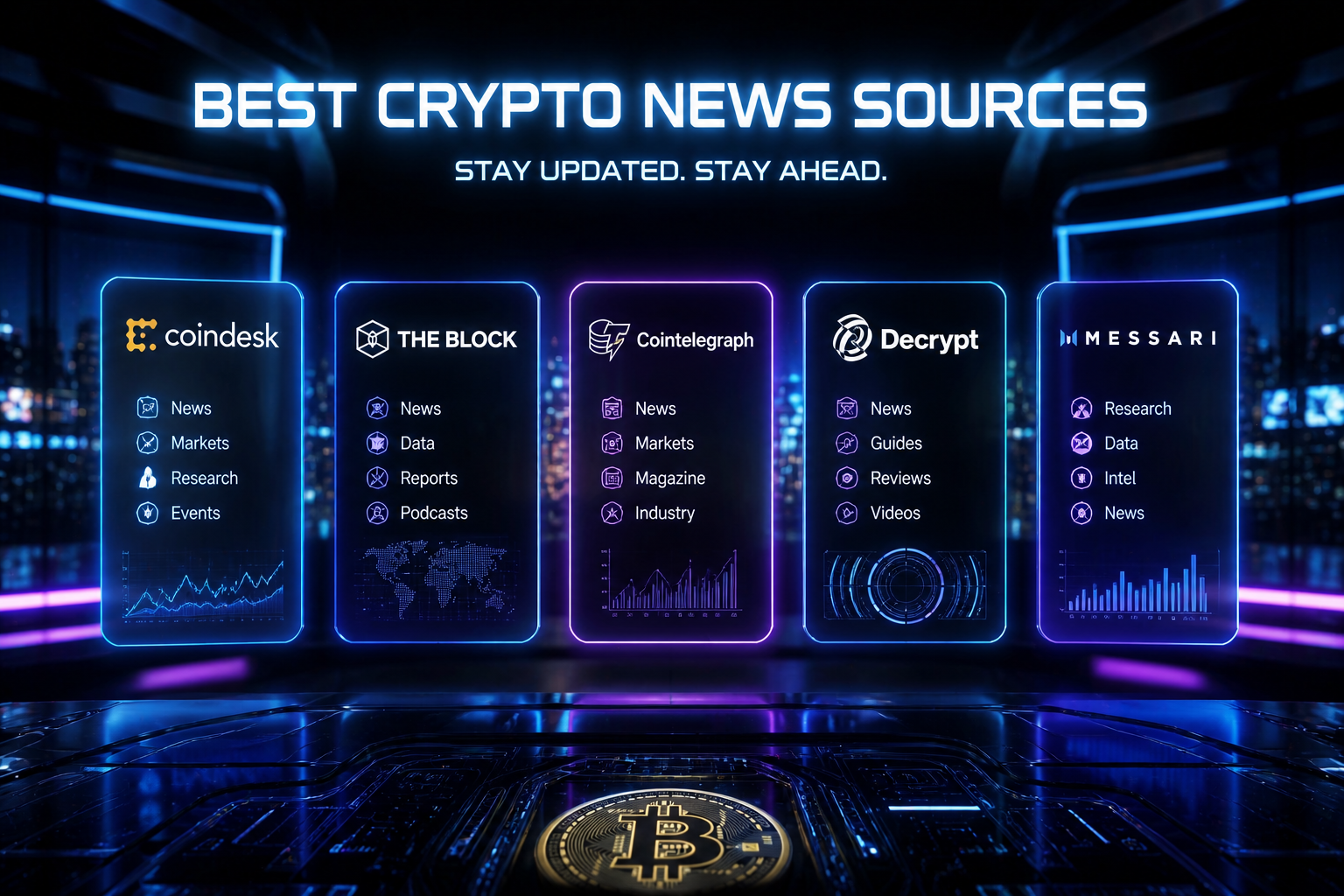
The Best Crypto News Sources in 2026 at a Glance
The crypto information landscape has exploded — and so has the noise. Between price-pumping influencers, thinly veiled sponsored content, and genuine breaking news all living in the same feed, separating signal from noise has never been harder. When evaluating the best crypto news sources 2026 has to offer, understanding the difference between credible journalism and paid promotion can protect your portfolio.
The 13 sources below were selected based on editorial independence, track record of accuracy, depth of coverage, and value to readers across different experience levels. Whether you’re tracking Bitcoin policy shifts, hunting DeFi alpha, or just trying to understand what happened to the market today, there’s a source on this list built for you.
| News Source | Best For | Free or Paid | Specialty |
|---|---|---|---|
| CoinDesk | General crypto news | Free | Breaking news, policy, market data |
| Decrypt | Accessible crypto journalism | Free | Web3, culture, beginner-friendly |
| CoinTelegraph | High-volume news coverage | Free | Price analysis, broad industry news |
| The Block | Institutional & research-grade | Freemium | Data, investigations, research |
| Messari | Deep research & analytics | Freemium | Protocol reports, market intelligence |
| CryptoPanic | News aggregation | Free | Multi-source feed, sentiment signals |
| Glassnode Insights | On-chain data readers | Freemium | Blockchain analytics, market health |
| Bloomberg Crypto | TradFi crossover investors | Paid | Macro-financial crypto reporting |
| Bankless | Ethereum & DeFi enthusiasts | Free/Paid | Newsletters, podcasts, Web3 culture |
| The Defiant | DeFi-focused readers | Freemium | DeFi protocols, yield, governance |
1. CoinDesk
Founded in 2013, CoinDesk is one of the oldest and most recognized names in crypto journalism. It has grown from a simple news blog into a full-scale media operation that includes original reporting, live event coverage (including the annual Consensus conference), a suite of market indices, and the widely-read Crypto Long & Short newsletter.
CoinDesk’s editorial team operates independently of its ownership structure — a point the outlet has publicly committed to maintaining. That commitment to editorial integrity gives it a credibility edge over many newer crypto media outlets that blur the line between content and promotion.
CoinDesk Key Features
- Covers breaking news across Bitcoin, Ethereum, altcoins, and DeFi
- Publishes in-depth policy and regulatory reporting
- Operates the CoinDesk Market Index (CMI) for broad market benchmarking
- Hosts Consensus, one of the most attended annual blockchain conferences globally
- Offers newsletters including The Node, Crypto Long & Short, and State of Crypto
What CoinDesk Covers Best
CoinDesk excels at regulatory and institutional news. When the SEC makes a move on spot Bitcoin ETFs or a major exchange faces legal scrutiny, CoinDesk is typically one of the first outlets with verified, sourced reporting — not just speculation.
Its market data section integrates live pricing with editorial context, so readers aren’t just seeing numbers — they’re getting explanations for why markets are moving. This combination of real-time data and journalism is something few outlets pull off as consistently. For those interested in understanding the broader implications, comparing crypto trade alert services can provide additional insights.
Who CoinDesk Is Best For
CoinDesk suits investors and industry professionals who want credible, well-sourced reporting they can act on. It’s particularly valuable for anyone tracking U.S. regulatory developments, exchange activity, or Bitcoin market trends at an institutional level.
2. Decrypt
Decrypt launched in 2018 with a deliberate goal: make crypto news readable for people who aren’t already deep in the ecosystem. That mission still shows in every article. The writing is clear, jargon is explained without being condescending, and the editorial coverage spans everything from token launches to the cultural side of Web3 — NFTs, gaming, and the metaverse included.
Decrypt Key Features
- Plain-language explanations of complex crypto topics
- Strong coverage of NFTs, Web3 gaming, and digital culture
- Daily news roundups and explainer-style features
- Independent editorial stance with no token holdings disclosed
What Sets Decrypt Apart From Other Outlets
Where CoinDesk leans institutional, Decrypt leans human. Stories are written for curious readers first — which means more background context, more “why does this matter” framing, and fewer assumptions about what the reader already knows. That accessibility doesn’t come at the cost of accuracy; Decrypt’s reporting is rigorously sourced.
Decrypt also runs a solid Learn section that doubles as a beginner’s encyclopedia for crypto concepts — making it useful as both a news source and a reference library.
Who Decrypt Is Best For
Decrypt is ideal for newer crypto investors, Web3 enthusiasts, and anyone interested in the cultural dimensions of blockchain technology beyond just price action. It’s also a strong secondary source for experienced investors who want broader context on trending stories.
Quick Tip: Bookmark Decrypt’s Learn section alongside its news feed. When a new protocol or token trend surfaces in the news, the Learn section often has a primer ready — saving you a separate Google deep-dive.
3. CoinTelegraph
CoinTelegraph is one of the highest-volume crypto news publishers in the world, producing dozens of articles daily across news, price analysis, opinion, and educational content. Founded in 2013, it has built a massive global readership and is particularly strong on altcoin coverage and technical price analysis.
What CoinTelegraph Covers Best
CoinTelegraph’s strength is breadth. Few outlets match its volume of coverage across Bitcoin, Ethereum, altcoins, DeFi, NFTs, and emerging blockchain ecosystems. Its technical analysis pieces — charting price movements, support/resistance levels, and market structure — are among the most read in the industry.
The outlet also runs CoinTelegraph Markets Pro, a paid subscription platform that provides algorithmic market signals and data tools for active traders looking for an edge beyond headlines.
Who CoinTelegraph Is Best For
CoinTelegraph works well for readers who want comprehensive daily coverage and aren’t focused on a single corner of the market. Active traders who track multiple assets will appreciate the technical analysis content and the sheer volume of updates.
CoinTelegraph Quick Reference
- Best for: Active traders, altcoin investors, and readers who want high-frequency updates
- Watch out for: Some sponsored content is clearly labeled — always check the byline and disclosure
- Bonus resource: CoinTelegraph’s Research arm publishes longer-form market reports worth bookmarking
4. The Block
The Block sits at the more serious end of the crypto journalism spectrum. Launched in 2018, it has built a reputation for data-driven investigative reporting and institutional-grade research. Its newsroom has broken major stories involving exchange collapses, venture capital flows, and regulatory enforcement actions — often before mainstream financial media caught on.
What The Block Covers Best
The Block’s research division is the real standout. Pro subscribers get access to detailed data dashboards tracking on-chain metrics, venture funding rounds, stablecoin flows, and protocol-level activity. This isn’t just news — it’s the kind of structured intelligence that hedge funds and crypto funds actually use to make decisions.
On the editorial side, The Block is known for careful, verified reporting. Its journalists regularly break news on major funding rounds, regulatory actions, and exchange-level developments — making it a must-follow for anyone tracking the business and financial infrastructure of the crypto industry.
Who The Block Is Best For
The Block is built for serious investors, analysts, and industry professionals who need more than headlines. The free tier offers solid news coverage, while the Pro tier unlocks a research suite that competes with traditional financial data terminals at a fraction of the cost.
The Block Pro Highlights: DeFi protocol dashboards • VC funding trackers • Stablecoin supply charts • Exchange volume data • Weekly research reports
5. Messari
Messari occupies a unique position in the crypto information ecosystem — it’s less of a traditional news outlet and more of a crypto intelligence platform. Founded by Ryan Selkis in 2018, Messari built its reputation on the Crypto Theses — an annual report that has become required reading for serious crypto investors and funds heading into each new year. For those interested in professional portfolio management, exploring crypto hedge funds can provide additional insights.
The platform combines original research, protocol-level data, governance tracking, and market analytics into a single interface. The free tier gives access to asset profiles and basic metrics, while the Pro subscription unlocks full research reports, screeners, and real-time data tools that go far beyond what most news outlets offer.
What Messari Covers Best
Messari’s protocol reports are genuinely exceptional — detailed breakdowns of individual blockchain projects covering tokenomics, team backgrounds, competitive positioning, and financial metrics. If you’re doing due diligence on a new L1 blockchain or a DeFi protocol before investing, a Messari report is one of the best structured resources available.
Beyond individual asset research, Messari tracks crypto governance proposals in real time — a feature that matters increasingly as DAOs and on-chain governance become more central to how protocols evolve. For those interested in professional management, exploring crypto hedge funds could provide valuable insights.
Who Messari Is Best For
Messari is built for investors who treat crypto like a serious asset class. If you’re allocating meaningful capital into emerging protocols, running a fund, or advising clients on digital asset exposure, the depth of Messari’s research justifies the Pro subscription cost many times over.
Even the free tier is worth bookmarking. Asset profiles on Messari often contain more structured, verified information than you’d find across a dozen separate news searches — making it a reliable first stop for any due diligence process.
6. CryptoPanic
CryptoPanic isn’t a news outlet in the traditional sense — it’s a news aggregator that pulls headlines from dozens of crypto sources into a single, filterable feed. For investors who follow multiple assets and don’t want to juggle fifteen browser tabs, it’s one of the most practical tools available. For those interested in exploring the pros and cons of crypto trade alert services, CryptoPanic offers a convenient way to stay informed.
How CryptoPanic Aggregates News
CryptoPanic collects articles from sources including CoinDesk, CoinTelegraph, Decrypt, The Block, and many others, then organizes them by asset, sentiment, and recency. Users can filter the feed by specific tokens — so if you only care about Solana or Chainlink news, you can isolate exactly that without wading through unrelated headlines. For those interested in the broader implications of crypto regulations, it’s important to be aware of the worst countries for crypto investors due to bans and restrictions.
The platform also layers in a community voting system where readers mark headlines as bullish, bearish, or important. This creates a rough sentiment signal alongside the raw news feed — not a trading indicator by itself, but a useful pulse check on how the community is reacting to developing stories in real time.
Who CryptoPanic Is Best For
CryptoPanic works best for active traders and multi-asset investors who need a fast, consolidated view of what’s happening across the market. The asset-specific filtering alone saves significant time for anyone managing a diversified crypto portfolio. For those looking to optimize their strategies, understanding the differences between DeFi yield farming and traditional savings can be beneficial.
The free tier covers most use cases well. The paid portfolio mode adds real-time alerts tied to your specific holdings — a worthwhile upgrade if you’re actively managing positions and need to react quickly to breaking developments.
7. U.Today
U.Today launched in 2018 and has grown into a high-frequency crypto news platform covering Bitcoin, Ethereum, XRP, and a broad range of altcoins. It’s particularly well-known in the XRP and Ripple community, where it consistently produces some of the most timely coverage of legal developments and ecosystem updates.
U.Today Coverage Highlights
- Daily news coverage across Bitcoin, Ethereum, XRP, Cardano, and Dogecoin
- Strong focus on altcoin-specific communities and niche token news
- Regular price analysis and on-chain activity breakdowns
- Press release coverage for new project launches and protocol updates
- A dedicated XRP and Ripple news section that rivals any outlet for volume and speed
What U.Today does particularly well is community-specific coverage. While major outlets tend to focus on Bitcoin and Ethereum with altcoins as an afterthought, U.Today treats tokens like XRP, ADA, and DOGE as primary beats — which makes it a go-to for investors whose portfolios lean toward those assets.
The trade-off is depth. U.Today publishes at a very high volume, and some articles prioritize speed over analysis. Use it as a fast-moving headline feed for altcoin activity rather than a source for deep investigative reporting.
8. CoinMarketCap News
CoinMarketCap is best known as the world’s most-visited crypto market data platform — but its integrated news section makes it more than just a price tracker. For investors who are already checking market caps and volume data daily, the built-in news feed creates a seamless bridge between price movement and the events driving it.
How CoinMarketCap Integrates News With Market Data
CoinMarketCap pulls news directly into individual asset pages, so when you’re looking at the price chart for Ethereum, relevant headlines appear right alongside the data. This contextual placement means you’re not just watching a candle drop — you’re immediately seeing whether a news event is likely behind the move.
The platform also features Alexandria, its educational content hub, which blends news with explainer articles on trending topics. For newer investors navigating their first market cycle, Alexandria offers useful context that pure news feeds often skip. The news aggregation draws from multiple external sources, so coverage breadth is solid even though CoinMarketCap itself doesn’t operate a large original-reporting newsroom.
9. Bloomberg Crypto
Bloomberg entered the crypto space as the industry matured past its early speculative phase and began attracting serious institutional capital. Today, Bloomberg Crypto operates as a dedicated vertical within the broader Bloomberg financial media operation — bringing the same rigorous sourcing standards that Wall Street has relied on for decades to digital asset coverage.
How Bloomberg Covers Crypto Differently
Bloomberg approaches crypto through a macro-financial lens that most native crypto outlets simply don’t replicate. Stories connect token price movements to broader monetary policy, institutional portfolio flows, and traditional market dynamics — context that matters enormously as crypto becomes more correlated with risk-on assets globally.
The Bloomberg Terminal integration is a significant differentiator for professional users. Subscribers can access crypto data, news alerts, and analytics directly within the Terminal environment — the same workspace where they track equities, bonds, and commodities. For portfolio managers with mixed traditional and digital asset exposure, this unified view is genuinely valuable.
Who Bloomberg Crypto Is Best For
Bloomberg Crypto is built for investors who operate at the intersection of traditional finance and digital assets. If you’re managing a fund, advising institutional clients, or simply want crypto news filtered through the same analytical rigor applied to equities, Bloomberg is unmatched.
The main limitation is access. Full Bloomberg coverage sits behind the Terminal subscription, which runs thousands of dollars annually — pricing it out of reach for most retail investors. Bloomberg’s free web coverage offers a lighter version of the same reporting, but without the depth or data integration that makes the paid product exceptional.
For high-net-worth individuals or professional traders who already use Bloomberg for traditional markets, adding the crypto vertical is a natural and worthwhile extension. For everyone else, the free articles available on Bloomberg.com provide sufficient exposure to the macro-financial perspective without the subscription cost.
10. Reuters Digital Assets
Reuters brings institutional-grade journalism credibility to crypto coverage through its Digital Assets vertical. Unlike native crypto outlets, Reuters applies the same editorial standards used for geopolitical and financial reporting to blockchain and digital asset stories — which means every major claim is verified, sourced, and held to a standard of accuracy that few crypto-native outlets consistently match. For investors who need to trust that what they’re reading is factually airtight before making decisions, Reuters Digital Assets is one of the most reliable options available.
11. Glassnode Insights
Glassnode is not a traditional news platform — it’s an on-chain analytics firm that publishes research and market intelligence derived directly from blockchain data. Founded in 2018, Glassnode has become the go-to platform for understanding what’s actually happening on the Bitcoin and Ethereum networks beneath the surface of price charts.
The Glassnode Insights blog publishes weekly on-chain reports that analyze metrics like HODL waves, exchange inflows and outflows, miner behavior, realized price levels, and long-term holder supply. These metrics tell a fundamentally different story than headlines — one based on verifiable network activity rather than sentiment or speculation.
On-Chain Data vs. Traditional News: What Glassnode Offers
Where traditional news tells you what happened in the market, Glassnode data tells you why — and often signals what might happen next. When long-term Bitcoin holders start moving coins to exchanges at scale, that’s a data signal worth tracking regardless of what headlines are saying. Glassnode makes that kind of structural market intelligence accessible in a way no news outlet can replicate.
Who Glassnode Is Best For
Glassnode is essential reading for Bitcoin and Ethereum investors who want to make data-driven decisions rather than react to news cycles. The free tier provides access to basic on-chain charts, while the paid Advanced and Professional tiers unlock real-time data, full metric libraries, and API access for quantitative traders.
If you only use one data-focused resource to complement your news diet, Glassnode’s weekly reports are arguably the single highest signal-to-noise source available in the crypto information ecosystem — particularly for understanding Bitcoin market cycles at a structural level.
12. Bankless
Bankless at a Glance
• Founded: 2019 by Ryan Sean Adams and David Hoffman
• Format: Newsletter, podcast, YouTube, and premium membership
• Focus: Ethereum ecosystem, DeFi, Web3 culture, and crypto-native finance
• Free Tier: Weekly newsletter and podcast episodes
• Paid Tier: Bankless Premium — deeper research, alpha reports, and community access
• Best Known For: Long-form thinking on the future of decentralized finance
Bankless started as a newsletter with a simple thesis: the traditional banking system is broken, and crypto-native financial tools are the alternative worth building toward. That perspective shapes everything the outlet produces — from podcast conversations with Ethereum core developers to deep dives on emerging DeFi protocols and Layer 2 scaling solutions.
The Bankless podcast has become one of the most influential long-form conversations happening in the crypto space. Episodes regularly feature founders, researchers, and economists discussing the technical and philosophical dimensions of decentralized finance at a depth that short-form news simply can’t achieve. Guests have included Vitalik Buterin, Andre Cronje, and leading figures from across the Ethereum and DeFi ecosystems. For those interested in understanding the broader landscape, it’s also important to be aware of the worst countries for crypto investors due to bans and restrictions.
What makes Bankless particularly valuable is its consistent intellectual framework. Rather than chasing daily price narratives, it focuses on the structural evolution of crypto as a financial system — helping readers develop a mental model for where things are heading rather than just reacting to where they are today. For anyone serious about understanding Ethereum and DeFi beyond surface-level headlines, Bankless is required reading.
What Makes Bankless Different From Traditional News Outlets
Bankless doesn’t pretend to be neutral. It has a clear point of view — that decentralized finance represents a generational shift in how money works — and it reports through that lens without apology. That intellectual honesty is refreshing in a space where many outlets quietly hold token positions or run sponsored content while presenting themselves as objective news sources. For those interested in exploring more about the impact of decentralized finance, check out this guide on professional portfolio management in the crypto space.
The newsletter format also creates a different kind of reader relationship than a standard news feed. Rather than scanning headlines, Bankless subscribers read longer pieces that build arguments over time — developing genuine understanding of DeFi mechanics rather than just reacting to price alerts. For long-term Ethereum investors, that depth of perspective compounds in value over months and years of reading.
13. The Defiant
The Defiant was founded in 2019 by Camila Russo, author of The Infinite Machine — one of the most widely read books on the history of Ethereum. That origin story matters, because it gives The Defiant a level of institutional knowledge about DeFi that most outlets simply don’t have. The publication covers decentralized finance with a specificity and depth that reflects a genuine understanding of how these protocols actually work, not just what their token prices are doing.
DeFi-Focused Coverage: What The Defiant Does Best
The Defiant specializes in protocol-level DeFi reporting — governance votes, liquidity dynamics, yield strategy shifts, smart contract upgrades, and the political economy of decentralized autonomous organizations. When Aave, Uniswap, or Compound makes a significant governance move, The Defiant covers the substance of what changed and why it matters to participants in those ecosystems — not just the headline.
Who The Defiant Is Best For
The Defiant is essential reading for active DeFi participants — liquidity providers, yield farmers, DAO governance voters, and anyone allocating capital into decentralized protocols. If your portfolio is meaningfully weighted toward DeFi tokens or you’re actively participating in on-chain governance, The Defiant’s coverage will surface relevant developments faster and with more context than any general crypto outlet.
How to Spot Reliable Crypto News vs. Hype
The single biggest risk in crypto isn’t volatility — it’s acting on bad information. Sponsored articles dressed up as investigative reporting, influencer-driven narratives without disclosed token holdings, and outright fabricated rumors spread faster in crypto than in almost any other asset class. Developing a reliable filter for what’s worth reading — and what’s worth ignoring — is as important as finding good sources in the first place.
The good news is that reliable crypto journalism follows the same principles as reliable journalism anywhere: named sources, verifiable data, transparent disclosures, and editorial accountability. The red flags are equally recognizable once you know what to look for.
Red Flags That Signal Biased or Paid Coverage
One of the most common forms of low-quality crypto content is the “sponsored post” that doesn’t clearly identify itself as such. Some outlets label these as “Press Release,” “Sponsored,” or “Partner Content” — but others bury the disclosure or skip it entirely. If an article is overwhelmingly positive about a project with no critical framing and no named journalist, treat it as marketing, not reporting.
Anonymous sourcing used to hype price targets is another major red flag. Legitimate outlets use anonymous sources to protect whistleblowers and industry insiders from retaliation — not to float token predictions without accountability. When a story’s entire premise rests on an unnamed source claiming a major exchange is “about to announce” something bullish, extreme skepticism is warranted.
Watch for these specific warning signs when evaluating a crypto news article:
Warning Signs of Unreliable Crypto News
- No named journalist or author listed on the byline
- Price predictions presented as fact rather than analysis
- “Sponsored,” “Advertorial,” or “Press Release” labels that are easy to miss
- No links to primary sources, official announcements, or verified data
- Articles published simultaneously across multiple low-authority sites — a classic astroturfing pattern
- Outlets that only publish positive coverage about projects known to run paid PR campaigns
How to Cross-Reference Crypto Stories Before Acting
Before acting on any crypto news story — especially one that involves a specific price catalyst, regulatory development, or project announcement — run it through at least two independent sources. If CoinTelegraph reports that a major institution has purchased Bitcoin, check whether CoinDesk, Reuters, or Bloomberg has confirmed the same story with their own sourcing. A story carried by only one outlet should be treated as unverified until corroborated.
Why On-Chain Data Beats Headlines Every Time
Headlines describe events. On-chain data describes reality. When you read that “whales are accumulating Bitcoin,” that claim is either verifiable on-chain or it isn’t — and platforms like Glassnode, Nansen, and CryptoQuant will tell you definitively which it is within minutes. Building the habit of checking on-chain data alongside news headlines is what separates reactive traders from informed investors.
Essential On-Chain Data Platforms
- Glassnode: Bitcoin and Ethereum on-chain analytics, HODL waves, exchange flows
- Nansen: Wallet labeling and smart money tracking across Ethereum and EVM chains
- CryptoQuant: Exchange reserve data, miner flows, stablecoin supply metrics
- Dune Analytics: Community-built dashboards for DeFi protocol metrics and on-chain activity
- Arkham Intelligence: Entity-level blockchain transaction tracking and wallet attribution
The reason on-chain data is so powerful is that it cannot be fabricated the way a press release can. When billions of dollars in Bitcoin move from cold storage to exchange wallets, that transaction is permanently recorded on the blockchain — visible to anyone who knows where to look, regardless of what any news outlet is reporting at the same time.
This doesn’t mean headlines are useless. News still surfaces the human context behind on-chain events — the regulatory decisions, the executive moves, the macro forces that explain why capital is flowing in a particular direction. The most informed crypto investors use both layers together: news for narrative context, on-chain data for ground truth.
Make it a non-negotiable habit. Before acting on any market-moving headline, spend two minutes checking whether the on-chain data supports the narrative being presented. More often than you’d expect, it doesn’t — and that discrepancy is information worth having before you place a trade. Avoiding common mistakes can be crucial for successful trading.
The Right Crypto News Source Depends on Your Goals
There’s no single best crypto news source for every investor — because different investors need fundamentally different things. A long-term Bitcoin holder focused on macro trends and regulatory developments will get more value from CoinDesk and Bloomberg Crypto than from a high-frequency feed like CryptoPanic. A DeFi yield farmer who needs to track governance proposals and protocol upgrades in real time will find The Defiant and Glassnode far more relevant than anything a traditional financial outlet produces. The key is building a curated stack that matches your specific investment strategy rather than trying to read everything.
A practical approach: choose one primary news outlet that aligns with your main crypto focus, one aggregator to catch developments you might miss, and one on-chain data platform to ground-truth the narratives you encounter. That three-layer system — curated news, broad aggregation, verified data — gives you comprehensive coverage without the information overload that leads to poor, emotionally-driven decisions. Resources like CoinLedger complement this stack well, helping investors stay organized on the tax and portfolio tracking side while they stay informed on the news side.
Frequently Asked Questions
Crypto investors regularly ask the same core questions about where to get reliable information, how often to consume it, and how much weight to give news events in their decision-making. The answers matter — because how you consume crypto information shapes how you invest.
What Is the Most Trusted Crypto News Source in 2026?
The most trusted crypto news sources in 2026 are CoinDesk and Reuters Digital Assets for general and regulatory news, The Block for institutional-grade research and investigations, and Glassnode Insights for on-chain data accuracy. No single outlet covers everything equally well — but these three together represent the highest consistent standard of verified, sourced reporting available in the crypto information ecosystem.
Are There Free Crypto News Apps Worth Using?
Yes — CoinDesk, Decrypt, CoinTelegraph, U.Today, and CryptoPanic are all free to use and collectively cover the full spectrum of crypto news without requiring a subscription. For deeper research, Messari and Glassnode both offer meaningful free tiers that provide more analytical depth than most paid news products. The paid upgrades at The Block and Messari are worth considering only if you’re allocating significant capital and need institutional-grade research to support your decisions. If you’re interested in exploring professional portfolio management, consider checking out this guide on crypto hedge funds.
How Often Should I Check Crypto News as an Investor?
For most long-term investors, a once-daily news check is sufficient — and often better than continuous monitoring, which creates anxiety and encourages reactive decision-making. Set a specific time each day to review your primary news source and aggregator, then step away. For active traders managing short-term positions, more frequent monitoring makes sense, but even then, the goal should be tracking specific catalysts rather than consuming every headline as it drops.
Can Crypto News Directly Influence Prices?
Yes — and the mechanism is well-documented across multiple market cycles. Major news events that have historically moved crypto prices include:
News Events That Move Crypto Prices
- Regulatory announcements from the SEC, CFTC, or international bodies
- Exchange insolvency events or withdrawal freezes
- Spot ETF approvals or rejections by major financial regulators
- Protocol-level hacks, exploits, or critical vulnerability disclosures
- Institutional adoption announcements from major publicly traded companies
- Macroeconomic events such as Federal Reserve interest rate decisions
The relationship between news and price isn’t always linear or immediate. Sometimes markets price in anticipated news events before they officially break — the “buy the rumor, sell the news” dynamic plays out repeatedly in crypto markets, particularly around scheduled events like Bitcoin halvings and major protocol upgrades.
It’s also worth noting that not all market-moving news originates from crypto-native outlets. Some of the most significant price-affecting announcements — SEC enforcement actions, Congressional hearings, and macroeconomic policy shifts — are first reported by traditional financial media including Bloomberg, Reuters, and the Wall Street Journal. Monitoring at least one mainstream financial outlet alongside your crypto-specific sources ensures you don’t miss macro-level developments that can move the entire market simultaneously.
The most dangerous scenario is acting on news before it’s verified. Crypto markets move fast enough that a single unverified tweet claiming a regulatory ban or a major exchange insolvency can trigger significant price moves before the story is confirmed or debunked. Training yourself to wait for corroboration from multiple credible sources, such as those listed here, before making any capital decision based on breaking news is one of the highest-value habits a crypto investor can develop.
What Is the Difference Between a Crypto News Site and a Crypto Data Platform?
A crypto news site publishes editorial content — articles, analysis, opinion, and investigative reporting written by journalists and researchers. The goal is to inform readers about events, trends, and developments in the crypto space through human-written narrative. CoinDesk, Decrypt, and CoinTelegraph are news sites.
A crypto data platform collects, organizes, and visualizes blockchain and market data — on-chain transaction volumes, exchange flows, wallet activity, protocol metrics, and price history. The goal is to surface verifiable quantitative information that helps investors understand market structure and network health without editorial interpretation. Glassnode, Nansen, and CoinMarketCap are data platforms.
The best-informed crypto investors use both — news platforms for understanding the human narrative behind market events, and data platforms for verifying whether that narrative is supported by actual on-chain activity. Neither alone is sufficient. Together, they create an information foundation strong enough to make genuinely informed investment decisions in one of the most information-dense and manipulation-prone markets in the world. Start building your personal crypto news stack today — and let platforms like CoinLedger handle the portfolio tracking and tax reporting so you can stay focused on what matters most.
DISCLAIMER: This article is for informational purposes only and does not constitute financial advice. Cryptocurrency investments carry significant risk. Always Do Your Own Research (DYOR) before making any investment decisions. The best crypto news sources 2026 mentioned here are provided for educational purposes only.


Latest
Guides & Tutorials
08 Jul 2026
Guides & Tutorials
04 Jul 2026
Guides & Tutorials
21 May 2026
Guides & Tutorials
13 May 2026
Guides & Tutorials
28 Apr 2026
Guides & Tutorials
15 Mar 2026