altcoin performance
Bitcoin consolidation
Bitcoin ETF flows
Bitcoin price analysis
CLARITY Act
crypto market news
Crypto Market Report June 22 2026
crypto regulations
DeFi protocols
Ethereum trends
institutional investors
market trends
on-chain analysis
Paxos SEC registration
portfolio strategy
Solana news
Technical Analysis
trading signals
transaction data
weekly market analysis

Coinposters
Crypto Market Report June 22, 2026: Weekly Price Trends, Breakouts & Portfolio Insights
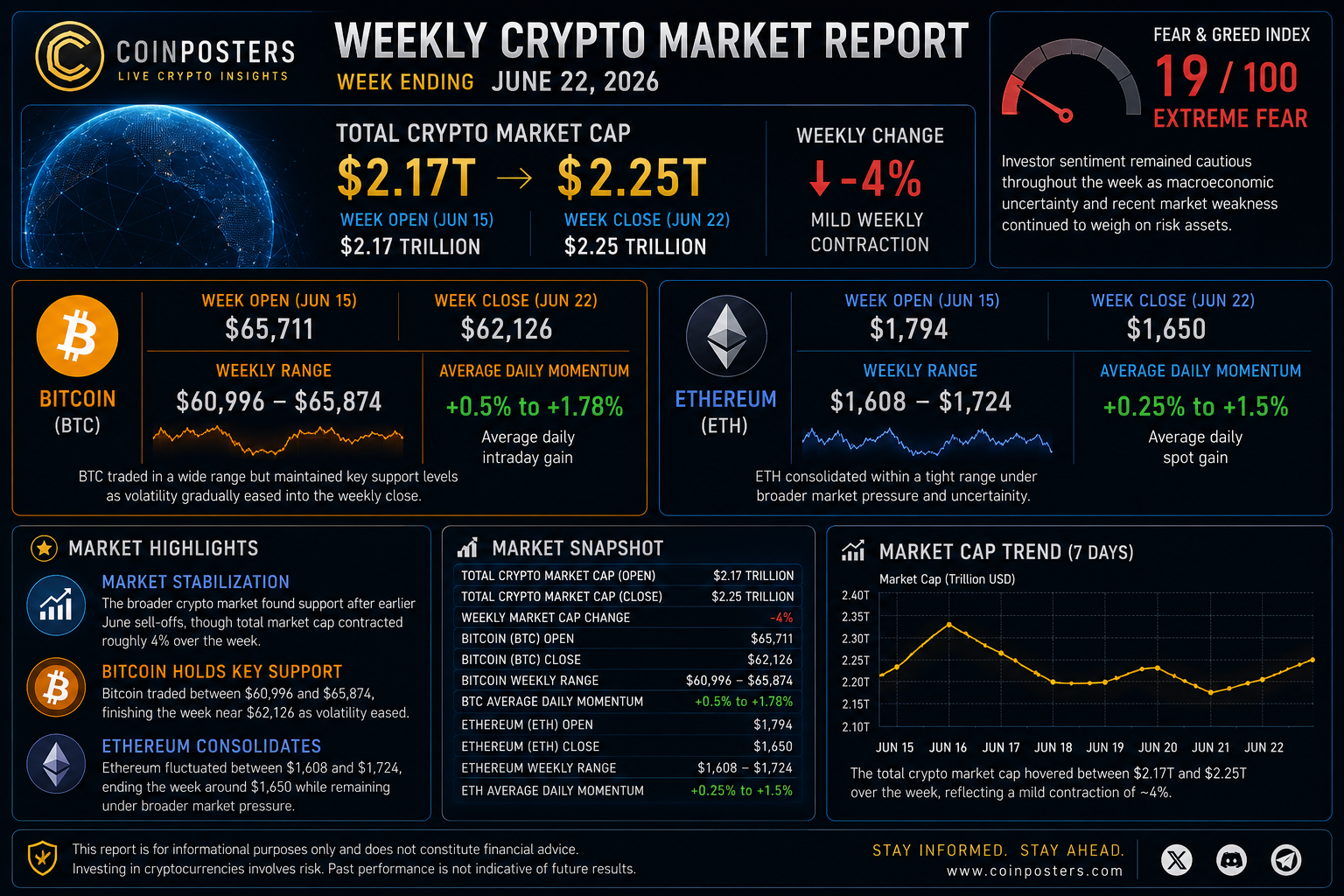
The Crypto Market Report June 22, 2026 reveals a market in consolidation rather than crisis: Bitcoin holding near $65K despite geopolitical shocks and Fed hawkishness, on-chain data showing record transaction counts but disproportionately small economic value, institutional players like Strategy quietly accumulating, and regulatory momentum building as Paxos becomes the first SEC-registered crypto firm under the newly enacted Clarity Act. For portfolio managers tracking this week’s trends, the Crypto Market Report June 22, 2026 signals selective accumulation beneath weak broad demand — a pattern historically preceding significant upside moves.
Key Takeaways: Crypto Market Report June 22, 2026
- •Bitcoin settled near $65K after volatile swings between $61K and $67K driven by geopolitical whiplash from collapsed US-Iran negotiations and hawkish Fed signals.
- •Bitcoin’s network hit near-record transaction counts, but roughly 80% of transactions are micro-payments below 0.01 BTC — signaling adoption without commensurate capital flow.
- •Solana outperformed the broader market, gaining 1.6% to close at $72.46 while BTC and ETH posted losses — a reminder altcoin selection still matters.
- •Paxos became the first SEC-registered crypto firm under the Clarity Act, setting a regulatory precedent that could reshape how digital asset businesses operate in the US.
- •Institutional behavior shows selective accumulation at current levels despite softening broad demand — a bifurcation that has historically preceded upside moves.
Article at a Glance: This comprehensive Crypto Market Report June 22, 2026 analyzes the week’s price action, on-chain data, institutional behavior, and regulatory developments across Bitcoin, Ethereum, and Solana. You’ll discover why Bitcoin’s record transaction counts mask a deeper story about economic throughput, how Glassnode’s Week 26 Market Pulse reveals resilient holder behavior despite softening institutional demand, why the Paxos SEC registration under the Clarity Act represents the most consequential regulatory event in crypto’s history, and exactly what technical levels matter for determining whether the current consolidation holds or breaks lower. The report includes detailed tables on asset performance, Glassnode indicators, and support/resistance zones, plus a FAQ section addressing the most critical questions from active portfolio managers. Whether you’re managing institutional allocations or tracking your personal holdings, this Crypto Market Report June 22, 2026 provides the data and analysis framework you need to navigate the current market environment with informed conviction.
Table of Contents
- Bitcoin Traded Between $61K and $67K This Week Before Settling Near $65K
- Why the US-Iran Peace Deal Collapse Shocked Crypto Markets on Monday
- Juneteenth Holiday Delayed the Market’s First Reaction Until Monday’s Cash Open
- How Bitcoin’s Network Activity Hit Near-Record Highs While Price Stayed Flat
- What Bitcoin’s On-Chain Data Is Actually Telling You Right Now
- The Glassnode BTC Market Pulse for Week 26
- Strategy’s Preferred Dividend Change and What It Means for Bitcoin Treasury Stocks
- Paxos Became the First SEC-Registered Crypto Firm Under the Clarity Act
- ETF Outflows, Loss Realization, and Defensive Options Positioning Weighed on Sentiment
- What BTC Breaking Below $60K Signals for Short-Term Price Direction
- Signs of Selective Accumulation Are Emerging Despite Weak Broad Demand
- What to Watch in the Crypto Market for the Week Ahead
- Frequently Asked Questions
June 2026 has been a week of mixed signals, macro pressure, and one regulatory milestone that the crypto world won’t stop talking about. For anyone tracking the crypto market with serious intent, this Crypto Market Report June 22, 2026 reveals exactly the kind of complexity that separates reactive traders from informed ones.
Price action was volatile but ultimately range-bound. On-chain activity looked impressive on the surface but told a more nuanced story underneath. And institutional behaviour — from Strategy’s continued Bitcoin accumulation to Paxos’s landmark SEC registration — gave the market plenty to digest. This Crypto Market Report June 22, 2026 breaks down all three layers so you can understand not just what happened this week, but what it actually means for your portfolio heading forward.
Bitcoin Traded Between $61K and $67K This Week Before Settling Near $65K
This week’s Crypto Market Report June 22, 2026 begins with price action that looked more dramatic in the chart than the closing numbers suggest. Bitcoin opened with momentum and surged to a seven-day high of $66,888 on Monday as optimism from a proposed US-Iran agreement carried over from the prior weekend. That rally didn’t last, and by week’s end, the story had completely reversed.
Week 26 Snapshot — Key Asset Performance
| Asset | Weekly Change | Closing Price | Notable Level |
|---|---|---|---|
| Bitcoin (BTC) | -3.7% | US$63,310 | 7-day high: US$66,888 |
| Ethereum (ETH) | -1.1% | US$1,707 | Underperformed vs. SOL |
| Solana (SOL) | +1.6% | US$72.46 | Outperformed broader market |
| USDT | Flat | ~$1.00 | Trading modestly below parity |
As the week progressed, the Federal Reserve struck a more hawkish tone, and attention quickly shifted to the scheduled signing of the US-Iran agreement — which then fell apart entirely. When negotiations collapsed over the weekend, BTC briefly dropped to around $62,200 before stabilising near $64,200 by Sunday. The week closed with BTC down approximately 1.8% on a rolling basis, settling in the lower half of the $60,000–$65,000 range that has defined price action since post-FOMC stabilisation. For understanding more about managing digital assets during volatility, explore our guide to navigating DeFi protocols safely.
Ethereum followed a similar path but held up slightly better, closing at $1,707 with a 1.1% weekly decline. Solana was the standout — gaining 1.6% to $72.46, outperforming the broader market and showing relative strength that traders should note heading into the next week.
Why the US-Iran Peace Deal Collapse Shocked Crypto Markets on Monday
Geopolitical Risk and Asset Price Volatility
Crypto markets had priced in optimism heading into the week. The proposed US-Iran agreement built positive sentiment across risk assets, and Bitcoin’s Monday rally to $66,888 was a direct reflection of that. When diplomatic negotiations collapsed, the risk-off reaction was swift and unforgiving.
BTC fell sharply, briefly touching $62,200, before buyers stepped back in and defended the low $60,000s. It’s a clear example of how geopolitical headlines — even ones that feel distant from digital assets — can drive short-term price action with real force. This week’s Crypto Market Report June 22, 2026 underscores how macro instability creates volatility that can either be a risk to manage or an opportunity to capitalize on depending on your positioning.
Juneteenth Holiday Delayed the Market’s First Reaction Until Monday’s Cash Open
The Juneteenth federal holiday meant that traditional financial markets were closed at a critical moment, which delayed the full market reaction to developing geopolitical events until Monday’s cash open. For crypto, which trades 24/7, this created an asymmetry — digital assets absorbed some of the initial volatility over the weekend while traditional markets were sidelined. By the time equities opened Monday, BTC had already priced in much of the optimism, which helps explain why the peak came so early in the week.
How Bitcoin’s Network Activity Hit Near-Record Highs While Price Stayed Flat
Here’s where this Crypto Market Report June 22, 2026 gets interesting. While BTC’s price ground sideways, the network itself was anything but quiet. Total daily transactions and average transactions per block both approached all-time highs in 2026. On the surface, this looks like strong adoption. Dig one layer deeper and the picture shifts — the economic value of those transactions is disproportionately small relative to the volume being processed.
What Bitcoin’s On-Chain Data Is Actually Telling You Right Now
On-chain data is one of those tools that rewards patience and punishes shallow readings. The headline numbers look bullish — near-record transaction counts, high block utilisation, and CryptoQuant’s activity index breaking above trend for the first time since mid-2024. But the composition of that activity tells a more complicated story that any serious Bitcoin watcher needs to understand before drawing conclusions.
The network is busy. That much is true. But why it’s busy, and what kinds of transactions are driving that volume, matters enormously for understanding whether this signals genuine demand growth or something more structural. For a deeper analysis, check out the weekly crypto market wrap.
CryptoQuant’s Activity Index Broke Above Trend for the First Time Since Mid-2024
CryptoQuant’s on-chain activity index crossing above its trend line is not a signal to ignore. The last time this happened was mid-2024, and it preceded a meaningful shift in market momentum. Whether June 2026 follows the same script remains to be seen, but the breakout is worth flagging for anyone monitoring leading indicators rather than just price.
Daily Transaction Counts and Transactions Per Block Are Near All-Time Highs in 2026
Both total daily transactions and average transactions per block are near all-time highs as of June 2026. The sub-0.001 BTC and sub-0.01 BTC cohorts have each surged this year, approaching the prior 2024 peak. Micro-transactions below 0.01 BTC now represent approximately 80% of all daily transactions, up from under 50% in 2023. Record-high transaction counts are driving the surge, but the economic weight behind those counts is thin.
The Transaction Count vs. Economic Value Split
When a network processes record transaction counts but the economic value moved per transaction is disproportionately small, it suggests the activity is driven by low-value use cases — micro-payments, dust transactions, or protocol-level activity — rather than large capital movements. This distinction is critical for understanding what the on-chain data in this Crypto Market Report June 22, 2026 actually signals about market health.
The Glassnode BTC Market Pulse for Week 26
Glassnode’s Week 26 BTC Market Pulse added important context to the price and on-chain picture. Spot trading volumes drifted toward the lower end of their recent range, institutional demand softened, and net selling replaced the aggressive taker demand that had characterised earlier periods of strength. Despite this, holder behaviour remained resilient — a signal that the market’s long-term base is not eroding even as short-term momentum fades.
Glassnode Week 26 Market Pulse — Key Signals
| Indicator | Reading | Implication |
|---|---|---|
| Spot Trading Volume | Lower end of recent range | Reduced participation |
| Institutional Demand | Softened | Accumulation pace slowing |
| Holder Behaviour | Resilient | Long-term base intact |
| Futures Positioning | Stable | No aggressive directional bets |
| Order Flow | Net selling | Taker demand has shifted defensive |
| Profitability Metrics | Strong | Market not in distress |
The combination of stable futures positioning and resilient holder behaviour is arguably the most important detail in the Week 26 Pulse. It indicates that despite a challenging macro environment and softening institutional demand, the structural foundation of the Bitcoin market has not cracked. That’s a meaningful distinction when deciding how to interpret the week’s price decline shown in this Crypto Market Report June 22, 2026.
Spot Trading Volumes Drifted to the Lower End of Their Recent Range
Spot volumes pulled back meaningfully from the elevated levels seen earlier in Q2 2026. Lower participation across major exchanges signaled that buyers were not stepping in aggressively at current price levels. The volume retreat came alongside BTC’s inability to reclaim the $65,800 level — a short-term momentum trigger identified by analysts. USDT continued to trade modestly below parity, reflecting abundant secondary-market supply and a cautious stablecoin environment.
Spot volume is one of the cleanest real-time reads on market conviction. When it contracts alongside price, it tells you that neither bulls nor bears are committing. That’s exactly what happened during the week of June 22 — BTC moved within a wide range, but the volume profile underneath that movement was thin and unconvincing.
The lower end of the recent volume range is not necessarily a crash signal. In past Bitcoin cycles, volume contractions during consolidation phases have often preceded sharp directional moves once a catalyst emerged. The question heading into the next week is simple: will volume return to confirm a breakout above $65,800, or will it remain suppressed and allow further drift toward the May cycle low near $59,100?
Institutional Demand Softened But Holder Behaviour Remained Resilient
Despite the softening in institutional demand, the holder cohort — those wallets with longer accumulation histories and higher cost bases — showed no meaningful signs of capitulation. This is the group that tends to define the structural floor of any Bitcoin market cycle. Their willingness to hold through a 3.7% weekly drawdown, a geopolitical shock, and a hawkish Fed pivot speaks to the maturity of Bitcoin’s current holder base.
Strategy’s Continued Bitcoin Accumulation
Strategy disclosed the purchase of an additional 1,587 BTC between June 8 and June 14 for approximately $100 million at an average price of $63,024 per coin — reinforcing that accumulation remains their primary objective regardless of short-term price noise. This institutional-grade buying during weakness is exactly the type of behavior highlighted in this Crypto Market Report June 22, 2026.
Futures Positioning Stayed Stable Despite Price Volatility
One of the more reassuring signals from Week 26 was the stability in futures positioning. Despite BTC swinging from near $61,000 to almost $67,000 within a single week, leveraged traders did not pile into aggressive long or short positions. Open interest held relatively steady, and funding rates did not spike in either direction. This kind of measured positioning in the derivatives market reduces the risk of a cascading liquidation event — the type of forced selling that drove BTC to the low $60,000 region earlier in June following a significant liquidation event and volatility repricing.
Net Selling Replaced Aggressive Taker Demand as Order Flow Shifted
Order flow data from the week revealed a clear shift: the aggressive taker demand that had supported BTC during earlier recovery attempts gave way to net selling pressure. Taker buyers — those hitting the ask and driving price upward — stepped back, and the order book reflected a market in defensive mode. This shift in order flow is consistent with the broader picture of softening institutional demand and reduced spot volumes documented in this Crypto Market Report June 22, 2026. It doesn’t signal panic, but it does confirm that the path of least resistance in the short term remains to the downside unless a fresh catalyst emerges to reverse the flow.
Strategy’s Preferred Dividend Change and What It Means for Bitcoin Treasury Stocks
Strategy made headlines again this week — and not just for its Bitcoin purchase. The company, which has become the most prominent corporate Bitcoin treasury vehicle in the world, announced a change to its preferred dividend structure. The move drew attention from analysts who argue that Strategy needs to pause its BTC acquisition program, rebuild its cash reserve, and become more deliberate about the timing of future purchases.
The concern is straightforward: continuously buying Bitcoin at market price — regardless of cycle positioning — removes the strategic optionality that could allow the company to accumulate more aggressively during genuine market weakness. For investors holding Bitcoin treasury stocks as a proxy for BTC exposure, this is a signal worth watching. The preferred dividend change alters the capital structure calculus and may affect how the market values Strategy’s BTC holdings relative to its liabilities going forward.
Paxos Became the First SEC-Registered Crypto Firm Under the Clarity Act
The single most consequential regulatory development of the week — and perhaps the most important signal covered in this entire Crypto Market Report June 22, 2026 — had nothing to do with price. Paxos became the first crypto firm to receive SEC registration under the newly enacted Clarity Act — a landmark moment for US digital asset regulation that the market has been anticipating for months.
This is not a minor compliance milestone. It represents the first time the regulatory framework established by the Clarity Act has been applied to a real operating business, setting a concrete precedent for what SEC registration looks like in practice for crypto firms. Paxos, known for its stablecoin infrastructure and institutional-grade custody solutions, was well-positioned to be first through the door. The company’s existing compliance infrastructure, its relationships with regulated financial institutions, and its track record with the New York Department of Financial Services made it a natural candidate to navigate the new registration process. The fact that it cleared successfully signals that the Clarity Act’s framework is operational — not just theoretical.
The Clarity Act Registration is Significant Because:
- → It creates a defined legal pathway for crypto firms to operate under SEC oversight without the ambiguity that has defined the regulatory environment since 2017
- → It establishes clear registration requirements that firms can actually plan around with certainty
- → It removes a primary barrier to deeper institutional participation in crypto
- → Paxos’s successful registration proves the framework works and serves as a template for other firms
What the Clarity Act Registration Actually Means for Crypto Regulation
The Clarity Act registration creates a defined legal pathway for crypto firms to operate under SEC oversight without the ambiguity that has defined the regulatory environment since at least 2017. Prior to this framework, crypto businesses faced a patchwork of enforcement actions, no-action letters, and conflicting guidance from multiple agencies. The Clarity Act changes that by establishing clear registration requirements, disclosure standards, and operational rules that firms can actually plan around.
For the broader market, this matters because regulatory clarity is one of the primary barriers to deeper institutional participation in crypto. Pension funds, sovereign wealth funds, and large asset managers operate under fiduciary obligations that make regulatory ambiguity a genuine obstacle. A functioning SEC registration framework removes one of the most cited objections to institutional crypto allocation — and Paxos clearing the first registration is proof that the framework works.
Why This Sets a Precedent for Other Crypto Firms Seeking Regulatory Clarity
Paxos’s successful registration is now the template. Other crypto firms — exchanges, custodians, stablecoin issuers, tokenized asset platforms — can study the Paxos filing, understand what the SEC required, and structure their own applications accordingly. The first registration is always the hardest because there is no precedent to follow. That barrier no longer exists. Expect a wave of Clarity Act registration filings in the months ahead as firms that have been waiting on the sidelines now have a concrete roadmap to follow. This could meaningfully accelerate institutional-grade infrastructure development in the US crypto market.
ETF Outflows, Loss Realization, and Defensive Options Positioning Weighed on Sentiment
Beyond the macro and regulatory headlines, several technical and structural factors combined to keep sentiment cautious throughout the week. Bitcoin ETF products experienced net outflows as some investors chose to reduce exposure following the earlier June liquidation event. Loss realization — measured by on-chain spent output profit ratio metrics — ticked higher, indicating that a subset of holders who bought above current levels began exiting positions. In the options market, the positioning skewed defensive, with increased demand for downside protection rather than upside calls.
Together, these three signals — ETF outflows, rising loss realization, and defensive options skew — paint a picture of a market that is de-risking at the margin rather than positioning for the next leg higher. This Crypto Market Report June 22, 2026 notes this pattern as contextually important for understanding the week’s broader sentiment.
What BTC Breaking Below $60K Signals for Short-Term Price Direction
The $60,000 level is not just a round number — it’s a technically and psychologically significant threshold that has acted as a pivot point throughout the 2025–2026 cycle. BTC briefly touched $62,200 following the collapse of US-Iran negotiations, which is close enough to the $60,000 zone to make the next few weeks critical for determining whether the current consolidation holds or breaks down further.
Critical Bitcoin Technical Levels to Monitor
- $65,800 — Short-term momentum trigger; reclaiming this level improves the near-term outlook
- $70,000 — Major resistance zone; a close above here would shift the broader trend back to bullish
- $62,200 — Weekly low touched after US-Iran deal collapse; immediate support
- $60,000 — Psychological and technical threshold; a sustained break below signals downtrend confirmation
- $59,100 — May 2026 cycle low; the next meaningful support if $60K fails
A sustained close below $60,000 would bring the May cycle low near $59,100 into direct focus. That level represents the most recent meaningful support zone established during a prior period of selling pressure, and losing it would shift the technical structure from consolidation to a confirmed downtrend characterized by lower highs and lower lows. The market is already tracing that pattern relative to late-2025 levels, and BTC remains well below the major resistance zone around $80,000.
On the upside, the key level to watch is $65,800. A recovery through that threshold would improve near-term momentum and open the door toward a retest of $70,000. A move back above $70,000 would materially strengthen the bull case and signal that the current drawdown was a correction within an ongoing uptrend rather than the beginning of a more significant structural decline.
The honest read here is that BTC is at an inflection point. The macro environment — a hawkish Fed, geopolitical uncertainty, and softening institutional demand — is not constructive for an immediate breakout. But the structural foundation, as reflected in resilient holder behaviour and stable futures positioning, has not broken down. This is a market that needs a catalyst, not a market that is collapsing. For insights on how DeFi strategies and risk assessment can impact market positioning, explore our comprehensive guide.
Signs of Selective Accumulation Are Emerging Despite Weak Broad Demand
Even in a week defined by net selling and ETF outflows, selective accumulation was visible beneath the surface. Strategy’s purchase of 1,587 BTC at an average of $63,024 between June 8 and June 14 is the most visible example, but on-chain data also shows that certain wallet cohorts — particularly those with accumulation histories spanning multiple cycles — continued adding to positions while short-term holders reduced exposure.
The Smart Money vs. Weak Hands Bifurcation
This bifurcation between weak hands exiting and strong hands quietly accumulating is a pattern that has historically preceded significant upside moves in Bitcoin. As documented in this Crypto Market Report June 22, 2026, it doesn’t guarantee a rally, but it does suggest that the smart money is not fleeing the asset class — it’s repositioning within it during a period of weakness.
What to Watch in the Crypto Market for the Week Ahead
The week ahead is defined by three questions: Can BTC reclaim $65,800 on meaningful volume? Will ETF flows reverse from net outflows to net inflows? And will any new macro catalyst — Fed commentary, geopolitical developments, or regulatory news — provide the directional trigger the market is waiting for?
Solana’s relative strength is worth monitoring as a leading indicator for altcoin sentiment, and any further Clarity Act registration announcements following the Paxos precedent could inject positive regulatory momentum into the broader market. Keep watching on-chain transaction composition — if high-value settlement activity begins to replace the micro-transaction dominance driving current network numbers, that would be a meaningful shift in the demand signal worth acting on. Stay tuned to crypto news calendars and market events for the next catalyst.
Frequently Asked Questions
This Crypto Market Report June 22, 2026 generated a lot of questions from crypto market participants — from the mechanics of the price drop to what the Paxos SEC registration actually changes. Here are the clearest answers to the most important ones.
Why Did Crypto Markets Drop the Week of June 22, 2026?
Crypto markets declined during the week of June 22, 2026, primarily due to the collapse of US-Iran diplomatic negotiations and a more hawkish tone from the Federal Reserve. BTC had rallied to a seven-day high of $66,888 on Monday as optimism from the proposed agreement carried over from the prior weekend, but when talks fell apart, risk sentiment reversed sharply. The Fed’s hawkish posture added additional headwinds, reducing appetite for risk assets broadly. ETF outflows, defensive options positioning, and rising loss realization among short-term holders compounded the selling pressure, leaving BTC down 3.7% on the week at $63,310.
What Does Bitcoin’s High Transaction Count But Low Economic Value Mean?
Bitcoin’s transaction count approaching all-time highs in 2026 sounds unambiguously bullish, but the composition of those transactions tells a more complex story. Approximately 80% of all daily BTC transactions are now micro-transactions below 0.01 BTC — up from under 50% in 2023. The sub-0.001 BTC and sub-0.01 BTC cohorts are the primary drivers of the surge, and while this reflects genuine network usage, the economic value moved per transaction is disproportionately small. High transaction volume with low economic throughput does not carry the same bullish weight as high-value settlement activity. It signals broad network adoption at the small-scale level, but it should not be read as evidence of large capital flows entering the asset.
What Is the Clarity Act and Why Does the Paxos SEC Registration Matter?
The Clarity Act is US legislation that establishes a defined regulatory framework for crypto firms to operate under SEC oversight. Prior to the Clarity Act, crypto businesses faced a fragmented and often contradictory regulatory environment, with enforcement actions, conflicting agency guidance, and no clear registration pathway. The Clarity Act changed that by creating specific registration requirements, disclosure standards, and operational rules that firms can plan around with certainty. Paxos becoming the first crypto firm to receive SEC registration under the Clarity Act matters because it proves the framework is operational. It is no longer theoretical legislation — it is a live regulatory process with a real approved applicant. Paxos’s registration serves as the template for every other crypto firm now considering the same pathway. The downstream implications are significant. Institutional investors who have cited regulatory ambiguity as a barrier to crypto allocation now have one less objection. Exchanges, custodians, stablecoin issuers, and tokenized asset platforms have a concrete roadmap to follow. And the US crypto market gains a level of legitimacy that has been missing since the asset class first emerged.
What Did Strategy’s Preferred Dividend Change Actually Do?
Strategy’s preferred dividend change altered the company’s capital structure by modifying the terms attached to its preferred share class. The practical effect is a shift in how the company’s financial obligations are balanced against its ongoing Bitcoin acquisition program. Analysts who have raised concerns about Strategy’s approach argue that continuously buying BTC at market price — regardless of where the market sits in its cycle — removes strategic optionality. A pause in acquisitions to rebuild cash reserves would give Strategy the flexibility to accumulate more aggressively during genuine market weakness, potentially improving its average cost basis and long-term BTC yield. For investors holding Strategy as a Bitcoin proxy, the preferred dividend change is a signal to reassess the relationship between the company’s capital obligations and its ability to sustain and grow its BTC treasury over time.
Is Bitcoin’s Price Likely to Recover After Settling Near $65K?
Bitcoin’s recovery from the current consolidation zone depends on several converging factors. On the technical side, reclaiming $65,800 on meaningful volume is the first requirement for improving near-term momentum, followed by a move above $70,000 to confirm a broader trend reversal. On the structural side, the signals are cautiously supportive — resilient holder behaviour, stable futures positioning, and continued institutional accumulation from players like Strategy suggest the market’s foundation has not deteriorated. The macro environment, however, remains a headwind. A hawkish Federal Reserve, ongoing geopolitical uncertainty, and softening spot volumes are not the conditions that typically produce sharp recoveries. What the market needs is a catalyst — a meaningful shift in Fed language, a resolution of geopolitical tensions, or a surge in ETF inflows — to break the current range and restore directional conviction.
The most balanced read is that Bitcoin is in a consolidation phase, not a structural breakdown. Consolidations resolve in both directions, and the current on-chain and derivatives data does not point clearly to either outcome. What it does suggest is that selective accumulation at current levels, with clearly defined downside risk management around $59,100, is a more informed approach than making aggressive directional bets in either direction while the market waits for its next catalyst.
For more weekly crypto market intelligence and institutional-grade analysis, Coinposters remains one of the most reliable resources for serious digital asset market participants looking to stay ahead of the curve. This Crypto Market Report June 22, 2026 analyzes weekly crypto market trends from multiple credible sources, so you can get a complete market report with detailed insights all in one place.
DISCLAIMER: This Crypto Market Report June 22, 2026 is for informational purposes only and does not constitute financial, investment, legal, or trading advice. The information provided reflects market assessments and analysis accurate at the time of publication, but crypto market conditions, institutional behavior, regulatory developments, and price levels evolve continuously and may change materially. Always conduct your own research (DYOR), verify information from multiple independent sources, and understand that your optimal investment or trading decisions may differ significantly from the assessments or frameworks provided here. Never make investment, trading, or portfolio allocation decisions based solely on any single report or analyst opinion. Past price performance and market patterns do not guarantee future results. Technical levels, support/resistance zones, and trend analyses described in this report are provided for informational purposes and represent one analytical perspective among many valid approaches. Regulatory developments like the Clarity Act and Paxos SEC registration may not unfold as anticipated, and their ultimate market impact remains uncertain. All cryptocurrency investment and trading carries substantial risk, including potential loss of all capital. Before committing significant capital to any crypto asset or strategy, ensure you fully understand the specific risks involved, your risk tolerance, and your investment timeline. If you are uncertain about any aspect of crypto markets or trading, consult with qualified financial advisors, investment professionals, or legal counsel before proceeding. This Crypto Market Report June 22, 2026 does not constitute an offer to sell or a solicitation to buy any security or cryptocurrency.




Latest
Market Brief
08 Jul 2026
Market Brief
04 Jul 2026
Market Brief
21 May 2026
Market Brief
13 May 2026
Market Brief
28 Apr 2026
Market Brief
15 Mar 2026