Coinposters
Coinbase vs Kraken for Trading and Tax Reporting: Pick the Right Crypto Exchange in 2026
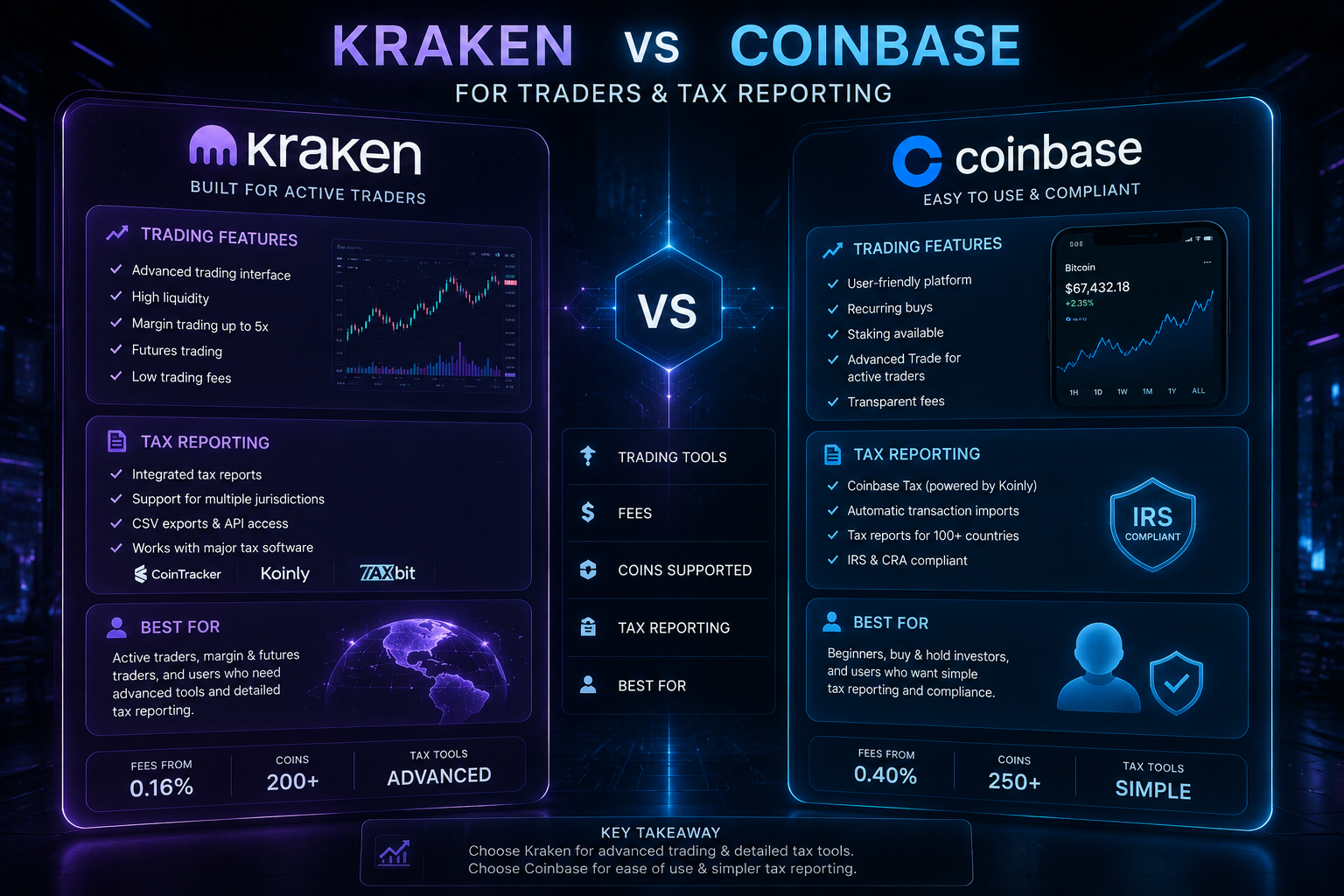
Coinbase vs Kraken Comparison · Trading & Tax · 2026 Guide
Coinbase vs Kraken for Trading and Tax Reporting: Pick the Right Crypto Exchange in 2026
Article at a Glance
- Fee gap is real: Kraken’s maker fees start at 0.25% and drop with volume, while Coinbase’s standard platform charges a flat spread plus transaction fee that can exceed 1.5% on small purchases — a meaningful difference for active traders.
- Beginners vs. advanced traders: Coinbase’s streamlined onboarding and simple buy/sell interface makes it the go-to for new users, while Kraken’s tiered tools and margin trading cater to experienced traders who want more control.
- Tax reporting is an afterthought on both platforms — neither Coinbase nor Kraken fully replaces dedicated crypto tax software, and understanding the gap could save you from a costly filing mistake.
- Security is strong on both sides, but each platform has a different history worth knowing before you deposit significant funds.
- Regional access matters more than most traders realize — Kraken operates in 190+ countries while Coinbase covers 100+, and staking availability varies dramatically depending on where you live.
Table of Contents
- Coinbase Wins on Simplicity, Kraken Wins on Cost
- Fee Structures: Where Your Money Actually Goes
- Supported Assets: Which Exchange Has More to Trade
- Trading Features and Tools
- User Experience: Beginner vs Advanced Trader
- Security Track Record and Platform Safety
- Staking and Passive Income Options
- Tax Reporting: The Feature Most Traders Overlook
- Customer Support: Who Actually Helps When Things Go Wrong
- Pick the Right Exchange for Your Situation
- Frequently Asked Questions
Choosing between Coinbase and Kraken isn’t just about which logo looks more trustworthy — it’s about matching a platform’s actual strengths to how you trade, what you trade, and what it costs you come tax season.
Both exchanges have earned their place at the top of the industry, but they serve different traders in fundamentally different ways. Kraken, a platform built with cost-efficiency and advanced tools in mind, consistently positions itself as the choice for traders who want more than a basic buy/sell experience. Understanding the real differences between these two platforms — beyond the marketing — is what separates profitable traders from frustrated ones.
Coinbase Wins on Simplicity, Kraken Wins on Cost — Here’s What That Means for You
The core trade-off between Coinbase and Kraken comes down to this: Coinbase prioritizes ease of use, and Kraken prioritizes value and depth. Neither is wrong — they’re just built for different people.
Platform Strengths Comparison
- Coinbase — Best for beginners, casual buyers, and anyone who wants a seamless fiat-to-crypto experience with minimal friction
- Kraken — Best for cost-conscious traders, those using margin or futures, and anyone trading at volume where fees compound fast
- Coinbase Advanced Trade — A middle ground for intermediate users who want charting and tighter fees without leaving the Coinbase ecosystem
- Kraken Pro — The full-featured trading interface built for users who want institutional-grade tools with a maker fee as low as 0.00% at high volume
The simplicity of Coinbase has a price — literally. When you buy $500 of Bitcoin on the standard Coinbase app, you’re often paying a spread of around 0.5% plus a transaction fee, which can push your total cost well above 1.5%. On Kraken, that same trade through their Pro interface could cost you as little as 0.25% as a taker.
That difference might seem small, but across dozens of trades per month, it adds up to real money. For traders doing $10,000 in monthly volume, the fee gap between platforms could mean hundreds of dollars saved annually.
Fee Structures: Where Your Money Actually Goes
Fees are the most important — and most misunderstood — part of picking a crypto exchange. Both Coinbase and Kraken have multiple fee tiers depending on which version of their platform you use, and the difference between them is significant. For those interested in broader financial strategies, comparing DeFi yield farming vs traditional savings can provide additional insights into potential returns.
Coinbase Standard Fees vs. Coinbase Advanced Trade Fees
| Feature | Coinbase Standard | Coinbase Advanced Trade |
|---|---|---|
| Spread | ~0.5% | Not applicable |
| Transaction Fee (small purchase) | Up to 1.49% | N/A |
| Maker Fee | N/A | 0.00% – 0.40% |
| Taker Fee | N/A | 0.05% – 0.60% |
| Best For | Casual one-time buyers | Active or intermediate traders |
The standard Coinbase app is designed for simplicity, and that convenience comes at a cost. The platform bundles its fees into the price you see, making it easy to miss how much you’re actually paying. On a $100 purchase, you might pay $1.49 in visible fees plus a spread baked into the quoted price. If you’re exploring different investment strategies, you might also be interested in comparing NFT vs DeFi investments to diversify your portfolio.
Coinbase Advanced Trade, which replaced Coinbase Pro, brings a proper maker-taker model to the table. At the lowest volume tier (under $10,000 in 30-day volume), taker fees start at 0.60% — still higher than Kraken’s equivalent tier. However, as your volume increases, those fees drop significantly, reaching 0.00% maker and 0.05% taker for users trading over $500 million per month. For those interested in understanding the broader landscape of trading strategies, exploring crypto trade alert services might provide additional insights.
For most retail traders, Coinbase Advanced Trade offers a reasonable fee structure if you’re already in the Coinbase ecosystem. But if fees are your primary concern, the numbers still favor Kraken at nearly every volume tier.
Kraken’s Maker-Taker Model and Volume Discounts
Kraken uses a tiered maker-taker fee structure on Kraken Pro that rewards higher trading volume with progressively lower fees. Here’s how it breaks down for standard spot trading:
Kraken Fee Tiers by Volume
- 0 – $50,000 (30-day volume): 0.25% maker / 0.40% taker
- $50,000 – $100,000: 0.20% maker / 0.35% taker
- $100,000 – $250,000: 0.14% maker / 0.24% taker
- $250,000 – $500,000: 0.12% maker / 0.22% taker
- $500,000 – $1,000,000: 0.10% maker / 0.20% taker
- $1,000,000+: Fees continue decreasing toward 0.00% maker
Even at the entry level, Kraken’s 0.25% maker fee undercuts Coinbase Advanced Trade’s 0.40% maker fee for the same volume tier. For anyone placing limit orders consistently, this difference compounds quickly.
The key advantage of Kraken’s model is that even casual-but-regular traders benefit from competitive pricing without needing to reach elite volume levels. A trader doing $5,000 per month still pays less on Kraken Pro than they would on Coinbase Advanced Trade at an equivalent tier.
Hidden Costs: Spreads, Withdrawal Fees, and Conversion Charges
Beyond the advertised fees, both platforms charge for withdrawals, though the structure differs by asset and network. Coinbase charges variable crypto withdrawal fees based on network conditions, and fiat withdrawal fees depend on your region and payment method. Kraken similarly charges per-asset withdrawal fees, but they are generally transparent and listed in detail on their fee schedule page. One area where Coinbase catches traders off guard is instant buy and debit card purchase fees, which can reach 3.99% — a rate that makes frequent small purchases extremely expensive over time. For those interested in understanding the impact of fees on crypto investment strategies, it’s crucial to consider these hidden costs.
Coinbase One Subscription: Is Zero-Fee Trading Worth It?
Coinbase One is a subscription service priced at $29.99/month (in the US) that offers zero-fee trading up to a monthly limit, priority customer support, and account protection. For traders doing consistent volume on the standard Coinbase interface, it can offset its cost quickly — but only if you’re trading enough to justify the flat monthly fee. For most active traders who have already migrated to Coinbase Advanced Trade or Kraken Pro, the subscription adds limited additional value.
Supported Assets: Which Exchange Has More to Trade
Asset selection is a practical concern that goes beyond just wanting access to obscure altcoins. The platform you use determines which markets you can enter, which pairs you can trade, and whether you can execute strategies that require specific token availability.
Coin Selection on Coinbase vs Kraken in 2026
Coinbase lists over 240 tradable assets as of 2026, focusing primarily on established and mid-cap cryptocurrencies with strong regulatory standing. The platform has historically been cautious about listing new tokens, prioritizing compliance over breadth. Kraken, while also selective, offers a comparable range with a particular depth in trading pairs — giving traders more flexibility when moving between assets without converting to fiat as an intermediary step. For those interested in understanding the broader implications of crypto regulations, you might want to explore the worst countries for crypto investors in 2026.
Availability by Region: What You Can and Can’t Access
Where you live directly affects what features you can access on either platform. This isn’t just about which coins are listed — it affects staking, margin trading, futures, and even basic account verification requirements.
US-based traders face the most restrictions on both platforms due to regulatory requirements. Kraken’s futures and margin products are not available to US retail clients without meeting specific requirements, and Coinbase has faced SEC scrutiny that has influenced which assets it lists and which staking products it offers domestically.
Outside the US, both platforms open up considerably. Kraken supports users in 190+ countries and offers its full suite of products in most jurisdictions. Coinbase operates in 100+ countries but supports a broader range of fiat currency on-ramps, which can matter for users in regions where direct bank transfers are the primary deposit method.
Regional Availability Comparison
| Feature | Coinbase | Kraken |
|---|---|---|
| Countries Supported | 100+ | 190+ |
| Fiat Currencies Supported | Broader range | Selective major currencies |
| US Margin Trading | Not available | Limited availability |
| US Staking | Restricted (ongoing regulatory pressure) | Available on select assets |
| Futures (Non-US) | Available via Advanced Trade | Available via Kraken Futures |
Trading Features and Tools
Both platforms have evolved well beyond simple buy/sell interfaces. The depth of tools available — and how accessible those tools are — is where Coinbase and Kraken diverge most clearly for serious traders.
Spot Trading: How Each Platform Compares for Everyday Trades
For standard spot trading — buying and selling crypto at current market prices — both platforms are fully capable. The difference shows up in execution quality, available order types, and the interface you’re working with when speed matters.
Coinbase’s standard app prioritizes one-tap buying over precise execution. You select an asset, enter an amount, and confirm — the platform handles everything else. This is great for dollar-cost averaging or one-time purchases, but it gives you almost no control over how your order is filled.
Coinbase Advanced Trade improves this significantly. You get a full order book view, real-time charting, and access to limit and stop orders. It’s a meaningful step up and lives within the same Coinbase account, making the transition from simple to advanced trading frictionless.
Kraken’s standard interface sits somewhere between Coinbase’s two tiers. It’s more feature-rich than the basic Coinbase app but slightly less intimidating than a full professional trading terminal. Kraken Pro takes it further with depth charts, multiple order types, and a layout familiar to anyone who has used a traditional trading platform.
Trading Features by Platform
| Feature | Coinbase App | Coinbase Advanced Trade | Kraken | Kraken Pro |
|---|---|---|---|---|
| Market Orders | ✓ | ✓ | ✓ | ✓ |
| Limit Orders | ✗ | ✓ | ✓ | ✓ |
| Stop Orders | ✗ | ✓ | ✓ | ✓ |
| Advanced Charting | ✗ | ✓ | Limited | ✓ |
| Order Book View | ✗ | ✓ | ✓ | ✓ |
Margin and Futures Trading on Kraken
Kraken offers margin trading with up to 5x leverage on select spot pairs for eligible users, and a dedicated Kraken Futures platform that supports perpetual and fixed-maturity futures contracts. This is one of Kraken’s clearest advantages over Coinbase for experienced traders — the ability to go long or short with leverage directly on the platform, without needing to move funds to a separate derivatives exchange. Coinbase offers futures trading through Coinbase Advanced Trade for non-US users, but the breadth of available contracts and the maturity of the Kraken Futures platform gives Kraken an edge here.
Coinbase Advanced Trade vs Kraken Pro: Side-by-Side
When you strip away the beginner-facing features and compare the two professional interfaces head-to-head, the gap narrows — but doesn’t disappear. Kraken Pro edges out Coinbase Advanced Trade on fee rates at most volume tiers, offers more flexibility in order types including trailing stop orders, and provides direct access to margin within the same interface. Coinbase Advanced Trade counters with a cleaner UI, tighter integration with the broader Coinbase ecosystem (including Coinbase Wallet and NFT tools), and a more intuitive experience for traders making the jump from the standard app.
Order Types Available on Each Platform
Order type flexibility is something casual traders rarely think about until they need it. Both Coinbase Advanced Trade and Kraken Pro support market, limit, and stop orders, but Kraken Pro goes further with stop-loss limits, take-profit orders, and trailing stops — tools that let you automate exit strategies without babysitting your positions. For traders who set entries and walk away, this depth of order control is a genuine advantage that Coinbase Advanced Trade hasn’t fully matched.
User Experience: Beginner vs Advanced Trader
The platform you find intuitive depends entirely on where you’re starting from. A first-time crypto buyer and a trader with three years of experience will have completely opposite reactions to the same interface, and both Coinbase and Kraken know exactly who they’re designing for.
Coinbase’s Simplified Interface and Onboarding Flow
Coinbase built its reputation on removing friction. Creating an account takes minutes, identity verification is streamlined, and the buy/sell interface is clean enough that someone who has never owned crypto can complete their first purchase in under five minutes. The mobile app is particularly well-designed — asset discovery, portfolio tracking, and recurring buy setup are all accessible without ever diving into settings or sub-menus. For anyone who finds the idea of crypto intimidating, Coinbase’s interface actively works to change that perception.
Kraken’s Dashboard and Learning Curve
Kraken’s standard interface is more feature-dense than Coinbase’s, which works in favor of intermediate users but can feel overwhelming to beginners. The account dashboard presents market data, open orders, and portfolio performance in a more information-rich layout — useful when you know what you’re looking at, but noisy when you don’t. The onboarding process is also slightly more involved, with tiered verification levels (Starter, Intermediate, and Pro) that unlock different deposit limits and features as you progress.
Kraken Pro amplifies this further. The full trading terminal is built for people who are comfortable reading order books, adjusting chart timeframes, and placing conditional orders. It’s not unfriendly — the layout is logical — but it does assume a baseline level of trading literacy that the standard Coinbase app never demands of its users. The payoff for climbing that learning curve is access to better fees, more order types, and a more complete trading environment.
Security Track Record and Platform Safety
Security is non-negotiable when you’re choosing where to hold and trade crypto. Both Coinbase and Kraken have invested heavily in platform security, and both are considered among the safer options in the industry — but their histories and approaches differ in ways worth understanding before you commit.
Coinbase, as a publicly traded company (NASDAQ: COIN), operates under significantly more regulatory and financial scrutiny than most exchanges. It holds the majority of customer crypto assets in cold storage — offline wallets that are inaccessible to online attackers — and maintains a USD Coin insurance policy for digital assets held on the platform. Coinbase also undergoes regular third-party Proof of Reserves audits, providing an additional layer of transparency about whether customer funds are actually held 1:1.
Kraken’s security architecture is similarly robust. The platform stores over 95% of deposits in air-gapped cold storage, uses geographically distributed servers, and employs a dedicated internal security team. Kraken also offers one of the more granular sets of account security options available, including global settings lock — a feature that prevents any account changes for a set time period even if someone gains access to your login credentials.
Security Features Comparison
| Security Feature | Coinbase | Kraken |
|---|---|---|
| Cold Storage | ~98% of assets offline | 95%+ in air-gapped cold storage |
| Two-Factor Authentication | ✓ (app, SMS, hardware key) | ✓ (app, hardware key) |
| Proof of Reserves | ✓ Third-party audited | ✓ Third-party audited |
| Global Settings Lock | ✗ | ✓ |
| FDIC Insurance (USD) | ✓ Up to $250,000 | ✗ |
| Crypto Asset Insurance | ✓ (limited policy) | ✗ |
History of Hacks or Breaches on Each Platform
Neither Coinbase nor Kraken has suffered a major exchange-wide hack comparable to the Mt. Gox or Bitfinex breaches. Coinbase has reported isolated incidents of individual account compromises — most notably a 2021 incident where approximately 6,000 accounts were accessed due to a flaw in its SMS account recovery process, though Coinbase reimbursed affected users. Kraken has maintained a clean record with no significant confirmed platform-level breaches, though like all exchanges, it deals with individual phishing attempts targeting users rather than the platform infrastructure itself.
Cold Storage, 2FA, and Account Protection Features
Both platforms support hardware security keys like YubiKey as a second factor, which is the gold standard for account protection. SMS-based 2FA, while better than nothing, is vulnerable to SIM-swapping attacks — Coinbase still offers it as an option, while Kraken actively encourages users to move away from SMS authentication entirely. For anyone holding meaningful funds on either platform, enabling a hardware key or authenticator app (such as Google Authenticator or Authy) is the single most impactful security step you can take.
Kraken’s global settings lock deserves a specific mention. Once activated, it prevents any changes to security settings, withdrawal addresses, or account information for a period of your choosing — even if an attacker has your password and 2FA device. It’s a simple but powerful feature that Coinbase doesn’t currently offer and that experienced traders holding significant balances will find genuinely valuable.
Regulatory Compliance and Licensing in 2026
Regulatory standing has become a key differentiator in the exchange market as governments tighten oversight of crypto platforms. Coinbase, as a publicly listed US company, operates under the strictest compliance requirements of any major exchange — it holds money transmitter licenses across multiple US states, is registered with FinCEN, and has worked directly with regulators to shape crypto policy. Kraken is similarly well-licensed globally, holding regulatory approvals across the EU, UK, Canada, and Australia, and has maintained a strong compliance posture through multiple rounds of regulatory pressure. Both platforms are considered among the most compliant exchanges operating in 2026.
Staking and Passive Income Options
Staking Rewards Comparison
| Asset | Coinbase Est. APY | Kraken Est. APY |
|---|---|---|
| Ethereum (ETH) | ~2.5% – 3.5% | ~3% – 7% |
| Solana (SOL) | ~3% – 5% | ~4% – 6% |
| Cardano (ADA) | ~2% – 3% | ~4% – 6% |
| Polkadot (DOT) | Limited availability | ~8% – 12% |
| Cosmos (ATOM) | ~4% – 5% | ~7% – 10% |
Staking is one of the most straightforward ways to generate passive income on crypto holdings, and both platforms offer it — but with meaningful differences in rates, asset coverage, and regional availability. Kraken consistently offers higher estimated APY across most stakeable assets, in part because it passes through a larger share of network rewards to users rather than taking a larger platform cut.
Coinbase staking is deeply integrated into the main app, making it accessible to users who may not understand the mechanics of proof-of-stake validation. You hold an eligible asset, opt in, and rewards accumulate automatically. The simplicity is genuinely useful for passive holders who aren’t actively managing their portfolios, but that convenience comes with lower yield rates than what Kraken typically offers on the same assets.
Kraken’s staking product requires slightly more navigation to set up but rewards the effort with better rates and a wider selection of stakeable assets. On assets like Polkadot and Cosmos, the yield difference between platforms is significant enough to matter meaningfully over a 12-month period — especially on larger holdings where even a 2% APY difference translates to hundreds of dollars annually.
One important distinction: Kraken offers both on-chain staking (where your assets are actually delegated to validators) and off-chain staking (flexible yield products that don’t involve actual network participation). Understanding which type you’re using matters for both yield expectations and tax treatment, since on-chain staking rewards are generally treated as income at the time of receipt under current IRS guidance.
Staking Rewards on Coinbase vs Kraken
Coinbase has faced direct regulatory pressure over its staking products in the US market. In 2023, the SEC took action against Coinbase’s staking-as-a-service program, resulting in restricted availability for US customers on certain assets. As of 2026, Coinbase’s US staking offering remains more limited than its international version, with ETH staking being the primary available option for most US retail users.
Kraken settled with the SEC in February 2023 over its staking program, paying $30 million and discontinuing its staking-as-a-service product for US clients. However, Kraken subsequently rebuilt its US staking offering within a compliant framework, and its on-chain staking options for US users have gradually expanded. Outside the US, Kraken’s staking suite is significantly broader and remains one of its strongest differentiators against Coinbase.
For non-US traders, the staking comparison decisively favors Kraken — more assets, higher rates, and greater control over how your stake is managed. For US traders, the comparison is closer, with both platforms operating under similar constraints imposed by the current regulatory environment.
What the yield numbers don’t capture is liquidity. Some staking options on both platforms involve lockup periods during which you cannot sell or move your staked assets. Kraken is generally more transparent about lockup terms on a per-asset basis, while Coinbase’s staking UI doesn’t always make lockup conditions immediately obvious before you opt in — something to verify before committing assets you might need access to quickly.
Restrictions on Staking by Region
US traders face the most staking restrictions on both platforms due to ongoing regulatory scrutiny of yield-bearing crypto products. In the EU, both platforms operate under MiCA (Markets in Crypto-Assets) regulations, which have created more standardized but sometimes more limited staking product structures. Traders in the UK, Canada, and Australia generally have access to broader staking options on Kraken than on Coinbase, making Kraken the stronger choice for passive income seekers outside the US.
Tax Reporting: The Feature Most Traders Overlook
Tax reporting is where most crypto traders realize too late that their exchange isn’t equipped to handle everything they need. Both Coinbase and Kraken generate transaction histories you can export, but the quality of those exports — and the built-in tools available — varies considerably, and neither platform fully replaces dedicated crypto tax software when your trading activity gets complex. For those looking to optimize their tax strategies, exploring tax-free crypto countries might offer significant advantages.
Coinbase Tax Tools and Built-In Reporting
Coinbase offers a built-in tax reporting tool called Coinbase Taxes, available directly within the platform. It calculates your gains and losses based on transaction history and generates a summary that can be used to populate tax forms. For users who trade exclusively on Coinbase and have relatively straightforward activity — spot buys, sells, and staking rewards — this tool covers the basics without requiring a third-party service.
The limitations become apparent quickly for active traders. Coinbase Taxes doesn’t handle activity from external wallets, other exchanges, or DeFi protocols. If you’ve moved assets off Coinbase to a hardware wallet or traded on a DEX, those transactions won’t appear in the Coinbase report, creating gaps in your cost basis calculations that could result in overpaying taxes or filing inaccurately. The tool also applies a single accounting method (typically HIFO or FIFO depending on your settings), whereas dedicated tax software lets you choose and optimize your method to minimize tax liability legally.
Tax Reporting Features Comparison
| Tax Feature | Coinbase Taxes | Kraken Tax Export |
|---|---|---|
| Built-In Gain/Loss Calculator | ✓ | ✗ |
| Downloadable CSV History | ✓ | ✓ |
| Form 8949 Generation | ✓ (basic) | ✗ |
| Cross-Exchange Tracking | ✗ | ✗ |
| DeFi / Wallet Activity | ✗ | ✗ |
| Accounting Method Selection | Limited | ✗ |
| Third-Party Software Integration | ✓ | ✓ |
Coinbase does issue 1099 forms to US customers in certain situations — specifically a 1099-MISC for staking and referral rewards exceeding $600, and 1099-B forms for users of Coinbase Pro (now Advanced Trade) under specific conditions. This means the IRS receives the same information Coinbase reports to you, making accurate reporting not just advisable but essential. Any discrepancy between what Coinbase reports and what appears on your return is a red flag that can trigger a review.
Kraken’s Transaction History Exports and Tax Support
Kraken takes a more bare-bones approach to tax reporting than Coinbase. The platform doesn’t offer a built-in gain/loss calculator or generate tax forms directly, but it does provide detailed transaction history exports in CSV format that cover spot trades, margin activity, staking rewards, deposits, and withdrawals. The exports are comprehensive and accurate — Kraken’s ledger history is one of the most complete in the industry — but converting that raw data into a usable tax report requires either manual work or a third-party tax tool.
Why Neither Exchange Replaces Dedicated Crypto Tax Software
The fundamental problem with relying on either platform’s native tools is scope. Both Coinbase and Kraken only see what happens on their own platform. The moment you send crypto to an external wallet, bridge assets to another chain, trade on a decentralized exchange, or receive tokens through an airdrop, that activity becomes invisible to your exchange’s reporting system. For traders with any meaningful on-chain activity, this creates cost basis gaps that can result in your gains being overstated — and your tax bill inflated — because the software can’t account for what you originally paid for assets that moved off-platform.
Dedicated crypto tax software solves this by aggregating data from every source: exchanges, wallets, DeFi protocols, NFT marketplaces, and staking platforms. It then applies your chosen accounting method across the entire unified transaction history to generate accurate, complete tax reports. The difference in filing accuracy between using exchange-native tools and a dedicated tax platform can be substantial, particularly for traders who are active across multiple venues.
Best Crypto Tax Tools That Integrate With Coinbase and Kraken
Several well-established crypto tax platforms offer direct API integrations with both Coinbase and Kraken, making the data import process largely automatic. Once connected, these tools pull your full transaction history, reconcile it with any external wallet activity you add, and generate the reports you need for filing. For those interested in optimizing their crypto investments, understanding the common mistakes and winning strategies can be beneficial.
The most widely used options that support both exchanges include Koinly, CoinTracker, TaxBit, and CryptoTrader.Tax. Each platform has different strengths — Koinly is known for broad DeFi support, TaxBit has positioned itself toward institutional and high-volume traders, and CoinLedger offers a clean interface suited to retail users who want to complete their filing quickly without advanced customization.
When evaluating tax software, the key factors to compare are the number of transactions included in each pricing tier, the quality of DeFi and NFT transaction handling, whether the software supports the accounting method your tax professional recommends, and how the generated reports map to the specific forms required in your jurisdiction. US traders primarily need Schedule D and Form 8949 support; traders in the UK, Australia, and Canada need software that handles their respective local reporting formats, which not all platforms equally support.
Crypto Tax Software Integration
| Tax Software | Coinbase Integration | Kraken Integration | DeFi Support | Best For |
|---|---|---|---|---|
| Koinly | ✓ API + CSV | ✓ API + CSV | Strong | Multi-chain active traders |
| CoinLedger | ✓ API + CSV | ✓ API + CSV | Moderate | Retail users, easy filing |
| TaxBit | ✓ API | ✓ API | Moderate | High-volume & institutional |
| CryptoTrader.Tax | ✓ CSV | ✓ CSV | Limited | Simple trade histories |
Customer Support: Who Actually Helps When Things Go Wrong
Customer support is one of those features you don’t think about until you desperately need it — and at that point, the difference between a responsive support team and a ticket queue that takes days to answer can mean real financial consequences. On this front, Kraken has a clear and well-documented advantage over Coinbase.
Kraken’s 24/7 Multilingual Support Including Phone
Kraken offers 24/7 customer support through live chat and email, and — unusually for a crypto exchange — also provides phone support in certain regions. The availability of a real phone line for account issues is a meaningful differentiator in an industry where most platforms rely entirely on async ticket systems that can leave users waiting days for resolution on urgent account problems.
The quality of Kraken’s support is consistently rated above industry average. Response times on live chat are generally fast during peak hours, and the support team is known for providing specific, technically accurate answers rather than copy-pasting from a FAQ. For traders managing larger balances or running into verification issues that need real-time resolution, this level of support accessibility is a genuine operational advantage.
Kraken Support Features
- Live chat: Available 24/7 directly within the Kraken platform
- Email/ticket support: Available for complex account or verification issues
- Phone support: Available in select regions for account-level issues
- Help center: Extensive documentation covering trading, security, and tax topics
- Multilingual support: Available in English, German, French, Italian, Portuguese, Russian, and Japanese
Kraken’s multilingual support capability matters more than it might initially seem. For non-English-speaking traders, the ability to communicate account issues in their native language speeds up resolution time and reduces the risk of miscommunication on sensitive account matters like withdrawal approvals or identity verification.
Coinbase Support Availability and Common Complaints
Coinbase’s customer support is one of the most frequently criticized aspects of the platform, particularly among US users. The platform relies primarily on a help center and automated ticket system, with live chat availability that is inconsistent and often limited to lower-complexity queries. Phone support is technically available through Coinbase One, the paid subscription tier, giving paying subscribers a support pathway that free users don’t have. The most common complaints about Coinbase support center on account lockouts during high-volatility market periods — exactly the moments when traders need access most urgently — and slow ticket response times that can stretch to several days. For casual users making infrequent purchases, this may never become an issue. For active traders or anyone holding significant funds on the platform, it’s a risk worth factoring into your decision. For a detailed comparison, you might want to check out top crypto exchanges.
Coinbase vs Kraken: Pick the Right Exchange for Your Situation
The right exchange comes down to one question: what does your trading actually look like? If you’re new to crypto, buying occasionally, and want the smoothest possible experience from signup to first purchase, Coinbase is built for you — its onboarding, mobile app, and simplified interface remove every possible barrier between you and owning crypto. But if you’re trading with any regularity, managing a portfolio across multiple assets, looking to stake for meaningful yield, or simply want to keep more of what you make by paying lower fees, Kraken wins on nearly every measurable metric that matters to an active trader. For tax reporting, neither platform alone is sufficient for complex trading activity — pair whichever exchange you choose with dedicated crypto tax software to ensure your filing is accurate and complete.
Frequently Asked Questions
Here are the most common questions traders ask when comparing Coinbase and Kraken heading into 2026:
Is Kraken cheaper than Coinbase for trading fees?
Yes, in almost every scenario. On the standard platforms, Coinbase’s fees on small purchases can exceed 1.5% when you factor in both the transaction fee and the built-in spread. Even comparing the professional interfaces directly, Kraken Pro’s entry-level maker fee of 0.25% beats Coinbase Advanced Trade’s 0.40% maker fee at the same volume tier. The gap widens further on the standard Coinbase app vs. any version of Kraken — making Kraken the cost-efficient choice for traders at every volume level.
Which exchange is better for beginners in 2026, Coinbase or Kraken?
Coinbase is better for beginners. The platform’s design philosophy centers on removing complexity — account creation is fast, the interface is intuitive, and you can complete a crypto purchase in minutes without needing to understand order types, trading pairs, or fee structures. Coinbase also offers Coinbase Learn, an educational rewards program that pays users small amounts of crypto for completing short lessons on different assets, which gives new users a low-stakes way to learn while building a portfolio.
Kraken is not unfriendly to beginners, but its standard interface assumes a slightly higher baseline of financial literacy. That said, a beginner who is willing to spend an hour learning the basics of the Kraken interface will find themselves positioned for significantly lower fees and a more scalable platform as their trading activity grows. The short-term learning curve pays off quickly for anyone who moves beyond occasional buying and starts trading with any regularity.
Do Coinbase and Kraken report to the IRS?
Yes, both exchanges report to the IRS for US-based users. Coinbase issues 1099-MISC forms for users who earn more than $600 in staking rewards, referral bonuses, or other income, and issues 1099-B forms for certain trading activity on Advanced Trade. Kraken similarly files reports with the IRS for US customers who meet reporting thresholds. This means the IRS already has data on your crypto activity from both platforms — accurate and complete tax reporting on your return is not optional, and discrepancies between what the exchange reports and what you file can trigger an audit or penalty notice.
Can I use the same crypto tax software for both Coinbase and Kraken?
Yes, all major crypto tax software platforms support both Coinbase and Kraken simultaneously. You connect both exchange accounts to a single tax platform — either via API key or CSV export — and the software aggregates your full transaction history across both exchanges into one unified report. This is the correct way to handle tax reporting if you trade on more than one platform, since keeping your reporting siloed by exchange creates incomplete cost basis records.
Recommended Tax Software for Both Exchanges
- Koinly — Supports API and CSV import from both Coinbase and Kraken; strong multi-chain support
- CoinLedger — Direct integrations with both platforms; good for straightforward trade histories
- TaxBit — API-based integrations with both; best suited for high-volume traders
- ZenLedger — Supports both exchanges plus a broad range of wallets and DeFi protocols
The practical workflow is straightforward: generate API keys with read-only permissions on both Coinbase and Kraken, connect them to your chosen tax platform, import any external wallet addresses for transactions that moved off-exchange, and let the software calculate your gains and losses across the combined history. Most platforms complete this process in under 30 minutes for traders with standard activity levels.
One important note on API permissions: always create read-only API keys for your tax software connections. A read-only key gives the tax platform access to view your transaction history without the ability to place trades or initiate withdrawals. Both Coinbase and Kraken support read-only API permissions, and using them ensures your account security is never compromised by a third-party software integration.
Is Kraken or Coinbase safer to store crypto on?
Both exchanges are considered secure, but no centralized exchange is the optimal long-term storage solution for significant crypto holdings. The principle of “not your keys, not your crypto” remains relevant — if you’re holding large amounts that you don’t intend to trade actively, a hardware wallet like a Ledger or Trezor is safer than either platform. For those interested in understanding why most crypto investors lose money, exploring common mistakes and strategies can be insightful.
For funds you need to keep on an exchange for active trading, both Coinbase and Kraken are among the most secure options available. Coinbase holds approximately 98% of assets in cold storage and provides limited crypto insurance coverage plus FDIC insurance on USD balances up to $250,000. Kraken holds 95%+ in air-gapped cold storage and offers the global settings lock feature, which provides an additional layer of protection against unauthorized account changes that Coinbase doesn’t currently match.
The most meaningful security factor on either platform isn’t the exchange’s architecture — it’s your own account security hygiene. Enabling a hardware security key or authenticator app for 2FA, using a unique email address not associated with any other account, and never reusing passwords are the actions that most directly determine whether your account stays secure, regardless of which exchange you choose.
If forced to choose a slight edge on security features, Kraken’s global settings lock and stronger push toward hardware-based 2FA over SMS give it a narrow advantage for security-focused traders. For most users, though, the practical security difference between the two platforms is minimal when both are used with strong personal security practices in place.
When choosing a crypto exchange, it’s important to consider factors such as fees, security, and ease of use. Two popular options are Coinbase and Kraken. Both platforms offer unique features and benefits, but it’s crucial to understand their differences to determine which one aligns best with your trading and tax reporting needs. For those interested in exploring tax implications further, you might find it helpful to learn about tax-free crypto countries and their regulations.
DISCLAIMER: DO YOUR OWN RESEARCH (DYOR)
The information provided in this article is for educational and informational purposes only. It does not constitute financial advice, investment advice, trading advice, or any other type of advice. Coinposters does not recommend buying, selling, or holding any cryptocurrency or making any investment decisions based solely on this content. Cryptocurrency markets are highly volatile and risky. Always conduct your own research, consult with qualified financial professionals, and only invest what you can afford to lose. Past performance does not guarantee future results. Never invest based solely on information from a single source.