Circle EURC stablecoin
cross-border crypto payments
dollar stablecoin dominance
dollar vs euro stablecoins
EUR USD exchange rate impact
euro pegged cryptocurrency
euro stablecoin trading
international crypto trading
MiCA regulation stablecoins
stablecoin liquidity comparison
stablecoin profitability analysis
USDC vs EURC comparison

Coinposters
Dollar-Pegged vs Euro-Pegged Stablecoins for International Trading | Profitability Comparison
Stablecoin Strategy · International Trading · Currency Analysis · 2026 Guide
Article-At-A-Glance: Dollar vs Euro Stablecoins for International Trading
- •Dollar-pegged stablecoins like USDT and USDC dominate with over 90% of the stablecoin market, offering deeper liquidity and wider exchange support than any euro-pegged alternative currently available
- •Euro-pegged stablecoins like EURC by Circle are growing fast and offer a direct, conversion-free bridge for traders operating within European markets and Eurozone businesses
- •The EUR/USD exchange rate directly impacts your profitability when switching between dollar vs euro stablecoins — a detail most traders overlook until it costs them
- •MiCA regulation in Europe is reshaping the euro stablecoin landscape, creating compliance advantages that dollar stablecoins operating in Europe may not match — a shift worth watching closely
- •The right stablecoin for international trading depends on your base currency, target markets, and yield goals — and the answer is not always the dollar
Table of Contents
- The Stablecoin That Wins in International Trading Is Not Always the Obvious One
- What Dollar-Pegged Stablecoins Actually Are
- What Euro-Pegged Stablecoins Actually Are
- Dollar vs Euro Stablecoins: The Core Differences That Affect Your Profits
- When Euro-Pegged Stablecoins Are the Better Choice
- When Dollar-Pegged Stablecoins Are the Better Choice
- Profitability Comparison: Dollar vs Euro Stablecoins Side by Side
- The Peg Stability Risk Most Traders Ignore
- Which Stablecoin Should You Use for International Trading in 2026
- Frequently Asked Questions
The Stablecoin That Wins in International Trading Is Not Always the Obvious One
Most traders default to dollar stablecoins without ever questioning whether that default is actually costing them money.
The assumption is simple: USDT and USDC are everywhere, so they must be the best choice. And in many cases, that is true. But international trading introduces a layer of complexity that makes the dollar vs euro stablecoins decision genuinely consequential. Currency exposure, liquidity depth, regulatory compliance, yield differences, and conversion friction all feed into your bottom line in ways that compound over time.
What Dollar-Pegged Stablecoins Actually Are
A dollar-pegged stablecoin is a cryptocurrency designed to maintain a 1:1 value with the U.S. dollar at all times. Every token in circulation is backed by an equivalent amount of reserve assets — typically a mix of cash, U.S. Treasury bills, and short-term bonds — held by the issuing organization. The peg works because users can always redeem one token for one dollar, which keeps market prices anchored.
USDT and USDC: The Two Giants Dominating the Market
Tether (USDT) is the most widely used stablecoin in the world and consistently ranks among the top three cryptocurrencies by total market capitalization. It operates across virtually every major exchange and blockchain network, making it the default liquidity layer for international crypto trading. USD Coin (USDC), issued by Circle, is USDT’s closest rival and is widely regarded as the more transparent and regulated option of the two.
The differences between USDT and USDC matter depending on your priorities:
- USDT — Highest liquidity, widest exchange availability, slightly more opaque reserve disclosures
- USDC — Strong regulatory compliance, fully audited reserves, slightly lower liquidity than USDT but still dominant across DeFi and CeFi platforms
- Both maintain the 1:1 dollar peg through full-reserve backing, not algorithmic mechanisms
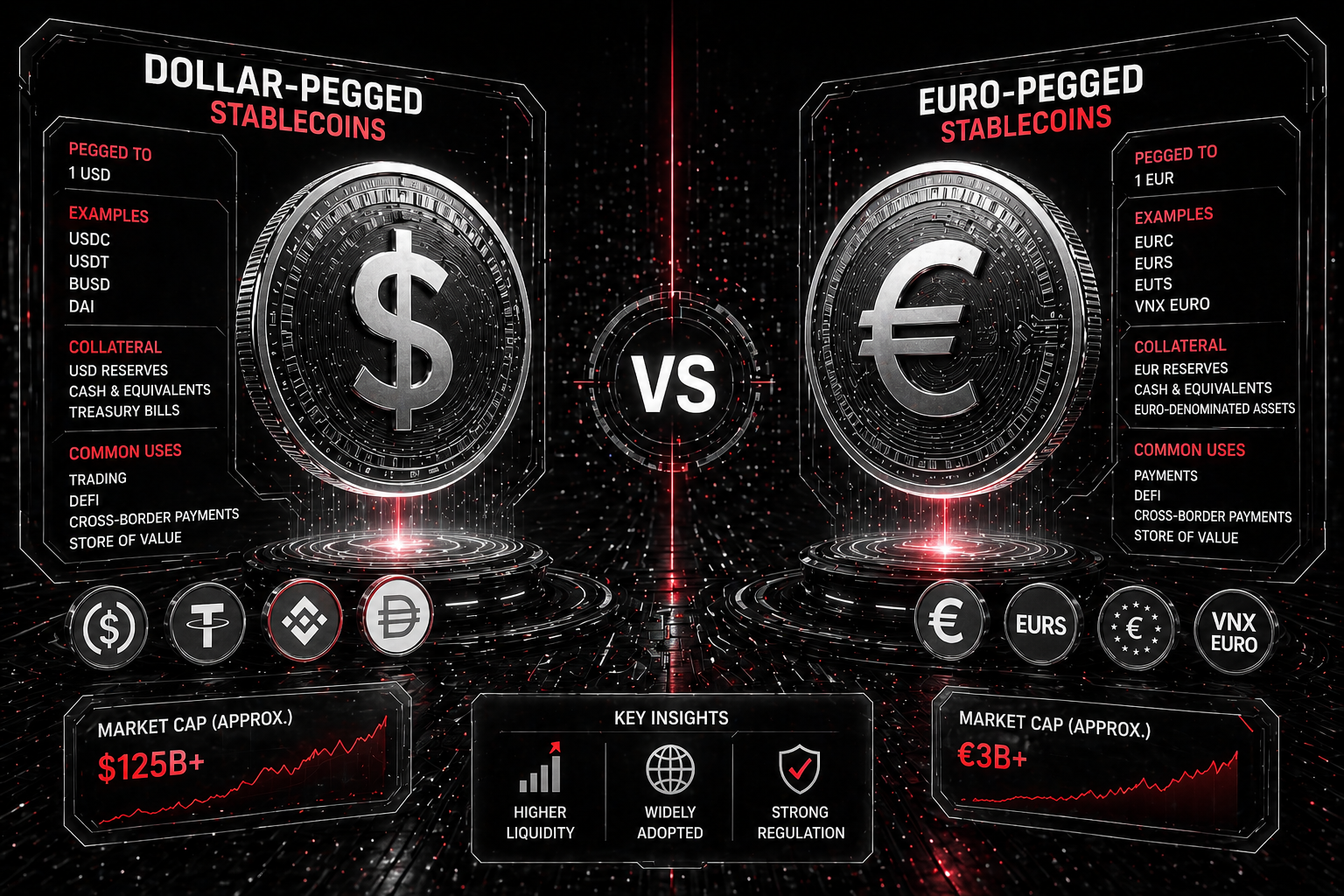
Market context: USDC alone holds over $50 billion in circulation. EURC, the leading euro stablecoin from the same issuer (Circle), holds approximately $340 million. That is a liquidity gap of roughly 147:1 between the two products from the same company.
How the 1:1 Dollar Peg Is Maintained
| Mechanism | How It Works | Who Uses It |
|---|---|---|
| Fiat Collateral | Every token is backed 1:1 by USD held in reserve accounts | USDT, USDC |
| Treasury Bills | Reserves held in short-term U.S. government debt for yield and stability | USDC, USDT |
| Redemption Guarantee | Users can redeem tokens directly for USD at face value, anchoring the market price | USDC (direct), USDT (qualified users) |
| Third-Party Audits | Regular attestations from accounting firms confirm reserve adequacy | USDC (monthly), USDT (quarterly) |
The redemption mechanism is what separates fiat-backed stablecoins from algorithmic ones. As long as the issuer holds sufficient reserves and users trust the redemption process, the peg holds. This is also why the transparency of reserve disclosures matters — it directly affects market confidence in the peg during periods of stress.
Why Dollar Stablecoins Hold 90%+ of the Stablecoin Market
The U.S. dollar’s role as the world’s reserve currency did not shrink when stablecoins emerged — it expanded into a new asset class. Because global trade, commodities pricing, and most cross-border settlements are denominated in dollars, a dollar-pegged stablecoin is immediately useful to traders in virtually every country. There is no conversion step, no currency mismatch, and no forex exposure when trading pairs are already denominated in USD. For a deeper understanding of how high-frequency crypto trading impacts the market, check out this article.
Network effects reinforce this dominance. The more exchanges list USDT and USDC, the more traders use them. The more traders use them, the more liquidity pools deepen. The deeper the liquidity, the tighter the spreads — which in turn attracts more volume. Breaking into that cycle is the core challenge facing euro stablecoins right now.
What Euro-Pegged Stablecoins Actually Are
Euro-pegged stablecoins work on the same fundamental principle as dollar stablecoins — a 1:1 peg maintained by full-reserve backing — but the reference currency is the euro rather than the U.S. dollar. One token always represents one euro. The reserves are held in euro-denominated assets, and the entire system is designed to serve users who operate in euros natively, without needing to convert into or out of the dollar.
EURC by Circle: The Leading Euro Stablecoin
EURC is issued by Circle — the same organization behind USDC — and it is currently the most prominent euro-backed stablecoin in active circulation. Each EURC token is backed 1:1 by euro-denominated assets held in reserve, and the stablecoin operates on a full-reserve model with the same compliance infrastructure Circle applies to USDC. It is available across multiple blockchain networks and is fully compliant with the European Union’s MiCA (Markets in Crypto-Assets) regulatory framework.
Circle also enables direct conversion between EURC and USDC, which effectively creates an always-on foreign exchange desk for qualified users. This interoperability makes EURC practical for businesses that need to toggle between euro and dollar liquidity depending on immediate trading needs.
How the Euro Peg Works Differently From the Dollar Peg
The mechanics of maintaining the peg are nearly identical between EURC and USDC — full reserves, third-party attestations, and a direct redemption guarantee. The meaningful difference is in the underlying reserve assets. EURC reserves are held in euro-denominated instruments rather than U.S. Treasuries. This means the yield generated by those reserves reflects European Central Bank (ECB) interest rate policy rather than U.S. Federal Reserve policy — a distinction that directly affects the economics of holding each stablecoin.
MiCA Regulation and What It Means for Euro Stablecoin Traders
The EU’s MiCA framework, which came into full effect for stablecoins in 2024, establishes strict requirements for any stablecoin issuer operating within the European Union. Issuers must maintain adequate reserves, publish regular disclosures, and obtain authorization from EU regulators. EURC was built with MiCA compliance as a core design requirement, giving it a structural advantage over dollar stablecoins that were not originally designed to meet EU standards.
For traders based in Europe or serving European counterparties, this regulatory clarity matters. MiCA compliance reduces the risk of a stablecoin being delisted or restricted by EU-regulated exchanges — a real operational risk for dollar stablecoins that lack equivalent EU authorization. Learn more about the worst countries for crypto investors facing bans and restrictions.
This is not a minor compliance footnote. As EU-regulated exchanges increasingly require MiCA-compliant assets for listing, the practical availability of non-compliant stablecoins on European platforms is narrowing. Traders who are not tracking this shift may find their preferred dollar stablecoin losing exchange support in key European markets over the next two to three years.
Dollar vs Euro Stablecoins: The Core Differences That Affect Your Profits
Setting aside the technical architecture, the decision between dollar vs euro stablecoins comes down to five practical factors: liquidity, trading pair availability, forex exposure, conversion costs, and yield. Each one has a direct line to your profit and loss.
None of these factors operate in isolation. A trader who enjoys slightly better euro-denominated yield on EURC may give it all back — and more — through wider spreads, fewer trading pairs, and hidden forex conversion costs. Equally, a trader who defaults to USDT for liquidity reasons while operating primarily in European markets is carrying unnecessary dollar exposure that erodes returns when EUR strengthens against USD.
$50B+
USDC circulation
$340M
EURC circulation
147:1
Liquidity gap ratio
Liquidity Gap: Why Dollar Stablecoins Have Deeper Markets
Liquidity is not just about how much of a stablecoin exists — it is about how quickly and cheaply you can move in and out of positions at the price you expect. USDC’s $50 billion+ circulation versus EURC’s approximately $340 million creates a real-world difference in trading conditions. On high-volume trades, the liquidity gap between dollar vs euro stablecoins translates directly into slippage — the difference between the price you expect and the price you actually get.
Trading Pair Availability on Major Exchanges
Dollar stablecoins are paired with nearly every tradeable asset on every major exchange. On Binance, Coinbase, Kraken, and OKX, USDT and USDC trading pairs number in the hundreds. EURC, by comparison, has a fraction of that coverage. On most platforms, euro stablecoin pairs are limited to the largest assets — Bitcoin, Ethereum, and a handful of top-tier altcoins. If your trading strategy involves mid-cap or emerging tokens, you will almost certainly need dollar stablecoins to access those markets efficiently.
Forex Exposure: How EUR/USD Swings Hit Your Returns
This is the factor most traders underestimate. When you hold EURC and the EUR/USD rate moves against you, your stablecoin’s purchasing power in dollar terms changes — even though its euro value stays perfectly stable. A trader holding EURC who watches the euro depreciate 5% against the dollar has effectively lost 5% of their dollar-equivalent portfolio value without making a single trade. This is not a hypothetical risk. EUR/USD moved more than 15% in a single year as recently as 2022, when the euro briefly fell below parity with the dollar for the first time in two decades.
Transaction Fees and Conversion Costs Between the Two
Converting between dollar and euro stablecoins is not free, even when the swap looks seamless on the surface. Circle’s direct EURC-to-USDC conversion is available for qualified institutional users, but retail traders typically convert through exchange order books, which carry spread costs, platform fees, and in some cases network gas fees on top. On Ethereum mainnet, a single conversion transaction can cost several dollars in gas during periods of network congestion — a meaningful cost if you are making frequent position adjustments.
For high-frequency traders or businesses making regular euro-to-dollar settlements, these conversion costs compound quickly. A seemingly small 0.1% conversion fee on a $500,000 monthly trading volume equals $500 per month — $6,000 per year — in pure friction costs that disappear directly from your returns. Choosing the right stablecoin from the start, rather than converting constantly, is often the more profitable approach.
When Euro-Pegged Stablecoins Are the Better Choice
Euro stablecoins are not trying to compete with USDT on global liquidity. They are solving a different problem — and for the traders who have that problem, they solve it better than any dollar stablecoin can.
Trading Within European Markets and Eurozone Businesses
If your counterparties, suppliers, clients, or trading partners operate in euros, holding EURC eliminates a conversion step that would otherwise cost you on every single transaction. A European e-commerce business settling supplier payments in crypto, or a trader arbitraging between EU-regulated exchanges, benefits directly from holding a euro-denominated asset that does not require touching the dollar at any point in the workflow. The operational simplicity alone can translate into meaningful cost savings over time.
Hedging Against Dollar Weakness With EURC
Traders with significant dollar stablecoin exposure are implicitly long on the U.S. dollar. When the dollar weakens against the euro — which it does in cycles driven by Federal Reserve rate decisions, U.S. fiscal policy, and macroeconomic conditions — that dollar exposure erodes real purchasing power for anyone whose costs are denominated in euros. Holding a portion of your stablecoin position in EURC acts as a natural hedge against that dollar weakness without requiring you to move into volatile crypto assets or traditional forex instruments.
This is particularly relevant for European traders or international businesses with euro-denominated expenses. Rather than taking on unnecessary currency risk by converting everything to dollars, splitting your stablecoin allocation between USDC and EURC lets you match your asset currency to your liability currency — a basic treasury management principle that applies just as well to crypto portfolios as it does to corporate balance sheets.
When Dollar-Pegged Stablecoins Are the Better Choice
For most international traders operating outside the Eurozone, dollar stablecoins remain the default choice for practical reasons that go beyond habit. The infrastructure advantage is simply too large to ignore in most trading scenarios. That said, understanding exactly where dollar stablecoins outperform helps you deploy them strategically rather than just reflexively.
The clearest signal to use dollar stablecoins is when your trading activity crosses multiple jurisdictions, involves emerging market assets, or requires access to the deepest possible liquidity pools. In those situations, the dollar’s status as the world’s reserve currency gives USDT and USDC structural advantages that no euro stablecoin can currently match.
Cross-Border Payments in Emerging Markets
In markets across Southeast Asia, Latin America, Sub-Saharan Africa, and the Middle East, the U.S. dollar is the de facto reference currency for international trade and settlement. USDT in particular has become the preferred cross-border payment rail in many of these regions precisely because recipients can hold dollar value without needing access to a U.S. bank account. Euro stablecoins simply do not carry the same recognition or utility in these markets — EURC is not widely listed on regional exchanges, and fewer counterparties in emerging economies have systems set up to receive or settle in euro-denominated crypto.
Access to the Widest Range of DeFi Protocols and Exchanges
DeFi runs on dollar liquidity. The largest liquidity pools on Uniswap, Curve, Aave, and Compound are denominated in USDC or USDT. Yield farming strategies, lending protocols, and automated market makers are almost universally built around dollar stablecoins because that is where the volume concentrates. Attempting to replicate a dollar stablecoin DeFi strategy with EURC means accepting thinner pools, higher slippage, lower yields, and fewer protocol options — at least for now. For those new to the crypto world, exploring beginner crypto investment strategies can be a helpful starting point.
Lower Slippage and Tighter Spreads on High-Volume Trades
Slippage is the silent killer of trading profitability at scale. When you execute a large order in a thin market, your own trade moves the price against you before it fills completely. Dollar stablecoins, with their vastly deeper order books and liquidity pools, minimize this effect in ways that euro stablecoins cannot currently match.
Consider a practical example: a $2 million USDC-to-ETH swap on a major DEX with deep liquidity might experience 0.05% slippage. The same trade routed through a thinner EURC pool could see 0.5% or more — ten times the slippage cost — before any fees are even factored in. At that volume, the dollar difference in execution quality is $9,000 per trade.
For active traders, this is not a marginal consideration. It is a structural cost that accumulates with every single trade executed in a thin market. The decision to use dollar stablecoins for high-volume trading is, in many cases, simply a decision to protect your margins.
Major Exchange Support Comparison
- USDT on Binance: Hundreds of active trading pairs with deep liquidity across spot, futures, and margin markets
- USDC on Coinbase: Native integration with the exchange, near-zero conversion fees between USD and USDC for verified users
- EURC on Kraken: Available but with significantly fewer trading pairs and lower liquidity depth than its dollar equivalents
- EURC on Bitstamp: One of the better-supported euro stablecoin venues in Europe, with MiCA-compliant infrastructure
Profitability Comparison: Dollar vs Euro Stablecoins Side by Side
Dollar vs Euro Stablecoins: Head-to-Head Comparison
- Liquidity depth: Dollar stablecoins win — USDC and USDT dwarf EURC in total circulation and available trading pairs
- Regulatory clarity in Europe: EURC wins — MiCA compliance gives it a structural advantage on EU-regulated platforms
- Forex risk for European traders: EURC wins — no dollar exposure means no EUR/USD slippage on euro-denominated operations
- DeFi access and yield strategies: Dollar stablecoins win — the overwhelming majority of DeFi protocols are built around USDC and USDT
- Cross-border utility in emerging markets: Dollar stablecoins win — USDT in particular is the dominant cross-border settlement tool in developing economies
- Conversion costs for euro-based businesses: EURC wins — eliminating the EUR/USD conversion step removes a recurring friction cost from every transaction
The profitability comparison is not one-size-fits-all. Your base currency, target trading markets, transaction volume, and yield requirements all shift the balance between dollar vs euro stablecoins. A European trader running an arbitrage strategy across EU-regulated exchanges operates in a fundamentally different environment than a Southeast Asian trader using USDT to move value across borders — and the optimal stablecoin choice reflects that difference.
What the comparison does reveal clearly is that defaulting to dollar stablecoins without analysis is a decision with real costs for specific trader profiles. European-based traders, euro-denominated businesses, and anyone seeking MiCA-compliant assets for EU exchange access are leaving tangible value on the table by ignoring EURC entirely.
At the same time, the liquidity gap between USDC and EURC is not closing quickly. Until euro stablecoin adoption reaches a scale where liquidity pools deepen significantly, dollar stablecoins will continue to offer execution quality advantages that matter most in high-volume, high-frequency trading environments.
Yield Differences: Interest Rates in the US vs Eurozone
The reserves backing dollar stablecoins are typically invested in U.S. Treasury bills and short-term U.S. government debt instruments. The yield on those instruments reflects Federal Reserve interest rate policy. When U.S. rates are high — as they were throughout 2023 and 2024 — the reserve yield is substantial, and some of that yield flows back to token holders through interest-bearing products and lending protocols built on top of USDC and USDT. Conversely, EURC reserves are held in euro-denominated instruments, which means yield is tied to ECB rate policy.
Historically, U.S. interest rates have run higher than Eurozone rates for extended periods, which has given dollar stablecoin holders a yield advantage in interest-bearing products. However, this is not a permanent structural advantage — ECB rates have risen significantly since 2022, and the rate differential between the two currency blocs narrows and widens in cycles. Traders who are actively seeking yield on their stablecoin holdings should track both the Fed funds rate and the ECB deposit facility rate when choosing which stablecoin to hold as their base asset.
How Reserve Asset Allocation Affects Stablecoin Returns
Where a stablecoin issuer parks its reserves determines how much yield those reserves generate — and whether any of that yield reaches token holders. USDC reserves are held primarily in short-term U.S. Treasury bills and cash equivalents, managed through Circle’s Reserve Fund. EURC reserves are held in euro-denominated instruments under ECB oversight. The practical difference is that the yield profile of each stablecoin’s reserves tracks its respective central bank’s rate environment, meaning the better-yielding stablecoin shifts depending on where interest rates sit in each currency bloc at any given time.
Real Cost of Holding Each Stablecoin Long-Term
The real cost of holding a stablecoin is not just the fees you see — it is the sum of conversion costs, opportunity cost from missed yield, forex exposure losses, and liquidity friction accumulated over time. A trader who holds USDT without using any yield product is leaving the entire reserve yield with Tether. A trader who holds EURC while their operations are dollar-denominated is taking on EUR/USD forex risk every single day. Neither situation is inherently wrong, but both have costs that are easy to miss when you are not looking for them.
Long-term holders benefit from mapping out the full cost structure of each option against their specific trading profile. The variables that matter most are:
- Base currency of your expenses: Match your stablecoin to your primary expense currency to eliminate unnecessary forex exposure
- Trading volume: Higher volume amplifies slippage differences between deep dollar markets and thinner euro markets
- Yield product access: Dollar stablecoin yield products are more widely available and often offer higher rates due to deeper DeFi integration
- Exchange geography: EU-based exchanges increasingly favor MiCA-compliant assets, giving EURC a platform access advantage in European markets
- Conversion frequency: The more often you convert between currency denominations, the more each conversion cost compounds against your returns
One practical way to reduce long-term holding costs is to treat your stablecoin allocation like a treasury position rather than a passive hold. Actively matching your stablecoin denomination to your near-term trading activity — using EURC for European settlements and USDC for global DeFi strategies — reduces both forex exposure and unnecessary conversion friction simultaneously.
The traders who optimize this correctly do not pick one stablecoin and stick with it forever. They hold a split allocation and rebalance based on where they are trading, what rates are doing in each currency bloc, and how their upcoming transaction flow is denominated. That approach requires a bit more active management, but it eliminates the largest hidden costs that single-stablecoin strategies carry over time.
The Peg Stability Risk Most Traders Ignore
The entire value proposition of a stablecoin rests on one assumption: the peg holds. When it does not, the losses can be catastrophic and nearly instantaneous. Most traders spend enormous energy comparing yields, fees, and liquidity across stablecoins while giving almost no thought to the probability — and consequence — of a peg failure in the specific stablecoin they are holding.
Peg risk is not equally distributed across stablecoins. The type of backing mechanism, the quality of reserve assets, the transparency of reserve disclosures, and the issuer’s ability to meet redemption demands under stress all determine how likely a given stablecoin is to hold its peg when markets move against it. Fiat-collateralized stablecoins like USDC and EURC carry fundamentally different peg risk profiles than algorithmic stablecoins — a distinction that became painfully clear in May 2022.
What Causes a Stablecoin Peg to Break
A stablecoin peg breaks when market confidence in the issuer’s ability to honor redemptions collapses faster than the issuer can respond. For fiat-backed stablecoins, the most likely trigger is a reserve shortfall — either actual (the reserves are genuinely insufficient) or perceived (the market believes they are insufficient even if they are not). The latter is particularly dangerous because it can create a self-fulfilling bank run dynamic: users rush to redeem before others do, overwhelming the issuer’s redemption infrastructure and pushing the market price below the peg before any real reserve problem even exists. To understand more about the dynamics of stablecoins, you might explore The Crypto Code.
Algorithmic stablecoins face a structurally different and more severe version of this risk. Without fiat reserves to fall back on, algorithmic pegs depend entirely on market participants continuing to believe in the mechanism. When that belief breaks — for any reason — there is no reserve pool to absorb redemption pressure, and the peg can collapse to zero within hours. This is not a theoretical risk. It is exactly what happened to TerraUSD (UST) in May 2022, when the algorithmic peg mechanism failed catastrophically under selling pressure.
Historical Peg Failures and What They Cost Traders
Major Stablecoin Peg Failures
- TerraUSD (UST), May 2022: Lost its dollar peg within 72 hours and collapsed to near zero, wiping out an estimated $40 billion in market value across the Terra ecosystem
- USDC, March 2023: Briefly depegged to approximately $0.87 after Circle disclosed $3.3 billion in reserves held at Silicon Valley Bank, which had just failed — the peg recovered within days once Circle confirmed reserve access, but traders who sold during the panic locked in real losses
- USDT, multiple instances: Has experienced brief depegs during periods of extreme market stress, including trading as low as $0.95 during the height of the 2018 crypto crash before recovering
The USDC Silicon Valley Bank episode is particularly instructive for euro stablecoin traders. The depeg had nothing to do with USDC’s overall reserve adequacy — Circle held the vast majority of reserves in U.S. Treasuries and remained fully solvent. The peg broke because of market panic over a single counterparty risk that was resolved within a business week. But traders who reacted to the depeg by selling at $0.87 turned a temporary market inefficiency into a permanent 13% loss on their position.
The lesson is not that fiat-backed stablecoins are unsafe. USDC and EURC, with their full-reserve models and regular audits, sit at the safer end of the stablecoin risk spectrum. The lesson is that even the most well-backed stablecoins can experience temporary depegs driven by market psychology rather than fundamental reserve failure — and that reacting emotionally to those depegs is often the most expensive mistake a trader can make. For a deeper understanding of market dynamics, you might want to explore crypto trade alert services and their pros and cons.
For euro stablecoins specifically, MiCA’s reserve and disclosure requirements add a regulatory backstop that reduces the probability of a reserve-driven confidence crisis. MiCA-compliant issuers must maintain liquid reserves, report regularly, and meet authorization standards set by EU regulators. This does not eliminate peg risk entirely, but it does mean that MiCA-compliant euro stablecoins like EURC operate under a level of regulatory scrutiny that reduces the likelihood of the kind of reserve opacity that triggered USDC’s 2023 depeg scare.
Which Stablecoin Should You Use for International Trading in 2026
The honest answer is that there is no universal winner — but there is almost certainly a better choice for your specific situation. Dollar stablecoins remain the dominant tool for global liquidity access, DeFi participation, and cross-border payments in emerging markets. Euro stablecoins are the better choice for EU-based traders, euro-denominated businesses, and anyone seeking MiCA-compliant assets on European regulated exchanges. The strategic move for most international traders is not to pick one and ignore the other — it is to hold both and deploy each where it performs best.
The EUR/USD rate environment currently adds another layer of strategic consideration. If ECB rates remain competitive with Fed rates — or if the euro strengthens against the dollar — the yield and forex arguments for holding EURC alongside USDC become more compelling than they have been in previous cycles. Traders who are not actively monitoring the rate differential between the two currency blocs are making a passive bet on the dollar remaining dominant without explicitly choosing to make that bet.
| Trader Profile | Recommended Stablecoin | Primary Reason |
|---|---|---|
| Global DeFi trader | USDC / USDT | Deepest liquidity pools, widest protocol access |
| EU-based crypto trader | EURC (primary) + USDC (secondary) | MiCA compliance, eliminates EUR/USD conversion costs |
| Cross-border payments (emerging markets) | USDT | Widest recognition and exchange availability globally |
| Euro-denominated business | EURC | Eliminates forex exposure on every transaction |
| High-frequency arbitrage trader | USDC / USDT | Tighter spreads, lower slippage at high volume |
| Yield-focused long-term holder | Depends on Fed vs ECB rate differential | Track rate environment and hold the higher-yielding option |
| Trader hedging dollar exposure | EURC | Natural hedge against USD weakness without leaving stablecoins |
The stablecoin landscape in 2026 is more nuanced than it was in 2020, when the choice was effectively USDT or nothing. The growth of regulated euro stablecoins, the implementation of MiCA, and the increasing sophistication of European crypto infrastructure mean that the dollar stablecoin default deserves to be questioned — not abandoned wholesale, but questioned carefully with your specific trading profile in mind.
Frequently Asked Questions
The most common questions traders have about dollar vs euro stablecoins tend to cluster around three themes: safety, yield, and practical usability. The answers depend more on your specific situation than most people expect.
What follows are direct answers to the questions that come up most often, without the oversimplification that makes most stablecoin comparisons less useful than they should be.
Is EURC safer than USDT for international trading?
EURC and USDT operate on fundamentally different transparency and regulatory models, which makes a direct safety comparison more nuanced than a simple yes or no. EURC is MiCA-compliant, issued by Circle with fully audited reserves, and designed from the ground up to meet EU regulatory standards. USDT is the most liquid stablecoin in the world but has historically maintained less transparent reserve disclosures, having faced regulatory scrutiny from the New York Attorney General and settled with the CFTC in 2021 over reserve misrepresentation claims.
From a pure reserve transparency and regulatory compliance standpoint, EURC holds a clear advantage over USDT. However, USDT’s liquidity advantage means that in a stress scenario where you need to exit a position quickly, the depth of USDT markets provides a practical safety buffer that EURC’s thinner markets cannot currently match.
| Safety Factor | EURC | USDT |
|---|---|---|
| Reserve Transparency | Full audits, MiCA-compliant disclosures | Quarterly attestations, historically less transparent |
| Regulatory Status | MiCA authorized in EU | Limited EU-specific authorization |
| Redemption Reliability | Direct redemption for qualified users | Redemption available for large holders, less accessible for retail |
| Liquidity Under Stress | Thinner markets, higher exit risk in volume | Deepest markets, easiest exit at scale |
| Historical Peg Stability | No significant depeg events to date | Multiple minor depegs, no permanent peg failure |
For traders prioritizing regulatory safety and reserve transparency, EURC is the stronger option. For traders who prioritize liquidity as their primary risk management tool, USDT’s market depth offers a different but equally real form of protection. The optimal choice depends on which type of risk you are more exposed to in your specific trading environment.
Can I earn yield on euro-pegged stablecoins the same way I can with dollar stablecoins?
EURC Yield Opportunities
- Centralized lending platforms: Some CeFi platforms offer EURC lending products, but rates and availability are significantly more limited than dollar stablecoin equivalents
- DeFi liquidity pools: EURC liquidity pools exist on Curve and Uniswap but with substantially lower total value locked (TVL) than USDC or USDT pools, resulting in lower yield opportunities
- Exchange staking/earn products: A small number of EU-regulated exchanges offer EURC earn products, but the catalog is much narrower than dollar stablecoin yield products
- Reserve yield pass-through: Like USDC, the underlying reserve yield from EURC is not automatically passed to token holders — you must actively deploy EURC into a yield product to capture any return
Yield opportunities for euro stablecoins are real but materially more limited than for dollar stablecoins currently. The DeFi ecosystem has been built around dollar liquidity for years, and euro stablecoin yield infrastructure is still developing. The practical consequence is that a yield-focused trader who switches entirely to EURC today will likely find fewer options, lower available rates, and thinner pools than they are accustomed to with USDC or USDT.
That said, the gap is narrowing. MiCA’s regulatory clarity is attracting more institutional participation in euro stablecoin markets, and as EURC adoption grows, the depth of yield products available to EURC holders will increase. Traders who are early to building euro stablecoin yield strategies may benefit from first-mover positioning as liquidity pools deepen.
The most practical near-term approach for yield-seeking traders is to maintain primary yield exposure in dollar stablecoins where product depth is greatest, while allocating a portion of holdings to EURC for operational and regulatory purposes. This hybrid approach captures the best of both worlds without forcing a yield sacrifice that the current euro stablecoin ecosystem is not yet equipped to replace.
Does the EUR/USD exchange rate affect my profits when trading with EURC?
Yes — directly and continuously. Every time you assess your portfolio in dollar terms while holding EURC, the EUR/USD exchange rate is either adding to or subtracting from your dollar-equivalent value. If you enter a position with EURC when EUR/USD is at 1.10 and exit when it has moved to 1.05, you have lost approximately 4.5% of dollar-equivalent value even if your EURC balance is unchanged. For traders whose profit targets and risk calculations are dollar-denominated, this forex layer adds meaningful complexity to position sizing and return analysis. Traders who operate entirely within the euro ecosystem — expenses, revenues, and targets all denominated in euros — do not face this problem, which is precisely why EURC serves that profile so effectively.
Which exchanges support euro-pegged stablecoins for international trading?
EURC is currently listed on Kraken, Bitstamp, Coinbase, and several EU-regulated exchanges that have prioritized MiCA-compliant asset listings. Bitstamp and Kraken offer the most robust EURC trading environments in Europe, with direct euro fiat on-ramps that allow traders to move between bank euros and EURC without touching the dollar at any point. On-chain, EURC is available on Ethereum, Avalanche, and Solana, with liquidity pools accessible via Curve Finance and Uniswap. Availability is expanding as MiCA compliance becomes a listing requirement on more EU-regulated platforms, so the exchange footprint for EURC in 2026 is meaningfully larger than it was previously.
Are euro-pegged stablecoins legal to use in all countries?
Euro-pegged stablecoins are legal to use in the European Union, the United Kingdom, and most jurisdictions where cryptocurrency is broadly permitted. Within the EU, MiCA provides a clear and unified legal framework that makes EURC one of the most regulatory-compliant stablecoins available to European traders. Outside the EU, the legal status depends on each country’s approach to cryptocurrency regulation more broadly — euro stablecoins do not carry any unique legal restrictions beyond those that apply to cryptocurrency assets generally in a given jurisdiction.
In countries with strict capital controls or outright cryptocurrency bans — such as China, Algeria, or Bolivia — neither euro nor dollar stablecoins are legally permitted for use. In countries with partial restrictions, local regulatory guidance should be consulted before using any stablecoin for cross-border transactions, as anti-money-laundering requirements and reporting obligations vary significantly by jurisdiction. The MiCA framework does not extend legal protection to EURC use outside the EU, even though the stablecoin itself is MiCA-compliant at the issuer level.
For most international traders operating in crypto-friendly jurisdictions, euro stablecoins present no legal complications beyond standard cryptocurrency compliance requirements. The MiCA compliance of EURC specifically may actually reduce regulatory friction compared to non-compliant alternatives in EU-adjacent markets where regulators are aligning their frameworks with European standards. If your trading operation spans multiple jurisdictions, legal counsel familiar with each country’s crypto regulatory environment remains the most reliable source of guidance on stablecoin usage legality.
Stablecoins have become a crucial component in the world of international trading, offering a bridge between volatile cryptocurrencies and traditional fiat currencies. By pegging their value to stable assets like the US dollar or euro, stablecoins provide traders with a reliable medium of exchange. Among the different types of stablecoins, dollar-pegged options are often favored for their widespread acceptance and liquidity. However, euro-pegged stablecoins are gaining traction in Europe, providing an alternative for traders operating within the eurozone. For those interested in exploring the cost implications of crypto trading, understanding how much crypto trading costs can be essential for maximizing profitability.
DYOR (Do Your Own Research)
This article is for informational purposes only and does not constitute financial advice. Cryptocurrency and stablecoin trading carry significant risk. The regulatory landscape, market conditions, and exchange support for stablecoins change frequently. Always verify current information, conduct your own research, and consult with qualified financial and legal professionals before making trading decisions. Past performance does not guarantee future results. Trade at your own risk.




Latest
Markets
08 Jul 2026
Markets
04 Jul 2026