Coinposters
Pros and Cons of Day Trading vs. Swing Trading Crypto: Which is More Profitable
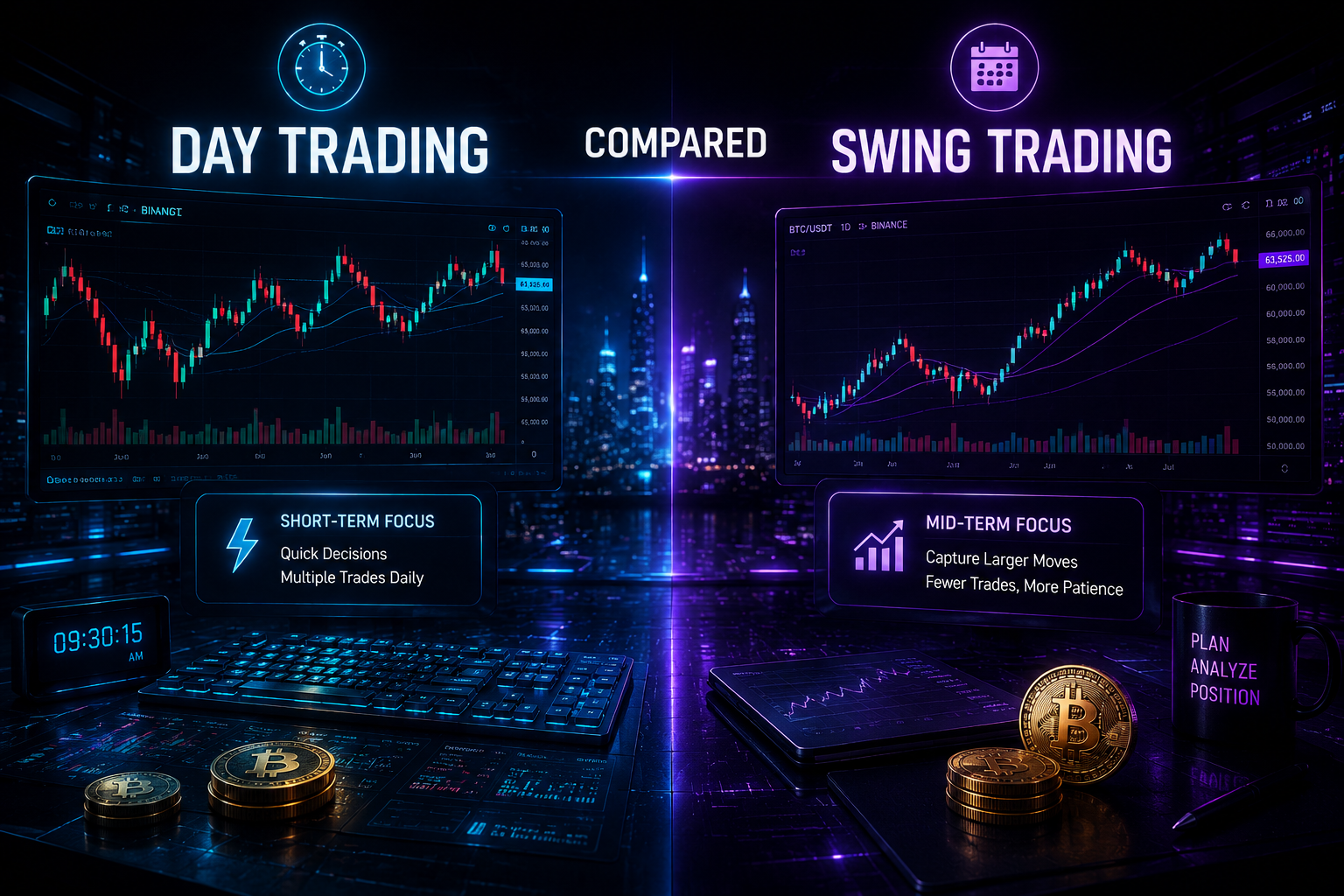
The truth is, neither day trading vs swing trading crypto is inherently more profitable; day trading rewards speed and intense daily focus, while swing trading rewards patience and larger moves with far less screen time, and the right choice depends on your skill, time, and psychology, not the strategy label.
Article at a Glance
Here’s the short version of day trading vs swing trading crypto:
- Day trading crypto means opening and closing all positions within a single 24-hour window, eliminating overnight risk but demanding intense focus and significant screen time.
- Swing trading crypto holds positions for days or weeks, capturing larger price moves with far less daily time commitment, making it more accessible for part-time traders.
- Neither strategy is universally more profitable; your skill level, available time, emotional discipline, and capital size determine which approach gives you the edge.
- Risk management, not just strategy selection, is the real differentiator between traders who grow their portfolios and those who blow them up.
- There’s a lesser-known hybrid approach some experienced traders use that combines both strategies depending on market conditions, covered in detail below.
Table of Contents
- Day Trading vs. Swing Trading Crypto: The Core Difference
- How Day Trading Crypto Actually Works
- Pros of Day Trading Crypto
- Cons of Day Trading Crypto
- How Swing Trading Crypto Actually Works
- Pros of Swing Trading Crypto
- Cons of Swing Trading Crypto
- Profit Potential Compared: Which Strategy Earns More
- Risk Management for Each Strategy
- Day Trading vs. Swing Trading: Which Strategy Fits You
- Frequently Asked Questions
Choosing between day trading and swing trading crypto isn’t just a preference, it’s a decision that directly shapes your risk exposure, daily routine, and long-term profitability.
Both strategies can generate real returns in crypto markets, but they demand completely different skill sets, time commitments, and psychological tolerance. Before you place a single trade, understanding exactly how each approach works, and where each one breaks down, can save you from costly mistakes that derail most new traders before they ever find their footing.
Day Trading vs. Swing Trading Crypto: The Core Difference
The fundamental difference comes down to time. Day traders open and close every position within the same trading day. Swing traders hold positions across multiple days or even weeks, targeting larger market moves. Everything else, strategy, tools, risk management, and mental approach, flows from that single distinction.
Day Trading Defined: In and Out Within 24 Hours
Crypto day trading, also called intraday trading, involves buying and selling digital assets like Bitcoin, Ethereum, or Solana within a single day. No position carries over to the next trading session. The goal is to profit from short-term price fluctuations that happen within minutes or hours, not from long-term market trends.
Day traders typically execute multiple trades per session, sometimes dozens, using tight entry and exit points driven almost entirely by technical analysis. Every trade is intentional and time-sensitive, hesitation costs money.
Quick Example: A day trader notices Bitcoin forming a bullish flag pattern on the 15-minute chart at 9:00 AM. They enter at $67,200, set a take-profit at $67,900, and a stop-loss at $66,900. By 11:30 AM, the target hits. Position closed. Profit locked. No exposure overnight.
Swing Trading Defined: Riding Trends Over Days or Weeks
Swing trading captures price “swings,” the natural up and down movements that play out over days, weeks, or occasionally months. A swing trader buys when they believe an asset is bottoming out within a trend and sells when they expect momentum to stall or reverse.
Unlike day traders who rely heavily on 1-minute to 15-minute charts, swing traders primarily use the 4-hour, daily, and weekly charts to identify setups. This longer timeframe means fewer trades, but each trade aims for a substantially larger price move, often 10% to 30% or more in crypto markets.
- Swing traders hold positions through normal market noise without reacting to every small price movement
- Trades are planned in advance with clear entry, stop-loss, and take-profit levels set before execution
- Position management requires checking charts once or twice daily rather than constant monitoring
- Fundamental catalysts, like protocol upgrades, exchange listings, or macro events, often play a larger role in trade selection
Why Crypto Markets Make Both Strategies Uniquely Challenging
Crypto trades 24 hours a day, 7 days a week, 365 days a year, there is no closing bell. This relentless market structure amplifies the demands of both strategies. For day traders, there is no natural pause to regroup. For swing traders, positions are exposed to weekend volatility and after-hours news events that traditional markets don’t face with the same intensity.
Crypto’s volatility is also dramatically higher than traditional asset classes. Bitcoin can move 5% to 10% in a single session. Altcoins can swing 20% to 40% in hours. That volatility creates massive opportunity, but it also magnifies losses when risk management breaks down, which is exactly why most retail traders struggle regardless of which strategy they choose.
How Day Trading Crypto Actually Works
Day trading in crypto is a systematic process built on speed, discipline, and technical precision. It is not guesswork, at least not for traders who survive long enough to become consistently profitable.
The Role of Technical Analysis in Day Trading
Technical analysis is the backbone of every day trading decision. Day traders rely on price action, chart patterns, volume data, and indicators to identify high-probability entry and exit points in real time. Common indicators include the Relative Strength Index (RSI), Moving Average Convergence Divergence (MACD), Bollinger Bands, and Volume Weighted Average Price (VWAP). The ability to read these signals quickly and accurately, under pressure, separates profitable day traders from the rest.
Common Day Trading Strategies Used in Crypto Markets
Scalping is among the most popular day trading approaches in crypto, traders make dozens of small trades targeting tiny price movements, often just 0.2% to 0.5% per trade, accumulating gains through sheer volume. Momentum trading is another widely used strategy where traders identify assets making strong directional moves on high volume and ride that momentum until signs of exhaustion appear.
Range trading works well in sideways crypto markets, where traders buy near established support levels and sell near resistance, repeating the cycle until the range breaks. Breakout trading, on the other hand, involves entering a position the moment price breaks above a key resistance or below a key support level, anticipating a sharp continuation in the breakout direction.
Tools Day Traders Rely On: TradingView, Bybit, and Binance
TradingView is the industry-standard charting platform for most crypto day traders, offering advanced technical indicators, real-time data, and multi-timeframe analysis in one interface. Execution platforms like Bybit and Binance provide the speed, liquidity, and order types, including limit orders, market orders, and conditional orders, that day trading demands. Many serious day traders also use crypto screeners to scan for assets showing unusual volume or momentum spikes in real time, narrowing their focus to the highest-probability setups available in that session. For those interested in different trading strategies, comparing active trading versus HODL might provide additional insights.
Pros of Day Trading Crypto
Day trading attracts a certain type of trader, someone who thrives under pressure, enjoys rapid decision-making, and wants to see results immediately rather than waiting days for a trade to play out. The appeal is real, but so are the trade-offs.
1. No Overnight Risk Since All Positions Close Daily
Because every position closes before the end of the trading session, day traders are never exposed to overnight market gaps or surprise news events that hit while they sleep. In crypto, where a single tweet, regulatory announcement, or exchange hack can move markets 15% in minutes, this is a meaningful structural advantage. You go to bed with cash, not risk.
2. High Profit Potential From Multiple Daily Trades
Skilled day traders don’t rely on a single large trade to generate returns. Instead, they stack multiple smaller wins across a session. A trader making 0.5% net profit per trade across 6 trades in a day is compounding gains at a rate that, over time, can significantly outperform buy-and-hold strategies in the right market conditions.
The compounding effect of consistent small wins is one of the most compelling mathematical arguments for day trading, when executed with discipline. The problem is that the same math works brutally in reverse when trades go wrong at high frequency.
3. Immediate Feedback Sharpens Trading Skills Faster
No other trading style delivers a faster feedback loop than day trading. Every trade, win or lose, gives you immediate data about your decision-making, strategy execution, and emotional control. A swing trader might complete 20 trades in a year. A day trader can complete 20 trades in a week, generating months’ worth of learning experience in a fraction of the time.
This accelerated learning curve is why many experienced traders, even those who eventually transition to swing trading, credit their early day trading years for building the technical foundation and market intuition they rely on today.
That said, the same speed that sharpens skills can also rapidly deplete capital if a trader hasn’t developed the discipline to cut losses quickly and objectively review their mistakes without emotional bias distorting the lesson.
| Advantage | Day Trading | Swing Trading |
|---|---|---|
| Overnight Risk Exposure | None, all positions close daily | Yes, positions held overnight and weekends |
| Profit Frequency | Multiple opportunities per session | Fewer trades, larger individual gains |
| Skill Development Speed | Fast, high trade volume accelerates learning | Slower feedback loop |
| Daily Time Required | 4 to 8+ hours of active monitoring | 30 to 60 minutes of chart review |
Cons of Day Trading Crypto
The drawbacks of day trading crypto are serious and worth examining honestly before committing to the strategy. Many traders are drawn in by the profit potential without fully appreciating the costs, not just financial, but personal.
The reality is that day trading has an extremely high failure rate among retail traders. Studies of retail day traders in traditional markets consistently show that the majority lose money over time, and crypto’s added volatility makes discipline even harder to maintain. The traders who thrive are typically those with structured strategies, strong emotional regulation, and well-defined rules for every scenario they encounter.
Understanding the cons upfront isn’t discouraging, it’s the first step toward approaching day trading with the respect and preparation it demands.
The Hidden Cost Reality: On a $10,000 account, a 0.1% trading fee per trade across 10 daily trades equals $100 in fees per day, or roughly $2,000 per month just in transaction costs. Your strategy needs to consistently outperform those fees before you see a single dollar of real profit.
1. Emotionally and Mentally Exhausting to Sustain
Constant real-time decision-making under financial pressure creates a level of psychological stress that most people significantly underestimate before they start. Watching a position move against you in real time, knowing every second of hesitation has a dollar cost, triggers emotional responses that override rational thinking. Fear, greed, and revenge trading are the three biggest account-killers in day trading, and all three are fueled by the intense emotional environment the strategy creates. For those interested in understanding the impact of trading fees, further reading can provide valuable insights.
2. Requires Constant Market Monitoring Throughout the Day
Effective day trading demands your full, undivided attention during active trading hours. Unlike swing trading where a position can manage itself for hours while you work or rest, day trading positions can deteriorate in minutes if left unattended. For most people with jobs, families, or other commitments, finding 4 to 8 uninterrupted hours daily for focused trading is simply not realistic, and trading distracted is often worse than not trading at all.
3. High Frequency of Trades Increases Exposure to Losses
Every trade you open is a new opportunity to lose money. When day traders execute 10, 20, or even 30 trades in a single session, they multiply their exposure to bad decisions, emotional errors, and unfavorable market conditions. A single losing streak of 5 consecutive trades, which is statistically inevitable at some point, can wipe out days of accumulated gains in a matter of hours.
This is why position sizing discipline is non-negotiable for day traders. Most professional day traders risk no more than 1% of their total account per trade. On a $10,000 account, that’s a $100 maximum loss per trade, a rule that feels unnecessarily conservative until a losing streak hits and that discipline is the only thing standing between you and a blown account. For those interested in understanding different strategies, comparing dollar-cost averaging vs. lump sum can provide additional insights.
4. Demands Deep Technical Knowledge to Trade Profitably
Day trading crypto is often compared to professional sports, competitive, unforgiving, and dominated by participants with significant advantages. Algorithmic trading bots execute orders in milliseconds, institutional desks have access to order flow data retail traders never see, and experienced professionals have years of pattern recognition built into their instincts. Breaking into profitable day trading without a deep foundation in technical analysis, market microstructure, and risk management is not a realistic starting point for most beginners.
How Swing Trading Crypto Actually Works
Swing trading is a slower, more deliberate approach to profiting from crypto markets. Instead of chasing intraday price fluctuations, swing traders position themselves ahead of larger directional moves, then hold through the natural volatility until the target is reached or the trade invalidates.
Reading Market Trends Over Longer Timeframes
Swing traders focus primarily on the 4-hour, daily, and weekly chart timeframes to identify the broader market trend and find high-quality entry points within it. The goal is to align with the dominant trend, buying pullbacks in uptrends, shorting rallies in downtrends, rather than trying to predict every short-term wiggle the market makes.
Key technical tools for swing traders include Fibonacci retracement levels, moving averages like the 50-day and 200-day EMA, RSI divergence on higher timeframes, and horizontal support and resistance zones that have been tested multiple times. A setup only becomes valid when multiple signals from different indicators align, confirming that the probability is genuinely in the trader’s favor before capital is ever committed.
“The trader who wins isn’t the one who picked the right strategy, it’s the one who mastered their chosen strategy well enough to execute it consistently under real market pressure.”
Common Swing Trading Strategies Used in Crypto Markets
Trend-following is the most widely used swing trading strategy in crypto. A trader identifies an asset in a clear uptrend, Bitcoin reclaiming its 50-day EMA after a healthy pullback, for example, and enters a long position targeting the next major resistance level. The trade might take 5 to 14 days to play out, but the potential reward is a 15% to 25% price move rather than the 0.5% to 2% targets typical of day trades.
Mean reversion is another effective swing strategy, particularly in range-bound markets. When an asset becomes statistically oversold on the daily RSI (below 30) and holds a known support level, a swing trader enters anticipating a bounce back toward the midpoint of the range. Breakout swing trading also works well in crypto, where assets consolidate for weeks before explosive moves, the difference from day trading breakouts is that swing traders hold the position through initial volatility rather than exiting within hours of entry.
Pros of Swing Trading Crypto
Swing trading appeals to traders who want genuine market exposure and real profit potential without surrendering their entire day to screen time. It’s the strategy that makes crypto trading sustainable as a long-term practice, especially for those who can’t or don’t want to trade full time.
The structural advantages of swing trading are significant, and for many traders, they make swing trading the objectively smarter starting point for building consistent profitability in crypto markets.
1. Less Screen Time Required Compared to Day Trading
A swing trader with well-placed entry orders, stop-losses, and take-profit targets set in advance can manage their entire portfolio in 30 to 60 minutes per day. The position does the work while the trader lives their life, working a job, spending time with family, or simply resting without a P&L chart burning a hole in their mind.
This time efficiency fundamentally changes the trader’s relationship with the market. Rather than being chained to price action every minute, swing traders engage with the market on their own schedule, checking in during the morning before work, reviewing charts in the evening, and adjusting stops as the trade develops over days.
The mental freedom that comes with this structure is genuinely undervalued by traders who haven’t experienced the chronic stress of day trading. Emotional decision-making is far less likely when you’re not staring at a flashing red P&L for 6 hours straight, and that emotional stability directly translates into better trade execution and more rational risk management decisions.
2. Larger Price Moves Mean Bigger Percentage Gains Per Trade
While a day trader targets 0.5% to 2% per trade, a swing trader in crypto realistically targets 10% to 40% per trade, sometimes more on high-momentum altcoins during bull market conditions. This means a single well-executed swing trade can generate returns that would take a day trader weeks of consistent performance to accumulate.
In a market like crypto, where Ethereum has moved 60% in a single month and mid-cap altcoins have tripled in weeks during bull runs, swing traders are positioned to capture the bulk of these major moves without needing to be glued to charts. The magnitude of the move, not the frequency of trades, is what drives returns in swing trading.
3. Lower Trade Frequency Reduces Transaction Costs
Every trade costs money in the form of exchange fees, spreads, and in some cases, funding rates on leveraged positions. A day trader executing 15 trades per day at 0.1% per trade is paying 1.5% in daily fees alone, a burden that compounds aggressively over a month of active trading. For more insights on how these fees compare, check out this article on crypto exchange fees. Swing traders executing 5 to 10 trades per month pay a fraction of those costs, meaning a larger percentage of gross profits actually flows into their account as real gains.
On platforms like Binance, spot trading fees start at 0.1% per side, meaning a round-trip trade costs 0.2%. For a swing trader holding a position for two weeks targeting a 20% move, that 0.2% fee is almost negligible. For a day trader chasing 0.5% moves at the same fee structure, the math gets painful fast.
Cons of Swing Trading Crypto
Swing trading isn’t a free pass to easy profits. It comes with its own set of meaningful challenges that can catch underprepared traders off guard, particularly in crypto, where markets are more volatile and unpredictable than any traditional asset class.
- Positions held overnight are exposed to unexpected news events, exchange hacks, or regulatory announcements
- Wider stop-losses are required to avoid being shaken out by normal market volatility, which increases dollar risk per trade
- Fewer trades mean fewer opportunities to recover quickly from a losing position
- Results take days or weeks to materialize, which requires a level of patience most new traders genuinely struggle to sustain
- Macro events, including interest rate decisions and geopolitical developments, can invalidate technically sound setups without warning
Understanding these risks doesn’t make swing trading a bad choice, it makes you a better swing trader. Every strategy has a weakness, and knowing yours in advance is the foundation of effective risk management.
The traders who fail at swing trading are usually the ones who set a trade, walk away, and forget about it entirely, only to return days later to find a stop-loss was never properly placed and a 20% move against them wiped out weeks of gains. Passive isn’t the same as careless. Swing trading still demands professional-grade risk controls.
1. Overnight and Weekend Risk From Sudden Market Shifts
Crypto never sleeps, and neither do the risks. A swing trade opened on a Friday afternoon in a technically perfect setup can be completely invalidated by Monday morning if a major exchange gets hacked, a government announces crypto restrictions, or a whale executes a massive sell order at 3 AM on a Sunday. These are scenarios that no chart pattern can predict and no technical analysis can protect against.
This is one of the most underappreciated risks of swing trading crypto specifically, unlike swing trading stocks, where markets are closed on weekends and major events typically surface during trading hours, crypto operates in a constant news cycle with no natural off-hours protection. A properly placed stop-loss is the only structural defense against this risk.
Real-World Risk Scenario: In May 2021, Bitcoin dropped over 30% in a single weekend following a series of regulatory announcements from China and environmental criticism from Elon Musk. Swing traders holding long positions without stop-losses, confident in the bullish technical setup, suffered catastrophic losses that months of prior gains couldn’t offset. Stop-losses set at 8% to 10% below entry would have limited damage to a manageable and recoverable level.
Managing overnight risk in swing trading comes down to two non-negotiable rules: always set a stop-loss before you close your laptop, and never hold a position so large that a single adverse overnight move threatens your overall account health.
Position sizing for swing trading should account for the wider stops required by longer timeframes. If your stop-loss is 10% below entry and you’re risking 2% of your total account per trade, your position size should be calculated so that a 10% adverse move costs you exactly 2% of capital, not more. This math must be done before every single trade, without exception.
2. Requires Patience to Wait Days or Weeks for Results
Most new traders dramatically underestimate how psychologically difficult it is to hold a position for 10 days while the market moves sideways or briefly dips against them. The urge to close early, either to lock in a small gain or to stop the psychological pain of watching unrealized losses, is one of the most common ways swing traders sabotage their own results before a trade has the opportunity to fully play out.
The solution is a pre-defined trading plan written before the position is opened, with specific entry, stop-loss, and take-profit levels, that you commit to honoring regardless of short-term price action. Traders who can follow a pre-set plan with discipline consistently outperform those who manage positions emotionally, even when the emotionally driven traders have better technical analysis skills.
3. Broader Stop-Losses Can Mean Larger Losses Per Trade
Because swing trades use wider stop-losses to accommodate multi-day price swings, when a trade does fail, the dollar loss per trade is typically larger than what a day trader would accept on a single position. This makes correct position sizing absolutely critical, a poorly sized swing trade with a 15% stop-loss on an oversized position can inflict serious damage on a portfolio in a way that a disciplined day trader’s 1% risk rule would never allow.
Profit Potential Compared: Which Strategy Earns More
This is the question every trader eventually asks, and the honest answer is that neither strategy inherently earns more. Profitability depends on the trader’s execution quality, discipline, market conditions, and capital size far more than on the strategy label itself.
What can be compared objectively are the structural mechanics of how each strategy generates returns, because those mechanics create different advantages under different market conditions. A bull market with sustained directional trends heavily favors swing traders capturing large moves. A choppy, range-bound market with predictable oscillations between support and resistance often favors disciplined day traders who can scalp the range repeatedly without needing a major directional trend to generate profit.
The most dangerous assumption any trader can make is that one strategy is simply “better” and defaulting to it regardless of what the market is actually doing. Adapting your approach to current market conditions is a more advanced, and significantly more profitable, skill than perfecting a single strategy in isolation.
How Day Traders Generate Returns Through Trade Volume
Day trading’s profit model is built on frequency. A trader consistently achieving a 55% win rate with an average reward-to-risk ratio of 1.5:1 across 15 trades per day is running a mathematically positive expectancy model, meaning the edge compounds across every session. The profit per individual trade is small, but the cumulative effect of running that edge repeatedly across hundreds of monthly trades creates meaningful returns for traders who can sustain the discipline required. For those interested in diversifying their strategies, exploring crypto portfolio rebalancing might offer additional insights.
The critical variable is consistency. One bad day where emotional trading leads to oversized positions and revenge trades can erase an entire month of disciplined gains. This is why professional day traders treat their strategy like a business system, rigid, rules-based, and completely non-negotiable regardless of how a specific session feels emotionally.
How Swing Traders Generate Returns Through Price Magnitude
Swing trading’s profit model is built on magnitude. Instead of needing 20 winning trades to generate a 10% monthly return, a swing trader might need just 2 or 3 well-executed trades that each deliver 10% to 20% gains. The math is structurally different, fewer opportunities but higher individual return potential per trade, with significantly lower transaction cost drag eating into gross profits.
In crypto specifically, the magnitude advantage of swing trading becomes most pronounced during strong trending markets. When Bitcoin enters a bull phase and rallies 40% over six weeks, a swing trader who entered early and held with conviction captures the bulk of that move. A day trader working the same period, closing positions daily, likely captures fragments of the trend but misses the compounding power of the full directional move.
Why Skill Level and Market Conditions Determine the Winner
The trader who wins isn’t the one who picked the “right” strategy, it’s the one who mastered their chosen strategy well enough to execute it consistently under real market pressure. A highly skilled day trader will outperform a mediocre swing trader in almost any market condition, and vice versa. Strategy selection matters, but execution quality is the actual determinant of long-term profitability. Market conditions then act as a multiplier, amplifying the returns of a well-matched strategy or grinding down a mismatched one over time.
Risk Management for Each Strategy
Regardless of whether you day trade or swing trade, risk management is the single variable that separates traders who last years from those who blow up their accounts in months. Every technical skill, every chart pattern, every indicator becomes irrelevant if you don’t have strict rules governing how much capital you’re willing to lose on any single trade, and the discipline to follow those rules when emotions run hot.
Stop-Loss and Take-Profit Rules for Day Traders
Day traders should operate with hard stop-losses on every single position, no exceptions. The most widely used professional standard is risking no more than 1% of total account capital per trade. On a $5,000 account, that means a maximum $50 loss per trade before the position is closed, regardless of conviction. Take-profit targets should be set at a minimum 1.5:1 reward-to-risk ratio, meaning if your stop-loss is $50, your target gain should be at least $75. Many experienced day traders use a 2:1 or 3:1 ratio, only entering trades where the potential reward significantly outweighs the defined risk. Trailing stops are also commonly used to lock in profits as a position moves favorably, automatically adjusting the exit point upward as price climbs without requiring manual intervention during fast-moving sessions.
Position Sizing and Risk Controls for Swing Traders
Swing traders face wider price swings, which means stop-losses need to be placed further from entry to avoid being prematurely stopped out by normal market volatility. A typical swing trade stop-loss might sit 8% to 15% below entry, far wider than a day trader would tolerate. To keep total risk at a manageable 1% to 2% of account capital despite these wider stops, position sizes must be proportionally smaller. The formula is straightforward: divide your maximum dollar risk per trade by the distance to your stop-loss in dollar terms to calculate the correct position size. Never skip this calculation. On the take-profit side, swing traders commonly use Fibonacci extension levels, previous major resistance zones, or a predefined risk-reward target of 3:1 or higher as exit benchmarks, holding through short-term noise until price reaches the objective or the trade invalidates.
Day Trading vs. Swing Trading: Which Strategy Fits You
Choosing the right strategy isn’t about which one sounds more exciting or which one you’ve seen promoted online. It’s about an honest assessment of your actual life circumstances, psychological makeup, and financial situation. The best strategy in the world fails when it’s executed by someone whose lifestyle, temperament, or capital base makes it structurally impossible to apply correctly.
Day Trading Suits Traders Who Can Commit Full Attention Daily
Day trading is the right fit if you can dedicate 4 to 8 hours of focused, distraction-free time to market analysis and trade execution every single day, not occasionally, but consistently. It suits traders who genuinely enjoy high-intensity decision-making, thrive under pressure without making impulsive choices, and have the technical foundation to read price action accurately in real time. It also requires starting capital sufficient to absorb the inevitable losing streaks without the financial pressure distorting your decision-making. If you need your trading profits to cover monthly expenses right now, day trading is the wrong vehicle, the pressure of needing to win will guarantee that you make the emotional mistakes that erode capital fastest.
Swing Trading Suits Traders With Limited Time but Strong Patience
| Factor | Day Trading | Swing Trading |
|---|---|---|
| Daily Time Required | 4 to 8+ hours active | 30 to 60 minutes |
| Trades Per Month | 100 to 400+ | 5 to 20 |
| Average Target Per Trade | 0.5% to 2% | 10% to 40% |
| Stop-Loss Width | Tight, 1% to 3% | Wide, 8% to 15% |
| Emotional Intensity | Extremely high | Moderate |
| Transaction Cost Impact | High, fees accumulate fast | Low, minimal trades |
| Best Market Condition | Volatile, range-bound markets | Strong trending markets |
| Overnight Risk | None | Significant |
Swing trading is the right fit if you have a full-time job, family responsibilities, or any other commitment that prevents you from watching charts for hours each day. It’s also the better match for traders who are still developing their technical skills, the slower pace gives you time to think through each decision carefully rather than reacting in seconds under pressure.
The patience requirement is real, though. If you find yourself obsessively checking your phone every 20 minutes to see if your swing trade moved, or if you feel compelled to close positions early every time the market dips slightly against you, swing trading will frustrate you as much as day trading would. The mental skill swing trading demands isn’t speed, it’s the ability to trust your analysis and hold through discomfort without intervening prematurely. For those interested in diversifying their strategies, exploring crypto portfolio rebalancing could be beneficial.
Starting capital requirements are also more forgiving with swing trading. Because you’re making far fewer trades and targeting larger moves, a $2,000 to $5,000 account can generate meaningful percentage returns without the transaction cost drag that makes day trading on a small account mathematically brutal. Position sizes will be smaller, and individual dollar gains will be modest at first, but the percentage returns and compounding potential are real from a much lower starting point than day trading realistically allows.
Ultimately, swing trading gives you a sustainable framework for developing market expertise without sacrificing your health, relationships, or primary income stream in the process. The traders who build the most durable long-term track records in crypto are overwhelmingly those who found a strategy they could apply consistently for years, not just weeks, without burning out. For those interested in different strategies, exploring dollar-cost averaging vs. lump sum crypto might provide additional insights into sustainable trading practices.
Why Some Traders Blend Both Strategies Based on Market Conditions
Some experienced traders don’t exclusively commit to one approach. Instead, they use swing trading as their primary framework, holding core positions on daily and weekly charts, while occasionally day trading specific high-volatility opportunities when market conditions make short-term setups exceptionally clear and high-probability. This hybrid approach requires a higher skill level because it demands proficiency in both timeframes simultaneously, but it offers the flexibility to generate returns in a wider range of market conditions. The key discipline is keeping the two approaches mentally and financially separate, using different account allocations or position tracking systems to prevent short-term day trade decisions from bleeding into long-term swing trade management. For those looking to optimize their strategies, understanding the benefits of crypto portfolio rebalancing can be crucial.
There is no objectively superior strategy between day trading and swing trading crypto, only the strategy that fits your specific circumstances, skills, and psychology well enough for you to execute it with genuine discipline over time. Day trading rewards speed, technical mastery, and emotional resilience under constant pressure. Swing trading rewards patience, strategic thinking, and the ability to trust a well-built plan without constantly second-guessing it. Both can generate significant returns in crypto markets, and both can devastate unprepared traders who underestimate the demands of the strategy they’ve chosen.
The most important decision you can make right now isn’t which strategy to pick, it’s committing to learn whichever strategy you choose at a deep enough level that you’re executing based on skill and structured rules rather than emotion and guesswork. Paper trade first. Build your system. Define your risk rules before you ever open a live position. The traders who approach crypto markets with that level of intentionality are the ones who are still trading, and growing, five years from now.
Frequently Asked Questions
These are the questions that come up most often when traders are deciding between day trading and swing trading crypto, answered directly and without oversimplification.
Can You Make a Living Day Trading Crypto?
Yes, but the honest reality is that only a small minority of retail traders achieve consistent profitability sufficient to replace a full-time income through day trading alone. The barriers are high: you need sufficient starting capital so that realistic percentage returns translate into meaningful dollar amounts, deep technical expertise, ironclad emotional discipline, and the ability to sustain that performance through both winning and losing stretches without deviating from your system. Traders who do make a living from crypto day trading typically spent years developing their skills, often trading part-time alongside other income, before transitioning to full-time trading once they had a verified edge and enough capital to support it. Treating day trading as a get-rich-quick vehicle almost always ends in capital destruction. Treating it as a serious professional skill that requires years of deliberate practice to master gives you a realistic path to eventually making it a primary income source.
Is Swing Trading Safer Than Day Trading in Crypto?
Swing trading carries different risks than day trading, not necessarily fewer. The risk profile is structurally distinct in ways that matter depending on your situation.
- Day trading eliminates overnight risk but creates high emotional stress and fee drag from frequent trading
- Swing trading eliminates constant monitoring pressure but exposes positions to overnight news events and weekend volatility
- Day trading losses can accumulate rapidly through a series of small losing trades in a single session
- Swing trading losses tend to be larger per individual trade due to wider stop-losses
- Both strategies carry the same fundamental risk, losing more than you planned, if position sizing rules aren’t followed precisely
In practice, swing trading tends to be more forgiving for beginners simply because the slower pace reduces the emotional pressure that causes most new traders to make catastrophically poor decisions in real time. That doesn’t make it “safe,” no active trading strategy in crypto is truly safe, but it does make the learning curve slightly less brutal for those still developing their market intuition and technical skills.
The safest version of either strategy is one executed with strict pre-defined risk rules, never risking more than 1% to 2% of capital per trade, and with a realistic understanding that losses are a normal and expected part of any trading system, not a sign that the strategy is broken.
How Much Capital Do You Need to Start Day Trading vs. Swing Trading Crypto?
For day trading, a realistic minimum is $5,000 to $10,000 in dedicated trading capital. Below that threshold, transaction fees consume too large a percentage of your gains, position sizes become too small to generate meaningful dollar returns, and the financial pressure of trading with money you can’t afford to lose will compromise your decision-making. Many professional day traders operate with $25,000 or more to give their risk management system enough room to function as designed without constant capital constraints limiting their trade selection.
Swing trading is more accessible at lower capital levels. Accounts starting at $1,000 to $3,000 can execute swing trades with proper position sizing and generate meaningful percentage returns, though the dollar amounts will be modest initially. The lower trade frequency means fees don’t erode gains the way they do in day trading, making smaller accounts genuinely workable for swing traders who are disciplined about their entry criteria and position sizing calculations. As your account grows through compounded returns, the dollar value of those same percentage gains scales naturally without needing to change your strategy.
Which Strategy Works Better in a Bear Market?
Both strategies can work in a bear market, but they require significant tactical adjustment. Swing traders can shift to shorting overextended rallies and targeting lower lows within the dominant downtrend rather than buying dips. Day traders can scalp volatility in both directions, profiting from sharp bear market bounces and breakdowns alike, as long as they remain directionally neutral and trade what the chart shows rather than their personal bias about where prices “should” be. The mistake most traders make in bear markets is continuing to apply bull market tactics, buying every dip expecting a reversal, when the structural trend has clearly shifted. Adapting your strategy to the actual market environment is a more valuable skill than perfectly executing any single strategy in isolation.
Can a Beginner Start With Day Trading or Should They Swing Trade First?
Swing trading is the strongly recommended starting point for most beginners, not because day trading is impossible to learn, but because the slower pace of swing trading gives you the mental space to actually absorb what the market is teaching you. When you have hours or days to observe how a trade develops rather than seconds to react, pattern recognition and strategic thinking develop more effectively without the distortion of extreme emotional pressure clouding every decision.
Starting with swing trading also preserves capital while you’re learning. The mistakes beginners make, entering too early, exiting too late, ignoring stop-losses, oversizing positions, are far less financially devastating at swing trading’s lower trade frequency than they are when repeated across 20 day trades in a single session. The same learning costs you $500 in swing trading might cost you $5,000 in day trading before you even realize what went wrong.
Once you have 6 to 12 months of swing trading experience, a genuine understanding of technical analysis, and a track record of following your risk rules consistently, you’ll have built the foundation needed to explore day trading with a realistic chance of success. The best day traders almost universally mastered the fundamentals at a slower pace before accelerating their trading frequency, and the shortcut of skipping that foundation almost always leads back to the same starting point, just with less capital to work with.
DYOR Disclaimer
This article is for informational purposes only and does not constitute financial, investment, or trading advice. Trading cryptocurrency carries substantial risk of loss and is not suitable for all investors. Always do your own research (DYOR) and consult a qualified financial professional before making any trading decisions.