Bitcoin digital gold thesis
Bitcoin ETF institutional demand
Bitcoin fixed supply vs Ethereum burn mechanism
Bitcoin vs Ethereum
BTC vs ETH investment comparison
crypto investment strategy 2026
crypto portfolio diversification
cryptocurrency portfolio allocation
DeFi investment comparison
ETH/BTC ratio analysis
Ethereum smart contracts
Ethereum staking yield
proof of work vs proof of stake

Coinposters
Bitcoin vs Ethereum 2026: Which Crypto Investment Delivers Better Portfolio Returns?
Crypto Investment Analysis · Bitcoin vs Ethereum · 2026 Portfolio Guide
Article at a Glance
- • Bitcoin has a fixed supply of 21 million coins — making it the go-to digital scarcity play, while Ethereum’s burn mechanism can make ETH deflationary depending on network activity.
- • Both BTC and ETH have delivered extraordinary 10-year returns — but which one is positioned better for your portfolio in 2026 depends on what kind of exposure you’re after.
- • Spot Bitcoin and Ethereum ETFs have changed the game — institutional money can now flow into both assets with far less friction, and it’s already moving the needle on price discovery.
- • The ETH/BTC ratio has been declining — a critical signal that many investors miss, and understanding it could save you from a costly allocation mistake.
- • The right BTC vs ETH split for your portfolio depends on your risk tolerance — conservative, balanced, and growth-focused strategies all call for different weightings, which we break down in detail below.
Table of Contents
- Bitcoin Is Up 16,200% and Ethereum 18,030% Over 10 Years
- Bitcoin vs Ethereum at a Glance
- Bitcoin vs Ethereum: Key Technical Differences
- Bitcoin as an Investment in 2026
- Ethereum as an Investment in 2026
- BTC vs ETH: Which Has More Upside in 2026?
- Bitcoin DeFi vs Ethereum DeFi
- Environmental Impact: Bitcoin Mining vs Ethereum Proof of Stake
- How to Allocate BTC and ETH in a Crypto Portfolio
- Bitcoin or Ethereum: Which One Is Right for You?
- Bitcoin Wins on Simplicity — But Ethereum Wins on Utility
- Frequently Asked Questions
Bitcoin Is Up 16,200% and Ethereum 18,030% Over 10 Years — But Which One Wins From Here?
Ten years of holding either asset would have turned a modest stake into a life-changing sum — but past returns don’t tell you where the next 10 years go. The real question investors are wrestling with in 2026 is whether Bitcoin’s institutional momentum or Ethereum’s utility-driven ecosystem produces stronger portfolio returns from here. This guide cuts through the noise and gives you the framework to decide. Coin Bureau, one of the most trusted voices in crypto research, has covered both assets extensively and provides much of the analytical groundwork that serious investors rely on.
Bitcoin vs Ethereum at a Glance
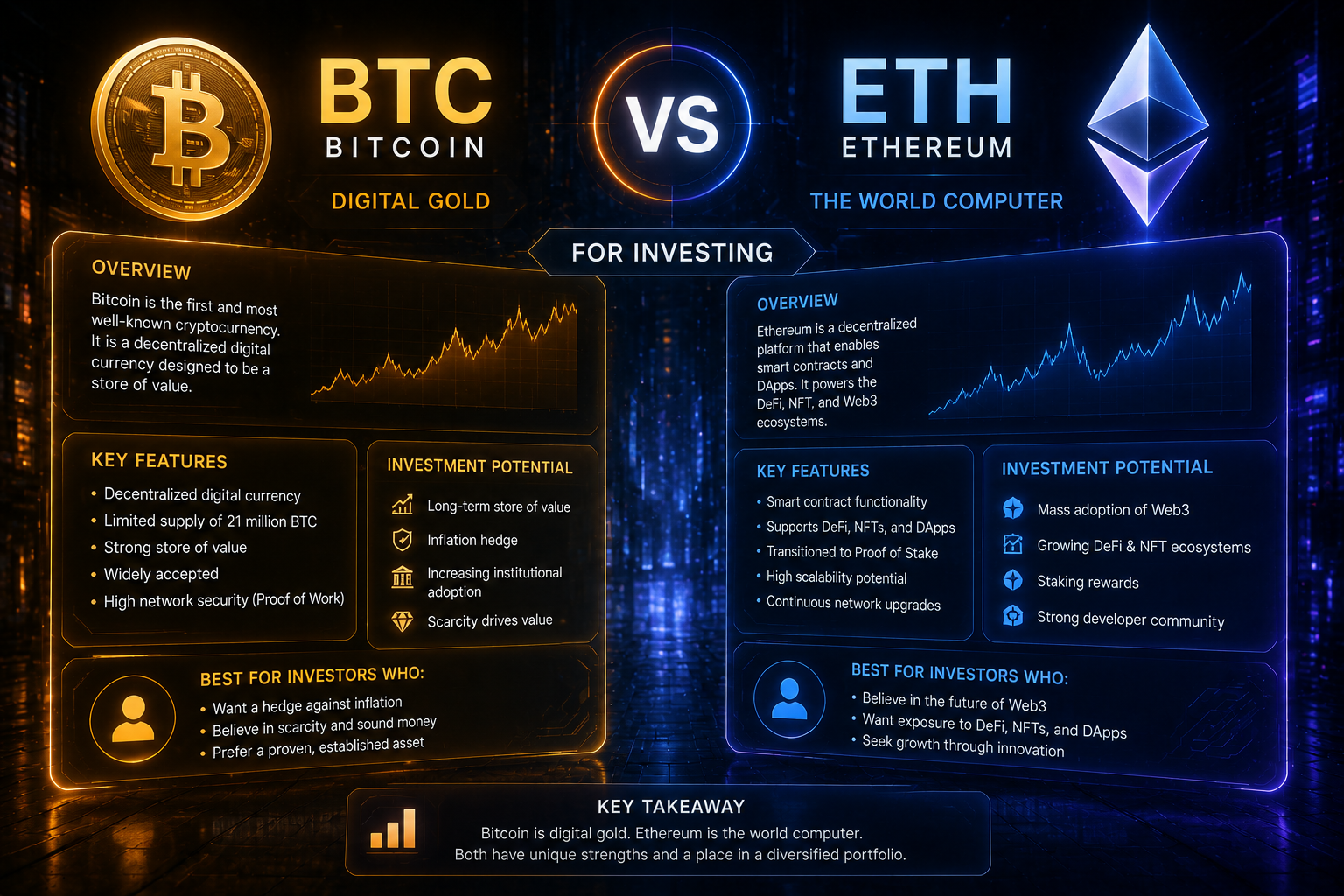
Before diving into technicals and investment theses, it helps to have a clear side-by-side snapshot. Bitcoin launched in 2009 as a peer-to-peer electronic cash system. Ethereum launched in 2015 as a programmable blockchain. Those two origin stories still define how each asset behaves today.
| Feature | Bitcoin (BTC) | Ethereum (ETH) |
|---|---|---|
| Launch Year | 2009 | 2015 |
| Consensus Mechanism | Proof of Work | Proof of Stake |
| Max Supply | 21 million BTC | No hard cap |
| Primary Use Case | Store of value / digital gold | Smart contracts / DeFi / dApps |
| Staking Yield | Not applicable | ~3–4% annually |
| Spot ETF Available | Yes (U.S. approved Jan 2024) | Yes (U.S. approved May 2024) |
| 10-Year Return | ~16,200% | ~18,030% |
What Bitcoin Actually Is and Does
Bitcoin is a decentralized, fixed-supply digital currency secured by a global network of miners. Every transaction is recorded on a public ledger, and no single entity — government, corporation, or developer — can alter the rules of the network. Its 21 million coin cap is arguably its most important feature. Scarcity baked directly into the protocol is what gives Bitcoin its “digital gold” narrative, and that narrative has only grown stronger as sovereign wealth funds and publicly traded companies have started holding BTC on their balance sheets.
Bitcoin doesn’t do smart contracts natively, it doesn’t host decentralized applications, and it doesn’t generate yield. It does one thing exceptionally well: hold value in a way that can’t be inflated away by a central authority.
What Ethereum Actually Is and Does
Ethereum is a programmable blockchain — a global computing platform where developers can deploy self-executing code called smart contracts. Every decentralized exchange, NFT marketplace, lending protocol, and stablecoin issuer that runs on Ethereum is using ETH to pay for computation. That creates constant, organic demand for the asset that isn’t purely speculative. As of 2026, Ethereum hosts the majority of total value locked (TVL) across all DeFi protocols, and its Layer 2 ecosystem — including Arbitrum, Optimism, and Base — processes millions of transactions daily.
The Core Difference: Monetary Premium vs Utility Premium
Bitcoin carries what analysts call a monetary premium — its value comes from people agreeing it is a reliable store of wealth, similar to gold. Ethereum carries a utility premium — its value is tied to how much the network is actually being used. Both are legitimate value drivers, but they respond differently to market conditions. Bitcoin tends to move with macro sentiment and institutional risk appetite. Ethereum tends to move with on-chain activity, developer growth, and DeFi adoption cycles. Understanding this distinction is the foundation of any serious BTC vs ETH portfolio decision.
Bitcoin vs Ethereum: Key Technical Differences
The technical architecture of each blockchain isn’t just an engineering detail — it directly shapes each asset’s security model, fee structure, energy use, and long-term economics. Here’s what actually matters for investors.
Proof of Work vs Proof of Stake
Bitcoin uses Proof of Work (PoW), where miners compete to solve computationally intensive puzzles to add new blocks. This process consumes significant energy but creates an externally verifiable cost to attack the network — making Bitcoin the most battle-tested and censorship-resistant blockchain in existence. Ethereum switched from Proof of Work to Proof of Stake (PoS) in September 2022 via the Merge. Validators now lock up ETH as collateral to propose and attest to blocks, slashing Ethereum’s energy consumption by approximately 99.95%. The trade-off is a different security model — one that’s younger and still proving itself at scale, but significantly more energy-efficient and capable of supporting staking rewards.
Bitcoin’s Fixed 21 Million Supply vs Ethereum’s Burn Mechanism
Bitcoin’s supply schedule is mathematically predetermined. Miners receive a block reward that halves approximately every four years — dropping from 50 BTC at launch to 3.125 BTC per block after the April 2024 halving. This creates predictable, decelerating issuance that eventually reaches zero around 2140. Ethereum takes a different approach. Since EIP-1559 (implemented in August 2021), a portion of every transaction fee is permanently burned, removing ETH from circulation. During periods of high network activity, the burn rate can exceed new issuance, making ETH net deflationary. This dynamic supply mechanism ties ETH’s scarcity directly to network demand — the more the network is used, the more ETH gets burned.
Block Times, Transaction Fees, and Settlement Speed
Bitcoin produces a new block roughly every 10 minutes, with final settlement typically considered secure after 6 confirmations — about an hour. Ethereum produces blocks approximately every 12 seconds, with single-slot finality targeted through ongoing upgrades. On fees, Ethereum’s base layer can get expensive during congestion, with gas fees historically spiking into the hundreds of dollars per transaction during bull market peaks. However, Layer 2 networks like Arbitrum and Base have reduced typical transaction costs to fractions of a cent.
Bitcoin’s Lightning Network addresses its own speed and cost limitations for small payments, though adoption remains more limited compared to Ethereum’s Layer 2 ecosystem. For investors, these differences matter most when evaluating utility — Ethereum’s infrastructure is simply better suited to high-frequency, low-cost transactional use cases at scale.
Bitcoin as an Investment in 2026
Bitcoin’s investment case has never been cleaner or more institutionally validated than it is right now. The asset that was once dismissed as a speculative curiosity is now held by sovereign wealth funds, pension allocators, and Fortune 500 treasuries. The structural drivers behind Bitcoin’s 2026 price action are stacking up in ways that are hard to ignore, especially with the growing interest in Bitcoin ETFs.
Why Institutions Are Buying BTC First
When institutions allocate to crypto, Bitcoin is almost always the first stop. The reasoning is straightforward: Bitcoin has the longest track record, the deepest liquidity, the clearest regulatory classification in most jurisdictions, and the simplest investment narrative. You don’t need to understand smart contracts or DeFi to understand digital scarcity. That simplicity is a feature, not a limitation, when you’re allocating capital on behalf of thousands of clients or a corporate board.
Spot Bitcoin ETFs and What They Mean for Price
The approval of spot Bitcoin ETFs in the United States in January 2024 was a watershed moment. Products from BlackRock (iShares Bitcoin Trust, ticker: IBIT), Fidelity (Wise Origin Bitcoin Fund, ticker: FBTC), and others gave traditional investors direct price exposure to BTC through familiar brokerage accounts. Within months of launch, these products collectively absorbed billions of dollars in inflows — with IBIT becoming one of the fastest ETFs in history to reach $10 billion in assets under management.
The significance for price is structural: ETF inflows represent sustained, price-insensitive buying from investors who are making long-term allocation decisions rather than speculative trades. Every dollar that flows into a spot Bitcoin ETF requires the issuer to purchase actual BTC, removing it from circulating supply. This dynamic, layered on top of post-halving supply reduction, creates a supply-demand imbalance that has historically preceded significant price appreciation.
Bitcoin’s 2024 Halving and Its Impact on Supply
The April 2024 halving cut Bitcoin’s block reward from 6.25 BTC to 3.125 BTC. That means approximately 450 BTC per day are now being issued to miners, down from 900 BTC per day prior to the halving. Historically, each of Bitcoin’s four halving events has been followed by a significant bull market within 12 to 18 months — though past cycles don’t guarantee future results, the supply shock mechanism is mathematically real. Fewer new coins entering the market, combined with record ETF demand, has made the 2024–2026 period one of the most supply-constrained environments Bitcoin has ever experienced.
Ethereum as an Investment in 2026
Ethereum’s investment case is more complex than Bitcoin’s — and that complexity is both its greatest strength and its biggest communication challenge. Where Bitcoin asks you to believe in digital scarcity, Ethereum asks you to believe in the long-term value of programmable money and decentralized infrastructure. In 2026, there’s mounting evidence that both beliefs can coexist in a well-structured portfolio, as discussed in this crypto investment comparison.
How ETH Staking Generates Yield
One of Ethereum’s most compelling advantages over Bitcoin as an investment is that ETH can generate yield simply by being staked. Validators who lock up 32 ETH to participate in consensus earn approximately 3–4% annually in staking rewards, paid in ETH. For investors who don’t want to run their own validator node, liquid staking protocols like Lido (stETH) and Rocket Pool (rETH) allow participation with any amount of ETH while maintaining liquidity. This yield transforms ETH from a passive holding into a productive asset — a distinction that matters enormously for institutional allocators comparing it against other portfolio positions.
Spot Ethereum ETFs and Institutional Demand
Spot Ethereum ETFs received U.S. approval in May 2024, following Bitcoin’s January approval by just a few months. Products from BlackRock (iShares Ethereum Trust, ticker: ETHA) and Fidelity (Fidelity Ethereum Fund, ticker: FETH) launched shortly after, giving traditional investors regulated access to ETH price exposure for the first time. Initial inflows were slower than Bitcoin’s ETF launch — partly because the Ethereum story requires more explanation, and partly because the approved ETFs do not currently include staking yield, making them less attractive than holding ETH directly.
That staking gap is significant. An investor holding ETHA through a brokerage account gets Bitcoin-style price exposure to ETH but misses out on the 3–4% annual yield that direct staking provides. Regulatory clarity around whether ETFs can pass staking rewards to shareholders remains a developing story in 2026, and any positive resolution could meaningfully accelerate institutional inflows into ETH products. For more insights on crypto investment strategies, consider exploring Bitcoin ETF vs holding coins.
Still, the existence of spot ETH ETFs represents a structural upgrade in Ethereum’s accessibility. Advisors who previously couldn’t recommend crypto to clients can now include ETH in model portfolios without custody complications. That opens a distribution channel that simply didn’t exist before 2024.
Key Insight: Spot Bitcoin ETFs pulled in over $35 billion in net inflows within their first year of trading. Ethereum ETFs, while slower to accumulate, represent the same structural shift in institutional accessibility — and analysts widely expect ETH ETF inflows to accelerate once staking yield is incorporated into the product structure.
Pectra, Fusaka, and Ethereum’s Post-Merge Roadmap
Ethereum’s development roadmap is one of the most active in the entire blockchain industry. The Pectra upgrade — scheduled for 2025 and rolling into 2026 — introduces significant improvements to validator UX, increases the maximum effective balance per validator from 32 ETH to 2,048 ETH, and bundles multiple EIPs that improve smart contract functionality. Fusaka, the upgrade that follows Pectra, is expected to introduce PeerDAS (Peer Data Availability Sampling), which dramatically increases the amount of data Layer 2 networks can publish to Ethereum’s base layer — a foundational piece of the long-term scaling strategy.
For investors, these upgrades matter because they signal that Ethereum’s core development team is executing consistently. Each upgrade that ships on schedule reinforces confidence in the network’s long-term competitiveness and makes the “Ethereum gets outcompeted” bear case harder to sustain.
Layer 2 Scaling and What It Means for ETH Value
Ethereum’s Layer 2 ecosystem — including Arbitrum, Optimism, Base, and zkSync — has become the primary venue for on-chain activity. These networks settle transactions cheaply and quickly while posting data back to Ethereum’s base layer for security. The debate among investors is whether L2 growth strengthens or weakens the ETH investment case. The bull argument: more L2 activity means more ETH burned in fees, more ETH staked to secure the base layer, and broader ecosystem growth that attracts more developers and capital. The bear argument: L2s capture transaction fee revenue that would otherwise go to ETH holders. The Fusaka upgrade’s data scaling improvements are specifically designed to tip this balance back toward ETH value accrual.
BTC vs ETH: Which Has More Upside in 2026?
This is the question every serious crypto investor is asking — and there’s no clean universal answer. It depends on your time horizon, your conviction in each asset’s thesis, and what you think the next 12–24 months look like for crypto markets broadly. What we can do is lay out the actual data and frameworks that inform a disciplined answer.
ETH/BTC Ratio: What It Tells Investors Right Now
The ETH/BTC ratio measures how much one ETH is worth in Bitcoin terms. When the ratio rises, ETH is outperforming BTC. When it falls, BTC is outperforming ETH — even if both assets are rising in dollar terms. As of 2026, the ETH/BTC ratio has been in a prolonged downtrend from its 2021 peak near 0.08, sitting in ranges that suggest Ethereum has significantly underperformed Bitcoin over the past two to three years. For contrarian investors, this ratio sitting at multi-year lows could signal a mean-reversion opportunity. For momentum investors, it reinforces the case for staying overweight Bitcoin until Ethereum shows a clear trend reversal. For those looking to diversify, understanding the Bitcoin investment strategy may offer valuable insights.
What Moves the ETH/BTC Ratio
The ETH/BTC ratio typically rises when DeFi activity surges, when Ethereum upgrades drive positive sentiment, or when the broader market enters a risk-on phase and investors rotate from Bitcoin into higher-beta crypto assets. It falls when institutions concentrate flows into Bitcoin, when Ethereum faces competitive pressure from alternative Layer 1 blockchains, or when macro conditions favor simple store-of-value narratives over utility-driven assets. Watching this ratio gives you a real-time read on which asset the market is currently rewarding — and it’s one of the most underutilized signals in retail crypto investing.
Bitcoin DeFi vs Ethereum DeFi
DeFi — decentralized finance — was largely built on Ethereum, but Bitcoin is no longer sitting on the sidelines. Understanding where each asset stands in the DeFi landscape changes how you think about their long-term utility and value capture.
Ethereum’s Dominant DeFi Ecosystem
Ethereum and its Layer 2 networks collectively host the vast majority of DeFi total value locked globally. Protocols like Uniswap, Aave, Maker (now Sky), and Curve run primarily on Ethereum’s ecosystem and collectively manage tens of billions in user assets. The network effects here are formidable — developers build on Ethereum because users are there, and users are there because the applications are best-in-class. Competing Layer 1 blockchains like Solana and Avalanche have carved out niches, but Ethereum’s composability and security track record keep it as the default home for serious DeFi capital.
BTCFi: Bitcoin’s Growing On-Chain Layer
Bitcoin’s DeFi ecosystem — sometimes called BTCFi — has grown meaningfully through protocols built on the Stacks network, the Lightning Network, and Bitcoin-native lending platforms. Wrapped Bitcoin (WBTC) has long allowed BTC holders to participate in Ethereum DeFi, but native Bitcoin DeFi is now a real category. While BTCFi’s TVL is a fraction of Ethereum’s, the direction of travel is clear: Bitcoin holders increasingly want yield and utility without leaving the Bitcoin ecosystem, and developers are building for that demand. For investors, BTCFi growth is a positive catalyst for Bitcoin that wasn’t priced into the original digital gold narrative.
Environmental Impact: Bitcoin Mining vs Ethereum Proof of Stake
Environmental impact has become a genuine consideration for institutional allocators, ESG-mandated funds, and retail investors who care about sustainability. Bitcoin and Ethereum now sit at opposite ends of the energy consumption spectrum — and that gap has real implications for which asset attracts which type of capital.
This isn’t just an ethical debate. Energy consumption affects miner economics, regulatory risk in certain jurisdictions, and the long-term cost basis of securing each network. Understanding the actual numbers — not the headlines — is what matters here.
Bitcoin’s Energy Consumption Debate
Bitcoin’s Proof of Work consensus is energy-intensive by design. The Cambridge Centre for Alternative Finance has tracked Bitcoin’s annualized electricity consumption, which has ranged from roughly 100 to over 150 terawatt-hours depending on the period — comparable to the energy use of mid-sized countries. Critics point to this as environmentally irresponsible. Defenders argue that Bitcoin increasingly runs on stranded renewable energy (particularly hydroelectric and flare gas), that it provides a buyer of last resort for excess grid capacity, and that the energy expenditure is the legitimate cost of the world’s most secure, decentralized financial network.
The mining industry’s renewable energy mix has been rising. Bitcoin Mining Council data has indicated that a significant and growing share of Bitcoin mining uses sustainable energy sources, though precise figures are debated. What’s clear is that the all-renewable Bitcoin miner is no longer a rarity — it’s increasingly the economic optimum.
Ethereum’s Carbon Footprint After The Merge
Ethereum’s transition to Proof of Stake in September 2022 reduced its energy consumption by approximately 99.95%, according to the Ethereum Foundation. The network now uses roughly 0.01 TWh annually — a rounding error compared to Bitcoin’s consumption and even smaller than the energy used by many traditional financial infrastructure systems. This shift has made Ethereum significantly more attractive to ESG-conscious institutional investors and removes one of the most commonly cited objections to crypto allocation in sustainability-focused portfolios.
How to Allocate BTC and ETH in a Crypto Portfolio
There’s no single right answer to how much BTC versus ETH you should hold — but there are rational frameworks based on your risk tolerance, investment horizon, and what you believe about each asset’s future. The three most common portfolio approaches in 2026 look like this:
Conservative Crypto Portfolio
A conservative crypto allocation prioritizes capital preservation and simplicity. In practice, that typically means a heavy tilt toward Bitcoin — somewhere in the range of 70–80% BTC and 20–30% ETH, with little to no exposure to smaller altcoins. Bitcoin’s longer track record, deeper liquidity, clearer regulatory status, and simpler narrative make it the lower-volatility choice within an already-volatile asset class. This allocation makes sense for investors who are newer to crypto, those with shorter time horizons, or those whose primary goal is uncorrelated store-of-value exposure rather than maximizing upside.
Within a conservative framework, Bitcoin also serves as the crypto equivalent of a large-cap anchor position. If you’re allocating 5% of a broader portfolio to crypto, putting 4% in BTC and 1% in ETH gives you meaningful exposure to the asset class without concentrating risk in Ethereum’s more complex and upgrade-dependent value drivers.
Balanced Crypto Portfolio
A balanced crypto portfolio treats both Bitcoin and Ethereum as core holdings, typically splitting somewhere between 50–60% BTC and 40–50% ETH. This approach captures the institutional momentum behind Bitcoin while maintaining meaningful exposure to Ethereum’s utility-driven upside. It’s the allocation that makes the most sense for investors who have a genuine conviction in the long-term future of decentralized finance and programmable money, but don’t want to bet exclusively on one thesis winning out.
Balanced Portfolio Components
- • BTC allocation (50–60%): Anchors the portfolio with store-of-value exposure and institutional-grade liquidity
- • ETH allocation (40–50%): Provides yield through staking, DeFi access, and exposure to the broadest smart contract ecosystem
- • Rebalancing cadence: Quarterly rebalancing helps capture gains from whichever asset outperforms in a given period
- • Staking integration: ETH holdings can be staked via Lido or Rocket Pool to generate 3–4% annual yield on the ETH portion of the portfolio
The balanced approach also gives you a natural hedge within crypto itself. When macro conditions drive institutional flows into Bitcoin, your BTC position carries the portfolio. When DeFi activity surges and the ETH/BTC ratio recovers, your ETH position picks up the slack. Neither asset needs to “win” for this portfolio to perform — it just needs the asset class as a whole to grow.
This is arguably the most intellectually honest allocation for investors who follow both assets closely and see merit in each thesis. It avoids the false binary of “Bitcoin or Ethereum” and instead asks: why not both, weighted by conviction and risk tolerance?
Growth-Focused Crypto Portfolio
A growth-focused portfolio tilts more aggressively toward Ethereum and may include Layer 2 tokens or other assets within the Ethereum ecosystem. A typical structure might be 40% BTC, 40% ETH, and 20% spread across high-conviction altcoins with strong fundamentals — though the altcoin component introduces significantly more volatility and requires active monitoring. The core BTC/ETH split within this framework still provides a stable base, but the overall portfolio is optimized for maximum upside rather than capital preservation.
This allocation is best suited to investors with a multi-year time horizon, a high risk tolerance, and enough portfolio diversification outside of crypto to absorb drawdowns. Crypto bear markets have historically seen 70–80% peak-to-trough declines in ETH and even steeper drops in smaller assets. A growth-focused crypto portfolio should be sized accordingly — large enough to matter if it works, small enough not to be catastrophic if it doesn’t.
Portfolio Framework Summary:
Conservative: 70–80% BTC / 20–30% ETH — prioritizes simplicity, liquidity, and store-of-value exposure
Balanced: 50–60% BTC / 40–50% ETH — captures both institutional momentum and DeFi utility, includes staking yield
Growth-Focused: 40% BTC / 40% ETH / 20% high-conviction altcoins — maximizes upside potential with proportionally higher drawdown risk
Note: These are frameworks, not financial advice. Adjust based on your personal risk tolerance, investment horizon, and overall portfolio context.
Regardless of which framework you use, the most important variable is position sizing relative to your total investable assets. A 100% crypto portfolio at any of these splits is a very different risk proposition than a 5% or 10% crypto allocation within a diversified portfolio of equities, bonds, and real assets. Size the position first, then optimize the internal BTC/ETH split. For those interested in the DeFi utility aspect, consider how it fits into your overall strategy.
Bitcoin or Ethereum: Which One Is Right for You?
The BTC vs ETH decision ultimately comes down to what you’re trying to accomplish. Different investor profiles genuinely call for different answers — and being honest about which category you fall into will do more for your returns than any technical analysis.
Best for Beginners
Bitcoin is the right first crypto for most beginners. The narrative is simple enough to explain in one sentence — fixed supply, decentralized, can’t be inflated. It has the longest track record, the most regulated products (ETFs, futures), and the deepest liquidity of any crypto asset. Starting with Bitcoin gives you time to understand the asset class without needing to track upgrade roadmaps, gas fees, DeFi protocols, or validator economics. Once you’re comfortable with Bitcoin and understand how crypto markets behave, adding Ethereum becomes a natural and well-informed second step.
Best for Long-Term Investors
Long-term investors with a 5+ year horizon have the strongest case for holding both BTC and ETH in meaningful allocations. Over long enough time frames, both assets have dramatically outperformed traditional asset classes — and the two assets’ different value drivers mean they don’t always move in perfect lockstep. Bitcoin’s four-year halving cycle, combined with growing institutional adoption, suggests continued structural demand. Ethereum’s expanding ecosystem, staking yield, and ongoing technical upgrades make it a compelling long-duration technology bet. Holding both, rebalancing periodically, and resisting the urge to trade around short-term volatility has historically been the highest-return strategy for patient investors in this space.
Best for DeFi Users
If you’re actively using decentralized applications — lending, borrowing, providing liquidity, trading on DEXs, or exploring yield strategies — Ethereum and its Layer 2 ecosystem is your home base. The composability of Ethereum-native protocols means your ETH can be staked for yield, used as collateral to borrow stablecoins, and deployed into liquidity pools simultaneously, all without a centralized intermediary. This productive use of ETH as an asset is something Bitcoin simply can’t replicate natively in 2026, though BTCFi is closing the gap incrementally.
For active DeFi participants, holding ETH isn’t just an investment decision — it’s a utility decision. You need ETH to pay gas fees on the Ethereum base layer, to interact with smart contracts, and to participate in governance of major protocols. The investment thesis and the utility thesis are inseparable for this user group, which makes ETH a natural portfolio anchor alongside whatever DeFi positions you’re running.
Best for Builders and Developers
Developer Ecosystem Comparison
- • Ethereum remains the default choice for developers building decentralized applications, with the largest developer community, best-in-class tooling (Hardhat, Foundry, Remix), and the most composable DeFi ecosystem to build on top of
- • Solidity — Ethereum’s smart contract language — is the most widely known blockchain programming language, meaning hiring, documentation, and community support are unmatched
- • Layer 2 networks built on Ethereum (Base, Arbitrum, Optimism) give developers access to low-cost environments while inheriting Ethereum’s security guarantees
- • Bitcoin’s development ecosystem is more constrained by design — Script, Bitcoin’s programming language, is intentionally limited, making it less suitable for complex application development
- • Stacks and other Bitcoin L2 solutions are expanding Bitcoin’s programmability, but the developer tooling and community size remain a fraction of Ethereum’s
For developers who are building products rather than just holding assets, the decision is almost always Ethereum. The ecosystem’s size creates a self-reinforcing advantage — more developers attract more users, which attracts more developers. That flywheel has been spinning since 2017 and shows no signs of stopping. For more insights, consider exploring NFT vs DeFi investment strategies to understand the broader ecosystem.
That said, Bitcoin development is its own specialization with genuine career and financial upside, particularly for those focused on the Lightning Network, Taproot-based applications, or the emerging BTCFi ecosystem. The total addressable market for Bitcoin-native applications is still relatively uncrowded, which means early movers in that space have significant opportunity.
The bottom line for builders: if you want to ship a product to the largest possible audience with the most mature tooling, build on Ethereum. If you want to build at the frontier of a less-developed ecosystem with significant upside if Bitcoin’s programmability narrative gains traction, Bitcoin L2 development is worth serious consideration.
In either case, holding the native asset of the chain you’re building on is both a practical necessity and an aligned incentive. Developers who believe in what they’re building tend to hold the assets that benefit if they’re right.
Bitcoin Wins on Simplicity — But Ethereum Wins on Utility: Here’s the Final Call
If you forced a single answer: Bitcoin is the better first allocation, and Ethereum is the better second one. Bitcoin’s institutional adoption, fixed supply, regulatory clarity, and simpler narrative make it the lower-risk entry point into crypto for most investors. The spot ETF infrastructure, post-halving supply dynamics, and growing sovereign adoption create a compelling structural case for continued demand. For investors who want one asset, one thesis, and one straightforward bet on the long-term monetization of digital scarcity — Bitcoin is that bet.
But Ethereum makes the portfolio better when added alongside Bitcoin. The staking yield, the DeFi ecosystem, the developer activity, and the ongoing technical upgrades give ETH a fundamentally different return profile that complements rather than duplicates Bitcoin’s value drivers. A portfolio that holds both, sized according to your risk tolerance and rebalanced with discipline, has historically captured more of crypto’s upside while maintaining better risk-adjusted characteristics than holding either asset alone. The BTC vs ETH debate doesn’t need a winner — it needs a portfolio weight.
Frequently Asked Questions
These are the questions investors ask most often when comparing Bitcoin and Ethereum — answered directly, without the hype.
Whether you’re allocating for the first time or reassessing an existing position, the answers below reflect the current state of both assets in 2026 and the frameworks that serious investors actually use to make these decisions.
Is Bitcoin or Ethereum a better long-term investment in 2026?
Quick Comparison: BTC vs ETH as Long-Term Investments
Bitcoin: Lower complexity, higher institutional adoption, clearest regulatory status, no yield, fixed supply — best for conservative long-term holders
Ethereum: Higher complexity, growing institutional access, staking yield of ~3–4%, dynamic supply — best for investors comfortable with a more active thesis
Both: Have outperformed virtually every traditional asset class over 5+ year time horizons historically
Bitcoin is better for investors who want the simplest, most institutionally validated long-term crypto exposure. Ethereum is better for investors who want yield, utility, and exposure to the growth of decentralized applications and programmable finance. The cleanest long-term answer for most investors is a meaningful allocation to both.
Time horizon matters enormously here. Over 1–2 year windows, whichever asset has stronger momentum in that specific cycle will likely win. Over 5–10 year windows, both assets have historically delivered returns that dwarf traditional asset classes, and the differences in their internal mechanics become less important than the broader adoption curve of crypto as an asset class.
What we can say with confidence is that both assets have survived multiple 80%+ drawdowns, multiple regulatory crackdowns, multiple “Bitcoin is dead” headlines, and multiple bear markets — and both have gone on to reach new all-time highs. That track record doesn’t guarantee the future, but it does suggest that dismissing either asset on the basis of short-term volatility is a mistake that long-term investors have repeatedly been punished for making.
Why has Ethereum underperformed Bitcoin in recent years?
Several factors have driven Ethereum’s underperformance relative to Bitcoin since the 2021 peak. First, institutional capital has disproportionately flowed into Bitcoin — both because it was approved for spot ETFs first and because its simpler narrative is easier to present to investment committees. Second, the rise of competing Layer 1 blockchains like Solana has fragmented Ethereum’s DeFi dominance narrative and introduced competitive pressure that didn’t exist in the same way in 2021. Third, Ethereum’s Layer 2 scaling strategy — while technically sound — has created a situation where L2s capture transaction fees that might otherwise accrue to ETH holders on the base layer, muddying the ETH value accrual story.
The ETH/BTC ratio declining from its 2021 peak doesn’t mean Ethereum has failed — it means Bitcoin has had a stronger relative bid during a period defined by institutional onboarding. If and when the next DeFi cycle drives meaningful on-chain activity, ETH’s burn mechanism and staking yield make a strong case for outperformance. The ETH/BTC ratio has historically cycled — the current lows have preceded significant Ethereum outperformance in prior cycles, though there’s no guarantee that pattern repeats.
Can you earn passive income with Bitcoin or Ethereum?
Ethereum is the clear winner here. Staking ETH through protocols like Lido (which issues stETH, a liquid staking token) or Rocket Pool (which issues rETH) currently generates approximately 3–4% annually in ETH-denominated yield. Running your own validator node requires 32 ETH but earns slightly higher returns and contributes directly to network security. This yield is paid in ETH, which means your principal grows in ETH terms over time — a form of compounding that Bitcoin simply doesn’t offer natively.
Bitcoin doesn’t generate yield in its base form. You can earn yield on BTC by lending it through centralized platforms or using it as collateral in DeFi protocols — but both approaches introduce counterparty risk that doesn’t exist when holding BTC directly. Several high-profile centralized crypto lenders collapsed in 2022 (Celsius, BlockFi, Genesis), wiping out billions in user funds. If yield generation matters to your investment strategy, Ethereum’s native staking is structurally superior to any Bitcoin yield product currently available — because the yield comes from the protocol itself, not from a third-party risk assumption.
What is the ETH/BTC ratio and why does it matter?
The ETH/BTC ratio is simply the price of one ETH expressed in Bitcoin terms. A ratio of 0.05, for example, means one ETH costs 0.05 BTC. When this ratio rises, ETH is outperforming Bitcoin — even if both are falling or rising in dollar terms. When it falls, Bitcoin is outperforming ETH. This ratio matters because it strips out the noise of dollar price movements and gives you a pure read on which asset the market is currently favoring. Portfolio managers who track the ETH/BTC ratio can time internal rebalancing between the two assets more precisely — rotating into ETH when the ratio signals deep undervaluation relative to historical ranges, and rotating toward BTC when Ethereum’s relative premium appears stretched. For a deeper understanding of Ethereum’s position in the market, explore this Ethereum vs Solana blockchain comparison.
Should a beginner buy Bitcoin or Ethereum first?
Bitcoin first — almost without exception. The learning curve for understanding Bitcoin is dramatically lower than for Ethereum, and that matters when you’re making your first crypto investment. Bitcoin’s value proposition is intuitive: there will only ever be 21 million of them, no one controls the network, and it has a 15-year track record of being the hardest asset in the world to counterfeit or inflate. You don’t need to understand gas fees, Layer 2 networks, staking validators, or smart contract audits to have a well-reasoned conviction in Bitcoin.
Ethereum is an excellent second investment once you’ve spent time understanding how crypto markets work, what on-chain activity looks like, and why programmable blockchains create value. Rushing into ETH without that foundation often leads to selling during upgrades that temporarily increase volatility, or misunderstanding why ETH’s price doesn’t always move in proportion to obvious network growth metrics.
Start with Bitcoin, hold it long enough to experience a full market cycle, and let that experience build the framework you need to invest in Ethereum with genuine conviction rather than speculation. The best crypto portfolios are built on understanding, not urgency.
DO YOUR OWN RESEARCH (DYOR)
All investment information, opinions, and analysis provided on Coinposters are for general informational and educational purposes only. Cryptocurrency markets are highly volatile and speculative. Any investment decision you make is entirely your own responsibility. Always conduct thorough independent research and consult with licensed financial advisors before making any investment decisions. Past performance does not guarantee future results.




Latest
Bitcoin
08 Jul 2026
Bitcoin
04 Jul 2026