Coinposters
How to Use Crypto News Calendars: Track ETF Updates, Listings & Market Events
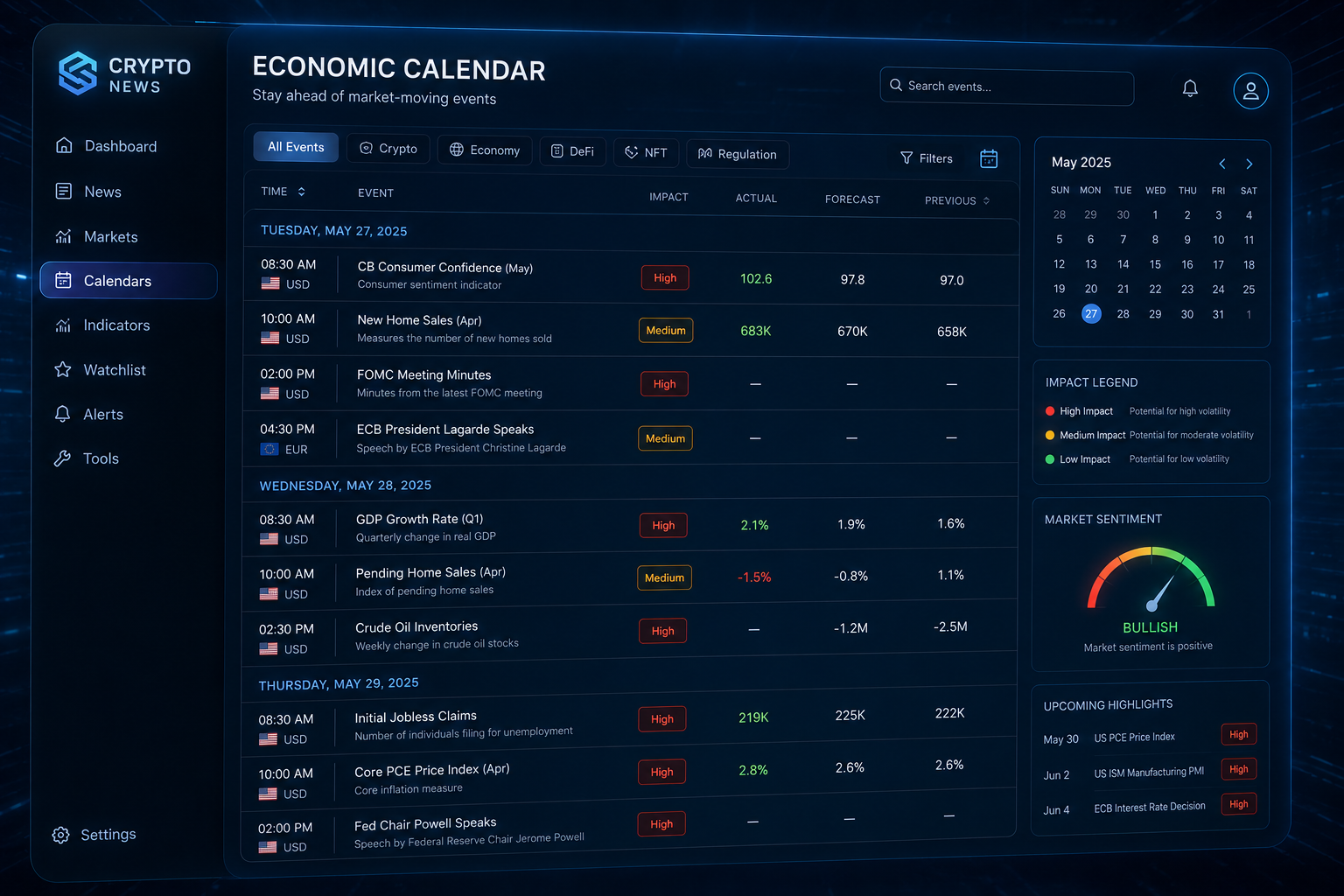
If you’re serious about crypto trading, a crypto news calendar is your competitive advantage—the difference between positioning ahead of market-moving events and perpetually reacting after the price has already moved. A crypto news calendar tracks ETF approvals, exchange listings, protocol upgrades, and token unlocks before they hit the market. This guide shows you how to use a crypto news calendar effectively, which crypto news calendar platforms actually work, and the exact daily routine that transforms a crypto news calendar from a passive tool into active trading edge.
Key Takeaways
- •A crypto news calendar is the single best tool for tracking market-moving events like ETF decisions, exchange listings, protocol upgrades, and token unlocks — giving traders a structured edge over those relying only on random news feeds.
- •Using a crypto news calendar like CoinMarketCal has logged over 12,000 verified events across 2,700+ coins since 2017, making it the most comprehensive crypto news calendar tracking resource available today.
- •Not every event on a crypto news calendar is created equal — confidence scores and community verification on your crypto news calendar are the difference between acting on solid intel and falling for manufactured hype.
- •Building a daily tracking routine using a crypto news calendar around your core holdings is the fastest way to turn calendar alerts from passive notifications into active trading advantage.
- •There’s a right and wrong way to react to ETF decisions and exchange listings tracked on a crypto news calendar — and most traders who ignore their crypto news calendar get it backwards.
Article at a Glance: If you’re trading crypto without a crypto news calendar, you’re flying blind. This article breaks down exactly what a crypto news calendar does, how to use a crypto news calendar to track ETF approvals and exchange listings before they move prices, which crypto news calendar platforms are worth your time, and the daily tracking routine that turns a crypto news calendar into actual trading edge.
Table of Contents
- What Is a Crypto News Calendar?
- How to Track ETF Updates With a Crypto Calendar
- How to Monitor Exchange Listings and Delistings
- The Best Crypto News Calendars to Use Right Now
- How to Build a Crypto Event Tracking Routine
- Common Mistakes Traders Make With Crypto Calendars
- Crypto Calendars Are Only as Good as How You Use Them
- Frequently Asked Questions
If you’re trading crypto without a news calendar, you’re flying blind in a market that moves on information.
The crypto market doesn’t wait for you to catch up. A single ETF approval, a surprise exchange listing, or a major protocol upgrade can swing a coin’s price by double digits within hours. General news feeds bury these events in noise. A crypto news calendar surfaces them directly, so you know what’s coming before the market reacts.
What Is a Crypto News Calendar and How Does It Work?
A crypto news calendar is a centralized, structured database of upcoming events that are likely to affect cryptocurrency prices. A crypto news calendar functions as your forward-looking information advantage. Think of a crypto news calendar as a financial economic calendar — similar to what forex traders use for interest rate decisions — but built specifically for the blockchain ecosystem. It pulls together confirmed and community-submitted events across hundreds of coins and projects, organized by date and category.
How Crypto Calendars Differ From General News Feeds
Standard crypto news sites like CoinDesk or CryptoSlate report on events after they happen or as they break. A crypto news calendar is forward-looking. Unlike a general news feed, a crypto news calendar tells you in advance that a specific coin has a mainnet upgrade scheduled for Thursday, or that a token unlock is hitting the market next Monday. That’s the critical time advantage a crypto news calendar provides. Instead of reacting after the move, you can position yourself ahead of it. For those interested in real-time updates, exploring crypto news aggregators alongside your crypto news calendar can be beneficial.
Types of Events You Can Track
The range of trackable events is broader than most traders realize. Here’s what a well-maintained crypto news calendar covers:
- •ETF filing deadlines and approval decisions — SEC response dates for Bitcoin and Ethereum ETF applications
- •Exchange listings and delistings — when a coin gets added to or removed from Binance, Coinbase, Kraken, and others
- •Protocol upgrades and hard forks — network-level changes that affect tokenomics or functionality
- •Token unlocks and vesting releases — large tranches of supply hitting the market from early investors or team allocations
- •Partnerships and product launches — officially announced integrations or new platform features
- •Regulatory decisions — government rulings, congressional hearings, and central bank digital currency updates
- •Community governance votes — DAO proposals that can change protocol rules or treasury spending
How to Track ETF Updates With a Crypto Calendar
ETF decisions are among the highest-impact events in the crypto calendar ecosystem. When the SEC approved spot Bitcoin ETFs in January 2024, Bitcoin’s price movement in the days surrounding that decision demonstrated exactly why tracking these dates matters. The approved spot Bitcoin ETFs — including the iShares Bitcoin Trust (IBIT) by BlackRock and the Fidelity Wise Origin Bitcoin Fund (FBTC) — saw billions in inflows within the first week, fundamentally changing institutional access to the asset class.
The key with ETF tracking using a crypto news calendar isn’t just knowing the approval date. It’s understanding the full timeline that your crypto news calendar tracks: the initial filing date, the SEC’s response window, any delay notices, and the final decision deadline. Each of those milestones shows up as a separate trackable event on a well-maintained crypto calendar, and each one can trigger price movement.
ETF Decision Timeline — What to Track:
Filing Date → Initial SEC submission; often triggers early speculative buying
First Response Window → SEC has 45 days to approve, deny, or extend
Extension Notices → SEC can extend review up to 240 days total; each notice moves markets
Final Deadline → The hard deadline where a decision must be made
Post-Decision → Watch for “buy the rumor, sell the news” price reversals
Why ETF Decisions Move Markets Fast
ETFs open crypto exposure to institutional investors, pension funds, and retail investors through traditional brokerage accounts — without those buyers needing to hold actual crypto. That dramatically expands the potential buyer pool. When an approval is expected, speculative demand builds in advance. When it’s denied, that demand collapses just as quickly. The speed of the reaction is what catches unprepared traders off guard.
What makes this even more critical to track is that the SEC doesn’t always announce decisions on a predictable schedule. They can respond early, issue last-minute extensions, or release decisions outside of market hours. Having the key dates logged in a crypto calendar with alerts set means you’re not dependent on stumbling across a news headline after the move has already happened.
How to Set Alerts for ETF Approval Dates
On CoinMarketCal, you can filter events by category and set coin-specific notifications. For ETF tracking, search for Bitcoin or Ethereum under the regulatory or partnership event categories and bookmark the relevant entries. Pair this with a Google Calendar export (CoinMarketCal supports .ics file exports) so the dates live inside your existing workflow. Set a reminder 48 hours before any major SEC deadline — that’s typically when pre-decision price action starts accelerating.
What to Do Before and After an ETF Decision
Before a decision, the market tends to price in optimism if sentiment is positive — meaning the actual approval can trigger a “sell the news” dump even when the outcome is bullish. After a denial, watch for an oversold bounce once the initial panic selling exhausts itself. Neither reaction is guaranteed, but understanding the pattern lets you make a more deliberate choice rather than an emotional one.
How to Monitor Exchange Listings and Delistings
Exchange listings are one of the most consistently price-moving events in crypto. When a token gets listed on a major exchange like Coinbase or Binance, it instantly gains access to millions of new potential buyers who couldn’t or wouldn’t purchase it on smaller decentralized platforms. The result is almost always a sharp price spike — sometimes 20% to 50% within the first few hours of trading going live.
Delistings work in reverse and are often more damaging than a listing is beneficial. When Binance announces it’s removing a token — particularly one with thin liquidity — holders rush to exit before trading becomes impractical. Tracking delisting notices gives you the window to exit a position before the panic selling compresses the price.
The tricky part is timing. Exchanges rarely announce listings far in advance. Binance, for example, typically announces new listings only 24 to 48 hours before trading opens. This short window is exactly why having real-time alerts through a crypto calendar is more effective than checking exchange announcement pages manually.
Why Listings Cause Price Spikes
It comes down to liquidity and access. Before a major listing, a token might only be tradable on two or three smaller DEXs or regional exchanges. The total addressable buyer pool is small. A Coinbase or Binance listing changes that overnight — suddenly the token is accessible to tens of millions of users with a familiar interface, fiat on-ramps, and built-in trust from the exchange’s brand. That demand surge, hitting limited supply, drives the price up fast.
There’s also an indexing effect. Many traders specifically watch for listings as a trading strategy — buying in advance of an anticipated listing and selling into the spike. This means that well-tracked listings often start moving before the official announcement, as experienced traders position themselves early.
How to Spot Listing Events Before They Happen
Getting ahead of a listing announcement requires combining multiple data sources. A crypto calendar gives you the confirmed events, but the early signals come from tracking exchange announcement channels and community chatter before anything is official.
- •Follow official exchange Telegram and Twitter channels — Binance, Coinbase, and Kraken all post listing announcements here first
- •Watch for unusual volume spikes on small DEXs — abnormal trading activity on Uniswap or PancakeSwap often precedes a major exchange listing
- •Monitor CoinMarketCal’s “unconfirmed” event section — community-submitted listing rumors often appear here days before official confirmation
- •Track project social media activity — sudden increases in a project’s Twitter engagement or Discord activity can signal an imminent announcement
- •Check exchange listing criteria pages — projects that recently met Coinbase’s listing standards or passed Binance’s due diligence review are strong candidates
Cross-referencing these signals with your crypto calendar creates a layered early warning system. No single source is reliable enough on its own, but when two or three data points align — a community-submitted calendar event, unusual DEX volume, and a spike in project social activity — the probability of an imminent listing rises significantly.
One important caveat: never size a position purely on a listing rumor. Unconfirmed calendar events carry real risk. If the listing doesn’t materialize, or gets delayed, the speculative premium built into the price can unwind quickly. Use position sizing that reflects the uncertainty of unconfirmed events versus the relative confidence of officially announced ones.
The Best Crypto News Calendars to Use Right Now
Not all crypto news calendars are built the same. The difference between a useful crypto news calendar and a noisy one comes down to event verification quality, update frequency, and how well the interface lets you filter what’s actually relevant to your portfolio. These three crypto news calendar platforms consistently stand out above the rest.
CoinMarketCal: Community-Verified Events for 2,700+ Coins
CoinMarketCal is the most comprehensive crypto event calendar available, tracking over 12,000 events across more than 2,700 coins since its launch in 2017. What separates it from competitors is its community verification system — every submitted event gets voted on by registered users, generating a confidence score that tells you at a glance how credible the event is. Events are filterable by coin, category, date range, and confidence threshold, so you can strip out low-quality submissions and focus on what’s actually confirmed. The platform also supports .ics calendar exports, letting you push verified events directly into Google Calendar or Outlook for seamless integration with your existing workflow.
CoinGecko Events: Clean Interface With Price Data Built In
CoinGecko’s events section integrates directly with its price tracking infrastructure, which is its biggest advantage. When you’re viewing an upcoming event for a specific token, you can see the historical price chart alongside it — making it straightforward to analyze how previous events for that same coin actually moved the market. This context is something CoinMarketCal doesn’t offer natively.
The trade-off is depth. CoinGecko’s events database is smaller than CoinMarketCal’s, and the community submission process is less robust. It works best as a secondary source to cross-reference events you’ve already found elsewhere, or as a quick way to check price history around past events before making a trading decision on an upcoming one.
Kryptocal: Real-Time Alerts on Mobile
Kryptocal focuses on mobile-first delivery, making it the strongest option for traders who need push notifications rather than a desktop dashboard. Its Telegram bot integration is particularly useful — you can configure it to send alerts for specific coins directly into a Telegram channel or personal chat, filtering by event type so you’re only notified about the categories that matter to your strategy. The event database is smaller than CoinMarketCal’s, but the alert infrastructure is faster and more customizable for on-the-go tracking.
How to Build a Crypto Event Tracking Routine With Your Crypto News Calendar
Having access to a crypto news calendar is only half the equation. The traders who actually benefit from using a crypto news calendar are the ones who build a consistent routine around their crypto news calendar — not the ones who check in sporadically when they remember to.
The goal is to make your crypto news calendar checking a non-negotiable part of your daily workflow, the same way a stock trader checks pre-market futures every morning. Fifteen minutes per day, structured correctly using your crypto news calendar, is enough to stay ahead of the vast majority of market-moving events across your core holdings.
The routine below is designed for active traders managing positions in five to fifteen coins. Adjust the depth and frequency based on how many assets you’re tracking and your typical holding timeframe. For additional insights, consider subscribing to crypto newsletters that cater to serious investors.
Sample Daily Crypto Calendar Routine
Morning (5 min) — Check CoinMarketCal for any events firing today or within the next 48 hours across your holdings. Note confidence scores.
Mid-Session (5 min) — Scan exchange announcement channels (Binance, Coinbase) for any same-day listing or delisting notices not yet on the calendar.
Evening (5 min) — Review the upcoming 7-day event window. Flag any high-confidence events for position review. Export new events to Google Calendar if needed.
1. Set Up Alerts for Your Core Holdings First
Start narrow. Before you try to track every event across the entire market, get comprehensive coverage on the coins you actually hold. On CoinMarketCal, use the portfolio watchlist feature to pin your core assets — the platform will then surface all upcoming events for those coins automatically at the top of your feed.
For each core holding, set a minimum confidence threshold. A setting of 70% or above filters out speculative community submissions and keeps your alerts focused on events with strong verification. Below that threshold, you’re getting a lot of noise that isn’t worth acting on until it gets further confirmed.
Once your core holdings are covered, you can expand outward — tracking events for coins you’re watching but don’t yet hold, or monitoring broad category events like regulatory decisions that affect the whole market regardless of specific holdings.
2. Check Your Calendar at the Same Time Daily
Consistency beats intensity here. Checking your crypto calendar at a fixed time every day — ideally before major trading sessions open — means you’re never caught off guard by an event you technically knew about but forgot to review. The Asian trading session opens at midnight UTC, the European session at 7:00 AM UTC, and the US session at 1:30 PM UTC. Scheduling your calendar check before the US session open covers the highest-liquidity window for most crypto markets.
Pair your calendar check with a quick scan of your price alerts. If a coin you’re holding has moved more than 5% overnight and there’s a calendar event attached to it, you now have an immediate context for why — and can make a faster, more informed decision about whether to adjust your position.
3. Cross-Reference Events With Price Charts
Every time you identify an upcoming high-confidence event, pull up the coin’s historical price chart and look at how previous similar events affected the price. If a project runs a quarterly token burn and the price has rallied an average of 8% in the week before each previous burn, that historical pattern is meaningful context for your positioning. CoinGecko’s integrated event-price view makes this faster, but you can do it manually on TradingView by marking the event dates directly on the chart.
The pattern won’t repeat every time — markets evolve and the same event type can have diminishing returns as it becomes more anticipated and priced in. But understanding the historical reaction gives you a baseline expectation, which is always better than having no reference point at all.
4. Filter Out Noise by Using Confidence Scores
CoinMarketCal’s confidence scoring system is one of its most underused features. Every event on the platform receives a percentage score based on community votes — users verify whether a submitted event is legitimate and well-sourced. A score above 80% indicates strong community consensus that the event is real and accurately described. Scores below 50% should be treated as unverified rumors until further confirmed through official project channels.
Making confidence score filtering a hard rule in your routine — not just a suggestion — dramatically reduces the amount of bad information you act on. The crypto space has no shortage of manufactured hype events, fake partnership announcements, and inflated listing rumors. The confidence score is your first line of defense against trading on noise instead of signal.
Common Mistakes Traders Make With Crypto News Calendars
Crypto news calendars are powerful tools, but they’re just as capable of generating bad trades as good ones when used without discipline. The most common failure mode isn’t ignoring your crypto news calendar — it’s misreading what the events on your crypto news calendar actually mean and reacting to them in predictable, exploitable ways.
The traders who consistently lose money around calendar events tend to share a few specific behavioral patterns. They treat every event as actionable, they ignore the quality indicators built into the platforms, and they fail to account for how much of the event’s impact is already priced in before it fires. Understanding these mistakes is the fastest way to stop making them.
Event Reaction Framework — How to Assess Before Acting
Step 1: Check the confidence score — Is the event above 70% verified? If not, treat it as a rumor.
Step 2: Assess market awareness — Has this event been widely discussed? High awareness = more likely already priced in.
Step 3: Review historical reaction — How did the coin respond to the same event type in previous cycles?
Step 4: Check current price action — Has the coin already moved significantly ahead of the event? If yes, the risk/reward of entering is compressed.
Step 5: Define your exit — Know exactly at what price you’re wrong before you enter, regardless of how strong the event looks.
Treating Every Event as a Buy Signal
The “buy the rumor, sell the news” dynamic is one of the oldest patterns in financial markets, and it plays out in crypto with amplified intensity. When a high-profile event — an exchange listing, a protocol upgrade, or an ETF decision — has been widely anticipated for weeks, the market often prices in the expected outcome well before the event fires. By the time the announcement is official, the buyers who drove the price up are already selling into the news. New buyers entering at the event date end up holding the bag.
This doesn’t mean events are useless as trading signals. It means the timing of your entry matters as much as the event itself. The traders who profit most from calendar events typically enter during the early anticipation phase — when the event is confirmed but not yet widely discussed — and exit before or at the event itself rather than after.
A practical filter: if a coin has already rallied more than 15% in the two weeks leading up to a calendar event, the risk of a post-event dump is substantially elevated. That doesn’t make entering wrong in every case, but it does mean the trade requires a tighter stop and a faster exit plan than an event where the price hasn’t pre-moved.
Ignoring Event Credibility Ratings
Skipping the confidence score check before acting on a calendar event is one of the most avoidable mistakes in crypto trading. CoinMarketCal’s community verification system exists precisely because the crypto space is full of unverified announcements, wishful project roadmap claims, and outright manufactured rumors. A listing event submitted by a single unverified user with a 30% confidence score is not equivalent to a confirmed Coinbase listing with an 95% score — but both show up in the same calendar feed if you’re not filtering. Always check the score before you trade on anything. Events below 60% confidence should require independent verification through the project’s official channels before you give them any weight in your decision-making.
Crypto News Calendars Are Only as Good as How You Use Them
A crypto news calendar doesn’t generate alpha on its own — it gives you the raw material to make better-informed, better-timed decisions. The edge from using a crypto news calendar comes from combining verified event data with price chart context, confidence score filtering, and a disciplined daily routine with your crypto news calendar that keeps you consistently ahead of the market rather than perpetually reacting to it. Build the habit of checking your crypto news calendar daily, apply the framework, and your crypto news calendar becomes one of the most reliable tools in your trading stack.
Frequently Asked Questions
What is the most reliable crypto event calendar available today?
CoinMarketCal is widely regarded as the most comprehensive and reliable crypto event calendar currently available. It tracks over 12,000 verified events across 2,700+ coins since 2017 and uses a community confidence scoring system to help users assess event credibility before acting on the information.
Can crypto news calendars predict price movements?
Crypto calendars don’t predict price movements — they surface confirmed and community-verified events that have historically correlated with price action. The calendar tells you what is happening and when. How the market reacts depends on sentiment, how much of the event is already priced in, and broader market conditions. Think of a crypto calendar as context, not a crystal ball.
How do I get alerts for specific coins on CoinMarketCal?
On CoinMarketCal, create a free account and add coins to your watchlist portfolio. The platform will automatically prioritize events for those coins in your feed. You can also configure email notifications for new events tied to your watchlist coins, and export upcoming events as .ics files to integrate directly with Google Calendar or Outlook. For mobile alerts, Kryptocal’s Telegram bot integration offers faster push notification delivery for coin-specific events.
Are crypto calendar events verified or user-submitted?
Most crypto calendar events — including those on CoinMarketCal — are initially user-submitted, meaning anyone with an account can propose an event. What differentiates quality platforms from low-quality ones is the verification layer applied after submission. For those interested in staying updated with crypto events, crypto news aggregators can provide real-time alerts and updates.
On CoinMarketCal, submitted events are voted on by the community, generating a confidence percentage that reflects how many verified users have corroborated the event against official sources. Events that reference official project announcements, exchange press releases, or blockchain-verifiable dates score highest. Events based purely on project roadmap speculation or unverified social media claims score low. Always use the confidence score as your primary filter before treating any submitted event as confirmed.
How far in advance are crypto events typically listed on these calendars?
It varies significantly by event type. Protocol upgrades, hard forks, and token unlocks are often listed weeks or even months in advance because they’re tied to pre-announced blockchain parameters or smart contract-enforced vesting schedules. These give traders the longest lead time to analyze and position.
Exchange listings sit at the opposite end of the spectrum. Binance and Coinbase typically announce new listings only 24 to 72 hours before trading opens, and sometimes less. Because of this short window, relying solely on calendar alerts for listing trades means you’re often working with a very tight timeline. Monitoring exchange official channels directly remains essential for this event category.
Regulatory events like SEC ETF decisions fall somewhere in between — the decision deadlines are publicly known months in advance and trackable on the calendar, but the actual content of the decision is unknown until released. This gives you the date certainty of a protocol upgrade combined with the binary outcome uncertainty of a listing announcement.
Typical Event Lead Times at a Glance
| Event Type | Lead Time |
|---|---|
| Token unlocks / vesting releases | 30 to 180+ days advance notice (smart contract verifiable) |
| Protocol upgrades / hard forks | 14 to 90 days advance notice (announced via project governance) |
| SEC ETF decision deadlines | 45 to 240 days advance notice (public SEC filing record) |
| Major conferences / summits | 30 to 120 days advance notice (event organizer announcements) |
| Exchange listings (Binance/Coinbase) | 24 to 72 hours advance notice (exchange announcement channels) |
| Emergency delistings | 0 to 24 hours notice (often immediate or same-day) |
Understanding these lead time differences is critical for setting realistic expectations around each event type. A token unlock you’ve had 60 days to analyze and prepare for is a fundamentally different trading scenario than a same-day listing announcement that requires an immediate decision under time pressure. For more insights on ETF decisions, you might find it useful to explore the Bitcoin ETF vs. holding Bitcoin strategies.
For events with longer lead times, use the window to do deep research — review historical price reactions, assess the project’s fundamentals, and decide in advance whether and how you want to be positioned. For short-notice events like exchange listings, have a predefined playbook ready: maximum position size, entry trigger, and exit target, so you’re not making those decisions in real time when emotions run high.
The best use of a crypto calendar isn’t just knowing what events are coming — it’s using the lead time each event provides to make thoughtful decisions before the market pressure kicks in. That’s the difference between a trader who profits consistently from calendar events and one who perpetually reacts too late or too emotionally to turn the information into real edge.
DISCLAIMER: This article is for informational purposes only and does not constitute financial, investment, legal, or trading advice. The information about crypto news calendars and event tracking reflects general market structures and may not apply equally to all traders based on their specific risk tolerance, experience levels, or trading objectives. Always conduct your own research (DYOR), verify information from multiple sources, understand that your optimal calendar strategy may differ from the recommendations provided, and never make investment decisions based solely on calendar event tracking. Past price reactions to similar events do not guarantee future results. The crypto calendar platforms and exchanges mentioned are referenced for example purposes and do not represent endorsements or guarantees of performance or reliability.