allocated gold reserves
Best stablecoins backed by gold
blockchain gold
commodity-backed tokens
crypto gold investment
DigixGlobal DGX
gold stablecoin comparison
gold tokens blockchain
gold-backed crypto assets
gold-backed stablecoins
inflation hedge
Kinesis Gold KAU
LBMA gold
Meld Gold
Paxos Gold PAXG
physical gold tokens
safe stablecoin options
store value crypto
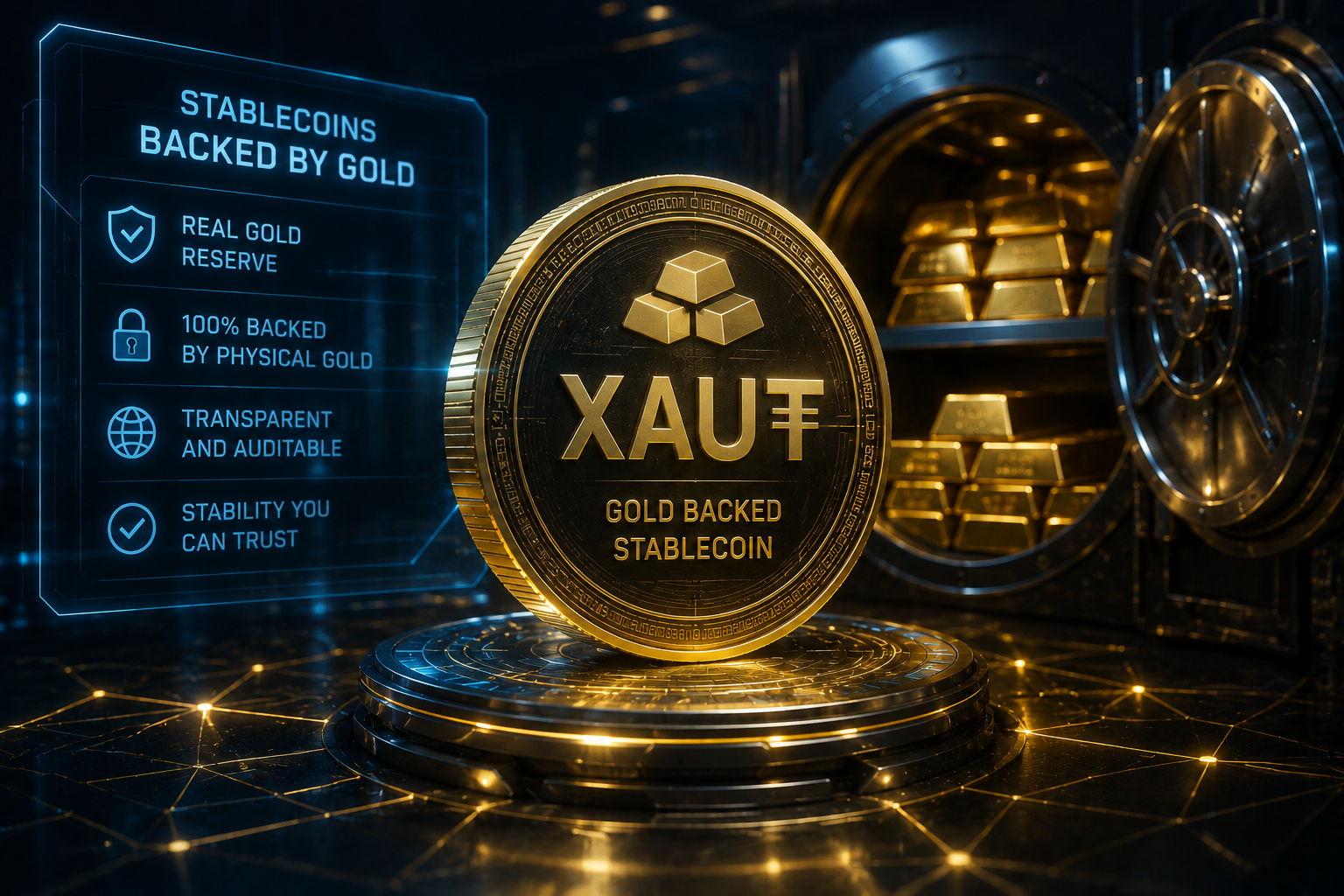
Tether Gold XAUt
tokenized gold

Coinposters
Best Stablecoins Backed by Gold 2026: Safest Options to Hedge Risk & Store Value
Best Stablecoins Backed by Gold 2026: Safest Options to Hedge Risk & Store Value
Gold soared in 2026 from highs of $5,400 to $4,200 where it sits at the time of writing this article, and the best stablecoins backed by gold now let you own a fraction of that bar without ever touching a vault – combining the inflation-hedge power of bullion with the speed and programmability of crypto. For investors hedging against dollar debasement, inflation, or geopolitical instability, gold-backed stablecoins offer a compelling proposition that neither Bitcoin nor dollar stablecoins can match.
Article at a Glance
- Gold-backed stablecoins let you own tokenized physical gold on the blockchain — combining the inflation-hedge power of bullion with the speed and programmability of crypto.
- Not all gold-backed tokens are equal — Tether Gold (XAUt) leads in liquidity, Paxos Gold (PAXG) leads in regulation, and Kinesis Gold (KAU) is the only one that pays you a yield just for holding.
- Unlike USDT or USDC, these tokens are not pegged to $1 — their value moves with the gold spot price, which crossed $5,400 per troy ounce in 2026.
- The biggest risk most buyers overlook isn’t price volatility — it’s custodian fraud and reserve misrepresentation, and there’s a specific checklist you should run before every large purchase.
- Finding the best stablecoins backed by gold requires understanding both the technology and the custodial infrastructure behind each token — a process covered comprehensively in this guide.
Table of Contents
- Gold at $4,200+ and These Tokens Let You Own It on the Blockchain
- How Gold-Backed Stablecoins Actually Work
- 1. Tether Gold (XAUt): The Most Liquid Gold-Backed Token
- 2. Paxos Gold (PAXG): The Most Regulated Option
- 3. Kinesis Gold (KAU): Earn Yield on Your Gold Holdings
- 4. DigixGlobal (DGX): The Pioneer That Paved the Way
- 5. Meld Gold: Built for Institutional and Large-Scale Buyers
- Gold-Backed Stablecoins vs. Gold ETFs vs. Physical Gold
- Biggest Risks You Need to Know Before Buying
- How to Buy Gold-Backed Stablecoins Safely in 2026
- The Best Gold-Backed Stablecoin Depends on What You Need
- Frequently Asked Questions
Gold at $4,200+ and These Tokens Let You Own It on the Blockchain
For most of financial history, owning gold meant storing a physical object — with all the friction that implies. Vaults, insurance, assay costs, and illiquidity. Gold ETFs solved some of that, but they live inside the traditional financial system, which comes with its own counterparty risks. Best stablecoins backed by gold are a third path: fractional, programmable, transferable in minutes, and — in the best cases — redeemable for actual bullion.
What Makes a Stablecoin “Gold-Backed”
A gold-backed stablecoin is a digital token where each unit represents a specific, fixed quantity of physical gold held in reserve by a custodian. The most common standard is one token = one troy ounce of gold, though some tokens represent smaller fractions. The issuer is responsible for purchasing, storing, and auditing that gold — and in theory, the token’s market price should track the gold spot price directly.
How Gold-Backed Tokens Differ From Bitcoin and Dollar Stablecoins
Bitcoin has no underlying asset — its value is driven entirely by supply, demand, and speculation. Dollar stablecoins like USDT or USDC are pegged to $1 and backed by cash, treasuries, or commercial paper. Gold-backed tokens occupy a completely different category: their value floats with the gold market, not a fiat currency or a speculative consensus.
How Best Stablecoins Backed by Gold Compare
Bitcoin: No underlying asset — value driven by supply, demand, and speculation
Dollar Stablecoins: Pegged to $1, backed by cash or treasuries
Gold-Backed Tokens: Float with gold market, preserve value against currency debasement
Gold-backed tokens move with bullion prices — up in dollar terms when gold rallies, down when it corrects
This distinction matters enormously for risk management. When the U.S. dollar weakens — as it did sharply in 2024 and 2025 — dollar stablecoins lose purchasing power in real terms. Gold, historically, moves in the opposite direction. A gold-backed token held during a dollar drawdown doesn’t just preserve value — it can actively appreciate in fiat terms.
That said, gold-backed tokens are not stable in the traditional stablecoin sense. If you’re expecting a $1 peg, you’ll be surprised. These tokens move with bullion prices — up in dollar terms when gold rallies, down when it corrects. The “stable” part refers to the underlying asset’s backing, not its dollar price.
Why 2026 Is a Turning Point for Tokenized Gold
Three forces converged in 2025-2026 to accelerate adoption: record gold prices driven by central bank buying and dollar weakness, the maturation of on-chain audit infrastructure, and growing institutional interest in programmable commodities. CoinGeek and Yahoo Finance both flagged tokenized gold as a category to watch — describing it as a “stable, transparent alternative” to both volatile crypto and dollar-backed stablecoins.
Regulatory clarity is also improving. Several jurisdictions have moved to classify gold-backed tokens as commodity-linked instruments rather than securities, reducing legal uncertainty for issuers and buyers alike. This is pulling serious institutional capital into the space for the first time.
How Gold-Backed Stablecoins Actually Work
The mechanics are straightforward in principle, but the execution varies significantly between issuers. When you buy a gold-backed token, you’re buying a claim — a digital representation of gold sitting in a vault somewhere. The quality of that claim depends entirely on the issuer’s transparency, the custodian’s credibility, and the redemption terms written into the token’s legal structure.
Every reputable gold-backed token follows the same basic model: for every token issued, an equivalent quantity of gold is allocated, stored, and held segregated from the issuer’s operating assets. That segregation detail is critical — it’s what protects holders if the issuer becomes insolvent.
The Role of Physical Gold Reserves and Custodians
Custodians are the backbone of every gold-backed stablecoin. These are typically major bullion banks, specialist vault operators, or regulated financial institutions that physically hold the gold on behalf of token holders. The custodian’s location matters too — vaults in Switzerland, Singapore, and the UK operate under strict regulatory oversight and are generally considered the gold standard for storage.
The issuer mints new tokens when gold is deposited and burns tokens when gold is redeemed or sold. This mint-and-burn mechanism is what keeps the token supply in direct proportion to the physical gold held in reserve. Any break in that relationship — even temporarily — is a red flag.
How Redemption Works: Can You Get Real Gold?
This is the question that separates serious gold-backed tokens from marketing exercises. True redemption means you can exchange your tokens for physical gold delivered to you or held in your name. In practice, most retail investors never redeem — they sell their tokens on an exchange instead. But the ability to redeem is what gives the token its fundamental value floor.
Redemption Policies Vary Across Best Stablecoins Backed by Gold:
Tether Gold (XAUt): Minimum ~430 XAUt (1 London Good Delivery bar) for physical redemption in Switzerland
Paxos Gold (PAXG): Redemption for LBMA-accredited bars, minimums starting at 430 PAXG for allocated delivery
Kinesis Gold (KAU): Supports redemption at multiple global vaults with lower minimums for retail investors
DigixGlobal (DGX): Originally offered 100g bar redemption through Singapore-based Malca-Amit vaults
Smaller holders who can’t meet redemption minimums can still access the gold’s value by selling tokens at spot-referenced prices on supported exchanges. Liquidity depth on those exchanges becomes critical in that scenario — a thinly traded token with a wide bid-ask spread is a hidden cost that compounds over time.
Blockchain Transparency and Real-Time Auditing
One genuine advantage tokenized gold has over gold ETFs is on-chain transparency. Every token issuance and burn is recorded immutably on the blockchain, giving anyone with a block explorer the ability to verify total supply at any moment. This is a meaningful improvement over quarterly ETF disclosures or annual audit reports.
The stronger issuers pair on-chain transparency with regular third-party attestations from recognized accounting firms. Paxos, for example, publishes monthly reserve reports. The weaker ones rely on self-reported figures — which should be treated as an immediate disqualifier for any serious buyer.
1. Tether Gold (XAUt): The Most Liquid Gold-Backed Token
Tether Gold is issued by TG Commodities Limited — a separate legal entity from Tether Operations, the company behind USDT. Launched in January 2020, XAUt has grown to become the highest-liquidity gold-backed token in the market, consistently ranking first by trading volume across major exchanges.
Who Issues It and How Reserves Are Held
Each XAUt token represents ownership of one troy fine ounce of gold on a specific physical gold bar held in Swiss vaults. Unlike pooled gold arrangements, Tether Gold uses an allocated gold model — meaning each token is linked to a specific bar identified by serial number, purity, and weight. Token holders can verify which bar backs their tokens using the verification tool on the official XAUt website.
The Swiss vault storage is a deliberate choice. Switzerland sits outside both EU and U.S. regulatory jurisdiction for commodity storage, and its vault operators carry some of the most robust insurance coverage in the world. The gold is stored free of any liens or encumbrances — a key legal protection that matters if TG Commodities ever faced a creditor action.
Reserve attestations are published, but critics have noted that Tether Gold’s audit trail is less frequent and less detailed than Paxos Gold’s monthly reports. For a token at this market cap, more frequent third-party verification would strengthen confidence considerably.
Despite that caveat, XAUt’s market depth is genuinely difficult to match. It trades on Bitfinex, Kraken, and a growing list of DeFi protocols — and its bid-ask spreads in normal market conditions are tight enough for institutional-sized trades without significant slippage.
| Feature | Tether Gold (XAUt) |
|---|---|
| Backing Standard | 1 token = 1 troy fine oz, allocated bar |
| Custodian Location | Switzerland |
| Supported Blockchains | Ethereum (ERC-20), Tron (TRC-20) |
| Redemption Minimum | ~430 XAUt (1 Good Delivery Bar) |
| Audit Frequency | Periodic (not monthly) |
| Primary Exchanges | Bitfinex, Kraken |
Supported Blockchains and Where to Buy
XAUt is available as both an ERC-20 token on Ethereum and a TRC-20 token on the Tron network. The Ethereum version is more widely supported across DeFi protocols and hardware wallets, making it the preferred choice for most users. Tron’s version offers lower transaction fees, which matters for smaller, frequent transfers.
For exchange purchases, Bitfinex offers the deepest XAUt order book — which makes sense given the structural relationship between Bitfinex and Tether. Kraken provides a more regulated on-ramp for U.S. and European buyers who require KYC-compliant access. Some DEX liquidity also exists through Curve Finance pools, though spreads there can widen during low-activity periods.
Redemption Policy and Minimum Thresholds
Physical redemption through TG Commodities requires holding the equivalent of at least one London Good Delivery bar — approximately 400 troy ounces, which translates to roughly 430 XAUt tokens. At $4,200 per ounce, that’s a redemption threshold of over $1.8 million, putting direct physical delivery firmly in institutional territory.
Retail holders who want to exit simply sell on-market. Given XAUt’s liquidity depth, this is generally frictionless — but it does mean retail buyers are always relying on secondary market pricing rather than direct gold conversion. That introduces a small but real basis risk: the token could trade at a slight premium or discount to the gold spot price depending on market conditions.
The key takeaway on XAUt: it’s the best choice for buyers who prioritize liquidity and DeFi integration, and who are comfortable with a slightly less rigorous public audit cadence than Paxos offers.
2. Paxos Gold (PAXG): The Most Regulated Option
Paxos Gold is issued by Paxos Trust Company, a New York-chartered trust company regulated by the New York Department of Financial Services (NYDFS). It launched in September 2019 and has since built a reputation as the most rigorously regulated gold-backed token in the market — a distinction that matters enormously for institutional buyers and risk-conscious retail investors.
Like XAUt, each PAXG token represents one troy fine ounce of gold held in LBMA-accredited vaults in London. The allocated gold model applies here too — your tokens correspond to specific, identifiable bars. But Paxos goes further with its transparency infrastructure than most competitors.
NYDFS Oversight and What It Means for Safety
NYDFS regulation isn’t just a compliance checkbox — it’s a substantive operational constraint. Paxos is required to maintain full reserve backing at all times, submit to regular examinations, and operate with segregated customer assets that cannot be commingled with Paxos’s corporate funds. If Paxos were to become insolvent, PAXG holders would have a direct legal claim on the underlying gold — it would not become part of a bankruptcy estate.
Monthly reserve attestations, published by a third-party accounting firm, confirm that PAXG tokens in circulation are always backed 1:1 by physical gold. This monthly cadence is the most frequent public verification of any major gold token issuer and represents a genuine transparency advantage over XAUt.
Fractional Ownership and Storage Fees
One of PAXG’s most practical advantages is fractional ownership. You can buy as little as 0.01 PAXG — representing 0.01 troy ounces of gold — making it accessible to investors who can’t or won’t commit to a full ounce. At $4,200 gold, that’s an entry point under $50. No gold ETF or physical dealer can match that accessibility without layering in significant per-transaction fees.
PAXG Storage and Fee Structure
Annual storage fee: 0.02% per month (0.24% annually), deducted automatically
Creation/destruction fees: 0.02% to 0.15% depending on transaction size
Insurance coverage: Included in London vault arrangement through Brinks custodian
Total annual cost: Approximately 0.24% — modest compared to private vault storage (0.10-0.15% annually plus separate insurance)
Storage fees are built into a small annual fee charged at 0.02% of your PAXG balance per month, deducted automatically from your holdings. There are also creation and destruction fees when minting or redeeming tokens directly with Paxos, ranging from 0.02% to 0.15% depending on transaction size. These costs are modest compared to allocated storage at a private vault, which typically runs 0.10% to 0.15% annually plus insurance — and PAXG includes insurance coverage in its London vault arrangement through its custodian, Brinks.
3. Kinesis Gold (KAU): Earn Yield on Your Gold Holdings
Kinesis Gold is the most unconventional entry on this list — and potentially the most interesting for long-term holders. Issued by Kinesis Money, KAU is a gold-backed token where 1 KAU = 1 gram of physical gold, stored in fully allocated, audited vaults across multiple global locations including London, Singapore, and Zurich. What sets KAU apart entirely from its competitors is a native yield system that pays token holders simply for participating in the network — something no other gold-backed stablecoin offers at scale.
How the Kinesis Yield System Works
The Kinesis yield system distributes a portion of transaction fees generated across the entire Kinesis network back to KAU holders, traders, minters, and referrers. It’s not an interest payment in the traditional sense — it’s more like a dividend from network activity, paid in physical gold (KAU) or silver (KAG). Yields fluctuate based on overall network trading volume, but the structure means that as the Kinesis ecosystem grows and transaction volume increases, holder yields can increase proportionally. This fundamentally changes the economics of holding tokenized gold from a pure store-of-value play into a yield-generating asset — without introducing the credit risk that comes with lending platforms.
Kinesis Debit Card and Real-World Spending
Kinesis also issues a Mastercard debit card that allows KAU holders to spend their gold holdings directly at any merchant that accepts Mastercard — converting gold to the local fiat currency at the point of sale in real time. This is a genuine differentiator. It transforms KAU from a passive investment vehicle into a spendable currency, closing the gap between the idea of gold as money and its practical use in daily life. For investors attracted to the historical concept of a gold standard, this feature makes KAU the closest real-world implementation currently available.
4. DigixGlobal (DGX): The Pioneer That Paved the Way
DigixGlobal launched DGX in 2018, making it one of the earliest gold-backed tokens ever created. Built on Ethereum, each DGX token represents 1 gram of 99.99% LBMA-standard gold stored in Malca-Amit’s vaults in Singapore and Canada. For its time, the project was technically sophisticated — using a Proof of Asset protocol to record custodian receipts, audit documentation, and chain of custody directly on-chain.
DGX never achieved the trading volumes of XAUt or PAXG, partly due to its fee structure — a 0.13% transfer fee on every transaction and a 0.60% annual storage fee deducted quarterly from holdings. Those fees, which seemed reasonable in 2018, became competitive disadvantages as lower-cost alternatives entered the market. Activity on the DGX platform slowed considerably by 2022-2023, and liquidity on secondary markets thinned.
Its historical significance is real, though. DigixGlobal proved that tokenized gold with on-chain audit trails was technically feasible and legally operable — a proof of concept that informed every project that followed it. For current buyers, DGX is not the first choice on liquidity or fee grounds, but it remains operational and its underlying gold reserves continue to be held in allocated storage with documented custody chains.
5. Meld Gold: Built for Institutional and Large-Scale Buyers
Meld Gold takes a fundamentally different approach from consumer-facing tokens like PAXG or KAU. Built on the Algorand blockchain and backed by partnerships with Australian gold refiners and bullion dealers, Meld Gold is designed to digitize the wholesale gold supply chain — connecting refiners, dealers, vaults, and large institutional buyers on a single tokenization infrastructure. It’s less of a retail investment product and more of a B2B gold settlement layer.
Target Audience and Minimum Investment Requirements
Who Meld Gold Is Designed For:
Gold refiners looking to tokenize production and settle trades digitally
Bullion dealers seeking faster, cheaper cross-border settlement
Family offices and funds managing large allocated gold positions
Treasury departments wanting gold exposure without physical logistics
Meld Gold’s minimum transaction thresholds are oriented around institutional lot sizes — the platform is not designed for someone buying a few hundred dollars of tokenized gold. Entry typically requires engagement at the business or accredited investor level, with direct integration into existing dealer and refiner workflows. This isn’t a weakness — it’s a deliberate positioning choice that allows Meld to offer tighter spreads and faster settlement for high-volume participants who don’t need a retail user interface.
The Algorand blockchain choice is notable. Algorand offers near-instant finality, low transaction fees, and a carbon-neutral consensus mechanism — all relevant for an institutional platform processing high-value, high-frequency gold transactions. Ethereum’s gas fee volatility would be a material operational cost at the volumes Meld’s target clients operate.
For retail investors reading this guide, Meld Gold is probably not your next purchase. But it represents an important piece of the tokenized gold ecosystem — the infrastructure layer that connects physical gold production to digital markets. As that infrastructure matures, it will improve liquidity and price efficiency for consumer-facing tokens too.
Custodial Partnerships and Audit Frequency
Meld Gold partners with Perth Mint-accredited refiners and established Australian vault operators — a supply chain with strong provenance documentation and regulatory standing. The Australian gold refining industry operates under strict chain-of-custody standards, and Meld’s on-chain tokenization records each step from refinery output to vault storage to token issuance.
Audit frequency is less publicly documented than Paxos’s monthly reports, which is a transparency gap for a platform targeting institutional buyers who typically demand rigorous reserve verification. As the platform scales, more frequent and formalized third-party attestations will likely become a prerequisite for the larger institutional mandates Meld is targeting.
Gold-Backed Stablecoins vs. Gold ETFs vs. Physical Gold
Each of these three options gives you exposure to gold — but they operate in completely different risk, cost, and accessibility frameworks. Choosing between them depends on what you’re actually trying to accomplish: short-term trading, long-term wealth preservation, inflation hedging, or programmable use in DeFi.
The comparison isn’t purely about returns — all three track the gold price closely in normal conditions. It comes down to how you access that value, what it costs to maintain your position, and what happens when something goes wrong with the issuer, fund manager, or vault operator holding your gold.
Liquidity: Which Option Moves Fastest?
Gold-backed stablecoins win on speed — transfers settle in minutes on-chain, 24 hours a day, 365 days a year, with no market close. Gold ETFs like SPDR Gold Shares (GLD) or iShares Gold Trust (IAU) trade during exchange hours only and require a brokerage account for access. Physical gold is the least liquid of all — selling a bar or coin requires finding a buyer, shipping if necessary, and waiting for assay or dealer settlement, which can take days. For anyone who needs to move in and out of a gold position quickly, tokenized gold has a structural advantage that ETFs and physical bullion simply cannot match.
Storage and Custody Costs Compared
Physical gold stored privately in a home safe carries no annual fee but exposes you to theft and loss risk. A professional vault in Switzerland or Singapore typically charges 0.10% to 0.15% annually plus insurance. Gold ETFs like GLD charge a 0.40% annual expense ratio — one of the most commonly cited hidden costs in passive gold investing. Tokenized gold sits in the middle: PAXG’s effective annual cost is approximately 0.24%, KAU charges 0.45%, and DGX charges 0.60%. XAUt does not publish a storage fee figure, but charges apply at creation and redemption. For long-term holders, these fee differentials compound significantly over a decade-long hold.
Counterparty Risk Across All Three Options
Physical gold held directly in your own possession has essentially zero counterparty risk — it cannot default, freeze, or halt withdrawals. That’s its greatest advantage and the reason central banks and serious wealth preservation buyers still prefer it. Everything else on this list introduces some form of counterparty dependency.
| Comparison Factor | Gold-Backed Tokens | Gold ETFs | Physical Gold |
|---|---|---|---|
| Liquidity | 24/7, minutes | Exchange hours only | Days to settle |
| Fractional Access | Yes (as low as 0.01 oz) | Yes (share price) | Limited (coins) |
| Annual Storage Cost | 0.24%–0.60% | ~0.40% (GLD) | 0%–0.15% |
| Counterparty Risk | Issuer + custodian | Fund manager + sub-custodian | None (self-custody) |
| Smart Contract Risk | Yes | No | No |
| DeFi Compatibility | Yes | No | No |
| Physical Redemption | Some issuers (high minimums) | Authorized participants only | Already physical |
The practical conclusion for most investors is a combination approach. Physical gold for the core, long-term wealth preservation position. Gold-backed tokens for the portion of your gold allocation that needs to move, be used as collateral in DeFi, or be accessed across borders quickly. Gold ETFs for exposure inside a traditional brokerage or retirement account where tokenized assets aren’t available.
None of these is universally superior. The right mix depends on your time horizon, technical comfort, jurisdictional access, and how much you value direct physical ownership versus operational convenience.
Biggest Risks You Need to Know Before Buying
The gold-backed stablecoin market has matured significantly since 2019, but it has not eliminated fundamental risks that every buyer needs to understand before committing capital. These aren’t theoretical concerns — they’re operational realities that have played out in adjacent crypto markets and could affect tokenized gold issuers under the right circumstances.
The risks broadly fall into three categories: custodian and reserve integrity, regulatory intervention, and smart contract or protocol failure. Understanding each category helps you evaluate which tokens carry acceptable risk for your specific situation — and which represent exposure you’re not being adequately compensated for.
Custodian Failure and Reserve Fraud Risk
Reserve fraud is the single most important risk in tokenized gold, and it’s one that retail buyers consistently underestimate. The core premise of every gold-backed token — that your digital token is backed by real, allocated, physical gold sitting in a vault — depends entirely on the issuer’s honesty and the quality of third-party verification. An issuer who mints more tokens than gold held in reserve, or who hypothecates the gold to other counterparties, creates an undercollateralized position that could collapse catastrophically if enough holders try to redeem simultaneously.
The analog risk in traditional finance — fractional reserve banking — is well understood and managed through deposit insurance and central bank backstops. Tokenized gold has no equivalent safety net. If a custodian fails or an issuer is found to have misrepresented reserves, token holders may face lengthy legal proceedings to recover value from the underlying gold assets. The protection hierarchy matters: tokens with segregated, allocated gold held in the holder’s name (as both XAUt and PAXG claim) are structurally safer than pooled reserve arrangements — but only if those claims are regularly verified by independent parties.
Regulatory Uncertainty in Key Markets
Regulatory treatment of gold-backed tokens varies significantly by jurisdiction, and the rules are still actively evolving in most major markets. In the United States, the SEC and CFTC have not issued definitive joint guidance on whether gold-backed tokens constitute securities, commodities, or a hybrid instrument. That ambiguity creates real operational risk for issuers — and by extension, for holders who could find their tokens delisted, frozen, or subject to forced redemption if a regulator moves against an issuer.
In the European Union, MiCA (Markets in Crypto-Assets Regulation) came into full effect in late 2024, and asset-referenced tokens — which includes gold-backed stablecoins — now fall under specific reserve, disclosure, and licensing requirements. Issuers who haven’t registered under MiCA cannot legally market to EU retail investors. This is actively reshaping which tokens remain accessible in European markets and which quietly restrict access to EU-based wallets. Before buying, confirm your chosen token’s regulatory status in your jurisdiction — not just whether it’s technically available on an exchange, but whether the issuer is operating in compliance.
Smart Contract Vulnerabilities
Every gold-backed token that operates on a programmable blockchain introduces smart contract risk — the possibility that a bug, exploit, or design flaw in the token’s code allows an attacker to mint unauthorized tokens, drain reserves, or freeze user funds. This is not a hypothetical concern. The broader DeFi ecosystem has seen billions of dollars lost to smart contract exploits since 2020, and gold-backed tokens are not immune simply because their underlying asset is physical.
The mitigation here is straightforward but non-negotiable: only hold tokens whose smart contract code has been audited by multiple independent security firms, with audit reports published publicly. Paxos engages in regular code audits and has a formal bug bounty program. Tether Gold’s contracts have been reviewed, but the publication of audit results is less systematic. For newer or smaller issuers, the absence of a published audit report is a hard disqualifier — the gas fees you save buying a cheaper token are irrelevant compared to the risk of a contract exploit draining your position entirely.
How to Buy Gold-Backed Stablecoins Safely in 2026
Buying tokenized gold is not significantly more complex than buying any other cryptocurrency — but the due diligence process before your first purchase is more consequential here than in most crypto categories. Because the value proposition depends entirely on the issuer’s reserve integrity, your research before hitting “buy” matters more than your timing.
1. Choose a Regulated Issuer With Verified Audits
Start with regulatory standing. Paxos Trust Company is chartered by the NYDFS, which means it operates under the most rigorous state-level financial regulation in the United States. TG Commodities (XAUt issuer) operates under Swiss regulatory oversight. Kinesis Money operates from the UAE with LBMA-affiliated vault partners. Prioritize issuers who can point to a specific regulatory relationship — not just a vague claim of “compliance” — and who publish reserve attestations from a named, recognized accounting firm. If the issuer can’t tell you exactly who audits their reserves and how often, move on.
2. Use a Non-Custodial Wallet for Long-Term Storage
Leaving your gold-backed tokens on an exchange after purchase introduces exchange counterparty risk on top of issuer risk — and that’s one layer of risk too many for a position intended as a long-term store of value. Transfer your tokens to a non-custodial hardware wallet like a Ledger Nano X or Trezor Model T after purchase. Both support ERC-20 tokens, which covers XAUt and PAXG on Ethereum. Self-custody means only you control your private keys, and no exchange insolvency, hack, or withdrawal freeze can affect your holdings. The physical gold backing your tokens doesn’t disappear because an exchange goes bankrupt — but your ability to access those tokens absolutely can if they’re held in an exchange wallet.
3. Verify Reserve Attestations Before Every Large Purchase
Before any purchase over $10,000 — or whatever threshold represents a material position for your portfolio — spend fifteen minutes verifying the issuer’s most recent reserve attestation. For Paxos Gold, this means checking the monthly report on the Paxos website and confirming the total PAXG supply matches the reported gold reserve in troy ounces. For Tether Gold, check the XAUt transparency page and cross-reference the total token supply with the stated allocated bars. Any meaningful gap between tokens outstanding and reported gold weight is a red flag that warrants delaying your purchase until clarification is available.
Also check the date of the most recent attestation. A report that’s six months old is not a current reserve verification — it’s a historical snapshot that tells you nothing about today’s reserve status. The industry best practice is monthly attestation. If the most recent report you can find is more than 60 days old, treat that as a negative signal and ask yourself why the issuer hasn’t published more recent data.
Finally, confirm the attestation comes from an independent third party — not an internal document published by the issuer itself. Self-reported reserve figures carry no evidentiary weight. The value of an attestation comes from the independence and reputational accountability of the firm conducting it. A Big Four accounting firm or a recognized specialist like Armanino or Cohen & Company carries meaningful credibility. An unnamed “independent auditor” cited in fine print carries none.
4. Check Liquidity Depth on Your Exchange Before Buying
Before placing a large order, look at the order book depth for your chosen token on your target exchange — not just the quoted price, but the actual bid and ask volume stacked within 0.5% of the current price. A token that quotes a tight spread on small trades can have enormous slippage on larger positions if the order book is shallow. For XAUt on Bitfinex and PAXG on Coinbase or Kraken, liquidity is generally sufficient for retail-sized positions. For smaller tokens, or for any token on a secondary exchange that isn’t its primary market, execute a test trade with a small amount first and observe the actual execution price versus the quoted price. That difference is your real transaction cost, not the stated fee.
The Best Gold-Backed Stablecoin Depends on What You Need
If you need maximum liquidity and DeFi compatibility, Tether Gold (XAUt) is the practical leader. If regulatory safety and audit transparency are your top priorities, Paxos Gold (PAXG) is the clear choice. If you want to earn yield on your gold while spending it through a debit card, Kinesis Gold (KAU) is genuinely unique. For institutional supply chain integration, Meld Gold fills a niche nothing else does. The “best” token is the one whose risk profile, fee structure, and feature set aligns with what you’re actually trying to accomplish — not the one with the highest trading volume or the most press coverage.
Quick Selection Guide for Best Stablecoins Backed by Gold
Maximum liquidity and DeFi integration: Tether Gold (XAUt)
Regulatory safety and transparency: Paxos Gold (PAXG)
Yield-generating gold holding: Kinesis Gold (KAU)
Institutional wholesale supply chain: Meld Gold
Historical significance and proven infrastructure: DigixGlobal (DGX)
Frequently Asked Questions
Gold-backed stablecoins are a relatively new asset class and they generate a lot of legitimate questions — especially from investors who understand traditional gold instruments but are new to the tokenized version. The questions below address the most common concerns we hear from buyers evaluating their first purchase, including stablecoin yield strategies.
Most of these questions don’t have universal answers — they depend on the specific token, issuer, and jurisdiction involved. Where that’s the case, we’ve flagged the key variables so you can apply the answer to your specific situation rather than relying on a generalization.
Are Gold-Backed Stablecoins Safer Than Dollar-Backed Stablecoins Like USDT?
It depends on what kind of risk you’re measuring. In terms of inflation protection and long-term purchasing power preservation, gold-backed tokens are significantly stronger than dollar-backed stablecoins. The U.S. dollar has lost purchasing power consistently over the past century, while gold has maintained or increased its real purchasing power over the same period. Holding USDT during a period of dollar weakness means watching your real wealth erode even though your nominal balance stays constant. Holding XAUt or PAXG during the same period means your position appreciates in dollar terms alongside the gold price.
In terms of price stability measured in dollars, USDT wins clearly — it’s designed to stay at $1.00 and generally does. Gold-backed tokens fluctuate with the gold market, which means they can decline 10-20% in dollar terms during a gold price correction. If your goal is to park funds without any dollar-value volatility, a gold-backed token is not a stablecoin in the traditional sense. If your goal is to preserve wealth against currency debasement, it’s the stronger instrument.
Can You Physically Redeem Gold-Backed Tokens for Real Gold?
Yes — but with important practical limitations. Both Tether Gold and Paxos Gold offer physical redemption, but the minimum thresholds effectively restrict this option to large holders. XAUt requires approximately 430 tokens (one London Good Delivery bar) for physical delivery in Switzerland — worth over $2 million at current gold prices. PAXG offers redemption starting at 430 PAXG for allocated bar delivery. Kinesis Gold has lower redemption minimums designed for retail participants, with delivery processed through its global vault network. Retail holders below these minimums exit their position by selling tokens on the secondary market at the prevailing gold-referenced price rather than through direct physical delivery.
Do Gold-Backed Stablecoins Pay Interest or Yield?
Most do not — holding XAUt or PAXG generates no yield beyond any appreciation in the gold price itself. The exception is Kinesis Gold (KAU), which distributes a portion of network transaction fees to holders as a yield paid in physical gold. The yield amount varies based on network transaction volume and is not guaranteed, but it represents the only gold-backed token structure where passive holding generates incremental returns beyond price appreciation. Some DeFi protocols also allow XAUt and PAXG to be used as collateral or provided as liquidity, which can generate additional yield — but that introduces DeFi protocol risk entirely separate from the token itself.
Are Gold-Backed Stablecoins Legal in Canada?
Gold-backed tokens are generally accessible to Canadian investors, but the regulatory landscape has specific nuances worth understanding. The Canadian Securities Administrators (CSA) has taken an active stance on crypto asset regulation, and platforms offering gold-backed tokens to Canadian residents must comply with provincial securities legislation. Several major exchanges — including Coinbase and Kraken — operate with registration or exemptions in Canada and offer PAXG and XAUt to Canadian users. Kinesis Money also accepts Canadian residents on its platform.
The practical consideration for Canadian buyers is tax treatment: the Canada Revenue Agency (CRA) treats cryptocurrency — including gold-backed tokens — as a commodity for tax purposes. Gains from buying and selling gold-backed tokens are generally treated as capital gains (or business income if you trade frequently), and the gold backing doesn’t change the CRA’s crypto classification. Canadian buyers should track their cost basis carefully and consult a tax professional familiar with both crypto and commodity taxation before building a significant position.
What Happens to Your Gold-Backed Tokens if the Issuer Goes Bankrupt?
The answer depends critically on whether the gold is held in allocated, segregated storage in the token holder’s name — or in a pooled reserve that’s part of the issuer’s balance sheet. For properly structured tokens like PAXG, the gold is held in segregated custody completely separate from Paxos’s corporate assets. If Paxos were to become insolvent, the underlying gold would not be part of the bankruptcy estate — token holders would have a direct legal claim on the physical gold backing their tokens. The NYDFS charter requirement for segregated customer assets is specifically designed to provide this protection.
For tokens without that regulatory backstop, the insolvency scenario is considerably more complicated. If the gold is technically an asset of the issuing company rather than a segregated client asset, bankruptcy proceedings could freeze redemptions while creditors and holders fight over the underlying gold in court. This is not a theoretical edge case — it’s the scenario that played out in multiple crypto lending platform collapses between 2022 and 2024, where users who believed their assets were safely held discovered they were unsecured creditors in bankruptcy proceedings.
The practical takeaway: always verify the specific legal structure governing your token’s gold reserves before purchasing. Look for explicit language about allocated storage, client asset segregation, and what happens to the gold if the issuer becomes insolvent. This information should be in the token’s legal documentation and is a non-negotiable due diligence step for any significant position. For a comprehensive understanding of how beginners can approach investments, check out this guide on how beginners can invest in cryptocurrency.
Gold-backed stablecoins have gained popularity as a means to hedge against market volatility and store value. These digital assets combine the benefits of cryptocurrency with the stability of gold, offering a unique investment opportunity. Investors interested in exploring decentralized finance can learn how to navigate DeFi protocols safely to maximize their returns while minimizing risks.
DYOR Disclaimer: This article is for educational purposes only and should not be considered financial or legal advice. Gold-backed stablecoins carry real risks including custodian failure, regulatory changes, smart contract vulnerabilities, and reserve misrepresentation. Always conduct your own research (DYOR) and consult with qualified financial and legal advisors before making investment decisions. Past performance does not guarantee future results. The information presented reflects market conditions as of 2026. Gold prices are highly volatile — never invest more than you can afford to lose. Verify reserve attestations and regulatory status directly with issuers before purchasing. Smart contract risks cannot be fully eliminated even with audits. This guide covers currently operational tokens; the tokenized gold market is rapidly evolving and regulatory treatment may change. Tax obligations vary by jurisdiction — consult a tax professional about your reporting requirements regarding gold-backed token transactions.


Latest
Markets
08 Jul 2026
Markets
04 Jul 2026