blockchain developer experience
blockchain speed and scalability
DeFi total value locked
DePIN decentralized infrastructure
Ethereum vs Solana comparison
EVM vs Rust development
Firedancer Solana upgrade
institutional blockchain adoption
Layer 2 rollups Ethereum
Proof of History vs Proof of Stake
smart contract development platforms
Solana transaction fees

Coinposters
Ethereum vs Solana: Which Blockchain Wins for Developers & Institutional Adoption?
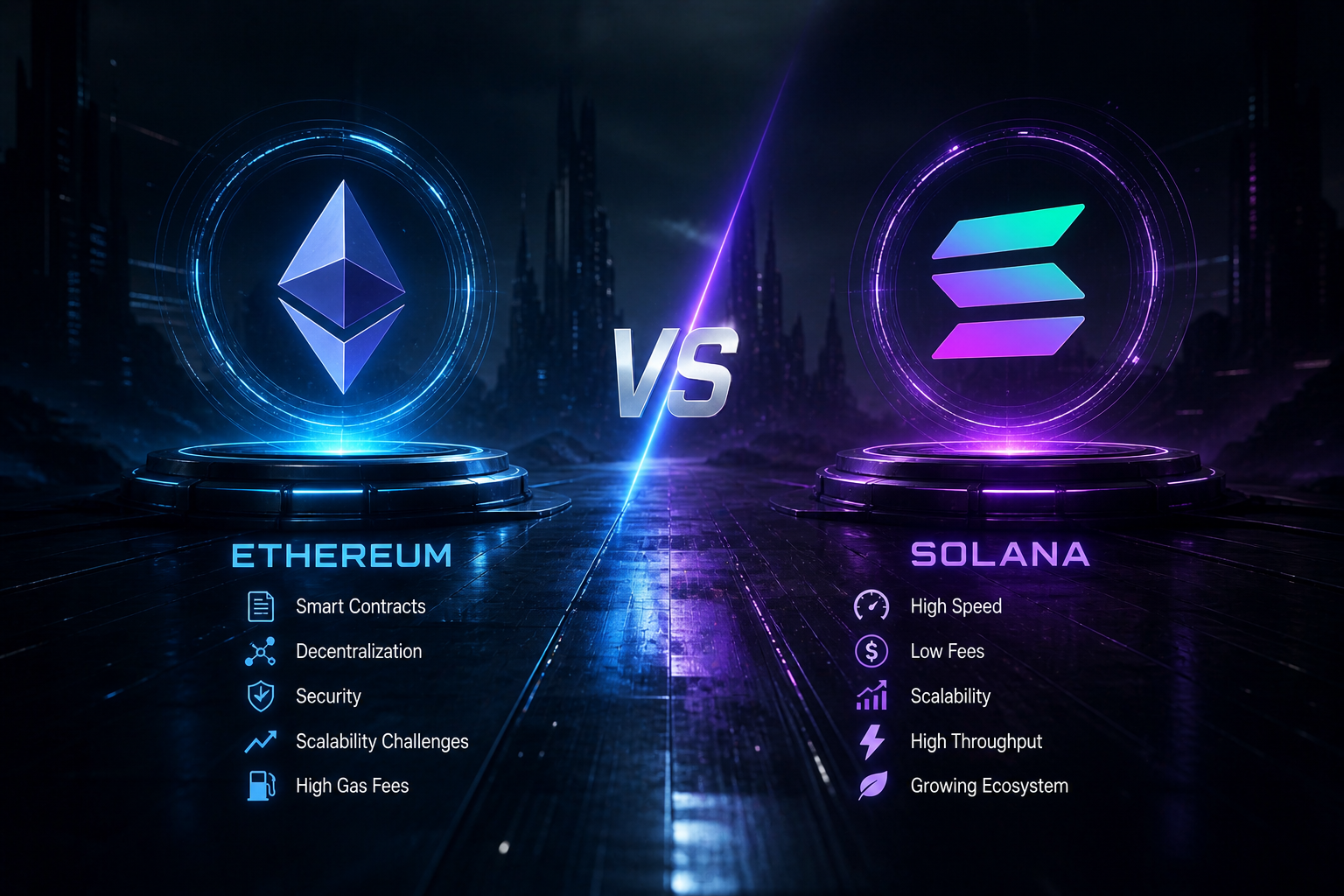
Ethereum vs Solana: Which Blockchain Wins for Developers & Institutional Adoption?
Article at a Glance
- •Speed vs. Security: Solana processes 3,000+ TPS compared to Ethereum’s ~30 TPS on mainnet, but Ethereum’s Layer 2 networks like Arbitrum and Optimism are closing that gap fast.
- •Cost Reality: Solana transaction fees average $0.00025, while Ethereum mainnet fees can spike to $50+ during congestion — a difference that fundamentally shapes which apps get built where.
- •Ecosystem Depth: Ethereum still dominates DeFi with over $60 billion in Total Value Locked (TVL), dwarfing Solana’s $8 billion — but Solana is winning the NFT volume and consumer app race.
- •Architecture Fork in the Road: Ethereum’s modular design relies on Layer 2 rollups for scaling; Solana bets everything on a monolithic high-performance chain — and the Firedancer upgrade could push Solana past 1 million TPS.
- •The Coexistence Play: These two blockchains are diverging into different roles rather than directly replacing each other — understanding that distinction is the key to smarter building and investing decisions.
Table of Contents
- Ethereum vs Solana: The Blockchain Decision That Actually Matters
- Core Architecture: How Each Blockchain Actually Works
- Raw Performance: Speed, Cost, and Scalability
- Developer Experience: Building on Ethereum vs Solana
- DeFi Dominance: Where the Money Actually Sits
- NFT Ecosystems: High Value vs High Volume
- Institutional Adoption: Who Trusts Which Chain
- Ethereum’s Layer 2 Roadmap vs Solana’s Firedancer Upgrade
- DePIN and Emerging Use Cases on Solana
- Which Blockchain Should You Build On or Invest In
- The Two Chains Will Likely Coexist, Not Compete
- Frequently Asked Questions
Ethereum vs Solana: The Blockchain Decision That Actually Matters
Choosing between Ethereum and Solana isn’t just a technical preference — it’s a strategic decision that shapes what you can build, who you can serve, and how much it costs to operate. When evaluating Ethereum vs Solana in 2026, understanding the fundamental tradeoffs between these two dominant smart contract platforms becomes essential for both developers and investors.
Both networks support smart contracts, decentralized applications, DeFi, and NFTs. But underneath that surface-level similarity, they are built on completely different philosophies about how a blockchain should work. Ethereum prioritizes decentralization and security above all else, layering speed on top through its growing ecosystem of Layer 2 solutions. Solana flips that equation, baking high-throughput performance directly into the base layer. Coinmerce, a leading European crypto platform, provides access to both ETH and SOL, making it easier for investors to participate in whichever ecosystem fits their strategy.
The “Ethereum killer” narrative that defined 2021 never really played out. Instead, what emerged is something more nuanced — two dominant chains carving out distinct territory in the broader Web3 landscape. Understanding where each excels is what separates informed participants from those making expensive guesses.
Core Architecture: How Each Blockchain Actually Works
Architecture is where the Ethereum vs Solana story really begins. Every performance difference, fee structure, and scalability limitation traces back to the foundational design choices each team made years ago. Understanding these choices can help avoid common mistakes that many crypto investors face.
Ethereum’s Proof of Stake Model After The Merge
Ethereum transitioned from Proof of Work to Proof of Stake in September 2022 through an upgrade known as The Merge. Under PoS, validators stake a minimum of 32 ETH to participate in block validation, replacing energy-intensive mining with a capital-based security model. This shift reduced Ethereum’s energy consumption by approximately 99.95% and set the stage for future scalability upgrades under the broader Ethereum roadmap.
The validator set on Ethereum is intentionally large and distributed. As of 2025, Ethereum has over 900,000 active validators securing the network — a decentralization depth that no other smart contract platform comes close to matching. That scale of validator participation is precisely why institutions treat Ethereum as the most battle-tested and censorship-resistant programmable blockchain in existence.
Solana’s Proof of History and Why It Changes Everything
Solana’s core innovation is Proof of History (PoH) — a cryptographic clock that timestamps transactions before they are added to the blockchain. Rather than requiring validators to communicate back and forth to agree on transaction order (which is slow), PoH creates a verifiable sequence of events that validators can process in parallel. This eliminates one of the biggest bottlenecks in traditional consensus mechanisms.
PoH is layered on top of a Proof of Stake consensus mechanism, giving Solana both speed and a degree of economic security. The result is a network capable of processing thousands of transactions per second with sub-second finality — performance numbers that are simply not achievable on Ethereum’s base layer without additional infrastructure.
Monolithic vs Modular: The Fundamental Design Difference
This is the architectural fork that defines everything downstream. Ethereum is a modular blockchain — it separates execution, settlement, and data availability into distinct layers. The base layer handles security and finality; Layer 2 networks like Arbitrum, Optimism, and zkSync handle execution at scale. Solana is a monolithic blockchain — execution, consensus, and data availability all happen on a single integrated layer, optimized to run as fast as possible on high-performance hardware.
Neither approach is objectively superior. Modularity gives Ethereum flexibility and specialization — different L2s can optimize for different use cases. Monolithic design gives Solana simplicity and raw throughput — there’s no bridging risk, no fragmented liquidity across rollups, and no complexity tax on developers building consumer-facing apps.
Raw Performance: Speed, Cost, and Scalability
When people debate Ethereum vs Solana, performance numbers are usually the first thing cited — and for good reason. The differences are dramatic enough to determine which blockchain is technically viable for a given application.
Transaction Speed: 30 TPS vs 3,000+ TPS
Ethereum’s base layer processes approximately 15 to 30 transactions per second. Solana, under normal network conditions, handles between 2,000 and 4,000 TPS, with theoretical peak capacity exceeding 50,000 TPS. That gap is enormous for latency-sensitive applications like high-frequency trading, real-time gaming, or consumer payment rails. Ethereum’s Layer 2 networks push effective throughput much higher — Arbitrum and Optimism each process hundreds of TPS — but the base layer constraint remains a ceiling that Solana simply doesn’t have.
Transaction Fees: Why Solana Wins on Cost Every Time
Solana’s average transaction fee sits around $0.00025. Ethereum mainnet fees during peak congestion have hit $50 to $200 per transaction, and even during quiet periods rarely drop below $1 to $3 for complex smart contract interactions. For micro-transaction use cases — think in-game item trades, small DeFi positions, or high-frequency NFT minting — Ethereum mainnet is economically unworkable. Solana isn’t.
Ethereum L2s have meaningfully closed this gap. Arbitrum and Optimism fees typically run $0.01 to $0.10 per transaction, and zkSync Era pushes even lower. But those savings come with the added complexity of bridging assets from Ethereum mainnet, introducing both time delays and smart contract risk that Solana users never have to think about.
~30 TPS
Ethereum Base Layer Speed
3,000+ TPS
Solana Base Layer Speed
$1-$50+
Ethereum Mainnet Fees
$0.00025
Solana Average Fees
Network Reliability and Solana’s Outage History
This is Solana’s most significant credibility problem. The network has experienced multiple full outages and partial degradations since its launch — including a 17-hour outage in September 2021, another major incident in January 2022, and further disruptions through 2023. Each incident stemmed from the network being overwhelmed by spam transactions or bot activity that the validator set couldn’t handle fast enough. For more insights on managing crypto portfolios, you might find this guide on professional portfolio management helpful.
Solana’s development team has consistently addressed these issues through protocol upgrades, and the network’s stability has improved considerably heading into 2025. But Ethereum has never experienced a full network outage. For institutional applications where downtime means real financial loss, that track record carries serious weight. For those interested in professional insights, here’s a guide on crypto hedge funds that highlights the importance of network reliability.
Developer Experience: Building on Ethereum vs Solana
Raw performance only matters if developers can actually build on the platform. The developer experience on each chain differs in language choice, tooling maturity, and the overall size of the community you can tap for help.
Solidity vs Rust: Which Language Is Easier to Learn
Ethereum smart contracts are written in Solidity, a language purpose-built for blockchain development with a syntax that feels familiar to JavaScript and C++ developers. Solidity has extensive documentation, a massive library of existing contracts to reference, and years of battle-tested patterns for common use cases like token standards (ERC-20, ERC-721) and governance systems. Most developers coming from a web background find the learning curve manageable within weeks.
Solana programs are written in Rust, one of the most technically demanding languages in software development. Rust is fast and memory-safe, which is why Solana chose it — but it has a notoriously steep learning curve even for experienced engineers. The upside is that Rust developers who master Solana development tend to build extremely optimized, efficient programs. The downside is that the barrier to entry filters out a significant portion of developers who would otherwise be willing to experiment.
Ethereum’s Tooling Ecosystem: Hardhat, Foundry, and Web3.js
Ethereum’s developer tooling is simply unmatched. Hardhat and Foundry are the dominant smart contract development frameworks, offering local testing environments, automated deployment scripts, and deep debugging capabilities. Web3.js and ethers.js provide robust JavaScript libraries for frontend integration. OpenZeppelin offers audited, reusable smart contract components that let developers skip reinventing security-critical code. The result is an ecosystem where a developer can go from idea to deployed contract in a single afternoon. For those interested in understanding more about the challenges and strategies in the crypto space, here’s an article on common mistakes and winning strategies.
Solana’s Developer Onboarding Challenges
Getting started on Solana is genuinely harder than on Ethereum, and the ecosystem largely acknowledges this. Beyond the Rust learning curve, Solana’s programming model is fundamentally different from EVM-compatible chains. Solana separates program logic from state storage — a concept called the account model — which requires developers to rethink how they structure data in ways that have no direct equivalent in Solidity development.
The tooling gap is real but narrowing. Anchor, Solana’s primary smart contract framework, has significantly reduced the boilerplate required to write and deploy programs. It abstracts away much of Rust’s complexity and provides a more structured development environment. But compared to Ethereum’s Hardhat or Foundry, Anchor’s documentation is thinner, error messages are less intuitive, and community-sourced solutions to common problems are harder to find.
Solana Developer Onboarding Challenges
- Account model complexity: Developers must manually manage account allocation and rent exemption, concepts that don’t exist on Ethereum.
- Limited audit firms: Fewer security firms specialize in Solana program audits compared to EVM contracts, creating a bottleneck for teams trying to launch safely.
- Smaller Stack Overflow presence: Debugging Solana-specific issues often means navigating Discord servers and GitHub issues rather than finding clean answers in established developer communities.
- Transaction size limits: Solana imposes a 1,232-byte limit on transactions, requiring careful optimization that Ethereum developers rarely need to think about.
Despite these friction points, Solana’s developer community has grown substantially. The Solana Foundation’s hackathon program has produced hundreds of production-grade projects, and the quality of tooling available in 2025 is meaningfully better than it was just two years ago.
Where the Developer Talent Pool Actually Lives
Ethereum has the largest smart contract developer community in the world by a wide margin. Electric Capital’s annual developer report consistently shows Ethereum maintaining more than 3x the monthly active developers of any competing ecosystem, including Solana. That depth matters practically — it means more auditors, more open-source libraries, more tutorials, and a larger hiring pool if you’re building a team.
Solana’s developer base is smaller but notably fast-growing and highly engaged. The Solana ecosystem attracted a significant wave of developers during the 2023 to 2024 cycle, particularly those building consumer-facing applications, DePIN projects, and high-frequency trading infrastructure where Solana’s performance advantages are non-negotiable. If your project genuinely requires throughput that Ethereum’s base layer can’t provide, you’ll find a focused and technically sharp developer community ready to help you build it.
DeFi Dominance: Where the Money Actually Sits
Total Value Locked is the clearest signal of where the market’s financial trust actually lives. TVL measures the total value of assets deposited into a blockchain’s DeFi protocols — lending platforms, decentralized exchanges, yield vaults, and more. It’s an imperfect metric, but it’s the best real-time indicator of which ecosystem is being used to move serious money.
Ethereum’s $60 Billion TVL vs Solana’s $8 Billion
Ethereum’s DeFi ecosystem holds approximately $60 billion in TVL across its mainnet and Layer 2 networks combined. That figure represents years of compounding network effects — protocols that have been running, surviving market crashes, and earning user trust since 2019 and 2020. Aave, Uniswap, MakerDAO, Curve, and Lido collectively account for a substantial portion of that locked capital, and each has undergone multiple security audits and survived extreme market conditions.
Solana’s DeFi TVL sits around $8 billion — significant in absolute terms, but roughly one-eighth of Ethereum’s footprint. The gap reflects both the relative youth of Solana’s DeFi ecosystem and the lingering trust deficit from the network’s past outages. Protocols like Jupiter, Marinade Finance, and Raydium have built genuine traction on Solana, and the growth trajectory heading into 2025 is steep. But for institutions moving nine-figure sums, the depth and battle-tested nature of Ethereum’s DeFi stack is still the deciding factor.
Blue-Chip Protocols: Uniswap, Aave, and MakerDAO
| Protocol | Chain | Category | Approximate TVL |
|---|---|---|---|
| Uniswap v3 | Ethereum + L2s | DEX | ~$4.5 billion |
| Aave v3 | Ethereum + L2s | Lending | ~$12 billion |
| MakerDAO / Sky | Ethereum | Stablecoin / Lending | ~$8 billion |
| Lido Finance | Ethereum | Liquid Staking | ~$23 billion |
| Jupiter | Solana | DEX Aggregator | ~$2 billion |
| Marinade Finance | Solana | Liquid Staking | ~$1.2 billion |
Ethereum’s blue-chip protocols have something Solana’s ecosystem simply can’t replicate yet — time. Aave has been audited dozens of times, has processed billions in liquidations without catastrophic failure, and has governance systems refined through years of real-world stress testing. That operational history is the product institutional treasury managers and risk committees actually read before approving capital allocation.
Solana’s DeFi protocols are increasingly competitive on the product side. Jupiter’s aggregator routing is technically impressive, and Marinade’s liquid staking solution offers compelling yields. But the protocols are younger, the audit histories are shorter, and the track records during extreme volatility events are still being established. The money will follow the track record — and that takes time to build. For a deeper understanding of the differences between these blockchains, you can explore this comparison of Solana vs Ethereum.
NFT Ecosystems: High Value vs High Volume
Ethereum and Solana have carved out distinct identities in the NFT market. Ethereum is where high-value, culturally significant NFT collections live — Bored Ape Yacht Club, CryptoPunks, and Art Blocks all call Ethereum home, with individual pieces regularly trading at prices that would be unthinkable on any other chain. Solana, meanwhile, has become the chain of choice for high-volume, accessible NFT activity — collections like Mad Lads and Tensor‘s trading infrastructure have built a fast, low-cost NFT experience that Ethereum mainnet simply cannot offer at comparable fee levels. If you’re a collector prioritizing prestige and store of value, Ethereum is the answer. If you’re building an NFT-integrated game, loyalty program, or high-frequency digital collectible platform where transaction costs directly impact user experience, Solana is the more practical foundation. For those interested in the broader implications of blockchain technology, exploring the crypto code can provide deeper insights.
Institutional Adoption: Who Trusts Which Chain
Institutional adoption is where the Ethereum vs Solana comparison shifts from technical specs to market reality. The question institutions ask isn’t “which chain is faster?” — it’s “which chain can we trust with billions of dollars, explain to our compliance team, and rely on not going down during a market crisis?”
Ethereum’s answer to that question is considerably stronger right now. BlackRock’s BUIDL fund — a tokenized money market fund — is deployed on Ethereum. Franklin Templeton’s OnChain U.S. Government Money Fund uses Ethereum and Stellar. JPMorgan’s Onyx platform, which has processed over $700 billion in repo transactions, uses a private Ethereum-compatible chain. These aren’t experiments — they are production financial infrastructure built on Ethereum’s rails.
Real World Asset Tokenization on Ethereum
Real World Asset (RWA) tokenization is the fastest-growing institutional use case in blockchain, and Ethereum is capturing the overwhelming majority of that activity. Tokenized U.S. Treasuries, private credit funds, and real estate assets are being issued as ERC-20 tokens, giving institutional investors on-chain exposure to traditional asset classes with programmable compliance features built in. The total value of tokenized RWAs on Ethereum has grown from under $1 billion in early 2023 to over $10 billion by 2025.
The reason institutions choose Ethereum for RWA tokenization comes down to three factors: regulatory familiarity, smart contract standardization, and liquidity depth. ERC-20 and ERC-3643 (the security token standard) are well-understood by legal teams and regulators. The liquidity available on Ethereum’s DeFi layer means tokenized assets can potentially be used as collateral, borrowed against, or traded without leaving the ecosystem.
Solana’s Push Into Consumer and Retail Markets
Solana is deliberately targeting a different institutional segment — the consumer-facing fintech and payments space. Visa expanded its USDC settlement pilot to Solana in 2023, citing the network’s transaction throughput and low cost as the key technical drivers. Shopify payment integrations, mobile-first crypto wallets like Phantom, and the explosive growth of Solana Pay demonstrate that the chain is positioning itself as infrastructure for everyday financial activity rather than institutional custody and settlement.
Regulatory Clarity and Why Institutions Lean Toward Ethereum
ETH received implicit regulatory clarity in the United States when the SEC approved spot Ethereum ETFs in May 2024, following the earlier approval of spot Bitcoin ETFs. That approval — while not a blanket endorsement of DeFi — signals that regulators view Ethereum as a commodity-like asset with a clear enough structure to allow regulated investment products. SOL does not yet have the same regulatory status in the U.S., and that gap meaningfully influences institutional allocation decisions, particularly for compliance-heavy entities like pension funds and registered investment advisors.
Ethereum’s Layer 2 Roadmap vs Solana’s Firedancer Upgrade
Both networks have significant technical upgrades in progress that will reshape the competitive landscape. Understanding what each upgrade actually delivers — not just the marketing language around it — is essential for anyone making a long-term building or investment decision.
How Danksharding Changes Ethereum’s Scalability Ceiling
Danksharding is Ethereum’s long-term answer to data availability bottlenecks that currently limit how cheaply and quickly Layer 2 networks can settle transactions back to mainnet. The first step, Proto-Danksharding (EIP-4844), went live in March 2024 and introduced “blobs” — a new data storage format that reduced L2 transaction costs by 80 to 90% almost immediately after activation. Full Danksharding, expected in later phases of the Ethereum roadmap, will expand blob capacity dramatically, potentially enabling Ethereum’s L2 ecosystem to process hundreds of thousands of transactions per second in aggregate while maintaining mainnet-level security guarantees. This is how Ethereum plans to make its modular architecture genuinely competitive with Solana’s raw throughput — not by speeding up the base layer, but by making the layers above it dramatically more efficient.
What Firedancer Actually Delivers for Solana
Firedancer is a second, independent validator client for Solana developed by Jump Crypto, and it may be the most significant technical upgrade in Solana’s history. Having a second independent client implementation dramatically improves network resilience — if one client has a bug or crashes, the other can keep the network running, which directly addresses Solana’s outage vulnerability. On the performance side, Firedancer has demonstrated throughput exceeding 1 million transactions per second in internal testing environments, though real-world network conditions will produce lower figures. Even at a fraction of that benchmark, Firedancer would make Solana’s performance ceiling effectively irrelevant for any application built today. The phased rollout began in 2024, and full deployment is expected to meaningfully change the reliability narrative that has historically been Solana’s biggest institutional obstacle.
Ethereum’s Scaling Strategy: Danksharding enables L2 networks to process hundreds of thousands of TPS in aggregate while maintaining mainnet security — modularity at scale.
Solana’s Scaling Strategy: Firedancer pushes the monolithic base layer toward 1 million TPS with dual-client redundancy — raw throughput without fragmentation.
DePIN and Emerging Use Cases on Solana
Decentralized Physical Infrastructure Networks — DePIN — is one of the most compelling emerging categories in crypto, and Solana has become its default home. DePIN projects use token incentives to crowdsource the build-out of real-world infrastructure: wireless networks, data storage, energy grids, and GPS systems. The economics of DePIN require extremely cheap, high-frequency transactions — conditions that make Ethereum mainnet cost-prohibitive and make Solana the obvious technical fit.
The most prominent examples are already operating at meaningful scale. Helium migrated to Solana in 2023 to support its decentralized wireless network, which relies on thousands of micro-transactions between hotspot operators and users. Hivemapper is building a decentralized Google Maps alternative, rewarding drivers with HONEY tokens for contributing dashcam footage — each data submission is a Solana transaction. Render Network uses Solana to coordinate distributed GPU rendering jobs for 3D artists and AI workloads. These aren’t whitepaper projects — they are live networks with real hardware, real users, and real economic activity flowing through Solana’s transaction layer every day. DePIN alone represents a use case category where Solana doesn’t just compete with Ethereum — it dominates.
Which Blockchain Should You Build On or Invest In
The honest answer is that the right choice depends entirely on what you’re building or why you’re allocating capital. Both networks are legitimate, both have real futures, and the worst decision you can make is choosing based on tribalism rather than fit. Here’s how to think through it clearly, and consider exploring The Crypto Code for more insights.
Choose Ethereum If You Are Building for Institutions or High-Value DeFi
If your application involves moving large sums of money, interfacing with regulated financial entities, or building on top of established DeFi primitives like Aave or Uniswap, Ethereum is the stronger foundation. The combination of regulatory recognition, deep liquidity, battle-tested smart contract standards, and the largest auditor ecosystem makes Ethereum the lowest-risk choice for high-stakes financial applications.
| Factor | Ethereum | Solana |
|---|---|---|
| Consensus Mechanism | Proof of Stake | Proof of History + PoS |
| Base Layer TPS | ~15–30 TPS | 2,000–4,000+ TPS |
| Average Transaction Fee | $1–$50+ (mainnet) | ~$0.00025 |
| Smart Contract Language | Solidity | Rust (via Anchor) |
| DeFi TVL | ~$60 billion | ~$8 billion |
| Active Validators | 900,000+ | ~1,900 |
| Network Outages | None | Multiple (improving) |
| Spot ETF Approval (U.S.) | Yes | No (as of 2025) |
| Primary Scaling Strategy | Layer 2 rollups | Monolithic base layer |
| RWA Tokenization Activity | Dominant ($10B+) | Early stage |
Ethereum’s Layer 2 ecosystem has also matured to the point where the old argument — “but Ethereum is too slow and expensive” — no longer holds for most applications. Deploying on Arbitrum One gives you Ethereum-grade security with transaction fees well under $0.10 and throughput that handles most consumer-facing apps without breaking a sweat. You get the trust of Ethereum’s mainnet settlement with the performance characteristics that were previously only available on alternative L1s.
The developer tooling advantage is also impossible to ignore for teams that want to move fast. Hardhat’s local testing environment, OpenZeppelin’s audited contract library, and the sheer volume of Solidity documentation and community support mean a competent team can ship production code faster on Ethereum than on Solana — even accounting for the higher baseline familiarity with Rust that some engineering teams have.
For investors, Ethereum’s spot ETF approval in the U.S. opens the door to regulated exposure through traditional brokerage accounts — a distribution channel that matters enormously for institutional allocators who cannot hold crypto directly. That regulatory clarity, combined with ETH’s role as the gas token for an ecosystem processing trillions in annual transaction volume, gives it a structural demand story that is easy to explain to a investment committee.
Choose Solana If You Are Building for Speed, Gaming, or Consumer Apps
If your application depends on sub-second transaction finality, costs fractions of a cent per interaction, or needs to onboard users who have never touched crypto before, Solana is the more honest technical choice. Mobile-first wallets like Phantom have set a UX standard on Solana that genuinely competes with traditional fintech apps — something Ethereum mainnet interactions have never achieved. For games that require thousands of micro-transactions per session, DePIN projects with dense IoT-scale activity, or consumer payment apps where a $2 gas fee would kill the product entirely, Solana’s architecture is simply better suited to the job.
The Firedancer upgrade arriving in full deployment will push Solana’s reliability and throughput into territory that makes the network’s past outage issues largely historical. Builders who get in now — learning the Anchor framework, building on Solana’s account model, contributing to the ecosystem before it reaches Ethereum’s maturity level — are positioning themselves in a growing developer community where talent is still scarce enough to matter competitively.
Why Holding Both Is a Legitimate Strategy
From a portfolio perspective, treating Ethereum and Solana as mutually exclusive bets misreads the market structure. ETH captures value from institutional DeFi, RWA tokenization, and the settlement layer that underpins trillions in L2 activity. SOL captures value from consumer adoption, high-frequency on-chain activity, and the DePIN category that could become a multi-trillion dollar infrastructure market over the next decade. These are different risk and return profiles, different catalysts, and different adoption curves — holding meaningful positions in both is a rational diversification strategy, not a hedge of conviction.
The Two Chains Will Likely Coexist, Not Compete
The framing of Ethereum vs Solana as a zero-sum competition was always more useful as a marketing narrative than as an accurate description of how blockchains actually develop. What’s playing out in practice is a division of labor — Ethereum becoming the high-security settlement and institutional finance layer, Solana becoming the high-performance consumer and infrastructure execution layer. Cross-chain bridges, interoperability protocols, and multi-chain development frameworks are making it increasingly normal for sophisticated projects to deploy on both networks simultaneously, routing different user segments and transaction types to whichever chain serves them best. For those interested in professional investment strategies, exploring crypto hedge funds can offer valuable insights.
The analogy that holds up is the relationship between TCP/IP and HTTP — foundational protocols that serve different layers of the internet stack without one replacing the other. Ethereum and Solana are converging on a similar coexistence model: different layers, different optimizations, both essential to the broader Web3 infrastructure that’s being built. The question for builders and investors in 2025 isn’t which chain wins — it’s which chain wins for your specific use case, and whether you’re positioned to benefit from the growth happening on both sides of that equation.
The Real Dynamic: Ethereum and Solana aren’t competing for the same use cases — they’re evolving into complementary infrastructure layers. Ethereum: institutional settlement and high-value DeFi. Solana: consumer apps and high-frequency infrastructure. Understanding which role each chain plays is what separates informed participants from expensive guesses.
Frequently Asked Questions
Is Solana faster than Ethereum in 2025?
Yes — Solana processes 2,000 to 4,000+ transactions per second on its base layer compared to Ethereum mainnet’s 15 to 30 TPS. However, Ethereum’s Layer 2 networks like Arbitrum and Optimism process hundreds of TPS each, and the aggregate throughput of Ethereum’s L2 ecosystem has significantly narrowed the real-world speed gap for most applications. Solana still wins on raw base-layer speed and transaction finality time, typically achieving finality in under 400 milliseconds compared to Ethereum’s ~12-second block times. For more insights on blockchain technologies, check out The Crypto Code.
Which blockchain has more developers, Ethereum or Solana?
Ethereum has considerably more developers. Electric Capital’s developer reports consistently show Ethereum maintaining the largest active developer community of any smart contract platform, with monthly active developers numbering in the thousands across mainnet and L2 ecosystems. Solana’s developer base is smaller but growing at a faster rate, driven by hackathon programs, improved tooling like the Anchor framework, and the appeal of building in a less saturated ecosystem.
For practical purposes, Ethereum’s developer depth means more auditors, more open-source libraries, more tutorials, and a larger hiring pool. Solana’s tighter but highly engaged community means faster iteration on novel ideas and a greater willingness to experiment with cutting-edge use cases like DePIN and on-chain consumer apps.
Is Ethereum still the best blockchain for DeFi?
By total value locked and protocol maturity, yes. Ethereum’s DeFi ecosystem holds approximately $60 billion in TVL — roughly 7 to 8 times Solana’s $8 billion — and houses the most battle-tested protocols in the space, including Aave, Uniswap, MakerDAO, and Lido. These protocols have survived multiple market crashes, been audited dozens of times, and processed hundreds of billions in cumulative volume. That operational track record is the foundation of DeFi trust, and it takes years to build.
Solana’s DeFi ecosystem is growing rapidly and offers genuine advantages in trading speed and fee efficiency — Jupiter’s DEX aggregator, for instance, offers routing quality that competes with Ethereum’s best aggregators at a fraction of the cost. But for large capital deployment, complex structured products, and any use case where smart contract risk tolerance is low, Ethereum’s DeFi stack remains the benchmark.
Can Solana replace Ethereum for institutional use?
Solana’s Institutional Adoption Obstacles
- Regulatory status: ETH has spot ETF approval in the U.S.; SOL does not yet, limiting direct institutional access through regulated vehicles.
- Network reliability: Ethereum has never experienced a full outage; Solana’s history of disruptions remains a compliance concern for institutions with strict uptime requirements.
- Audit ecosystem: The pool of firms qualified to audit Solana programs is significantly smaller than those capable of auditing EVM smart contracts.
- RWA infrastructure: Existing tokenized asset issuance is overwhelmingly built on Ethereum standards like ERC-20 and ERC-3643, creating switching costs for any institution considering Solana.
Short answer: not in the near term, and likely not in the same categories. Solana is making real institutional inroads in payments and consumer fintech — Visa’s USDC settlement pilot on Solana is a genuine signal — but the high-value custody, RWA tokenization, and regulated fund infrastructure market is firmly Ethereum’s territory for the foreseeable future.
The more realistic institutional trajectory for Solana is capturing the infrastructure layer for high-throughput financial applications — think real-time settlement rails, micropayment systems, and tokenized loyalty programs — where Ethereum’s speed and cost profile create genuine friction. Institutions building in those categories are already running proofs of concept on Solana, and that segment will grow.
The clearest path to broader Solana institutional adoption runs through regulatory clarity. A U.S. spot SOL ETF approval — which several asset managers have applied for — would fundamentally change the institutional accessibility equation and bring Solana into the consideration set for a much wider range of allocators. For more insights on ETFs, explore the Bitcoin ETF vs. holding coins strategies.
Should I invest in Ethereum or Solana for long-term growth?
Both assets have credible long-term value propositions, but they derive value from different mechanisms. ETH’s value is tied to its role as the monetary asset of the world’s largest smart contract settlement layer — gas fees, staking yields, and institutional demand from spot ETF flows all contribute to sustained demand. As Ethereum’s L2 ecosystem grows, base layer fee revenue and ETH burn rates (via EIP-1559) scale with it. For a deeper comparison, you can explore Solana vs Ethereum to understand which blockchain might be better for your investment strategy.
SOL’s value proposition is more growth-stage in nature. It captures value from transaction fee volume on a network that is still in the early phases of consumer and DePIN adoption. The potential upside is higher if Solana’s throughput advantages translate into dominant market share in high-volume consumer categories — but the risk profile is also higher given the smaller validator set, past reliability issues, and ongoing regulatory uncertainty around SOL’s classification.
A reasonable long-term framework treats ETH as the lower-volatility, institutionally-anchored position and SOL as the higher-growth, higher-risk position within a diversified crypto allocation. Neither is a speculation on technology alone — both are bets on network adoption, developer momentum, and the continued expansion of the on-chain economy as a whole. For those interested in exploring professional management options, crypto hedge funds offer a structured approach to navigating these dynamic markets.
The worst outcome for either investment is not losing to the other — it’s the broader crypto market failing to achieve meaningful mainstream adoption. That shared dependency is precisely why the most informed participants hold both, size them according to their risk tolerance, and focus less on which chain “wins” and more on whether the overall ecosystem they’re invested in continues to grow.
DISCLAIMER: This article is for informational purposes only and does not constitute financial advice. Cryptocurrency investments carry significant risk. Always Do Your Own Research (DYOR) before making any investment decisions. The Ethereum vs Solana comparison provided here is for educational purposes only.


Latest
Markets
08 Jul 2026
Markets
04 Jul 2026