Coinposters
Crypto Podcast vs Newsletter: Which Format Helps Beginners Improve Trading Decisions?
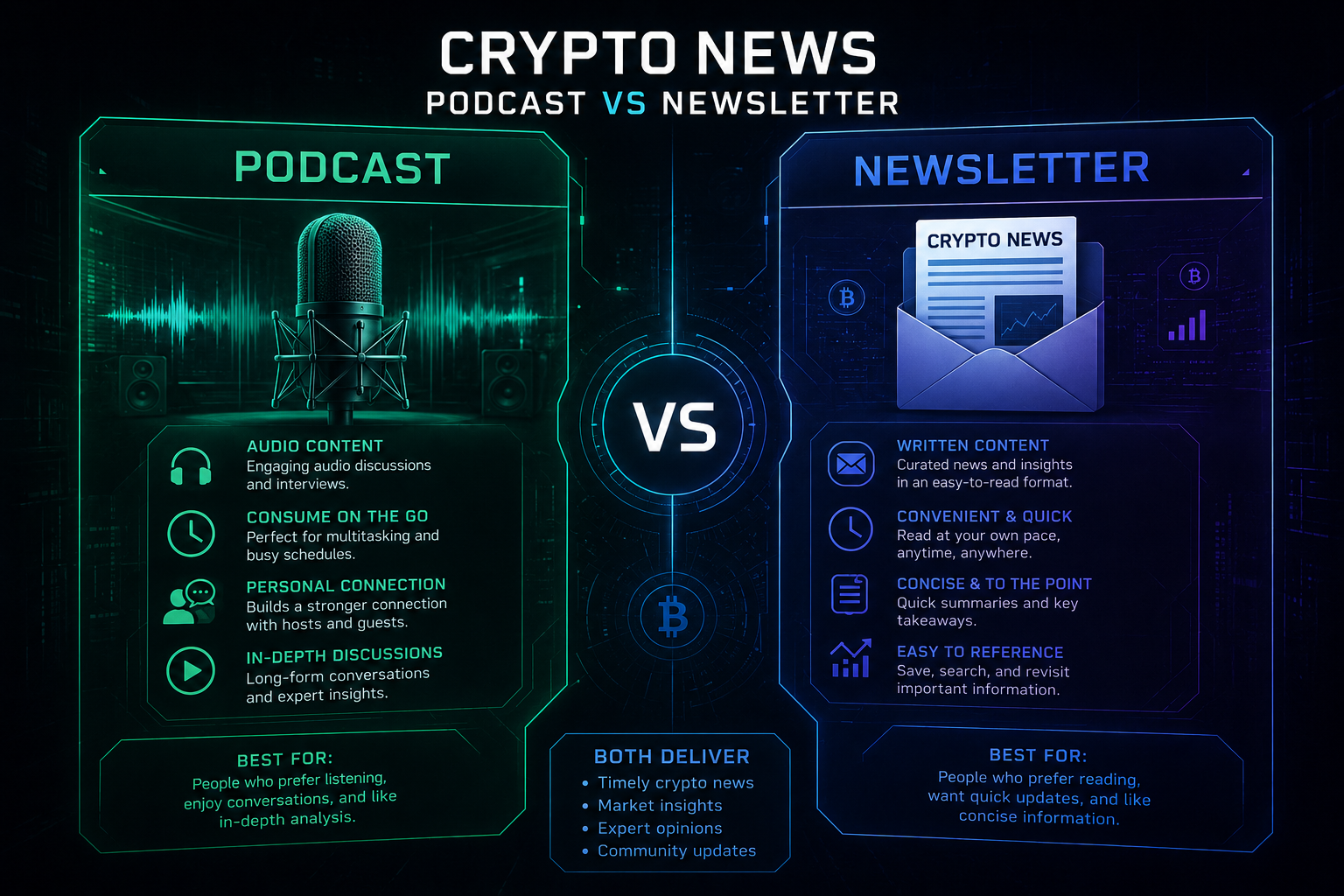
The format you use to consume crypto news shapes how fast you improve as a trader—but most beginners waste time choosing between crypto podcast vs newsletter when they should be using both. Here’s the strategic breakdown of when podcasts work better, when newsletters work better, and the exact content rotation that builds trading confidence faster than either format alone.
Key Takeaways
- •The format you use to consume crypto news directly shapes how fast you improve as a trader — not just what you know in a crypto podcast vs newsletter comparison.
- •Crypto podcast formats build contextual understanding over time, but newsletters deliver faster, more actionable signals for day-to-day decisions.
- •Beginners who rely on only one format are leaving a major edge on the table — the smartest approach uses both strategically.
- •Not all crypto content is created equal — some formats actively hurt your decision-making by creating noise instead of clarity.
- •There is a specific rotation strategy that combines podcasts and newsletters to build trading confidence faster than either format alone.
Article at a Glance: When choosing between crypto podcast vs newsletter, beginners typically focus on convenience rather than effectiveness. This article breaks down exactly what each format delivers, why podcasts excel at building mental frameworks while newsletters excel at delivering actionable signals, how the choice between crypto podcast vs newsletter affects your trading confidence timeline, and the specific content stack that combines both formats to accelerate your improvement as a trader.
Table of Contents
- Why Your Information Format Matters as Much as the Information Itself
- How Crypto Podcasts Work for Beginner Traders
- How Crypto Newsletters Work for Beginner Traders
- Podcasts vs. Newsletters: A Direct Comparison for Trading Decisions
- Signs You Are Consuming Crypto Content That Hurts Your Decisions
- The Smartest Way to Use Both Formats Together
- The Verdict: Which Format Wins for Beginner Crypto Traders
- Frequently Asked Questions
The format you use to consume crypto news matters just as much as the news itself — and most beginners get this completely wrong.
When you are just getting started in crypto trading, you are not short on information. Podcasts, newsletters, YouTube channels, Twitter threads — the content is everywhere. The real problem is signal versus noise. Choosing the wrong format does not just slow your learning down; it actively builds bad habits that cost you money. Crypto trading education platforms have increasingly recognized this gap and started tailoring content specifically around how beginners actually absorb and act on information.
Why Your Information Format Matters as Much as the Information Itself
Think about how a doctor reads a patient chart versus how they listen to a colleague describe symptoms. Both are information, but the format changes how deeply they process it and what they do next. The same principle applies to understanding crypto podcast vs newsletter trade-offs. A podcast you half-listen to during your commute and a newsletter you read with your morning coffee produce completely different cognitive outcomes — even if the underlying information is identical.
Research into learning and memory consistently shows that the medium shapes retention and application. Audio-first content tends to build familiarity and emotional context. Written content tends to build analytical precision.
For a beginner trader trying to close the gap between knowing something and acting on it correctly, that distinction is not trivial.
The Core Difference Between Passive Learning and Active Decision-Making
Podcasts are largely passive. You absorb ideas while doing something else, which means your brain is in a lower-attention processing state. Newsletters, on the other hand, demand your eyes and often your hands — you highlight, you reread, you follow a chart link. That active engagement is closer to what you need when you are actually placing a trade.
How Crypto Podcasts Work for Beginner Traders
A crypto podcast is an audio show — usually released on a regular schedule — where hosts discuss market news, blockchain technology, trading strategies, or crypto culture. The format ranges from solo commentary and interview-style episodes to panel discussions with analysts and developers. For a beginner, the appeal is obvious: you can learn while commuting, exercising, or cooking. There is no screen required. For those who prefer reading, there are also crypto newsletters that provide valuable insights.
The best crypto podcasts do something newsletters often cannot replicate as naturally — they let you hear how experienced traders think in real time. When an analyst talks through why they are cautious about a specific altcoin, the reasoning unfolds in a conversational way that can feel more intuitive than reading a bullet-pointed breakdown. That narrative quality is genuinely useful for beginners trying to internalize trading logic, not just memorize rules.
What You Actually Learn From Audio-First Crypto Content
Audio content tends to excel at building mental frameworks. Shows like the Coin Bureau Podcast and What Bitcoin Did are structured around deep-dive conversations that walk listeners through macro context, project fundamentals, and market cycles. After a few weeks of consistent listening, a beginner starts to develop a mental model of how the market behaves — not just what it did last Tuesday. For those interested in expanding their knowledge, exploring the best crypto newsletters can be a valuable resource.
The Attention Problem: Why Multitasking Kills Retention
Here is the catch.
The same convenience that makes podcasts attractive is also their biggest liability. Multitasking splits your cognitive load, and research from the American Psychological Association has shown that task-switching reduces productivity and retention significantly.
When you are half-listening to a breakdown of Federal Reserve policy and its impact on Bitcoin while also navigating traffic, you are not fully processing either task.
For a beginner trader, this is a real problem. Crypto markets are driven by nuance. Missing a key qualifier — “this is only relevant if ETF approval happens before Q3″ — can completely change how you interpret the rest of the analysis. Podcasts are excellent for building background knowledge, but they carry a higher risk of partial learning when consumed passively, which is most of the time.
Best Podcasts for Beginners Who Want to Improve Trading Decisions
Not every crypto podcast is worth your time. The best ones for beginners combine accessibility with genuine analytical depth. Here are the standouts:
- •Coin Bureau Podcast — Best overall for education and market analysis, released weekly with deep-dive structure
- •Crypto 101 — Best entry point for true beginners covering wallets, blockchain basics, and self-custody
- •What Bitcoin Did — Best for understanding Bitcoin’s macro and monetary context through long-form interviews
- •CoinDesk Podcast Network — Best for daily crypto news, regulation updates, and market developments
- •The Pomp Podcast — Best for macro investing context that connects traditional finance to crypto markets
How Crypto Newsletters Work for Beginner Traders
A crypto newsletter is a written publication delivered directly to your inbox — daily, weekly, or somewhere in between — covering market analysis, price action, project updates, regulation news, and trading insights. Unlike podcasts, newsletters are designed to be read with intention. You open them, you scan the structure, you decide what matters to you right now.
That intentionality is a feature, not a side effect. When you sit down to read a crypto newsletter, even for five minutes, you are making a conscious decision to engage with market information. That low-level habit of deliberate engagement mirrors the mindset you need when you are actually managing a position. Newsletters quietly train you to be more purposeful with information — which is exactly the habit beginner traders need to build.
Why Written Format Builds Better Analytical Habits
Reading forces a different kind of processing than listening. When you encounter a claim in a newsletter — say, that Bitcoin’s realized cap has crossed a historically bullish threshold — you can pause, reread it, and look up what realized cap means before moving on. That friction is valuable. It slows you down just enough to actually think rather than just absorb.
Written content also makes it easier to compare and cross-reference. You can scroll back, copy a chart link, open a second tab, and test the claim against live data. That kind of active verification is a foundational trading skill. Newsletters, almost by accident, teach you to do this regularly.
Format Comparison at a Glance
| Feature | Crypto Podcast | Crypto Newsletter |
|---|---|---|
| Consumption Style | Passive (audio, multitask-friendly) | Active (reading, focused) |
| Best For | Building mental frameworks and context | Actionable signals and analytical habits |
| Update Frequency | Weekly or episodic | Daily or weekly |
| Retention Risk | Higher (multitasking reduces retention) | Lower (intentional reading improves recall) |
| Speed of Information | Slower (production takes time) | Faster (can be sent same day) |
| Beginner Accessibility | High (conversational tone) | Medium–High (varies by publication) |
The table above makes the trade-offs clear when considering crypto podcast vs newsletter options. Podcasts win on accessibility and context-building. Newsletters win on speed, retention, and analytical habit formation. Neither format dominates outright — which is exactly why the best strategy for beginners is not to choose one, but to understand what each does well.
What matters most at the beginner stage is not the volume of information you consume, but how often that information translates into a clearer, more confident decision. Newsletters have a structural edge here because they are built to be scanned, prioritized, and acted on — not just enjoyed.
The Speed Advantage: Newsletters Deliver Faster Actionable Signals
Crypto markets do not wait. A regulatory announcement, a whale wallet movement, or an exchange listing can shift price action within minutes. Podcasts, by nature, cannot keep up with that pace — recording, editing, and publishing takes hours at minimum. A well-run crypto newsletter can land in your inbox the same morning a major story breaks, giving you context and analysis before most retail traders have even seen the headline.
Best Newsletters for Beginners Who Want Clearer Market Context
The best crypto newsletters for beginners combine plain-language explanation with actual market data — not just opinion. Look for publications that cite on-chain metrics, reference historical price cycles, and clearly separate news from analysis.
- •Milk Road — Beginner-friendly daily newsletter with a conversational tone, market updates, and crypto explainers
- •The Block Research — More data-heavy, excellent for beginners ready to graduate into on-chain analysis
- •CoinDesk Daily — Reliable daily news digest covering regulation, markets, and technology developments
- •Bankless Newsletter — Best for beginners focused on Ethereum and DeFi with strong educational framing
- •Pomp Letter — Macro-focused written commentary connecting Bitcoin to broader economic trends
Podcasts vs. Newsletters: A Direct Comparison for Trading Decisions
When you put both formats side by side, the differences stop being abstract and start being practical. The question when evaluating crypto podcast vs newsletter is not which format is objectively better — it is which format produces better outcomes for a beginner trader trying to make fewer mistakes and build faster conviction in their decisions.
Podcasts build the why behind market behavior. Newsletters build the what to watch and when. Both are genuinely useful, but they operate at different layers of your trading intelligence. Understanding exactly where each format excels helps you stop consuming content randomly and start consuming it strategically.
Depth of Analysis: Which Format Goes Further
Podcasts have a real edge in depth — not because they always go further technically, but because the conversational format allows ideas to develop naturally. A 90-minute episode of What Bitcoin Did can follow a single thesis from its historical roots through to current market implications in a way that most newsletters simply do not have the space or format to replicate. For understanding macro cycles, monetary policy, and the broader crypto narrative, audio wins on depth. If you’re interested in exploring the best crypto newsletters that cater to serious investors, there are curated options available.
Timeliness: Which Format Keeps You Ahead of Market Moves
Newsletters win this category without much competition.
Daily publications like Milk Road and CoinDesk Daily are specifically built around speed and relevance. By the time a podcast records, edits, and publishes an episode responding to a major market event, a newsletter has already delivered three follow-up editions with updated analysis, price levels, and expert reaction. For a beginner trying to understand why their portfolio moved yesterday, the newsletter is almost always the faster answer.
Bias and Narrative Risk in Both Formats
Both formats carry bias risk — but it shows up differently. Podcast hosts can create parasocial relationships with listeners, which means a beginner might start trusting a host’s opinion the same way they trust a friend’s advice, without applying the same critical filter they would use with written content. This is particularly dangerous in crypto, where influencer-driven narratives have historically preceded some of the worst retail losses.
Newsletters carry a different bias risk: sponsored content and undisclosed conflicts of interest. Some of the most widely read crypto newsletters have accepted payment to feature specific token projects without clear disclosure. As a beginner, you need to check whether a newsletter clearly separates editorial content from sponsored placements. If a newsletter is aggressively bullish on a specific low-cap token with no critical framing, that is a red flag regardless of how professional the layout looks.
Which Format Builds Long-Term Trading Confidence Faster
Trading confidence does not come from consuming more content — it comes from consistently connecting information to outcomes. Here is how each format contributes to that process:
- •Podcasts build a mental model of market behavior through repeated exposure to expert reasoning and historical context
- •Newsletters train the habit of daily market awareness and teach beginners to prioritize relevant signals over noise
- •Podcasts improve your ability to hold a thesis across a longer time horizon by reinforcing macro understanding
- •Newsletters improve your ability to react appropriately to short-term developments without overreacting emotionally
The honest answer is that newsletters build actionable confidence faster for most beginners. The reason is simple: a newsletter gives you something concrete to assess every single day. Over time, you start recognizing patterns — certain on-chain metrics that precede moves, regulatory signals that historically suppress price, exchange flow data that hints at institutional accumulation.
Podcasts build confidence more slowly, but the confidence they build tends to be more durable. Understanding why Bitcoin behaves as a risk-on asset during liquidity expansions does not help you today, but it will help you avoid panic-selling in the next macro downturn — and that kind of composure is worth more than any short-term signal.
For a beginner with limited time, newsletters should be the daily anchor and podcasts should be the weekly depth layer. That combination produces faster growth than either format alone because you are simultaneously building two different but complementary skills: situational awareness and structural understanding.
Signs You Are Consuming Crypto Content That Hurts Your Decisions
Not all crypto content is neutral. Some of it actively degrades your decision-making by flooding you with low-quality signals, emotional narratives, and hype-driven analysis designed to generate engagement rather than insight. The clearest sign you are in this trap is when your confidence increases but your results do not — you feel more informed, but you are still making the same impulsive mistakes.
Watch for these specific warning signs in both formats. A podcast that spends more time on price predictions than explaining the reasoning behind them is optimizing for entertainment, not education. A newsletter that leads every edition with how much a specific coin has pumped — without discussing risk or context — is built around excitement, not analysis. If you find yourself more anxious after consuming crypto content than before you started, that is a reliable signal the format or source is adding noise, not clarity.
The Smartest Way to Use Both Formats Together
The best beginner crypto traders do not choose between podcasts and newsletters — they build a simple, sustainable stack that uses each format for what it does best. This is not about consuming more content. It is about consuming the right content at the right time in the right mode of attention.
The core principle is this: use newsletters to stay current and use podcasts to stay grounded. Daily newsletter reading keeps you aware of what is happening in the market right now. Weekly podcast listening keeps you anchored in the bigger picture so that daily volatility does not derail your long-term thinking. When these two habits work together, they create a feedback loop that accelerates learning faster than either format on its own.
The mistake most beginners make is doing the opposite — bingeing podcasts when they first get excited about crypto, then switching to obsessively checking news when markets get volatile. That pattern produces the worst of both formats: shallow macro understanding combined with anxiety-driven reaction to short-term noise. A structured rotation fixes this entirely, and utilizing crypto newsletters can be an effective way to maintain a balanced perspective.
Recommended Weekly Content Stack for Beginner Traders
| Frequency | Format | Recommended Source | Goal |
|---|---|---|---|
| Daily (5–10 min) | Newsletter | Milk Road or CoinDesk Daily | Market awareness, news context |
| Weekly (30–60 min) | Podcast | Coin Bureau Podcast or What Bitcoin Did | Macro understanding, mental framework |
| Weekly (15–20 min) | Newsletter (deep read) | Bankless or The Block Research | On-chain analysis, DeFi context |
| As needed | Podcast | CoinDesk Podcast Network | Breaking news depth and regulation updates |
This stack takes less than two hours per week total and covers every layer a beginner needs: daily news awareness, weekly macro context, on-chain data literacy, and regulatory awareness. The key is consistency over volume — five minutes of focused newsletter reading every morning compounds into real market intuition over 90 days.
1. Use Newsletters for Daily Market Awareness
Start every trading day with a single newsletter read — not a scroll through Twitter, not a YouTube rabbit hole, just one focused newsletter. This anchors your awareness in verified information before you encounter any of the noise that floods social media throughout the day. Publications like Milk Road are specifically designed for this habit: short, scannable, and structured so that even a five-minute read gives you the three or four things that actually matter in the market right now.
2. Use Podcasts for Weekly Context and Deeper Education
Schedule one podcast episode per week — not per day. The goal is not to consume as many episodes as possible but to let one well-chosen conversation fully develop in your mind before you move to the next. Pick a show that matches your current knowledge level and commit to it for at least four weeks before adding another. The Coin Bureau Podcast is ideal if you want structured market education. What Bitcoin Did works better if you want macro and monetary theory. Either way, one episode a week, listened to with full attention, will compound your understanding faster than three episodes consumed while distracted.
3. Build a Rotation That Matches Your Trading Goals
Your content rotation should reflect what you are actually trying to do in the market. A beginner focused on Bitcoin accumulation needs different inputs than a beginner exploring DeFi yield strategies. A Bitcoin-focused trader gets more value from The Pomp Podcast and the Pomp Letter newsletter combination. A DeFi-curious beginner will extract more signal from the Bankless Newsletter paired with the Bankless Podcast. Aligning your content stack to your actual trading thesis means every piece of content you consume is reinforcing the same direction rather than pulling your attention across ten different narratives.
Review your rotation every 30 days. Ask yourself one question: is this content making my decisions clearer or more complicated? If a newsletter is adding anxiety without adding insight, cut it. If a podcast is entertaining but not improving how you think about trades, replace it. The best information diet is the one you actually stick to — and the one that translates most directly into better decisions at the moment you need to make them.
The Verdict: Which Format Wins for Beginner Crypto Traders
If you had to pick just one format to start with, newsletters win for beginner crypto traders — but only by a specific margin and for a specific reason.
Newsletters are faster, more actionable, and structurally better suited to building the daily market awareness habit that separates traders who improve quickly from those who plateau. For a beginner trying to shorten the distance between information and confident action, written content delivers that connection more reliably than audio.
That said, the real answer is not a single winner. The traders who improve fastest are not the ones who found the best podcast or the best newsletter — they are the ones who built a simple, consistent system using both. Here is what that winning combination looks like in practice:
- •Daily newsletter habit builds market awareness and trains you to identify what actually matters versus what is just noise
- •Weekly podcast habit builds the macro framework that keeps you from making panic decisions during volatile markets
- •Source quality over source quantity — two excellent sources outperform ten mediocre ones every single time
- •Active reading beats passive listening for building the analytical habits that directly improve trade decisions
- •Format alignment with your trading thesis ensures every piece of content reinforces one direction instead of scattering your focus
The format debate ultimately comes down to this: podcasts make you a more knowledgeable crypto participant, and newsletters make you a more aware crypto trader. You need both roles. Knowledge without awareness makes you well-informed but slow. Awareness without knowledge makes you reactive but shallow. Together, they build the combination that actually moves the needle for beginners.
Start with one newsletter tomorrow morning. Add one weekly podcast in your second week. Review both after 30 days and adjust based on what is actually improving your thinking. That is the entire system — and it works because it is built around compounding small, focused habits rather than trying to consume everything at once.
Frequently Asked Questions
These are the questions beginners ask most often when trying to decide how to structure their crypto information diet. The answers below are direct and practical — no fluff, just what you actually need to know to make a smarter choice.
Can I rely on a crypto podcast alone to make better trading decisions?
Relying solely on podcasts for trading decisions is not recommended for beginners. Podcasts are excellent for building mental frameworks, understanding macro context, and absorbing expert reasoning — but they are too slow and too passive to serve as your primary trading signal source. By the time a podcast episode responds to a major market event, the initial price move has already happened. For more timely updates, consider using crypto news aggregators that provide real-time alerts.
Use podcasts as your education layer, not your decision layer. For actual trade decisions — when to enter, what to watch, which signals matter right now — a daily newsletter gives you far more relevant and timely input. Podcasts and newsletters work best as a pair, with each covering the layer the other format cannot reach effectively.
Are free crypto newsletters reliable enough for beginners?
Yes — many of the best crypto newsletters for beginners are completely free, and free does not mean low quality. Publications like Milk Road and CoinDesk Daily have built large audiences precisely because their free tiers deliver genuine value. The reliability question is less about price and more about transparency and track record.
Before trusting any newsletter, check for these reliability markers: clear authorship with verifiable backgrounds, transparent sponsorship disclosure with editorial content clearly separated, consistent publishing history even during slow news periods, data-backed claims that reference on-chain metrics or cited sources, and no aggressive price predictions that promise specific tokens will 10x.
Free newsletters that meet these criteria are genuinely reliable for beginners. Paid newsletters that fail these checks are not worth a single dollar.
How many crypto newsletters or podcasts should a beginner follow?
Start with one newsletter and one podcast — that is it. Most beginners make the mistake of subscribing to five newsletters and following ten podcasts in their first week, which creates information overload and leads to worse decisions, not better ones. One focused daily newsletter plus one weekly podcast episode gives you everything you need to build a solid foundation in your first 60 to 90 days. Add a second source only after you have fully integrated the first into your routine and can articulate what you are learning from it.
Do crypto podcasts cover news fast enough to act on?
Generally, no. Most crypto podcasts operate on a weekly or episodic release schedule that makes them structurally too slow for breaking news. Even daily podcast formats like parts of the CoinDesk Podcast Network take several hours from event to publication after accounting for recording and production time. For news you need to act on — regulatory decisions, exchange announcements, significant on-chain movements — a daily newsletter or a curated news aggregator will always be faster. Use podcasts for the deeper context that comes after the news breaks, not for the news itself.
What is the biggest mistake beginners make when consuming crypto content?
The biggest mistake is confusing confidence with competence. Beginners who consume large amounts of crypto content — podcasts, newsletters, YouTube, Twitter — often develop a strong sense of conviction about specific trades or tokens without developing the underlying analytical skill to evaluate whether that conviction is justified. The content creates a feeling of being informed without actually building the critical thinking that trading requires.
The fix is simple but uncomfortable: slow down your consumption and increase your verification. After reading a newsletter analysis, ask whether you can find the underlying data it references and whether the conclusion still holds when you check it yourself. After listening to a podcast thesis, write down the core argument in two sentences and test it against a historical price chart. This active engagement turns passive consumption into actual skill-building.
The traders who improve fastest are not the ones who consume the most crypto content — they are the ones who do something with what they consume. That single shift, from passive absorption to active verification, is what separates beginners who grow quickly from those who stay stuck for years.
DISCLAIMER: This article is for informational purposes only and does not constitute financial, investment, legal, or trading advice. The debate between crypto podcast vs newsletter consumption formats reflects general information architecture principles and may not apply equally to all traders based on their specific learning styles, experience levels, or trading goals. Always conduct your own research (DYOR), verify information from multiple sources, understand that your optimal content strategy may differ from the recommendations provided, and never make investment decisions based solely on content consumption advice. Past trading confidence improvements do not guarantee future results. The podcasts and newsletters mentioned are referenced for example purposes and do not represent endorsements or guarantees of performance or reliability.