Coinposters
Best Risk Management Rules That Every Active Crypto Trader Needs in 2026

The best risk management rules for active crypto traders in 2026 include risking no more than 1 to 2% of capital per trade, always using a hard stop loss, sizing positions correctly, requiring a strong risk to reward ratio, controlling leverage, and knowing when to stop trading. Applied together, these rules are what separate traders who survive long term from those who blow up their accounts.
Article At A Glance: Protect Your Capital Before Chasing Profits
- Most active crypto traders lose money not from bad picks, but from skipping the crypto risk management rules that fix that directly.
- Never risk more than 1-2% of your total capital on a single trade, no matter how confident you feel about the setup.
- A stop-loss is not optional, traders who skip it are one bad trade away from an account-ending loss.
- Leverage is the fastest way to grow an account and the fastest way to blow one up, Rule 6 shows exactly where the line is.
- Keep reading to find out which single mistake turns manageable losses into total account wipeouts, and how to avoid it entirely.
Table of Contents
- Most Crypto Traders Lose Money: Here’s Why Crypto Risk Management Rules Matter
- Rule 1: Never Risk More Than 1-2% of Your Capital Per Trade
- Rule 2: Always Set a Stop-Loss Before You Enter Any Trade
- Rule 3: Master Position Sizing on Every Single Trade
- Rule 4: Never Trade Without a Risk-to-Reward Ratio of At Least 1:2
- Rule 5: Diversify Across Assets, But Not Too Much
- Rule 6: Cut Leverage or Risk Blowing Up Your Account
- Rule 7: Keep a Trading Journal to Spot Costly Patterns
- Rule 8: Know When to Stop Trading Entirely
- Consistent Risk Management Separates Profitable Traders From Gamblers
- Frequently Asked Questions
The Rules At A Glance
| Rule | Standard |
|---|---|
| Max risk per trade | 1-2% of total capital |
| Minimum risk-to-reward ratio | 1:2 |
| Optimal open positions | 4-5 positions |
| Daily loss limit | 3% of account equity |
| Safe effective leverage | 2x to 3x |
Crypto trading rewards discipline far more than it rewards brilliance, and strong crypto risk management rules are what make that discipline possible to sustain.
Every year, thousands of traders enter the market with solid strategies, good instincts, and real enthusiasm, then blow up their accounts within months. The problem is rarely the strategy. It’s the complete absence of a structured approach to risk. Without rules in place before emotions take over, even a winning trader will eventually give everything back to the market.
Most Crypto Traders Lose Money: Here’s Why Crypto Risk Management Rules Matter
The crypto market is one of the most unforgiving financial environments on the planet. Assets can drop 30% in hours, liquidity can evaporate without warning, and sentiment can flip from euphoric to catastrophic overnight. Traders who walk in without a defined risk framework don’t just underperform, they get eliminated.
The Emotional Trading Trap That Wipes Out Accounts
Fear and greed don’t just influence trading decisions, they dominate them, especially in crypto. When a position moves against a trader, the instinct is to hold and hope. When a position runs in their favor, greed pushes them to add size at exactly the wrong time. These emotional responses feel rational in the moment, which is what makes them so dangerous.
The pattern repeats itself across skill levels. A trader has a great week, feels invincible, oversizes their next trade, gets hit by unexpected volatility, and watches a month’s worth of gains disappear in a single session. This isn’t bad luck, it’s the predictable result of trading without rules that override emotion.
Having a structured risk framework is what separates traders who survive long enough to get good from those who quit in frustration after a few bad weeks.
Why Volatility Punishes Traders Without a Risk Plan
Bitcoin can move 10% in a single day. Altcoins regularly swing 20-40% on no news at all. This level of volatility is precisely what attracts active traders, but it cuts both ways with brutal efficiency. Without predefined risk limits, a single volatile session can erase weeks of careful, disciplined trading.
The One Mistake That Turns Small Losses Into Account-Ending Disasters
It’s not the first loss that destroys accounts. It’s the refusal to accept it.
Traders who move stop-losses, average into losing positions, or hold through margin calls are all making the same core mistake: letting a small, manageable loss become an unmanageable one. A 10% drawdown requires an 11% gain to recover. A 50% drawdown requires a 100% gain just to break even. The math is punishing, and the only protection against it is a risk management plan you commit to before you ever enter a trade.
Rule 1: Never Risk More Than 1-2% of Your Capital Per Trade
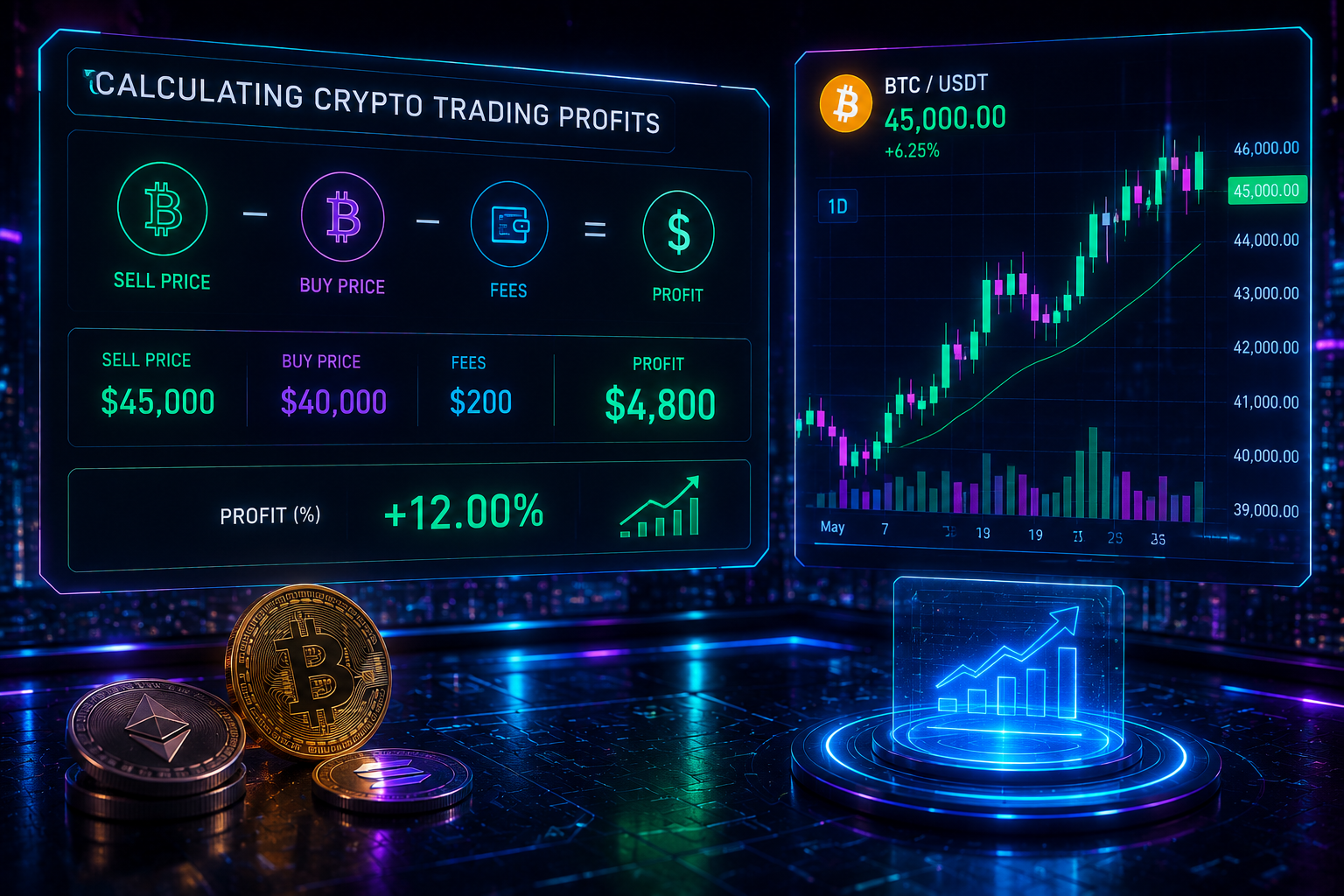
This is the foundation everything else is built on. The 1-2% rule means that if your total trading account is $10,000, you risk a maximum of $100 to $200 on any single position, not the full position size, just the amount you’re prepared to lose if the trade goes wrong.
How the 1% Rule Keeps You in the Game Long-Term
Risking 1% per trade means you can absorb 50 consecutive losing trades and still have more than 60% of your capital intact. That’s not a hypothetical, that’s the mathematical cushion that keeps you trading through drawdown periods that would otherwise knock you out entirely. Longevity in the market is how skill compounds into consistent profitability.
How to Calculate Your Maximum Risk Per Trade
The calculation is straightforward once you have three numbers: your account size, your risk percentage, and your entry and stop-loss prices.
Example: Account size = $10,000 | Risk per trade = 1% = $100 | Entry price = $2,000 per ETH | Stop-loss = $1,950 per ETH | Distance to stop = $50
Position size = Maximum risk / Distance to stop = $100 / $50 = 2 ETH
If this trade hits your stop-loss, you lose exactly $100, 1% of your account, and live to trade another day.
Rule 2: Always Set a Stop-Loss Before You Enter Any Trade
A stop-loss isn’t pessimism, it’s professionalism. Entering any trade without a predefined exit point for a losing scenario is not trading, it’s gambling with extra steps. The stop-loss is the line you draw before emotions get involved, which is the only time you can trust yourself to draw it accurately.
The most common reason traders skip stop-losses is confidence. They’re certain the trade will work. But certainty is not a risk management strategy. Every professional trader, from hedge fund managers to independent day traders, uses hard stop-losses because they understand that no setup has a 100% win rate, and the market doesn’t care how certain you feel.
Where to Place Your Stop-Loss Without Getting Shaken Out
Placing a stop-loss too close to your entry is one of the most common and costly mistakes in active trading. You get stopped out by normal price noise, then watch the trade move in the direction you originally expected, without you in it. Stop-loss placement should be based on market structure, not on how much money you’re willing to lose.
- Below key support levels for long positions, if support breaks, the thesis is invalidated
- Above key resistance levels for short positions, a breakout above resistance means the setup is wrong
- Beyond recent swing lows or highs to avoid being stopped out by normal volatility wicks
- Outside of consolidation zones where price action is choppy and unpredictable
- Never at round numbers like $50,000 or $2,000, these attract stop hunts from larger market participants
Once your stop placement is determined by market structure, you then adjust your position size to ensure the dollar risk stays within your 1-2% limit. The stop placement comes first, the position size is calculated around it.
Why Moving Your Stop-Loss Further Is a Losing Habit
| Behavior | Short-Term Outcome | Long-Term Outcome |
|---|---|---|
| Holding original stop-loss | Small loss accepted | Capital preserved for next trade |
| Moving stop-loss further away | Avoids immediate loss | Larger loss when stop eventually hits |
| Removing stop-loss entirely | Position stays open | Catastrophic loss or margin call |
| Averaging into a losing trade | Lower average entry price | Doubled exposure to a failing thesis |
Moving a stop-loss in the direction of a losing trade is the single most self-destructive habit an active trader can develop. It reframes discipline as a suggestion and turns a rule-based system into an emotion-based one. The moment you move a stop-loss because a trade is going against you, you’ve handed control of your account to the market.
Hard Stop-Loss vs. Mental Stop-Loss: Which One Actually Works
A mental stop-loss is a promise you make to yourself when conditions are calm. A hard stop-loss is an order sitting on the exchange that executes automatically when price hits your level, regardless of how you feel in that moment. The difference between these two approaches is the difference between a system and an intention, and in fast-moving crypto markets, intentions fail constantly.
When Bitcoin drops 8% in fifteen minutes and your mental stop triggers, the emotional pull to wait for a bounce is overwhelming. Most traders wait. The bounce doesn’t come. The 8% loss becomes 15%. Hard stop-losses remove that choice entirely, which is exactly the point. The exchange executes your plan before your emotions get a vote.
Rule 3: Master Position Sizing on Every Single Trade
Position sizing is the mechanism that connects your risk percentage to your actual trade. It determines how many units of an asset you buy or sell based on the distance to your stop-loss and the maximum dollar amount you’re willing to lose. Most traders focus obsessively on entry signals and ignore position sizing completely, which is like building a high-performance engine and forgetting to install brakes. A perfect entry with a wrong position size can still destroy an account. The formula is simple: divide your maximum risk in dollars by the distance from your entry to your stop-loss in dollars, and the result is the number of units you trade. Every single time, without exception.
Rule 4: Never Trade Without a Risk-to-Reward Ratio of At Least 1:2
Risk-to-reward ratio (RRR) defines how much profit you target relative to how much you’re risking. A 1:2 RRR means for every $100 you risk, you’re targeting a $200 profit. This single filter eliminates the majority of low-quality trade setups before they ever cost you money. Trading with anything less than a 1:2 ratio significantly raises the win rate you need just to break even, at 1:2 the breakeven win rate is roughly 33%, and it climbs fast as the ratio worsens, a difficult standard to maintain consistently in volatile crypto markets.
How to Calculate Your Risk-to-Reward Ratio in Under a Minute
The calculation requires three price levels: your entry, your stop-loss, and your profit target. The risk is the distance in dollars from entry to stop-loss. The reward is the distance from entry to your profit target. Divide the reward by the risk to get your ratio. For example, if you enter Bitcoin at $95,000, set a stop at $93,500 (risk = $1,500), and target $98,000 (reward = $3,000), your RRR is 1:2. That’s a trade worth considering. If the math doesn’t reach at least 1:2, skip the trade and wait for a better setup, there will always be another one.
Why a High Win Rate Means Nothing Without Strong Risk-to-Reward
A trader winning 70% of their trades sounds impressive until you see they’re risking $300 to make $100 on every trade. At that ratio, three losses wipe out seven wins. Conversely, a trader who wins only 40% of their trades but consistently maintains a 1:3 RRR is highly profitable over time. The math is irrefutable, win rate and risk-to-reward must be evaluated together, and in practice, a lower win rate with strong RRR is far more sustainable than chasing a high win rate with poor trade selection.
Rule 5: Diversify Across Assets, But Not Too Much
Diversification in crypto trading is a balance between spreading risk and maintaining meaningful exposure to your best ideas. The goal isn’t to own everything, it’s to ensure no single position, sector, or correlated group of assets can sink your entire account at once. Done correctly, diversification smooths your equity curve without diluting your returns to the point of irrelevance.
How Over-Diversification Kills Crypto Returns
Holding 25 different crypto positions simultaneously creates a different problem than holding none. At that level of spread, your winners don’t move the needle and your losers still sting. You end up with portfolio performance that mirrors the broader market index, except with the added friction of trading fees, position monitoring, and cognitive overload across too many setups.
Over-diversification also dilutes conviction. If a trade setup is genuinely strong, clear structure, defined risk, favorable RRR, it deserves meaningful allocation. Spreading capital across dozens of mediocre setups instead of concentrating on high-conviction ones is how traders achieve average results despite above-average analysis.
The Diversification Spectrum for Active Crypto Traders
Under-diversified (1-2 positions): High conviction but extreme concentration risk, one bad trade has outsized account impact.
Optimal range (4-5 positions): Meaningful diversification without diluting performance. Each position carries real weight. Losses are contained. Winners matter.
Over-diversified (15+ positions): Risk is spread but so is attention and capital. Performance converges toward market average. Edge is neutralized.
The sweet spot for most active traders sits in the four to five position range. This provides enough diversification that a single bad trade won’t define your week, while keeping enough concentration that your best ideas actually move your portfolio.
It’s also worth noting that in crypto, diversification across assets doesn’t always mean diversification across risk. During broad market selloffs, Bitcoin, Ethereum, and most altcoins fall together with high correlation. True diversification requires thinking about sector exposure, DeFi, Layer 1s, AI tokens, and stablecoins react differently to different market conditions.
The Right Number of Positions to Hold as an Active Trader
For day traders and short-term swing traders, fewer positions almost always outperform more. Attention is a finite resource, and every additional open position divides your focus, increases your emotional load, and raises the likelihood of a missed exit or ignored stop-loss.
Three to five simultaneous positions is a practical ceiling for most active traders. This is enough to absorb a loss on any single trade without materially damaging overall performance, while keeping each position meaningful enough that wins actually compound your account.
If you find yourself constantly scanning for new positions to add while existing ones are still open, that’s a signal, not of opportunity, but of distraction. The best traders aren’t the ones who trade the most. They’re the ones who wait for the right setups, size them correctly, and manage them without letting new opportunities pull their attention away from open risk.
Rule 6: Cut Leverage or Risk Blowing Up Your Account
Leverage is the most seductive and most destructive tool available to active crypto traders. It amplifies gains in a way that feels like skill, then amplifies losses in a way that feels like catastrophe. The crypto market’s built-in volatility already provides more than enough movement for disciplined traders to profit, adding high leverage on top of that volatility is one of the fastest ways to go from active trader to cautionary tale.
- 2x leverage: Doubles both gains and losses, manageable with tight risk management and small position sizes
- 5x leverage: A 20% adverse move wipes your entire margin, common intraday crypto swings make this genuinely dangerous
- 10x leverage: A 10% move against you causes full liquidation, Bitcoin moves 10% in a single day with regularity
- 20x-100x leverage: Used almost exclusively by speculators, not traders, liquidation can occur on normal market noise within minutes
- Isolated margin: Limits liquidation risk to one position’s margin, always preferable to cross-margin when using any leverage
The traders who survive long-term in leveraged crypto markets are almost universally those who treat leverage as a tool to use sparingly, not as a multiplier to maximize on every trade. The instinct to use maximum available leverage is exactly backward, the higher the leverage, the smaller the position size needs to be to keep dollar risk within your 1-2% limit.
If the math of applying your 1-2% risk rule forces you into an extremely small position size even at moderate leverage, that’s the system working correctly. It means the trade’s stop distance is too wide for the leverage level, and you should either reduce leverage, widen your risk tolerance, or skip the trade entirely.
How Liquidation Works and Why It Happens Faster Than You Think
Liquidation occurs when your position’s losses consume enough of your margin that the exchange automatically closes your trade to prevent a negative balance. At 10x leverage, a 10% move against you triggers full liquidation. But in practice, liquidation often happens before that theoretical threshold because of funding rates, slippage on the liquidation order, and the exchange’s maintenance margin requirements eating into your buffer. A position that looks like it has room suddenly doesn’t, and by the time most traders react, the exchange has already closed it for them.
Safe Leverage Levels for Active Crypto Traders in 2026
For most active traders, 2x to 3x effective leverage represents the upper boundary of what can be managed responsibly alongside a strict 1-2% risk rule and defined stop-losses. At this level, you benefit from amplified returns on winning trades without exposing yourself to the cascade of margin calls and forced liquidations that have ended the accounts of even experienced traders in volatile market conditions.
The traders consistently profitable over multi-year periods in crypto tend to operate with leverage well below what exchanges make available. The availability of 100x leverage on major derivatives exchanges is a feature for the exchange’s revenue, not a recommendation for how to trade. Treat maximum available leverage the same way you’d treat a car’s top speed: technically possible, rarely appropriate, and genuinely dangerous without expert conditions to support it.
Rule 7: Keep a Trading Journal to Spot Costly Patterns
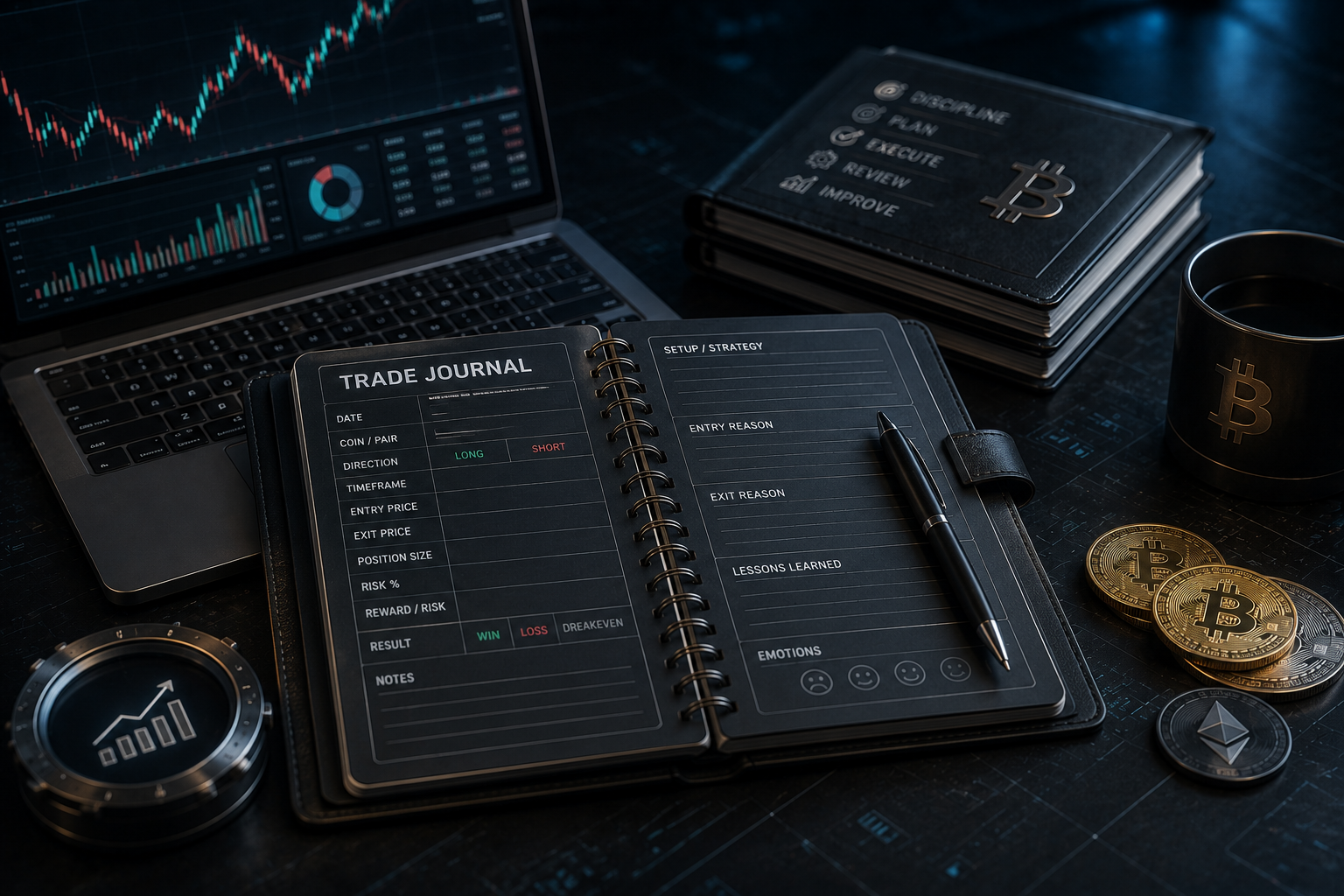
Most traders think they know why they’re losing money. A journal proves them wrong. A trading journal is a systematic record of every trade you take, entry price, exit price, position size, the setup you identified, and critically, how you felt when you made the decision. Over weeks and months, patterns emerge that are completely invisible in the moment but blindingly obvious in retrospect.
The journal doesn’t need to be complicated. A simple spreadsheet with the following columns covers everything that matters:
- Date and time of entry and exit
- Asset traded and direction (long or short)
- Entry price, stop-loss level, and profit target
- Position size and dollar risk on the trade
- Actual exit price and profit or loss in dollars
- Setup type, breakout, support bounce, trend continuation, etc.
- Emotional state, confident, anxious, revenge trading, FOMO
- Notes, what you saw, what actually happened, what you’d do differently
Review your journal weekly. Look for which setups are actually profitable versus which ones feel good but consistently underperform. Look for time-of-day patterns, market condition patterns, and emotional state patterns. Most traders who do this honestly discover two or three setup types that are genuinely profitable, and five or six that cost them money every time they take them. Eliminating the losers and doubling down on the winners is one of the highest-leverage improvements any active trader can make.
Rule 8: Know When to Stop Trading Entirely
Knowing when not to trade is just as valuable as knowing when to trade. There are specific conditions, both market-driven and psychological, where the statistically correct action is to close your platform, step away, and return when conditions improve. Most traders never develop this skill because stopping feels like weakness. In practice, it’s one of the most disciplined moves a trader can make.
Daily Loss Limits That Protect You From Revenge Trading
A daily loss limit is a hard cap on how much you’re willing to lose in a single trading session before you stop entirely. A commonly used benchmark is 3% of total account equity, meaning if your $10,000 account drops to $9,700 in one day, you close everything and don’t open another trade until the next session. No exceptions.
The reasoning behind this rule is behavioral, not mathematical. After a significant loss, the brain shifts into recovery mode. Trades start being taken not because the setups are good, but because you need to “win back” what you lost. This is revenge trading, and it is responsible for more account wipeouts than almost any other single behavior in active trading. A predefined daily loss limit interrupts that cycle before it starts, removing the temptation entirely by making the decision in advance, when you’re still thinking clearly.
Signs You Are Too Emotional to Trade Right Now
The most dangerous trading sessions aren’t the ones where the market is volatile, they’re the ones where you are. Emotional states that impair trading judgment don’t always feel dramatic. Sometimes they’re subtle, and that subtlety is what makes them so destructive.
Watch for these specific warning signs before and during any trading session:
- You’re entering trades within minutes of a loss, skipping your normal setup criteria
- You’ve increased your position size after a losing trade to “make it back faster”
- You’re watching charts and feeling genuinely angry, anxious, or desperate
- You’ve moved a stop-loss further away because you “know” the trade will come back
- You entered a trade because you saw someone else post a position on social media
- You’re trading assets or timeframes you don’t normally trade, chasing volatility
- You haven’t slept properly, have been drinking, or are under significant personal stress
Any one of these signals is enough to justify closing your positions, stepping away from the screen, and returning with a clear head. The market will still be there tomorrow. Your capital needs to be there too.
Consistent Risk Management Separates Profitable Traders From Gamblers
The eight rules covered in this article aren’t restrictions, they’re the infrastructure that makes long-term profitability possible. Every trader who has built a sustainable track record in crypto has some version of these rules operating in their process. The specific parameters vary, but the underlying principles don’t: define your risk before you enter, size positions to protect your capital, demand a favorable risk-to-reward setup, and stop trading when your judgment is compromised. Applied consistently, these rules don’t just protect you from catastrophic losses, they create the conditions where your edge, whatever it is, can actually compound over time. That compounding is how real wealth gets built in the markets, and it only happens to traders who are still in the game.
Frequently Asked Questions
Below are answers to the most common questions active crypto traders have about risk management, covering the fundamentals that make the difference between accounts that survive and accounts that don’t.
What Is the Most Important Risk Management Rule in Crypto Trading?
The single most important rule is never risking more than 1-2% of your total capital on any one trade. This rule is the foundation everything else depends on. It ensures that no single trade, no matter how wrong your analysis, no matter how sudden the market move, can do irreparable damage to your account. Every other risk management rule supports this one, but if you only implement one change, make it this.
How Much of My Portfolio Should I Risk on a Single Crypto Trade?
Risk 1% to 2% of your total trading capital per trade, measured as the dollar distance from your entry to your stop-loss multiplied by your position size. For a $5,000 account, that’s $50 to $100 maximum risk per trade, not $50 to $100 position size, but $50 to $100 of potential loss if the trade hits your stop. This distinction matters enormously when using leverage, where a small position can carry large loss exposure if the stop is placed too far from entry.
Does Risk Management Still Matter in a Bull Market?
Risk management matters more in a bull market than most traders realize. Rising markets create overconfidence, encourage larger position sizes, and make it easy to confuse a favorable market environment with personal trading skill. When the trend eventually reverses, and it always does, traders who loosened their risk rules during the bull run give back their gains faster than they made them. The 2021 bull market made thousands of traders feel invincible. The 2022 bear market reminded them that risk management isn’t optional regardless of market direction.
What Is a Good Risk-to-Reward Ratio for Crypto Day Trading?
A minimum of 1:2 is the standard floor, meaning for every dollar risked, you’re targeting at least two dollars in profit. Many experienced crypto day traders operate at 1:3 or better on their highest-conviction setups. The higher the ratio you can consistently achieve, the lower your win rate needs to be for your overall strategy to remain profitable.
For example, a trader maintaining a 1:3 risk-to-reward ratio only needs to win 25% of their trades to break even before fees. That’s a meaningful statistical cushion that keeps a strategy viable even through extended drawdown periods, something every active trader will inevitably experience regardless of their skill level.
How Do I Stop Emotional Trading From Ruining My Results?
The most effective solution is removing as many real-time decisions as possible from the equation. Set your stop-loss and profit target as hard orders the moment you enter a trade. Define your daily loss limit before the session starts. Write down the specific criteria a setup must meet before you’ll take it, and only take trades that meet all of those criteria, no exceptions based on gut feel or urgency.
A trading journal accelerates this process significantly. When you review your journal and see, in black and white, that every trade you took while frustrated or anxious resulted in a loss, the emotional trades start feeling less compelling. Data overrides instinct in a way that willpower alone rarely can. The goal isn’t to eliminate emotion, it’s to build a system where emotion has less opportunity to influence execution.
DYOR Disclaimer: This article is for informational and educational purposes only and does not constitute financial, investment, or trading advice. Cryptocurrency trading, especially with leverage, carries substantial risk of loss. Always do your own research (DYOR) and consult a qualified financial advisor before making trading decisions.