Coinposters
Bitcoin vs Ethereum 2026: Which Is More Profitable for Long-Term Investors?
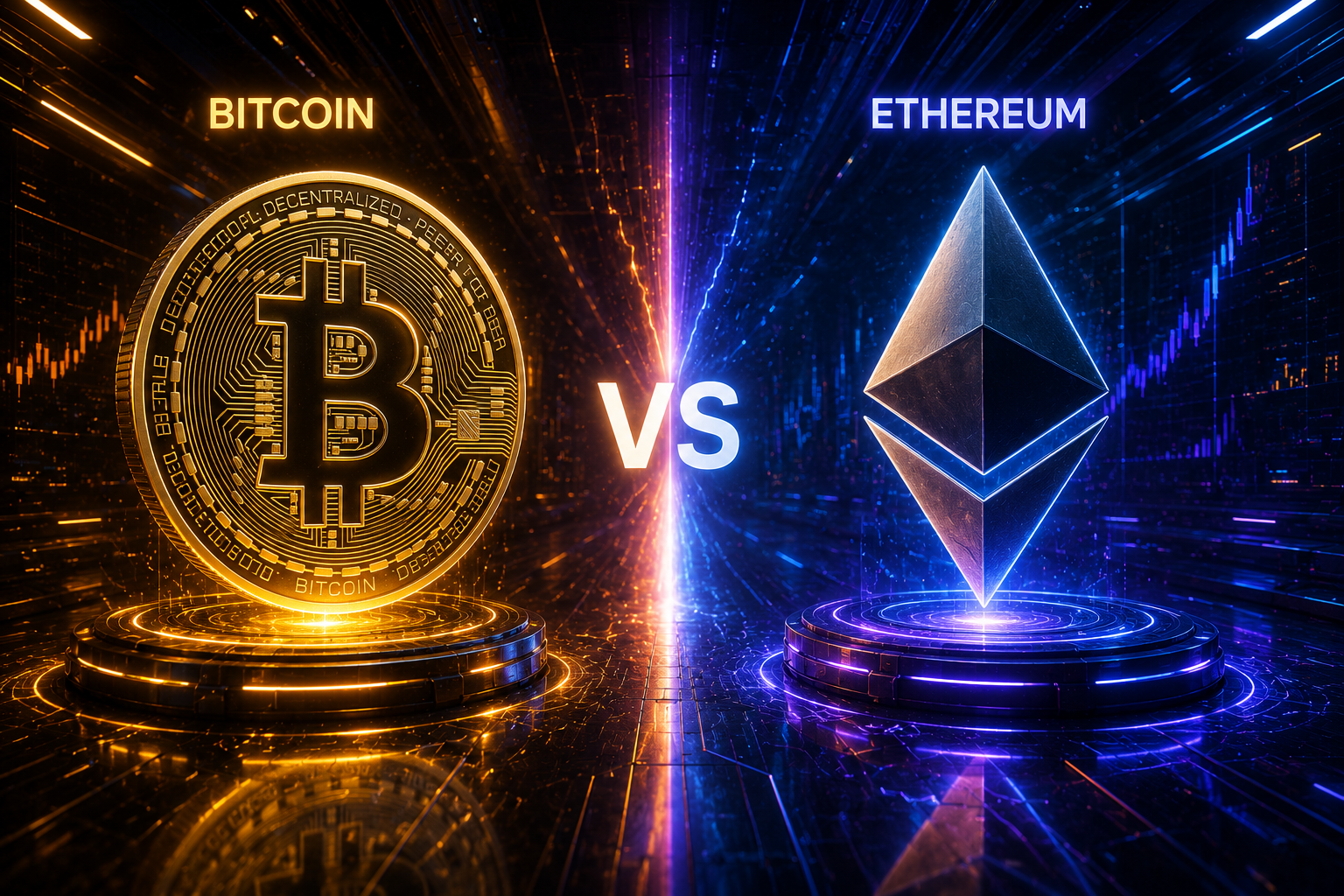
BTC vs ETH: Which one generates more profit in 2026?
In the Bitcoin vs Ethereum 2026 debate, neither asset is objectively “better”, Bitcoin is the lower-risk, higher-certainty monetary asset while Ethereum is the higher-risk, higher-upside utility layer, and most experienced investors hold both rather than choosing one.
Article at a Glance
Here’s the short version of the Bitcoin vs Ethereum 2026 comparison:
- Bitcoin peaked near $126,000 in October 2025 and now trades around $62,000-$64,000, while Ethereum peaked near $4,950 in August 2025 and now sits around $1,750-$1,800, but raw price alone tells you almost nothing about which is the better long-term investment.
- Bitcoin operates as a monetary asset with a hard cap of 21 million coins, while Ethereum functions as a programmable settlement layer powering DeFi, stablecoins, and tokenized real-world assets.
- The ETH/BTC ratio sits at roughly 0.028 as of mid-2026, meaning Ethereum has significantly underperformed Bitcoin in BTC terms, a critical signal for long-term portfolio positioning.
- Ethereum’s post-Merge proof-of-stake model now offers staking yields and a deflationary burn mechanism, reshaping its investment case compared to Bitcoin’s pure scarcity model.
- Many experienced investors hold both assets, but the weight you give each should depend on whether you’re optimizing for monetary store-of-value or exposure to on-chain economic growth.
Table of Contents
- Bitcoin at $63K, Ethereum at $1,750: What That Gap Means
- What Is Bitcoin and Why Do People Buy It in 2026?
- What Is Ethereum and Why Do People Buy It in 2026?
- Bitcoin vs Ethereum: Core Technical Differences That Affect Your Returns
- Historical Returns: How BTC and ETH Have Actually Performed
- Bitcoin vs Ethereum as Long-Term Investments in 2026
- BTCFi vs Ethereum DeFi: Where Is the Real On-Chain Money Going?
- Environmental Impact: Bitcoin Mining vs Ethereum Proof of Stake
- How to Allocate BTC and ETH in a Long-Term Crypto Portfolio
- Bitcoin or Ethereum: Which One Should You Actually Buy?
- Frequently Asked Questions
The Bitcoin vs Ethereum debate in 2026 is not really about which coin is “better”, it’s about which type of asset fits your investment strategy.
Bitcoin vs Ethereum at a Glance: 2026 Snapshot
| Metric | Bitcoin (BTC) | Ethereum (ETH) |
|---|---|---|
| Cycle Peak (Oct/Aug 2025) | ~$126,200 | ~$4,950 |
| Current Price (Mid-2026) | ~$62,000-$64,000 | ~$1,750-$1,800 |
| Market Cap | #1 Crypto Asset | #2 Crypto Asset |
| Consensus Mechanism | Proof of Work | Proof of Stake |
| Max Supply | 21 Million BTC | No Hard Cap (Deflationary Burn) |
| ETF Availability | Spot Bitcoin ETF (US-Approved) | Spot Ethereum ETF (US-Approved) |
| Staking Yield | None | ~3-4% APR |
| Primary Investment Role | Digital Gold / Store of Value | Programmable Money / Utility Layer |
| ETH/BTC Ratio (Mid-2026) | – | ~0.028 |
Bitcoin at $63K, Ethereum at $1,750: Here Is What That Gap Actually Means for You
When most people look at Bitcoin trading in the low $60,000s and Ethereum near $1,750, the first reaction is that Bitcoin is more expensive. That’s the wrong way to look at it. Price per coin means nothing in isolation. What matters is market capitalization, supply dynamics, and the underlying value driver of each asset, and those three things are dramatically different between BTC and ETH.
Both assets set fresh cycle highs in 2025, Bitcoin near $126,200 in October and Ethereum near $4,950 in August, before a sharp correction pulled the total crypto market down substantially through the first half of 2026. Bitcoin still commands the largest share of the market, driven by institutional capital, sovereign-level interest, and ETF inflows that weren’t possible even two years ago. Ethereum’s position is still enormous, but its growth story in 2026 is built on an entirely different foundation, one centered on what’s actually happening on-chain.
Bitcoin’s Monetary Premium vs Ethereum’s Utility Premium
Bitcoin’s value is anchored in scarcity and trust. There will only ever be 21 million BTC, and that fact alone, combined with growing institutional adoption, creates what’s called a monetary premium. People hold Bitcoin the same way they hold gold: as a long-term store of value that protects purchasing power against inflation and currency debasement. For more insights on Bitcoin and Ethereum, check out this analysis comparing Bitcoin vs Ethereum.
Ethereum’s value works differently. It comes from utility, the fees generated on the network, the economic activity happening in DeFi protocols, the stablecoins settled on-chain, and the tokenized real-world assets being issued on Ethereum’s base layer. If Bitcoin is digital gold, Ethereum is closer to digital infrastructure. The more the network gets used, the more valuable ETH becomes.
“If Bitcoin is digital gold, Ethereum is closer to digital infrastructure. The more the network gets used, the more valuable ETH becomes.”
Why the Right Answer Depends on What You Are Actually Investing In
This distinction matters more than most investors realize. If you buy Bitcoin expecting it to behave like a tech stock with rapid, usage-driven growth, you’ll likely be frustrated. If you buy Ethereum expecting the predictable, slow-accumulation quality of a hard monetary asset, you’ll be confused by its volatility patterns. They are genuinely different instruments, which is exactly why comparing them purely by price or percentage gains misses the point entirely.
What Is Bitcoin and Why Do People Buy It in 2026?
Bitcoin is a decentralized digital currency with a fixed supply of 21 million coins, secured by a global network of miners using proof-of-work consensus. It launched in 2009, and for a long time it was treated as a speculative experiment. In 2026, it is treated as a macro asset, held by pension funds, sovereign wealth vehicles, and on corporate balance sheets. That shift didn’t happen by accident.
Bitcoin’s Fixed Supply of 21 Million Coins and the 2024 Halving
In April 2024, Bitcoin went through its fourth halving event, cutting the block reward from 6.25 BTC to 3.125 BTC per block. This happens every 210,000 blocks, roughly every four years, and it reduces the rate at which new Bitcoin enters circulation by 50%. Historically, halvings have preceded significant price appreciation over the following 12 to 18 months, driven by a simple supply-demand imbalance: less new Bitcoin hitting the market while demand holds steady or grows.
The 2024 halving also happened alongside the approval of spot Bitcoin ETFs in the United States, a combination that created a demand shock the market had never seen before. True to the historical pattern, Bitcoin reached a new cycle peak of approximately $126,200 in October 2025, almost exactly 18 months after the halving, before correcting sharply into 2026 as the broader market cooled and now trading in the low $60,000s.
How Institutional Adoption and Spot Bitcoin ETFs Changed the Game
The approval of spot Bitcoin ETFs in the US was a structural turning point. It created a compliant, regulated on-ramp for institutional capital, pension funds, endowments, and wealth managers, that previously couldn’t hold BTC directly due to regulatory or custodial constraints. The result was a wave of sustained buying pressure from entities that typically hold positions for years, not days. This is the single biggest reason Bitcoin’s investment narrative has shifted from “speculative asset” to “portfolio allocation tool” at the institutional level.
Why Bitcoin Behaves Like Digital Gold
Bitcoin shares several key properties with gold: it’s scarce, durable, divisible, and not controlled by any government or central bank. But it improves on gold in critical ways, it’s easier to transfer globally, easier to verify, easier to self-custody, and its supply schedule is mathematically enforced by code rather than dependent on mining output. In 2026, Bitcoin’s correlation with gold during periods of macro stress is one reason long-term investors treat it as a hedge against currency debasement and geopolitical uncertainty, not just a crypto bet.
What Is Ethereum and Why Do People Buy It in 2026?
Ethereum is a programmable blockchain that launched in 2015 with a vision that went far beyond digital currency. Where Bitcoin is designed to do one thing extremely well, store and transfer value, Ethereum is designed to be a platform. Smart contracts, decentralized applications, stablecoins, NFTs, DeFi protocols, and tokenized real-world assets all run on Ethereum’s base layer. That breadth of use cases is precisely what makes ETH a fundamentally different investment.
By 2026, Ethereum has firmly established itself as the dominant settlement layer for on-chain finance. More stablecoins are issued on Ethereum than any other chain. The majority of tokenized US Treasury products and real-world assets use Ethereum as their settlement base. The DeFi ecosystem, lending, borrowing, derivatives, liquidity provision, is overwhelmingly Ethereum-native. This isn’t just market share; it’s deep network entrenchment that becomes harder to displace with every new protocol built on top of it.
How Ethereum’s Proof-of-Stake Transition Reshaped Its Investment Case
In September 2022, Ethereum completed “The Merge,” transitioning from energy-intensive proof-of-work mining to proof-of-stake consensus. This was one of the most significant technical achievements in crypto history. The immediate effect was a roughly 99.95% reduction in Ethereum’s energy consumption. The longer-term investment effect was more nuanced: it transformed ETH from a purely speculative asset into one that generates yield for holders who stake it, while simultaneously introducing a deflationary fee-burn mechanism that reduces circulating supply during periods of high network activity.
ETH Staking Yields and What They Mean for Long-Term Holders
Staking ETH currently generates approximately 3-4% APR, paid in newly issued ETH. This is not a trivial number in a crypto context. It means long-term holders aren’t just waiting for price appreciation, they’re compounding their ETH position over time by participating in network security. For investors who plan to hold ETH for three to five years, the staking yield meaningfully changes the total return calculation versus simply holding BTC with no native yield.
It’s worth noting that staking yield is not risk-free. Validators can face “slashing” penalties for malicious or faulty behavior, and liquid staking protocols like Lido introduce smart contract risk on top of the base staking risk. For most long-term holders, these risks are manageable, but they are real and should factor into any honest comparison with Bitcoin’s simpler hold-and-wait model.
Dencun, Pectra, and Fusaka: Ethereum’s Upgrade Roadmap Explained Simply
Ethereum runs on a continuous upgrade roadmap designed to improve scalability, reduce fees, and expand its capabilities. The Dencun upgrade in early 2024 introduced “proto-danksharding,” a technical change that dramatically reduced fees on Ethereum’s Layer 2 networks like Arbitrum, Optimism, and Base by creating temporary data storage “blobs” that are cheaper than permanent calldata. The result was transaction fees on L2s dropping by as much as 90%, making Ethereum-based applications far more accessible.
The Pectra upgrade in 2025 continued Ethereum’s scaling journey with improvements to validator mechanics and account abstraction, simplifying how users interact with smart contracts and wallets. Looking ahead, Fusaka is the next major upgrade on the roadmap, focused on full danksharding and further data availability improvements that would make Ethereum’s Layer 2 ecosystem even more efficient. Each upgrade incrementally strengthens the case for Ethereum as a long-term infrastructure investment by expanding what the network can handle without compromising security.
Bitcoin vs Ethereum: The Core Technical Differences That Affect Your Returns
The technical differences between Bitcoin and Ethereum aren’t just interesting for developers, they directly affect how each asset behaves as an investment. Supply mechanics, consensus models, energy use, and upgrade frequency all feed into the risk-return profile you’re taking on when you buy either asset.
Proof of Work vs Proof of Stake and Why It Matters for Investors
Bitcoin uses proof of work (PoW), which requires miners to expend real-world energy to validate transactions and secure the network. This energy cost is not a bug, it’s a feature. It makes attacking the Bitcoin network extraordinarily expensive, and it ties Bitcoin’s security to a physical resource (electricity and hardware) that cannot be faked or inflated away. The tradeoff is energy consumption and slower transaction throughput.
Ethereum uses proof of stake (PoS), where validators lock up ETH as collateral to participate in block production. This is vastly more energy-efficient and allows for faster finality, but it introduces different security assumptions. In PoS, economic security comes from the value of staked ETH: the more ETH locked in validators, the more expensive an attack becomes. Critics argue PoS concentrates power among large ETH holders; proponents argue the economic incentives are more than sufficient to maintain network integrity. For investors, the practical upshot is that PoS enables staking yields, which PoW cannot offer.
Bitcoin’s Hard Cap vs Ethereum’s Burn Mechanism
Bitcoin’s supply cap is absolute. There will never be more than 21 million BTC, this is enforced at the protocol level and would require consensus from the entire network to change, something that has never happened and is considered essentially impossible given Bitcoin’s decentralized stakeholder base. As of 2026, roughly 19.7 million BTC have already been mined, meaning less than 1.3 million remain to enter circulation over the next century. That mathematically shrinking supply, combined with growing demand, is the core engine of Bitcoin’s long-term value thesis.
How Ethereum’s EIP-1559 Burn Works: Every transaction on Ethereum pays a “base fee” that is permanently destroyed, removed from the total ETH supply forever. When network activity is high enough, the amount of ETH burned exceeds the amount issued to stakers, making ETH net deflationary. During peak usage periods in 2021 and 2022, Ethereum was burning millions of dollars worth of ETH per day. In lower-activity periods, issuance can slightly exceed burns, making ETH mildly inflationary. This means Ethereum’s supply is dynamic and activity-dependent, not fixed like Bitcoin’s.
This is a fundamental philosophical difference between the two assets. Bitcoin investors get certainty, the supply schedule is known decades in advance. Ethereum investors get a more complex dynamic where the asset can become more scarce during periods of high network demand, potentially amplifying price appreciation when usage spikes. Neither model is strictly superior; they reflect different design priorities and reward different types of investors.
For long-term holders, the practical implication is this: Bitcoin’s scarcity is guaranteed by math. Ethereum’s scarcity is earned by usage. If you believe on-chain economic activity will grow significantly over the next five to ten years, Ethereum’s burn mechanism could make it increasingly scarce over time. If you want certainty over speculation, Bitcoin’s hard cap is unmatched in the entire asset class.
Historical Returns: How BTC and ETH Have Actually Performed
Past performance doesn’t guarantee future results, but in crypto, understanding how Bitcoin and Ethereum have actually performed across different market cycles tells you a great deal about their risk profiles, their correlation to each other, and what kind of volatility you need to be prepared to stomach as a long-term holder.
Multi-Year Price Performance Comparison
- Bitcoin (BTC), 2021 Peak: ~$69,000 in November 2021, following the institutional wave and first futures ETF approvals
- Ethereum (ETH), 2021 Peak: ~$4,800 in November 2021, driven by the DeFi summer explosion and NFT boom
- 2022 Bear Market Low, BTC: Dropped to approximately $15,500 in November 2022 following the FTX collapse, a drawdown of roughly 77% from peak
- 2022 Bear Market Low, ETH: Fell to approximately $880 in June 2022, a drawdown of roughly 82% from its peak
- 2024 Recovery, BTC: Bitcoin broke its all-time high in March 2024, driven by spot ETF approval and post-halving momentum, reaching $73,000+ before consolidating
- Cycle Peak, BTC: Bitcoin reached a new all-time high of approximately $126,200 in October 2025
- Cycle Peak, ETH: Ethereum reached an all-time high of approximately $4,950 in August 2025, still its high-water mark
- Mid-2026: Following a sharp correction, BTC trades around $62,000-$64,000 and ETH around $1,750-$1,800, both well off their 2025 peaks
What this picture reveals is important: Bitcoin set a new all-time high in October 2025, matching the historical pattern of significant post-halving appreciation roughly 18 months after the April 2024 halving. Ethereum also set a fresh all-time high in August 2025, its first time exceeding the 2021 peak in nominal USD terms. Both assets have since pulled back significantly through the first half of 2026, a fact that surprises many investors who assumed the 2025 highs marked a durable new floor rather than a cyclical peak.
The reason for the relative divergence between the two comes back to the monetary premium vs utility premium distinction. Bitcoin attracted a wave of new institutional capital through ETFs that had no equivalent in Ethereum’s demand structure at the same scale. Ethereum’s value depends on network usage growing faster than its supply dynamics, and while usage has grown substantially, the ETF demand for ETH has been more modest than what BTC experienced.
It’s also worth noting that both assets have delivered extraordinary long-term returns compared to virtually every traditional asset class. Investors who held BTC or ETH through the full multi-year cycle, including the brutal 2022 drawdown, came out significantly ahead even after the 2026 correction. The challenge is always the behavioral one: can you hold through an 80% drawdown without selling?
That question isn’t rhetorical. The investors who compounded the most wealth in both BTC and ETH over the past several years were those who accumulated during bear markets and held through recoveries. Dollar-cost averaging into either asset during 2022’s lows and holding through the 2025 peaks would have produced returns that are difficult to match in any other asset class, which is precisely why long-term conviction matters more than short-term price timing in crypto.
Volatility Patterns and Drawdown Risk Between BTC and ETH
Both Bitcoin and Ethereum are significantly more volatile than traditional assets like stocks or bonds, but they are not equally volatile with each other. Historically, Ethereum has experienced deeper percentage drawdowns than Bitcoin in bear markets, while also delivering larger percentage gains in bull markets. This makes ETH a higher-beta version of BTC in many market environments: more upside, more downside, more volatility in both directions. For long-term investors, this means position sizing matters even more with ETH than it does with BTC. If you’re considering investing in Bitcoin, you might want to explore whether Bitcoin mining is still worth it in 2026.
Bitcoin’s volatility, while still dramatic by traditional finance standards, has been gradually declining on a long-term basis as the asset matures and its holder base diversifies. The entry of institutional investors with multi-year time horizons has added a structural “buy the dip” dynamic that didn’t exist in earlier cycles. Ethereum’s volatility remains higher in part because its price is more sensitive to shifts in on-chain activity, developer sentiment, and upgrade execution risk, variables that Bitcoin simply doesn’t carry.
The ETH/BTC Ratio and What It Tells Long-Term Investors
The ETH/BTC ratio is one of the most useful metrics for comparing the two assets, and it’s one that most casual investors completely ignore. As of mid-2026, the ratio sits at approximately 0.028, meaning one ETH is worth about 2.8% of one Bitcoin. At its peak in late 2021, the ratio reached roughly 0.08, meaning ETH was worth about 8% of one Bitcoin. That collapse in ratio from 0.08 to 0.028 tells you that even though ETH’s dollar price has risen significantly since 2021, it has dramatically underperformed Bitcoin on a relative basis over this cycle.
For long-term investors, the ETH/BTC ratio is not just trivia, it’s a portfolio performance benchmark. If you held ETH instead of BTC over the past few years, you made money in dollar terms but lost significant ground relative to simply holding Bitcoin. Whether that trend reverses in the next cycle depends largely on whether Ethereum’s on-chain growth and upgrade roadmap begin to attract the same scale of institutional capital that has flowed into BTC. That is the key unresolved question in the Bitcoin vs Ethereum debate for 2026 and beyond.
Bitcoin vs Ethereum as Long-Term Investments in 2026
Once you understand what each asset actually is, the investment comparison becomes much cleaner. Bitcoin and Ethereum are not competing for the same role in a portfolio, they serve different functions, attract different types of capital, and respond differently to macro conditions. The question isn’t which one is better in absolute terms; it’s which one (or what combination) aligns with your specific investment goals, time horizon, and risk tolerance.
The Case for Bitcoin: Scarcity, Liquidity, and Macro Relevance
Bitcoin’s investment case in 2026 rests on three pillars. First, its supply is absolutely fixed, no other asset in the world, digital or physical, offers mathematically guaranteed scarcity at this scale. Second, Bitcoin now has the deepest liquidity in the crypto market, with spot ETFs providing a regulated on-ramp that has brought in billions in institutional capital. Third, and perhaps most importantly, Bitcoin has achieved macro relevance, it is increasingly discussed by central banks, sovereign wealth funds, and government treasuries as a reserve asset consideration. That conversation happening at that level is something Ethereum has not yet achieved.
Bitcoin’s simplicity is also a feature for long-term investors. There are no upgrade risks, no smart contract vulnerabilities, no governance debates about monetary policy. The rules were set in 2009 and they have not changed. For investors who want maximum predictability in their crypto allocation, a “set it and forget it” approach over a 10-year horizon, Bitcoin’s clarity is compelling in a way that Ethereum, with its continuous upgrade roadmap, cannot match.
The Case for Ethereum: DeFi Growth, Stablecoins, and On-Chain Settlement
Ethereum’s investment case is more complex, and potentially more asymmetric. The bet on ETH is essentially a bet that on-chain finance will continue to grow, that Ethereum will maintain its dominant position as the base settlement layer for that activity, and that the resulting fee burns and network demand will drive ETH’s value higher. Ethereum already settles the majority of stablecoin transactions globally, hosts the dominant DeFi protocols by total value locked, and is the platform of choice for tokenized real-world assets, a market that is growing rapidly as traditional financial institutions explore blockchain-based settlement for bonds, equities, and other instruments.
Which Has More Upside From Here?
- Bitcoin upside drivers: Continued institutional ETF inflows, potential sovereign adoption as a reserve asset, post-halving supply constraint, and growing correlation with gold as a macro hedge
- Ethereum upside drivers: DeFi total value locked growth, expansion of tokenized real-world assets on-chain, Layer 2 ecosystem maturation post-Dencun and Pectra, staking yield compounding, and a potential ETH/BTC ratio recovery if Ethereum ETF demand accelerates
- Bitcoin risk factors: Regulatory hostility to proof-of-work mining, competition from gold ETFs for the same institutional capital, and the risk that Bitcoin’s role as a macro hedge gets crowded out if traditional safe havens reassert dominance
- Ethereum risk factors: Execution risk on the upgrade roadmap, Layer 2 fragmentation reducing base layer fee revenue, competition from other smart contract platforms, and the ongoing challenge of explaining a complex investment thesis to institutional allocators
The honest answer on upside is that Bitcoin’s path to higher prices is clearer and more institutionally legible right now. The ETF pipeline is established, the narrative is simple, and the macro environment in 2026, with continued currency debasement concerns globally, plays directly into Bitcoin’s store-of-value thesis.
Ethereum’s potential upside is arguably larger in percentage terms if everything comes together: the upgrade roadmap executes, DeFi continues to grow, real-world asset tokenization accelerates, and institutional demand for ETH catches up to BTC. That’s a lot of “ifs,” but each individual component is already showing real progress, not just theoretical promise.
What most experienced investors land on is this: Bitcoin is the lower-risk, higher-certainty position. Ethereum is the higher-risk, higher-potential-upside position. Neither is a bad long-term investment, they just sit at different points on the risk-return spectrum within crypto.
The right allocation between them should reflect where you sit on that spectrum personally, not which coin has the louder community on social media or which had the better month.
BTCFi vs Ethereum DeFi: Where Is the Real On-Chain Money Going?
One of the most interesting developments in 2025 and into 2026 is the emergence of BTCFi, Bitcoin-native decentralized finance. For years, DeFi was almost exclusively an Ethereum story. That is beginning to change, and the implications for both BTC and ETH as long-term investments are significant.
Ethereum’s Dominance in DeFi, Stablecoins, and Tokenized Assets
Ethereum still commands the dominant share of on-chain economic activity by almost every measure. The top DeFi protocols, Aave, Uniswap, Maker (now Sky), Curve, Lido, are either Ethereum-native or have their primary liquidity on Ethereum and its Layer 2 networks. Stablecoin issuance on Ethereum dwarfs every other chain combined. And the emerging tokenized real-world asset market, where traditional financial instruments like US Treasuries, corporate bonds, and real estate are represented as tokens on a blockchain, is overwhelmingly settling on Ethereum. BlackRock’s BUIDL fund, one of the most prominent tokenized Treasury products, launched on Ethereum. That institutional endorsement of Ethereum as the preferred settlement layer for regulated financial products is not a small signal.
Bitcoin’s Growing BTCFi Layer and What It Could Mean for BTC’s Value
BTCFi refers to financial applications being built on top of Bitcoin, enabling Bitcoin holders to lend, borrow, earn yield, and participate in DeFi without selling their BTC or bridging to another chain. Protocols like Babylon (Bitcoin staking), Stacks (Bitcoin Layer 2 with smart contracts), and Rootstock (RSK) are building out this infrastructure. The appeal is obvious: Bitcoin holders represent the largest pool of dormant, yield-free capital in crypto. If even a fraction of that capital becomes active in DeFi applications, it could generate significant fee revenue and demand pressure for BTC. For those interested in exploring DeFi further, understanding DeFi risk assessment is crucial.
The caveat is that BTCFi is still early-stage and fragmented compared to Ethereum’s mature DeFi ecosystem. The total value locked in Bitcoin-based DeFi protocols remains a fraction of Ethereum’s figures. For now, BTCFi is a compelling directional thesis for Bitcoin’s long-term value, but it doesn’t yet change the day-to-day reality that Ethereum is where the on-chain economic activity is concentrated. Investors should watch BTCFi development closely as a potential catalyst that could shift the BTC investment narrative from purely “store of value” to “productive asset” over the next several years.
Environmental Impact: Bitcoin Mining vs Ethereum Proof of Stake
This is a topic that increasingly matters to institutional investors with ESG mandates. Bitcoin’s proof-of-work mining consumes significant amounts of energy, estimates suggest the Bitcoin network uses energy comparable to a mid-sized country on an annual basis. The counterargument from Bitcoin advocates is that an increasing share of mining uses renewable energy sources, and that the energy expenditure is the deliberate security mechanism, not waste. As of 2026, estimates suggest more than 50% of Bitcoin mining uses sustainable energy sources, according to the Bitcoin Mining Council’s reporting, though critics argue the methodology is self-reported and difficult to verify independently.
Ethereum’s transition to proof of stake via The Merge in 2022 reduced the network’s energy consumption by approximately 99.95%. This is not a marginal improvement, it fundamentally changed Ethereum’s environmental profile from one that rivaled Bitcoin in energy use to one that consumes roughly the same energy as a small office building. For institutional investors with ESG requirements, this distinction is material. Several large asset managers have explicitly cited Ethereum’s energy efficiency as a factor in their willingness to offer ETH exposure to clients who would not accept Bitcoin’s energy footprint. This is an often-underappreciated competitive advantage for Ethereum in the institutional allocation conversation.
How to Allocate BTC and ETH in a Long-Term Crypto Portfolio
Portfolio allocation between Bitcoin and Ethereum is not a one-size-fits-all decision. The right split depends on your investment timeline, your existing exposure to risk assets, your conviction in each asset’s specific thesis, and your ability to hold through significant drawdowns without panic selling. What follows is a framework, not financial advice, for thinking about how BTC and ETH might fit together in a long-term crypto allocation.
The most common mistake investors make is allocating based on recent performance rather than forward-looking thesis alignment. If you’re buying more ETH because it went up last week, or avoiding BTC because it “already had its run,” you’re making reactive decisions that rarely serve long-term investors well. The better approach is to decide what role each asset plays in your portfolio, store of value anchor vs on-chain growth exposure, and size your positions according to your conviction in each thesis, not the recent price action.
Conservative Portfolio: BTC-Heavy With Small ETH Exposure
A conservative long-term crypto portfolio treats Bitcoin as the primary position and uses Ethereum as a smaller, higher-upside complement. This structure makes sense for investors who want meaningful crypto exposure but prioritize capital preservation and lower volatility within the asset class. The anchor is Bitcoin’s proven monetary premium; the ETH allocation gives you access to on-chain growth without betting the majority of your crypto allocation on execution risk.
- BTC allocation: 70-80% of total crypto portfolio
- ETH allocation: 20-30% of total crypto portfolio
- Rebalancing frequency: Annually, or when one asset outperforms the other by more than 30%
- Best suited for: Investors with a 5-10 year horizon who want macro hedge exposure with limited smart contract or upgrade risk
- Staking approach: Stake the ETH portion to earn the 3-4% APR and reinvest rewards into more ETH quarterly
The logic here is straightforward: Bitcoin’s institutional demand pipeline, its post-halving supply dynamics, and its hard cap make it the most predictable long-term hold in crypto. Ethereum’s 20-30% slice gives your portfolio leverage to on-chain economic growth without overexposing you to ETH’s higher volatility profile.
This is also the structure that aligns most closely with how many institutional crypto funds are currently positioned in 2026. The majority of professionally managed crypto allocations are still BTC-heavy, with ETH as a secondary position and everything else in the “high-conviction speculative” bucket, if present at all. That isn’t herd mentality; it reflects a genuine risk management discipline that most retail investors would benefit from applying to their own portfolios.
If you’re entirely new to crypto and building your first position, starting with an 80/20 BTC/ETH split and gradually adjusting based on your growing understanding of each asset is a reasonable, battle-tested approach that has served long-term holders well across multiple market cycles.
Balanced Portfolio: Equal Weight BTC and ETH
A 50/50 split between Bitcoin and Ethereum is the balanced approach, and it’s more nuanced than it sounds. Equal weighting doesn’t mean you’re indifferent between the two assets. It means you have high conviction in both investment theses simultaneously: you believe Bitcoin will continue to appreciate as a macro store-of-value asset, and you believe Ethereum’s on-chain economy will grow sufficiently to drive significant ETH price appreciation. The 50/50 structure gives you full exposure to both outcomes without having to call which one outperforms.
The main risk of equal weighting is that it can feel uncomfortable during cycles where one asset dramatically outperforms the other, as Bitcoin has done relative to Ethereum in BTC terms this cycle. The discipline required to maintain equal weighting through those periods, and resist chasing the outperformer, is what separates long-term balanced investors from short-term momentum traders. Rebalancing annually back to 50/50 enforces the buy-low, sell-high dynamic automatically, you’ll be selling some of the outperformer and buying more of the underperformer at every rebalance, which has historically been the right move across full crypto cycles.
Growth-Focused Portfolio: ETH-Heavy With BTC as Monetary Anchor
An ETH-heavy allocation, roughly 60-70% ETH, 30-40% BTC, is for investors with high conviction in Ethereum’s on-chain growth thesis, a longer time horizon of 7-10+ years, and the risk tolerance to handle ETH’s deeper drawdown potential. The BTC position serves as the portfolio’s monetary anchor: a stabilizing force during risk-off periods when even ETH sells off sharply. This structure maximizes your exposure to Ethereum’s potential upside from DeFi expansion, real-world asset tokenization, and the ETH/BTC ratio recovering toward historical levels, but it requires the strongest stomach of the three frameworks. This allocation is best suited to investors who have already held through at least one full crypto bear market and understand from personal experience what an 80% drawdown feels like.
How to Use Dollar-Cost Averaging to Build Either Position
Dollar-cost averaging (DCA), investing a fixed dollar amount at regular intervals regardless of price, is the single most effective strategy for building long-term BTC and ETH positions without being destroyed by timing risk. Rather than trying to call market bottoms (which even professional traders consistently fail to do), a weekly or biweekly DCA into your target BTC/ETH allocation smooths your average entry price across multiple market conditions. If you’re targeting a 70/30 BTC/ETH split and investing $500 per month, you’d put $350 into Bitcoin and $150 into Ethereum on the same day each month, automatically. Over 36 months, you’ll have bought at highs, at lows, and everywhere in between, which is exactly the point. The math of DCA works in your favor in volatile assets, because you buy more units when prices are low and fewer when prices are high, naturally lowering your average cost basis over time.
Bitcoin or Ethereum: Which One Should You Actually Buy?
After covering supply mechanics, historical returns, upgrade roadmaps, DeFi dominance, environmental profiles, and portfolio frameworks, the answer to this question is both simpler and more personal than most financial content suggests. There is no universally correct choice between Bitcoin and Ethereum. The right asset, or combination, is the one that maps to your specific investment thesis, time horizon, and emotional capacity for volatility.
What you should avoid is making this decision based on recent price performance, social media sentiment, or which asset your favorite influencer is currently promoting. Both Bitcoin and Ethereum are legitimate, battle-tested assets with distinct value propositions. The investors who have built the most wealth in crypto over the last decade are almost universally those who understood what they owned, had a clear reason for owning it, and held through the inevitable periods of terror when prices dropped 70-80% from peak. That conviction only comes from genuine understanding, which is why framework matters more than price targets. For those new to the space, understanding how beginners can invest in cryptocurrency with low risk can be a crucial first step.
Buy Bitcoin If This Sounds Like You
Bitcoin is likely the better primary position if you want a long-term store of value with the highest institutional legitimacy in crypto, you’re drawn to the simplicity and certainty of a fixed 21 million supply, you plan to hold for five or more years without actively managing the position, you’re primarily interested in protecting purchasing power against currency debasement rather than generating on-chain yield, or you’re newer to crypto and want to start with the asset that has the longest track record, the deepest liquidity, and the clearest regulatory acceptance. Bitcoin rewards patience and conviction more than any other crypto asset, and it has done so consistently across every market cycle it has ever experienced.
Buy Ethereum If This Sounds Like You
Ethereum makes more sense as your primary or significant position if you have high conviction in the long-term growth of on-chain finance and decentralized applications, you want a crypto asset that generates native yield through staking, you believe the ETH/BTC ratio will recover as Ethereum’s upgrade roadmap executes and institutional ETF demand for ETH accelerates, you’re interested in participating in DeFi, liquid staking protocols, or the broader Ethereum ecosystem directly, or you have a longer time horizon and the risk tolerance to hold through deeper drawdowns in exchange for potentially larger upside. Ethereum is a more complex investment, but complexity is where asymmetric opportunities often live for investors willing to do the work to understand it properly.
Why Many Long-Term Investors Simply Hold Both
The most common answer among experienced, long-term crypto investors when asked “Bitcoin or Ethereum?” is simply: both. Not because they can’t decide, but because they’ve internalized that BTC and ETH serve genuinely different functions in a portfolio, are not actually competing for the same role, and that holding both in appropriate proportions gives you exposure to the two most defensible long-term investment theses in the entire crypto asset class. The debate framing of “Bitcoin vs Ethereum” is largely a media construct. In practice, the most rational, evidence-based approach for most long-term investors is to own both, size them according to your risk profile, and revisit your allocation annually as each asset’s thesis evolves.
Frequently Asked Questions
Below are the most common questions investors ask when comparing Bitcoin and Ethereum as long-term investments in 2026.
Is Bitcoin or Ethereum a better long-term investment in 2026?
Neither Bitcoin nor Ethereum is universally “better,” they serve different investment roles. Bitcoin is the more predictable, institutionally mature store-of-value asset with a hard 21 million supply cap and deep ETF-driven liquidity. Ethereum is the programmable base layer for on-chain finance, offering staking yield and exposure to DeFi, stablecoin settlement, and real-world asset tokenization growth. The better investment depends entirely on which thesis you have more conviction in. That said, Bitcoin has outperformed Ethereum in BTC terms during the current cycle, with the ETH/BTC ratio falling from roughly 0.08 in late 2021 to approximately 0.028 in mid-2026. This means BTC has been the stronger performer on a relative basis in this cycle, though many Ethereum investors expect the ratio to recover as Ethereum’s upgrade roadmap matures and institutional ETF demand for ETH builds. Both assets have delivered exceptional long-term returns for investors who held through full market cycles without panic selling.
What is the ETH/BTC ratio and why should investors track it?
The ETH/BTC ratio measures how much one ETH is worth in Bitcoin terms, not in dollars. As of mid-2026, the ratio is approximately 0.028, meaning one ETH equals about 2.8% of one Bitcoin. Investors track this ratio because it strips out the noise of overall crypto market movements and shows you directly whether ETH is outperforming or underperforming Bitcoin over time. A rising ETH/BTC ratio means Ethereum is gaining ground on Bitcoin; a falling ratio means Bitcoin is the stronger performer regardless of what both assets are doing in dollar terms. For portfolio managers deciding how to weight BTC vs ETH, the ratio is a cleaner benchmark than dollar price comparisons alone.
Does Ethereum staking make ETH better than Bitcoin for passive income?
Ethereum staking currently generates approximately 3-4% APR paid in ETH, which means long-term holders can compound their ETH position over time without selling. Bitcoin offers no native yield, you hold BTC and wait for price appreciation. In that narrow comparison, ETH does offer something Bitcoin doesn’t: a native return on your holdings that doesn’t require trusting a third party (if you run your own validator) or accepting smart contract risk (if you use a liquid staking protocol like Lido or Rocket Pool).
However, calling ETH “better” than BTC purely because of staking yield oversimplifies the comparison. Staking yield is paid in ETH, so if ETH underperforms BTC significantly over your holding period (which it has in the current cycle), the yield may not compensate for the relative underperformance. Additionally, staking introduces its own risk vectors: validator slashing penalties, smart contract vulnerabilities in liquid staking protocols, and the liquidity lock-up of staked ETH in certain setups. Staking yield is a genuine advantage for ETH, but it needs to be evaluated in context, not in isolation.
How did the 2024 Bitcoin halving affect BTC’s long-term price outlook?
The April 2024 Bitcoin halving cut the block reward from 6.25 BTC to 3.125 BTC, reducing the rate of new Bitcoin issuance by 50%. This was Bitcoin’s fourth halving event, and it followed the same supply-reduction logic that preceded significant price appreciation in the 12-18 months following the 2012, 2016, and 2020 halvings. The 2024 halving was uniquely powerful because it coincided almost exactly with the approval of spot Bitcoin ETFs in the United States, a demand catalyst of a scale the market had never previously experienced.
The combined effect of reduced supply and dramatically increased institutional demand through ETFs created the conditions for Bitcoin’s move from around $40,000 at the time of ETF approval in January 2024, to $73,000+ by March 2024, and then to a new cycle peak of approximately $126,200 in October 2025, almost exactly 18 months after the halving. Bitcoin has since corrected significantly through the first half of 2026, trading in the low $60,000s as of mid-year. The long-term implication of the halving is that new Bitcoin issuance is now so low that even modest increases in institutional demand can create significant upward price pressure. With the next halving expected around 2028, the current post-peak consolidation period is historically associated with continued accumulation before the next supply shock. For those looking to invest in cryptocurrency, understanding these dynamics can be crucial.
Bitcoin Halving History and Post-Halving Price Performance
| Halving Event | Date | Block Reward Before | Block Reward After | BTC Price at Halving | Peak Price ~18 Months Later |
|---|---|---|---|---|---|
| 1st Halving | November 2012 | 50 BTC | 25 BTC | ~$12 | ~$1,150 (Dec 2013) |
| 2nd Halving | July 2016 | 25 BTC | 12.5 BTC | ~$650 | ~$19,800 (Dec 2017) |
| 3rd Halving | May 2020 | 12.5 BTC | 6.25 BTC | ~$8,600 | ~$69,000 (Nov 2021) |
| 4th Halving | April 2024 | 6.25 BTC | 3.125 BTC | ~$63,000 | ~$126,200 (Oct 2025) |
Past halving cycles don’t guarantee future performance, each cycle has operated in a different macro environment with a different investor base. But the structural logic of halvings remains intact: less new supply entering the market, combined with the demand dynamics of the current institutional era, continues to make the post-halving period one of the most closely watched windows in all of crypto investing.
Can you invest in both Bitcoin and Ethereum at the same time?
Yes, and for most long-term investors, holding both Bitcoin and Ethereum simultaneously is the most rational approach. There is no technical or practical barrier to owning both assets. You can purchase BTC and ETH on the same exchange, hold them in the same hardware wallet like a Ledger Nano X or Trezor Model T, and manage them within the same portfolio framework. Spot ETFs for both assets are now available in the US, meaning investors can also gain exposure to BTC and ETH through a standard brokerage account without managing self-custody at all.
The portfolio frameworks covered earlier in this article, conservative (70-80% BTC / 20-30% ETH), balanced (50/50), and growth-focused (60-70% ETH / 30-40% BTC), all involve holding both assets simultaneously. The key is deciding your target allocation based on your investment thesis and risk tolerance, then using dollar-cost averaging to build toward that allocation methodically rather than trying to time entries around short-term price movements.
Coin Bureau, a leading source of independent crypto research and education, provides in-depth analysis on both Bitcoin and Ethereum to help investors stay informed on the developments that actually matter for long-term portfolio decisions, if you want to go deeper on either asset’s thesis, it’s a resource worth bookmarking.
DYOR Disclaimer
This article is for informational purposes only and does not constitute financial, investment, or tax advice. Cryptocurrency prices are highly volatile and past performance does not indicate future results. Always do your own research (DYOR) and consult a qualified financial professional before making any investment decisions.




Latest
Bitcoin
08 Jul 2026
Bitcoin
04 Jul 2026