Coinposters
How to Navigate DeFi Protocols Safely: Beginner to Advanced Investor Guide
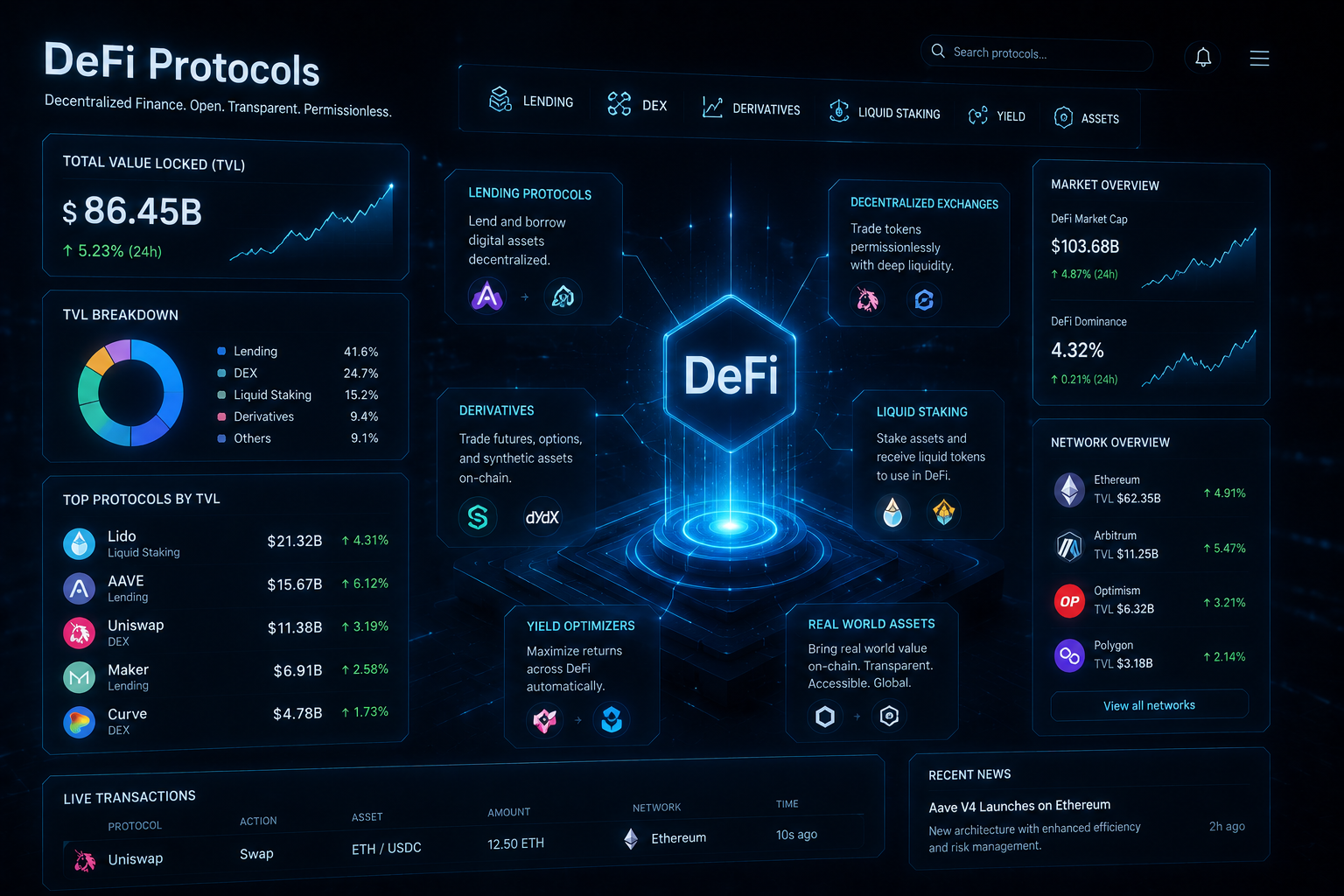
DeFi protocols can generate significant returns — but without the right knowledge and protective habits, the same tools that build wealth can wipe out your capital overnight. This guide walks you through every critical step to navigate DeFi protocols safely: from setting up your first wallet to building a layered research process that filters out 99% of obvious scams and keeps your capital protected as you scale up.
Key Takeaways: How to Navigate DeFi Protocols Safely
- •DeFi protocols can generate significant returns — but without the right knowledge, the same tools that build wealth can drain your wallet overnight.
- •Smart contract bugs, rug pulls, and MEV attacks are the most common ways DeFi investors lose money, and all three are largely avoidable with the right habits.
- •Your seed phrase is your single point of failure — anyone who has it owns your wallet, full stop.
- •Starting on testnets costs nothing and can save you thousands by letting you learn protocol mechanics before real money is involved.
- •Platforms like CoW Protocol are changing how traders interact with DeFi — offering built-in protections against some of DeFi’s most predatory risks.
Article at a Glance: When you navigate DeFi protocols safely, you’re not just protecting capital—you’re building the foundation for sustainable wealth generation. This comprehensive guide covers everything from understanding how DeFi actually works, to identifying and avoiding the biggest risks, to executing your first transaction without costly mistakes. You’ll learn how to navigate DeFi protocols safely at every level: beginner, intermediate, and advanced—with specific tools, checklists, and platforms that serious investors use to maintain control of their capital.
Table of Contents
- DeFi Can Make You Money — Or Wipe You Out
- How DeFi Actually Works
- The Biggest Risks in DeFi (And How to Spot Them Early)
- How to Set Up Your First DeFi Wallet Safely
- The Best Beginner DeFi Protocols to Start With
- How to Execute Your First DeFi Transaction Without Losing Money
- Intermediate DeFi: Build Smarter Habits
- Advanced DeFi Risk Management Strategies
- Tools Every Serious DeFi Investor Should Use
- Start Small, Win Big: The Right DeFi Mindset
- Frequently Asked Questions
DeFi can make you money — or wipe you out — and the difference almost always comes down to how prepared you are before your first transaction.
Decentralized finance has quietly evolved from a niche blockchain experiment into a multi-billion dollar ecosystem offering lending, borrowing, trading, and yield generation — all without a bank or broker involved. Whether you’re here because you’re curious, cautious, or ready to dive in, understanding how to navigate DeFi protocols safely is the most important skill you can build. CoW Protocol’s DeFi Learning Hub is one of the better free resources for building that foundation, designed specifically to help users understand DeFi safely and securely.
DeFi Can Make You Money — Or Wipe You Out
Yes, DeFi can be genuinely profitable. Yield farming, liquidity provision, and lending protocols like Aave have allowed investors to earn returns that traditional finance simply can’t match. But the same decentralized structure that removes gatekeepers also removes safety nets. There are no customer service lines, no fraud departments, and no refunds. When funds are gone in DeFi, they’re usually gone for good.
The investors who win in DeFi consistently aren’t necessarily the ones chasing the highest APYs — they’re the ones who understand the mechanics, manage their risk deliberately, and never invest more than they can afford to lose. That mindset is where this guide starts.
How DeFi Actually Works
DeFi is a collection of financial applications built on public blockchains. Instead of relying on centralized institutions to process and verify transactions, DeFi uses code — specifically smart contracts — to execute financial operations automatically. No humans in the loop, no waiting for business hours, no permission required.
Blockchains Are the Foundation
Every DeFi transaction runs on a blockchain — a distributed ledger that records and verifies activity across thousands of nodes simultaneously. Ethereum remains the dominant chain for DeFi, but networks like Solana and Avalanche have grown significantly. Layer 2 networks built on Ethereum — including Arbitrum and Optimism — have also become major players by offering faster transactions and dramatically lower fees than Ethereum’s mainnet.
Smart Contracts Replace the Middleman
A smart contract is a self-executing piece of code stored on the blockchain. When you swap tokens, deposit into a lending pool, or provide liquidity, you’re interacting directly with a smart contract that enforces the rules of that transaction automatically. There’s no bank approving your loan or broker executing your trade — the contract handles everything the moment the conditions are met. This is powerful, but it also means any bug in that contract becomes your problem.
Layer 2 Networks Make DeFi Cheaper and Faster
Layer 2 solutions like Arbitrum and Optimism process transactions off Ethereum’s main chain and then settle them in batches on-chain. For everyday DeFi users, this means gas fees that might cost $40 on Ethereum mainnet can drop to under $1 on a Layer 2. If you’re starting out, deploying on a Layer 2 network is one of the smartest practical decisions you can make. To further enhance your DeFi strategy, consider exploring various liquidity pools and investment strategies.
DeFi Blockchain Networks Compared
| Network | Typical Gas Cost | Speed | Best For |
|---|---|---|---|
| Ethereum Mainnet | $5 – $50+ | Slow | Large transactions |
| Arbitrum (L2) | Under $1 | Fast | Beginners |
| Optimism (L2) | Under $1 | Fast | Active traders |
| Solana | $0.00025 | Very Fast | High volume |
The Biggest Risks in DeFi (And How to Spot Them Early)
Every experienced DeFi investor has a story about a close call or an outright loss. The risks in this space are real, specific, and worth understanding in detail before you put a single dollar on the line.
Smart Contract Exploits
Smart contracts are only as secure as the code they’re written in. Bugs and vulnerabilities in contract code have led to some of the largest hacks in crypto history, with hundreds of millions of dollars drained from protocols in single attacks. Before depositing into any protocol, check whether it has undergone independent third-party security audits — and whether those audits are publicly accessible. A protocol without a published audit from a reputable firm like CertiK, Trail of Bits, or OpenZeppelin is a significant red flag.
Rug Pulls and Exit Scams
A rug pull happens when a protocol’s developers drain the liquidity pool or treasury and disappear with user funds. These scams are most common in newer, unaudited projects offering unusually high APYs — often thousands of percent — to attract capital fast. The warning signs are consistent: anonymous teams, no audits, newly deployed contracts, and locked liquidity with short unlock timelines. If a project is offering 5,000% APY and launched two weeks ago, that yield is a trap, not an opportunity.
🚩 Red Flags That Signal a Potential Rug Pull
- • Anonymous or unverifiable development team
- • No published security audit from reputable firm
- • APY rates in the thousands of percent
- • Deployed less than 30 days ago
- • Liquidity locked for less than 12 months
- • No verifiable community or engagement
Impermanent Loss in Liquidity Pools
Impermanent loss occurs when you provide liquidity to a decentralized exchange (DEX) and the price ratio of your deposited tokens changes. The more the prices diverge, the more your position loses value compared to simply holding those tokens. It’s called “impermanent” because if prices return to their original ratio, the loss disappears — but in practice, that doesn’t always happen. Liquidity provision can still be profitable when trading fees outpace the loss, but it requires careful pair selection and ongoing monitoring.
MEV Attacks and Front-Running
Maximal Extractable Value (MEV) refers to the profit that miners or validators can extract by reordering, inserting, or censoring transactions within a block. In practical terms, this often shows up as front-running — where bots detect your pending transaction and place their own order ahead of it to profit at your expense. This is most damaging on large token swaps where price impact is significant. Protocols like CoW Protocol address this directly by using batch auctions that settle trades at uniform prices, making front-running structurally impossible within a batch.
How to Set Up Your First DeFi Wallet Safely
Before you can interact with any DeFi protocol, you need a non-custodial wallet — and setting it up correctly is one of the most critical steps you’ll take in your entire DeFi journey.
Why Non-Custodial Wallets Are Non-Negotiable
A non-custodial wallet means you — and only you — control the private keys to your funds. Unlike a centralized exchange where the platform holds your assets on your behalf, a non-custodial wallet puts you in full control. MetaMask is the most widely used option due to its browser extension compatibility and support for virtually every DeFi application. Alternatives include Rabby Wallet, which includes built-in transaction simulation, and hardware wallets like Ledger or Trezor for storing larger amounts offline.
How to Secure Your Seed Phrase
When you set up your wallet, you’ll receive a 12 or 24-word seed phrase — also called a recovery phrase. This is the master key to your wallet. Anyone who has it can access and drain your funds from anywhere in the world, instantly. Write it down on paper and store it in a physically secure location. Never photograph it, type it into any website, or store it in cloud storage. No legitimate DeFi platform, support team, or person will ever ask you for your seed phrase — if someone does, it’s a scam, every single time.
✓ How to Secure Your Seed Phrase
DO: Write it down on paper • Store in fireproof safe • Keep in multiple physical locations • Use metal seed storage for valuable wallets
DON’T: Photograph it • Type it anywhere online • Store in cloud services • Email it to yourself • Give it to anyone (ever)
The Best Beginner DeFi Protocols to Start With
Not all DeFi protocols are created equal, and where you start matters enormously. The protocols listed here have been selected based on track record, security history, audit transparency, and ease of use for newcomers — not because they offer the highest yields.
Each of these platforms represents a different corner of the DeFi ecosystem. Together, they give you a well-rounded introduction to what decentralized finance actually looks like in practice — from swapping tokens to earning yield to borrowing against your crypto holdings. For those interested in deeper insights, you might want to explore how to spot winning altcoins before the crowd moves.
CoW Swap for Safe Token Swapping
CoW Swap, built on CoW Protocol, is one of the most beginner-friendly and structurally secure DEX aggregators available. It routes trades through a batch auction system where multiple orders are settled together at a uniform clearing price, which eliminates front-running and MEV attacks by design — not just as a feature, but as a fundamental property of how the protocol works. For anyone making their first token swap, this level of built-in protection is significant. CoW Swap also searches for Coincidence of Wants (CoWs) — situations where two traders want exactly what the other has — allowing direct peer-to-peer settlement that bypasses liquidity pools entirely and reduces fees.
Aave and Compound for Lending and Borrowing
Aave and Compound are the two most established lending protocols in DeFi, with billions in total value locked (TVL) and multiple security audits across years of operation. On Aave, you can deposit supported crypto assets — ETH, USDC, DAI, and others — to earn variable or stable interest rates, or borrow against your existing holdings by posting collateral. Compound operates similarly, using an algorithmic interest rate model that adjusts automatically based on supply and demand. Both protocols have withstood the test of time in an ecosystem where that’s genuinely rare.
Yearn Finance for Automated Yield Strategies
How Yearn Finance Works
Yearn Finance aggregates yield strategies across multiple DeFi protocols automatically. Instead of manually moving funds between Aave, Compound, and Curve to chase the best rates, Yearn’s Vaults do it for you — optimizing yield in real time through smart contract automation. You deposit a supported asset, receive a yToken representing your share, and Yearn handles the rest.
Yearn Finance is best understood as a yield optimizer rather than a lending or trading platform. It’s built for users who want to earn on their crypto without actively managing positions across multiple protocols. The trade-off is that Yearn adds a layer of smart contract complexity — your funds interact with multiple underlying protocols simultaneously — so it’s worth understanding the basics of those underlying protocols before committing significant capital to a Yearn Vault.
Yearn charges a 2% annual management fee and a 20% performance fee on profits generated. These are deducted automatically from vault returns, so the APY figures you see are displayed before fees in some interfaces — always check the fee structure before depositing.
MakerDAO for Decentralized Stablecoins
MakerDAO is the protocol behind DAI — one of the most widely used decentralized stablecoins in the DeFi ecosystem. Unlike USDC or USDT, which are issued by centralized companies, DAI is generated by users who lock up collateral (typically ETH or other approved assets) in a Maker Vault and mint DAI against it. The system maintains DAI’s peg to the US dollar through overcollateralization and algorithmic stability mechanisms.
For beginners, MakerDAO is worth knowing about primarily because DAI appears everywhere in DeFi — it’s used as a stable base asset in lending pools, liquidity pairs, and yield strategies across the ecosystem. Understanding where it comes from and how it maintains its peg gives you a meaningful edge when evaluating any protocol that relies heavily on it.
Beginner DeFi Protocols at a Glance
| Protocol | What It Does | Risk Level | Time in Market |
|---|---|---|---|
| CoW Swap | Safe token swapping with MEV protection | Low | Established |
| Aave | Lending & borrowing | Low | 5+ years |
| Compound | Algorithmic lending | Low | 5+ years |
| Yearn | Automated yield farming | Medium | 4+ years |
| MakerDAO | Decentralized stablecoin | Low | 6+ years |
How to Execute Your First DeFi Transaction Without Losing Money
Knowing the theory is one thing. Actually executing a transaction — connecting your wallet, approving a contract, and confirming a swap — is where most beginners make costly mistakes. The good news is that these mistakes are almost entirely preventable with the right preparation.
The single most important rule for your first DeFi transaction: start with an amount you are completely comfortable losing. Not because you expect to lose it, but because treating early transactions as tuition removes the emotional pressure that leads to rushed decisions.
Start on Testnets Before Risking Real Capital
Most major DeFi protocols have testnet versions — identical interfaces running on test blockchains where transactions use valueless test tokens instead of real funds. Ethereum’s Sepolia testnet and Arbitrum’s testnet are both accessible through MetaMask with a simple network switch. Spending 30 minutes executing test swaps, approvals, and deposits on a testnet will teach you more about DeFi mechanics than hours of reading — and it costs absolutely nothing.
How to Run a Token Swap Step by Step
Once you’re ready for a real transaction, here’s the exact process for executing a token swap safely. For those new to the world of decentralized finance, understanding how liquidity pools work can be beneficial before proceeding with a swap.
7-Step Token Swap Process
- Navigate directly to the protocol URL — always type it manually or use a verified bookmark. Never click links from social media or DMs.
- Connect your wallet by clicking the “Connect Wallet” button and selecting MetaMask or your preferred wallet.
- Select your swap tokens — the token you want to swap FROM and the token you want to swap TO.
- Enter your swap amount and review the quoted output, price impact, and slippage tolerance before proceeding.
- Click “Approve” if this is your first interaction with that token — this is a separate transaction that authorizes the protocol to spend your tokens.
- Confirm the swap transaction in your wallet, review the gas fee, and submit.
- Wait for confirmation — typically 15 seconds to a few minutes depending on network congestion.
Keep slippage tolerance as low as possible — 0.5% is a reasonable starting point for most liquid pairs. High slippage settings expose you to worse execution prices and make you a more attractive target for MEV bots.
What Transaction Fees Actually Mean
Gas fees are payments made to the network validators who process your transaction. They fluctuate based on how congested the blockchain is at any given moment — on Ethereum mainnet, a simple token swap can cost anywhere from $5 to over $50 during peak periods. On Layer 2 networks like Arbitrum or Optimism, that same transaction typically costs less than $1.
There’s an important distinction between gas fees and protocol fees. Gas fees go to the network; protocol fees go to the DeFi platform. Some protocols, like CoW Swap, have no additional protocol fees on top of gas for standard swaps. Always check what you’re paying and to whom before confirming any transaction.
Intermediate DeFi: Build Smarter Habits
Once you’ve executed your first few transactions and understand the mechanics, the next stage is building habits that protect your capital as your DeFi activity grows. Most losses in DeFi at the intermediate level aren’t from market crashes — they’re from avoidable mistakes like interacting with unaudited contracts, concentrating too much into a single protocol, or failing to monitor positions that require active management.
The DeFi space moves fast. A protocol that looks solid today can have a critical vulnerability discovered tomorrow. Building a research habit and maintaining awareness of what your capital is actually doing at all times is what separates investors who survive multiple market cycles from those who don’t.
At this stage, it also becomes worth thinking about portfolio structure rather than individual positions. Where is your capital deployed? What are the specific risks of each protocol? What’s your exit plan if something goes wrong? These questions sound basic, but the majority of DeFi investors never ask them until it’s too late.
How to Research a Protocol Before Investing
Before committing capital to any DeFi protocol, run through this checklist systematically:
Protocol Research Checklist
- □Audit status: Has the protocol been audited by a reputable firm? Are the audit reports publicly available and recent?
- □TVL history: Check DeFi Llama for total value locked over time. Sudden TVL drops are often the first visible sign of a problem.
- □Team transparency: Is the team public and identifiable? Anonymous teams aren’t automatically disqualifying, but they raise the risk profile.
- □Time in market: How long has the protocol been live without a major incident? Longevity under real market conditions is one of the strongest signals of security.
- □Community activity: Is there an active, engaged community on Discord or governance forums? Dead communities often precede dead protocols.
- □Token contract: For newer projects, check the contract on Etherscan or use tools like Token Sniffer to scan for honeypot mechanisms or hidden mint functions.
Time in Market as a Trust Signal
In DeFi, a protocol that has been running without incident for two or three years carries meaningfully more trust than one that launched six months ago — even if the newer protocol has shinier features and higher yields. Smart contract vulnerabilities are typically discovered and exploited when code is new and hasn’t yet been stress-tested by real-world attack attempts. Aave, Uniswap, Compound, and MakerDAO have all survived multiple market cycles and hack attempts, which is exactly why they remain the default recommendation for anyone building a DeFi foundation.
This doesn’t mean newer protocols should be avoided entirely. It means they should represent a smaller, risk-allocated portion of your overall DeFi exposure — capital you’re genuinely prepared to lose in exchange for higher potential upside.
Diversify Across Protocols, Not Just Tokens
Holding five different tokens on a single protocol doesn’t diversify your smart contract risk — if that protocol gets exploited, everything you have there is at risk simultaneously. True DeFi diversification means spreading capital across multiple protocols on multiple chains, so that a single exploit or failure can only ever affect a portion of your total holdings. To learn more about diversifying your investments, check out this DeFi yield and investment strategy guide.
Advanced DeFi Risk Management Strategies
At the advanced level, risk management in DeFi becomes a systematic practice rather than a checklist. Sophisticated DeFi investors maintain real-time visibility into every position, actively manage their token approvals, and apply tiered risk frameworks to decide how much capital belongs in established protocols versus experimental high-yield opportunities.
The tools covered in this section are used by serious DeFi participants daily. They don’t eliminate risk, but they give you the information needed to make faster, better decisions — especially when market conditions shift rapidly or a protocol comes under attack.
How to Track Your Full Portfolio With Zapper and DeBank
Zapper and DeBank are the two most widely used DeFi portfolio trackers, and both are free. Connect your wallet address — read-only, so there’s zero security risk — and you instantly see every position you hold across all chains and protocols in a single dashboard. DeBank is particularly strong for tracking lending positions, outstanding debt, and net worth across wallets, while Zapper excels at visualizing liquidity pool positions and yield farming activity. If you’re actively using more than two or three protocols, running without one of these tools means you almost certainly have blind spots in your portfolio.
Both platforms also display your full transaction history, which makes tax reporting significantly more manageable. DeFi tax obligations are real and frequently overlooked — every swap, every liquidity event, and every yield payout can be a taxable event depending on your jurisdiction. Using DeBank or Zapper as a running ledger from day one is far easier than reconstructing your history later.
Why You Must Revoke Unused Token Approvals on Revoke.cash
Every time you interact with a DeFi protocol for the first time, you sign a token approval — a permission that allows that protocol’s smart contract to spend your tokens. Most users sign these approvals and forget about them completely. The problem is that every active approval is an open door. If a protocol you approved six months ago gets exploited tomorrow, that approval can still be used to drain the approved tokens from your wallet — even if you haven’t used the protocol since. Revoke.cash lets you connect your wallet and see every single active approval across all chains, with a one-click revoke button for each. Auditing and cleaning your approvals every few months is one of the highest-leverage security habits in DeFi.
How to Limit Exposure on High-Yield Experimental Protocols
High-yield experimental protocols — anything offering APYs that established platforms can’t come close to matching — should be treated as a separate, high-risk allocation within your overall DeFi portfolio. A practical framework used by experienced DeFi investors is to cap any single experimental protocol at 5% to 10% of total crypto holdings. This isn’t about avoiding opportunity; it’s about ensuring that when one of these protocols inevitably fails — and statistically, a meaningful percentage do — the damage is contained. Use a separate wallet for experimental activity so that a compromised approval on a new protocol can’t cascade into your primary holdings. For more insights on managing your crypto investments, consider subscribing to crypto newsletters tailored for serious investors.
Tools Every Serious DeFi Investor Should Use
Beyond the protocols you invest in, the tools you use to monitor, research, and stay informed will define the quality of your decisions. The DeFi ecosystem generates enormous amounts of on-chain data in real time — the investors who know how to read that data have a structural edge over those who don’t.
Dune Analytics and DeFi Llama for Real-Time Data
DeFi Llama is the go-to source for tracking Total Value Locked across every protocol and chain. It’s free, updated in real time, and provides historical TVL charts that can reveal whether a protocol is growing, stagnating, or quietly bleeding capital. Sudden drops in TVL — particularly when not explained by a broader market downturn — are one of the earliest warning signals of a protocol in distress.
Dune Analytics takes on-chain data a step further, allowing analysts to query blockchain data directly using SQL and share custom dashboards. You don’t need to write queries yourself — thousands of community-built dashboards already track DEX volumes, liquidation events, wallet activity, and protocol health metrics in real time. Bookmarking a few relevant Dune dashboards for the protocols you use most is a habit worth building early.
Bankless and The Defiant for DeFi News
Staying current in DeFi isn’t optional — protocol upgrades, governance votes, and exploit disclosures happen constantly and can directly affect the value and safety of your positions. Bankless and The Defiant are two of the most respected independent media outlets covering the DeFi space with genuine analytical depth rather than hype-driven content. Both offer free newsletters and paid tiers with deeper research. Following CoW Protocol’s own blog and research output is also valuable, particularly for understanding MEV-related developments and best practices in trade execution. For more insights, consider exploring the best crypto newsletters for serious investors.
Essential DeFi Tools Quick Reference
| Tool | Purpose | Cost |
|---|---|---|
| DeFi Llama | Track TVL and protocol health | Free |
| DeBank | Portfolio tracking & management | Free |
| Zapper | Multi-protocol dashboard | Free |
| Revoke.cash | Manage token approvals | Free |
| Dune Analytics | On-chain data dashboards | Free (with paid tiers) |
| Bankless | DeFi news & research | Free (with paid tiers) |
Start Small, Win Big: The Right DeFi Mindset
Five Principles for DeFi Success
- •Treat your first few months in DeFi as an education, not an investment sprint.
- •Never invest more than you can afford to lose completely — this isn’t a disclaimer, it’s the actual risk profile of early-stage DeFi participation.
- •Prioritize understanding over yield — knowing why a protocol generates returns tells you far more about its risk than the APY number alone.
- •Move slowly and verify everything — most DeFi losses happen in moments of rushed decision-making driven by FOMO.
- •Build incrementally — master one protocol category before expanding into the next.
The investors who build lasting wealth in DeFi are almost never the ones who doubled their money on a new protocol in week one. They’re the ones who survived the bad weeks, learned from close calls, and compounded both returns and knowledge over multiple market cycles. Patience is a genuine competitive advantage in a space dominated by speculation and short-term thinking.
DeFi rewards the prepared. Every hour spent understanding smart contract mechanics, reading audit reports, and practicing on testnets directly reduces your probability of a catastrophic loss. It also increases your ability to recognize real opportunity when it appears — because you understand the difference between a protocol with genuine utility and one built solely to attract and exit with liquidity.
As your confidence grows, so should your discipline. Increase position sizes gradually, maintain a diversified protocol spread, and never stop revoking old approvals and auditing your wallet’s exposure. The habits that protect a $500 portfolio protect a $50,000 portfolio just as effectively — the only difference is the stakes. For more insights on maintaining a diversified protocol, check out this liquidity pools investment strategy guide.
Frequently Asked Questions
DeFi comes with a steep learning curve, and the questions below represent the most common points of confusion for investors at every level. Clear answers to these questions will help you move forward with more confidence and fewer costly assumptions.
If you’re just getting started, reading through all of these — even the ones that don’t feel immediately relevant — will give you a more complete picture of the risks and mechanics involved before you put capital at stake.
What is the safest DeFi protocol for beginners?
The safest DeFi protocols for beginners are those with the longest track records, multiple independent audits, and the largest TVL — specifically Aave for lending, Uniswap for token swapping, and CoW Swap for trade execution with built-in MEV protection. These platforms have each operated through multiple market cycles and survived real-world attack attempts, which is the most meaningful signal of security available in DeFi. Start with one, understand it completely, then expand.
How do I avoid rug pulls in DeFi?
Avoiding rug pulls comes down to consistent due diligence before committing any capital. The warning signs are almost always visible in advance — the problem is that high advertised yields create urgency that overrides careful thinking. Before depositing into any new protocol, run through these checks:
- •Verify the team is publicly identifiable or the project has a strong, verifiable community reputation.
- •Confirm at least one published audit from a reputable firm exists and is recent.
- •Check that liquidity is locked for a meaningful period — and verify the lock on-chain, not just on the project’s website.
- •Look up the contract address on Token Sniffer or Honeypot.is to scan for malicious code patterns.
- •Check DeFi Llama for TVL history — if a protocol has no TVL history, it’s brand new and carries maximum risk.
- •Search the project name alongside “exploit,” “scam,” or “rug” to see if there are community reports or warnings.
If a project is offering APYs in the thousands of percent and launched within the past few weeks, that yield is almost certainly being funded by new depositors rather than genuine protocol revenue — the classic structure of a short-lived rug pull.
There is no single check that eliminates rug pull risk entirely. Even audited projects have been exploited. The goal is to raise the bar high enough that you filter out the vast majority of obvious scams while maintaining realistic expectations about the risk that remains.
It’s also worth noting that using separate wallets for experimental protocols limits the blast radius of any single incident. A rug pull on a new protocol can only access what’s in the wallet connected to it — keeping your primary DeFi holdings in a separate wallet you use exclusively for established protocols is one of the simplest and most effective protective measures available.
What is impermanent loss and should I worry about it?
Impermanent loss is the difference in value between holding two tokens outright versus depositing them as a liquidity pair in an automated market maker (AMM) like Uniswap. When the price of one token in your pair moves relative to the other, the AMM automatically rebalances your position — which means you end up holding more of the token that fell in value and less of the one that rose. The result is a lower total value than you’d have if you’d simply held both tokens in your wallet.
Whether to worry about it depends on what pairs you’re providing liquidity for. Stablecoin-to-stablecoin pairs — like USDC/DAI — experience minimal impermanent loss because both assets are pegged to the same value. Volatile pairs like ETH/a-small-cap-altcoin carry significant impermanent loss risk during price swings. For beginners, stablecoin liquidity pools are the more sensible starting point if you want to explore liquidity provision without substantial impermanent loss exposure.
How much money do I need to start in DeFi?
Technically, you can start with as little as $50 to $100, though on Ethereum mainnet, gas fees may consume a disproportionate percentage of small transactions. Starting on a Layer 2 network like Arbitrum or Optimism — or using a testnet first — makes small amounts practical. A more comfortable starting point for real capital is $200 to $500, spread across one or two established protocols, on a Layer 2 where fees are low. The exact amount matters less than starting with capital you can genuinely afford to lose entirely while you’re learning.
What happens if I lose my seed phrase?
If you lose your seed phrase and lose access to your wallet — through a lost device, forgotten password, or hardware failure — your funds are permanently inaccessible. There is no recovery process, no customer support team, and no blockchain mechanism that can restore access without the seed phrase. This is the irreversible reality of non-custodial wallets, and it’s why secure seed phrase storage is the single most important security practice in all of DeFi.
Store your seed phrase in at least two physically separate, secure locations — a fireproof safe at home and a secure location elsewhere is a common approach. Never store it digitally in any form: no photos, no cloud documents, no password managers, no email drafts. The moment your seed phrase exists in digital form, it becomes accessible to anyone who can access that device or account.
For wallets holding significant value, consider a metal seed phrase backup — stainless steel plates designed to store seed phrases are available from several manufacturers and are resistant to fire and water damage that would destroy a paper backup. Products like the Cryptosteel Capsule or Bilodeau Metallic Seed Storage are purpose-built for this.
If you still have access to your wallet but suspect your seed phrase has been compromised, act immediately — create a new wallet, generate a fresh seed phrase, and transfer all assets out of the compromised wallet as fast as possible. Speed is everything in this scenario; once a bad actor has your seed phrase, they can drain your wallet at any moment.
Ready to navigate DeFi with greater confidence and built-in protection? CoW Protocol offers one of the most user-protective trading environments in decentralized finance — purpose-built to keep your trades safe from MEV, front-running, and unnecessary fees.
DISCLAIMER: This article is for informational purposes only and does not constitute financial, investment, legal, or trading advice. Navigating DeFi protocols safely requires understanding that the DeFi ecosystem carries inherent risks that no protocol or tool can completely eliminate. This guide reflects general best practices and educational information, but does not guarantee safety or profitability. Smart contract exploits, regulatory changes, market volatility, and technological failures are real risks in DeFi. Always conduct your own research (DYOR), verify information from multiple sources, understand that your optimal DeFi strategy may differ significantly from the recommendations provided, and never make investment decisions based solely on any single source or guide. Past results from DeFi investments do not guarantee future results. The protocols and tools mentioned are referenced for example and educational purposes and do not represent endorsements or guarantees of performance, reliability, or security. Participation in DeFi carries substantial risk of loss, including total loss of capital. Before using any DeFi protocol or tool, ensure you fully understand the specific risks involved, the protocol’s smart contract architecture, your local regulations around cryptocurrency and DeFi participation, and your personal risk tolerance. If you are uncertain about any aspect of DeFi, consult with qualified financial or legal professionals before committing capital.

Latest
DeFi News
08 Jul 2026
DeFi News
04 Jul 2026
DeFi News
21 May 2026
DeFi News
13 May 2026
DeFi News
15 Mar 2026