Coinposters
Crypto Newsletters vs Market Analysis: Which Wins for Retail Investors? | CoinPosters

Information Strategy Guide · 2026
Crypto Signals vs
Crypto Newsletter:
Which Beats the Market
for Retail Investors?
Most crypto investors are losing an edge they don’t even know they have — not because they lack information, but because they’re using the wrong type at the wrong time.
Article at a Glance
- →Crypto newsletters and market analysis serve completely different purposes — newsletters curate and simplify, while market analysis gives you the raw tools to form your own conclusions.
- →Over 60% of active crypto investors subscribe to at least two specialized newsletters to maintain a competitive information edge — but that alone isn’t enough for serious trading decisions.
- →Exchange-affiliated newsletters carry hidden bias risks — knowing how to spot sponsored content disguised as research can protect your portfolio from costly mistakes.
- →The real power move is combining both — using newsletters as your information foundation and market analysis tools to verify the signals before you act.
- →Beginners and active traders need different setups — keep reading to find out exactly which approach fits your current level and what tools are worth your time in 2026.
Table of Contents
- Crypto Newsletters vs. Market Analysis: Here’s What Actually Works
- What Crypto Newsletters Actually Give You
- What Market Analysis Actually Gives You
- Where Crypto Newsletters Fall Short
- Where Market Analysis Falls Short
- The Best Crypto Newsletters Worth Your Attention
- How to Build a System That Uses Both
- Newsletters Win for Beginners, Analysis Wins for Active Traders
- Frequently Asked Questions
When it comes to crypto newsletters vs market analysis, most retail investors are making a costly mistake: they treat the two as interchangeable when they serve fundamentally different purposes. Crypto newsletters curate and summarize what has already happened. Crypto market analysis gives you the raw data tools to act on what is happening right now. Understanding the difference between crypto newsletters vs market analysis isn’t optional — it’s the foundation your entire information strategy should be built on. The cryptocurrency space moves fast: regulatory shifts, on-chain anomalies, protocol upgrades, and macro correlations can all flip market direction within hours. For a deeper look at how to evaluate data sources critically, our guide to on-chain vs fundamental analysis covers the mechanics behind each approach in detail.
Crypto Newsletters vs Market Analysis: Here’s What Actually Works
Newsletter vs. Market Analysis — Quick Comparison
| Feature | Crypto Newsletter | Market Analysis |
|---|---|---|
| Information Type | Curated, summarized | Raw data, interpreted |
| Skill Required | Low to moderate | Moderate to high |
| Timeliness | Delayed (daily/weekly) | Real-time |
| Bias Risk | High (sponsorships) | Low (data-driven) |
| Best For | Beginners, context-building | Active traders, verification |
| Cost | Free to premium | Often subscription-based |
Why Most Crypto Investors Get This Choice Wrong
The most common mistake is treating crypto newsletters vs market analysis as if they’re interchangeable. They’re not. A newsletter tells you what happened and sometimes why — market analysis tells you what the data is saying right now. Investors who rely solely on newsletters are essentially driving by looking in the rearview mirror. By the time a weekly digest lands in your inbox, the opportunity it describes may have already closed.
On the flip side, jumping straight into raw market analysis without a strong foundational understanding of what you’re looking at leads to paralysis. Traders new to on-chain metrics or technical indicators often misread signals because they lack the contextual knowledge that a well-written newsletter would have provided. The mistake isn’t picking one over the other — it’s not understanding the role each one plays.
Crypto Newsletters vs Market Analysis: The Core Difference
Newsletters are editorial products. Someone has already filtered, framed, and packaged the information for you. Market analysis — whether technical, fundamental, or on-chain — is an investigative process where you work directly with data. One is a finished meal, the other is cooking from scratch. Both can feed you, but only one teaches you what’s actually in the food.
What Crypto Newsletters Actually Give You
At their best, crypto newsletters compress hours of research into a five-minute read, giving you a curated view of market movements, regulatory developments, and project updates without requiring you to monitor fourteen different platforms simultaneously.
Curated Information Without the Research Grind
The volume of blockchain-related content published every single day is staggering. Quality newsletters act as curated filters — aggregating what matters and cutting what doesn’t. Publications like The Block’s daily newsletter and Glassnode’s weekly insights pull together on-chain data, price movements, and macro context into formats that are actually digestible. For investors managing full-time jobs alongside crypto portfolios, this curation is genuinely valuable. Industry data shows that over 60% of active crypto investors subscribe to at least two specialized newsletters to maintain a competitive information advantage. For more insights, check out this list of best crypto news sites.
The Risk of Bias in Exchange-Affiliated Newsletters
Here’s what most newsletter roundup articles won’t tell you directly: when a newsletter is published by an exchange, that exchange has a financial incentive tied to your behavior. Binance Research, Kraken Intelligence, and Coinbase’s educational content are all high-quality — but they exist within ecosystems that benefit when you trade more, deposit more, or use their specific products. That doesn’t make the content false, but it does mean you should read it with a calibrated level of skepticism.
Sponsored content disguised as objective research is an even sharper risk in independent newsletters that monetize through token project partnerships. The tell-tale signs include unusually bullish language on low-cap tokens, absence of risk disclosures, and recommendations that happen to align with a token’s marketing cycle. Always check whether a newsletter discloses its sponsorships — if it doesn’t, that’s your first red flag.
Red Flags: Sponsored Content Disguised as Research
- ⚠Unusually bullish language on low-cap tokens with no discussion of competitive risks
- ⚠Absence of risk disclosures or tokenomics red flags on featured projects
- ⚠Recommendations that align suspiciously with a token’s current marketing cycle
- ⚠No clear disclosure of sponsorships at the top of each issue
- ⚠Strong buy narratives with no verifiable on-chain backing for the bullish thesis
Free vs. Premium Newsletters: Where the Real Value Sits
Free newsletters are more than enough for beginners and casual investors building foundational knowledge. The real case for premium subscriptions kicks in when your trading frequency increases and the cost of missed or delayed information starts to outweigh the subscription fee. Premium tiers from publications like Messari Pro typically unlock proprietary research reports, earlier access to analysis, and deeper dives into protocol fundamentals that free tiers don’t touch.
What Market Analysis Actually Gives You
Market analysis is where you stop relying on someone else’s interpretation and start building your own. It’s the difference between reading a weather forecast and learning how to read atmospheric pressure yourself.
On-Chain Data vs. Price Charts: Two Different Lenses
Technical analysis and on-chain analysis are both forms of market analysis, but they answer different questions. Price charts — using tools like TradingView — tell you what traders are doing with price right now, identifying patterns like support/resistance zones, RSI divergence, or moving average crossovers. On-chain analysis, available through platforms like Glassnode or Nansen, tells you what’s happening at the blockchain level: wallet accumulation patterns, exchange inflows and outflows, miner behavior, and smart money movements.
These two lenses often point in the same direction — but when they diverge, that divergence itself is one of the most powerful signals available. A price chart showing bullish momentum while on-chain data shows large wallet sell pressure is a setup worth paying serious attention to.
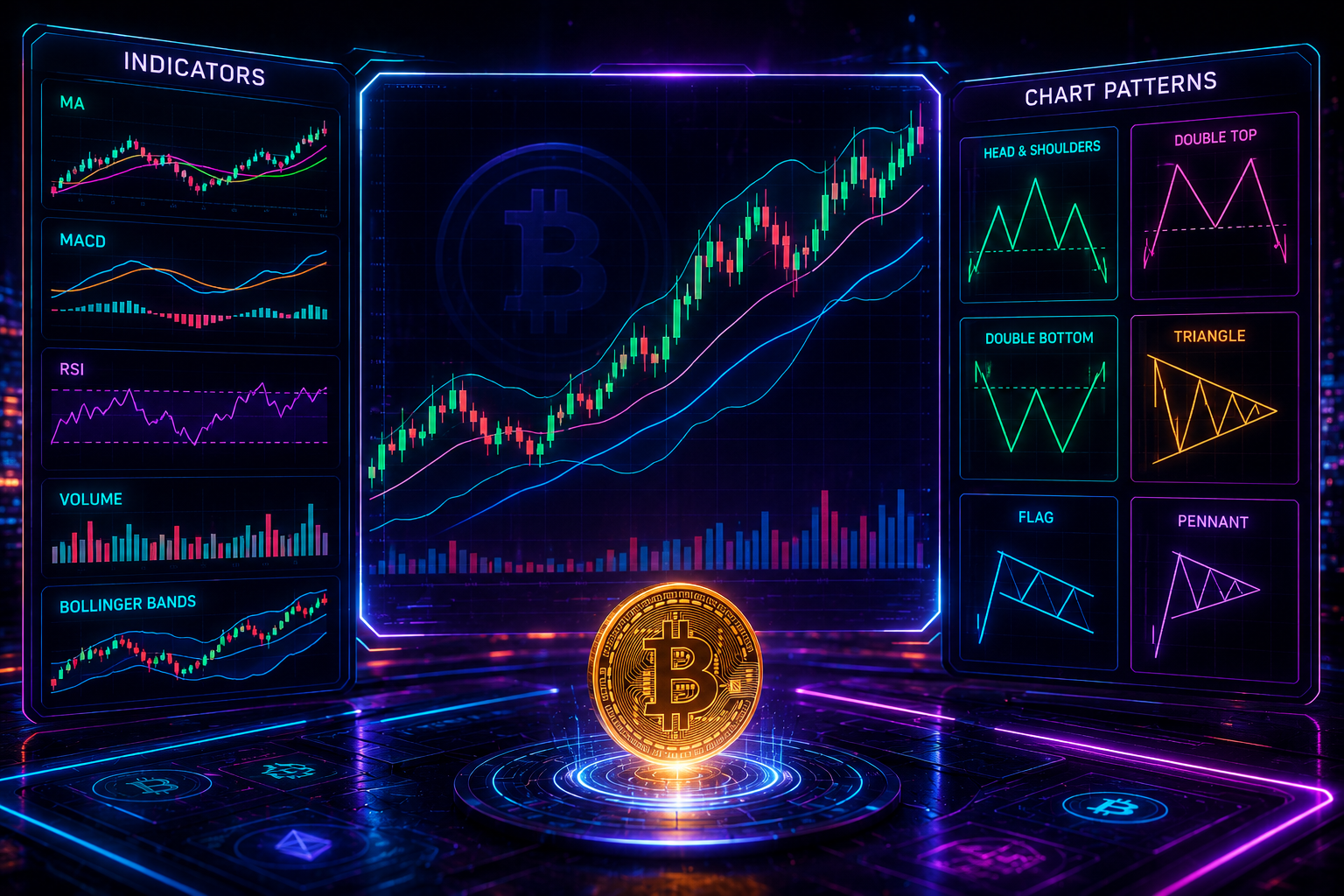
Technical Analysis Tools Every Crypto Investor Should Know
You don’t need to master every indicator to use technical analysis effectively. Starting with a focused toolkit produces better results than overwhelming yourself with twenty different signals. For those interested in broader market insights, exploring crypto research platforms can complement your technical analysis approach.
Core Technical Analysis Tools — Your Starting Toolkit
- ◆RSI (Relative Strength Index) — identifies overbought and oversold conditions on any timeframe
- ◆Moving Averages (50-day and 200-day) — tracks trend direction and potential reversal zones
- ◆Volume Profile — shows where most trading activity has occurred at specific price levels
- ◆MACD (Moving Average Convergence Divergence) — useful for spotting momentum shifts before price confirms them
- ◆Bollinger Bands — measures volatility and highlights potential breakout or breakdown zones
Why Raw Market Analysis Has a Steep Learning Curve
The honest reality is that technical and on-chain analysis take time to use well. Misreading an RSI signal on a low-timeframe chart or misinterpreting exchange inflow data has led experienced traders into bad positions. The learning curve isn’t a reason to avoid it — it’s a reason to combine it with quality newsletter context while you build the skill set progressively.
Where Crypto Newsletters Fall Short vs Market Analysis
Even the best newsletters have structural limitations that become costly the longer you rely on them exclusively. Understanding exactly where they break down helps you plug those gaps with the right tools before they affect your portfolio.
The core problem is that newsletters are inherently backward-looking. By design, they summarize what has already happened rather than what is happening right now. In a market where Bitcoin can move 8% in four hours on a single macro data release, a newsletter published at 7am EST is already working with stale information by noon.
Publication Delays That Cost You Real Money
Most crypto newsletters operate on daily or weekly publication cycles. That cadence works fine for long-term context-building, but it creates a dangerous blind spot for time-sensitive opportunities. When the Federal Reserve signals an unexpected policy shift, when a major protocol exploit surfaces, or when a regulatory body announces emergency enforcement action, the investors who respond within the first hour capture dramatically different outcomes than those who read about it the next morning in their inbox. A daily newsletter simply cannot compress that gap, which is why exploring the best crypto research platforms can be crucial for staying ahead.
Sponsored Content Hidden as Objective Research
The monetization model behind many free newsletters creates a conflict of interest that is rarely disclosed clearly. Token projects pay for newsletter features, and that payment doesn’t always come with a visible disclaimer. What reads like an independent deep-dive on a promising Layer 2 protocol is sometimes a paid placement. The language tends to be subtly promotional — heavy on upside potential, light on competitive risks or tokenomics red flags. Cross-referencing any newsletter’s strong buy narrative with on-chain data from Glassnode or social sentiment tools like LunarCrush is a reliable way to pressure-test whether the enthusiasm is organic or manufactured.
Where Crypto Market Analysis Falls Short vs Newsletters
Raw market analysis is powerful, but it has its own failure modes — and they tend to hit hardest at exactly the moment traders feel most confident in their read of the data.
The biggest structural weakness is that market analysis operates in a context vacuum. A technically perfect chart setup can be completely invalidated by a regulatory announcement, a protocol hack, or a macroeconomic shift that the price chart had no way of predicting. On-chain data shows you wallet behavior, but it doesn’t explain why those wallets are moving the way they are. That explanatory context — the why behind the what — is precisely where quality newsletters add back value.
“A technically perfect chart setup can be completely invalidated by a regulatory announcement that the price chart had no way of predicting. That’s where newsletters earn their place.”
Information Overload Without Clear Action Steps
Access to too many analytical tools without a structured framework is one of the fastest ways to become a worse trader. In the crypto newsletters vs market analysis debate, this is where newsletters often win: they provide pre-filtered context that narrows which signals deserve your attention. Monitoring RSI, MACD, volume profile, on-chain flows, funding rates, open interest, and social sentiment simultaneously creates decision paralysis rather than sharper conviction. Every additional data layer introduces the possibility of conflicting signals, and without a clear hierarchy for how to weight each one, investors end up frozen or overtrading in response to noise.
The solution isn’t more data — it’s a defined decision framework. Establishing in advance which two or three indicators you treat as primary signals, and using everything else as secondary confirmation, dramatically reduces the cognitive load of live market analysis. Newsletters can actually help here by providing the macro context that narrows which signals deserve your attention on any given week. For those interested in deeper insights, understanding the difference between on-chain analysis vs. fundamental analysis can further refine your decision-making process.
Best Crypto Newsletters for Market Analysis in 2026
Not all crypto newsletters are built the same. The ones worth subscribing to in 2026 earn their place through analytical rigor, transparent sourcing, and content that holds up under scrutiny — not just content that sounds confident. For a comprehensive list of newsletters, check out this crypto newsletters guide.
Top Crypto Newsletters Compared — 2026
| Newsletter | Best For | Bias Level | Cost |
|---|---|---|---|
| Binance Research | Data-dense institutional-grade reports | Platform-affiliated | Free |
| CoinDesk Markets Daily | Real-time market-open trading context | Low | Free |
| Kraken Intelligence | Macro context, institutional-quality analysis | Low-moderate | Free |
| Messari Pro | Deep protocol fundamentals, proprietary research | Very Low | Premium |
Binance Research: Institutional-Grade Insights for Retail Investors
Binance Research publishes some of the most data-dense reports available to retail investors without a six-figure institutional subscription. Their market updates regularly include on-chain statistics, derivatives data, and macro correlation analysis that most standalone newsletters don’t go near. Reports frequently break down Bitcoin dominance trends, altcoin liquidity cycles, and DeFi protocol health metrics using verifiable on-chain sources.
The key caveat is what was mentioned earlier — Binance has an obvious platform interest. Use their research for the data and the structural analysis, but independently verify any directional calls before acting on them. Their quarterly market outlook reports in particular are worth bookmarking as reference documents even if you trade on a different exchange.
CoinDesk Markets Daily: Real-Time Commentary With Trading Context
CoinDesk Markets Daily stands out because it actually attempts to bridge the timing gap that plagues most newsletters. Published each morning with market-open commentary, it incorporates overnight price action, futures market data, and relevant macro events into a format that gives you genuine trading context rather than just historical recap. For investors who don’t have time to run their own pre-market analysis every day, this is one of the most practically useful free options available.
Kraken Intelligence: Balanced Views Without the Hype
Kraken Intelligence consistently delivers research that reads closer to institutional analysis than exchange marketing. Their reports regularly cover topics like Bitcoin volatility cycles, cross-asset correlations between crypto and traditional markets, and deep dives into specific blockchain ecosystems — all with cited data sources and measured language that avoids the breathless price prediction tone common in the space. Their monthly market recap reports are particularly strong for building the kind of macro context that improves your ability to interpret technical signals. Pairing Kraken Intelligence reports with TradingView gives you both the narrative and the chart-level confirmation in one workflow.
How to Combine Crypto Newsletters and Market Analysis Into One System
The investors who consistently outperform in crypto aren’t choosing between crypto newsletters vs market analysis — they’ve built a repeatable system that uses both in their appropriate roles. The winning approach to crypto newsletters vs market analysis is sequential: newsletters build context, market analysis confirms signals before you act. Here’s exactly how to structure that system from the ground up, starting with the safest crypto portfolio strategy for beginners.
1. Start With One Educational Newsletter as Your Foundation
Before adding any analytical tools, establish one reliable newsletter as your macro context layer. This should be a publication that covers regulatory developments, protocol news, and broader market narratives without leaning heavily on price predictions. Kraken Intelligence or The Block’s daily digest work well for this role. Read it consistently — daily or weekly depending on publication frequency — and use it to build a mental model of what forces are currently shaping market conditions.
Consistency matters more than volume here. One newsletter read carefully every day builds a stronger foundational understanding than five newsletters skimmed sporadically. You’re not trying to capture every piece of news — you’re building pattern recognition for how different types of events tend to affect crypto market structure.
Give yourself 30 days before evaluating whether a newsletter is actually adding value to your decision-making. It takes time to calibrate whether the information you’re receiving is genuinely influencing your thinking or just generating the feeling of being informed without the substance behind it.
2. Add a Technical Analysis Tool Like TradingView for Chart Confirmation
Once your newsletter foundation is in place, layer in a charting platform. TradingView gives you access to Bitcoin, Ethereum, and altcoin price charts across every timeframe, with built-in indicators like RSI, MACD, Bollinger Bands, and volume profile all available without a paid subscription. The free tier is genuinely capable — most retail traders never need to upgrade beyond it. Use TradingView specifically to confirm or challenge the directional narratives your newsletter is presenting. If Kraken Intelligence is flagging bullish momentum in Ethereum, pull up the ETH/USDT weekly chart and check whether the technical structure actually supports that read before acting on it.
3. Use On-Chain Platforms Like Glassnode to Verify Newsletter Claims
Glassnode is the most widely used on-chain analytics platform available to retail investors, and its free tier covers enough ground to meaningfully improve your decision-making. Key metrics worth tracking include exchange net flow (whether Bitcoin is moving onto exchanges — a sell signal — or leaving exchanges — a hold/accumulation signal), the SOPR (Spent Output Profit Ratio) which shows whether holders are selling at a profit or loss, and the MVRV Z-Score which helps identify historically overvalued and undervalued price zones. When a newsletter makes a strong directional call, cross-referencing it against these on-chain metrics takes less than ten minutes and can save you from acting on a narrative that the blockchain data simply doesn’t support.
4. Cross-Reference Major Calls Across at Least Two Independent Sources
No single newsletter and no single indicator should be the sole basis for a significant portfolio decision. The rule of two independent sources isn’t about being indecisive — it’s about filtering out the noise that any single source inevitably carries. If Binance Research is bullish on a Layer 2 protocol and Glassnode’s on-chain data shows accumulation by large wallets in the same asset, that convergence carries real weight. If the newsletter is bullish but the chart shows a distribution pattern and exchange inflows are rising, that divergence is a signal to wait.
Independence matters here. Two exchange-affiliated newsletters agreeing with each other is not the same as two genuinely independent sources converging. Use publications from different business models — one exchange-affiliated, one independent — and pair them with at least one data-driven tool that has no editorial agenda. That combination gives you a signal stack that’s much harder for market noise or sponsored content to corrupt.
5. Set a Weekly Review Routine to Filter Signal From Noise
The final piece of the system is structure. Set aside 30 to 45 minutes once a week — Sunday evenings work well — to review what your newsletters covered, what your charts are showing, and whether your on-chain metrics have shifted in any meaningful direction. This weekly synthesis is where the real edge gets built. You’re not reacting to individual headlines; you’re identifying whether the overall weight of evidence across all your sources is shifting in a consistent direction. Consistency in this routine compounds over time — after three months, you’ll have built a calibrated sense of how different market signals tend to unfold that no single newsletter subscription can give you on its own.
Crypto Newsletters vs Market Analysis: Who Wins at Each Level
“The investors who consistently outperform in crypto aren’t choosing between newsletters and market analysis — they’ve built a repeatable system that uses both in their appropriate roles.”
CoinPosters · Information Strategy Guide 2026
If you’re early in your crypto journey, newsletters are the right primary tool. They lower the barrier to understanding what’s happening in the market without requiring you to interpret raw data you don’t yet have the context to read correctly. Start with one strong publication — CoinDesk Markets Daily or Kraken Intelligence — and focus on understanding the macro narratives shaping the market before you touch a single indicator. The goal at this stage is pattern recognition, not trade execution.
Active traders operate in a different environment entirely. When you’re making decisions on a weekly or daily basis, the publication delay of even the best newsletter becomes a structural liability. Your edge at that level comes from being able to read on-chain data in real time, interpret chart structure across multiple timeframes, and act on signal convergence before it becomes consensus. Newsletters still have a role — they provide the macro context that prevents you from trading against major structural forces you might miss while focused on short-term chart patterns — but they move to a supporting role rather than the lead.
Frequently Asked Questions
The most common questions about crypto newsletters versus market analysis come down to practical decisions: how many sources are enough, whether free options can do the job, and how to protect yourself from biased information. Here are direct answers to the questions that matter most for building a reliable information strategy in 2026.
How Many Crypto Newsletters Should I Subscribe to Without Getting Overwhelmed?
Two to three newsletters is the practical ceiling for most investors. One should cover macro market context and regulatory developments — Kraken Intelligence fits this role well. A second should provide more frequent price and sentiment updates — CoinDesk Markets Daily works here. A third, optional, subscription can focus on a specific sector you’re actively investing in, such as DeFi, Layer 2 ecosystems, or AI-adjacent blockchain projects.
Beyond three, the returns diminish sharply. You start spending more time reading than thinking, and the overlapping coverage from multiple sources creates the illusion of comprehensive research without the clarity that actually drives good decisions. Subscribe to one or two publications for 30 days before adding anything else — evaluate whether each one is genuinely changing how you think about the market before increasing your information load. For those new to investing, understanding the safest crypto portfolio strategy can also aid in making informed decisions.
Can Free Crypto Newsletters Replace Paid Market Analysis Tools?
For beginners and long-term holders, free newsletters provide substantial value and can absolutely serve as your primary information source without any premium subscription. The gap opens up when you move into active trading — at that point, the real-time data access, deeper on-chain metrics, and proprietary research available through paid platforms like Glassnode Studio or Messari Pro start to justify their cost through better-timed decisions rather than reaction to yesterday’s news. The honest benchmark is this: if your portfolio size and trading frequency mean that one better-timed entry or exit per month would cover the subscription cost, the paid tool is worth it.
How Do I Know if a Crypto Newsletter Is Biased or Sponsored?
Check three things immediately: whether the newsletter discloses sponsorships clearly at the top of each issue, whether the bullish language on specific tokens appears without any discussion of competitive risks or downside scenarios, and whether the tokens being featured happen to align with recent token launch or marketing cycles. Legitimate publications disclose paid placements explicitly. If a newsletter consistently recommends low-cap tokens with no risk disclosure and no verifiable on-chain backing for the bullish narrative, treat every recommendation as sponsored content regardless of what the disclaimer section says.
What Is the Best Market Analysis Tool for Crypto Beginners?
TradingView is the best starting point for beginners entering market analysis. Its interface is intuitive, the free tier covers all major crypto pairs across every timeframe, and the built-in indicator library includes everything a new analyst needs without requiring custom scripts or advanced configuration. The platform also has a large community of published chart analyses that beginners can study to understand how experienced traders are framing setups — which accelerates the learning curve faster than reading about indicators in isolation. Once you’re comfortable with basic chart reading, add Glassnode’s free on-chain metrics as a second layer to start understanding what blockchain data looks like alongside price action.
Should I Trust a Crypto Newsletter That Makes Specific Price Predictions?
Specific price predictions — “Bitcoin will hit $150,000 by Q3” or “ETH is heading to $8,000 this cycle” — are a reliable quality filter. The newsletters worth your time present structural frameworks, on-chain evidence, and macro conditions that inform your own thinking. The ones that make specific price calls are either performing for engagement or selling confidence they don’t actually have.
No analytical model — technical, fundamental, or on-chain — can reliably predict specific price targets in a market as reactive as crypto. What good analysis can do is identify high-probability zones, risk/reward setups, and structural conditions that favor a directional bias. A crypto newsletter framing its outlook in those terms is demonstrating genuine analytical discipline. One giving you a number and a date is demonstrating something else entirely.
Use price predictions as a credibility filter, not as trading signals. If a newsletter’s value proposition is built on its price prediction accuracy, the publication hasn’t earned a place in your information stack. When deciding between crypto newsletters and market analysis, it’s important to consider your investment strategy. For those who prefer a more hands-off approach, newsletters can provide curated insights and updates. However, if you’re looking for a more in-depth understanding of the market, on-chain analysis might be more beneficial. Ultimately, the choice depends on your personal preferences and investment goals.
Disclaimer
This article is for informational purposes only and does not constitute financial or investment advice. Do Your Own Research (DYOR) before acting on any information from newsletters, market analysis tools, or any other source. All cryptocurrency investments carry substantial risk. Newsletter content, data platforms, and third-party sources referenced in this article are provided for informational purposes only — inclusion does not constitute endorsement. CoinPosters is not responsible for any financial losses arising from actions taken based on the information provided in this article.
CoinPosters
Your guide to navigating crypto in 2026 and beyond.



Latest
Markets
08 Jul 2026
Markets
04 Jul 2026