Coinposters
Is Dogecoin a Good Investment? Historical Data, Risk Analysis & 2026 Outlook
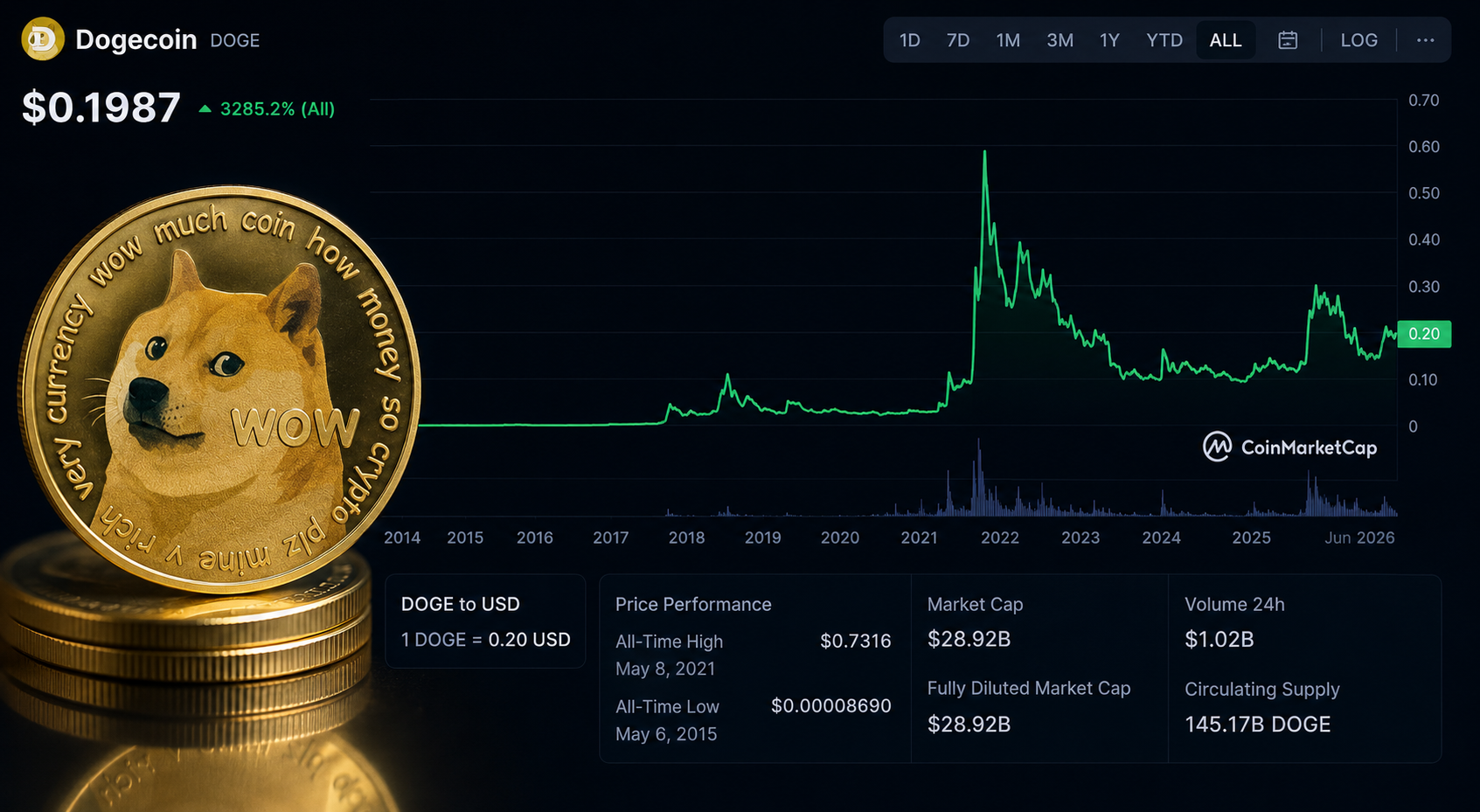
Is Dogecoin a good investment in 2026? For disciplined short-term traders who size positions carefully, it can be. As a long-term holding, the data says otherwise, DOGE is down roughly 90% from its 2021 peak, trading near $0.07-$0.08 in mid-2026 with no fundamental floor beneath it.
Article at a Glance
Here’s the short version of whether Dogecoin is a good investment right now:
- Dogecoin started as a joke in 2013 but now ranks among the top cryptocurrencies by market cap, making it impossible to ignore in any serious crypto portfolio discussion.
- DOGE has no supply cap, with approximately 5 billion new coins mined every year, which creates constant inflationary pressure that works against long-term price appreciation.
- The 2021 bull run saw Dogecoin surge over 10,000%, from $0.007 to an all-time high near $0.73, but DOGE is trading around $0.07-$0.08 in mid-2026, roughly 90% below that peak.
- Social media sentiment and Elon Musk’s public statements remain two of the most powerful price drivers for DOGE, more so than any technical development or fundamental metric.
- Most analysts place Dogecoin’s realistic 2026 base case between $0.10 and $0.18, with a $1 target requiring an almost perfect storm of conditions, keep reading to find out what those conditions actually are.
Table of Contents
- Dogecoin in 2026: Hype Asset or Legitimate Investment?
- What Is Dogecoin and How Does It Actually Work?
- Dogecoin Price History: What the Data Actually Shows
- What Drives Dogecoin’s Price?
- Dogecoin Risk Analysis: What Investors Need to Know
- Dogecoin Price Prediction 2026
- Is Dogecoin a Good Long-Term Investment?
- Dogecoin vs Other Meme Coins in 2026
- The Verdict on Dogecoin as an Investment in 2026
- Frequently Asked Questions
Dogecoin in 2026: Hype Asset or Legitimate Investment?
Dogecoin is one of the most polarizing assets in the entire cryptocurrency market, and that divide has only sharpened as 2026 has played out.
On one side, you have investors who made life-changing returns riding the 2021 meme wave. On the other, you have analysts who point to its unlimited supply, lack of development, and near-total dependence on social media hype as reasons to avoid it entirely. The truth, as with most things in crypto, sits somewhere in between, and it depends almost entirely on how you plan to use it in your portfolio. Understanding what Dogecoin actually is, how it has historically performed, and what realistic price scenarios look like for the rest of 2026 is the only way to make a decision grounded in data rather than hype.
What Is Dogecoin and How Does It Actually Work? – Is Dogecoin a Good Investment
Dogecoin (DOGE) is a peer-to-peer digital currency that was created in December 2013 by software engineers Billy Markus and Jackson Palmer. It was built on a fork of Litecoin, which itself is a fork of Bitcoin, meaning its underlying blockchain technology is not particularly novel. Transactions on the Dogecoin network are confirmed roughly every one minute, faster than Bitcoin’s ten-minute block time, and fees are extremely low, often fractions of a cent.
From Internet Joke to Top 10 Cryptocurrency
What began as a parody based on the popular “Doge” Shiba Inu meme quickly developed a genuine community. By 2014, the Dogecoin community had raised funds to sponsor NASCAR driver Josh Wise and send the Jamaican bobsled team to the Winter Olympics. That grassroots energy helped DOGE maintain a loyal user base even during years of minimal price activity, and it ultimately laid the groundwork for the explosive retail attention it received in 2021.
How Dogecoin Differs From Bitcoin and Ethereum
Bitcoin has a hard cap of 21 million coins. Ethereum has transitioned to a proof-of-stake model and introduced token-burning mechanisms that reduce supply over time. Dogecoin has neither of these features. It uses a proof-of-work consensus mechanism, similar to early Bitcoin, and has no maximum supply limit. There is also no active core development team pushing meaningful upgrades or use-case expansion, which is a stark contrast to the robust developer ecosystems behind Ethereum or Solana.
The Unlimited Supply Problem Explained Simply
Every single year, approximately 5 billion new DOGE tokens enter circulation through mining rewards. As of mid-2026, the total circulating supply is over 150 billion coins. This constant issuance means that for the price to go up, demand must continuously outpace the new supply entering the market, a structural challenge that no amount of hype permanently solves. It is the single biggest fundamental argument against Dogecoin as a long-term store of value.
Dogecoin Price History: What the Data Actually Shows
Looking at Dogecoin’s price history is not just a history lesson, it is one of the most useful tools for understanding how this asset actually behaves under different market conditions. For those interested in exploring other investment options, you might want to consider the fastest growing altcoins as well.
DOGE does not trade like Bitcoin or Ethereum. It trades like a sentiment asset, meaning its price moves are largely driven by waves of retail attention rather than institutional accumulation or protocol milestones. Recognizing this pattern is essential before putting a single dollar into it.
DOGE in 2017: The First Wave of Attention
During the broader 2017 crypto bull market, Dogecoin saw its first significant price surge, briefly touching $0.017 in January 2018 before collapsing alongside the rest of the market. For context, that price represented a massive percentage gain from its sub-penny origins, but it also demonstrated for the first time how quickly DOGE could give back gains once retail enthusiasm faded.
The 2021 Bull Run: From $0.007 to $0.73
The 2021 rally is the defining chapter in Dogecoin’s history and the event most new investors point to when justifying their interest in DOGE. What started the year at approximately $0.007 per coin reached an all-time high near $0.73 on May 8, 2021, a gain of over 10,000% in just five months. The catalyst was a perfect collision of forces that had never previously aligned.
- The WallStreetBets Reddit community pivoted attention from stocks to crypto
- Elon Musk tweeted about Dogecoin repeatedly, calling it “the people’s crypto”
- Robinhood made DOGE easily accessible to millions of retail investors
- The broader crypto market was in a historic bull cycle, with Bitcoin reaching $64,000
- Celebrity endorsements from figures like Snoop Dogg and Mark Cuban added fuel
That combination created a speculative frenzy unlike anything the meme coin space had seen. But it also showed exactly how fragile DOGE’s price support actually was, the moment sentiment shifted, the selloff was brutal.
Post-Peak Crash and the 2022 to 2024 Bear Market
After peaking in May 2021, Dogecoin entered a prolonged decline that tracked, and in some cases exceeded, the broader crypto bear market. By late 2022, DOGE was trading below $0.07, erasing more than 90% of its peak value. The 2022 to 2024 period saw occasional sentiment-driven spikes, often tied to Elon Musk’s Twitter/X activity, but no sustained recovery. This pattern confirmed what skeptics had argued all along: without structural demand drivers, DOGE cannot hold its gains.
Where DOGE Stands in Mid-2026
Dogecoin briefly rallied to a local high near $0.27 in July 2025 on broader market strength, but 2026 has been a difficult year. DOGE spent the first half of the year sliding, breaking below its $0.08-$0.12 accumulation range in June and testing multi-month lows near $0.07 by early July, down roughly 90% from its 2021 all-time high. Futures open interest fell from $1.7 billion in May to under $1 billion in June, with over $130 million in long liquidations, a sign that leveraged optimism has been getting flushed out rather than rewarded. The broader crypto market has also cooled significantly through 2026 after setting fresh highs in late 2025, and DOGE, true to form, has moved with more volatility than Bitcoin or Ethereum in both directions. That gap between where DOGE is trading and where it was in 2021, or even in mid-2025, is exactly what makes the 2026 investment question so compelling, and so complicated.
What Drives Dogecoin’s Price?
If you want to understand Dogecoin’s price, forget the traditional fundamental analysis playbook. Revenue, earnings, and development milestones matter very little here.
DOGE is one of the clearest examples in financial markets of a sentiment-driven asset. Its price is determined almost entirely by three overlapping forces: social media attention, influential public figures, particularly Elon Musk, and the general direction of the Bitcoin market cycle. Understanding how each of these works is the starting point for any serious Dogecoin investment analysis in 2026.
Social Media Sentiment and Retail Investor Behavior
Dogecoin’s price is essentially a real-time measure of retail enthusiasm. When platforms like Reddit, X (formerly Twitter), and TikTok light up with DOGE content, volume spikes within hours. This is not speculation, it is a documented pattern that has repeated across every major DOGE price movement since 2021. Google Trends data consistently shows that search interest in “buy Dogecoin” correlates almost perfectly with short-term price surges, and then collapses just as fast when the conversation moves on. For traders, this creates exploitable momentum windows. For long-term holders, it creates nerve-wracking volatility with no fundamental floor to fall back on.
Elon Musk’s Influence on DOGE Price Movements
No single individual has had more measurable impact on Dogecoin’s price than Elon Musk. His tweets, memes, and public statements have triggered double-digit percentage moves in DOGE within minutes on multiple documented occasions. When he changed Twitter’s logo to the Dogecoin Shiba Inu mascot in April 2023, DOGE jumped over 30% in under 24 hours. When he announced that Tesla would accept DOGE for merchandise in January 2022, the price surged again. These are not coincidences, they are cause-and-effect relationships that traders now actively monitor.
The problem with Musk-driven price action is that it is completely unpredictable and entirely outside any investor’s control. His attention can shift instantly, and there is no way to systematically time entries and exits around his social media behavior at scale. His role as head of the Department of Government Efficiency (DOGE) in the U.S. government briefly renewed speculative interest in the coin, with some retail investors treating the naming overlap as a bullish signal, a reminder of just how narrative-driven this asset truly is.
Bitcoin Market Cycles and Their Effect on DOGE
Dogecoin does not move independently of the broader crypto market. Historically, DOGE’s biggest rallies have occurred during Bitcoin bull cycles, typically with a lag of several weeks to months as retail capital flows from Bitcoin into progressively riskier altcoins. Bitcoin’s most recent halving in April 2024 reduced block rewards from 6.25 BTC to 3.125 BTC, and Bitcoin did rally to a new all-time high near $126,000 in October 2025 on that momentum. But Bitcoin has since corrected significantly through the first half of 2026, and without Bitcoin leading a fresh leg higher, meaningful altcoin season conditions for DOGE have not yet materialized this cycle.
Dogecoin Risk Analysis: What Investors Need to Know
Every investment carries risk, but Dogecoin’s risk profile is genuinely unusual compared to most assets, including other cryptocurrencies. The risks here are not just market-related. They are structural, meaning some of them are baked into the very design of the coin and cannot be fixed by a price rally or a favorable news cycle. Anyone considering a DOGE position in 2026 needs to understand all four of these risk categories before committing capital.
Volatility Compared to Other Major Cryptocurrencies
Dogecoin is significantly more volatile than Bitcoin and Ethereum on a percentage basis. While Bitcoin’s 30-day average volatility has historically ranged between 40% and 80% annualized, DOGE has routinely exceeded 100% to 150% annualized volatility during active market periods. That means the swings, both up and down, are dramatically larger than what most investors are prepared for emotionally or financially.
To put this in concrete terms: a $10,000 position in DOGE that grows to $40,000 in a bull run can realistically fall back to $3,000 to $5,000 in the correction that follows. This is not a hypothetical, it is precisely what happened to investors who bought near the 2021 peak, and again to anyone who bought during the 2025 rally only to watch DOGE fall roughly 90% from its highs. Position sizing and strict risk management are not optional with this asset. They are mandatory.
“Without structural demand drivers, DOGE cannot hold its gains.”
Inflation Risk From Unlimited Token Supply
With 5 billion new DOGE entering circulation every year and no mechanism to slow or stop that issuance, Dogecoin faces a structural inflation rate that diminishes over time as a percentage of total supply but never reaches zero. At a circulating supply of over 150 billion coins in mid-2026, the annual inflation rate sits at roughly 3.2% to 3.4%, which sounds manageable until you factor in that this new supply must be absorbed by the market continuously just to keep the price flat. Any period of weak demand means the price drifts lower simply due to supply pressure, with no halving event or burn mechanism to provide relief, and 2026’s price action is a live demonstration of exactly that dynamic.
No Major Development Roadmap or Utility Growth
Dogecoin’s GitHub development activity has been minimal for years. Unlike Ethereum, which has executed multiple major protocol upgrades and supports a sprawling DeFi and NFT ecosystem, or Solana, which processes thousands of transactions per second and hosts hundreds of active applications, Dogecoin’s primary use case in 2026 remains tipping and speculative trading. There is no active roadmap introducing smart contracts, layer-2 scaling, or institutional-grade utility. Without a compelling reason for new users to hold DOGE beyond speculation, demand remains almost entirely sentiment-dependent.
Regulatory Risk for Meme-Based Crypto Assets
The global regulatory environment for cryptocurrency is tightening, and meme coins could face disproportionate scrutiny. Assets with no clear utility, no defined issuer, and price histories dominated by social media manipulation are exactly the type of instruments regulators in the U.S., EU, and UK have signaled concern about. While Dogecoin itself has not been the target of any major enforcement action to date, any broader crackdown on speculative crypto assets or celebrity-driven market manipulation could directly impact DOGE’s liquidity and accessibility on major exchanges.
Dogecoin Price Prediction 2026
Pinning down a precise price target for Dogecoin for the rest of 2026 is less about finding the right model and more about identifying which scenario is most likely to play out. DOGE does not respond to discounted cash flow analysis or earnings revisions. It responds to market cycles, sentiment waves, and macro crypto conditions. With DOGE trading near $0.07-$0.08 as of early July 2026, here is how the bullish, bearish, and base cases actually break down.
Bullish Case: What Has to Go Right for DOGE to Rally
The bullish scenario for DOGE for the remainder of 2026 requires several conditions to align simultaneously. First, Bitcoin needs to stabilize and resume a bull trend after its 2026 correction, pulling retail capital back into the broader crypto ecosystem. Second, altcoin season needs to materialize, historically, this occurs three to six months after a Bitcoin peak, as investors rotate profits into higher-risk assets chasing larger percentage gains, a rotation that has not meaningfully arrived yet this cycle.
Third, a major sentiment catalyst needs to emerge for DOGE specifically. This could be an Elon Musk announcement, a major retailer expanding DOGE payment acceptance, or a viral social media moment that reignites mainstream retail interest. Without at least one of these narrative drivers, DOGE is unlikely to meaningfully outperform the broader altcoin market even in a bull cycle.
Dogecoin does now have real institutional access points that didn’t exist in prior cycles: the REX-Osprey DOGE ETF (DOJE) launched in September 2025, and 21Shares’ TDOG followed on Nasdaq in January 2026 as the first product with Dogecoin Foundation backing and spot exposure. So far, though, that access has not translated into meaningful demand, combined assets across both funds sit at roughly $20 million, a fraction of what Bitcoin’s ETF cohort attracted in its first week alone. That gap between institutional access and institutional interest is one of the clearest signals that DOGE’s 2026 story is still a retail sentiment story, not an institutional one.
If Bitcoin stabilizes and at least one sentiment catalyst emerges, the upside case for DOGE through the rest of 2026 points to a price range between $0.22 and $0.35, with more aggressive models allowing for $0.45 to $0.75+ under 2021-style mania conditions, though most analysts consider that upper range a low-probability outcome this year.
| Scenario | Price Range | Key Conditions Required |
|---|---|---|
| Bearish | $0.05 – $0.08 | Continued Bitcoin weakness, low retail interest, regulatory pressure |
| Base Case | $0.10 – $0.18 | Moderate crypto stabilization, average sentiment activity |
| Bullish | $0.22 – $0.35 | Bitcoin recovery, altcoin season, major DOGE catalyst |
| Extreme Bull | $0.45 – $0.75+ | 2021-style retail mania, viral moment, Musk involvement |
Bearish Case: Why DOGE Could Underperform in 2026
The bearish case is straightforward and does not require anything catastrophic to happen, in many ways it has already been playing out. If Bitcoin fails to stabilize and altcoins continue underperforming, DOGE could remain range-bound or drift lower. Add in the constant selling pressure from 5 billion new coins per year, declining retail attention as newer meme coins like Shiba Inu and PEPE compete for the same audience, minimal ETF traction despite two funds now being available, and a tightening regulatory environment, and DOGE could easily spend much of the rest of 2026 trading in the $0.05 to $0.08 range. For investors who bought during the 2025 rally, that represents a significant loss of capital with no clear catalyst for recovery yet in sight.
Can Dogecoin Reach $1 in 2026?
Reaching $1 would require Dogecoin to achieve a market capitalization of roughly $150 billion or more based on current circulating supply, which would make it one of the largest crypto assets in the world, rivaling Ethereum’s market cap during its peak periods. That is not mathematically impossible, but it requires a simultaneous explosion in retail demand, a historic bull market, and a major viral catalyst all happening within the same window. Most serious analysts consider the $1 target a very low-probability outcome for 2026 specifically, given DOGE is currently trading roughly 13 to 14 times below that level.
The more useful question is not whether DOGE can hit $1, but whether the risk-to-reward ratio at current prices justifies the position size you are considering. If DOGE is trading at $0.07 to $0.08 and your downside is $0.04 to $0.05 while your upside in a bull case is $0.20 to $0.30, the risk-reward math becomes more interesting, but only if you treat it as a speculative allocation, not a core portfolio holding.
Is Dogecoin a Good Long-Term Investment?
Dogecoin can generate impressive short-term returns, but holding it as a long-term investment is a fundamentally different proposition, and one that requires a much higher tolerance for uncertainty. For those interested in comparing it with other options, exploring Bitcoin vs Ethereum as long-term investments might provide valuable insights.
The core problem with a long-term DOGE thesis is that the asset has no yield, no deflationary mechanism, no growing utility layer, and no development roadmap that would create organic demand over a multi-year horizon. Every long-term gain DOGE has ever produced has come from sentiment cycles, not fundamentals. That means a long-term holder is essentially betting that future retail enthusiasm will exceed today’s level, which is possible, but it is not investing in the traditional sense. It is speculating on crowd psychology at scale.
Short-Term Trading vs Long-Term Holding: Key Differences
Short-term traders who understand DOGE’s sentiment mechanics can profit from it repeatedly. The playbook is relatively consistent: monitor Bitcoin’s macro trend, watch for social media volume spikes, enter early in the momentum phase, and exit before retail enthusiasm peaks. This requires active management, tight stop-losses, and the discipline to take profits even when the crowd is still excited. It is not a passive strategy, but it aligns with how Dogecoin actually behaves as an asset.
Long-term holders, by contrast, face a much harder path. Anyone who bought DOGE at its 2021 peak, or even during its 2025 local high near $0.27, and held into mid-2026 has lost the large majority of their investment with no dividends, no staking rewards, and no fundamental improvement in the underlying asset to justify patience. The asymmetry here matters: short-term traders can use DOGE’s volatility as a feature, while long-term holders are almost entirely at the mercy of macro sentiment cycles they cannot control or predict.
How Much of Your Portfolio Should DOGE Represent?
Most risk-aware crypto portfolio frameworks treat meme coins as a speculative satellite allocation, typically no more than 1% to 5% of total portfolio value. The reasoning is simple: the potential upside in a bull scenario is significant, but so is the downside in a bear scenario, and the asset provides no income or hedging benefit to offset that downside risk. Allocating more than 5% of your portfolio to DOGE means your overall returns become dangerously dependent on sentiment events you cannot model or predict.
A more disciplined approach is to define your maximum loss tolerance before entering. If you are comfortable losing 80% to 90% of a given position, because history shows that is entirely possible and has already happened twice, then size accordingly. Never let a speculative meme coin position grow large enough through appreciation that it distorts your overall risk profile without a deliberate rebalancing decision.
Dogecoin vs Other Meme Coins in 2026
The meme coin landscape in 2026 is dramatically more crowded than it was during Dogecoin’s 2021 peak. DOGE now competes for retail attention and speculative capital with dozens of established and emerging meme assets, each trying to capture the next viral moment.
Shiba Inu (SHIB) is the most direct competitor, positioning itself as the “Dogecoin killer” with a deflationary burn mechanism and a broader ecosystem that includes ShibaSwap, a layer-2 network called Shibarium, and an active development team. PEPE coin emerged in 2023 and captured significant retail trading volume by leveraging internet meme culture in a way that felt fresh to a younger audience. Meanwhile, newer entrants like Floki Inu and various Solana-based meme tokens are aggressively competing for the same speculative dollars that might otherwise flow to DOGE.
What DOGE still has that most competitors do not is name recognition, exchange availability, and a decade-long track record. It is listed on virtually every major exchange globally, including Coinbase, Binance, and Kraken, and it benefits from the kind of brand familiarity that newer meme coins cannot manufacture overnight. That liquidity advantage matters, it means large positions can be entered and exited more efficiently, and it reduces the risk of getting trapped in a low-volume asset during a market downturn.
- Shiba Inu (SHIB): Has a burn mechanism and active ecosystem development through Shibarium, more utility than DOGE but less mainstream recognition
- PEPE: Captured strong retail momentum in 2023 to 2024 with viral meme appeal, but has no development roadmap or utility case
- Floki Inu (FLOKI): Positioned as a utility meme token with a gaming metaverse project, but adoption remains early stage
- Solana-based meme coins: Benefit from fast transaction speeds and low fees, making them attractive for active traders, but most lack staying power
- Dogecoin (DOGE): Wins on liquidity, exchange depth, brand recognition, and celebrity association, but trails on utility and development activity
The Verdict on Dogecoin as an Investment in 2026
Dogecoin is not a fraudulent asset, but it is also not a fundamentally sound investment in the traditional sense. It is a high-volatility, sentiment-driven speculative instrument that can produce extraordinary short-term returns and devastating long-term losses depending entirely on when you enter, how much you allocate, and how disciplined you are about taking profits. In a favorable second-half-2026 macro environment, where Bitcoin stabilizes and retail capital flows into altcoins, DOGE has a realistic path back to $0.22 to $0.35. In a continued risk-off environment, it can fall further toward $0.05 with little warning and no fundamental support level to catch it. For those considering entering the crypto market, it’s crucial to understand how beginners can invest in cryptocurrency with low risk.
The investors who have actually made money with Dogecoin over the long run are not the ones who held through every cycle hoping for $1, they are the ones who treated it as a trading vehicle, sized their positions appropriately, and exited when the momentum peaked. If you approach DOGE with that same discipline in 2026, it can be a legitimate component of a broader speculative crypto strategy. If you approach it as a long-term wealth-building asset, the historical data is not on your side.
Frequently Asked Questions
Here are the most common questions investors ask when evaluating Dogecoin as part of their 2026 crypto strategy.
Is Dogecoin a good investment for beginners in 2026?
Dogecoin is accessible for beginners in terms of price per coin and exchange availability, but it is not an ideal starting point for new investors. Its extreme volatility, dependence on social media sentiment, and lack of fundamental value drivers make it very easy to buy at the wrong time and panic-sell at a loss, a pattern reinforced by DOGE’s roughly 90% decline from its 2021 peak. Beginners are better served by establishing a foundation in Bitcoin and Ethereum before adding speculative meme coin exposure. If you do invest in DOGE as a beginner, keep the allocation small, no more than 2% to 3% of your total portfolio, and accept upfront that you could lose most of it.
What is the realistic price target for Dogecoin in 2026?
With DOGE trading near $0.07-$0.08 as of early July 2026, the most commonly cited base case for the rest of 2026 sits between $0.10 and $0.18, assuming a moderate crypto stabilization with average sentiment activity. The bullish scenario, requiring a Bitcoin recovery, altcoin season, and a major DOGE-specific catalyst, points toward $0.22 to $0.35. The $1 target is technically possible but requires a near-perfect combination of conditions that most analysts consider very low probability for 2026 specifically. Planning around the base case while sizing your position to benefit meaningfully from the bullish scenario is the most rational approach.
Does Dogecoin have any real-world use cases?
Yes, but they are limited compared to other major cryptocurrencies. Dogecoin is accepted as payment by a small but notable number of merchants, with the most high-profile example being Tesla’s online merchandise store, which began accepting DOGE in January 2022. The Dallas Mavericks, owned by Mark Cuban, also accept Dogecoin for tickets and merchandise. AMC Theatres and a handful of other retailers have added DOGE payment options. Two DOGE-linked ETFs, DOJE and TDOG, also now trade in the US, though combined assets remain small at roughly $20 million.
However, these use cases have not translated into meaningful on-chain transaction volume or sustained demand for the token as a medium of exchange. Most DOGE transactions are still speculative trades rather than commercial payments, and the absence of smart contract functionality means it cannot participate in the DeFi, NFT, or Web3 ecosystems that are driving genuine utility adoption across the broader crypto market.
Why does Elon Musk have such a large impact on Dogecoin’s price?
Elon Musk’s influence on DOGE comes from a combination of his massive social media following, his track record of directly addressing the coin by name, and the market’s learned response to his statements. When one of the most followed individuals on the planet with a demonstrated ability to move markets makes a specific comment about a low-liquidity asset, the resulting price impact is mathematically predictable, a surge of buy orders hits a relatively thin order book and the price spikes rapidly.
The deeper issue is that Musk has positioned himself as a genuine advocate for Dogecoin across multiple years and multiple platforms, which means his association with the coin is not perceived as casual or ironic by retail investors. His acquisition of Twitter (now X), the naming of the Department of Government Efficiency as DOGE, and Tesla’s merchandise payment integration have all reinforced the narrative that he has a long-term interest in the coin’s success, making retail investors more likely to respond to each new signal with buying activity. For those considering diversifying their investments, exploring fastest growing altcoins might offer additional opportunities.
Is it too late to invest in Dogecoin in 2026?
It is not too late if you are approaching it correctly. “Too late” assumes you missed a single entry point that will never return, but Dogecoin has demonstrated multiple boom-and-bust cycles, each offering new entry opportunities at different price levels. With DOGE trading roughly 90% below its all-time high as of mid-2026, the question is not whether you missed the best possible entry, but whether the current risk-to-reward ratio makes sense for your specific investment goals and risk tolerance.
If DOGE is currently trading well below its previous cycle highs and the macro crypto environment eventually turns bullish again, there is a legitimate case for a small speculative allocation. The historical cycle pattern suggests that if Bitcoin resumes its post-halving appreciation trajectory, altcoin momentum, including DOGE, could build meaningfully in the months that follow, though that rotation has not clearly started as of mid-2026.
What is genuinely too late is chasing Dogecoin after a major sentiment spike has already occurred. Buying DOGE after it has already surged 50% to 100% in a short window because of a viral moment or Musk tweet is one of the highest-risk entries possible. That is the scenario where retail investors consistently buy the peak and absorb the losses while earlier holders take profits.
The most rational approach for the rest of 2026 is to define your position size based on a maximum loss scenario, enter during calm market periods rather than after hype spikes, set clear profit targets before you buy, and treat the entire allocation as speculative capital you are genuinely prepared to lose. That discipline, more than any price prediction model, is what separates investors who profit from DOGE from those who get burned by it. For deeper insights into crypto investment strategy and market analysis, Mudrex provides research and tools designed to help investors navigate assets exactly like this one.
DYOR Disclaimer
This article is for informational purposes only and does not constitute financial, investment, or tax advice. Dogecoin is a highly volatile, speculative asset with no fundamental yield or utility floor, past performance does not indicate future results. Always do your own research (DYOR) and consult a qualified financial professional before making any investment decisions.