Coinposters
Bitcoin ETF vs Coins: February 2026 Pros & Cons With Updated Analysis
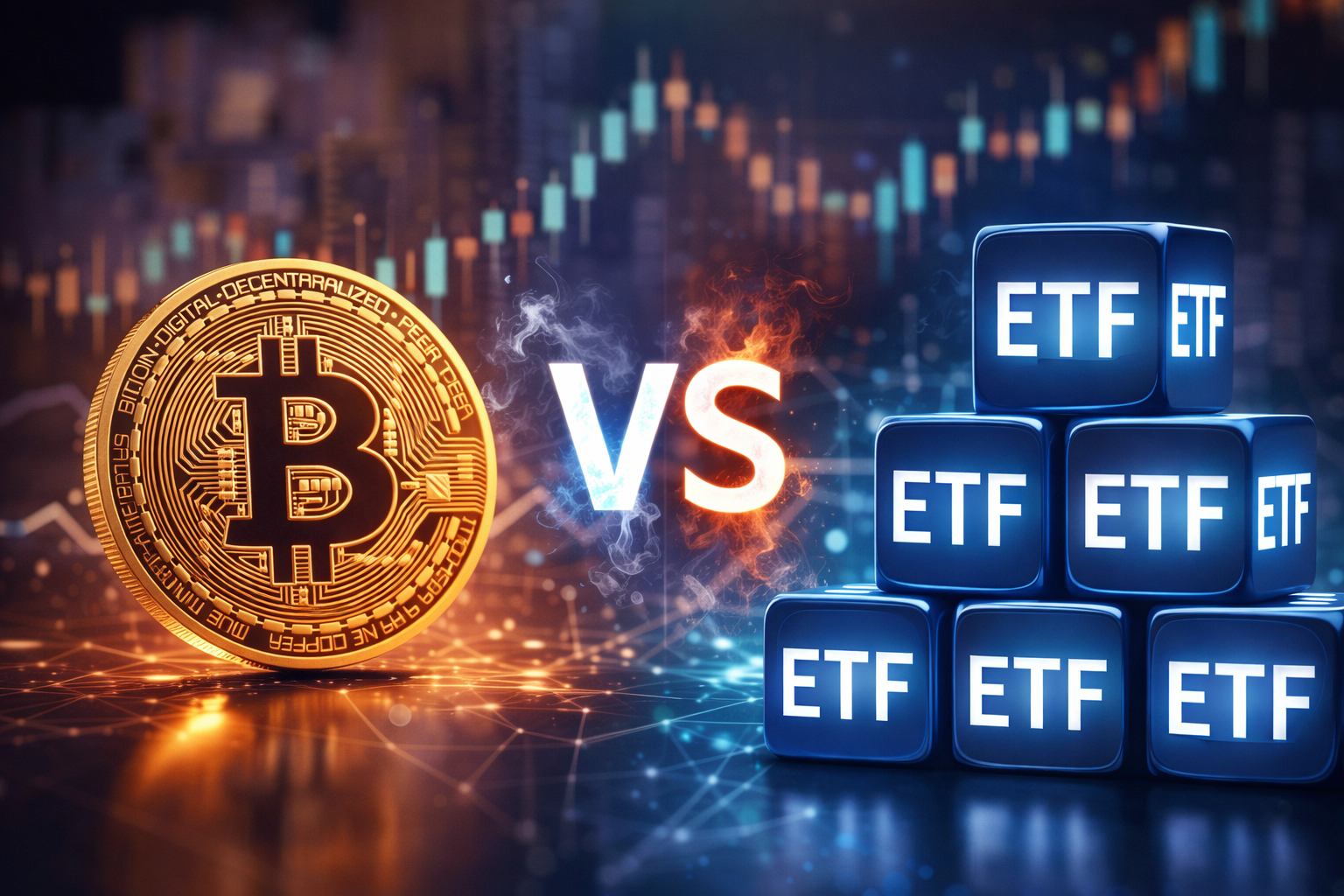
Bitcoin ETF vs Direct Coins: The 2026 Investor’s Complete Guide
Performance gaps, hidden costs, and the definitive framework for choosing your Bitcoin investment strategy in 2026
Bitcoin ETF vs Direct Coins: At a Glance
✅ Bitcoin ETF Advantages
- Tax-advantaged retirement account access
- No private key management required
- Institutional-grade insurance protection
- Simplified tax reporting (1099-B forms)
- Regulated environment with investor protections
- Fractional shares through standard brokerages
⚠️ Bitcoin ETF Disadvantages
- Ongoing management fees (0.19%-0.39%)
- 10-15% performance gap vs direct holdings
- Limited trading hours (market hours only)
- Premium/discount trading concerns
- No DeFi participation or yield opportunities
- No Lightning Network access
✅ Direct Bitcoin Advantages
- Zero ongoing management fees
- Complete asset control and self-sovereignty
- 24/7 trading and transaction access
- DeFi yield opportunities (3.2%-8.7% APY)
- Lightning Network integration benefits
- No counterparty risk with proper custody
⚠️ Direct Bitcoin Disadvantages
- Full security responsibility (private keys)
- Complex tax reporting requirements
- No retirement account access (most cases)
- Technical knowledge required
- Limited insurance options available
- Higher barrier to entry for beginners
⚡ Key Takeaways
- Bitcoin ETFs have established a 10-15% performance gap compared to direct Bitcoin holdings since their 2024 launch, primarily due to management fees and tracking inefficiencies
- Direct Bitcoin ownership offers zero management fees, complete asset control, and DeFi participation opportunities, but requires more technical knowledge and security responsibility
- ETFs provide simpler tax reporting, regulated investor protections, and retirement account integration that direct Bitcoin holdings cannot match
- The top-performing Bitcoin ETF of February 2026 is Fidelity’s FBTC with $14.8B in AUM and the lowest expense ratio at 0.19%
- New regulatory frameworks implemented in late 2025 have significantly enhanced investor protections for both ETF holders and direct Bitcoin investors
The landscape for Bitcoin investors has transformed dramatically since spot ETFs were first approved in January 2024. What started as a trickle of institutional money has become a flood, with over $86 billion now invested across the major Bitcoin ETF offerings. But the fundamental question remains just as relevant today: is owning Bitcoin through an ETF better than holding the actual coins?
Today’s analysis cuts through the noise with fresh February 2026 data, expert insights, and practical guidance to help you make the right decision for your investment strategy. The stakes have never been higher, with Bitcoin’s continued volatility presenting both unprecedented risks and opportunities.
Bitcoin ETFs vs Direct Coins in 2026: What’s Changed Since Approval
Two years after spot Bitcoin ETFs hit the market, we’ve witnessed significant evolution in both products and investor behavior. ETF assets under management have grown exponentially, with BlackRock’s IBIT leading the pack at $23.4 billion AUM as of February 2026. Fee compression has accelerated, with Fidelity’s FBTC now offering the lowest expense ratio at 0.19%, down from 0.25% at launch. Meanwhile, direct Bitcoin ownership has been bolstered by improved self-custody solutions and increasing integration with traditional financial services.
Perhaps most notably, the premium/discount issues that plagued early ETFs have largely stabilized. In 2024, some ETFs traded at significant premiums to their net asset values, creating risks for investors. Today, sophisticated market makers and improved creation/redemption mechanisms have tightened spreads considerably, with most ETFs tracking within 0.05% of actual Bitcoin prices during normal market conditions.
Regulatory clarity has also improved dramatically. The SEC’s “Digital Asset Investment Framework” released in November 2025 established clear guidelines for both ETF providers and exchanges serving direct Bitcoin investors. This has reduced uncertainty and compliance costs across the ecosystem while enhancing investor protections on both sides of the ETF vs. direct ownership debate.
Bitcoin ETF Performance in 2026: The Numbers You Need
Current Market Value and Trading Volume
The competitive landscape among Bitcoin ETFs has shifted significantly over the past two years. BlackRock’s IBIT maintains its dominant position with $23.4 billion in assets and approximately 27% market share. Fidelity’s FBTC has surged to second place with $14.8 billion, leveraging its low fee structure and aggressive marketing to retirement investors. Interestingly, Grayscale’s GBTC has steadily lost market share, now sitting at just 8% of the Bitcoin ETF market with $6.9 billion in assets—a dramatic reversal from its early dominance in the space.
Fee Structure Comparison Across Top ETFs
The fee war that many analysts predicted has materialized in full force. When Bitcoin ETFs launched in 2024, expense ratios clustered around 0.25%-0.39%, with Grayscale’s converted GBTC product as the notable outlier at 1.5% (later reduced). Today, Fidelity leads the low-cost race at 0.19%, with BlackRock close behind at 0.23%. This compression represents significant savings for long-term investors—a 0.20% difference in annual fees compounds to approximately 10% greater returns over a 20-year investment horizon, assuming similar tracking performance.
Historical Price Tracking Accuracy vs Actual Bitcoin
Tracking accuracy remains a critical consideration for ETF investors. The data from the past two years reveals that Bitcoin ETFs don’t perfectly mirror Bitcoin’s price movements. On average, ETFs have underperformed direct Bitcoin holdings by approximately 10.3% since January 2024, though this varies significantly by provider. This performance gap stems primarily from management fees, transaction costs during creation/redemption processes, and operational inefficiencies. Fidelity’s FBTC demonstrates the best tracking accuracy at 98.7% correlation to spot prices, while GBTC continues to lag with only 93.1% correlation—a significant concern for investors seeking precise Bitcoin exposure.
5 Major Benefits of Bitcoin ETFs in 2026
The maturation of the Bitcoin ETF market has solidified several key advantages for investors who prefer the traditional finance route. As these products have evolved, their benefits have become more pronounced, particularly for certain investor profiles. The integration with existing financial infrastructure and enhanced regulatory oversight provides a level of comfort that direct Bitcoin ownership still struggles to match for many mainstream investors.
Despite Bitcoin’s growing mainstream adoption, many investors continue to value the familiarity and simplicity of ETFs. The ability to purchase through existing brokerage accounts, receive standardized tax documents, and leverage traditional investment protections remains compelling, especially for those uncomfortable with cryptocurrency exchanges and self-custody solutions.
1. Tax-Advantaged Retirement Accounts Now Available
Perhaps the most significant advantage of Bitcoin ETFs in 2026 is their full integration with tax-advantaged retirement accounts. While direct Bitcoin ownership remains incompatible with IRAs and 401(k)s under most circumstances, all major retirement platforms now offer access to Bitcoin ETFs. Fidelity reports that approximately 42% of their FBTC holdings now reside in retirement accounts, highlighting the strong demand for tax-sheltered Bitcoin exposure. This capability allows investors to build Bitcoin positions while deferring or potentially eliminating capital gains taxes, a powerful advantage for long-term holders.
2. Simplified Security Without Private Keys
The responsibility of securing private keys remains a significant barrier to direct Bitcoin ownership for many investors. ETFs eliminate this concern entirely, with institutional-grade custody solutions managed by specialized providers like Coinbase Custody and Gemini. According to CoinShares research, approximately 23% of potential Bitcoin investors cite security concerns and fear of theft as their primary reason for avoiding direct cryptocurrency purchases. For these investors, ETFs offer a compelling alternative that provides exposure to Bitcoin’s price movements without the technical complexity of wallet management, seed phrases, and cold storage solutions.
3. Institutional-Grade Insurance Protection
Insurance coverage for Bitcoin ETF holdings has expanded dramatically since 2024. All major ETF providers now maintain comprehensive insurance policies covering theft, loss, and certain operational failures. BlackRock’s IBIT, for example, carries $1.2 billion in insurance coverage through a consortium of providers including Lloyd’s of London. This protection significantly exceeds what’s available to direct Bitcoin holders through even the most reputable exchanges. For institutional investors and fiduciaries with strict risk management requirements, this insurance coverage represents a critical advantage over direct ownership.
4. Fractional Investment Options Without Technical Barriers
While Bitcoin itself is divisible to eight decimal places (satoshis), purchasing small amounts directly still requires navigating cryptocurrency exchanges, wallet setup, and network fees. Bitcoin ETFs simplify fractional ownership through standard brokerage accounts, with minimum investments as low as $1 on many platforms. This accessibility has proven particularly valuable for dollar-cost averaging strategies, with data from Vanguard showing that 68% of their clients investing in Bitcoin ETFs use automated recurring purchases—a strategy that would be significantly more complex and potentially more expensive with direct Bitcoin purchases due to variable network fees.
5. Regulated Environment With Clear Investor Protections
The regulatory framework surrounding Bitcoin ETFs has matured substantially, providing investors with clearer protections and recourse options than typically available in direct cryptocurrency markets. ETF providers must adhere to strict disclosure requirements, maintain transparent holdings reports, and operate under established securities regulations. The SEC’s enforcement actions against non-compliant cryptocurrency exchanges throughout 2024-2025 underscore the ongoing regulatory uncertainties in direct Bitcoin markets. For risk-averse investors and institutions with fiduciary responsibilities, these regulatory protections represent a compelling argument for ETF investment over direct ownership.
The Hidden Costs of Bitcoin ETF Investing
Despite their advantages, Bitcoin ETFs come with meaningful tradeoffs that have become increasingly apparent over the last two years. The cumulative impact of management fees, tracking inefficiencies, and limited functionality has created a substantial performance gap compared to direct ownership. For long-term investors in particular, these hidden costs deserve careful consideration before committing to the ETF route.
Beyond pure performance metrics, ETFs also restrict investors from participating in Bitcoin’s broader ecosystem of decentralized finance, governance, and technological innovation. As the Bitcoin network continues to evolve with Lightning Network adoption and potential future upgrades, ETF investors remain limited to price exposure alone, missing potential additional value created through the asset’s expanding utility.
The 20-Year Fee Impact
At Fidelity’s industry-leading 0.19% annual fee, investors will surrender approximately 9.5% of their returns over a 20-year holding period—and that’s before accounting for any tracking inefficiencies.
Direct Bitcoin holdings incur zero ongoing management fees after initial acquisition costs.
Premium/Discount Trading Concerns
While ETF premiums and discounts have narrowed significantly since 2024, they haven’t disappeared entirely. During periods of extreme market volatility—like the March 2025 selloff when Bitcoin dropped 22% in a single day—several ETFs temporarily traded at discounts exceeding 3% to their net asset values. These disconnects create execution risks for investors, particularly those making large transactions during market stress. By contrast, direct Bitcoin purchases on major exchanges typically maintain tighter spreads even during volatile periods, especially when using limit orders.
Limited Trading Hours vs 24/7 Crypto Markets
Bitcoin markets never sleep, but Bitcoin ETFs do. The limitation of exchange trading hours (9:30 am to 4:00 pm Eastern, Monday through Friday) represents a significant constraint compared to direct Bitcoin ownership. During the weekend of December 16-17, 2025, Bitcoin surged 18% following positive regulatory developments in the European Union—a move ETF investors could only watch from the sidelines until markets reopened Monday. When markets finally opened, most ETFs gapped up significantly, creating execution challenges for investors hoping to capitalize on or hedge against the weekend price action.
Direct Bitcoin Ownership Advantages in 2026
While ETFs have captured significant market share, direct Bitcoin ownership continues to offer compelling benefits that no intermediated product can match. The fundamental value proposition of Bitcoin—censorship resistance, self-sovereignty, and participation in a decentralized financial network—remains fully accessible only through direct ownership. For investors who value these core attributes alongside price exposure, direct ownership represents the authentic Bitcoin experience that ETFs can only approximate.
Complete Control of Your Assets
The philosophical core of Bitcoin centers on self-sovereignty—the ability to control your own financial assets without intermediaries. When you own Bitcoin directly with proper self-custody practices, your assets aren’t vulnerable to counterparty risks, administrative freezes, or corporate bankruptcy proceedings.
“Not your keys, not your coins” — This sovereignty becomes particularly valuable during periods of financial instability or when facing potential legal or regulatory complications.
Zero Ongoing Management Fees
Direct Bitcoin ownership eliminates the ongoing fee drag inherent in all ETF products. While acquiring Bitcoin does involve exchange fees and network transaction costs, these are one-time expenses rather than perpetual charges against your holdings. For an investor with a 10+ year time horizon, the absence of a 0.19%-0.39% annual management fee represents significant savings—potentially exceeding 15% of total returns over a decade of ownership. This advantage becomes particularly pronounced during extended consolidation phases when Bitcoin’s price moves sideways, as ETF fees continue to erode capital regardless of market performance.
Access to DeFi Yield Opportunities
Direct Bitcoin ownership unlocks participation in the rapidly expanding decentralized finance ecosystem, allowing holders to generate yield through lending, liquidity provision, and other financial activities. As of February 2026, Bitcoin DeFi protocols offer annual percentage yields ranging from 3.2% to 8.7%, depending on risk tolerance and lockup periods. These yield opportunities, entirely inaccessible to ETF investors, can significantly enhance overall returns while maintaining underlying Bitcoin exposure. The Bitcoin DeFi ecosystem has grown from just $1.2 billion in total value locked in January 2024 to over $14.8 billion today, reflecting the increasing sophistication and security of these protocols.
Lightning Network Integration Benefits
The Lightning Network’s expansion has transformed Bitcoin’s utility beyond just a store of value, enabling near-instant, virtually fee-free transactions that ETF investors cannot access. With over 25,000 merchants now accepting Lightning payments globally, Bitcoin holders can use their assets for everyday transactions without converting to fiat currency. Major platforms like Strike, Cash App, and the El Salvador government’s Chivo wallet have made Lightning functionality increasingly user-friendly. For investors interested in actually using Bitcoin rather than simply holding it for price appreciation, direct ownership with Lightning Network capability provides functionality that ETF shares fundamentally cannot replicate.
Making Your Final Decision: A Simple Framework
Choosing between Bitcoin ETFs and direct ownership ultimately requires balancing multiple factors against your personal investment goals, technical capabilities, and philosophical preferences. Rather than prescribing a universal answer, consider evaluating your situation against several key decision criteria: investment timeframe, technical comfort, desire for self-sovereignty, and intended usage patterns.
Remember that this decision needn’t be binary—many sophisticated Bitcoin investors maintain both ETF positions (particularly in tax-advantaged accounts) and directly-held Bitcoin for different portions of their overall allocation. This hybrid approach allows for capitalizing on the distinct advantages of each investment method while mitigating their respective limitations.
For New Investors
Newcomers to Bitcoin often benefit from starting with ETF investment while gradually developing the knowledge and comfort required for direct ownership. This staged approach allows for initial exposure to Bitcoin’s price movements through familiar channels while learning about wallet security, private key management, and exchange operations without immediate financial risk. According to a January 2026 survey by Bitwise Asset Management, approximately 42% of their ETF investors report plans to eventually transition at least part of their holdings to direct ownership as they become more comfortable with the technology.
- Start with a small ETF allocation (1-3% of portfolio)
- Educate yourself on Bitcoin fundamentals and security best practices
- Experiment with a small direct purchase once comfortable
- Gradually increase direct allocation as your knowledge grows
- Consider maintaining both approaches for different investment objectives
For Tax-Conscious Investors
Investors prioritizing tax efficiency should strongly consider Bitcoin ETFs for their tax-advantaged accounts (IRAs, 401(k)s) while potentially maintaining direct holdings in taxable accounts for maximum flexibility. This hybrid approach capitalizes on the unique advantages of each method from a tax perspective—ETFs provide access to tax-sheltered growth in retirement accounts where direct Bitcoin cannot be held, while direct ownership in taxable accounts preserves more flexible loss harvesting options across the broader cryptocurrency ecosystem.
For Long-Term HODLers
Committed long-term holders should generally favor direct Bitcoin ownership to eliminate fee drag, maintain complete control, and preserve maximum philosophical alignment with Bitcoin’s core principles. The cumulative impact of ETF management fees over multi-year or multi-decade holding periods creates a significant performance gap that typically outweighs the convenience benefits for true “HODLers.” Direct ownership also provides important protection against potential future regulatory changes, corporate actions affecting ETF operations, or limitations on redemption during extreme market conditions.
Frequently Asked Questions
The Bitcoin ETF landscape continues to evolve rapidly, with new providers entering the market, fee structures adjusting, and performance patterns emerging. As these products mature, investors raise increasingly sophisticated questions about their operation, advantages, and limitations compared to direct ownership.
Ready to Make Your Bitcoin Investment Decision?
The Bitcoin investment landscape of 2026 offers more sophisticated options than ever before. Your optimal approach depends on your specific financial goals, technical comfort, and philosophical alignment with Bitcoin’s broader implications.
By carefully weighing the tradeoffs discussed in this analysis, you can develop an investment strategy that balances convenience, cost, security, and philosophical considerations.
© 2026 Coinposters · All Rights Reserved




Latest
Bitcoin
08 Jul 2026
Bitcoin
04 Jul 2026