Coinposters
Altcoin Investing vs DeFi Investing: Which Strategy Delivers Higher Returns for Long-Term Holders
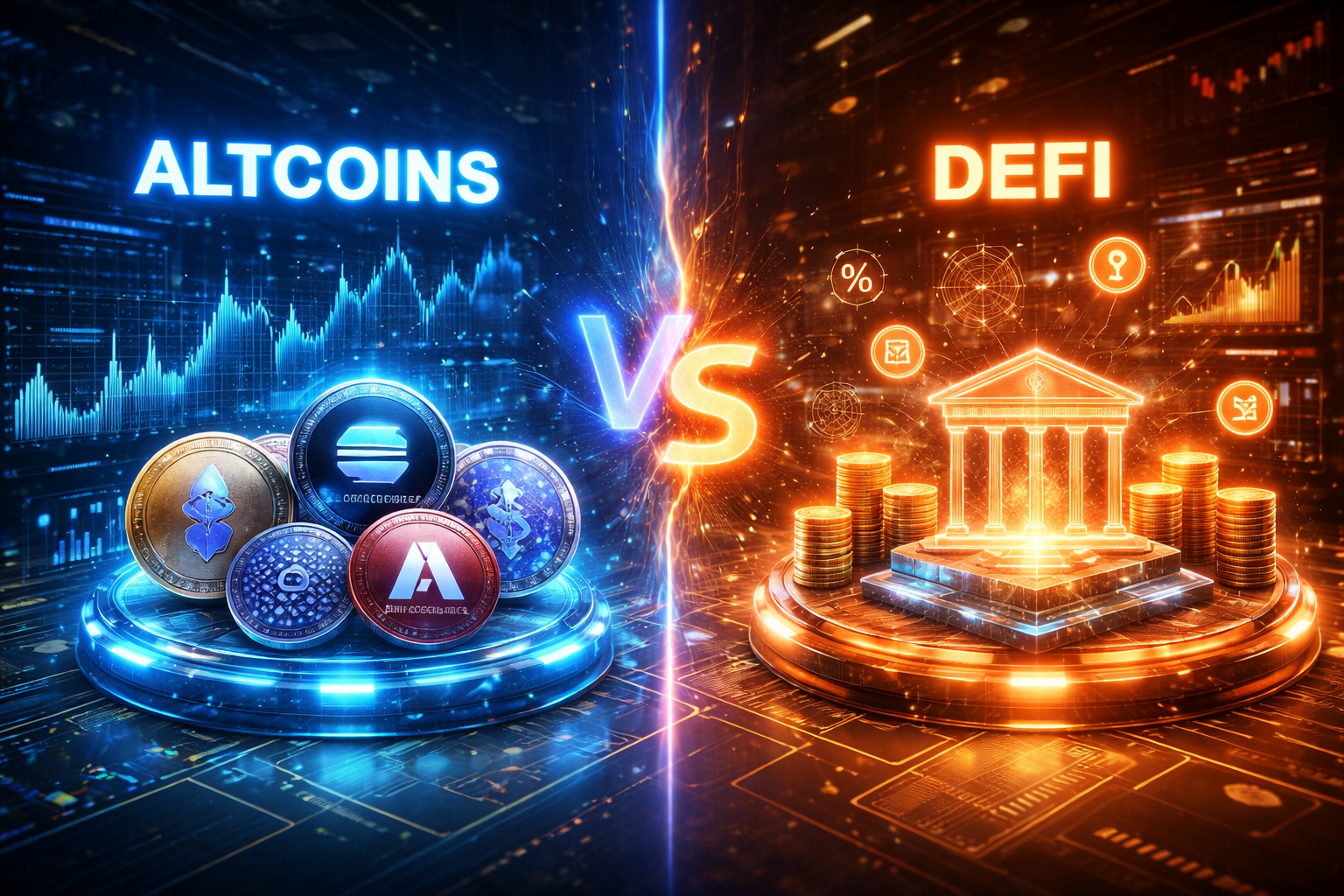
Long-Term Strategy Guide · 2026
Altcoin Investing
vs DeFi Investing:
Which Strategy
Delivers Higher
Returns for
Long-Term Holders?
One bets on future value. The other generates yield on what you already hold. Knowing the difference could define your long-term results.
Article at a Glance
- →Altcoin investing and DeFi investing are fundamentally different strategies — one bets on price appreciation, the other generates yield on assets you already hold.
- →DeFi protocols like Aave and Compound commonly offer 6–15% APY, but those returns come with smart contract risk, liquidity risk, and token volatility most beginners underestimate.
- →The 60/30/10 allocation model — splitting your portfolio across large-cap, mid-cap, and small-cap altcoins — is one of the most practical frameworks for managing long-term risk without sacrificing upside.
- →Market cycles hit altcoins and DeFi strategies differently — understanding that timing gap could be the difference between compounding gains and getting wiped out in a bear market.
- →You can combine both strategies in a single portfolio — and for serious long-term holders, doing so is often smarter than choosing just one.
Table of Contents
- Altcoins vs DeFi: The Long-Term Returns Battle
- What Altcoin Investing Actually Looks Like
- What DeFi Investing Actually Looks Like
- Altcoin Returns vs DeFi Returns: A Direct Comparison
- Risks You Cannot Ignore in Each Strategy
- How to Research Altcoins Before Investing
- How to Build a Long-Term Altcoin Portfolio
- How to Get Started With DeFi as a Long-Term Strategy
- Which Strategy Is Right for You
- Frequently Asked Questions
Altcoins vs DeFi: The Long-Term Returns Battle
Most crypto investors eventually face the same fork in the road: do you buy and hold altcoins, or do you put your assets to work through DeFi? The altcoin investing vs DeFi investing debate gets lumped together constantly, but these two strategies operate on completely different logic.
Altcoin investing is essentially a bet on future value — you buy a token today hoping it’s worth significantly more tomorrow, next year, or next cycle. DeFi investing is about generating yield from what you already hold, using protocols that run on smart contracts instead of banks. One is growth-oriented, the other is income-oriented. Knowing which one fits your goals — or how to blend both — is one of the most important decisions you’ll make as a long-term crypto holder.
Why This Comparison Matters More in 2026
The altcoin market has matured significantly. As of 2026, altcoins represent more than half of total cryptocurrency market capitalization, spanning smart contract platforms, DeFi tokens, utility tokens, and everything in between. That’s not a niche corner of crypto anymore — it’s the majority of the market.
At the same time, DeFi has evolved past its 2020–2021 “wild west” phase. Protocols are more audited, interfaces are more accessible, and the yield opportunities are more diverse. The question is no longer whether DeFi is legitimate — it’s whether it makes more sense for your specific goals than simply holding altcoins long-term.
The Core Difference Between Holding Altcoins and Using DeFi
Holding an altcoin is passive by nature. You research a project, buy the token, secure it in a wallet, and wait for price appreciation. Your return depends almost entirely on whether the market values that project more in the future than it does today.
DeFi is active by comparison. You’re deploying capital into protocols — lending pools, liquidity pools, yield farms — and earning a return based on usage of that protocol. The asset you hold may or may not appreciate in price, but you’re generating yield on top of whatever price movement happens. That distinction matters enormously when you’re planning a multi-year strategy.
What Altcoin Investing Actually Looks Like
Altcoin investing isn’t just “buying coins that aren’t Bitcoin.” It’s a discipline that requires understanding market structure, project fundamentals, tokenomics, and where a project sits in the broader crypto ecosystem.
Smart Contract Platforms: Ethereum, Solana, Avalanche, and Cardano
The most established altcoin category is smart contract platforms — blockchains that allow developers to build decentralized applications on top of them. Ethereum remains the dominant player, but competitors like Solana, Avalanche, and Cardano have carved out real market segments by offering different trade-offs in speed, cost, and decentralization. For those looking to explore further, here are some best crypto trading platforms to consider.
These large-cap platforms generally offer lower volatility and higher liquidity compared to smaller altcoins. For long-term holders, they represent the more conservative end of the altcoin spectrum — meaningful upside potential without the near-total loss risk that comes with smaller, less-established tokens. Solana in particular has demonstrated resilience and developer adoption that makes it a credible long-term holding for many serious investors. For those considering the broader financial landscape, exploring crypto-friendly banks could be beneficial for managing investments effectively.
Utility Tokens vs Meme Coins: Risk Profiles Compared
Not all altcoins carry the same risk. The difference between a utility token and a meme coin isn’t just philosophical — it’s the difference between owning something with underlying demand drivers versus something driven almost entirely by social sentiment.
Altcoin Types — Risk Profiles at a Glance
- ◆Utility tokens — Power specific blockchain ecosystems with built-in demand tied to actual usage. Examples: Chainlink (LINK) for oracle services, Uniswap (UNI) for DEX governance.
- ◆Governance tokens — Give holders voting rights over protocol decisions and often accrue value as the protocol grows. Examples: AAVE and COMP.
- ◆Meme coins — Like Dogecoin and Shiba Inu, have produced explosive short-term gains but carry extreme long-term volatility with no fundamental demand floor.
- ◆Layer-2 tokens — Such as Polygon (POL) and Arbitrum (ARB), increasingly relevant as Ethereum scaling solutions gain traction.
For long-term holders, utility tokens and platform tokens offer the strongest fundamental case. Meme coins can be part of a speculative allocation, but they should never anchor a serious long-term strategy.
How Tokenomics Affect Long-Term Altcoin Value
Tokenomics — the supply and distribution mechanics of a token — can make or break a long-term investment regardless of how good the underlying technology is. A project with heavy insider allocation (where early investors or the founding team hold 30–50% of total supply) creates massive sell pressure the moment vesting periods end. Always check how many tokens are held by insiders, when those tokens unlock, and what the total supply inflation schedule looks like over the next three to five years. For more insights, consider exploring hodling vs active trading strategies to better understand investment impacts.
What DeFi Investing Actually Looks Like
DeFi removes the intermediary entirely. Instead of depositing funds into a bank or a centralized platform, you interact directly with smart contracts — self-executing code that runs on blockchains like Ethereum or Solana. There’s no company holding your funds. The protocol holds them, governed by code.
That model creates genuine opportunities for yield generation that traditional finance simply can’t match at the same access level. But it also introduces a completely different category of risk that requires honest evaluation before you commit capital. For those interested in exploring various strategies, here are some DeFi income strategies that can help in passive crypto earning.
Lending and Borrowing Protocols: Aave and Compound
Aave and Compound are the two most established DeFi lending protocols. The mechanics are straightforward: you deposit crypto assets into a lending pool, borrowers take loans against collateral, and you earn interest on your deposited assets. Aave supports a wide range of assets including USDC, ETH, WBTC, and DAI, with variable and stable interest rate options depending on market conditions. Compound operates similarly, with algorithmic interest rates that adjust in real time based on supply and demand within each pool.
Yield Farming and Liquidity Pools Explained Simply
Yield farming takes DeFi a step further. Instead of just lending assets, you provide liquidity to decentralized exchanges like Uniswap or Curve Finance by depositing token pairs into a liquidity pool. In return, you earn a share of the trading fees generated by that pool, plus often additional token rewards from the protocol itself.
The catch is something called impermanent loss — when the prices of your deposited tokens diverge, you can end up with less total value than if you’d simply held both tokens outright. It’s not a theoretical risk. It’s a real cost that eats into yield, particularly in volatile markets. Understanding impermanent loss before entering any liquidity pool is non-negotiable.
Typical DeFi Returns: What 6–15% APY Really Means
DeFi protocols commonly offer 6–15% APY on various assets, and in some cases significantly higher during periods of high demand or new protocol incentive programs. To put that in context, a 10% APY on a $10,000 position generates $1,000 per year — compounding if you reinvest rewards. That’s meaningfully better than most traditional savings vehicles.
DeFi APY in Context — 10% on $10,000
$1,000
Annual yield at 10% APY on a $10,000 position
6–15%
Typical APY range on established DeFi lending protocols
Variable
Rates fluctuate with market demand — never rely on a fixed APY projection
But the headline APY number rarely tells the full story. Rates on DeFi protocols are variable and can drop sharply. Reward tokens earned through yield farming can lose value faster than the yield accumulates. And the underlying asset you’re depositing is still subject to its own price volatility. A 12% APY on an altcoin that drops 60% in value still results in a significant net loss. Always evaluate DeFi returns in the context of the total position — not just the yield percentage.
Altcoin Returns vs DeFi Returns: A Direct Comparison
Price appreciation and passive yield are two fundamentally different return mechanisms, and comparing them requires understanding what you’re actually measuring in each case.
An altcoin investment in Solana at the start of 2023 would have produced extraordinary price appreciation by late 2024, far exceeding any DeFi yield strategy running over the same period. Conversely, a stablecoin lending position on Aave through the 2022 bear market would have generated consistent 4–8% APY while most altcoin holders watched their portfolios decline 70–90%. The right strategy depends heavily on where you are in the market cycle.
Price Appreciation vs Passive Yield: Two Different Games
Altcoin price appreciation is asymmetric — you can lose 100% of your investment or gain 1,000%+ depending on the project and timing. That asymmetry is exactly what draws investors in, but it also means your returns are entirely dependent on future market sentiment, adoption, and macro conditions. You have no return until you sell, and you have no floor if the project fails.
DeFi yield is a different animal. It compounds continuously, it doesn’t require price appreciation to generate a return, and it can be deployed on stablecoins to eliminate price risk entirely. The trade-off is that yields are modest compared to a successful altcoin run, and the smart contract and liquidity risks are ever-present. Think of altcoins as lottery tickets with better-than-average odds, and DeFi yield as a high-interest account with unconventional fine print.
“In a bull market, altcoins dramatically outperform DeFi yields. In a bear market, the equation flips hard — and stablecoin DeFi keeps compounding while altcoin portfolios bleed.”
How Market Cycles Affect Each Strategy Differently
In a bull market, altcoins dramatically outperform DeFi yields. A 10x on a mid-cap altcoin over 18 months dwarfs any APY a lending protocol can realistically offer. But in bear markets, the equation flips hard. Altcoin portfolios can shed 80–90% of their value while a stablecoin DeFi position on Aave continues generating 4–8% APY regardless of broader market conditions. Savvy long-term holders shift allocation between these two strategies based on cycle positioning — increasing DeFi exposure during late bull and bear phases, rotating back into altcoins during accumulation periods before the next cycle begins.
Risks You Cannot Ignore in Each Strategy
Every crypto strategy carries risk. What separates experienced investors from beginners isn’t risk avoidance — it’s understanding exactly which risks you’re taking on and sizing your positions accordingly. Both altcoin investing and DeFi come with distinct risk profiles that need to be evaluated honestly before you commit capital.
Neither strategy is inherently safer than the other. They carry different categories of risk, and in some market conditions, one will destroy capital far faster than the other. The goal is to know what you own, why you own it, and what specific scenario would cause you to lose money before that scenario actually happens.
Altcoin-Specific Risks: Dilution, Abandonment, and Hype Collapse
Altcoins face three risks that DeFi positions don’t. First, token dilution — when a project continuously mints new tokens to fund operations or reward validators, existing holders get diluted over time even if the project performs well technically. Second, project abandonment — development teams in crypto can and do walk away, leaving token holders with worthless assets and no legal recourse. Third, hype collapse — many altcoins are priced almost entirely on narrative and speculation, meaning once the narrative fades, there’s no fundamental demand floor to catch the price. Projects that surged 50x in a bull run on hype alone have routinely declined 95%+ once that narrative cycle ended.
DeFi-Specific Risks: Smart Contract Bugs, Hacks, and Liquidity Crises
DeFi risk is technical in nature. Smart contract bugs have resulted in hundreds of millions of dollars in losses across protocols — even audited code has been exploited. The DeFi ecosystem has seen repeated high-profile hacks, with losses across protocols collectively running into the billions. Liquidity crises are another real threat: during extreme market stress, liquidity can dry up rapidly, making it impossible to exit positions at acceptable prices. And if you’re earning yield in a governance token that gets hacked or loses market confidence, your yield can effectively go to zero overnight.
Notable DeFi Exploits — A Reminder of Protocol Risk
| Protocol | Year | Loss | Type |
|---|---|---|---|
| Ronin Network | 2022 | ~$625M | Bridge exploit |
| Wormhole Bridge | 2022 | ~$320M | Smart contract bug |
| Various Protocols | Ongoing | $Billions total | Exploits, rug pulls, oracle attacks |
Which Strategy Has Hurt Long-Term Holders More Historically
The honest answer is altcoins — specifically small and mid-cap altcoins — have caused more total capital destruction for long-term retail holders than DeFi has. The reason is volume: far more people hold altcoins than actively use DeFi protocols, and the asymmetric downside of speculative tokens in bear markets has wiped out enormous amounts of retail capital across multiple cycles.
That said, DeFi hacks have caused sudden, catastrophic losses for users who concentrated capital in unaudited or poorly secured protocols. The Ronin Network hack in 2022 resulted in approximately $625 million in losses. The Wormhole bridge exploit cost around $320 million. These weren’t gradual declines — they were near-instant total losses for affected users.
The takeaway isn’t that one strategy is safer than the other across the board. It’s that altcoin risk tends to be slow-moving and market-cycle-dependent, while DeFi risk can be sudden and protocol-specific. Both require position sizing discipline — and neither should receive more than 5–10% of your total investment capital if you’re managing a broader financial portfolio.
How to Research Altcoins Before Investing
The difference between a well-researched altcoin position and a speculative gamble is the depth of your due diligence. Most retail investors skip this process entirely — they see a token trending on social media and buy in without ever looking at the fundamentals. That’s how capital gets destroyed in bear markets.
Solid altcoin research covers four core areas: the technical problem being solved, development activity, on-chain metrics, and tokenomics. Each one can independently disqualify a project, regardless of how compelling the narrative sounds on the surface.
1. Analyze the Whitepaper and Technical Problem Being Solved
A whitepaper should clearly articulate what problem the protocol solves, why blockchain is the right solution for that problem, and how the technical architecture achieves it. Vague whitepapers full of buzzwords and no technical specifics are a red flag. Ask one question as you read: does this protocol need a token to function, or is the token just a fundraising vehicle? If the token isn’t integral to the protocol’s mechanics, the long-term demand case is weak regardless of how the project markets itself.
2. Check GitHub Activity and Developer Consistency
Code commits on GitHub tell you whether a development team is actively building or quietly coasting on hype. A project with consistent, meaningful commits from multiple contributors over 12–24 months has demonstrated real development discipline. A project with sparse commits, long gaps in activity, or a single dominant contributor carries significantly higher abandonment risk.
Look specifically at the frequency of commits, the number of active contributors, and whether recent commits reflect meaningful development work rather than minor documentation changes. Tools like Artemis, Santiment, and Token Terminal all surface developer activity metrics without requiring you to manually read GitHub repositories.
What Healthy GitHub Activity Looks Like for an Altcoin Project
- ✓Multiple active contributors — not just 1–2 developers
- ✓Regular commits over the past 6–12 months with no major gaps
- ✓Meaningful code changes — not just documentation edits
- ✓Open issues being actively addressed and closed
- ✕Red flag: Last commit was 3+ months ago
- ✕Red flag: Single developer controls all commits
- ✕Red flag: Repository is private or activity is hidden
Developer activity isn’t a guarantee of price performance — some actively developed projects still fail to gain market adoption. But low or declining developer activity is one of the most reliable early warning signs that a project is losing momentum before the market prices it in.
Cross-referencing GitHub data with social channel activity can also reveal a divergence pattern worth watching: projects that are very loud on Twitter and Discord but quiet on GitHub are often more focused on marketing than building. That divergence tends to resolve badly for token holders over 12–24 month periods.
3. Read On-Chain Metrics: TVL, Active Addresses, and Transaction Volume
On-chain metrics cut through marketing narratives and show you what’s actually happening on a protocol. Total Value Locked (TVL) tells you how much capital has been committed to a DeFi protocol — a rising TVL indicates growing user trust and capital deployment. Active address counts reveal whether a network is growing its real user base or just recycling the same wallets. Transaction volume shows genuine economic activity versus low-engagement speculative trading.
Tools like DeFiLlama (for TVL data), Glassnode, and Nansen provide these metrics across major protocols and networks. A project with rising TVL, growing active addresses, and increasing transaction volume over a 6–12 month window is showing organic growth signals that are far more reliable than price action alone.
4. Evaluate Tokenomics and Insider Allocation
Before investing in any altcoin, pull up the token distribution breakdown and vesting schedule. If insiders — founding teams, early investors, and venture capital funds — collectively hold more than 30% of total supply with vesting periods that end within the next 12–18 months, you’re looking at significant potential sell pressure. The project may be technically excellent and still underperform because the market is absorbing millions of dollars in insider token unlocks on a regular schedule. CoinGecko, Messari, and the project’s own documentation are the primary sources for this information.
How to Build a Long-Term Altcoin Portfolio
Building a long-term altcoin portfolio isn’t about picking the most exciting tokens — it’s about constructing a risk-managed position that can survive a bear market without being completely wiped out while still capturing meaningful upside in a bull cycle. That requires deliberate allocation across market cap tiers, consistent entry strategies, and secure storage practices.
The 60/30/10 Allocation Model for Large, Mid, and Small-Cap Altcoins
A practical framework used by many long-term crypto investors allocates portfolio weight based on market cap tier — balancing lower-risk established projects with higher-risk, higher-reward smaller positions. The 60/30/10 model provides a starting structure that can be adjusted based on your personal risk tolerance and cycle positioning.
The 60/30/10 Altcoin Allocation Model
60%
Large-Cap Altcoins
Top 20 by market cap. ETH, SOL, AVAX. Lower volatility, higher liquidity, established developer ecosystems.
30%
Mid-Cap Altcoins
Ranked ~21–100. Proven use cases, more growth runway. Higher risk than large-caps with meaningful upside.
10%
Small-Cap Altcoins
High-risk, high-reward speculative positions. Size each one knowing it could go to zero.
This model isn’t static. During late bull market conditions when speculative froth builds up in small-caps, rotating some of that 10% back into large-caps or even stablecoin DeFi positions is a rational risk management move. The model gives you a starting framework — your job is to adapt it as market conditions evolve.
Within each tier, diversification across sectors matters too. Holding three large-cap smart contract platforms and nothing else concentrates your exposure to a single narrative. A more resilient large-cap allocation might include a smart contract platform, a DeFi protocol token, and a Layer-2 scaling solution — three projects with different demand drivers that don’t all rise and fall on the same catalyst.
Dollar-Cost Averaging to Reduce Timing Risk
Timing the crypto market is a losing game for most investors — including experienced ones. Dollar-cost averaging (DCA) removes the pressure of finding a perfect entry point by spreading your purchases across regular intervals regardless of price. Instead of trying to buy the exact bottom of a cycle, you buy a fixed dollar amount weekly or monthly, which averages your cost basis over time and significantly reduces the impact of short-term volatility on your overall position.
The math works in your favor during volatile markets. When prices drop, your fixed dollar amount buys more tokens. When prices rise, it buys fewer. Over a 12–24 month accumulation window, this mechanical approach consistently outperforms lump-sum entries for investors who don’t have a reliable edge in timing the market. For those interested in learning more, exploring the best crypto research platforms available can provide valuable insights.
DCA Best Practices for Crypto Holders
- ◆Set a fixed amount you’re comfortable losing entirely — DCA doesn’t eliminate risk, it manages entry timing
- ◆Choose a consistent interval — weekly or bi-weekly tends to work better than monthly for highly volatile assets
- ◆Automate where possible — Coinbase, Kraken, and Binance all offer recurring buy features that remove emotion from the equation
- ◆Avoid pausing during dips — the instinct to stop buying when prices fall is exactly backward for a DCA strategy; those are the purchases that lower your average cost the most
Hardware Wallets vs Exchange Storage for Long-Term Holders
If you’re holding altcoins for 12 months or longer, keeping them on an exchange is one of the most unnecessary risks you can take. Exchanges have been hacked, frozen, and collapsed — FTX being the most catastrophic recent example, where users lost billions in assets they believed were safely held. A hardware wallet like the Ledger Nano X or Trezor Model T stores your private keys offline, meaning your assets remain in your control regardless of what happens to any exchange or platform.
The practical rule is straightforward: anything you plan to hold long-term goes in cold storage. Funds you need for active trading or DeFi interaction can stay in a hot wallet or on-exchange for accessibility. Long-term holdings belong in hardware wallets — full stop. The one-time cost of a Ledger Nano X (approximately $149) is trivial compared to the risk of losing an entire long-term position to an exchange insolvency or hack.
How to Get Started With DeFi as a Long-Term Strategy
Getting started with DeFi doesn’t require deep technical knowledge, but it does require deliberate preparation. Rushing into DeFi protocols without understanding the mechanics, the risks, and the specific platform you’re using is one of the fastest ways to lose capital in crypto.
DeFi Starter Checklist — Before You Deploy Any Capital
- ✓Set up a non-custodial wallet (MetaMask or Phantom depending on chain)
- ✓Fund wallet with a small test amount first (under $50)
- ✓Verify the protocol URL directly — bookmark it, never use search engine links
- ✓Check the protocol’s audit history on their official documentation
- ✓Understand the specific yield mechanism before depositing (lending vs liquidity pool vs yield farm)
- ✓Confirm you understand the withdrawal process before committing funds
- ✕Never connect your wallet to a protocol from an unsolicited link
- ✕Never approve unlimited token spending permissions without understanding the risk
- ✕Never deploy more than you can afford to lose entirely in any single protocol
The checklist above isn’t theoretical caution — each item on it corresponds to a real attack vector that has been exploited to drain user funds from DeFi wallets. Phishing sites mimicking legitimate protocols, malicious token approvals, and unaudited contracts have collectively cost users hundreds of millions of dollars. A few minutes of verification per transaction is a reasonable trade-off for protecting your capital. Additionally, understanding mobile vs desktop wallet options can further enhance your security measures.
Start with established, heavily audited protocols before exploring newer or higher-yield alternatives. Aave and Compound on Ethereum, or lending protocols on Solana like Kamino Finance, have track records and security histories that newer protocols simply don’t have yet. Build your DeFi experience on proven infrastructure first, then expand to higher-risk opportunities as your technical confidence grows.
CeFi vs DeFi: Which Entry Point Makes Sense for You
Centralized Finance (CeFi) platforms like Coinbase, Kraken, and Nexo offer yield products that function similarly to DeFi — earning interest on crypto deposits — but with a custodial layer managing the technical complexity. You don’t interact with smart contracts directly. You deposit assets into the platform, and the platform manages the yield generation on your behalf. It’s a more familiar experience that mirrors traditional banking, but it reintroduces counterparty risk.
DeFi removes that counterparty — your assets interact directly with smart contracts rather than being held by a company. That means you’re not exposed to platform insolvency risk the way FTX users were. But it does mean you’re exposed to smart contract risk, and you’re responsible for every interaction you make with those contracts. There’s no customer support to call if you make a mistake.
The honest entry-point recommendation depends on your technical comfort and your priority. If your primary concern is yield generation with minimal technical complexity, CeFi platforms are a legitimate starting point. If your priority is self-custody and eliminating platform risk, DeFi is the right path — but invest time in learning the mechanics before investing money in the protocols.
CeFi vs DeFi — Complete Comparison
| Factor | CeFi | DeFi |
|---|---|---|
| Custody of Assets | Platform holds your assets | You hold your assets |
| Technical Complexity | Low — familiar banking interface | Moderate to High — wallet + protocol interaction |
| Typical APY Range | 2–8% on major assets | 6–15%+ depending on protocol |
| Primary Risk | Platform insolvency or freeze | Smart contract exploits, impermanent loss |
| Best For | Beginners, passive yield seekers | Self-custody advocates, technically confident users |
| Recovery Options | Customer support available | No recourse — transactions are irreversible |
Setting Up a Wallet and Connecting to DeFi Protocols
The most widely used DeFi wallet for Ethereum-based protocols is MetaMask — a browser extension and mobile app that generates a non-custodial wallet you control via a 12-word seed phrase. For Solana-based DeFi, Phantom is the equivalent standard. Setup takes under ten minutes: install the extension, generate your wallet, write down your seed phrase on paper (never digitally), and fund the wallet from an exchange. The seed phrase is the only thing standing between you and permanent loss of access to your wallet — store it offline in at least two physical locations.
Once your wallet is set up and funded, connecting to a DeFi protocol is as simple as visiting the official protocol URL — always verified directly, never through a search engine ad — and clicking “Connect Wallet.” The protocol will prompt your MetaMask or Phantom extension to approve the connection. From there, you can deposit assets, view real-time APY rates, and manage your positions directly through the protocol’s interface. For those interested in maximizing returns, exploring DeFi income strategies can be beneficial. Every transaction requires gas fees (paid in ETH for Ethereum-based protocols, SOL for Solana), so always maintain a small reserve of the native chain token to cover transaction costs.
Which Strategy Is Right for You
“If you’re serious about long-term wealth building in crypto, combining both — holding quality altcoins in cold storage while deploying stablecoins into DeFi yield strategies — is the most sophisticated and resilient approach available to retail investors today.”
CoinPosters · Long-Term Strategy Guide 2026
If you’re early in your crypto journey and prioritizing growth over income, a structured altcoin portfolio using the 60/30/10 model with DCA entries gives you meaningful upside exposure with built-in risk management. If you already hold crypto and want to put idle assets to work, DeFi lending on established protocols like Aave is a logical addition to your strategy. And if you’re serious about long-term wealth building in crypto, combining both — holding quality altcoins in cold storage while deploying stablecoins or lower-volatility assets into DeFi yield strategies — is the most sophisticated and resilient approach available to retail investors today.
Frequently Asked Questions
Here are answers to the most common questions about combining altcoin investing and DeFi strategies for long-term portfolio building.
Can you combine altcoin investing and DeFi investing in the same portfolio?
Yes — and for most serious long-term holders, combining both strategies is smarter than choosing just one. A practical approach is to hold your core altcoin positions in cold storage for long-term price appreciation while deploying stablecoins or underutilized assets into DeFi lending protocols to generate passive yield. The two strategies serve different functions: altcoins provide asymmetric upside, while DeFi generates consistent income on capital that would otherwise sit idle. The key is keeping each allocation sized appropriately — DeFi positions in audited protocols, altcoin positions diversified across market cap tiers — so that a failure in one area doesn’t cascade into the other.
How frequently should you review and rebalance a long-term altcoin portfolio?
A quarterly review is the minimum for a long-term altcoin portfolio — checking on-chain metrics, developer activity, and whether the fundamental thesis for each holding still holds. A full rebalance back to your target allocation (such as the 60/30/10 model) should happen at least twice a year, or whenever a single position grows to represent more than 25–30% of your total crypto portfolio due to price appreciation. More frequent rebalancing in crypto tends to generate unnecessary taxable events and trading costs without materially improving outcomes for long-term holders.
Are DeFi returns sustainable over a multi-year holding period?
DeFi returns on established protocols like Aave and Compound have demonstrated relative sustainability over multi-year periods, though the specific APY rates fluctuate significantly based on market conditions and protocol demand. Stablecoin lending positions have historically been the most consistent — generating 3–8% APY across multiple market cycles including bear markets where most other crypto strategies underperformed. More speculative DeFi strategies involving newer protocols or aggressive yield farming are far less sustainable, with many offering elevated initial yields that collapse as protocol incentive programs wind down. For long-term DeFi positioning, established protocols with proven security histories on core assets are considerably more reliable than chasing the highest available APY at any given time.
How do you identify promising altcoin projects before they go mainstream?
The clearest early signals come from on-chain data, not social media. Projects showing consistent growth in active addresses, rising TVL, and increasing transaction volume over a 6–12 month window before any significant price movement are demonstrating organic adoption. Developer activity on GitHub — specifically sustained, multi-contributor commit histories — indicates a team that is building rather than marketing. Projects that solve a specific, real problem with a token that’s integral to the protocol’s function have stronger long-term demand mechanics than narrative-driven tokens.
Ecosystem positioning also matters. Projects building within high-growth ecosystems — Solana’s expanding DeFi infrastructure, Ethereum’s Layer-2 ecosystem, or emerging real-world asset tokenization protocols — benefit from broader ecosystem tailwinds in addition to their own adoption metrics. Identifying quality projects within growing ecosystems before those ecosystems reach mainstream attention is one of the most reliable ways to build early positions with strong long-term fundamentals.
Is DeFi investing safe for beginners with limited technical knowledge?
DeFi carries real technical risk that beginners need to respect — but it’s approachable with the right preparation. Starting with established, heavily audited protocols like Aave on Ethereum or Kamino Finance on Solana, using small amounts to learn the mechanics before committing larger capital, and taking time to understand wallet security and transaction approvals will dramatically reduce your risk exposure as a new DeFi user.
The most common mistakes beginners make in DeFi are entirely avoidable: connecting wallets to phishing sites, approving unlimited token spending permissions without understanding the implications, and chasing high-APY unaudited protocols that turn out to be exploits or rug pulls. Each of these risks can be managed with basic verification habits and a rule of starting with protocols that have 12+ months of audit history and significant TVL. For more on secure storage, consider the differences between a hardware wallet vs software wallet for crypto security.
For beginners who want DeFi exposure without managing the technical complexity directly, CeFi platforms with yield products are a legitimate intermediate step. Build your fundamental understanding of how DeFi works before you interact with it directly, and never deploy capital into a protocol you haven’t researched and tested with a small amount first. The learning curve is real, but it’s shorter than most beginners expect — and the self-custody and yield generation capabilities on the other side of that curve are genuinely worth the effort. Additionally, explore various DeFi income strategies to enhance your passive crypto earnings.
Disclaimer
This article is for informational purposes only and does not constitute financial or investment advice. Do Your Own Research (DYOR) before making any crypto investment, deploying capital into DeFi protocols, or building an altcoin portfolio. All investments in cryptocurrency carry substantial risk of loss. DeFi protocols carry additional smart contract, liquidity, and technical risks. Past performance of any protocol, token, or strategy is not indicative of future results. Always consult a qualified financial advisor before making investment decisions. CoinPosters is not responsible for any financial losses arising from actions taken based on the information provided in this article.
CoinPosters
Your guide to navigating crypto in 2026 and beyond.



Latest
Altcoins
25 Feb 2026
Altcoins
21 Feb 2026
Altcoins
13 Feb 2026
Altcoins
07 Feb 2026
Altcoins
06 Feb 2026