Coinposters
What Are Stablecoins & Utility Tokens | Are They Worth Investing in 2026?
Crypto Investing · 2026 Guide
What they are, how they work, which belongs in your portfolio — and how to tell the difference between genuine value and hype.
CoinPosters Research Desk · Updated February 2026 · 12 min read
Key Takeaways
Stablecoins provide stability in the volatile crypto market, maintaining a fixed value typically pegged to real-world assets, while utility tokens offer functional benefits within specific blockchain ecosystems.
By 2026, stablecoins have evolved into essential financial infrastructure with regulatory clarity and enhanced yield-generating capabilities through DeFi integration.
Utility tokens with strong tokenomics and real-world utility have established themselves as potential growth investments, though they carry significantly higher risk than stablecoins.
A balanced crypto portfolio in 2026 typically includes both asset types: stablecoins for stability and predictable yields, and carefully selected utility tokens for growth potential.
Understanding the regulatory landscape is crucial — compliant, transparent platforms give investors the clearest picture of both stablecoin and utility token risk profiles.
The crypto landscape has fundamentally transformed since the early days of Bitcoin maximalism. Today’s investors face a more sophisticated ecosystem where stablecoins provide essential stability and utility tokens power increasingly practical applications. As we navigate 2026, understanding these distinct token types has become a fundamental requirement for anyone serious about cryptocurrency investing.
The evolution of both stablecoins and utility tokens has been remarkable, with dramatic increases in institutional adoption and practical use cases emerging across industries. What began as experimental concepts have matured into financial tools with defined roles in modern portfolios. This comprehensive guide will help you understand what these assets are, how they function in today’s market, and whether they deserve a place in your investment strategy.
Whether you’re a seasoned crypto veteran or just beginning your journey, the distinctions between these token types matter more than ever as the market has matured.
The 2026 Crypto Investment Landscape at a Glance
|
15–30%
Recommended stablecoin allocation for most portfolios |
40–60%
Suggested blue-chip crypto foundation (BTC/ETH) |
|
150–200%
Typical DAI crypto-collateralization ratio |
50–80%
LTV ratio on crypto lending markets |
The Crypto Investment Landscape in 2026
Cryptocurrency has evolved from a fringe investment to an established asset class with institutional backing and mainstream acceptance. Following the regulatory clarity provided by major economies between 2023 and 2025, the market has matured significantly. We’ve witnessed the integration of blockchain technology into traditional financial systems, creating a hybrid ecosystem where cryptocurrency operates alongside — rather than against — conventional finance.
The days of pure speculation have given way to more sophisticated investment strategies focused on utility and practical application. Corporations now regularly hold Bitcoin and stablecoins on their balance sheets, while decentralized finance (DeFi) protocols have been standardized and secured against many of the vulnerabilities that plagued earlier iterations.
“The market has segmented into distinct asset categories with specific investment profiles — and understanding each one is now the baseline for serious crypto investing.”
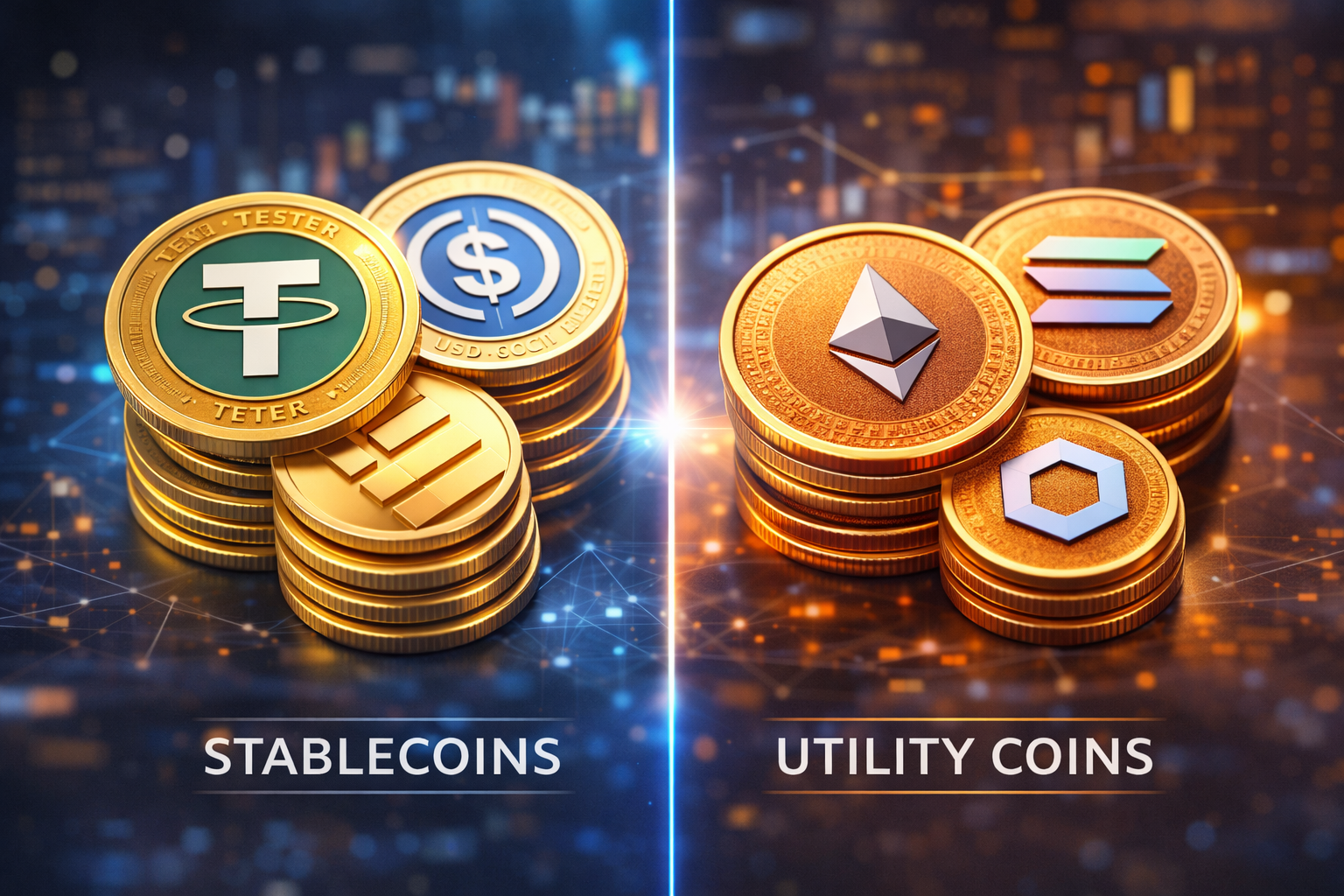
Stablecoins have become the foundation of the crypto economy — the digital dollars that facilitate transactions and provide shelter during volatility. Utility tokens, meanwhile, represent equity-like interests in blockchain projects with established use cases and revenue models.
What Exactly Are Stablecoins?
Stablecoins are cryptocurrencies engineered to maintain a stable value by pegging their price to external assets like the US dollar, euro, or gold. Unlike Bitcoin or Ethereum, which can experience dramatic price swings, stablecoins aim to provide the benefits of blockchain technology — such as borderless transfers and programmability — without the volatility that makes most cryptocurrencies impractical for everyday transactions.
These digital assets serve as bridges between traditional finance and the crypto economy. By 2026, stablecoins have evolved from simple trading pairs to sophisticated financial infrastructure, powering everything from cross-border payments to yield-generating strategies in decentralized finance.
The Three Types of Stablecoins You Need to Know
Backed 1:1 by Traditional Currency
For every token in circulation, the issuer holds one dollar (or euro, etc.) in reserve. Regular attestations and audits verify these reserves. Examples include USDC and USDT. The dominant choice in 2026 due to regulatory compliance, auditable reserves, and straightforward redemption.
Over-Collateralized With Crypto Assets
Uses other cryptocurrencies as collateral, typically at 150–200% ratios to absorb market volatility. Smart contracts automatically liquidate undercollateralized positions. DAI remains the benchmark; LUSD has emerged as a notable alternative. Preferred for DeFi applications due to fully on-chain operation.
Partial Collateral + Algorithmic Supply Controls
Combines partial collateralization with smart contract protocols that automatically adjust supply based on demand. Purely algorithmic models failed catastrophically in 2022 (Terra/UST). Surviving models like FRAX use hybrid approaches. When price rises above target, supply is increased; when it falls, supply is reduced or buyer incentives are activated.
Yield-Generating Opportunities With Stablecoins
By 2026, stablecoins have evolved beyond simple value preservation to become powerful yield-generating assets. The maturation of DeFi protocols has created numerous avenues for stablecoin holders to earn passive income at rates that consistently outperform traditional banking products.
Stablecoin Yield Strategies Compared
| Strategy | How It Works | Risk Level | Typical Profile |
|---|---|---|---|
| Liquidity Provision (DEXs) | Deposit stablecoin pairs into AMMs, earn a portion of trading fees | Low–Medium | Steady fee income; concentrated liquidity improves efficiency |
| Lending Platforms | Lend stablecoins to borrowers who post collateral at 50–80% LTV | Low–Medium | Protocol-to-protocol lending with insurance layers |
| Yield Farming / Liquidity Mining | Earn platform tokens for providing liquidity | Medium | Higher upside; dependent on platform token value |
| Proof-of-Stake Staking | Lock stablecoins in PoS protocols to validate transactions | Low | Predictable yield; lock-up periods apply |
| Tokenized Real-World Assets (RWAs) | Deploy stablecoins into tokenized treasury bills, bonds, real estate | Low | Bridges DeFi yields with traditional financial security |
Stablecoin Risks You Can’t Afford to Ignore
Despite their relative stability, stablecoins carry three primary risk categories every investor should evaluate carefully before allocating capital.
⚠ Counterparty Risk — Fiat-backed stablecoins depend directly on the issuer’s solvency, reserve management, and regulatory compliance. The move toward transparent attestations has reduced but not eliminated this risk, as evidenced by several smaller stablecoin depeggings between 2022 and 2025.
⚠ Technical / Smart Contract Risk — Crypto-collateralized and algorithmic stablecoins rely on complex smart contracts. Despite extensive audits, the possibility of exploits, oracle failures, or governance attacks cannot be dismissed. The increasing interconnectedness of DeFi protocols also introduces systemic cascading risks.
⚠ Regulatory Jurisdiction Risk — While regulatory uncertainty has decreased significantly by 2026, meaningful differences remain between regions. These divergences can affect stablecoin availability, functionality, tax treatment, and compliance requirements depending on an investor’s location.
15–30%
Recommended stablecoin allocation within the crypto portion of a portfolio in 2026, according to CoinPosters research. Adjust up in bearish conditions, down when high-conviction utility token opportunities arise.
Utility Tokens Explained
Utility tokens function as specialized digital assets that grant holders specific rights, privileges, or functionality within a blockchain ecosystem. Unlike cryptocurrencies primarily designed as stores of value or mediums of exchange, utility tokens serve practical purposes within their respective networks — whether providing access to services, conferring voting rights, or enabling specific operations within decentralized applications.
These tokens represent a fundamentally different value proposition than stablecoins. While stablecoins aim for price stability, utility tokens typically embrace price discovery based on the perceived value of their underlying utility. Their worth is intrinsically linked to the demand for the services they facilitate, the growth of their ecosystems, and the token’s role within that system.
“By 2026, the market has naturally selected for tokens with genuine utility and sound tokenomics — those lacking substantive value propositions have largely disappeared.”
How Utility Tokens Power Blockchain Ecosystems
Utility tokens serve as the economic engines of their respective blockchain ecosystems, creating aligned incentives between users, developers, and investors. They facilitate access to specific services — such as computing resources on decentralized cloud platforms or transaction processing on specialized networks. The token’s necessity for utilizing these services creates natural demand that supports its value over time. Governance rights, fee sharing, and staking mechanisms layer additional utility on top of basic access functions, creating multi-dimensional value propositions that can sustain long-term holder interest when backed by genuine adoption.
Stablecoins vs. Utility Tokens — Side by Side
| Factor | Stablecoins | Utility Tokens |
|---|---|---|
| Primary Purpose | Price stability, transactions, yield | Access, governance, ecosystem participation |
| Price Behavior | Pegged (minimal movement) | Volatile; driven by adoption and tokenomics |
| Risk Profile | Low–Medium | Medium–High |
| Return Potential | Yield-based (predictable) | Growth-based (asymmetric upside) |
| Regulatory Status | Clearer frameworks in 2026 | Varies by jurisdiction; utility vs. security distinction key |
| Portfolio Role | Stability layer, dry powder, income | Growth layer, speculation management |
| Best For | Conservative to moderate investors | Investors with higher risk tolerance and long horizons |
Evaluating Utility Tokens as Investments
Unlike stablecoins, utility tokens represent investments in specific blockchain applications and ecosystems, with price performance directly tied to adoption and token economic design. Their investment profile more closely resembles early-stage venture capital than traditional financial assets, offering potentially significant upside coupled with substantial risk.
Project Fundamentals to Analyze Before Investing
When evaluating utility tokens, the strength of the underlying project remains the most critical factor in determining long-term investment viability. Serious investors should thoroughly examine the problem the project aims to solve, the size of its addressable market, and whether blockchain technology truly enhances the solution. Projects solving genuine pain points with clear competitive advantages have consistently outperformed those attempting to force blockchain technology into use cases where it adds minimal value.
Team assessment has become increasingly sophisticated, extending beyond simple resume verification to include track record analysis, technical capability evaluation, and commitment assessment. The most successful utility token projects of 2026 are led by teams that combine deep domain expertise in their target industry with blockchain development experience and business acumen.
Red Flags That Signal a Poor Utility Token Investment
Excessive team token allocations without vesting schedules · Unclear or forced token utility · No independent security audits · Heavy reliance on forked code without meaningful improvements · Governance controlled by a small number of wallets · Revenue model that doesn’t require the token
Technical shortcuts and security vulnerabilities remain persistent concerns in the utility token space. The history of exploits between 2021 and 2025 demonstrated that technical excellence is not optional in blockchain development, with even minor vulnerabilities potentially leading to catastrophic losses for token holders.
Token Economics and Their Impact on Long-Term Value
By 2026, tokenomics has evolved from a marketing buzzword to a rigorous discipline combining economics, game theory, and mechanism design. Well-designed utility tokens implement value accrual mechanisms that directly link token price to protocol success, creating virtuous cycles where increased usage drives token appreciation.
Supply dynamics have proven especially critical to long-term token performance. The most successful projects implement adaptive issuance models that respond to network usage metrics — reducing emissions during periods of low demand and increasing them to incentivize participation when needed.
The Regulatory Landscape for Crypto in 2026
The regulatory environment for cryptocurrencies has fundamentally transformed since the uncertainty of the early 2020s. Major jurisdictions have implemented comprehensive frameworks that provide clear guidelines for different token categories, creating a more predictable operating environment for both projects and investors.
Regulatory Treatment by Token Type — 2026 Summary
| Token Type | Regulatory Status | Key Requirements | Investor Impact |
|---|---|---|---|
| Fiat-Backed Stablecoins | Most regulated category | Reserve audits, AML/KYC, operational resilience standards | High transparency; reduced anonymity |
| Crypto-Collateralized Stablecoins | Lighter oversight than fiat-backed | Smart contract audits, governance disclosure | More flexibility; on-chain verifiability |
| Utility Tokens (genuine utility) | Clearer frameworks emerging | Must demonstrate functional utility in working products | Lighter burden than securities |
| Utility Tokens (disguised securities) | Treated as securities | Full securities registration and disclosure | Higher compliance cost; limited access in some regions |
Building a Balanced Crypto Portfolio for 2026 and Beyond
Creating a resilient crypto portfolio in 2026 requires balancing stability and growth potential across multiple asset classes. Most financial advisors specializing in digital assets recommend a foundation of blue-chip cryptocurrencies like Bitcoin and Ethereum (40–60% of crypto allocation), supplemented by stablecoins and high-conviction utility tokens.
Recommended Portfolio Allocation by Risk Profile — 2026
| Conservative | Moderate | Aggressive |
|---|---|---|
| 40–50%Blue-chip crypto (BTC/ETH) | 50–60%Blue-chip crypto (BTC/ETH) | 40–60%Blue-chip crypto (BTC/ETH) |
| 25–30%Stablecoins | 15–20%Stablecoins | 10–15%Stablecoins (dry powder) |
| 20–30%Established utility tokens | 20–30%Diversified utility tokens | 30–45%Growth-focused utility tokens |
Portfolio construction should also consider correlation between assets, with ideal allocations including tokens from different blockchain ecosystems, application categories, and risk profiles. Regular portfolio reviews and rebalancing have become essential practices as the market continues to evolve rapidly.
Strategic Entry Points in the Current Market
Dollar-cost averaging remains the most reliable strategy for building positions in both stablecoins and utility tokens, removing the pressure of perfect market timing and reducing the impact of short-term volatility. For stablecoins, entry timing is less critical than selecting the right platforms for deployment. For utility tokens, accumulating during broader market corrections when fundamentally strong projects experience temporary drawdowns has historically produced superior returns.
|
Strategy 01
Dollar-Cost Averaging Remove timing pressure entirely. Build positions gradually over fixed intervals regardless of price. Most effective for long-horizon investors. |
Strategy 02
Correction Accumulation For utility tokens, accumulate during market-wide corrections when strong fundamentals diverge from price. Monitor on-chain metrics to validate thesis. |
Strategy 03
Yield Optimization For stablecoins, focus on selecting the optimal DeFi deployment strategies rather than entry timing. Diversify across platforms to manage counterparty risk. |
The Final Verdict
Stablecoins have cemented their place as essential components of crypto portfolios in 2026, offering a unique combination of blockchain efficiency, programmability, and price stability. The regulatory clarity achieved by leading stablecoin issuers further strengthens their investment case.
Utility tokens present a more nuanced proposition — their worth is highly dependent on project-specific factors rather than broad market trends. Investors willing to conduct thorough research can identify tokens with asymmetric upside potential. However, these opportunities come with substantially higher risk profiles, requiring careful position sizing and ongoing risk management.
Frequently Asked Questions
How much of my portfolio should I allocate to stablecoins versus utility tokens?
The ideal allocation depends primarily on your risk tolerance, investment timeframe, and financial goals. As a baseline, CoinPosters recommends maintaining stablecoins at 10–30% of the crypto portion of your portfolio — higher for conservative investors, lower for aggressive ones — with the remainder split between blue-chip crypto and carefully selected utility tokens. See the allocation table above for specific breakdowns by risk profile.
Consider your investment timeline carefully: shorter horizons generally warrant higher stablecoin allocations. Regular rebalancing is essential — most disciplined investors establish threshold triggers (typically ±5–10% from target allocations) that prompt portfolio adjustments to maintain their desired risk profile.
What happens to stablecoins during extreme market downturns?
Different stablecoin types exhibit varying behaviors during extreme market conditions. The table below summarizes estimated performance ranges based on historical market cycles from 2024–2026.
| Type | Peg Range Under 70% Market Drawdown | Key Risk Factor |
|---|---|---|
| Fiat-Collateralized | $0.98 – $1.02 Historically maintained |
Issuer solvency & reserve confidence |
| Crypto-Collateralized | $0.95 – $1.05 Historically maintained |
Collateral liquidation cascades |
| Hybrid Algorithmic | $0.85 – $1.15 Temporary deviations observed |
Algorithmic mechanism failure under stress |
* Ranges based on estimated historical performance patterns. Past performance does not guarantee future results.
Purely algorithmic models have largely failed during periods of extreme market stress — the 2022 Terra/UST collapse being the defining example. Hybrid models have proven more resilient but still experience greater deviations than fully collateralized alternatives.
Can utility tokens become worthless, and how can I protect myself?
Yes — utility tokens can and do become worthless, as demonstrated by numerous failed projects between 2018 and 2025. Risks include technological obsolescence, team dissolution, regulatory challenges, security breaches, and fundamentally flawed tokenomics. Unlike stablecoins, utility tokens have no price floor beyond what market participants collectively determine.
Protection begins with thorough due diligence before investment, followed by ongoing monitoring. Diversification across multiple tokens, sectors, and blockchain ecosystems limits project-specific exposure. Implementing strict position sizing and pre-defined exit strategies can help preserve capital. Quarterly reassessment of whether the original investment thesis remains valid is a discipline that separates successful utility token investors from the rest.
Are there tax advantages to holding stablecoins versus other cryptocurrencies?
Stablecoins may offer certain tax efficiency advantages compared to volatile cryptocurrencies, since their stable value typically generates fewer taxable events from price appreciation. However, yields from lending, staking, or liquidity provision generally create taxable income in most jurisdictions.
By 2026, many countries have implemented clearer guidelines for DeFi activities, with some distinguishing between different yield sources for tax purposes. Consulting with a tax professional specializing in digital assets remains essential for optimizing tax efficiency while maintaining compliance.
Which stablecoins and utility tokens have the best track record since 2023?
Among stablecoins, USDC leads the fiat-backed category; DAI has dominated the crypto-collateralized segment, successfully navigating multiple extreme market events while maintaining its peg through adaptive governance.
In the utility token space, infrastructure tokens powering interoperability, data availability, and scaling solutions have generally outperformed application-specific tokens. Real-world asset (RWA) tokens emerged as notable outperformers during 2024–2025, bridging traditional finance and blockchain technology to unlock new efficiency for previously illiquid assets.
The most reliable performance indicator across both categories remains fundamental utility — tokens that solve genuine problems, create measurable value for users, and capture a portion of that value through well-designed tokenomics have consistently outperformed those built primarily for speculation.
Disclaimer: This article is for informational purposes only and does not constitute financial, investment, or legal advice. Cryptocurrency investments are highly volatile and may result in significant losses. Always conduct your own due diligence and consult a qualified financial advisor before making investment decisions. CoinPosters does not endorse any specific cryptocurrency, token, or platform mentioned in this article.




Latest
Altcoins
25 Feb 2026
Altcoins
21 Feb 2026
Altcoins
13 Feb 2026
Altcoins
07 Feb 2026
Altcoins
06 Feb 2026