Coinposters
Hot Wallet vs Cold Wallet: Which Offers Better Security for Storing Bitcoin?
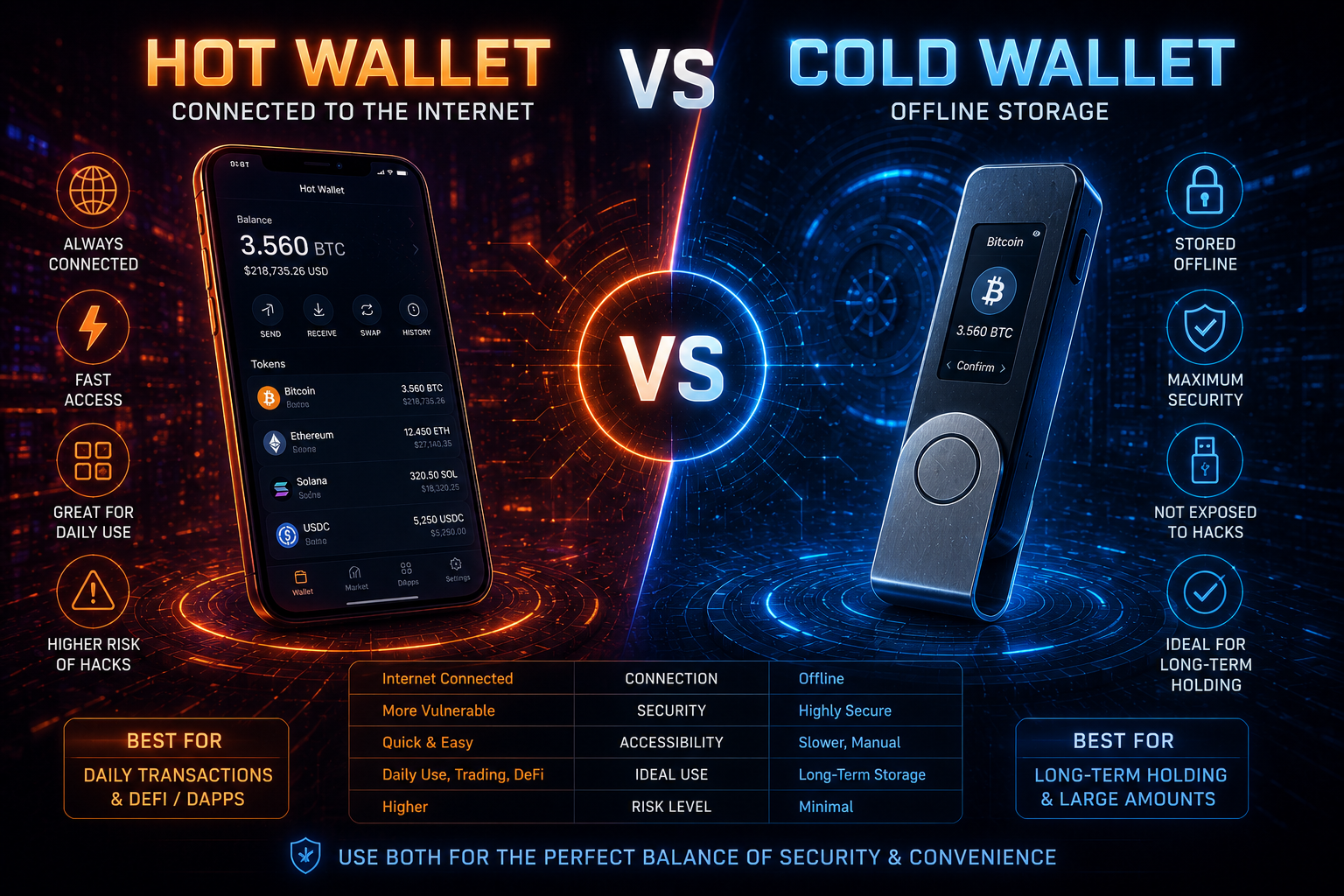
In the hot wallet vs cold wallet debate, cold wallets win on raw security by keeping your private keys fully offline, while hot wallets win on convenience for everyday spending, which is why most serious Bitcoin holders end up using both.
Article at a Glance
Here’s the short version of the hot wallet vs cold wallet question:
- Cold wallets are the gold standard for Bitcoin security, keeping your private keys offline eliminates the majority of hacking risks that hot wallets face daily.
- Hot wallets trade security for convenience, they are ideal for frequent transactions but expose your assets to phishing, malware, and exchange breaches.
- Most serious Bitcoin holders use both, a two-tier strategy keeps small amounts in a hot wallet for spending while cold storage protects larger holdings.
- Your seed phrase is your true last line of defense, lose it and you lose access to your Bitcoin permanently, regardless of wallet type.
- There is a specific threshold most experts recommend for when to move Bitcoin to cold storage, and the answer might surprise you.
Table of Contents
- $2.2 Billion Stolen in 2024: Your Bitcoin Wallet Choice Matters
- What Hot and Cold Wallets Actually Are
- Hot Wallet Security: Real Risks You Need to Know
- Cold Wallet Security: Why It’s the Gold Standard
- Hot Wallet vs Cold Wallet: A Direct Security Comparison
- The Two-Tier Strategy Most Serious Bitcoin Holders Use
- Which Wallet Fits Your Situation
- Cold Wallets Win on Security, But the Best Setup Uses Both
- Frequently Asked Questions
$2.2 Billion Stolen in 2024: Your Bitcoin Wallet Choice Matters – Hot Wallet vs Cold Wallet
Crypto hackers stole over $2.2 billion in 2024, and the wallet you choose is your first and most important line of defense. Whether you are just buying your first Bitcoin or moving serious money into crypto, understanding how hot and cold wallets differ in security is not optional, it is essential. This hot wallet vs cold wallet guide breaks down everything in plain language so you can make a smart, confident decision about where to store your Bitcoin.
What Hot and Cold Wallets Actually Are
At its core, a Bitcoin wallet is a tool that stores the keys you need to access and move your Bitcoin. There are two fundamentally different approaches to how those keys are stored, online or offline. That single difference in connectivity is what separates a hot wallet from a cold wallet, and it has enormous implications for your security.
Hot Wallets: Always Online, Always Accessible
A hot wallet is any crypto wallet that maintains a constant connection to the internet. This includes mobile apps like Trust Wallet or Coinbase Wallet, desktop software wallets, and the built-in wallets on crypto exchanges. Because they are always online, hot wallets make it fast and easy to send, receive, or trade Bitcoin at any moment. That convenience, however, comes at a cost, an internet-connected wallet is permanently exposed to the same online threats that target your bank account, email, or any other digital asset.
Cold Wallets: Offline Storage With Maximum Protection
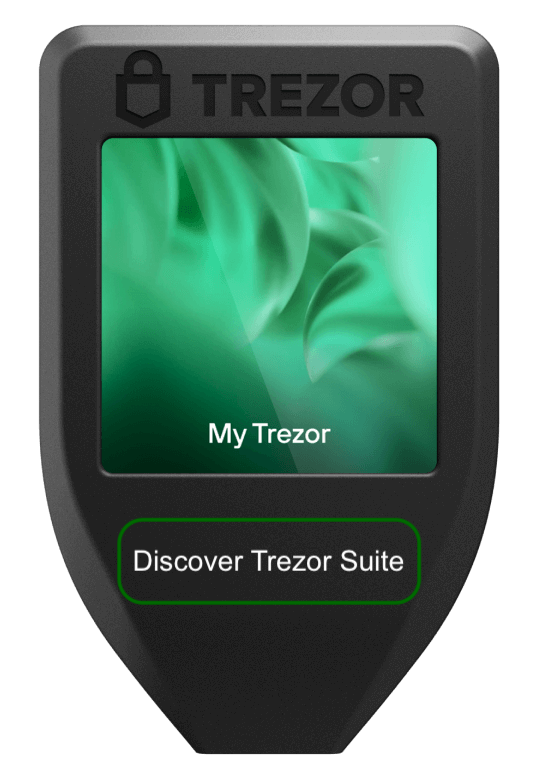
A cold wallet stores your private keys entirely offline. The most common type is a hardware wallet, a small physical device, similar to a USB drive, from brands like Ledger or Trezor. There are also paper wallets, which are literally printed documents containing your keys. Because cold wallets have no internet connection during storage, they are essentially invisible to remote hackers. The trade-off is that accessing your funds requires a few more steps than simply opening an app.
| Feature | Hot Wallet | Cold Wallet |
|---|---|---|
| Internet Connection | Always online | Offline during storage |
| Primary Use | Frequent transactions | Long-term storage |
| Security Level | Moderate | High |
| Convenience | High | Lower |
| Risk Type | Hacking, phishing, malware | Physical loss or theft |
| Best For | Daily use, small amounts | High-value, long-term holdings |
| Examples | Coinbase Wallet, Trust Wallet | Ledger Nano X, Trezor Model T |
What a Wallet Actually Stores (It’s Not Your Bitcoin)
Here is something that trips up most beginners, your Bitcoin never actually lives inside your wallet. Bitcoin always exists on the blockchain, a public distributed ledger. What your wallet stores is your private key, which is a unique cryptographic code that proves you own the Bitcoin associated with your address and authorizes you to move it. Think of it like a PIN to a safe deposit box. The gold stays in the vault; your PIN just lets you access it. Lose the PIN, lose access to the gold, permanently. For more insights on cryptocurrency storage, you might want to explore crypto debit cards that offer additional security features.
Hot Wallet Security: Real Risks You Need to Know
Hot wallets are not inherently dangerous, but they carry a fundamentally different risk profile than cold storage. Because your private keys exist on an internet-connected device, every moment your wallet is online is a moment it could theoretically be targeted. Understanding the specific attack vectors helps you appreciate why security experts consistently recommend against storing large amounts of Bitcoin in a hot wallet long-term.
The most significant risk is not always a sophisticated hack. Often, it is simple human error, clicking a malicious link, downloading a fake wallet app, or connecting your wallet to a compromised website. In fact, the majority of individual crypto losses come from social engineering and phishing rather than brute-force technical attacks.
- Exchange hacks: If your Bitcoin sits in an exchange wallet, a breach of that exchange can wipe out your holdings.
- Malware: Keyloggers and clipboard hijackers can capture your private keys or replace wallet addresses mid-transaction.
- Phishing sites: Fake versions of popular wallet apps or exchange login pages trick users into entering their credentials.
- SIM swapping: Attackers port your phone number to gain access to SMS-based two-factor authentication.
- App vulnerabilities: Software wallets depend on secure code, any bug or unpatched vulnerability can become an entry point.
How Hackers Target Hot Wallets
Hackers targeting hot wallets typically go after the path of least resistance. For individual users, that often means attacking the device the wallet runs on rather than the wallet itself. If your phone or computer is infected with malware, an attacker can monitor your clipboard, which means when you copy and paste a Bitcoin wallet address, the malware silently replaces it with the hacker’s address. You send the funds, and they are gone.
At the exchange level, attacks tend to be larger and more coordinated. When an exchange is breached, every user with funds in a custodial hot wallet on that platform is potentially affected, regardless of how careful those individual users were. This is precisely why the phrase “not your keys, not your coins” is so widely repeated in the crypto community.
Phishing Attacks and Malware Threats
Phishing is the single most common way Bitcoin holders lose funds through hot wallets. Attackers create convincing replicas of legitimate wallet interfaces, MetaMask, Coinbase, Trust Wallet, and distribute links through email, social media, or even paid search ads. Once a user enters their seed phrase or login credentials on a fake site, the attacker gains full control of the wallet within seconds.
Real-World Example: In 2023, a large-scale phishing campaign targeted Ledger hardware wallet users via email, directing them to a cloned site that requested their 24-word seed phrase under the pretense of a “security update.” Thousands of users who entered their phrase, intended for hardware wallets, saw their funds drained immediately.
The lesson: no legitimate wallet service will ever ask for your seed phrase.
Malware threats work differently but are equally damaging. Trojans disguised as legitimate software, including fake wallet apps downloaded from unofficial sources, can silently record keystrokes, capture screenshots, or monitor clipboard data. The Electrum Bitcoin wallet has been a repeated target, with attackers creating counterfeit versions that steal funds upon installation.
What Multi-Factor Authentication Actually Protects Against
Multi-factor authentication (MFA) adds a second verification step beyond your password, typically a code from an authenticator app like Google Authenticator or Authy, or an SMS message. For exchange-based hot wallets, MFA is an important layer of protection that prevents unauthorized logins even if your password is compromised. However, MFA is not a complete solution. It does not protect your private keys directly, does not prevent malware already on your device from acting, and SMS-based MFA is vulnerable to SIM-swap attacks. Use an authenticator app rather than SMS wherever possible, and treat MFA as one layer of defense, never the only one.
Cold Wallet Security: Why It’s the Gold Standard
Cold wallets have earned their reputation as the safest way to store Bitcoin, and the reason is straightforward. When your private keys never touch an internet-connected device during storage, the entire category of remote attacks simply does not apply. No phishing link, no malware, no exchange breach can reach keys that are physically disconnected from the network.
Hardware wallets like the Ledger Nano X and Trezor Model T are the most practical form of cold storage for most people. They are purpose-built devices that store your private keys in a secure chip and require physical confirmation, pressing a button on the device itself, before any transaction is signed. Even if you plug a hardware wallet into a virus-infected computer, the keys never leave the device. The transaction is signed internally, and only the signed transaction data is transmitted, never the key itself. For those interested in diversifying their crypto portfolio, it’s worth exploring the fastest growing altcoins in the market.
Why Being Offline Eliminates Most Attack Vectors
Every major category of hot wallet attack, malware, phishing, exchange hacks, clipboard hijacking, SIM swapping, requires internet access to the private key at some point in the chain. Cold wallets break that chain entirely. When your keys are stored on a Ledger Nano X sitting in a drawer, a hacker on the other side of the world has no pathway to reach them. The attack surface is reduced to the physical world only, which is a dramatically smaller and more controllable threat.
Physical Theft and Loss: The Cold Wallet Trade-Off
Cold wallets are not without risk, the risks are just different in nature. A hardware wallet can be physically stolen, lost in a house fire, or simply misplaced. Unlike a forgotten password that can sometimes be recovered, a lost hardware wallet with no backup means permanent loss of access to your funds. This is the trade-off that cold storage demands: you take on the responsibility of physical security in exchange for eliminating digital threats.
The good news is that a stolen hardware wallet alone is not enough to access your funds. Every reputable hardware wallet is PIN-protected, and multiple failed PIN attempts will wipe the device. An attacker who steals your hardware wallet cannot access your Bitcoin without your PIN, and even then, they would need physical possession of the device. The real vulnerability is not the device itself, but what we cover next.
How Seed Phrases Work as Your Last Line of Defense
Every hardware wallet generates a seed phrase, typically 12 or 24 random words, when it is first set up. This phrase is the master backup for your entire wallet. Anyone who has your seed phrase can regenerate your wallet on any compatible device and access all your Bitcoin instantly. It bypasses the PIN, bypasses the device, and bypasses every other protection. Your seed phrase is the single most sensitive piece of information in your entire crypto setup.
Protecting your seed phrase is where most cold wallet security actually lives. Best practices include writing it on paper and storing it in a fireproof safe, never photographing it or storing it digitally, and considering engraving it on a steel backup plate, products like the Cryptosteel Capsule or Bilodeau Steel Wallet are designed for exactly this purpose. Never store your seed phrase in cloud storage, email, or a notes app. Ever.
“Your seed phrase is the single most sensitive piece of information in your entire crypto setup.”
Hot Wallet vs Cold Wallet: A Direct Security Comparison
The security gap between hot and cold wallets is significant, but the right choice depends on how you actually use Bitcoin. Hot wallets carry real, constant exposure to digital threats but offer unmatched convenience for active use. Cold wallets eliminate remote attack vectors entirely but require more effort to access and place the full burden of physical security on you. Neither is perfect in isolation, which is exactly why most experienced Bitcoin holders do not choose one over the other.
The Two-Tier Strategy Most Serious Bitcoin Holders Use
Think of it like how most people handle physical cash. You carry a small amount in your wallet for daily spending, but you do not walk around with your entire life savings in your back pocket. The same logic applies to Bitcoin storage, and it is the approach that security experts consistently recommend.
The two-tier strategy splits your Bitcoin between a hot wallet and a cold wallet based on purpose. The hot wallet holds a small amount, enough for transactions, trading, or short-term use. The cold wallet holds the bulk of your holdings in offline security until you actually need to move it. This setup means you get the convenience of instant access for everyday activity without exposing your full stack to digital threats.
The practical reality is that most people who lose Bitcoin to hacks were not targeted because they were high-profile, they were targeted because their entire holding was sitting in an accessible hot wallet. Splitting your storage removes the single point of failure that makes hot-wallet-only setups so vulnerable.
Setting up this strategy is simpler than most beginners expect. You maintain a hot wallet, like Coinbase Wallet or Trust Wallet, for day-to-day activity, and a hardware wallet, like the Ledger Nano X or Trezor Model T, for long-term storage. Transfers between the two are straightforward and take only a few minutes when needed. If you’re new to cryptocurrency, here are some tips on how beginners can invest in cryptocurrency with low risk.
- Hot wallet: Keep only what you need for active use, think of it as your spending account.
- Cold wallet: Store the majority of your Bitcoin here, your savings vault.
- Seed phrase storage: Keep your cold wallet backup phrase in a secure physical location, separate from the device.
- Regular audits: Periodically check that your hardware wallet is functioning and your seed phrase backup is intact and accessible.
How Much Bitcoin to Keep in Each Wallet
There is no single right answer, but a widely used rule of thumb is to keep no more than you would be comfortable losing in a hot wallet at any given time. For someone who trades occasionally, that might mean keeping the equivalent of a few hundred dollars in a hot wallet while moving everything else to cold storage. If you hold Bitcoin purely as a long-term investment and rarely transact, even the smallest threshold makes sense, essentially using cold storage exclusively and treating the hot wallet as a temporary transfer point only.
How Institutions Balance Hot and Cold Storage
- Exchanges like Coinbase keep the majority of customer funds, reportedly around 98%, in cold storage, with only a small percentage in hot wallets to cover daily withdrawal demands.
- Custodial services such as BitGo use multi-signature cold storage, requiring multiple independent approvals before any funds can be moved.
- Bitcoin ETF custodians operate under strict regulatory requirements to maintain institutional-grade cold storage solutions for client assets.
The institutional approach makes the case clearly: even organizations with the most sophisticated cybersecurity teams in the world do not trust hot wallets with large holdings. They use cold storage as the default and treat hot wallets as a necessary but minimized operational tool.
Individual Bitcoin holders can apply the same philosophy at a personal scale. The specific products differ, but the principle is identical, minimize hot wallet exposure, maximize cold storage, and treat every dollar of unnecessary hot wallet balance as an accepted but avoidable risk.
It is also worth noting that the two-tier approach does not require expensive hardware to start. Entry-level hardware wallets like the Ledger Nano S Plus retail for around $79, making cold storage accessible even for holders with modest Bitcoin amounts. The cost of a hardware wallet is a one-time investment in permanent security, a worthwhile trade compared to the alternative.
Once you have both wallets set up, the day-to-day experience requires very little extra effort. Most people check their cold wallet holdings infrequently and simply move funds into the hot wallet when they need to transact. The hardware wallet stays safely stored until that moment, silently protecting your Bitcoin without any ongoing maintenance.
Which Wallet Fits Your Situation
The best wallet setup is the one that matches how you actually use Bitcoin, not the one that sounds most technically impressive. Security matters, but so does the practical reality of your habits, your holdings, and your goals. A fortress-level cold storage setup does no good if you are constantly moving funds in and out for daily trading, and an exchange hot wallet is genuinely risky if you are holding significant Bitcoin for the long term.
Before deciding, ask yourself three questions: How often do I need to access my Bitcoin? How much am I holding? How comfortable am I taking on physical security responsibility for a hardware device and seed phrase? Your answers should guide the weight you give each wallet type in your setup.
- Occasional trader or active user: A reputable hot wallet with strong MFA and a modest balance is workable, but keep amounts limited.
- Long-term holder with significant Bitcoin: Cold storage is non-negotiable. A hardware wallet like the Ledger Nano X or Trezor Model T is the baseline.
- Beginners just starting out: A trusted exchange with custodial cold storage, like Coinbase, offers a managed middle ground while you learn.
- High-value holders: Consider multi-signature cold storage setups or professional custodial services for an additional security layer.
The most important thing is not to let perfect be the enemy of good. Starting with any form of cold storage, even a basic hardware wallet, is a massive security improvement over keeping everything on an exchange indefinitely.
You Trade Frequently or Need Quick Access
- Use a reputable non-custodial hot wallet like Trust Wallet or Coinbase Wallet, you control your keys directly rather than relying on an exchange.
- Enable authenticator-app-based MFA rather than SMS verification on all accounts.
- Keep balances low, treat it like a spending wallet, not a savings account.
- Never store your hot wallet seed phrase digitally, write it down and keep it secure.
- Regularly move excess funds to cold storage once they exceed your active-use threshold.
Frequent traders face a genuine tension between security and speed. Every additional security layer adds friction to transactions, and in fast-moving markets, friction has a cost. The practical resolution is to optimize your hot wallet for reasonable security, strong authentication, trusted software, non-custodial key control, rather than maximum security, and to keep cold storage as the destination for any Bitcoin you are not actively using.
It is also worth separating trading activity from holding activity mentally. If you are actively trading, the Bitcoin on your exchange hot wallet is your trading capital. Your cold wallet holds your actual investment. Treating them as separate pools with different risk tolerances makes the two-tier strategy feel natural rather than complicated.
One practical tip: set yourself a personal rule, any Bitcoin you have not moved in 30 days gets transferred to cold storage. It is a simple habit that naturally pushes long-term holdings into secure offline storage without requiring constant manual decisions about what to move and when.
You Are Holding Bitcoin Long-Term
If you are holding Bitcoin as a long-term investment, sometimes called “HODLing”, cold storage is not just recommended, it is the obvious choice. Your Bitcoin sits untouched for months or years at a time, which means the inconvenience of a hardware wallet is barely noticeable in practice. You are not accessing it daily. The Ledger Nano X or Trezor Model T sits in a secure location, your seed phrase is backed up safely, and your Bitcoin is protected from every remote attack vector that exists. That is the setup long-term holders should be working toward.
You Hold a Significant Amount of Bitcoin
The threshold where cold storage becomes non-negotiable is different for everyone, but a commonly cited benchmark is simple: if losing it would materially hurt you financially, it belongs in cold storage. That might be $500 worth of Bitcoin for one person, or $50,000 for another. The amount in dollar terms matters less than the personal significance of the loss. For those interested in spending their Bitcoin, exploring options like crypto debit cards might be worthwhile.
For high-value holders, a single hardware wallet may not be enough. Multi-signature (multisig) setups, where multiple independent keys are required to authorize a transaction, add a further layer of protection against both theft and single-point-of-failure loss. Services like Casa or Unchained offer managed multisig cold storage solutions specifically designed for individuals holding significant Bitcoin who want institutional-grade security without managing it entirely themselves.
Cold Wallets Win on Security, But the Best Setup Uses Both
When it comes to raw security, cold wallets win, and it is not particularly close. Keeping your private keys offline eliminates the vast majority of attack vectors that cost Bitcoin holders billions of dollars every year. But security is not the only variable in a practical Bitcoin storage strategy. Convenience, access frequency, and the size of your holdings all shape what the right setup actually looks like for you specifically.
- Cold storage is the foundation, the bulk of your Bitcoin should always be in offline storage, regardless of how much you hold.
- Hot wallets serve a real purpose, for active use, trading, or frequent transactions, a reputable hot wallet with strong security practices is a legitimate tool.
- The two-tier strategy is the expert consensus, split your holdings by purpose, not by preference, and treat your cold wallet as untouchable unless you genuinely need to move funds.
- Your seed phrase is the real vulnerability, protect it physically with the same seriousness you would apply to a title deed or passport.
- Start simple, then scale security, a basic hardware wallet and a non-custodial hot wallet is a dramatically better setup than most beginners have, and it is enough to protect against the overwhelming majority of real-world threats.
The worst outcome in Bitcoin storage is paralysis, doing nothing because the options feel overwhelming. A Ledger Nano S Plus at $79 and a free download of Trust Wallet gets you 90% of the way to a secure, practical two-tier setup in under an hour. Do not let perfect security theory prevent you from implementing good security today.
The crypto space moves fast and threats evolve constantly, but the core principle has not changed since Bitcoin was created: control your own keys, keep the bulk of your holdings offline, and treat your seed phrase like the master key it actually is. Everything else is refinement on top of those fundamentals.
Frequently Asked Questions
Understanding Bitcoin wallet security raises a lot of practical questions, especially for newer holders who are still getting comfortable with how the technology works. The questions below cover the most common concerns that come up when people are deciding how to store their Bitcoin safely.
Many of these questions share an underlying theme, the tension between security and convenience. The answers are not always black and white, because the right approach genuinely depends on individual circumstances. But there are clear, evidence-based principles that apply broadly, and they are worth knowing before you make any storage decisions.
Whether you are securing your first Bitcoin purchase or revisiting a setup you have had for years, these answers cut through the common misconceptions and give you the practical clarity you need.
Can a Cold Wallet Be Hacked?
A cold wallet cannot be hacked remotely, full stop. Because the private keys are stored offline, there is no network pathway for an attacker to exploit. The scenarios where cold wallet security fails are almost exclusively physical or human in nature: someone steals both your device and discovers your PIN, or your seed phrase is compromised because it was stored insecurely.
There is one narrow technical exception worth knowing. Researchers have demonstrated theoretical “supply chain attacks”, where a hardware wallet is tampered with before it reaches the buyer, but reputable manufacturers like Ledger and Trezor have implemented tamper-evident packaging and firmware verification specifically to counter this. Always buy hardware wallets directly from the official manufacturer, never from third-party marketplaces like eBay or Amazon third-party sellers, where the chain of custody cannot be verified.
What Happens if You Lose Your Cold Wallet?
Losing your hardware wallet device is not the end of the world, as long as you have your seed phrase. Your seed phrase is a complete backup of your wallet. You can purchase any compatible hardware wallet, enter your seed phrase during setup, and recover full access to your Bitcoin instantly. The device itself is just a convenient interface. Your Bitcoin is on the blockchain; the seed phrase is the key to it. Lose the seed phrase without a backup, however, and the loss is permanent, no company, no support team, and no technology can recover it for you.
Is a Hot Wallet Safe for Small Amounts of Bitcoin?
Yes, with the right precautions. A non-custodial hot wallet like Trust Wallet or Coinbase Wallet, used on a secure and updated device, with authenticator-app MFA enabled, is a reasonable tool for holding small amounts of Bitcoin intended for active use. The key word is small. Define your personal threshold, the amount you would be genuinely okay losing, and keep your hot wallet balance at or below that level. Anything above that threshold belongs in cold storage.
Do You Need Both a Hot and Cold Wallet?
Not necessarily, it depends entirely on how you use Bitcoin. If you are a pure long-term holder who never transacts, a cold wallet alone is a perfectly complete setup. You move Bitcoin in, store it securely, and only connect your hardware wallet when you are ready to move funds. There is no practical need for a hot wallet in that scenario.
If you trade regularly, use Bitcoin for purchases, or interact with decentralized applications, a hot wallet becomes a genuinely useful tool, and pairing it with cold storage for your primary holdings gives you the best of both worlds. Most active Bitcoin users eventually arrive at the two-tier setup naturally, simply because the convenience of a hot wallet for active use and the security of cold storage for long-term holding solve different problems that both need solving.
The honest answer is that the vast majority of people who hold any meaningful amount of Bitcoin benefit from having both. The cost of a basic hardware wallet is low, the setup is straightforward, and the security improvement over a hot-wallet-only approach is substantial. If you have been putting it off, there is no compelling reason to wait. For those looking to invest in cryptocurrency with low risk, starting with a hardware wallet is a prudent step.
What is the Safest Cold Wallet for Bitcoin in 2026?
There is no single universally correct answer, but the two hardware wallets that consistently top security comparisons are the Ledger Nano X and the Trezor Model T. Both are purpose-built for secure offline key storage, support Bitcoin natively, and have extensive third-party security audits behind them. The right choice between them often comes down to personal preference around interface and ecosystem rather than meaningful security differences.
Here are the strongest options across different use cases:
- Ledger Nano X ($149): Bluetooth connectivity for mobile use, supports over 5,500 assets, secure element chip (CC EAL5+ certified), best for users who want flexibility alongside strong security.
- Trezor Model T ($179): Fully open-source firmware, touchscreen interface, no secure element but compensates with complete code transparency, preferred by users who prioritize auditability.
- Ledger Nano S Plus ($79): The most affordable entry point into serious cold storage, no Bluetooth but retains the same secure element chip as the Nano X, ideal for beginners or budget-conscious holders.
- Coldcard Mk4 ($149.99): The preferred choice for advanced Bitcoin-only users, with air-gapped transaction signing capabilities and features designed for maximum security with no compromise on convenience.
- Foundation Passport ($259): Open-source hardware and firmware, air-gapped, Bitcoin-only, positioned for security-first users who want the most transparent and auditable option available.
For most people entering cold storage for the first time, the Ledger Nano S Plus offers the most accessible entry point without sacrificing meaningful security. If you are a more advanced holder or prioritize open-source transparency, the Trezor Model T or Coldcard Mk4 are worth the additional investment and learning curve.
Whichever device you choose, the same rules apply across all of them: buy directly from the official manufacturer, complete your setup on a clean device, write your seed phrase on paper immediately, and store that phrase separately from the device itself in a secure physical location. No hardware wallet in the world protects you if your seed phrase is sitting in a Google Doc.
The bottom line is that choosing the right Bitcoin wallet comes down to understanding your own situation, how you use Bitcoin, how much you hold, and how much responsibility you are prepared to take on for your own security. Cold wallets win on security, hot wallets win on convenience, and the smartest setup combines both with clear boundaries between them.
DYOR Disclaimer
This article is for informational purposes only and does not constitute financial, investment, or security advice. No storage method is completely risk-free, and individual circumstances vary widely. Always do your own research (DYOR) and consult qualified security professionals for guidance specific to your holdings.