Coinposters
Tokenized Real World Assets: The Next Financial Revolution or Another Crypto Mirage?
Blockchain · Investing · 2026 Deep Dive
$30 billion already tokenized, a 400% market expansion, and institutions like BlackRock and JPMorgan all in. Is this the moment real-world assets go fully on-chain?
CoinPosters Research Desk · Updated 2026 · 20 min read
Key Takeaways
Tokenized real-world assets (RWAs) represent physical assets on blockchain, creating over $30 billion in market value by transforming traditionally illiquid investments into tradable digital tokens.
Four major RWA categories have emerged: real estate, commodities, securities, and alternative investments — each addressing specific market inefficiencies and creating new investment paradigms.
Institutional adoption from players like BlackRock, JPMorgan, and Franklin Templeton signals mainstream legitimacy, driving a 400% market expansion since 2022.
RWA technology solves real problems through fractional ownership, 24/7 global trading, elimination of intermediaries, and automated compliance through smart contracts.
While promising unprecedented market access and efficiency, RWA projects require careful due diligence to distinguish genuine innovation from marketing hype.
The blockchain industry has been searching for its killer application beyond speculation since Bitcoin’s inception. While DeFi and NFTs captured attention during previous cycles, neither created the sustainable bridge to traditional finance that many anticipated. Enter tokenized real-world assets (RWAs) — potentially the most significant development in the crypto space since smart contracts.
This emerging sector is rapidly transforming how we think about asset ownership, liquidity, and investment accessibility while solving long-standing problems in traditional markets. From commercial real estate to gold bars to U.S. Treasury bills, tokenization is creating an entirely new investment paradigm — one with real economics behind it.
Traditional Asset Markets Are Broken: Why RWAs Matter Now
For decades, traditional asset markets have operated on antiquated infrastructure, creating artificial barriers to entry and unnecessary inefficiencies. Real estate transactions take months to complete and often require 30–40% of the asset value in transaction costs. Fine art and collectibles remain accessible only to the ultra-wealthy, while private equity locks up capital for years with minimal transparency.
These inefficiencies have created a perfect storm for disruption through blockchain technology. The tokenization of real estate, commodities, securities, and alternative assets isn’t just a technological upgrade — it’s a complete reimagining of how value is stored, transferred, and accessed globally.
The Six Market Failures RWAs Are Fixing
| Real Estate 60–90 day transactions with 30–40% in total costs |
Fine Art $1M+ minimums; accessible to ultra-wealthy only |
| Private Equity Capital locked for years; $250K+ minimum investments |
Cross-Border Settlement Days of friction vs. seconds on-chain |
| Title Insurance ~$15B collected annually; less than 5% paid in actual claims |
Art Market Commissions 15–50% intermediary fees vs. 2–5% on tokenized platforms |
What Are Tokenized Real-World Assets?
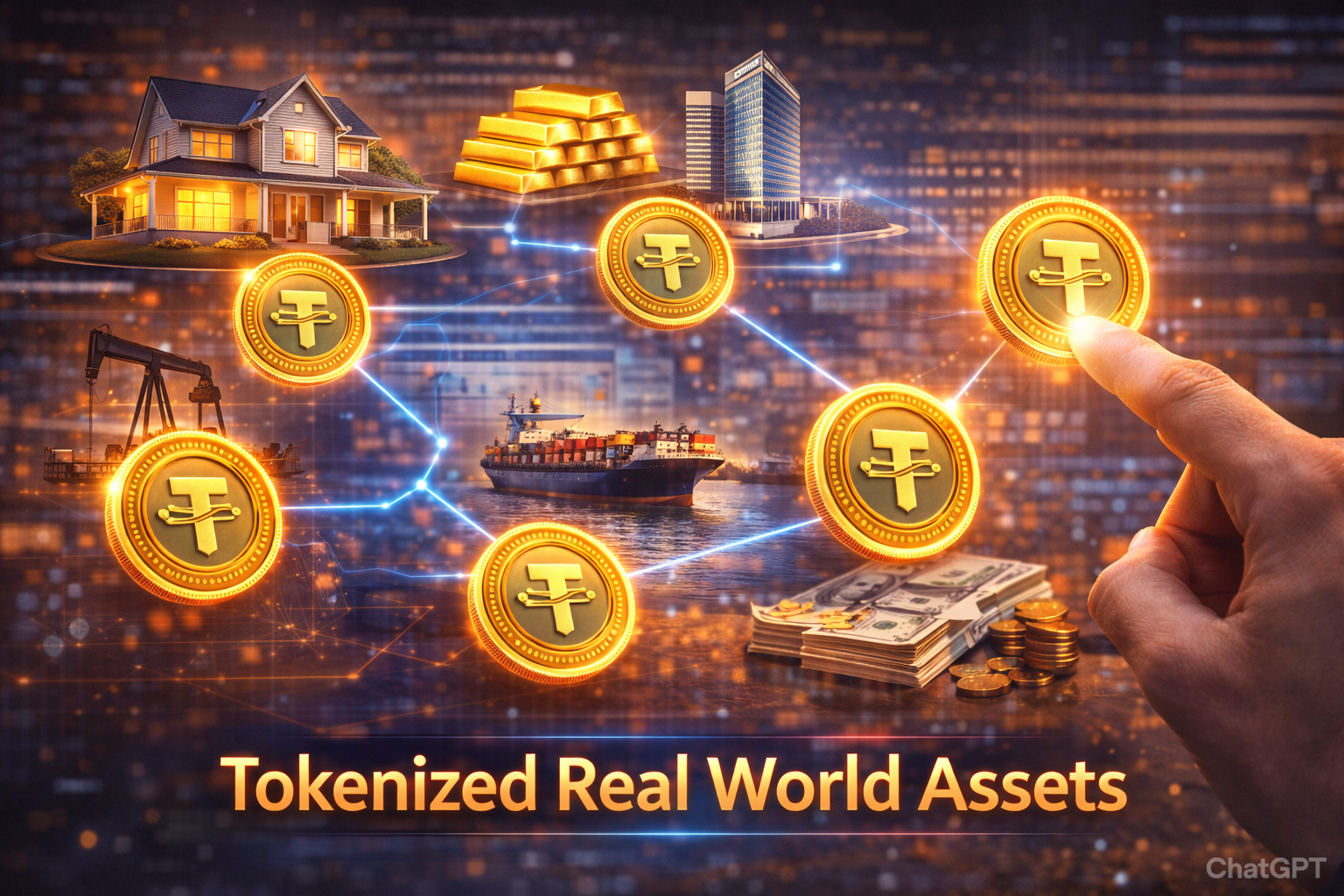
Tokenized real-world assets (RWAs) are blockchain-based tokens that derive their value from underlying assets existing in the physical world — whether commercial real estate, commodities like gold, corporate debt, or even intellectual property. Through cryptographic verification and smart contracts, these tokens establish verifiable ownership while enabling previously impossible functionality.
The fundamental innovation lies in how RWAs transform traditionally illiquid or inaccessible assets into programmable, divisible, and instantly transferable digital representations. Each token contains embedded rights, compliance parameters, and connection to the legal frameworks governing the underlying assets — creating a powerful hybrid that maintains the security of traditional assets while harnessing the efficiency of blockchain technology.
The Bridge Between Physical and Digital Value
RWAs require three essential components to function properly: legal frameworks that recognize token ownership as legally enforceable, custody solutions that securely manage the underlying assets, and technological infrastructure that maintains the integrity of this connection. When properly implemented, RWAs create a seamless interface allowing value to flow efficiently between traditional and digital markets.
CoinPosters Institutional Research
“Real-world asset tokenization represents the next evolutionary step in finance — not by replacing traditional assets, but by enhancing how they’re owned, traded, and managed. We’re witnessing the transformation of previously static assets into dynamic financial instruments with unprecedented utility.”
The transformation typically follows a structured three-phase process: legal preparation (due diligence, valuation, SPV or trust establishment), technical implementation (token structure, compliance parameters, ownership rights encoding), and ongoing management (custody, yield distributions, secondary market mechanisms).
How RWAs Differ From Pure Crypto Assets
RWAs vs. Pure Crypto Assets — Key Distinctions
| Factor | Tokenized RWAs | Pure Crypto Assets |
|---|---|---|
| Value Source | Underlying physical or financial asset | Market sentiment / ecosystem utility |
| Regulation | Established securities frameworks | Evolving, often unclear |
| Price Behavior | Follows underlying asset fundamentals | High volatility, sentiment-driven |
| Legal Enforceability | Direct, legally enforceable connection | Limited off-chain enforcement |
| Investor Profile | Traditional + crypto investors | Primarily crypto-native |
Four Major Categories of Tokenized Assets
|
Category 01 Real Estate RealT and Lofty pioneer fractional residential and commercial property ownership. Yields derived from rental income. Entry from as little as $50. Average yields: 7–11% annually. |
Category 02 Commodities Paxos Gold (PAXG) and Tether Gold (XAUT) create tokens fully backed by physical gold, enabling fractional ownership and instant transferability of precious metals. |
|
Category 03 Securities Polymath and Securitize facilitate regulated security tokens representing equities, bonds, and funds. Ondo Finance provides tokenized U.S. Treasury exposure with regulatory compliance. |
Category 04 Alternative Assets Carbon credits, intellectual property, fine art, collectibles. Masterworks has tokenized works by Picasso and Banksy, bringing blue-chip art to investors with minimums far below traditional thresholds. |
$30 Billion and Growing: The Current RWA Market
The tokenized real-world asset market expanded from less than $2 billion in early 2021 to over $30 billion by mid-2023, with continued growth into 2026. Fixed income and private credit dominate at approximately 58% of total tokenized value, while real estate follows at 23% and commodities at 15%.
RWA Market — Key Growth Metrics
|
$30B+
Total tokenized value by mid-2023 (historical baseline) |
400%
TVL growth in RWA protocols since early 2022 |
|
620%
Year-over-year growth in real estate tokenization |
$3.7B
Average monthly RWA transaction volume (Q2 2023) |
RWA Market Composition — Share of Total Tokenized Value
| Fixed Income / Private Credit |
58% |
| Real Estate |
23% |
| Commodities |
15% |
| Other / Alternative |
4% |
Top 5 RWA Projects Leading the Charge
Leading RWA Protocols — At a Glance
| Protocol | Focus | Key Metric |
|---|---|---|
| Centrifuge | Private credit & invoice tokenization | $182M+ TVL in lending pools |
| MakerDAO | U.S. Treasuries & corporate bonds | $1.6B+ allocated (~50% of protocol collateral) |
| Goldfinch | Emerging market loans (Mexico, Nigeria, Indonesia) | $150M+ in real-world loans facilitated |
| Ondo Finance | Tokenized U.S. Treasuries & bank deposits | Significant institutional traction; regulatory-compliant |
| Maple Finance | Institutional capital marketplace | $1.8B+ in total loans facilitated |
Institutional Money Flowing Into the Space
The institutional adoption of RWA protocols marks a significant turning point for the broader crypto industry. JPMorgan’s launch of its Tokenized Collateral Network in 2023 demonstrated traditional finance’s growing acceptance of blockchain infrastructure. BlackRock’s subsequent launch of a tokenized fund signaled that digital asset infrastructure had matured sufficiently for the world’s largest asset manager. Franklin Templeton’s blockchain-native money market fund represents one of the most ambitious integrations of traditional finance with DeFi infrastructure.
These institutional moves were accompanied by over $1.5 billion in direct investments in RWA infrastructure and token purchases during 2022–2023 alone. Their participation established standardized frameworks for tokenization processes, creating greater interoperability and liquidity across platforms while attracting a new wave of traditional investors.
When the world’s largest asset manager enters a market, it doesn’t just bring capital — it brings legitimacy, legal precedent, and a blueprint for everyone who follows.
Real Utility: Where RWAs Actually Solve Problems
Beyond the impressive market growth statistics, tokenized real-world assets are providing solutions to longstanding inefficiencies that have plagued traditional financial markets. The transformation isn’t merely technological — it’s addressing fundamental economic and accessibility barriers that have excluded large segments of the global population from investment opportunities and efficient capital allocation.
Fractional Ownership of Previously Inaccessible Assets
Perhaps the most revolutionary aspect of RWAs is their ability to democratize access to investment classes previously reserved for institutional or ultra-high-net-worth investors. Commercial real estate properties that once required multi-million-dollar minimum investments can now be accessed with as little as $50 through tokenization platforms like RealT. Fine art masterpieces worth tens of millions can be fractionally owned through platforms like Masterworks. Even private equity opportunities, traditionally locked behind $250,000+ minimum investments, are being fractionalized with minimums as low as $1,000.
Traditional vs. Tokenized — Cost and Access Comparison
| Asset Class | Traditional Format | Tokenized Format |
|---|---|---|
| Real Estate Transaction Costs | 5–10% | 1–2% |
| Art Market Commissions | 15–50% | 2–5% |
| Cross-Border Securities Intermediaries | 3–7 parties | 1–2 essential parties |
| Real Estate Minimum Investment | $500,000+ | From $50 |
| Private Equity Minimum | $250,000+ | From $1,000 |
| Real Estate Settlement Time | 60–90 days | Seconds (theoretically) |
24/7 Trading and Global Liquidity
Traditional asset markets operate on archaic schedules, with trading limited to business hours in specific time zones and settlement processes that can take days or weeks. RWAs eliminate these arbitrary constraints, enabling 24/7 global trading with near-instantaneous settlement. For international investors, the ability to trade without waiting for foreign markets to open represents a revolutionary improvement in market accessibility.
The global accessibility of RWA markets also creates unprecedented liquidity opportunities. Secondary market trading of previously illiquid assets like private equity stakes — which traditionally required complex legal arrangements and took months to complete — can now happen instantly on-chain. Tokenized real estate, where traditional transactions can take 60–90 days, theoretically allows ownership transfers in seconds with dramatically reduced fees.
Tokenization has the potential to transform real property from one of the most illiquid asset classes in existence into one of the most liquid — with 24/7 global trading and near-instant settlement.
Removing Intermediaries and Their Fees
Traditional asset markets are plagued by layers of intermediaries, each extracting fees while adding friction to transactions. The title insurance industry alone collects approximately $15 billion annually in premiums for real estate transactions in the U.S., despite paying out less than 5% of that amount in actual claims. Asset tokenization dramatically reduces or eliminates many of these intermediary layers through automated verification and transaction processing — reducing transaction costs by up to 80% in some asset classes.
Automated Compliance Through Smart Contracts
Regulatory compliance represents one of the most complex and costly aspects of traditional asset management. RWAs address this through programmable compliance embedded directly into tokens. These “compliance by design” mechanisms ensure that tokens can only be transferred to eligible investors based on KYC verification, accreditation status, geographic location, and holding periods — automating compliance checks at the transaction level through cryptographic proofs and on-chain identity solutions.
The Technology Behind RWA Tokenization
The technological infrastructure enabling RWA tokenization represents a sophisticated convergence of blockchain protocols, legal frameworks, and traditional finance systems. Understanding this technology stack is crucial for distinguishing between truly innovative RWA projects and those merely applying blockchain buzzwords to conventional assets.
RWA Technology Stack — Layer by Layer
| Layer | Function | Examples |
|---|---|---|
| Blockchain Protocol | Base settlement and security layer | Ethereum, Solana, Avalanche, Stellar |
| Layer 2 Scaling | Reduce fees by up to 99% vs. mainnet | Polygon, Optimism |
| Oracle Networks | Connect on-chain tokens to real-world data | Chainlink, UMA, Band Protocol |
| Custody Solutions | Secure management of underlying physical assets | Anchorage, BitGo, Fireblocks |
| Identity / Compliance | On-chain KYC/AML verification | Civic, Blockcerts |
Ethereum remains the dominant platform due to robust security, extensive development ecosystem, and established token standards (ERC-20 and ERC-1400 for securities). Alternative chains have gained traction for specific use cases: Solana for real estate platforms seeking high throughput, Avalanche’s subnet architecture for permissioned securities environments, and Stellar for commodities and cross-border applications where fast settlement and low fees matter most.
Oracle networks serve as the essential connective tissue between tokenized assets and their real-world counterparts — delivering trusted data feeds that verify asset ownership, valuation updates, compliance status, and real-world events. Without trustworthy connections to real-world data and events, the fundamental value proposition of tokenized assets breaks down entirely.
Case Studies: RWAs in Action
Real Estate Tokenization Success Stories
The Harbor platform made history in 2018 by tokenizing a $20 million student housing complex near the University of South Carolina — the first compliant security token offering for commercial real estate in the U.S. The tokenization reduced the minimum investment from $500,000 to $21,000 while expanding the potential investor pool globally.
More recently, RealT has pioneered fractional ownership of residential rental properties, with over 200 properties tokenized and more than 9,000 unique investors participating. Their model generates on-chain rental income distributions, with average annual yields between 7–11% paid directly to token holders’ wallets.
In Europe, Tokeny Solutions partnered with Benrion to tokenize €27 million worth of luxury real estate in Lisbon, Portugal — reducing transaction costs by 65% compared to traditional structures while decreasing settlement time from weeks to minutes.
Case Study Snapshot — Harbor Platform (2018)
| Asset | $20M student housing complex, SC |
| Traditional Minimum | $500,000 |
| Tokenized Minimum | $21,000 |
| Significance | First compliant security token for US commercial real estate |
How BlackRock’s BUIDL Changed the Game
When BlackRock — with over $10 trillion under management — entered the RWA space, it signaled a watershed moment for the industry. Their Blockchain-Utilized Infrastructure for Digital Liquidity (BUIDL) initiative launched in 2023 with the tokenization of $100 million in U.S. Treasury bills, creating instantly transferable tokens that maintain full regulatory compliance while enabling 24/7 trading.
The initiative demonstrated reported efficiency gains: settlement times reduced from T+1 to T+0 (same-day), and transaction costs reportedly decreased by approximately 75% compared to traditional Treasury trading. Six major global banks participated from day one, creating institutional-level liquidity immediately. The success of this initiative prompted BlackRock to announce plans for expanding their tokenization strategy across multiple asset classes — with a target of $1 trillion in tokenized assets by 2025, a milestone already in the rearview as we enter 2026.
MakerDAO’s RWA Vault Strategy
MakerDAO has implemented one of the most ambitious RWA strategies in the crypto space. Through their RWA Master Participation Trust, they have allocated over $1.6 billion to real-world assets — approximately 50% of their total collateral base. Beginning in 2021 with a $500 million investment in short-term U.S. Treasuries, the strategy expanded to include corporate bonds, private credit, and revenue-based financing for mid-sized businesses.
The initiative has reportedly generated approximately $38 million in annual revenue for the protocol while reducing reliance on crypto-native collateral — enhancing stability during market volatility. This model has been so successful that Aave and Compound have launched similar RWA integration strategies, signaling a broader convergence between DeFi and traditional finance.
Regulatory Landscape for Tokenized Assets
The regulatory environment for tokenized real-world assets continues to evolve rapidly, with different jurisdictions taking varied approaches. Understanding the current landscape is essential for both issuers and investors, as compliance requirements significantly impact tokenization structures, investor eligibility, and secondary market trading.
Global Regulatory Frameworks for Tokenized Assets
| Jurisdiction | Framework | Status |
|---|---|---|
| United States | SEC securities law; Howey Test; Reg D/A+/S exemptions | Active enforcement; evolving |
| European Union | MiCA regulation + existing securities law for tokenized instruments | Framework in place |
| Singapore | Payment Services Act; explicit tokenized securities recognition | Favorable; clear pathways |
| Switzerland | FINMA token classification (payment / utility / asset tokens) | Mature; proportionate requirements |
| Hong Kong | Comprehensive digital asset regulation pivot | Growing hub; active RWA activity |
| UAE (ADGM / DIFC) | Frameworks specifically designed for digital securities | Major RWA innovation hub |
Red Flags: When RWAs Are Just Marketing Hype
As with any rapidly growing sector, the RWA space has attracted its share of projects that promise more than they can deliver. Distinguishing between legitimate innovation and marketing hype requires careful analysis of several key factors.
4 Red Flags to Watch For
| 1 | Token value misaligned from underlying asset Legitimate tokens maintain close correlation to backing assets. Arbitrary value multiples without economic justification = hype. |
| 2 | Centralized control disguised as decentralization Superficial voting on minor decisions while retaining absolute authority over fees, management, and liquidation = governance theater. |
| 3 | Vague or unverifiable custody arrangements No clear documentation of who holds assets, what insurance exists, or how segregation is maintained. Complex cross-border structures that obscure rather than clarify. |
| 4 | No legal enforcement mechanism Sophisticated tokenization without legal infrastructure for enforcement. Smart contracts alone cannot enforce rights in most jurisdictions — supporting legal frameworks are non-negotiable. |
Investing in RWAs: What You Need to Know
The investment case for RWAs centers on combining the stability and yield generation of traditional assets with the efficiency and accessibility advantages of blockchain technology. For crypto-native investors, RWAs offer portfolio diversification beyond purely speculative digital assets. For traditional investors, tokenized assets can provide access to previously inaccessible opportunities with improved liquidity characteristics.
Due Diligence Checklist for RWA Projects
RWA Due Diligence — Investor Checklist
01Examine underlying asset quality using traditional metrics (property condition, credit ratings, authentication)
02Verify the legal framework connecting tokens to assets (trust agreements, offering memoranda, SPV structure)
03Confirm smart contract audits from reputable firms and review the development team’s track record
04Evaluate oracle reliability and how real-world data is connected to on-chain token value
05Confirm independent third-party verification procedures and their publication schedule
06Review secondary market liquidity — thin markets can create significant price impact for larger positions
07Understand bankruptcy protection structure — SPV/trust arrangements vs. exposure as unsecured creditor
CoinPosters Market Analysis
“Tokenized real-world assets represent the convergence of traditional finance and blockchain innovation. However, this convergence creates a hybrid risk profile requiring sophisticated due diligence across multiple domains — evaluating underlying asset quality, legal structures, technological implementation, and market dynamics as an integrated whole.”
Portfolio Allocation Strategies
RWA Portfolio Allocation — Three Approaches
| Approach | Allocation | Strategy |
|---|---|---|
| Conservative | 5–10% of portfolio | Established RWA platforms with proven track records; primarily income-focused |
| Moderate | 10–20% of portfolio | Distributed across multiple asset classes (real estate, fixed income, commodities) with varying risk profiles |
| Aggressive | 20–30% of portfolio | Includes emerging RWA categories and earlier-stage projects; barbell approach with established vs. speculative |
| Liquidity Rule | Min. 25% of RWA holdings | Always maintain at least 25% of RWA investments in highly liquid tokens regardless of approach |
Real estate tokens offer steady yield and moderate appreciation. Tokenized private credit delivers higher yield with higher risk. Commodity tokens provide inflation hedging with improved divisibility. The asset class you choose should match your investment objective — not just your crypto conviction.
The Future of Tokenized Assets
The trajectory of tokenized real-world assets points toward integration with mainstream finance rather than a parallel alternative system. As regulatory frameworks mature and institutional adoption accelerates, we’re witnessing the early stages of a fundamental transformation in how assets are owned, traded, and managed globally.
What’s Coming Next — Key Development Areas
→Market expansion to intellectual property, carbon credits, and infrastructure assets
→Development of standardized legal frameworks specifically designed for tokenized assets
→AI integration for automated valuation, compliance monitoring, and risk assessment
→Cross-chain interoperability enabling seamless trading across different blockchain protocols
→Zero-knowledge proof systems for compliance verification without exposing sensitive data
→Central bank recognition of tokenized assets as eligible collateral for financial operations
$4–30 Trillion Market Potential by 2030
Market Size Projections for Tokenized Assets — By 2030
| Scenario | Projected Market Size | Key Driver |
|---|---|---|
| Conservative Estimate | $4 trillion | Hundredfold increase from 2023 baseline; gradual adoption |
| Mid-Range Estimate | $16 trillion | ~10% of global GDP; broad institutional adoption |
| Aggressive Estimate | $30 trillion | Rapid institutional adoption in securities markets; full integration with TradFi |
Privacy-preserving technologies represent a crucial area for future development. Zero-knowledge proof systems and confidential transaction technologies are being adapted for RWA applications, potentially enabling compliance verification without exposing sensitive details — unlocking tokenization for asset classes with privacy requirements, such as private company equity or certain intellectual property rights.
The convergence of RWAs with IoT infrastructure enables real-time monitoring and automated management of physical assets, creating new efficiency in commercial real estate and industrial equipment. The SIX Digital Exchange in Switzerland is already live with regulated digital asset trading and settlement — demonstrating that institutional-grade tokenized asset infrastructure is not a future concept but a present reality.
Verdict: Real Revolution or Rehashed Hype?
CoinPosters Verdict
Tokenized real-world assets represent a genuine financial innovation with substantial staying power — not merely another crypto hype cycle. Unlike purely speculative digital assets, RWAs derive fundamental value from underlying assets while enhancing that value through improved efficiency, accessibility, and functionality. The rapidly growing institutional participation, regulatory progress, and expanding use cases all point to sustainable development rather than temporary enthusiasm.
Important qualifier: Not all RWA projects create genuine value. Implementation challenges remain significant, and maturation timelines may extend longer than optimistic projections suggest. The most profound impacts will emerge gradually through infrastructure improvements and business model innovations rather than overnight disruption.
Frequently Asked Questions
What’s the difference between RWAs and stablecoins?
Stablecoins are designed primarily as medium-of-exchange tokens that maintain consistent value (usually pegged to a fiat currency), functioning essentially as digital cash within crypto ecosystems. Their primary utility is facilitating trading, settlements, and providing stable value storage without the volatility typical of cryptocurrencies.
In contrast, RWA tokens represent ownership in specific underlying assets, with their value directly reflecting those assets — including any appreciation, depreciation, or yield generation. Stablecoins maintain reserves that collectively back all tokens without assigning specific assets to specific holders. RWA tokens establish direct legal connections between specific assets and token holders through structures like trusts or SPVs.
How do I verify that an RWA token is actually backed by real assets?
Begin by examining the legal documentation connecting tokens to underlying assets — trust agreements, offering memoranda, and security agreements. These should clearly specify the legal entity holding the assets, the rights conveyed to token holders, and enforcement mechanisms.
Beyond documentation, responsible projects implement regular verification conducted by independent third parties. For physical assets, this includes inspections and valuation reports from recognized appraisers. For financial assets, it includes attestations from regulated custodians. The most transparent projects publish these reports on predictable schedules and maintain accessible historical records.
Can I redeem an RWA token for the underlying physical asset?
Redemption capabilities vary significantly. Some tokenized commodity platforms — particularly precious metals — offer direct physical redemption where token holders can exchange tokens for the corresponding physical assets, subject to minimum quantities and processing fees. Several gold-backed tokens allow redemption for physical gold bars once certain threshold amounts are reached.
For more complex assets like real estate or corporate equity, direct redemption for the physical asset is typically impractical. Instead, these projects implement alternative liquidity mechanisms: property sale provisions after specified holding periods with proceeds distributed proportionally, buyback programs at net asset value, or conversion rights to traditional shares during liquidity events.
Are RWA tokens considered securities by regulators?
Most tokenized real-world assets that represent investment opportunities with expectations of profit derived from others’ efforts meet the definition of securities under frameworks like the Howey Test in the U.S. and similar standards elsewhere. This classification applies regardless of technological implementation — regulators consistently focus on the economic reality of the arrangement rather than the digital format. Tokens representing income-generating real estate, corporate equity, debt instruments, or investment funds almost universally qualify as securities and must comply with applicable regulations.
What happens to my RWA tokens if the issuing company goes bankrupt?
The protection of token holders during issuer bankruptcy depends entirely on the legal structure established for the specific RWA project. The most robust implementations utilize bankruptcy-remote structures like SPVs or trusts that hold assets separately from the issuing company’s balance sheet — establishing token holders as beneficial owners rather than creditors, preventing underlying assets from being considered part of the bankruptcy estate.
Less robust implementations might leave token holders as unsecured creditors — significantly compromising their position. Sophisticated RWA projects address bankruptcy scenarios explicitly in their documentation, detailing protections including independent trustees with fiduciary obligations to token holders, automated processes for transferring asset management responsibilities, and dedicated reserves for ensuring operational continuity during transitions. Always verify bankruptcy remoteness before investing.
Disclaimer: This article is for informational and educational purposes only and does not constitute financial or investment advice. Tokenized real-world assets carry significant risks including regulatory uncertainty, smart contract vulnerabilities, custody risk, and liquidity limitations. Always conduct your own due diligence and consult a qualified financial advisor before making investment decisions. Past performance of any asset class does not guarantee future results.