Coinposters
Stablecoins vs. Altcoins in 2026: Which One Actually Deserves Your Money?
Cryptocurrency Strategy · Investment Analysis · 2026 Guide
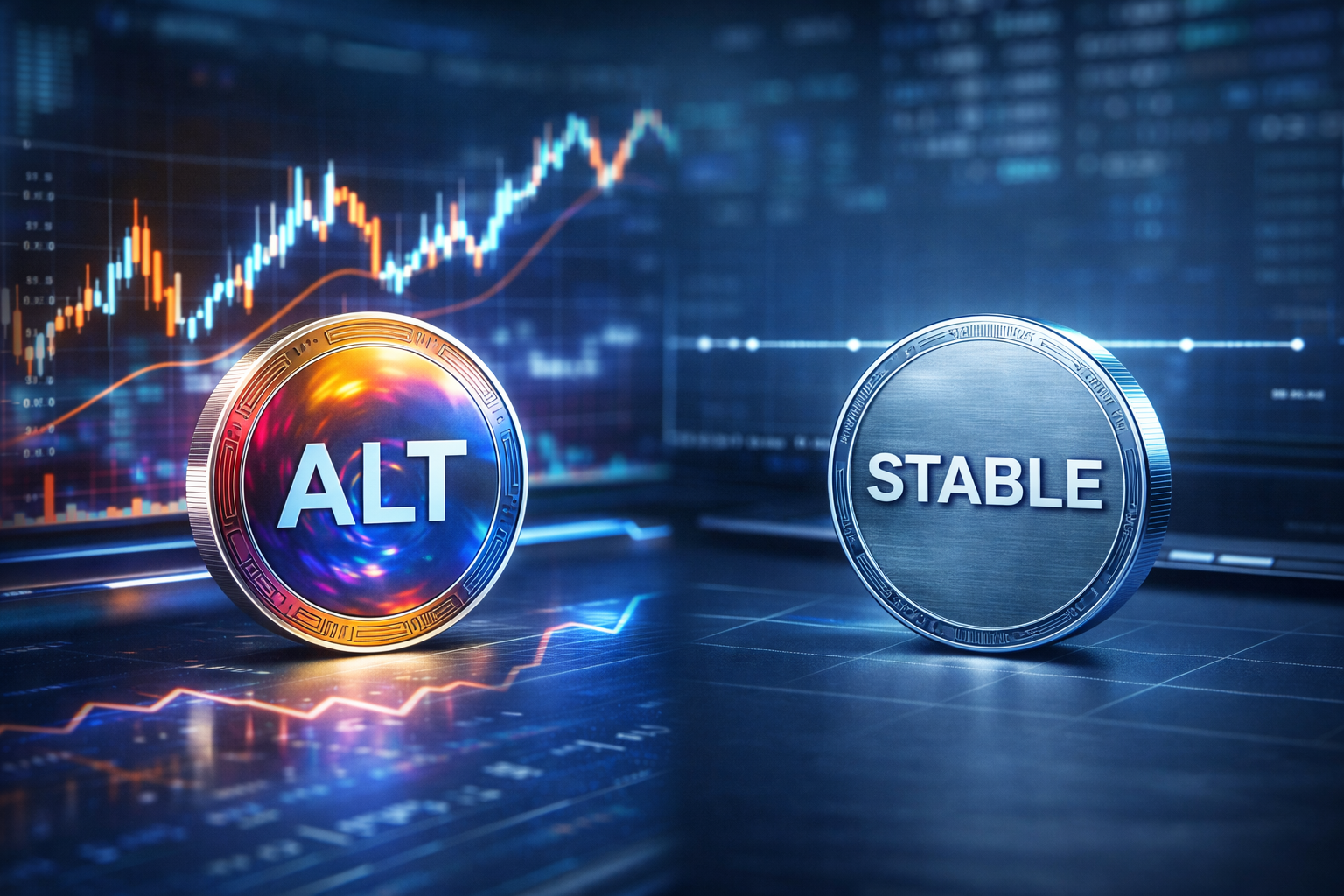
Choosing between stablecoins and altcoins isn’t about picking a winner — it’s about understanding that these two asset classes are built for completely different jobs. Here’s the complete framework for making the right choice in 2026.
Coinposters Research Team · Updated 2026 · 18 min read
Key Takeaways
Stablecoins are designed for price stability, pegged to assets like the US dollar, while altcoins are driven by market forces and can gain or lose value rapidly.
Altcoins offer higher return potential but come with significantly more risk — project failure, liquidity gaps, and extreme volatility are all real possibilities.
Technically, stablecoins are a subcategory of altcoins — but their behavior, purpose, and risk profile are so different that treating them as separate asset classes is the smarter approach.
The right choice depends entirely on what you need the asset to do — stable settlement and payments, or speculative upside exposure.
There is a framework investors can use to match risk tolerance, use case, and regulatory environment to the right asset — and it could save you from a costly mistake.
Two Very Different Assets, One Important Decision
Choosing between stablecoins and altcoins isn’t really about picking a winner — it’s about understanding that these two asset classes are built for completely different jobs.
The crypto market in 2026 has matured significantly. Digital assets now represent a critical layer of global payments infrastructure, and the distinction between assets designed for stability versus those designed for growth has never been more important to understand.
Whether you’re managing treasury operations, building a DeFi position, or simply trying to grow your portfolio, the asset you choose shapes everything that follows.
For investors navigating these decisions, platforms like MEXC provide access to both stablecoins and a wide range of altcoins — making it easier to build a strategy that actually matches your goals rather than defaulting to whatever is trending.
What Is a Stablecoin and What Is an Altcoin?
Stablecoins and altcoins are both types of crypto assets that exist outside of Bitcoin, but that’s roughly where the similarity ends.
How Stablecoins Maintain Their Price
A stablecoin is a digital token engineered to hold a consistent value — most commonly pegged 1:1 to the US dollar or another major fiat currency like the euro. That peg can be maintained in a few distinct ways, and the mechanism matters more than most investors realize.
Three Primary Peg Mechanisms
→Fiat-backed stablecoins — Reserves of actual currency or equivalent assets held in custody back every token issued. USD Coin (USDC) and Tether (USDT) operate this way
→Crypto-collateralized stablecoins — Over-collateralized crypto reserves back the token, with systems in place to liquidate collateral if values drop. DAI is the most established example
→Algorithmic stablecoins — Smart contracts manage supply and demand algorithmically to maintain the peg, without direct collateral backing. This model has a troubled history following the TerraUSD collapse in 2022
The goal in every case is the same: keep the token trading within a fraction of a cent of its target price. A well-managed stablecoin should move only a fraction of a cent around its peg — that’s the defining characteristic that separates it from every other crypto asset class.
What Counts as an Altcoin in 2026
The term “altcoin” simply refers to any cryptocurrency that isn’t Bitcoin. That definition is broad by design, because the altcoin universe is genuinely enormous and diverse. In 2026, altcoins represent the majority of the global crypto market and span wildly different categories with distinct purposes and risk profiles.
Major Categories of Altcoins
→Stablecoins — Price-stable tokens pegged to fiat or other assets (technically altcoins, but functionally separate)
→Utility tokens — Fuel specific platforms or services, such as ETH powering Ethereum transactions
→Governance tokens — Grant holders voting rights over protocol decisions in decentralized ecosystems
→Play-to-earn tokens — Used within blockchain-based gaming economies
→Meme coins — Community-driven assets with limited technical utility, often driven by speculation and social sentiment
→Security tokens — Represent ownership of real-world assets and are subject to securities regulations
Think of stablecoins as the cash equivalent sitting inside the crypto ecosystem — a tool for stability, settlement, and access — while other altcoins represent the growth and risk side of the ledger.
How Prices Are Determined for Each Asset
Price mechanics are where stablecoins and altcoins diverge most clearly — and understanding the difference is essential before allocating capital to either.
What Keeps a Stablecoin at $1
Stablecoin prices are not determined by market speculation. Instead, they are actively managed through reserve ratios, arbitrage incentives, and in some cases algorithmic supply adjustments.
When a fiat-backed stablecoin like USDC trades slightly above $1, arbitrageurs can mint new tokens and sell them, pushing the price back down. When it trades below $1, they can redeem tokens for the underlying dollar, reducing supply and pushing the price back up. This constant arbitrage activity is what keeps the peg tight under normal market conditions.
What Drives Altcoin Prices Up and Down
Altcoin prices are driven by a combination of supply and demand, market sentiment, technological development, and broader macroeconomic conditions. Unlike stablecoins, there is no active peg mechanism smoothing out price movements.
An altcoin can surge 300% on a product announcement or collapse 80% on a security exploit — sometimes within the same week.
Stablecoin Risks vs Altcoin Risks
Stablecoin Risks:
Peg failure, reserve mismanagement, regulatory pressure, and counterparty risk. Even USDT, the largest stablecoin by market cap, has briefly traded as low as $0.96 during periods of extreme market stress.
Altcoin Risks:
Extreme volatility, liquidity gaps, project failure, smart contract vulnerabilities, and regulatory uncertainty. Many altcoins trade on thin order books, meaning large sell orders can move prices dramatically.
The Collapse of TerraUSD and What It Still Means for Investors
The TerraUSD (UST) collapse in May 2022 remains the most important case study in crypto risk management. UST was an algorithmic stablecoin that maintained its dollar peg through a complex relationship with its sister token LUNA.
When confidence cracked, the system entered a death spiral — UST lost its peg, LUNA was hyperinflated to try to restore it, and within days, over $40 billion in combined market value was wiped out.
The lesson: any asset whose stability depends on continuous market confidence — rather than hard collateral — carries tail risk that standard volatility metrics will never capture.
What You Can Actually Do With Each Asset
Risk profiles matter, but use cases are what determine which asset actually belongs in your strategy. Stablecoins and altcoins are not just different in how they behave — they are built to do fundamentally different things inside and outside the crypto ecosystem.
Stablecoin Use Cases: Payments, DeFi Access, and Treasury Management
Stablecoins are built for day-to-day financial operations. Cross-border payments are one of the strongest use cases — sending USDC internationally settles in seconds at a fraction of the cost of a traditional wire transfer, with no currency conversion risk.
Businesses are increasingly using stablecoins for treasury management, holding dollar-denominated value on-chain to access DeFi yield opportunities or simply to move capital faster across banking systems.
Altcoin Use Cases: Investment Exposure, Governance, and Blockchain Utility
Altcoins serve a far wider range of functions depending on the specific asset. Ethereum (ETH) is required to pay transaction fees on the Ethereum network, making it a functional necessity for anyone interacting with the world’s largest smart contract platform.
Governance tokens like UNI (Uniswap) or AAVE give holders direct voting power over protocol upgrades, fee structures, and treasury allocations — turning token ownership into organizational participation.
The altcoin universe tracked by Coinposters will continue to expand and differentiate as the crypto market matures. As the cryptocurrency market evolves, altcoins are gaining real-world utility that extends far beyond what was possible even three years ago — from tokenized real-world assets to decentralized identity systems to on-chain financial derivatives.
Stablecoins vs. Altcoins: Side-by-Side Comparison
Laying these two asset classes next to each other makes the core tradeoffs immediately visible. Neither is universally better — they are optimized for different outcomes.
Stablecoins vs Altcoins — Complete Comparison
| Feature | Stablecoins | Altcoins |
|---|---|---|
| Price Behavior | Pegged, minimal movement | Market-driven, high volatility |
| Primary Purpose | Stability, settlement, payments | Growth exposure, utility, governance |
| Return Potential | Low (yield via DeFi only) | High (with proportional risk) |
| Risk Level | Low-to-moderate | Moderate-to-very high |
| Regulatory Clarity | Increasing, still evolving | Varies widely by token type |
| Liquidity | High for major stablecoins | Varies significantly by asset |
| Best For | Payments, treasury, DeFi access | Portfolio growth, ecosystem participation |
The most sophisticated crypto portfolios in 2026 don’t treat this as an either/or decision. Stablecoins provide the stable foundation — the dry powder and operational liquidity — while carefully selected altcoins provide the growth exposure. The ratio between them should reflect your actual risk tolerance, not your optimism during a bull run.
How to Choose the Right Asset for Your Goals in 2026
The decision between stablecoins and altcoins comes down to three things: what job you need the asset to do, how much volatility you can realistically absorb, and what regulatory and technical environment you are operating in.
Start With What Job You Need the Asset to Do
If the asset needs to hold value reliably, move across borders without friction, or serve as collateral in a lending protocol, a fiat-backed stablecoin like USDC or USDT is the right tool. These assets are purpose-built for predictability.
If the asset needs to generate significant capital growth, provide access to a specific blockchain ecosystem, or give you a stake in a governance structure you believe in, then an altcoin is the appropriate choice.
The Coinposters Decision Framework
Choose Stablecoins If:
You need capital preservation, operational liquidity, cross-border payments, DeFi collateral, or access to yield without price risk.
Choose Altcoins If:
You seek asymmetric growth exposure, can tolerate real volatility over multi-year horizons, want ecosystem governance participation, or need blockchain-specific utility.
Match Your Risk Tolerance to the Right Asset Class
Risk tolerance is not a feeling — it is a number. Before allocating to any altcoin, calculate the maximum dollar amount you could lose on that position without it affecting your financial stability or forcing you to sell at the worst possible time.
If losing 80% of a position would cause real financial harm, that position is too large for your actual risk tolerance, regardless of how confident you feel about the asset.
The investors who consistently outperform in crypto are not the ones who pick the best altcoins — they are the ones who size their positions correctly relative to their actual risk capacity.
The Verdict: Which Is the Better Investment in 2026?
Neither stablecoins nor altcoins are universally better — they are built for different outcomes and belong in different parts of a well-constructed crypto strategy.
If your goal is capital preservation, operational liquidity, or access to DeFi yield without price risk, stablecoins like USDC and USDT are the clear choice.
If your goal is asymmetric growth exposure and you can tolerate real volatility over a multi-year horizon, carefully selected altcoins with strong fundamentals — think Ethereum, Solana, or governance tokens tied to protocols with genuine adoption — offer opportunities that no stablecoin can match.
The smartest approach in 2026 is not to choose one over the other, but to use each asset for exactly what it was designed to do.
Frequently Asked Questions
Here are direct answers to the questions crypto investors ask most often when comparing stablecoins and altcoins in 2026.
Can stablecoins generate returns like altcoins can?
Stablecoins cannot generate capital appreciation the way altcoins can — their price is designed not to move. However, stablecoins can generate yield when deployed through DeFi protocols, lending platforms, and liquidity pools.
Common Stablecoin Yield Strategies in 2026
→Lending on Aave or Compound — Deposit USDC or USDT into decentralized lending protocols to earn interest from borrowers
→Liquidity provision — Supply stablecoins to trading pairs on decentralized exchanges like Uniswap V3 to earn a share of trading fees
→Yield aggregators — Platforms like Yearn Finance automatically rotate stablecoin deposits across the highest-yielding DeFi strategies
→Centralized platform staking — Exchanges and custodians offer fixed or variable APY on stablecoin holdings, though this introduces counterparty risk
What happened to algorithmic stablecoins and are they still relevant?
The algorithmic stablecoin model was severely damaged by the TerraUSD (UST) collapse in May 2022, which wiped out over $40 billion in market value within days and destroyed confidence in peg mechanisms that rely on algorithmic supply management rather than hard collateral.
In 2026, the dominant stablecoins are overwhelmingly fiat-backed — USDC and USDT together account for the vast majority of stablecoin transaction volume globally.
What altcoins beyond Ethereum are worth evaluating in 2026?
Ethereum remains the anchor of the altcoin market due to its unmatched developer ecosystem, institutional adoption, and role as the primary platform for DeFi and tokenization. But several other altcoins have developed genuine utility and adoption worth evaluating.
Altcoins Worth Evaluating in 2026
Solana (SOL) — Leading high-throughput smart contract platform, processing transactions at speeds and costs that Ethereum’s base layer cannot match
Chainlink (LINK) — Dominant oracle network connecting smart contracts to real-world data. Critical infrastructure as tokenized real-world assets grow
Avalanche (AVAX) — Strong position in enterprise blockchain deployments and institutional DeFi through its subnet architecture
The common thread across all of these is genuine utility and active development — they are not meme coins or narrative-driven assets. Evaluating any altcoin in 2026 should start with those same two criteria: does it do something real, and is there an active team continuing to build it?
Ready to Build Your Crypto Strategy?
Use Each Asset for What It Was Designed to Do
If you’re ready to put this framework into action, MEXC offers access to both leading stablecoins and a wide range of vetted altcoins, giving you the tools to build a crypto strategy that reflects your actual goals — not just the market’s current mood.
For more insights on stablecoins, explore what are stablecoins and their potential investment value in 2026.
Disclaimer: This article is for informational purposes only and does not constitute financial advice. Cryptocurrency investments carry significant risk including total loss of capital. Stablecoin pegs can fail, altcoin projects can collapse, and regulatory environments can change rapidly. Always conduct your own research, understand the risks, and never invest more than you can afford to lose. Past performance does not guarantee future results. Coinposters is not responsible for investment decisions made based on this content.




Latest
Altcoins
25 Feb 2026
Altcoins
21 Feb 2026
Altcoins
13 Feb 2026
Altcoins
07 Feb 2026
Altcoins
06 Feb 2026