beginner crypto alerts
best crypto price alerts 2026
Binance alerts
Bybit notifications
crypto portfolio tracking alerts
crypto trade alert services
cryptocurrency alerting platform
exchange alert systems
multi-exchange monitoring
real-time crypto notifications
standalone crypto alerts
TradingView crypto alerts

Coinposters
2026 Crypto Trade Alert Services Compared With Pros and Cons of Each
Crypto Alerts · Trading Tools · Exchange Reviews · 2026 Comparison
Article At A Glance
- •Crypto trade alert services range from exchange-native tools like Binance and Bybit to standalone platforms like Cryptocurrency Alerting — each with different strengths depending on your trading style.
- •The fastest alerts come from exchange-based services since they pull directly from live order book data, giving active traders a real-time edge.
- •Standalone alert platforms offer multi-exchange monitoring, making them the better choice if you trade across several platforms or just want broad market visibility.
- •Not all alert services are created equal — delivery channels, asset coverage, and customization depth vary wildly, and choosing the wrong one can mean missed trades.
- •Keep reading to find out which service fits your exact trading style — whether you’re a high-frequency trader, a beginner, or a long-term portfolio watcher.
Table of Contents
- What Makes a Crypto Alert Service Worth Using
- Bybit: Best for TradingView-Integrated Alerts
- Binance: Best for Advanced Price Alert Customization
- OKX: Best for Ease of Use
- Coinbase: Best for Beginner-Friendly Watchlist Alerts
- eToro: Best for Social Trading Notifications
- Cryptocurrency Alerting: Best Standalone Alert Platform
- CoinStats: Best for Portfolio-Based Alerts
- Investing.com: Best for Multi-Asset Alert Coverage
- Which Crypto Alert Service Fits Your Trading Style
- Frequently Asked Questions
Missing a price move in crypto is expensive — the right alert service is the difference between catching a breakout and watching it from the sidelines.
Crypto markets move 24/7, and no trader can stare at charts around the clock. That’s where crypto trade alert services come in. These tools notify you the moment a coin hits a target price, breaks a key level, or triggers a technical condition — so you can act fast without being glued to a screen. Coinposters has reviewed and ranked dozens of these platforms to help traders find the most reliable and effective alert tools available today.
What Makes a Crypto Alert Service Worth Using
A good alert service does more than ping you when Bitcoin moves. The best platforms deliver alerts fast, support multiple notification channels, cover a wide range of assets, and give you enough customization to match your strategy. Speed matters most — a delayed alert in a volatile market is nearly useless.
Here’s what separates a quality alert service from a mediocre one:
- Alert delivery speed — Real-time is the standard. Anything with a lag of more than a few seconds can cost you entry price.
- Notification channels — Top platforms support SMS, email, Telegram, Discord, Slack, and push notifications.
- Asset coverage — Does it cover Bitcoin only, or can it track thousands of altcoins across multiple exchanges?
- Customization depth — Can you set percentage-change alerts, technical indicator triggers, or volume spikes — or just simple price targets?
- Free vs. paid tiers — Some platforms offer solid free plans; others lock critical features behind expensive subscriptions.
Exchange-Based vs. Standalone Alert Platforms
Exchange-based alert tools — like those built into Binance, Bybit, or OKX — pull directly from live order book data on that specific platform. This makes them extremely fast and accurate for traders who are already executing trades on that exchange. The tradeoff is that they only monitor assets available on that single platform.
Standalone alert platforms like Cryptocurrency Alerting and CoinStats work differently. They aggregate data from multiple exchanges, giving you a broader view of the market. This is ideal for traders who hold assets across several platforms or want to monitor obscure altcoins that aren’t listed on major exchanges.
The choice really comes down to focus. If you trade primarily on one exchange, the native alert tools are hard to beat for speed and integration. If you’re managing a diversified portfolio across multiple platforms, a standalone app gives you centralized control without juggling multiple exchange dashboards.
“The fastest alerts come from exchange-based services since they pull directly from live order book data, giving active traders a real-time edge.”
1. Bybit: Best for TradingView-Integrated Alerts
Bybit stands out because of how deeply its alert system connects with TradingView. Traders who already use TradingView for charting and technical analysis can pipe those alerts directly into Bybit’s notification system — bridging analysis and execution in one seamless flow. It supports SMS, Slack, Discord, Telegram, and push notifications, covering essentially every channel an active trader could need.
Bybit covers Bitcoin, major altcoins, and a wide range of crypto derivatives, making it a strong pick for traders who work with futures and perpetual contracts alongside spot markets.
Pros of Bybit Alerts
- Direct TradingView integration for technical-trigger alerts
- Multi-channel delivery: SMS, Slack, Discord, Telegram, and push notifications
- Covers spot and derivatives markets
- Fast alert execution tied to live exchange data
- No standalone subscription required — alerts are built into the Bybit account
Cons of Bybit Alerts
- Only monitors assets listed on Bybit — no cross-exchange tracking
- Full alert customization requires familiarity with TradingView
- Not available in all regions due to regulatory restrictions
2. Binance: Best for Advanced Price Alert Customization
Binance offers one of the most advanced native alert systems among crypto exchanges. The alert setup process is intuitive, and the platform supports a high degree of customization — you can set alerts based on price targets, percentage changes, and specific market conditions. Given that Binance lists thousands of trading pairs, the asset coverage alone makes it a top-tier option for traders who need broad crypto market monitoring within a single exchange.
Pros of Binance Alerts
- Extensive customization for price and percentage-based alerts
- Covers thousands of trading pairs including BTC, ETH, and deep altcoin markets
- Integrated directly with trading — easy to act on alerts immediately
- Supports push notifications and in-app alerts
- Includes trading signal support to assist entry and exit decisions
Cons of Binance Alerts
- Limited to Binance-listed assets only
- Interface can feel overwhelming for beginners
- Regulatory availability varies by country
1000s
Trading pairs on Binance for alert coverage
24/7
Crypto markets never sleep — alerts keep you informed
Real-Time
Speed matters — seconds can cost you entry price
3. OKX: Best for Ease of Use
OKX earns its spot for ease of use. The alert interface is clean and straightforward, making it one of the most accessible exchange-native alert systems available. Traders can set price alerts quickly without digging through menus, which matters when markets are moving fast. OKX covers spot, futures, and options markets, giving it solid depth for more advanced traders who still want a simple alert setup.
Pros of OKX Alerts
- Clean, intuitive interface — alerts can be set in seconds
- Covers spot, futures, and options markets
- Push notifications and in-app delivery
- Good asset coverage across Bitcoin and major altcoins
Cons of OKX Alerts
- Alert customization is less advanced compared to Binance
- Restricted in certain jurisdictions including the United States
- No cross-exchange monitoring capability
4. Coinbase: Best for Beginner-Friendly Watchlist Alerts
Coinbase keeps things simple, and that’s exactly why it works for newer traders. The platform lets you add assets to a watchlist and set price alerts directly from that list — no complex setup, no technical indicator knowledge required. You get notified when a coin you’re watching hits your target price, which is enough for most people just getting started with active monitoring.
What Coinbase lacks in depth, it makes up for in accessibility. The mobile app is clean, alerts are easy to configure in under a minute, and the delivery is reliable through push notifications. For anyone transitioning from casual crypto holder to active trader, Coinbase alerts provide a low-friction entry point into systematic market monitoring.
Coinbase Alert Features:
- Watchlist alerts — Set price notifications for any asset on your Coinbase watchlist
- Push notifications — Delivered directly to your mobile device via the Coinbase app
- Simple setup — No technical knowledge required to configure alerts
- Asset coverage — Limited to coins listed on Coinbase, but includes all major cryptocurrencies
Where Coinbase falls short is customization. You can’t set percentage-change alerts, volume triggers, or technical indicator conditions. It’s a price-target-only system, which means experienced traders will quickly outgrow it. If you’re trading altcoins not listed on Coinbase, you’ll need a separate alert tool entirely.
Still, for Bitcoin, Ethereum, and the top 50 to 100 coins by market cap, Coinbase alerts do the job cleanly. It’s the best starting point for crypto newcomers who want to build the habit of monitoring prices without drowning in complexity.
Pros of Coinbase Alerts
- Extremely beginner-friendly setup and interface
- Integrated directly with your Coinbase trading account
- Reliable push notifications for watchlist assets
- No extra apps or subscriptions needed
Cons of Coinbase Alerts
- No percentage-change, volume, or technical indicator alerts
- Limited to Coinbase-listed assets only
- Not suitable for advanced or multi-exchange traders
- No SMS, Telegram, or Discord delivery options
5. eToro: Best for Social Trading Notifications
eToro takes a different angle on crypto alerts by blending price notifications with its social trading ecosystem. Beyond standard price alerts, eToro notifies you when traders you follow — called Popular Investors — make significant moves. This makes it uniquely valuable for copy traders and social investors who want to stay in sync with the strategies of experienced traders, not just raw price data.
Pros of eToro Alerts
- Social trading notifications — get alerted when top traders make moves
- Price alerts integrated with watchlist and portfolio assets
- Mobile push notifications and email delivery
- Covers crypto, stocks, ETFs, and forex — useful for multi-asset traders
- Copy trading alerts let you mirror strategies passively
Cons of eToro Alerts
- Alert customization is basic compared to standalone platforms
- Not available to US residents for crypto trading in all states
- Social features can create noise if you follow too many traders
eToro’s alert system won’t satisfy a technical analyst looking for RSI-triggered notifications or volume spike alerts. But for someone building a portfolio around copy trading or social investing strategies, no other platform delivers this combination of price alerts and community-driven signals in one place. It’s a niche fit — but a very strong one for that niche.
“Standalone alert platforms offer multi-exchange monitoring, making them the better choice if you trade across several platforms or just want broad market visibility.”
6. Cryptocurrency Alerting: Best Standalone Alert Platform
Cryptocurrency Alerting is purpose-built for traders who want maximum control over their notification setup without being locked into a single exchange. The platform monitors prices across dozens of exchanges simultaneously and delivers alerts through an impressive range of channels including email, SMS, Telegram, Discord, Slack, and push notifications. It also does something most exchange-native tools can’t — it alerts you when a new coin gets listed on a supported exchange, which is a significant edge for traders who target listing pumps.
The customization depth here goes well beyond simple price targets. You can configure alerts based on percentage change over a time period, volume thresholds, and portfolio value changes. For traders running more complex monitoring strategies across multiple exchanges and asset classes, Cryptocurrency Alerting is in a category of its own among standalone platforms.
Pros of Cryptocurrency Alerting
- Monitors prices across multiple exchanges simultaneously
- New coin listing alerts — notifies you when an altcoin gets listed on a supported exchange
- Multi-channel delivery: email, SMS, Telegram, Discord, Slack, push notifications
- Advanced alert types including percentage change, volume, and portfolio value triggers
- Not tied to any single exchange — fully independent monitoring
The free tier on Cryptocurrency Alerting is genuinely functional — not a stripped-down teaser. Paid plans unlock higher alert limits, faster delivery speeds, and additional notification channels, making it scalable as your trading activity grows.
Cons of Cryptocurrency Alerting
| Limitation | Detail |
|---|---|
| No built-in trading execution | Alerts only — you must switch to an exchange to act on them |
| Free tier alert limits | Number of simultaneous alerts is capped on the free plan |
| Learning curve | Advanced alert configuration takes time to master |
| No social or copy trading features | Pure price and market monitoring only |
The biggest practical limitation is that Cryptocurrency Alerting doesn’t execute trades. It’s a monitoring and notification tool, not a trading platform. Every alert still requires you to open your exchange, assess the situation, and place the order manually — which adds time between signal and execution. For those interested in exploring automated crypto investing, there are platforms that offer trading execution features.
That said, for traders who want clean, unbiased market data from a neutral third-party platform rather than an exchange with its own commercial interests, this independence is actually a feature, not a flaw. You’re getting the data without the upsell.
Overall, Cryptocurrency Alerting is the top choice for traders who prioritize flexibility, multi-exchange coverage, and customization over the convenience of an all-in-one exchange platform.
7. CoinStats: Best for Portfolio-Based Alerts
CoinStats approaches alerts from a portfolio management angle rather than a pure trading angle. It connects to your wallets and exchange accounts, tracks your holdings in real time, and delivers instant alerts when your portfolio value, individual asset prices, or market conditions hit thresholds you’ve defined. It’s the right tool when your priority is protecting and monitoring an existing portfolio rather than hunting new trade entries. For those interested in professional portfolio management, you might find this Crypto Hedge Funds guide useful.
Pros of CoinStats Alerts
- Portfolio-linked alerts — monitors total portfolio value, not just individual coin prices
- Connects to wallets and exchanges for unified tracking
- Instant push notifications with fast delivery
- Covers a wide range of cryptocurrencies including major altcoins
CoinStats also integrates DeFi wallets, which is a meaningful advantage for traders active in decentralized finance. Most exchange-native alert tools completely ignore DeFi holdings, leaving a blind spot in your monitoring. CoinStats closes that gap by pulling data from on-chain wallet addresses alongside centralized exchange balances.
Cons of CoinStats Alerts
- More portfolio tracker than active trading alert tool
- Advanced alert features require a paid subscription
- Less suitable for short-term or high-frequency traders
- Alert customization for technical triggers is limited compared to standalone alert platforms
8. Investing.com: Best for Multi-Asset Alert Coverage
Investing.com is not a crypto-native platform, but that’s precisely what makes it valuable in this context. It covers crypto, stocks, forex, commodities, and indices all in one place — and its alert system works across all of these asset classes. For traders who move between crypto and traditional markets, or who want to monitor macroeconomic indicators alongside their crypto positions, Investing.com delivers coverage no pure-crypto platform can match.
The alert setup is straightforward and supports price targets, percentage changes, and economic event notifications. You can get alerted when the US Federal Reserve makes an interest rate decision at the same time you’re monitoring Bitcoin breaking a resistance level — that kind of cross-market context is genuinely useful for informed trading decisions.
Delivery options include push notifications, email, and browser alerts. The mobile app is well-developed and handles crypto price alerts with the same reliability it brings to traditional market notifications. For crypto traders who also keep one eye on macro conditions, Investing.com is a smart addition to any alert toolkit.
Pros of Investing.com Alerts
Investing.com covers more asset classes than any other platform on this list. You get crypto price alerts alongside stock, forex, commodity, and economic event notifications — all in one app. The alert setup is clean and quick, push notifications are reliable, and the free tier is genuinely useful without requiring an upgrade to access basic crypto monitoring features.
- Multi-asset coverage: crypto, stocks, forex, commodities, and indices
- Economic event alerts — Fed decisions, CPI releases, earnings reports
- Push notifications, email, and browser alert delivery
- Free to use with no account registration required for basic alerts
- Well-developed mobile app with consistent notification reliability
Cons of Investing.com Alerts
- Not built specifically for crypto — altcoin coverage is shallower than crypto-native platforms
- No cross-exchange monitoring or DeFi wallet integration
- Technical indicator-based alerts are limited compared to standalone crypto tools
- New coin listing alerts are not available
| Platform | Best For | Key Strength |
|---|---|---|
| Bybit | TradingView Users | Technical indicator alerts |
| Binance | Advanced Traders | Extensive customization |
| OKX | Quick Setup | Clean interface |
| Coinbase | Beginners | Simplicity |
| eToro | Copy Traders | Social notifications |
| Cryptocurrency Alerting | Multi-Exchange | Cross-platform monitoring |
| CoinStats | Portfolio Tracking | Wallet integration |
| Investing.com | Multi-Asset Traders | Macro coverage |
Which Crypto Alert Service Fits Your Trading Style
There is no single best crypto alert service — the right choice depends entirely on how you trade, what you trade, and how many platforms you use. A high-frequency derivatives trader on Bybit has completely different monitoring needs than a long-term Bitcoin holder checking prices weekly. Matching your alert tool to your actual behavior is what makes the difference between a useful notification and one that gets ignored.
Here is a clear breakdown by trading style to help you decide:
Best Options for Active Traders
Active traders need speed, customization, and multi-channel delivery above everything else. Bybit is the top pick for derivatives traders who use TradingView for charting — the integration between technical analysis triggers and live exchange alerts is unmatched. Binance is the runner-up for spot traders who want advanced price and percentage-change customization across thousands of trading pairs. For traders working across multiple exchanges simultaneously, Cryptocurrency Alerting is the only standalone platform that delivers the monitoring breadth and channel flexibility that active multi-exchange trading demands.
Best Options for Beginners
Coinbase is the clear starting point. It requires zero technical knowledge, integrates directly with your existing account, and delivers reliable push notifications for any asset on your watchlist. The simplicity is the feature — when you are still building trading habits and learning to read market movements, a clean and friction-free alert system keeps you focused on learning rather than configuring software. As your skills and trading complexity grow, you can layer in a more advanced platform like Cryptocurrency Alerting or Binance without losing what you set up on Coinbase.
Best Options for Portfolio Trackers
CoinStats is the strongest option for traders whose primary goal is monitoring an existing portfolio rather than hunting new entries. Its ability to connect wallets, exchange accounts, and DeFi positions into a single unified dashboard — with alerts tied to total portfolio value — is something no exchange-native tool offers. For traders who also want to track macro conditions alongside their crypto holdings, pairing CoinStats with Investing.com covers both crypto portfolio monitoring and broader market context in a practical two-app setup.
Active Traders
Best Choice: Bybit (TradingView integration) or Binance (advanced customization) or Cryptocurrency Alerting (multi-exchange)
Beginners
Best Choice: Coinbase (simplicity) then upgrade to Cryptocurrency Alerting or Binance as skills grow
Portfolio Trackers
Best Choice: CoinStats (portfolio-linked alerts) paired with Investing.com (macro context)
Frequently Asked Questions
Crypto alert services come with a lot of variations in features, pricing, and use cases. The questions below address the most common points of confusion traders run into when choosing and using these tools.
Whether you are evaluating your first alert app or looking to upgrade from a basic setup, these answers cut through the noise and give you what you need to make an informed decision. For those interested in enhancing their strategies, exploring crypto analysis tools can be a valuable step.
What is the best free crypto price alert app in 2026?
Cryptocurrency Alerting offers the strongest free tier among standalone platforms — you get multi-exchange monitoring, several notification channels, and multiple alert types without paying anything. For exchange-native free alerts, Binance and Bybit both include robust alert functionality as a standard part of having an account, with no additional subscription required.
The key distinction is what “free” actually includes. Exchange-native free alerts are unlimited within the platform but restricted to that exchange’s listed assets. Cryptocurrency Alerting’s free plan caps the number of simultaneous active alerts but gives you cross-exchange coverage that no exchange-native tool can replicate. If you trade across multiple platforms, the free tier on Cryptocurrency Alerting delivers more practical value than an unlimited but single-exchange native alert system.
What is the difference between exchange-based and standalone crypto alert services?
Exchange-based alert services are built directly into a trading platform like Binance, Bybit, OKX, or Coinbase. They pull price data from that exchange’s live order book, which makes them fast and accurate — but only for assets listed on that specific platform. You cannot use a Binance alert to monitor a token that is only available on OKX.
Standalone alert platforms like Cryptocurrency Alerting and CoinStats operate independently of any single exchange. They aggregate market data from multiple sources simultaneously, which means you can monitor assets across a dozen exchanges from one dashboard. This cross-exchange visibility is the core advantage of standalone tools, and it is the reason active traders with diversified holdings tend to prefer them.
The practical choice comes down to where you trade. If 90% of your activity happens on one exchange, the native alert tools are faster and require no extra setup. If you spread trades across multiple platforms or hold assets in DeFi wallets, a standalone platform closes the monitoring gaps that exchange-native tools leave open.
“Missing a price move in crypto is expensive — the right alert service is the difference between catching a breakout and watching it from the sidelines.”
Can crypto alert apps tell you when to buy and sell?
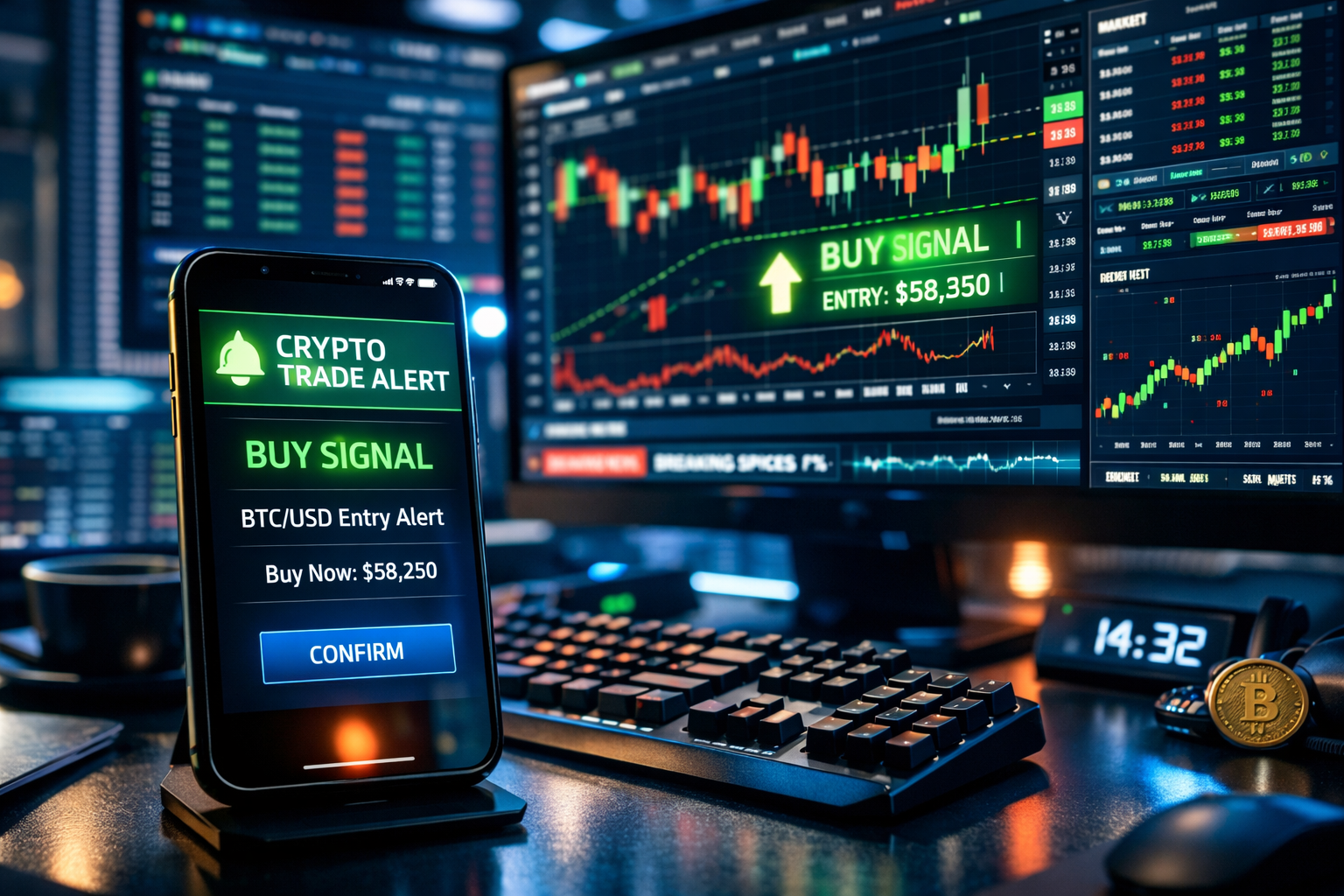
Most crypto alert apps notify you when a predefined condition is met — they do not make trading decisions for you. A price alert firing means your target level was hit, not that buying or selling is necessarily the right move at that exact moment. The decision still requires your judgment based on broader market context, risk tolerance, and strategy.
Types of Crypto Alerts Available:
- Price alerts — Notify you when an asset reaches a specific price you set in advance
- Percentage-change alerts — Trigger when a coin moves up or down by a defined percentage within a time window
- Volume alerts — Signal unusual trading volume that may precede a significant price move
- Technical indicator alerts — Available on platforms with TradingView integration like Bybit, these fire when RSI, MACD, or moving average conditions are met
- New listing alerts — Cryptocurrency Alerting notifies you when a coin gets listed on a supported exchange, which many traders use as a signal for potential early price action
The closest thing to a “buy or sell signal” from an alert service comes from technical indicator triggers — particularly RSI overbought/oversold conditions or moving average crossovers configured through TradingView and routed through Bybit’s alert system. These are objective, rules-based signals tied to your predefined strategy, but they still require you to evaluate whether the trade makes sense in the current market environment.
Think of alert services as your market watchdog, not your trading advisor. They make sure you never miss a key level — but the call on what to do when you get the notification is always yours.
Do crypto alert services work for Bitcoin and altcoins?
Every platform on this list supports Bitcoin and Ethereum alerts without exception. Where the services diverge significantly is altcoin depth. Exchange-native tools like Binance cover thousands of altcoin trading pairs, while Coinbase’s alert coverage is limited to coins listed on its platform — which is a much smaller selection. Standalone platforms like Cryptocurrency Alerting monitor prices across multiple exchanges, which gives them access to altcoins that would never appear on a single-exchange alert system.
For traders focused specifically on small-cap or newly launched altcoins, Cryptocurrency Alerting’s new listing alert feature is a standout capability. Being notified the moment a token gets listed on a supported exchange — before the broader market reacts — is a meaningful timing advantage that no exchange-native alert tool provides.
Are crypto trade alert services safe to use?
Exchange-native alert services — Binance, Bybit, OKX, Coinbase, and eToro — carry the same security profile as the exchanges themselves. You are not granting any additional permissions beyond what your existing exchange account already requires. Your funds remain in your exchange account, and alert settings are just a feature of your existing login. No additional risk is introduced by turning on price notifications.
Standalone platforms like Cryptocurrency Alerting and CoinStats require a separate account and, in some cases, read-only API connections to your exchanges for portfolio tracking features. Read-only API keys allow the platform to view your balances and trading history without the ability to place trades or withdraw funds. This is the standard security configuration and is considered safe as long as you verify that the API key permissions are genuinely set to read-only when you create them.
The main security hygiene rules to follow with any alert service are straightforward: use a unique strong password for standalone alert platform accounts, enable two-factor authentication wherever it is offered, and never grant API keys with withdrawal or trading permissions to a third-party monitoring tool — read-only access is all these services need and all they should ever be given. For additional tips on safeguarding your assets, consider learning about crypto scams and warning signs.
Overall, the security risk of using a reputable crypto alert service is minimal when basic account security practices are followed. The real risk is not using alerts at all — missing a critical market move because you had no monitoring in place is a far more common and costly outcome than any security issue tied to a legitimate alert platform. If you are serious about trading smarter and staying ahead of price moves, Coinposters provides independent reviews and comparisons of the top platforms to help you choose with confidence. For those interested in exploring different strategies, you might consider the differences between high-frequency trading and hodling to optimize your investments.
DYOR (Do Your Own Research)
This article is for informational purposes only and does not constitute financial advice. Cryptocurrency trading carries substantial risk. Always conduct your own research before making investment decisions. The platforms mentioned are reviewed based on publicly available information and user experiences. Features, availability, and terms may change. Verify all details directly with each service provider before use.