Coinposters
How to Strip Emotion From Your Crypto Investing – Psychological Check List to Avoid Loosing Money to Rash Decisions
Crypto Psychology · Investment Discipline · 2026 Trading Guide
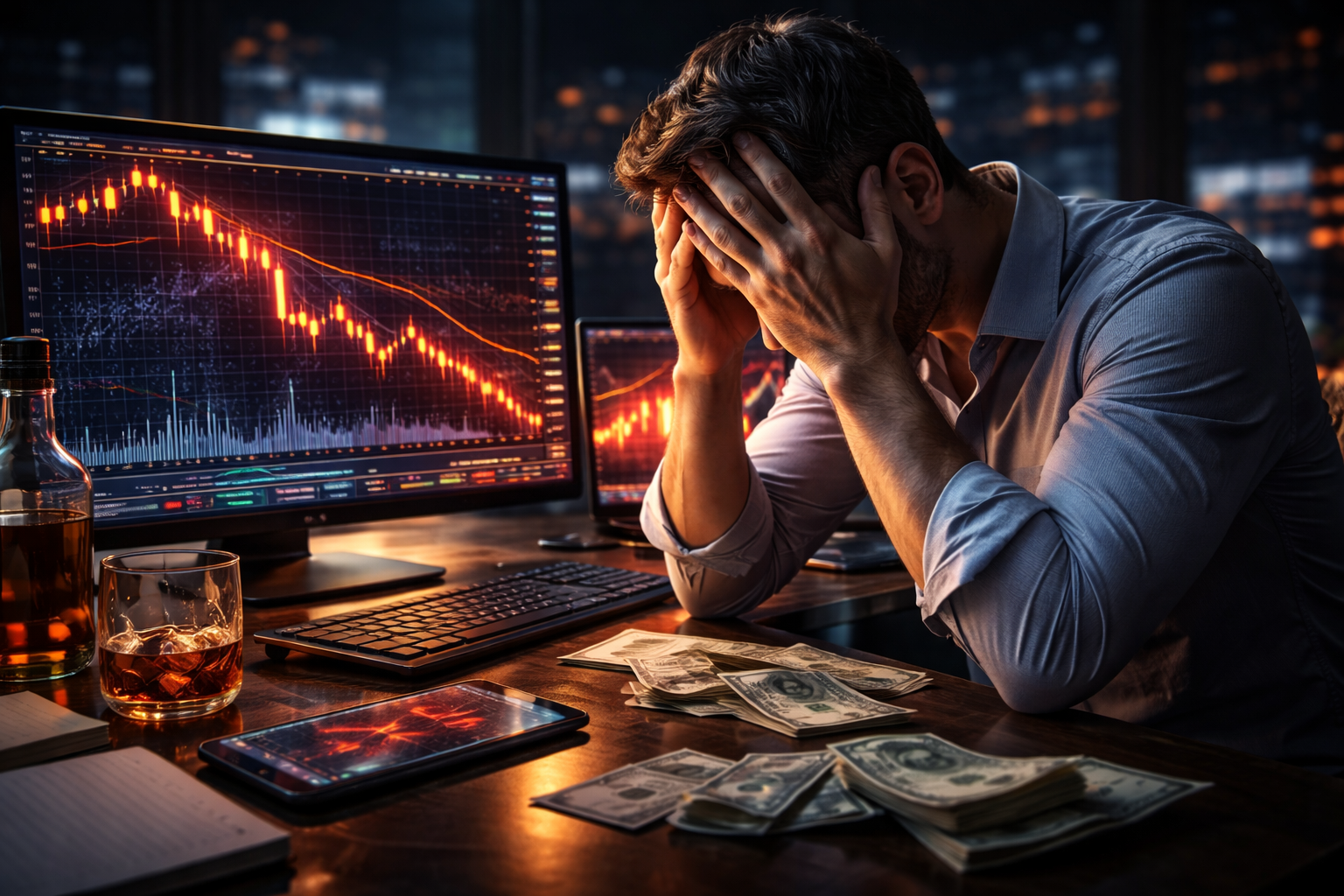
Emotional investing in crypto destroys more portfolios than bear markets. Here’s the 10-point psychology checklist that strips fear, greed, and FOMO from your decisions in 2026.
Coinposters Research Team · Updated 2026 · 28 min read
Key Takeaways
Emotions like fear, greed, and FOMO are the #1 reason crypto investors lose money — not the market itself.
The crypto market runs 24/7, creating a pressure cooker environment that amplifies emotional decision-making far beyond what traditional stock markets produce.
Panic selling, revenge trading, and confirmation bias are the three most portfolio-damaging emotional traps — and most investors don’t even realize they’re doing it.
A rules-based investment plan, set before you ever enter a position, is the single most effective tool to strip emotion from your crypto decisions.
Later in this article, you’ll find a 10-point psychological checklist that professional-level investors use to keep discipline when markets go chaotic.
Emotional investing in crypto is the #1 reason investors lose money — not picking the wrong coin, not market crashes, but the inability to control fear and greed when prices move. Most crypto investors don’t lose money because they picked the wrong coin — they lose it because emotional investing in crypto clouds their judgment during critical decision points in 2026.
Crypto is one of the few asset classes where behavioral psychology is more predictive of outcomes than almost any technical indicator. Understanding how to strip emotion from your decision-making isn’t just useful — it’s the difference between building long-term wealth and watching it evaporate in a single panic-driven sell.
Emotions Are Quietly Draining Your Crypto Portfolio
You might think your biggest risk in crypto is a rug pull, a bear market, or a bad trade call. The data tells a different story. Emotional investing in crypto — not market conditions — is the primary driver of underperformance for retail crypto investors. The market doesn’t take your money. Your reaction to the market does.
Common Emotional Behaviors That Destroy Portfolios
→Buying at all-time highs because of social media hype
→Selling during dips out of fear, only to watch the price recover
→Holding a losing position too long because of attachment to a project
→Chasing pumps after missing the initial move
→Over-allocating to a single asset after a winning streak breeds overconfidence
Each of these behaviors has one thing in common: emotion in the driver’s seat.
Why Crypto Is the Perfect Storm for Emotional Decision-Making
Traditional stock markets close. Crypto never does. That 24/7 availability means your nervous system is constantly exposed to price swings, breaking news, Twitter threads, and Discord alerts — with zero enforced cool-down period. Add to that the extreme volatility of assets that can move 20-40% in a single day, and you have a market specifically engineered — unintentionally — to trigger your fight-or-flight response on a loop.
There’s no closing bell to give you breathing room. No overnight reset. Just continuous exposure to financial uncertainty.
The Neurochemistry Behind Fear and Greed in Markets
When Bitcoin drops 15% in an hour, your brain doesn’t process that as a financial event — it processes it as a threat. Your amygdala triggers a cortisol spike, your prefrontal cortex (responsible for rational decision-making) goes partially offline, and you’re suddenly making portfolio decisions in the same neurological state you’d use to dodge a car.
On the flip side, when a token you hold 3x’s overnight, a dopamine surge makes you feel invincible — and that’s equally dangerous. Both fear and euphoria bypass the analytical parts of your brain, which is exactly why your worst trades almost always feel like your most certain ones in the moment.
How Emotional Investors Consistently Underperform
The pattern is remarkably consistent and well-documented in behavioral finance. Emotional investors buy high — driven by FOMO when everyone is talking about a coin — and sell low — driven by panic when the market corrects. They chase performance, abandon sound strategies mid-execution, and interpret short-term noise as long-term signals.
In volatile crypto markets, this gap widens significantly. An investor who held Bitcoin through its major drawdowns and did nothing would have dramatically outperformed the average trader who actively responded to every price movement. Doing less, with discipline, almost always beats doing more, with emotion.
The Psychology of Fear and Greed in Emotional Investing Crypto
Fear and greed aren’t character flaws — they’re hardwired evolutionary responses that kept humans alive for millennia. The problem is that those same circuits are terrible at managing a crypto portfolio. Understanding exactly how these two forces operate in the market gives you the ability to catch yourself before they do damage. For those looking to diversify their investments, exploring options like precious metals vs. cryptocurrency can offer additional insights.
How FOMO Pushes You Into Buying at the Worst Time
Fear of Missing Out (FOMO) is responsible for more ill-timed crypto purchases than any other psychological force. It activates when you see a coin you didn’t buy now up 300%, when your group chat is flooding with screenshots of gains, or when a project is trending on X (formerly Twitter) and everyone seems to be getting rich except you. The pressure is visceral and immediate — and it almost always leads you to buy at or near the top of a move.
FOMO is particularly dangerous in crypto because the gains are real and visible. Unlike abstract stock market rallies, seeing someone post a wallet screenshot showing a $40,000 gain on a meme coin creates a powerful social comparison trigger. Your brain registers this as a loss — something you missed — and pushes you to act immediately to avoid missing the next wave.
That urgency is the enemy of rational entry points.
Why Greed Makes You Hold Too Long and Lose Gains
Greed operates on the other side of the trade. You’re up 4x on a position, your original thesis has played out, and the smart move is to take profits — but the voice in your head says “just a little more.” That voice has cost crypto investors fortunes. Greed anchors your expectations to increasingly unrealistic price targets, keeps you in positions long past their peak, and then leaves you holding through the entire correction back to your entry point — or below it.
The Panic Selling Spiral During Bear Markets
Bear markets expose every emotional weakness in a portfolio strategy. As prices fall, fear escalates in a feedback loop — each new low triggers more anxiety, which triggers more selling, which pushes prices lower, which triggers more fear. Retail investors who panic sell during deep corrections lock in losses and then face a second emotional trap: watching the recovery happen without them. Many never re-enter at lower prices out of shame, confusion, or the fear of being wrong again — meaning they absorb the full loss without capturing any of the rebound.
The Most Costly Emotional Traps Crypto Investors Fall Into
Beyond the headline emotions of fear and greed, there’s a whole ecosystem of specific behavioral traps that quietly destroy portfolio performance. Most investors experience all of these at some point — the goal is to recognize them before they cost you.
Revenge Trading After a Loss
Revenge trading happens when a loss triggers the emotional need to “win it back” immediately. Instead of stepping back, analyzing what went wrong, and waiting for a high-probability setup, the revenge trader doubles down, over-leverages, or jumps into the next available trade to recover losses as fast as possible. This behavior almost always compounds the original loss.
Emotional Attachment to a Specific Coin or Project
This trap is subtle and deeply personal. It usually starts with genuine conviction in a project’s technology or team — and that conviction is not inherently bad. The problem develops when the line between investment thesis and emotional identity blurs. When a coin becomes part of who you are, every price drop feels like a personal attack, and you interpret negative news as FUD (Fear, Uncertainty, and Doubt) rather than legitimate information worth evaluating.
The clearest sign you’ve crossed this line? When you feel defensive about a coin in conversation — not analytical, but defensive.
Confirmation Bias and Selective Information Filtering
Confirmation bias is the tendency to seek out and prioritize information that supports what you already believe, while dismissing or ignoring contradictory evidence. In crypto, this plays out daily — investors deep in a position actively avoid bearish analysis, only follow bullish content creators, and interpret any critical report as biased or wrong.
The Illusion of Control in a Volatile Market
Crypto markets are largely unpredictable over short timeframes. Yet the constant availability of charts, indicators, and data feeds creates a powerful illusion that with enough analysis, you can master and predict the next move. This illusion of control leads to over-trading, over-analyzing, and placing excessive confidence in technical setups in markets that are frequently driven by macro events, whale movements, and pure sentiment that no indicator can capture.
Overconfidence After a Winning Streak
A winning streak in crypto doesn’t mean you’ve cracked the market — it often means the market conditions temporarily aligned with your strategy. The danger is that the brain can’t easily tell the difference between skill and luck, especially when both look identical in your portfolio balance.
How to Protect Against Overconfidence
→Resist the urge to increase position size after consecutive wins
→Keep your entry and exit criteria identical regardless of recent performance
→Review your last five winning trades and honestly assess how much was skill versus favorable conditions
→Treat a winning streak as a heightened-risk period, not a green light to go bigger
What Emotional Investing Actually Costs You
Emotional decisions in crypto aren’t just uncomfortable in hindsight — they have a measurable financial cost. Every panic sell locks in a real loss. Every FOMO buy at the top represents real capital deployed at the worst possible moment. Every revenge trade that compounds a loss is real money that compounds against you.
What makes this especially painful is the asymmetry of losses in crypto. A 50% loss requires a 100% gain just to get back to even. A 75% loss requires a 300% gain. Emotional decisions don’t just cost you the money lost — they put you in a mathematical hole that demands extraordinary performance just to recover neutral ground.
The Real Cost of Emotional Decisions
→Panic selling: Locks in losses during temporary corrections that often reverse within days or weeks
→FOMO buying: Inflates your average entry price and reduces your margin for error dramatically
→Revenge trading: Compounds losses by adding undisciplined positions on top of already damaged capital
→Overholding from greed: Converts unrealized gains into losses by missing logical exit points
→Inaction from fear: Causes missed compounding opportunities that can represent significant long-term wealth
Missed Opportunities From Inaction or Hesitation
Fear doesn’t only cause action — it causes paralysis. Some of the most costly emotional mistakes in crypto are the trades that never happened. An investor who researched Ethereum thoroughly in early 2020, had a clear thesis, had the capital available, but hesitated because the market “felt uncertain” missed one of the most significant appreciation events in crypto history.
No single emotional mistake usually destroys a portfolio outright. What does the real damage is the accumulation of small emotional errors across dozens of decisions.
The Psychological Checklist to Strip Emotion From Your Crypto Decisions
This isn’t a motivational list of vague advice — it’s a practical, implementable framework that removes the entry points for emotional interference in your investing process. The goal is to make as many decisions as possible before you’re in the heat of a market move, when your judgment is clearest and your cortisol is lowest.
1. Build a Rules-Based Investment Plan Before You Invest
Your investment plan should answer every major decision in advance: which assets you’ll invest in and why, what percentage of your portfolio each will represent, what conditions trigger a buy, what conditions trigger a sell, and how you’ll handle a drawdown of 30%, 50%, or 70%. When you have written answers to these questions before the market moves, you’re no longer making decisions under pressure — you’re executing a plan you made with a clear head.
2. Set Stop-Loss and Take-Profit Levels in Advance
Before you enter any position, define exactly the price at which you’ll exit if the trade goes against you, and the price at which you’ll take profits if it goes in your favor. These levels should be based on your analysis and risk tolerance — not adjusted in real time based on how you feel when you’re watching the chart.
3. Automate Your Investments to Remove In-the-Moment Decisions
Automation is one of the most powerful emotional circuit-breakers available to crypto investors. Dollar-cost averaging (DCA) strategies, where you invest a fixed amount at regular intervals regardless of price, completely remove the timing decision — and timing decisions are where emotion does the most damage.
Automation Tools Available to Crypto Investors
→Recurring buys on platforms like Coinbase, Kraken, and Binance that execute on a schedule
→Grid trading bots that automatically buy dips and sell rallies within a pre-defined range
→Rebalancing tools that automatically restore your target portfolio allocation when assets drift
→Stop-loss and take-profit orders on exchanges that execute without requiring you to be present
4. Limit Your Exposure to Real-Time Price Checking
Constantly checking prices is not analysis — it’s anxiety dressed up as diligence. Every time you check a red portfolio, your stress response activates slightly. Do that thirty times a day and you’ve subjected yourself to thirty micro-doses of financial anxiety, each one making you slightly more likely to make an impulsive decision.
5. Audit Your Reasoning Before Every Trade
Before executing any trade, run a simple internal audit. Ask yourself directly: Why am I making this trade right now? Then answer honestly. If the honest answer involves any variation of “because everyone else is,” “because I’m scared of missing it,” “because I need to make back what I lost,” or “because it feels right” — stop. Those are emotional drivers, not investment theses.
6. Keep a Trading Journal to Spot Emotional Patterns
A trading journal is one of the most underused and highest-impact tools in a disciplined investor’s toolkit. For every trade you make, record the date, asset, entry price, position size, your stated rationale at the time of entry, your emotional state, the outcome, and what you’d do differently.
7. Define Your Risk Tolerance and Stick to It
Risk tolerance isn’t just about how much volatility you can intellectually accept — it’s about how much drawdown you can experience without making an emotional decision. Define your true risk tolerance by asking: At what portfolio loss level would I be genuinely unable to sleep, unable to focus on my work, or unable to resist the urge to sell?
8. Diversify Your Portfolio to Reduce Emotional Pressure on Single Assets
When 80% of your portfolio is in a single asset, every price move becomes an emotional event. Thoughtful diversification across multiple assets, market caps, and crypto sectors reduces the emotional weight of any single position’s movement and gives you the psychological breathing room to hold your strategy through volatility without panic.
9. Manage Your Social Media and News Consumption
Crypto Twitter, Reddit, Discord, and Telegram are engineered for engagement — and engagement in financial communities almost always means emotional content. This doesn’t mean going dark entirely — it means being deliberate about your information diet. Follow analysts who show their reasoning, not just their calls.
10. Know When to Step Away From the Market Entirely
There are market conditions — and personal emotional states — where the single best trade you can make is no trade at all. When you’ve just taken a significant loss, when you’re sleep-deprived, when a major life stressor is consuming your mental bandwidth, or when the market is in a chaotic, news-driven frenzy with no clear directional logic, stepping away completely is not weakness. It’s professional-grade discipline.
The market will always be there tomorrow. Your capital, once lost to an emotionally driven decision made in a compromised state, may take years to recover.
Long-Term Mindset Shifts That Protect Your Portfolio
The checklist above gives you tactical tools. But underneath every tool is a mindset — a fundamental way of relating to markets, risk, and uncertainty that either supports disciplined behavior or undermines it.
Why Time Horizon Is Your Most Powerful Emotional Buffer
Short time horizons are the single greatest amplifier of emotional decision-making in crypto. When you’re thinking in hours or days, every price movement is significant, every piece of news is urgent, and every dip looks like the beginning of a crash. When you’re thinking in years, the same events shrink to noise against the larger trend.
How Professional Traders Separate Emotion From Execution
Professional Trading Habits
→They trade a plan, not a feeling — every position has a written thesis, entry, stop, and target defined before execution
→They treat losses as business costs — an expected, pre-budgeted part of operating in markets
→They review performance on process, not outcome — a good decision that loses money is still a good decision
→They use position sizing to manage anxiety — never sizing a position so large that its movement dominates their emotional state
→They have pre-defined “circuit breakers” — rules that automatically pause trading after a certain daily loss
→They separate market time from analysis time — research done away from live charts, where real-time prices can’t contaminate thinking
Mental Health and the Crypto Rollercoaster
The psychological stress of watching significant sums of money fluctuate wildly, often while surrounded by a community culture that glorifies gains and stigmatizes losses, takes a genuine toll on mental health that deserves direct attention.
Recognizing Burnout and Anxiety Specific to Crypto Trading
Crypto burnout has a specific signature: you find yourself checking prices compulsively even when you don’t want to, experiencing physical anxiety symptoms when markets move, feeling unable to think about anything other than your portfolio during volatile periods, or making trading decisions just to relieve the discomfort of uncertainty rather than because they’re strategically sound.
Emotional Discipline Is Your Real Edge in Crypto
Every serious crypto investor eventually arrives at the same realization: the market itself is not the primary obstacle to building wealth. The primary obstacle is the person making decisions about the market. Technical analysis, on-chain data, fundamental research — these are all valuable inputs. But they’re only as good as the emotional state of the person interpreting and acting on them.
Frequently Asked Questions
Emotional investing in crypto is one of the most searched and least honestly answered topics in the space. The questions below cover the real-world situations where emotional discipline breaks down most often — and what to actually do about them.
How Can I Tell If I Am Making an Emotional Decision in Crypto?
The clearest signal is urgency without a logical basis. When you feel a strong pressure to act right now — to buy immediately before it goes higher, or to sell immediately before it drops further — and that pressure is coming from a feeling rather than a pre-defined trigger in your investment plan, you are almost certainly making an emotional decision.
A second reliable signal is physical. Emotional financial decisions are almost always accompanied by identifiable physical sensations: elevated heart rate, shallow breathing, a feeling of tightness in the chest, or an adrenaline-like urgency. These are your body’s stress response activating — and they are a reliable indicator that your prefrontal cortex has taken a back seat to your amygdala.
The most honest self-check is this: write down your reason for the trade in one clear sentence. If that sentence includes any of the following, stop and wait at least 24 hours before reconsidering.
Emotional Signal Detection Guide
| Emotional Signal in Your Reasoning | What It Actually Means | What to Do Instead |
|---|---|---|
| “Everyone is buying this right now” | FOMO-driven herd behavior | Return to your investment plan criteria |
| “I need to make back what I lost” | Revenge trading impulse | Step away from charts for 24 hours minimum |
| “It feels like the right time” | Gut instinct overriding strategy | Write out your actual analytical rationale |
| “I can’t afford to miss this move” | Scarcity-driven urgency, classic FOMO | Remind yourself there is always another trade |
| “This project can’t fail, I believe in it” | Emotional attachment overriding analysis | Evaluate the asset as if you didn’t hold it |
What Is the Difference Between Panic Selling and Smart Risk Management?
Panic selling is a reactive, emotion-driven exit that happens in response to fear of further loss — it bypasses your strategy and is made in the heat of a market move without reference to pre-defined criteria. Smart risk management is a proactive, pre-planned exit that triggers based on specific price levels or portfolio thresholds you defined before entering the position.
Is Emotional Investing More Common in Crypto Than in Stocks?
Yes — significantly. The structural features of crypto markets create a uniquely high-pressure emotional environment that traditional stock markets don’t replicate. The 24/7 trading cycle eliminates enforced cooling-off periods. The extreme short-term volatility creates more frequent and more intense emotional triggers. The heavy social media culture around crypto creates constant community-driven FOMO and herd behavior.
What Role Does Community and Social Media Play in Emotional Investing?
Community and social media are among the most powerful emotional triggers in crypto. Platforms reward engagement, and in financial communities, the most engaging content is almost always the most emotionally charged: extreme price predictions, viral pump announcements, coordinated community enthusiasm around specific projects, and public shaming of those who sold “too early.”
How Do I Rebuild Confidence After a Major Emotional Trading Mistake?
The first and most important step is to separate self-worth from trading performance. A major loss caused by an emotional decision is a learning event — not a verdict on your intelligence, your worth, or your future potential as an investor. Every experienced crypto investor has an emotional trading disaster in their history.
Steps to Rebuild Confidence
→Write a full, honest account of exactly what happened — what you felt, what you did, and why
→Identify the specific emotional trigger — FOMO, panic, revenge, attachment, or overconfidence
→Identify where emotion got in — was it the entry, exit, sizing, or asset selection
→Write a specific rule or system change that closes that exact gap going forward
→Return to markets with significantly reduced position sizes until confidence in your process is rebuilt
Disclaimer: This article is for informational and educational purposes only. Cryptocurrency investing involves substantial risk of loss. Past performance is not indicative of future results. The psychological strategies discussed are tools for managing emotions, not guarantees of profitable outcomes. Always conduct your own research and consult with a licensed financial advisor before making investment decisions. Coinposters does not provide investment advice or recommendations.




Latest
Markets
25 Feb 2026
Markets
21 Feb 2026
Markets
13 Feb 2026
Markets
07 Feb 2026