Coinposters
Do Crypto Signals Work? Backtested Results, Track Records & What Experts Say

Crypto Trading Intelligence · 2026
Do Crypto Signals
Work? Backtested
Results, Track Records
& What Experts Say
Crypto signals can work — but the real question is whether the provider giving them to you actually knows what they’re doing.
Article at a Glance
- →Crypto signals can work — but their effectiveness depends heavily on the provider’s methodology, transparency, and your own risk management approach.
- →Claimed success rates from providers like Learn2Trade (79%) and CryptoSignals.org (82%) often don’t match independent reviews and real user experiences.
- →AI-powered models like LSTM and XGBoost are changing how signals are generated, improving accuracy beyond what human analysts alone can achieve.
- →Backtested results look great on paper, but past performance is never a guarantee — and most providers only show you their wins.
- →Before trusting any signal provider with real money, there are four specific verification steps every trader should run first — covered below.
Table of Contents
- What Crypto Signals Actually Are
- How Crypto Signals Work
- What Backtested Results Actually Show
- Crypto Signal Provider Track Records: The Real Numbers
- How to Tell If a Signal Provider Is Trustworthy
- Risk Management Makes or Breaks Signal Trading
- Free vs. Paid Crypto Signals: Which One Is Worth It
- The Verdict on Crypto Signals
- Frequently Asked Questions
Crypto signals can work — but the real question is whether the provider giving them to you actually knows what they’re doing. The crypto signals industry is flooded with bold claims, screenshot-only track records, and Telegram groups with thousands of members that rarely deliver consistent results. Yet, when used correctly with sound risk management and verified providers, crypto signals genuinely help traders make faster, more informed decisions. For a foundation on how to manage risk alongside signals, our guide to the safest crypto portfolio strategy covers the principles every signal user needs. Kraken’s crypto signals explainer also provides useful foundational context on how the industry operates.
What Crypto Signals Actually Are
A crypto signal is a trading alert — generated either by a human analyst or an automated algorithm — that tells you when to enter or exit a trade. It’s not a magic tip or a guaranteed win. It’s a structured recommendation based on market data, technical patterns, or fundamental events.
Crypto signals are used across all major cryptocurrencies including Bitcoin, Ethereum, and altcoins. They’re designed to remove guesswork and give traders a defined action plan with clear parameters.
Buy, Sell, Stop-Loss: The Three Core Components of Crypto Signals
Every legitimate crypto signal should contain three essential elements. Without all three, it’s not a signal — it’s speculation.
The Three Essential Components of Every Legitimate Crypto Signal
- Entry PriceThe price point at which you should open your trade position
- Take-Profit (TP)The target price where you close the trade to lock in gains
- Stop-Loss (SL)The price floor that automatically closes your trade to limit losses
These three components work together to define a trade’s risk-to-reward ratio before you ever place an order. A well-structured signal might show an entry at $42,000 for Bitcoin, a take-profit at $45,500, and a stop-loss at $40,800 — giving you a clear picture of potential upside versus downside before a single dollar is committed. For beginners looking to understand more about trading strategies, exploring a safest crypto portfolio strategy can be beneficial.
Crypto signals without stop-loss levels are a serious red flag. Any provider skipping this component is either inexperienced or deliberately withholding risk information.
Human Analysts vs. AI-Generated Crypto Signals
There are two main sources of crypto signals: human analysts and automated algorithms. Human analysts rely on chart reading, news interpretation, and years of trading experience. They can pick up on nuance and context that algorithms sometimes miss — but they’re also slower, subject to emotion, and can’t monitor every market simultaneously.
AI-generated crypto signals, on the other hand, process vast datasets at speeds no human can match. They identify patterns across hundreds of trading pairs in real time. The tradeoff is that automated systems can struggle in unprecedented market conditions where historical patterns break down. The best modern signal providers combine both approaches.
Where Crypto Signals Are Delivered: Telegram, Discord, and Apps
Most crypto signal providers use Telegram as their primary delivery channel because of its speed and group broadcast capabilities. Discord is also common, particularly among younger trading communities. Some premium services deliver signals through proprietary apps or web dashboards with additional tools built in.
Delivery speed matters more than most new traders realize. A signal for an entry at $1.85 on a volatile altcoin can become irrelevant within minutes if the price has already moved to $2.10 by the time you see it.
What a Real Crypto Signal Looks Like
- 📈Pair: ETH/USDT
- 🎯Entry: $2,280 – $2,310
- ✅Take-Profit 1: $2,400
- ✅Take-Profit 2: $2,500
- 🛑Stop-Loss: $2,180
- ⏱Timeframe: 4H Chart
- 🧠Basis: RSI oversold + support level retest
This format gives you everything needed to execute a trade with defined risk. Any signal missing these details should be treated with caution.
How Crypto Signals Work
Behind every crypto signal is an analytical process — whether that’s a trader staring at candlestick charts for hours or an algorithm scanning market data across hundreds of assets simultaneously. Understanding how signals are generated helps you evaluate whether a provider’s methodology is actually sound.
Technical Analysis: Charts, Patterns, and Price Movements
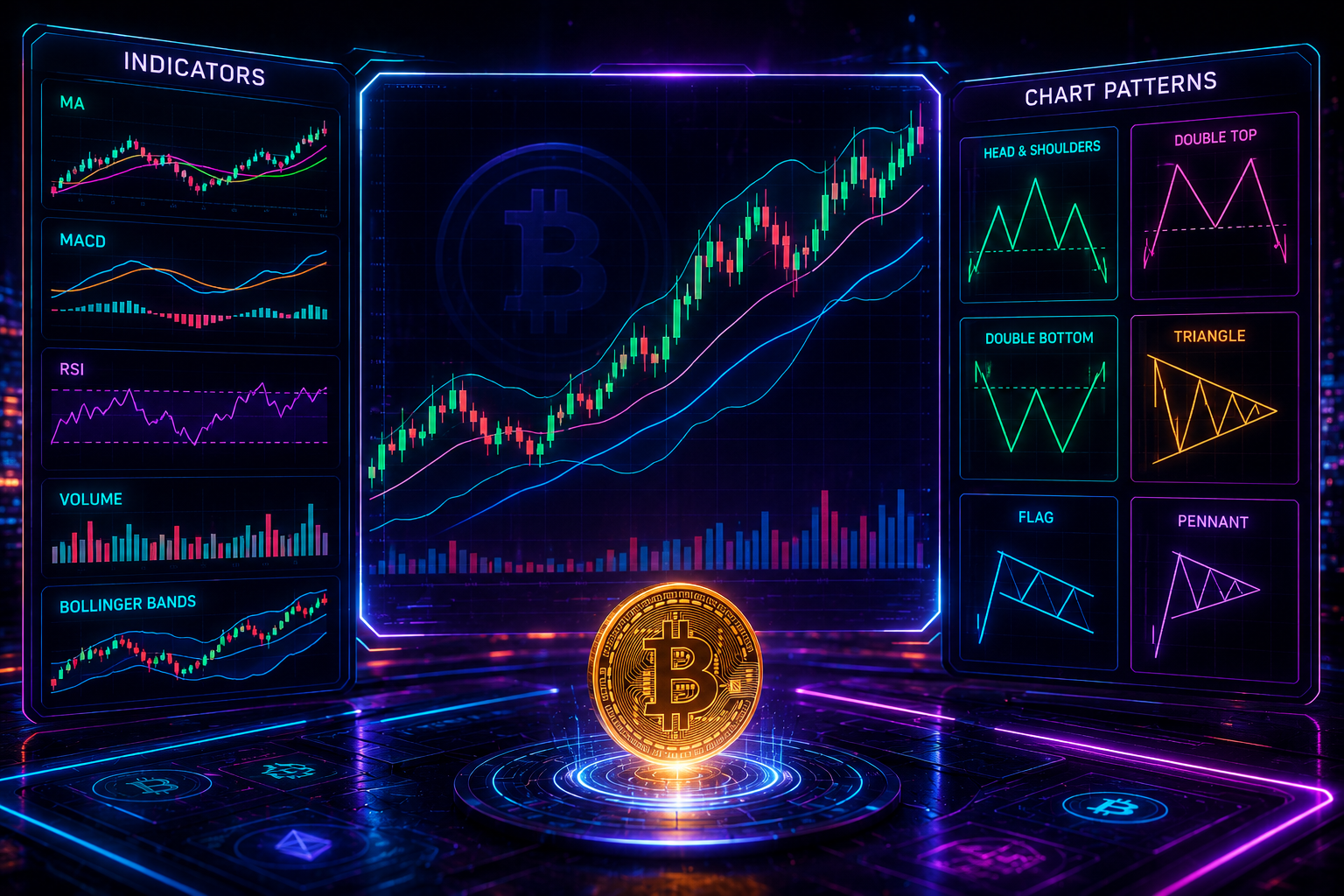
Most crypto signals are rooted in technical analysis (TA). Analysts look at price action, volume, moving averages, RSI (Relative Strength Index), MACD (Moving Average Convergence Divergence), and support/resistance levels to predict where a price is likely to move next. When multiple indicators align — say, a price bouncing off a key support level while RSI shows oversold conditions — that convergence forms the basis of a signal. To understand how this fits alongside other analytical methods, our guide to technical analysis vs on-chain analysis covers the differences in depth.
Fundamental Analysis: News, Events, and Market Sentiment
Fundamental analysis looks beyond charts at the underlying forces driving price. This includes protocol upgrades, exchange listings, regulatory news, macroeconomic shifts, and on-chain data like wallet activity and transaction volumes. Signals generated from fundamental triggers tend to be longer-term in nature and are more common in swing trading strategies than short-term scalping.
How AI Models Like LSTM and XGBoost Improve Crypto Signal Accuracy
Two AI models have become increasingly important in crypto signal generation: Long Short-Term Memory (LSTM) networks and XGBoost. LSTM is a type of recurrent neural network that excels at finding patterns in sequential time-series data — exactly the kind of data that price charts represent. XGBoost is a gradient boosting algorithm that handles large, complex datasets with high predictive efficiency.
When these models are trained on historical price data combined with sentiment analysis from social media and news sources, they can generate signals with measurably improved accuracy compared to rule-based systems alone. However, even the most sophisticated AI model is only as good as the quality and diversity of data it’s trained on — garbage in, garbage out.
What Backtested Results Actually Show
Backtesting is the process of running a crypto signal strategy against historical market data to see how it would have performed. It’s one of the most valuable tools in a trader’s arsenal — and one of the most commonly misused by signal providers trying to sell subscriptions.
A strategy that shows 85% accuracy over the last two years of backtested data sounds impressive. But that number is only meaningful if the backtest used realistic conditions — including trading fees, slippage, and periods of low liquidity. Many providers present cherry-picked backtests run during bull markets, which tells you almost nothing about how the signals will perform during sideways or bearish conditions.
Why Backtesting Is Not a Guarantee of Future Crypto Signal Performance
Markets evolve. A strategy perfectly tuned to 2021’s bull market conditions may completely fall apart in a 2022-style bear market. This is called overfitting — when a model is too closely calibrated to past data and loses its predictive power in new market environments. The crypto market is particularly prone to sudden structural changes driven by regulation, institutional behavior, and macroeconomic shocks that no historical dataset can fully anticipate. Treat backtested results as context, not proof. The right question to ask any signal provider isn’t “what does your backtest show?” — it’s “what do your live, real-money results look like over the last 6 to 12 months?”
How Combining Technical Indicators With Crypto Signals Reduces False Alerts
One of the biggest problems with standalone crypto signals is false positives — alerts that look valid but lead to losing trades. The solution most experienced traders use is confirmation through multiple technical indicators. When a signal says “buy ETH at $2,280” and that entry also aligns with a key Fibonacci retracement level, a 200-period moving average support, and above-average volume, the probability of success increases significantly. Combining RSI, MACD, and Bollinger Bands with incoming signals creates a filter layer that weeds out low-quality alerts before they cost you money. This approach won’t eliminate losses — nothing does — but it dramatically reduces the noise and keeps you out of trades that were questionable from the start.
Crypto Signal Provider Track Records: The Real Numbers
Claimed success rates are everywhere in the crypto signals space. The gap between what providers advertise and what independent users actually experience is often significant. Here’s what the data and user reviews actually show for some of the most talked-about providers.
Learn2Trade: 79% Success Rate Claim and 3.9-Star TrustPilot Rating
Learn2Trade is one of the more established names in crypto signals, claiming a 79% success rate across their trade recommendations. Their TrustPilot rating sits at 3.9 stars, which is relatively solid compared to most competitors in this space. They deliver between 3 and 5 signals per day and operate primarily through Telegram. Their signals typically include entry, stop-loss, and multiple take-profit levels — a positive sign of structured methodology.
CryptoSignals.org: 82% Claim vs. 1.8-Star TrustPilot Rating
CryptoSignals.org advertises an 82% success rate and claims to deliver 10 to 15 crypto signals per day — one of the highest volumes in the industry. On paper, that sounds impressive. The reality, according to independent user reviews, tells a very different story.
Their TrustPilot rating sits at just 1.8 stars, a dramatic contrast to their claimed accuracy. Recurring complaints from users include signals that arrive too late to execute at the listed entry price, poor customer support, and a lack of transparent trade history that would allow independent verification of the 82% claim. This is one of the clearest examples in the industry of the gap between marketing claims and lived user experience.
Degenpump: 98% Pump Accuracy and Automation Support
Degenpump takes a different approach, focusing specifically on pump signals — short-term price surge opportunities — and claiming a 98% pump accuracy rate. They differentiate themselves through automation support, allowing users to connect signals directly to trading bots for faster execution. For traders who want to capitalise on short-term momentum moves without manual execution delays, this integration is a meaningful feature. To understand more about the tools that can aid in such strategies, check out the best crypto research platforms available.
However, pump-focused crypto signals carry inherently higher risk than conventional trade signals. The entry and exit windows are extremely narrow, and missing the timing by even a few minutes can turn a profitable setup into a loss. The 98% claim should be evaluated with the same scepticism applied to any provider — ask for verified trade logs, not just the headline number.
Why Crypto Signal Providers Only Show Wins and Hide Losses
“A Telegram group can post 20 winning trades in a row, quietly delete the 8 losing signals, and advertise a ‘100% win rate this week.’ This practice is widespread and deliberately misleading.”
This is the single most important thing to understand about the crypto signals industry: there is no universal standard requiring providers to disclose their full trade history. A Telegram group can post 20 winning trades in a row, quietly delete the 8 losing signals from the channel, and then advertise a “100% win rate this week.” This practice is widespread and deliberately misleading. Until you see a provider’s complete, unedited trade log — wins and losses together — their claimed success rate is just a marketing number.
How to Tell If a Crypto Signal Provider Is Trustworthy
With so many providers making inflated claims, knowing what to look for before you hand over money or follow a crypto signal is critical. The good news is that trustworthy providers consistently display a specific set of behaviours that make them stand out from the noise.
Run through this checklist before committing to any signal service — free or paid. For those interested in diversifying their investments, understanding the difference between a crypto index and a crypto fund can be crucial context for how signals fit into a broader strategy.
1. Ask for Verified Trade History, Not Just Screenshots
Screenshots are easy to fake and even easier to cherry-pick. A legitimate crypto signal provider should be able to point you to a verified trading log — ideally one hosted on a third-party platform like Myfxbook or a publicly audited channel where signal history cannot be retroactively edited. If a provider can’t or won’t show you their complete historical record including losing trades, that absence of transparency is your answer.
Look specifically for the drawdown figures, not just the win rate. A provider with a 70% win rate but a 40% maximum drawdown is far more dangerous to your capital than one with a 60% win rate and a controlled 10% drawdown. The full picture matters.
2. Check TrustPilot and Independent Reviews
TrustPilot ratings give you a fast, crowd-sourced reality check on a provider’s actual performance. As shown with CryptoSignals.org’s 1.8-star rating versus their 82% accuracy claim, the gap between advertised performance and user experience can be enormous. Cross-reference TrustPilot with Reddit communities like r/CryptoSignals and r/CryptoCurrency, where traders share unfiltered experiences without promotional bias. Pay close attention to how providers respond to negative reviews. A company that dismisses complaints, offers no resolution, or responds defensively is showing you exactly how they handle accountability — which is a direct reflection of how reliable their signals will be.
3. Look for Transparent Stop-Loss and Risk Management Rules
Every crypto signal a reputable provider sends should come with a clearly defined stop-loss level. Beyond individual signals, trustworthy providers will also communicate a broader risk management philosophy — things like maximum recommended position size per trade, how many simultaneous open positions they suggest, and what percentage of your portfolio any single signal should represent. If a provider sends signals without stop-loss levels or avoids discussing risk management altogether, they are prioritising the appearance of wins over your financial protection. That is not a provider worth trusting with your capital.
4. Test Crypto Signals on a Demo Account Before Using Real Money
Before you commit real capital to any crypto signal provider, run their signals through a demo account for a minimum of 30 days. Most major exchanges including Binance and Bybit offer paper trading or testnet environments where you can execute trades without financial risk. This gives you a real-world sample of the provider’s timing, accuracy, and communication quality under actual market conditions — not the curated examples they use in their marketing materials. It’s also wise to be aware of crypto scams and red flags to protect yourself during this testing phase.
Risk Management Makes or Breaks Crypto Signal Trading
Even the best crypto signal in the world can destroy your portfolio if you don’t manage risk properly. Signals tell you what to trade — risk management determines how much you put on the line and whether a string of losses wipes you out or barely makes a dent.
Position Sizing: Never Risk More Than You Can Afford to Lose
The standard rule used by professional traders is to risk no more than 1% to 2% of your total portfolio on any single trade. So if you’re working with a $5,000 account, that means a maximum of $50 to $100 at risk per signal — not $5,000 on a high-conviction call. This approach keeps you in the game long enough to let the statistical edge of a good signal provider play out over time.
Position Sizing in Practice — The 1–2% Rule
| Account Size | 1% Max Risk | 2% Max Risk | Why It Matters |
|---|---|---|---|
| $1,000 | $10 | $20 | 5 losing trades = max 10% portfolio loss |
| $5,000 | $50 | $100 | 5 losing trades = max 10% portfolio loss |
| $10,000 | $100 | $200 | 5 losing trades = max 10% portfolio loss |
Many beginners make the mistake of over-allocating on signals that feel like sure things. The crypto market has no sure things. A disciplined position sizing strategy means that even a losing streak of 5 consecutive trades doesn’t end your trading career.
Stop-Loss Orders: Your Last Line of Defense
A stop-loss is a pre-set price level that automatically closes your trade if the market moves against you. It’s the difference between a controlled 5% loss and a catastrophic 40% drawdown. Every crypto signal you act on should have a stop-loss attached — and you should actually use it, not mentally note it and then override it when the price starts dropping because you “believe in the trade.” For a comprehensive guide on managing risks, check out this safest crypto portfolio strategy for beginners.
Trailing stop-losses add another layer of protection by locking in profits as the price moves in your favour, while still cutting losses if the market reverses. Platforms like Kraken, Binance, and Bybit all support trailing stop orders natively. Use them.
Free vs. Paid Crypto Signals: Which One Is Worth It
Free crypto signals exist across countless Telegram groups and Discord servers, and some genuinely provide value — particularly for beginners learning how to read and execute structured trade recommendations. The limitation is consistency and depth. Free signal providers typically offer fewer signals, less detailed analysis, and little to no customer support. They’re a reasonable starting point for learning, but not a long-term trading strategy.
Paid crypto signal services, when legitimate, offer more frequent signals, verified track records, dedicated analyst teams, and risk management guidance. Prices vary widely — from $30 to $300+ per month depending on the provider and the level of service. The key word here is when legitimate. A paid subscription is only worth it if the provider can demonstrate a verified performance history with real trade logs, not just claimed win rates. Always test with a demo account before paying for any premium service. For beginners, understanding crypto portfolio diversification strategies can be an essential part of managing risks effectively.
The Verdict on Crypto Signals
“Crypto signals work — but only when you choose verified providers, apply strict risk management, and treat signals as one input in your decision-making process rather than a guaranteed outcome.”
CoinPosters · Crypto Trading Intelligence 2026
Crypto signals work — but only when you choose verified providers, apply strict risk management, and treat signals as one input in your decision-making process rather than a guaranteed outcome. Used correctly, they save time, reduce emotional trading, and expose you to setups you might have missed on your own. Used blindly, they’re an expensive way to learn that marketing claims and real performance are rarely the same thing.
Frequently Asked Questions
Here are the most common questions traders ask about crypto signals, answered directly based on how the industry actually works — not how providers market themselves.
Crypto Signal Provider Comparison — Claims vs Reality
| Provider | Claimed Rate | TrustPilot | Daily Signals | Verdict |
|---|---|---|---|---|
| Learn2Trade | 79% | 3.9 ★ | 3–5 | Most credible among reviewed providers |
| CryptoSignals.org | 82% | 1.8 ★ | 10–15 | Significant gap between claims and user experience |
| Degenpump | 98% pump | N/A | Varies | High risk, short windows, automation-focused |
The table above highlights a pattern that runs through the entire crypto signals industry: the providers making the biggest accuracy claims often have the weakest independent user ratings. Always prioritise TrustPilot scores and community reviews over headline win-rate numbers.
One more thing worth noting — a high daily signal volume isn’t a benefit, it’s a burden. Receiving 15 signals a day means you’re constantly making execution decisions, increasing the chance of mistakes and emotional trading. Quality over quantity applies here more than almost anywhere else in trading. For those interested in understanding more about trading strategies, exploring technical analysis vs. on-chain analysis can be beneficial.
Do crypto signals actually work for beginners?
Yes, crypto signals can work for beginners — but with an important condition. Beginners should use signals as a learning tool alongside their own research, not as a shortcut that replaces understanding the market. Following a signal without knowing why it was generated means you have no framework for evaluating whether it’s a good call or a bad one. Start with a demo account, learn the basics of technical analysis, and use signals to reinforce that learning rather than replace it.
What is a realistic success rate for crypto signals?
A realistic, independently verified success rate for a high-quality crypto signal provider sits between 60% and 75%. Any provider claiming above 80% consistently should be asked for a full, unedited trade log before you believe that number. In trading, a 60% win rate combined with disciplined risk management and a favourable risk-to-reward ratio is enough to be consistently profitable over time. You don’t need a 90% win rate — you need good entries, controlled losses, and compounding gains.
Are free crypto signals as reliable as paid ones?
Free crypto signals can be legitimate, but they’re less consistent and typically less detailed than premium services. Many free Telegram groups use initial quality signals to build an audience before pushing paid upgrades or affiliated products. That said, some free providers — particularly those run by experienced traders building a community — genuinely deliver value.
The reliability question isn’t really free vs. paid — it’s verified vs. unverified. A free provider with a transparent trade history beats a paid provider with cherry-picked screenshots every single time. Apply the same due diligence regardless of price.
How do I know if a crypto signal provider is scamming me?
Scam crypto signal providers follow recognisable patterns once you know what to look for. The warning signs are consistent across the industry and show up early if you’re paying attention. Watch for providers who guarantee profits, promise unusually high win rates without verified proof, or create urgency around “limited spots” in their group. These are psychological pressure tactics, not the behaviour of a legitimate trading operation.
- ⚠Claims of 90%+ win rates with no verifiable trade history
- ⚠No stop-loss levels included in signals
- ⚠Deleted or edited message history in Telegram channels
- ⚠Refusal to answer direct questions about methodology
- ⚠Pressure to invest through affiliated exchanges or wallets
- ⚠Testimonials that are anonymous or unverifiable
- ⚠Low TrustPilot scores paired with dismissive responses to negative reviews
If a provider ticks more than one of these boxes, walk away. The crypto signals space has no shortage of legitimate alternatives that don’t rely on pressure tactics or hidden trade histories to attract members.
Should I follow crypto signals blindly or do my own research too?
Never follow any crypto signal blindly — full stop. Even the best signal providers have losing streaks, and if you don’t understand the reasoning behind a trade, you won’t know whether to hold your position during volatility or cut it early.
The most effective approach is to use signals as a starting point. When a signal comes in, run a quick check: Does the entry make sense on the chart? Is the broader market trend supporting this direction? Does the risk-to-reward ratio meet your personal criteria? This takes minutes once you build the habit, and it significantly improves your results over following signals mechanically.
Think of crypto signals the way a navigator uses GPS — it gives you a recommended route, but you still need to watch the road. If there’s an obvious obstacle the system hasn’t accounted for, you don’t drive into it just because the algorithm said to. For those interested in understanding more about navigating the crypto world, exploring a diversification strategy can be quite beneficial.
The traders who get the most out of crypto signals are the ones who combine them with their own growing market knowledge. Over time, that combination builds genuine trading skill that works with or without a signal provider — and that’s the real goal.
Disclaimer
This article is for informational and educational purposes only and does not constitute financial or investment advice. Do Your Own Research (DYOR) before acting on any crypto signal or engaging with any signal provider. TrustPilot ratings and provider claims referenced in this article reflect information available at the time of writing and may change. CoinPosters is not responsible for any financial losses arising from the use of crypto signals or signal providers discussed in this article. Always apply strict risk management and consult a qualified financial advisor before trading.
CoinPosters
Your guide to navigating crypto in 2026 and beyond.