Coinposters
Technical Analysis vs On-Chain Analysis: Which Times Market More Accurately?
Crypto Trading Strategy Guide · 2026
Technical Analysis
vs On-Chain Analysis:
Which Times the
Crypto Market
More Accurately?
Most traders pick a side — charts or chain data — but the sharpest ones know how to use both.
Article at a Glance
- →Technical analysis reads price charts and patterns to time trades, while on-chain analysis digs into actual blockchain data to understand what’s really happening beneath the surface.
- →Neither method alone gives you the full picture — the most effective crypto traders combine both to make smarter, more confident decisions.
- →On-chain metrics like active addresses, exchange inflows, and SOPR can signal major market moves before they show up on a price chart.
- →Technical analysis has a steep learning curve, but on-chain tools like Glassnode and CryptoQuant have made blockchain data more accessible than ever for everyday traders.
- →Keep reading to find out exactly when to use each method — and which combination gives you the strongest trading edge in crypto markets.
Table of Contents
- Two Ways to Read the Crypto Market
- What Is Technical Analysis in Crypto?
- What Is On-Chain Analysis?
- Technical Analysis vs On-Chain Analysis: Core Differences
- When to Use Technical Analysis vs On-Chain Analysis
- How to Combine Both Methods for Smarter Trades
- One Method Alone Is Not Enough
- Frequently Asked Questions
Two Ways to Read the Crypto Market
The debate between technical analysis vs on-chain analysis is one every serious crypto trader eventually faces. Understanding the distinction between these two methods could be the edge that separates a well-timed trade from a costly mistake — whether you’re swing trading Bitcoin or evaluating a new altcoin position. Our guide to on-chain analysis vs fundamental analysis covers how blockchain data fits into a broader research framework. For the foundational mechanics of blockchain analysis, Wikipedia provides a solid technical overview.
On-chain metrics are grounded in hard, verifiable facts pulled directly from the blockchain, while technical analysis focuses on price action and market psychology. Both tell a story — just different chapters of the same book. In the technical analysis vs on-chain analysis debate, the answer isn’t which one wins — it’s understanding when to reach for each.
What Is Technical Analysis in Crypto?
Technical analysis (TA) is the practice of studying historical price data and trading volume to forecast future price movements. It operates on the assumption that all known information is already reflected in the price, and that patterns tend to repeat over time due to predictable human behavior. In crypto, TA is widely used because markets run 24/7 and price action is often driven by sentiment and momentum rather than earnings reports or revenue. For a comprehensive reference, CoinDesk’s technical analysis coverage tracks how professional traders apply these methods in real markets.
Price Charts and What They Tell You
A price chart is more than just a line moving up or down — it’s a visual record of every decision made by every market participant over a given timeframe. Candlestick charts, the most common format in crypto trading, display the open, high, low, and close price for each time period. Reading these patterns gives traders clues about where buyers and sellers are battling it out.
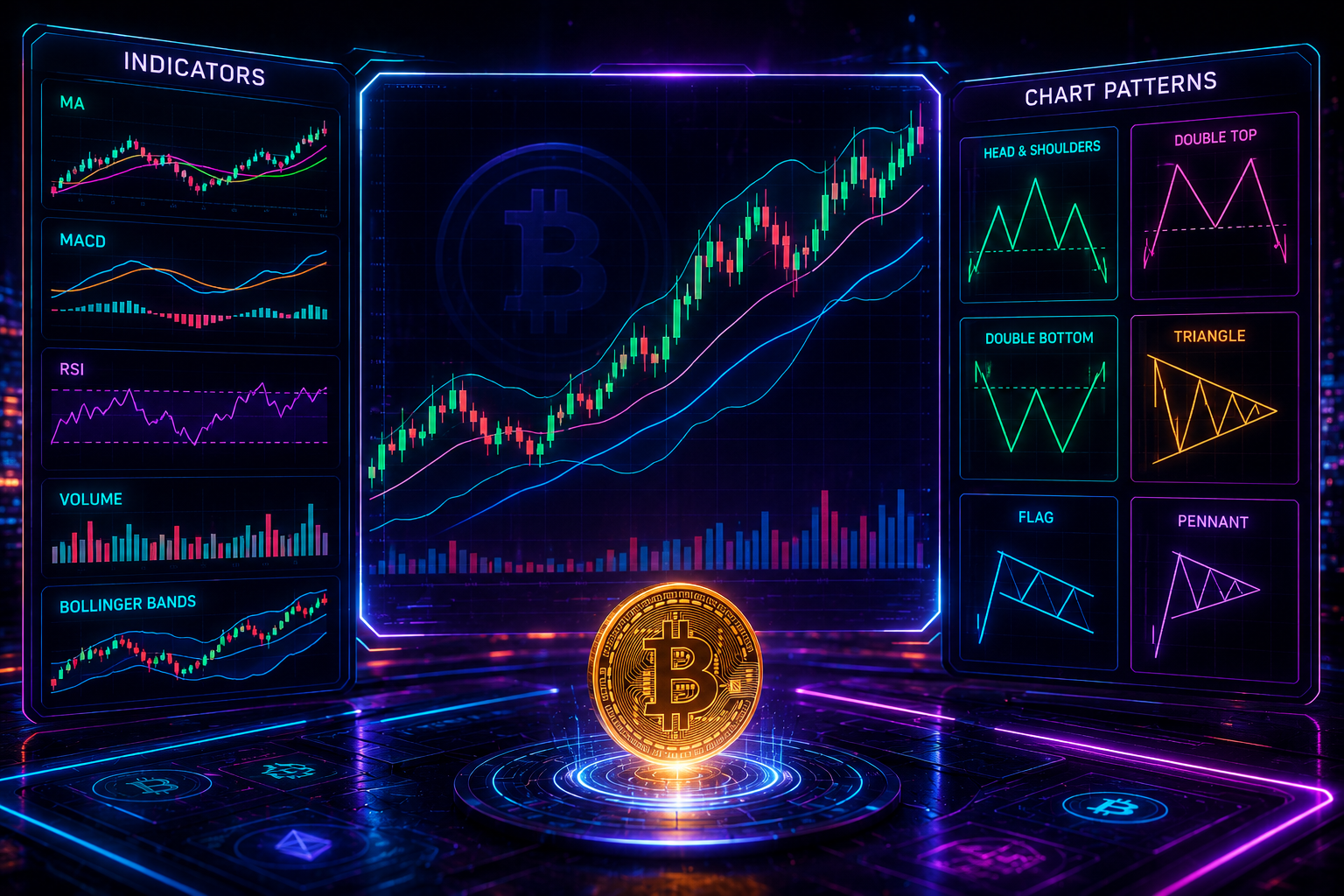
Common Chart Patterns — Technical Analysis
- ◆Head and Shoulders — a reversal pattern signaling a trend change
- ◆Double Bottom / Double Top — strong support or resistance signals
- ◆Bull/Bear Flags — continuation patterns that follow sharp price moves
- ◆Ascending and Descending Triangles — breakout setups forming over weeks or months
- ◆Wyckoff Accumulation/Distribution — longer-term patterns showing institutional activity
Common Technical Indicators Traders Use
Beyond chart patterns, traders layer in technical indicators to sharpen their entries and exits. The Relative Strength Index (RSI) measures momentum on a scale of 0 to 100 — readings above 70 suggest overbought conditions, while below 30 signals oversold territory. The Moving Average Convergence Divergence (MACD) tracks the relationship between two exponential moving averages and is widely used to spot trend reversals. Bollinger Bands measure volatility by placing bands two standard deviations above and below a moving average, and a squeeze in the bands often precedes a major price move.
Volume indicators like the On-Balance Volume (OBV) and Volume-Weighted Average Price (VWAP) are also critical — price moves backed by strong volume carry much more weight than those that aren’t. Most traders use a combination of two to three indicators rather than piling on every tool available.
The Role of Bitcoin Dominance in Technical Analysis
Bitcoin dominance — the percentage of total crypto market cap held by Bitcoin — is a unique TA tool specific to crypto. When BTC dominance rises, it often signals capital flowing out of altcoins and into Bitcoin, typically during risk-off periods. When it falls, altcoins tend to outperform. Watching this chart alongside individual asset charts adds an important layer of context that equity traders simply don’t have access to.
Where Technical Analysis Falls Short
Technical analysis works well in trending markets but can produce false signals in sideways or highly manipulated conditions. Crypto markets are especially vulnerable to sudden whale movements, exchange hacks, regulatory news, and macro shocks — none of which a chart pattern can predict. TA also tells you nothing about whether a blockchain network is actually being used or whether long-term holders are accumulating or distributing. That’s where on-chain analysis steps in.
What Is On-Chain Analysis?
On-chain analysis is the practice of reading publicly available blockchain data to evaluate the health, activity, and value of a cryptocurrency network. Unlike TA, which is based entirely on price and volume, on-chain analysis looks at what’s actually happening on the blockchain — who is moving coins, where they’re going, and how much activity the network is generating. Think of it as the fundamental analysis of crypto, but with transaction-level transparency that no traditional financial market offers. For a broader overview of what constitutes fundamental analysis, CoinMarketCap’s Academy glossary provides a useful reference.
Because every transaction on a public blockchain is permanently recorded and visible, on-chain analysts can track wallet behavior, miner activity, exchange flows, and holder patterns in real time. This isn’t speculation — it’s raw data that reflects the actual decisions of real participants in the network. For those interested in understanding the broader context of crypto investments, exploring a crypto portfolio strategy can provide valuable insights.
Blockchain Data as a Trading Signal
When large amounts of Bitcoin suddenly flow onto exchanges, that’s a potential sell signal — holders are moving coins to where they can be sold. When coins flow off exchanges into cold wallets, it suggests accumulation and reduced sell pressure. These movements show up in on-chain data before they ever show up in price, giving analysts who know what to look for a meaningful head start.
Key On-Chain Metrics Every Trader Should Know
There are dozens of on-chain metrics, but a focused set of them do most of the heavy lifting when it comes to actionable trading signals:
Key On-Chain Metrics — What Each One Measures
| Metric | What It Measures | Signal |
|---|---|---|
| Active Addresses | Unique wallets transacting daily | Rising = growing network usage |
| Exchange Inflows/Outflows | Coins moving onto or off exchanges | High inflows = potential sell pressure |
| SOPR | Whether moved coins are in profit or loss | Below 1 in downtrend = capitulation signal |
| MVRV Ratio | Market cap vs realized cap | Above 3.5 historically preceded BTC tops |
| Hash Rate | Miner computational commitment | Rising = long-term network confidence |
| NVT Ratio | Network value vs transaction volume | High NVT = potential overvaluation |
How On-Chain Data Differs From Stock Market Analysis
In traditional markets, fundamental analysis relies on earnings reports, balance sheets, and cash flow statements — data that companies release quarterly, often with delays and the possibility of manipulation. On-chain analysis flips that model entirely. Every transaction on a public blockchain is recorded in real time, permanently, and without any single party controlling what gets reported. There’s no earnings call needed when you can watch capital flows directly.
Stock market investors also don’t have visibility into who is holding shares, when institutional players are accumulating, or how many active users a platform has at the wallet level. On-chain analysts have all of that. For Bitcoin, you can see exactly how many addresses hold more than 1,000 BTC, track when those wallets last moved their coins, and determine whether long-term holders are in profit or underwater — all without a single press release.
Technical Analysis vs On-Chain Analysis: Core Differences
Both methods aim to answer the same fundamental question — where is this asset’s price headed? — but they approach it from completely different angles. Technical analysis is reactive, working with the price history that already exists. On-chain analysis is more investigative, digging into the underlying network behavior that often precedes price movement. Understanding these differences in the technical analysis vs on-chain analysis debate helps you know which tool to reach for depending on your timeframe and trading goal.
Data Sources: Price History vs Blockchain Activity
Technical analysis draws entirely from market data — price, volume, and derivatives information like open interest and funding rates. On-chain analysis pulls from the blockchain itself: transaction counts, wallet balances, coin age, miner behavior, and exchange flows. One tells you what traders are feeling; the other tells you what they’re actually doing with their money.
Short-Term Trading vs Long-Term Valuation
Technical analysis shines in short to medium-term trading. If you’re looking for an entry point over the next few hours or days, chart patterns and momentum indicators are your most practical tools. A well-drawn support level or an RSI divergence on the 4-hour chart gives you something concrete to act on immediately.
On-chain analysis is built for a longer lens. Metrics like MVRV Z-Score and the Puell Multiple are designed to identify macro tops and bottoms in Bitcoin’s market cycle — the kind of signals that play out over months, not minutes. Glassnode’s data showed that every time Bitcoin’s MVRV Z-Score entered the red zone, it marked a major cycle bottom, a pattern that has held across multiple market cycles.
That said, some on-chain metrics do have short-term utility. Exchange inflow spikes can precede sharp sell-offs within hours, and sudden movements by large wallets — often called “whale alerts” — can shift market sentiment quickly. The key is knowing which metrics operate on which timeframe.
Technical Analysis vs On-Chain Analysis — Full Comparison
| Factor | Technical Analysis | On-Chain Analysis |
|---|---|---|
| Primary Data Source | Price charts, volume, derivatives | Blockchain transactions, wallet data |
| Best Timeframe | Short to medium-term | Medium to long-term |
| Predicts Manipulation? | Partially (volume anomalies) | Better (exchange flows, whale activity) |
| Applies to All Assets? | Yes — stocks, forex, crypto | Crypto only (public blockchains) |
| Real-Time Utility | High | Moderate to High |
| Learning Curve | Moderate | Moderate to Steep |
Accessibility and Learning Curve
Technical analysis has been around for over a century and has a massive library of educational resources, from free YouTube tutorials to full certification courses. Most crypto exchanges like Binance and Coinbase display basic TA tools natively on their trading interfaces. On-chain analysis is newer to mainstream trading and requires dedicated platforms like Glassnode, CryptoQuant, or Nansen — some of which sit behind paywalls. However, free tiers on these platforms have improved significantly, and tools like Bitcoin’s stock-to-flow model and Glassnode’s free dashboard have lowered the barrier of entry considerably.
When to Use Technical Analysis vs On-Chain Analysis
The right tool in the technical analysis vs on-chain analysis question depends entirely on what you’re trying to answer. Are you looking for a precise entry on a breakout setup today? That’s a TA question. Are you trying to figure out whether Bitcoin is in the early stages of a new bull cycle or approaching a macro top? That’s an on-chain question. The two methods aren’t in competition — they operate on different frequencies, and knowing when to tune into each one is what separates reactive traders from strategic ones.
Best Scenarios for Technical Analysis
Technical analysis is most powerful when markets are trending clearly — either up or down — and when there’s strong volume confirming the move. It’s the go-to method for day traders, swing traders, and anyone executing trades with a defined time horizon of hours to weeks.
TA is also highly effective when used around key macro events like Bitcoin halving dates, major exchange listings, or scheduled protocol upgrades. Traders can use Fibonacci retracement levels and volume profile analysis to identify high-probability entry zones ahead of these catalysts. The combination of a known event with a well-defined technical structure creates some of the cleanest setups in crypto.
Best Use Cases for Technical Analysis
- ◆Day trading and scalping — RSI, MACD, and candlestick patterns provide fast, actionable signals
- ◆Identifying support and resistance — horizontal levels, moving averages, and VWAP act as reliable price anchors
- ◆Timing entries after news events — TA helps find structure after volatile, sentiment-driven price swings
- ◆Breakout trading — ascending triangles, bull flags, and consolidation ranges set up high-reward breakout trades
- ◆Risk management — stop-loss placement and take-profit targets are naturally defined by chart structure
One important caveat: TA loses reliability in low-liquidity environments and during black swan events. If a major exchange collapses or a government announces a sweeping crypto ban, no chart pattern will save you. TA works best as a precision tool within a broader market context. To explore different analysis methods, you might consider comparing on-chain analysis vs fundamental analysis for undervalued crypto.
Best Scenarios for On-Chain Analysis
On-chain analysis is most valuable when you’re making high-conviction, longer-term decisions about whether to hold, accumulate, or reduce exposure to a crypto asset. If the MVRV ratio is flashing extreme overvaluation while long-term holders are distributing coins to new buyers — as seen near Bitcoin’s November 2021 peak — that’s a macro warning signal that no candlestick pattern would have caught as early. On-chain data also helps cut through FUD and hype: when prices are crashing but exchange outflows are accelerating, smart money is buying the dip, not panicking. For more insights, explore the value of market analysis for retail investors.
How to Combine Both Methods for Smarter Trades
The most effective approach to technical analysis vs on-chain analysis isn’t choosing between them — it’s building a workflow where each method validates and strengthens the other. Use on-chain data to establish your macro bias: is the market in an accumulation phase or a distribution phase? Then drop down to the charts to find your precise entry and exit points within that larger context. This top-down approach means you’re not just trading patterns blindly — you’re trading patterns that are aligned with what the blockchain is actually telling you about supply, demand, and holder behavior.
Using On-Chain Data to Confirm Technical Setups
The most powerful trades happen when on-chain data and technical setups are pointing in the same direction. Say Bitcoin forms a textbook bull flag on the daily chart — that’s an interesting setup, but it becomes a high-conviction trade when you layer in on-chain confirmation: exchange outflows are rising, long-term holder supply is increasing, and the MVRV ratio is in neutral territory. Every additional signal in the same direction reduces your risk and sharpens your edge.
A practical example: in early 2023, Bitcoin broke above its 200-day moving average — a significant TA signal — while on-chain data from Glassnode simultaneously showed long-term holders accumulating at the fastest rate in over a year. Neither signal alone was conclusive, but together they created one of the strongest macro buy signals of that cycle. This is the combined method working exactly as it should.
Tools That Support Both Analysis Types
You don’t need a dozen different platforms to run this workflow effectively. For technical analysis, TradingView remains the gold standard — its charting tools, custom indicators, and multi-timeframe analysis capabilities are unmatched at any price point. For on-chain analysis, Glassnode offers the deepest Bitcoin and Ethereum metrics, while CryptoQuant excels at exchange flow data and miner activity. Nansen adds wallet labeling and smart money tracking for traders who want to follow specific on-chain players. Exploring the best crypto research platforms available in 2026 can help you identify which tools best fit your trading style and budget.
One Method Alone Is Not Enough
If you only use technical analysis, you’re trading shadows — patterns formed by price without any understanding of the underlying network activity driving them. You’ll catch some moves, but you’ll also get whipsawed by manipulated patterns and miss the macro picture entirely when it matters most.
If you only use on-chain analysis, you’ll have strong conviction about the big picture but struggle to time your entries and exits with any precision. Knowing that Bitcoin is in an accumulation phase doesn’t tell you whether the price will drop another 20% before reversing — chart structure does.
“On-chain data tells you the story. Technical analysis tells you where you are in it. Used together, they give you both the map and the compass.”
The real edge in crypto trading comes from fluency in both languages. On-chain data tells you the story; technical analysis tells you where you are in it. Used together, they give you both the map and the compass. For those looking to explore further, understanding the difference between crypto index and crypto fund investing can provide deeper insights into market trends.
Quick Reference — Which Method to Reach For
- 📊 Technical AnalysisTiming a short-term entry, setting stop-losses, trading breakouts, or navigating a trending market
- ⛓ On-Chain AnalysisEvaluating macro market cycle position, identifying smart money behavior, assessing long-term holder sentiment, or cutting through hype and FUD
- ✅ Use BothMaking any high-conviction trade where timing and context both matter — which is most of the time
Building this dual-method habit takes time, but even a basic on-chain check before entering a technical trade will immediately improve your decision-making. Start with one or two on-chain metrics — exchange inflows and MVRV — and learn how they behave across different market conditions. Add more tools as your understanding deepens.
Frequently Asked Questions
Here are the most common questions traders ask when trying to decide between technical analysis vs on-chain analysis — and the honest answers that will actually help you trade smarter.
Is technical analysis reliable for crypto trading?
Technical analysis is reliable in trending, liquid markets — and unreliable in choppy, low-volume, or news-driven conditions. In crypto, where sentiment shifts fast and liquidity can evaporate quickly, TA works best when combined with broader context. RSI divergences and moving average crossovers on Bitcoin’s daily chart have historically been solid signals, but the same indicators on a low-cap altcoin with thin order books can produce far more false signals.
The key is understanding what TA can and cannot do. It can help you identify high-probability setups, manage risk through defined levels, and time entries within a trend. It cannot predict black swan events, account for blockchain-level activity, or tell you whether a project has genuine network adoption. Use it as a precision tool, not an oracle.
TA Reliability by Market Condition
- 🟢Trending market with high volume — TA signals are highly reliable
- 🟡Sideways / ranging market — TA signals are moderate, use with caution
- 🔴News-driven or black swan event — TA signals break down, prioritise risk management
- 🟡Low-liquidity altcoins — TA signals are inconsistent, on-chain data more useful
For Bitcoin and Ethereum — the two most liquid crypto assets — technical analysis has a strong track record when applied consistently and without over-optimisation. The further you move down the market cap rankings, the more carefully you need to apply TA. For those looking to diversify, understanding the difference between a crypto index and a crypto fund can be beneficial.
What are the best on-chain metrics for beginners?
Start with metrics that are intuitive and have a clear, direct relationship to price behavior. Exchange Net Flow is one of the easiest to understand — when large amounts of Bitcoin flow onto exchanges, selling pressure may be building; when coins flow off, accumulation is likely. Active Addresses give you a pulse on network usage — a rising number of daily active addresses alongside rising price is a healthy, confirmed uptrend. MVRV Ratio is beginner-friendly once you understand the concept: when the market value of Bitcoin is significantly higher than the average cost basis of all holders, the market is historically overheated.
These three metrics alone — exchange flow, active addresses, and MVRV — will give any beginner a meaningful macro view of Bitcoin’s market condition without needing to dive deep into more complex derivatives like SOPR bands or realized cap cohort analysis. Glassnode’s free tier provides access to all three, making them accessible without any upfront cost.
Can on-chain analysis predict crypto price movements?
On-chain analysis cannot predict price movements with certainty — nothing can. What it does is identify conditions that have historically preceded significant price moves, giving you probabilistic insight rather than a crystal ball. The distinction matters, especially for newer traders who might treat any single metric as a definitive signal.
The MVRV Z-Score, for instance, has flagged every major Bitcoin cycle top and bottom since 2011 by identifying when the market value is statistically extreme relative to realized value. That’s not prediction — it’s pattern recognition backed by verifiable on-chain data. Similarly, spikes in exchange inflows from long-term holder wallets have preceded notable sell-offs in multiple cycles.
Where on-chain analysis genuinely excels is in eliminating noise. When prices are dropping and social media is in panic mode, on-chain data showing continued exchange outflows and accumulation by large wallets cuts through the emotion and grounds your decision in what’s actually happening. That’s an edge that pure technical traders simply don’t have access to.
⚠ Important: No single on-chain metric should be used in isolation to make trading decisions.
The strongest signals occur when multiple independent metrics converge — for example, when MVRV enters the danger zone and exchange inflows spike and long-term holder distribution accelerates simultaneously. Confluence is everything. Used as part of a broader analytical framework, on-chain metrics significantly improve the quality of your market reads — particularly at macro turning points where technical analysis alone tends to lag behind.
Do professional crypto traders use technical or on-chain analysis?
Most professional crypto traders and institutional desks use both. Firms like Pantera Capital, Galaxy Digital, and Ark Invest have publicly referenced on-chain metrics in their market research, while their trading desks rely on technical analysis for execution. At the individual professional level, traders like Willy Woo and PlanB built their entire reputations on on-chain modelling, while others like Credible Crypto and Rekt Capital are known for deep technical analysis work — and even they cross-reference the other discipline regularly.
The split often comes down to role: macro analysts and fund managers lean heavily on on-chain data for positioning decisions, while traders responsible for execution lean on TA to optimise entries and exits within that framework. If you’re operating as both analyst and trader — which most retail traders are — developing proficiency in both is not optional, it’s necessary. For those seeking to enhance their skills, exploring crypto research platforms can be a valuable resource.
What tools can I use for on-chain analysis?
The on-chain analytics space has matured significantly, and there are now strong options across every budget level. Glassnode is the most comprehensive platform for Bitcoin and Ethereum on-chain data, with a free tier that covers the most essential metrics and paid plans available for advanced access. CryptoQuant specialises in exchange flow data and miner metrics, and its alert system is particularly useful for catching sudden exchange inflow spikes in real time. Nansen focuses on wallet intelligence and smart money tracking across Ethereum and EVM-compatible chains, making it the go-to tool for DeFi and NFT market analysis.
For Bitcoin-specific cycle analysis, LookIntoBitcoin offers free access to models like the Stock-to-Flow chart, MVRV Z-Score, and the Pi Cycle Top Indicator — making it one of the best starting points for on-chain beginners. IntoTheBlock provides a more user-friendly interface for on-chain data across a broader range of cryptocurrencies beyond just Bitcoin and Ethereum. For a practical guide to combining technical analysis vs on-chain analysis within a daily trading workflow, exploring the full range of on-chain analysis tools and approaches is the natural next step.
Disclaimer
This article is for informational and educational purposes only and does not constitute financial or investment advice. Do Your Own Research (DYOR) before making any trading or investment decision based on technical or on-chain analysis. All crypto investments carry substantial risk of loss. Past performance of any metric, indicator, or analytical method is not indicative of future results. CoinPosters is not responsible for any financial losses arising from actions taken based on the information provided in this article.
CoinPosters
Your guide to navigating crypto in 2026 and beyond.




Latest
Markets
08 Jul 2026
Markets
04 Jul 2026